




Abstract
Background:
Many ice hockey goaltending techniques force hip joints and groin muscles into extreme ranges of motion, which may increase the risk of hip and groin problems.
Purpose:
To explore how elite goaltenders and goaltending coaches perceive the demands of common goaltending techniques on the hip and groin region. We further explored differences in perception between goaltenders and their coaches as well as between junior (age <20 years) and senior (age ≥20 years) goaltenders.
Study Design:
Cross-sectional survey.
Methods:
We developed a model to categorize common ice hockey goaltending techniques into quantifiable units and invited elite goaltenders and coaches in Sweden to complete an online survey. Participants were asked to rate the perceived demands of each technique on the hip and groin using a Likert scale (not at all, slightly, somewhat, very, or extremely demanding). Using the chi-square test, the proportion of participants perceiving each technique as very or extremely demanding were compared between goaltenders and coaches as well as between senior and junior goaltenders.
Results:
We received responses from 132 goaltenders and 43 coaches. The stances most frequently perceived as very or extremely demanding were the reverse vertical horizontal post-play (40%) and the butterfly save (25%). Among transitions, movements into the post were most frequently rated as very or extremely demanding (11%–40%). Several techniques were perceived as demanding by a larger share of coaches than goaltenders (difference, 13%–46%; P < .001–.028) and a larger share of senior versus junior goaltenders (difference, 12%–20%; P = .13–.18).
Conclusion:
The post-play and the butterfly were the goaltending techniques most frequently perceived as demanding, and more coaches than goaltenders percieved these techniques demanding. The results of this study may inform injury prevention efforts for ice hockey goaltending.
At some point during an ice hockey season, 7 of 10 goaltenders experience hip and groin problems. 23 If we were to take a snapshot at any given time during the season, an average of 3 of 10 goaltenders would be experiencing hip and groin problems. 23 The modern style of goaltending, characterized by more kneeling body postures and increased usage of the butterfly save technique, is suspected to put these athletes at increased risk for hip and groin problems. 17 These problems often significantly impair athletic performance 23 and may lead to long absences from participation. 3,13
Groin pain can be classified into clinical entities of adductor-, iliopsoas-, pubic-, or inguinal-related pain, 20 but pain may also originate from the hip joint. 14 The hip joint is involved in approximately 10% of all hip and groin problems in the National Hockey League 5 and these injuries may require surgical treatment, which results in long absences from the sport. 3,13 Morphological variations of the hip joint, such as cam and pincer morphology, that lead to a compromised fit between the femoral head and acetabulum are common in ice hockey players, with goaltenders displaying the greatest prevalence. 10 These morphological variations are associated with the development of femoroacetabular impingement syndrome (FAIS). 8 FAIS can be considered an overuse injury in these athletes because of the repeated exposures to extreme ranges of motion in the hip. 7,21,22 These ranges of motion also repeatedly load the groin muscles. As a result, the majority of hip and groin problems in ice hockey goaltenders are considered overuse problems. 23 We therefore need better understanding of ice hockey goaltender save techniques and movement patterns to help prevent overuse injuries.
Existing research has mainly investigated hip kinematics during the butterfly save technique, 7,21,22 a frequently used goaltender movement that is considered to expose athletes to an increased risk for injury. During a butterfly save, the goaltender drops down to their knees and flairs their lower leg by maximally internally rotating the hip joint. The large hip internal rotation angles combined with the vertical impact through the femur from the knees up into the hip is suspected to increase the risk of injury at the hip joint. Additional research has found that other types of movement patterns such as goaltender skating or decelerating (specifically, the T-push goaltender movement) also place the hip joint in large internally rotated positions that potentially result in high hip joint loads. 21 These biomechanical investigations are essential to our understanding of goaltender body positions during specific goaltender movements. They also help explain the effects that repeated movement exposures have on the development of athletes’ hip and groin pain. However, biomechanical analyses focus on very specific movements, investigating a small portion of the goaltending game, which does not account for how different movement patterns are experienced by goaltenders.
A deeper understanding of typical goaltending techniques that cause discomfort and may lead to hip and groin problems is an integral first step to planning risk-reduction strategies for athletes and directing future biomechanical evaluations. In this study, we aimed to explore the perceived demand that common goaltending techniques have on the hip and groin region. Furthermore, we explored potential differences in perspective between goaltenders and goaltending coaches, as well as between junior and senior goaltenders.
Methods
In this cross-sectional study, we surveyed elite ice hockey goaltenders and their coaches to identify which typical goaltending techniques are perceived as highly demanding and may result in future hip and groin problems. The ethics board at Lund University decided that ethical approval was not necessary for this study, as we did not handle any sensitive personal data or include physical engagement.
Participants
We invited all ice hockey goaltenders and their coaches at the highest levels of play in Sweden (Swedish Hockey League, Swedish Women’s Hockey League, Hockey Allenesque, J20 National League, and elite ice hockey high schools) to participate in a web-based survey. Contact data for all eligible players and coaches were provided by a representative of the Swedish Ice Hockey Association.
Survey
We based the survey on a model that categorized ice hockey goaltending movements into quantifiable units. The survey was pilot tested to ensure that the generated questions adequately covered all aspects of the model. Pilot testing on 5 goaltenders and 5 goaltending coaches confirmed content validity, face validity, and comprehensiveness of the survey. The final survey consisted of 44 questions and took approximately 15 minutes to complete.
Model for the Survey
To quantify the perceived hip joint and groin loads on goaltenders, we developed a comprehensive model of the different components of a goaltender’s postures and movements on the ice. A former elite goaltender and head of goaltending at the Swedish Ice Hockey Association (T.M.) developed the first version of the model, which was then sent for feedback to 5 current Swedish elite goaltending coaches. These coaches were encouraged to confirm the model’s content and identify any missing aspects of goaltending. The finalized model (Figure 1) categorized goaltending into (1) stances (body postures that goaltenders commonly adopt: stand up, butterfly, or post-play [saves that incorporate leaning or being in contact with the goal post]) (Figure 2), (2) transitions (movements between stance postures), and (3) standing or kneeling movements in the goal crease (the area directly in front of the goal) (Table 1).

Diagrammatic model of the different components of goaltending movements. Red indicates stance positions, black indicates transition movements between stances, and green indicates movements in the crease. RVH, reverse vertical horizontal; VH, vertical horizontal.

Goaltending stances: (A) standing, (B) butterfly, (C) reverse vertical horizontal post-play, and (D) vertical horizontal post-play.
Breakdown of Crease Movements

Question Generation
Questions were generated through collaborative discussions within the research team and covered all aspects of the goaltending model (Figure 1). Participants were asked to rate the perceived demand that different goaltending stances, transitions, and crease movements placed on the hip and groin, by using a 5-point Likert scale (not at all, slightly, somewhat, very, or extremely demanding). Open text fields were provided to obtain greater detail regarding the most demanding part of stances, transition movements, and crease movements. Participants who rated a transition movement as somewhat, very, or extremely demanding were asked which part of the movement (pushoff, transition, or landing) was the most demanding. Participants who rated crease movements as somewhat, very, or extremely demanding were asked to choose the most demanding part of the movement (for standing crease movements: T-push, shuffle, or C-cut; for kneeling crease movements: side to side, pivot and push, or C-cut). We further asked participants to rank the frequency that different stances, transitions, and crease movements occur during regular team practice, goaltending practice, and games. Basic characteristic information (sex, experience, and level of play) was also collected.
Data Collection
The survey was sent to all participating goaltenders and coaches in November 2020. Two reminders were sent 1 week apart. Participation in the survey was voluntary and anonymous, and participants provided informed consent after receiving information about the study and before responding.
Statistical Analysis
Descriptive statistics regarding perceived demand were presented in the form of percentages for categorical data or median and interquartile range for ordinal data. In addition, we compared differences in perceived demand between goaltenders and coaches, and between junior goaltenders (age <20 years) and senior goaltenders (age ≥20 years). For group comparisons, ordinal scales of perceived demand were dichotomized by collapsing the 2 highest alternatives (very /extremely demanding) and the 3 lowest alternatives (not at all/slightly/somewhat demanding). Potential group differences were analyzed by chi-square test. The ranking of performance frequency of different goaltending aspects was presented as mean rank for each aspect. Data were analyzed using SPSS Statistics 26 (IBM Corp).
Results
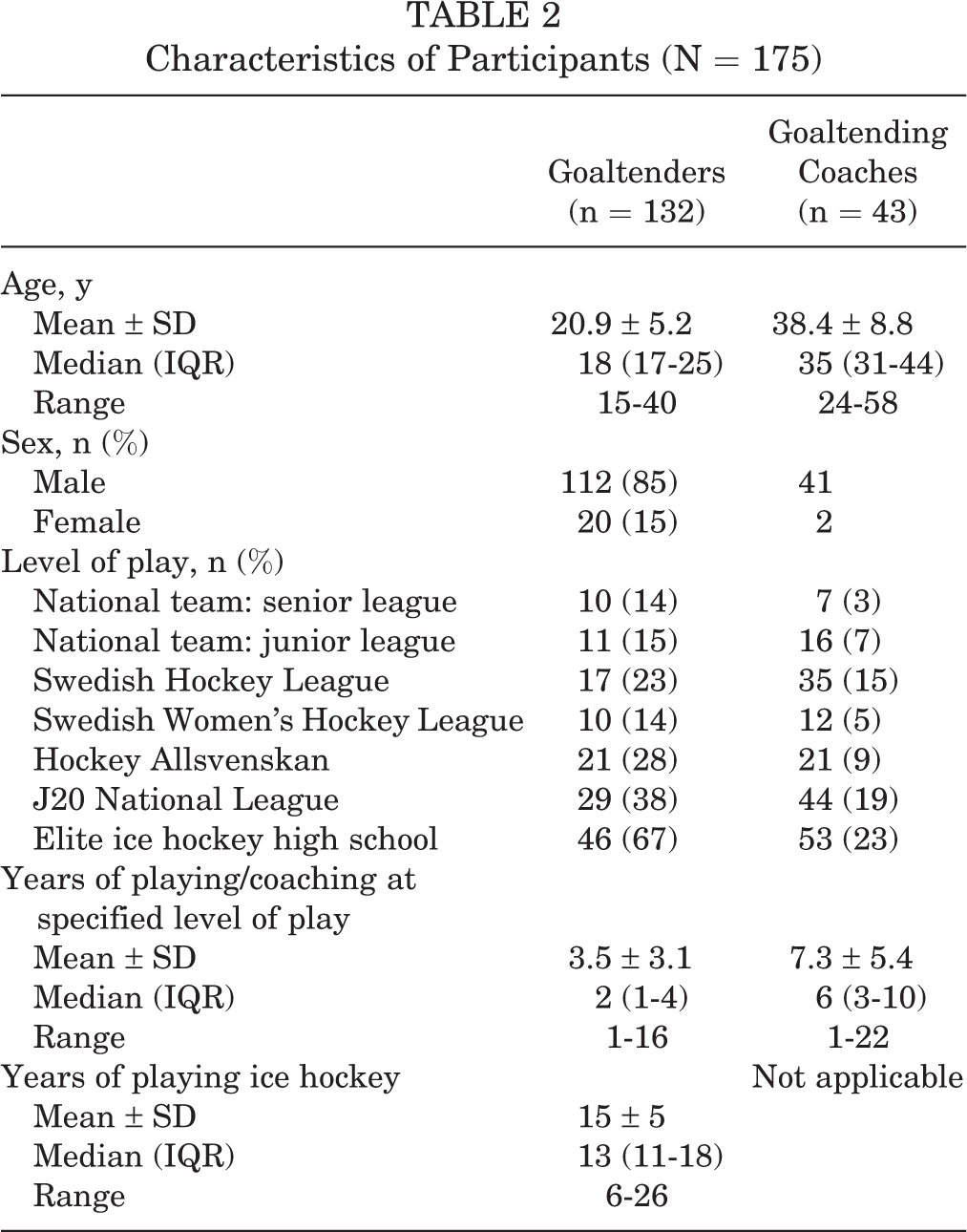
We invited 196 elite goaltenders and 54 goaltending coaches to participate in the study. A total of 132 goaltenders (response rate, 67%) and 43 goaltending coaches (response rate, 81%) responded. Characteristic information of the 175 participants (total response rate, 70%) is summarized in Table 2.
Characteristics of Participants (N = 175)
Perceived Hip and Groin Demands Associated With Goaltending Movements
The stance that most frequently was considered demanding was the reverse vertical horizontal (RVH) post-play, rated as very or extremely demanding by 40% of the participants, followed by the butterfly stance, rated as very or extremely demanding by 25.2% of the participants (Figure 3). Transitions involving RVH post-play were rated most demanding, with transitions from standing to post-play and post-play to post-play rated as very or extremely demanding by 39.7% and 37.8% of the participants, respectively (Figure 4). Adopting or landing in the RVH post-play stance was considered demanding during transitions, but also pushing out of the RVH post-play stance was associated with high perceived load on the hip and groin (Table 3). Standing crease movements were rated to be at least somewhat demanding by 25% (n = 44) of the participants. Among those participants, the T-push was most frequently rated as very or extremely demanding by 39% (n = 17). Crease movements while in a butterfly (ie, kneeling posture) were rated to be at least somewhat demanding by 47% (n = 82) of participants. Among those participants, the pivot and push crease movements were most frequently rated very or extremely demanding (37%; n = 30).

Perceived demand of different goaltending stances on the hip and groin among goaltenders and goaltending coaches. RVH, reverse vertical horizontal; VH, vertical horizontal.
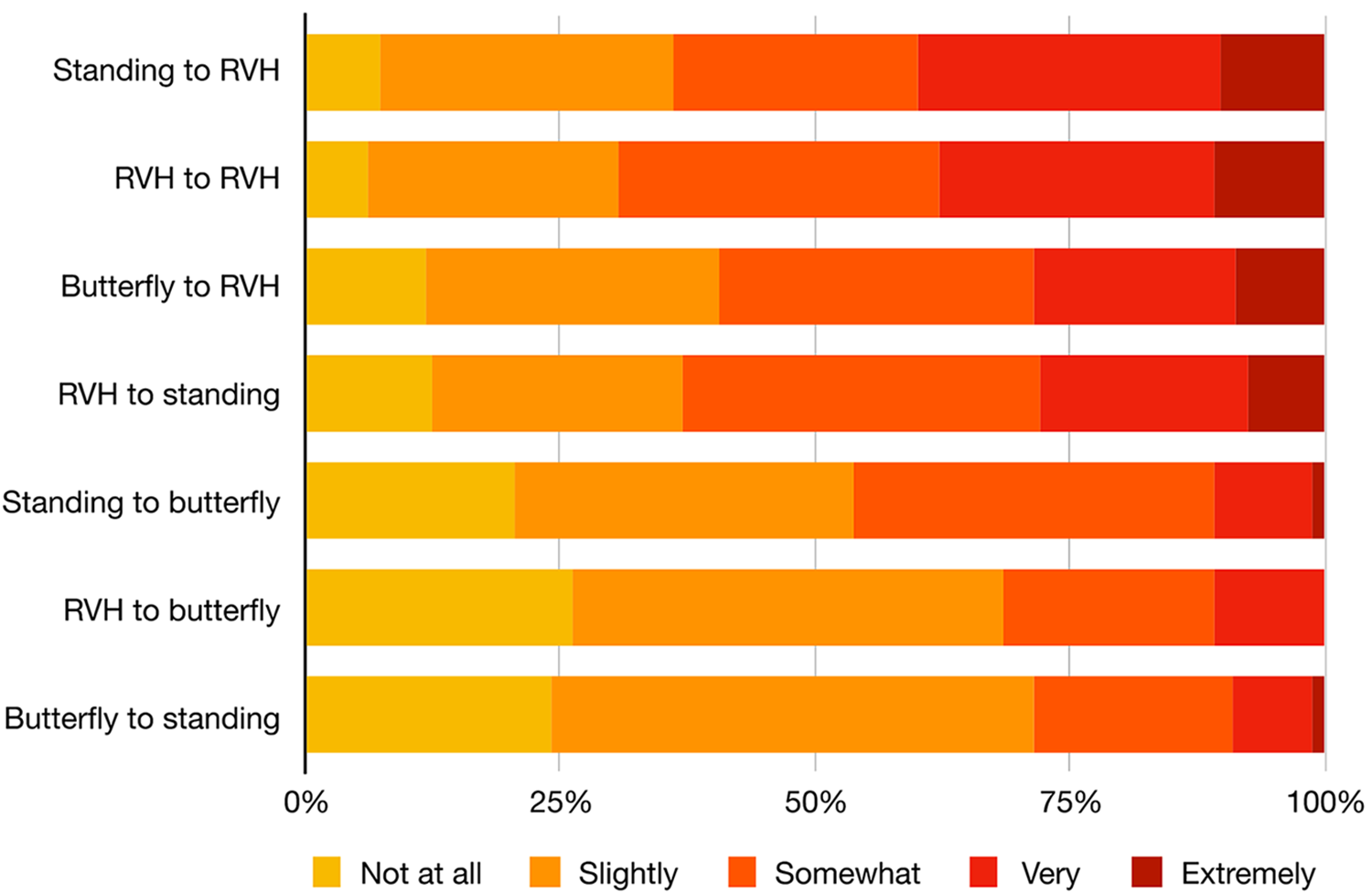
Perceived demand of different goaltending transitions on the hip and groin among goaltenders and goaltending coaches. RVH, reverse vertical horizontal.
Perceptions Regarding the Most Demanding Part of Each Transition Movement a

a Data are reported as % (n). RVH, reverse vertical horizontal.
b Number of goaltenders and coaches who rated the movement as somewhat, very, or extremely demanding on the hip and groin.
Perceptual Differences by Group
Compared with coaches, goaltenders consistently perceived movements as less demanding on the hip and groin region. Senior goaltenders generally perceived most movements more demanding than junior goaltenders, but this difference was statistically significant only for the transitions from standing to butterfly, butterfly to RVH, and RVH to RVH (Table 4).
Perceptions Regarding the Most Demanding Part of Goaltending Movements According to Group a

a Data are reported as % (n). Comparison between the proportion of participants who rated the movement as very or extremely demanding on the hip and groin. Bolded P values indicate statistically significant difference between groups (P < .05, chi-square test). RVH, reverse vertical horizontal; VH, vertical horizontal.
b Juniors = age <20 years; seniors = age ≥20 years.
Perceived Frequency of Goaltender Stances and Transitions
Standing stances and butterfly stances were ranked as the most frequently performed among different stances during team practice, goaltender practice, and games; post-play stances were ranked as less frequently performed. Transitions between standing stance to butterfly stance were identified to be the most frequently performed (Figure 5).

Frequency (mean rank) of goaltending stances (ranked 1-4) and transitions (ranked 1-7) in team practice, goaltending practice, and matches as perceived by goaltenders and their coaches. RVH, reverse vertical horizontal post-play; VH, vertical horizontal post-play.
Discussion
In this study, 67% of all Swedish elite league goaltenders and 81% of their goaltending coaches provided their perceptions on which goaltending techniques and movements place stress on the athletes’ hip and groin region. The main findings were that (1) RVH stances and butterfly stances as well as transitions involving RVH are most frequently perceived as demanding; 40% respectively 25% (RVH and butterfly stance) as well as 11-40% (RVH transitions) of participants rated these techniques as very or extremely demanding (2) most (10 of 13) goaltending techniques were perceived as demanding by a larger share of coaches than goaltenders (difference, 13%–46%; P < .001–.028), and (3) some goaltending techniques were perceived as demanding by a larger share of senior goaltenders than junior goaltenders (difference, 12%–20%; P = .13–.18).
Both goaltenders and coaches perceived the RVH post-play stance, butterfly stance, and the transitions involving RVH to be the most demanding for the hip and groin region. Taking a closer look at these movements, forces on the hip joint appear to be the common factor behind these perceptions. The butterfly and RVH stances require the goaltender to internally rotate and flex the hip joint. RVH also require these postures, but there is an additional element of adduction and hip internal rotation caused by rotation of the trunk toward the post. The combination of internal rotation, flexion, and adduction body postures are used during clinical examinations of the hip joint as a provocation test for FAIS. 15 However, these clinical evaluations have low specificity and frequently provoke pain in the absence of FAIS. The flexion, adduction, and internal rotation (FADIR) test, for example, provokes pain in 95% of symptom-free individuals without FAIS. 15 Therefore, goaltenders may experience pain and discomfort in these positions without FAIS-related hip morphology. On the other side, the FADIR will provoke pain in 99% of all individuals with FAIS and related morphological variations, 15 meaning a goaltender with FAIS will most likely experience pain while performing an RVH or butterfly.
Goaltending coaches perceived all movements involving the butterfly and RVH to be more demanding for the hip and groin than goaltenders. Senior goaltenders perceived transitions involving the butterfly and RVH as more demanding than junior goaltenders. These findings indicate a gradual increase in perceived demand as age and experience increase. Older players get injured more frequently 4 and since goaltending coaches are often previous goaltenders, they may have experienced or witnessed more injuries. As we have established in the previous paragraph, hip loads and hip morphology may influence the extent that the butterfly and RVH are experienced as demanding or painful. In ice hockey players, cam morphology develops between 13 and 16 years of age. 9 #x00A0;Once skeletal growth is completed, change in hip morphology is unlikely. 18 Considering the results of previous studies, we can assume that up to 70% of our participants have cam morphology. 10 The presence of cam morphology does not equal the presence of FAIS 8 but is associated with articular changes over time. 1 Therefore, the high hip load of the RVH and butterfly may explain why older participants rate these movements as more demanding than younger participants.
The differences observed in our study may also be owing to personal and environmental factors. Goaltending coaches may have responded in the context of their experiences with many goaltenders and the hip and groin problems they encountered over time. Although the survey did not measure individual pain experiences, goaltenders may have responded to our survey from a perspective based on their individual on-ice experiences. That individual perspective is likely focused on performance and playing time, which may lead to a tendency to shut out discomfort and pain. Even though the proportion of participants rating techniques as very or extremely demanding differed between goaltenders and coaches, there were similarities in what techniques they perceived to be the most demanding. Future studies may involve or at least include the perspectives of medical officials, such as sports medicine physicians, physiotherapists, and athletic trainers, in a collaborative effort to drive the theme of prevention.
Hip and groin problems are highly prevalent in ice hockey goaltenders and often associated with reduced performance and sporting function. 23 Once the magnitude of the injury has been described, determining the cause and mechanism of hip and groin problems is considered the next step in the injury prevention sequence. 19 The cause of injury has been described as a multifactorial and dynamic process 12 in which a predisposed athlete (eg, a goaltender with potential intrinsic risk factors such as cam morphology or previous hip and groin problems) is exposed to certain extrinsic risk factors (high repetitions of a movement that has extreme ranges of motion) and therefore becomes an athlete that is susceptible to injury. Once a susceptible athlete goes through an inciting event in which tissue capacity is overloaded, an injury may be inflicted. In ice hockey goaltenders, hip and groin problems most often have gradual onsets and can be considered overuse injuries. 23 Hence, it is unlikely that a single event incites hip and groin problems; rather, they are caused by a series of events in which load repeatedly exceeds the goaltenders load tolerance. 16 Our study provides new insights about how repetitive load is experienced by goaltenders and coaches and has practical implications for future efforts to reduce the risk for hip and groin problems in ice hockey goaltenders.
Future Directions
Goaltenders are expected to save pucks, and saving pucks is the reason techniques such as the RVH and butterfly were developed and are frequently used. However, our study implies that these techniques, although they may improve goaltender efficiency, may come at the expense of hip and groin health. The butterfly is reported to be performed most frequently and may, over time, lead to hip and groin problems. 5 However, the association between objective performance, load, and subsequent problem development needs further examination. Therefore, in future studies, it may be appropriate to count the number of butterfly movements, like pitch counts in baseball. 6,11 Keeping track of goaltender workloads by quantifying their exposure to techniques such as the butterfly or the RVH may be an important step toward primary injury prevention of hip and groin problems. In addition, goaltenders that already suffer from hip and groin pain may benefit from modifications to the frequency and execution of the RVH and the butterfly as a measure of secondary prevention. There is only 1 study, published in 2008, 2 that quantified common goaltender movements, but that study no longer accurately depicts modern goaltending techniques because it does not include the RVH. 2 Our study hence emphasizes the need for updated biomechanical evaluations that look beyond the frequently executed butterfly by including the highly demanding RVH. Such biomechanical investigations may further improve our understanding of the forces acting on goaltenders’ hips and groins and facilitate adaptation of protective equipment and potential technique modifications to reduce the risk for injury.
Strengths and Limitations
Our study reported the perceived load on the hip joint and groin muscles during different goaltending movements. We did not investigate the forces applied to the goaltenders’ hip and groin. Therefore, conclusions drawn from our results are limited to goaltenders’ perceptions. While this may be seen as a limitation, we consider it a strength since it allowed us to provide a comprehensive picture of perceived demand during goaltending in general as opposed to very specific and limited biomechanical aspects of goaltending. Our study is the first of our knowledge to measure both players’ and coaches’ perceptions of goaltending techniques, and as a result there were no previously validated instruments to evaluate this specific research question. Therefore, extensive measures were taken during questionnaire development to create a valid data collection tool. The goaltending model underlying our survey was developed by an established expert in the field and pilot tested for face validity and comprehensiveness by high-level coaches and goaltenders.
The cooperative effort between researchers and the Swedish goaltending community enabled the whole population of Swedish elite goaltenders and coaches to be invited for participation in our study, which resulted in a relatively high response rate. Within the population of respondents were subgroups, such as senior and junior goaltenders, female and male goaltenders, and goaltenders with current or previous hip and groin problems. Perceptions of goaltending techniques may differ in these subgroups, but we only investigated differences between coaches and players as well as between junior and senior players. Potential differences between female and male players may exist; however, they were not investigated. In addition, goaltenders were not asked about previous or current hip and groin problems, since our aim was to examine the perceived demand of goaltending techniques on the hip and groin, rather than existing problems. Therefore, we do not know whether goaltending movements are experienced differently by individuals with and without personal experience of hip and groin problems.
Conclusion
Post-play and the butterfly were the goaltending techniques most frequently perceived as demanding, and a significantly larger share of coaches than goaltenders held this perception. A larger share of senior than junior goaltenders perceived transitions between these types of goaltending techniques to be demanding. The results of this study may inform primary and secondary injury prevention efforts for ice hockey goaltenders and drive future biomechanical investigations goaltender injury patterns.
Footnotes
Acknowledgment
The authors thank all participating goalies and goalie coaches for their contributions.
Final revision submitted May 7, 2021; accepted July 26, 2021.
One or more of the authors has declared the following potential conflict of interest or source of funding: R.J.F. has collaborated with and received research funds from CCM Hockey. AOSSM checks author disclosures against the Open Payments Database (OPD). AOSSM has not conducted an independent investigation on the OPD and disclaims any liability or responsibility relating thereto.
Ethical approval for this study was waived by Lund University.