



Abstract
Background:
Musculoskeletal pain could represent a psychological stressor in adolescent athletes. However, few epidemiological studies have investigated this association.
Purpose:
To assess the relationship between musculoskeletal pain (shoulder, elbow, wrist, and low back) and psychological stress responses in high school baseball players.
Study Design:
Cross-sectional study.
Methods:
Participants comprised male Japanese high school baseball players who had completed a questionnaire as part of their annual medical evaluation in 2016. Experiences of shoulder, elbow, wrist, and low back pain during the previous season were investigated. Pain severity was graded as 1 (mild, playing without interference), 2 (moderate, playing with interference), or 3 (severe, could not play because of pain). The Stress Response Scale–18 was used to measure stress response: low, medium, rather high, and high. Prevalence rates of shoulder, elbow, wrist, and low back pain and their association with psychological stress responses were investigated using univariate and multivariable analyses.
Results:
A total of 944 players (223 pitchers and 721 fielders) were included in this study. Their mean age was 16.1 ± 0.6 years, and 66% were high school juniors, while 33.6% were seniors. In pitchers, the prevalence rates during the previous year of severe (grade 3) interference with playing because of elbow, shoulder, wrist, and low back pain were 21.5% (n = 48), 19.3% (n = 43), 3.6% (n = 8), and 18.4% (n = 41), respectively, whereas in fielders, the respective prevalence rates were 17.1% (n = 123), 17.9% (n = 129), 6.7% (n = 48), and 19.3% (n = 139). After adjusting for confounding factors (playing on a top-performing team, high school grade level, and all other sites of musculoskeletal pain), the authors found significant associations in pitchers between severe experiences of elbow pain and low back pain and medium to high psychological stress responses (odds ratio, 2.64 [95% CI, 1.32-5.39], P = .006 and odds ratio, 2.32 [95% CI, 1.12-4.89], P = .024, respectively). No significant associations were seen between musculoskeletal pain and psychological stress responses in fielders.
Conclusion:
In the current study, elbow and low back pain were associated with stronger psychological stress responses compared with other musculoskeletal pain in high school baseball pitchers.
Adolescent athletes experience various stressors, ranging from performance-related variables such as musculoskeletal injuries to organizational variables such as conflicts with teammates and coaches. 5 In addition, sensitivity to stress is heightened during adolescence because of the rapid neurological and physiological development occurring at this stage. 2 An inability to cope adaptively with such stressors has been associated with increased burnout levels and the risk of dropping out of sports. 10
Baseball is one of the most popular sports, and player performance is potentially more affected by mental and emotional factors than physical factors when compared with other sports. 21 However, little is understood about the psychological health of young baseball players. 6 The only 2 studies 4,6 that investigated psychological stress in youth baseball players (age, 4-10 years) found no association between baseball participation and stress levels. On the other hand, musculoskeletal pain can be a psychological stressor in adolescent athletes. 5,10 One small cross-sectional study 13 (n = 56) revealed that high school baseball players with shoulder pain experienced impaired physical quality of life, but not impaired mental quality of life, compared with those without shoulder pain. However, no extensive epidemiological study has investigated whether musculoskeletal pain affects psychological stress responses in high school baseball players. In addition, musculoskeletal pain in baseball players is presumed to differ between pitchers and fielders in terms of the sites of pain that affect performance. 15,21 Elbow pain may affect pitching performance in pitchers, 15 while wrist pain may affect hitting performance in fielders. 18
The authors used epidemiologic data obtained from the medical checkups of high school baseball players to assess the relationship between musculoskeletal pain in different anatomic areas (shoulder, elbow, wrist, and low back) and psychological stress response. It was hypothesized that the psychological stress responses caused by musculoskeletal pain in baseball players may differ between player positions.
Methods
Participants
The research ethics committee of our institute approved the protocols for this cross-sectional study, and all participants or their guardians provided written informed consent or assent before enrollment; the informed consent form was distributed to each player and their guardian before the day of the medical checkup. This cross-sectional study involved players from high school baseball teams in all local communities in Fukushima Prefecture, Japan, in 2016. All players were boys, were first-year (junior) or second-year (senior) high school students, and had participated in the annual medical checkup immediately after the end of the 2016 baseball season. No exclusion criteria were set.
Characteristics of Players
We used data from a self-reported questionnaire form completed during the annual medical checkup. The questionnaire was distributed to each player before the medical checkup and collected on the day of the checkup. Items on the questionnaire included age, team, playing position, duration of baseball experience, and total weekly practice (both days per week and hours per week). Players who had practiced and played as a pitcher were considered pitchers even if they had also played other positions.
Exposure of Interest: Musculoskeletal Pain
Our main exposure of interest was new-onset (ie, during the previous year) musculoskeletal pain that interfered with playing, as measured in the self-reported questionnaire. Previous episodes of pain were assessed using the following yes/no question: “Have you ever felt pain in your [elbow, shoulder, wrist, and low back] before?” New-onset episodes of pain were assessed using the following question: “Have you felt pain or discomfort in your [elbow, shoulder, wrist, and low back] within the previous year while playing baseball?” Responses were graded as 0 (“not at all”), 1 (mild; “I could play without interference, but feeling pain or discomfort in my [elbow, shoulder, wrist, and low back]”), 2 (moderate; “I could play baseball with interference”), or 3 (severe; “I could not play baseball due to my [elbow, shoulder, wrist, and low back] pain”).
Primary Outcome: Psychological Stress Response
The primary outcome was psychological stress response. This was measured using the Stress Response Scale–18 (SRS-18), which comprises eighteen 4-point Likert-type items. 23,24 Each item is scored from 0 (disagree) to 3 (agree), yielding a maximum score of 54 points. A higher score indicates a higher level of psychological stress response. The reliability and validity of the SRS-18 have been confirmed. 24 Based on the validation study, 24 the SRS-18 scores for male high school students were categorized into 4 grades: 0 (0-10 points; low stress response), 1 (11-22 points; medium stress response), 2 (23-34 points; rather high stress response), and 3 (35-54 points; high stress response).
Statistical Analysis
Participants with complete data were entered into the primary analysis. Descriptive statistics were calculated for the baseline characteristics, in which continuous data are summarized as means and standard deviations, while dichotomous and categorical data are provided as proportions. The Wilcoxon signed-rank test was used to compare continuous and ordinal variables, and the chi-square test was used to compare categorical variables. Elbow, shoulder, wrist, or low back pain of grade 3 (severe) was taken as the primary explanatory variable, and SRS-18 score (grade 0 [low] vs ≥1 [medium to high stress response]) was the outcome variable; odds ratios (ORs) and 95% CIs were calculated.
The following variables were considered potential confounders and included as covariates in multivariable logistic regression analysis: playing on a top-performing team (ie, a team that finished in the top 8 of the 78 teams participating in the 2016 Fukushima Prefectural High School Baseball Championship tournament); level of high school (junior or senior); and each additional musculoskeletal pain location (elbow, shoulder, wrist, or low back). In terms of variables that can affect psychosocial stress responses, higher-performing teams may subject players to more pressure to succeed, might have a better support system of coaches and teammates, and might motivate players to practice harder and longer. Differences in school grades were included as a confounding factor because Japanese high school sports clubs, especially baseball teams, implement a strict hierarchy of seniority such that juniors are under pressure from seniors to comply with demands. 7 Each additional location for musculoskeletal pain (elbow, shoulder, wrist, or low back) was also considered as a potential confounder, since musculoskeletal pain can sometimes be comorbid and multiple pain locations can affect each other. 20
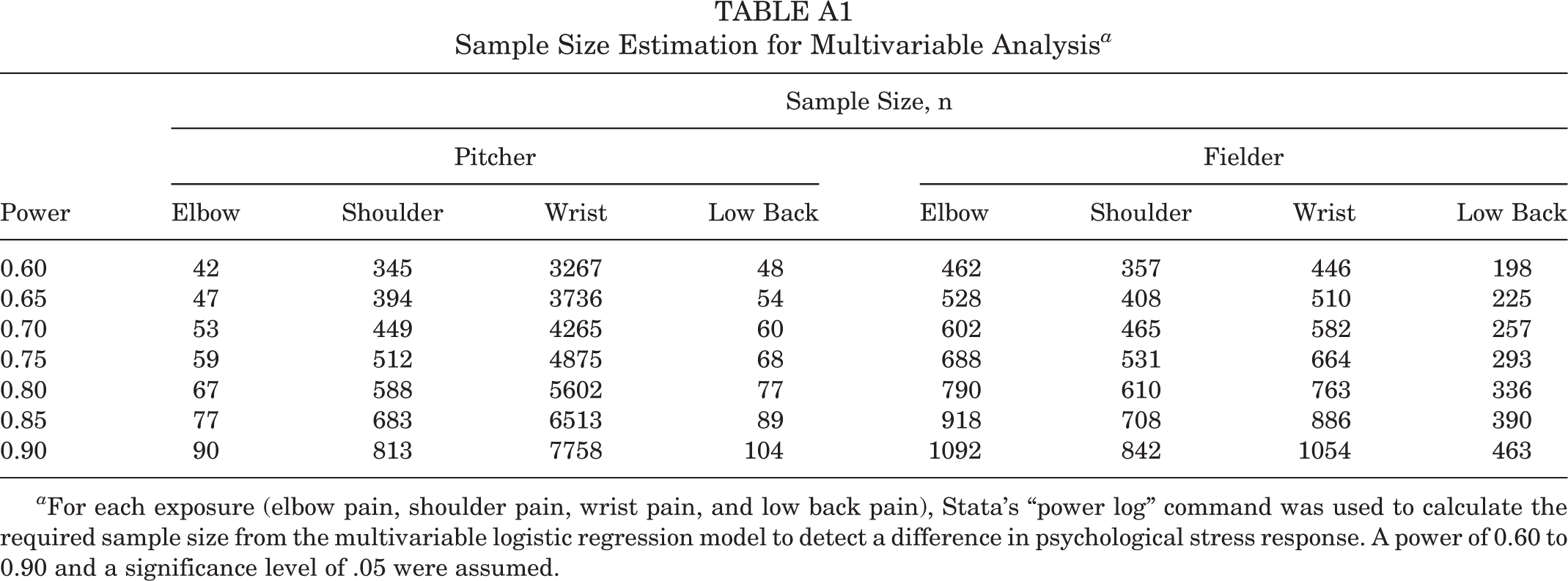
Uni- and multivariable analyses with adjustment of confounding variables were conducted using JMP version 15.0.0 software (SAS Institute). In addition, for each site of pain exposure (elbow, shoulder, wrist, or low back), Stata’s “power log” command (Stata Statistical Software Release 15.1; Stata) was used to calculate the required sample size from multivariable logistic regression modeling to detect differences in psychological stress response. A power of 0.60 to 0.90 and a significance level of .05 were assumed. All tests were 2-sided, and values of P < .05 were considered statistically significant.
Results
Of the 1172 male players from 72 high school baseball teams who participated in the 2016 annual medical checkup, 944 players (223 pitchers, 721 fielders) without missing data were included in this study. The characteristics of the study participants are presented in Table 1.
Summary of Player Data a

a Data are presented as mean ± SD or n (%).
b Top 8 team means that the team finished among the top 8 teams in the 2016 Fukushima Prefectural High School Baseball Championship.
Previous episodes of elbow pain were significantly more frequent among pitchers (178; 79.8%) than among fielders (490; 68.0%) (P < .001). Previous episodes of wrist pain were significantly more frequent among fielders (365; 50.6%) than among pitchers (63; 28.3%) (P < .001). In pitchers, the prevalence rates during the previous year of severe (grade 3) interference with playing because of elbow, shoulder, wrist, and low back pain were 21.5%, 19.3%, 3.6%, and 18.4%, respectively, whereas in fielders, the respective prevalence rates were 17.1%, 17.9%, 6.7%, and 19.3% (Table 2). Grades of interference of playing because of new-onset wrist pain were significantly higher among fielders than among pitchers (P < .0001). Grades of interference of playing because of new-onset elbow pain were significantly higher among pitchers than among fielders (P = .0123).
Musculoskeletal Pain and Interference with Playing a

a Data are presented as n (%). New-onset pain was defined as pain within the previous year.
b Statistically significant difference between pitchers and fielders (P < .05).
c Statistically significant difference between pitchers and fielders (P < .001).
Overall prevalence rates of SRS-18 grades 0, 1, 2, and 3 in players were 64.6%, 26.1%, 7.4%, and 1.9%, respectively (Table 3). There were no significant differences in SRS-18 grades between positions.
SRS-18 Grades Among Players a
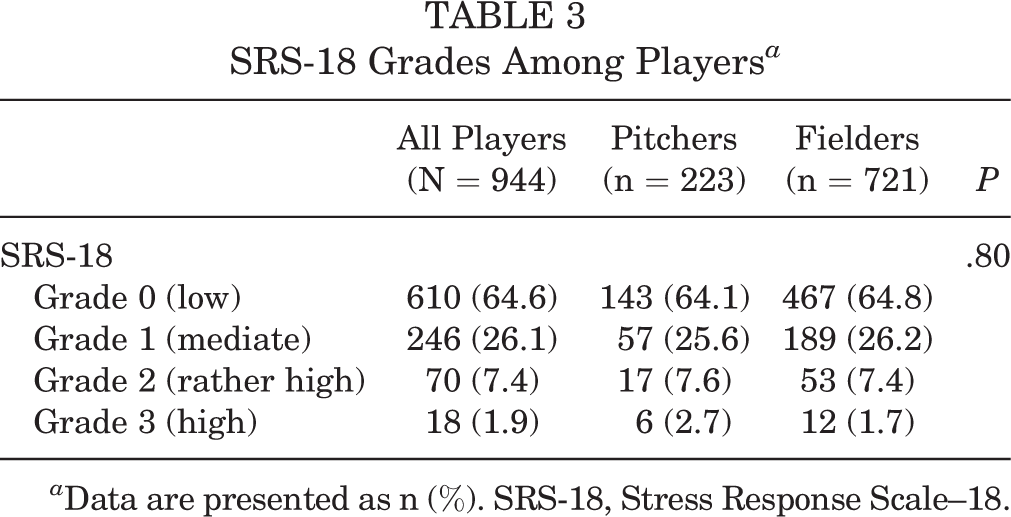
a Data are presented as n (%). SRS-18, Stress Response Scale–18.
In univariate analyses, significant associations were found in pitchers of severe experiences of elbow pain and low back pain with SRS-18 grade ≥1 (medium to high stress responses) (P = .011 and P = .036, respectively) (Table 4).
Univariate Analysis for Association Between Severe Interference With Playing Due to Musculoskeletal Pain and SRS-18 Grade ≥1 a

a Severe interference with pain defined as grade 3 on the self-reported questionnaire (“I could not play baseball due to my [elbow, shoulder, wrist, and low back] pain”); stress response grade according to the Stress Response Scale–18. 23,24
b Statistically significant (P < .05).
After adjusting for confounding factors (team performance, high school level, and other musculoskeletal pain), with pain in each region using logistic regression modeling, a significant association was found in pitchers of severe experiences of elbow pain and low back pain with SRS-18 grade ≥1 (OR, 2.64 [95% CI, 1.32-5.39], P = .006 and OR 2.32 [95% CI 1.12-4.89], P = .024, respectively) (Table 5). On the other hand, no significant association was seen between shoulder, elbow, wrist, and low back pain and psychological stress responses in fielders (Table 5). The required sample size for multivariable analysis is shown in Appendix Table A1, assuming a power of 0.60 to 0.90. Considering that there were 223 pitchers and 721 fielders, the study had sufficient power to detect differences in stress responses due to elbow or back pain in pitchers (>0.9) and detect differences in stress responses due to shoulder, wrist, or back pain in fielders (>0.8).
Multivariable Analysis for Association of Musculoskeletal Pain Severely Interfering With Playing and Psychological Stress Response (SRS-18) a

a Models were adjusted for participant team, grade, and all other sites of musculoskeletal pain (elbow, shoulder, wrist, and low back pain) that severely interfere with playing. SRS-18, Stress Response Scale.
b Top 8 team means that the team finished among the top 8 teams in the 2016 Fukushima Prefectural High School Baseball Championship.
c Statistically significant (P < .05).
Discussion
Our study revealed a significant association in pitchers between severe interference with playing because of elbow pain and low back pain and medium to high psychological stress responses (OR, 2.64 [P = .006] and OR, 2.32 [P = .024], respectively). On the other hand, there was no significant association between shoulder, elbow, wrist, and low back pain and psychological stress responses in fielders. Thus, among high school baseball pitchers, elbow and low back pain could be associated with stronger psychological stress responses compared with musculoskeletal pain in other regions. Pitchers may be more susceptible to the effects of psychological stress due to musculoskeletal pain, particularly elbow and low back pain, compared with fielders. A particular emphasis on psychological support might thus be needed for pitchers.
Issues of musculoskeletal pain and psychological stress for adolescent athletes have long been debated, although little evidence has been accumulated in baseball. 6,10,17 Whether musculoskeletal pain provokes a stress response in the athlete strongly depends on how the pain affects his or her sports performance. 14 The present study therefore focused on which pain sites exerted greater effects on psychological stress response by assessing severities of musculoskeletal pain in high school baseball players. Elbow pain is the most common musculoskeletal pain for pitchers and is known to impact performance. 15,25 Although one study revealed an association between elbow pain and individual psychological traits (less agreeableness, greater depressiveness, and greater perfectionism) in the nonathletic, middle-aged population, 1 the high stress responses due to elbow pain in this study might reflect player irritability, anger, and anxiety regarding their pitching performance. 8,9,12,22 On the other hand, even in adolescents, low back pain is the musculoskeletal pain that has been linked to psychological stress factors for the longest period of time. 11,29 Psychological stress responses from low back pain might thus affect baseball performance, 27,28 and both directions of causal relationship between low back pain and psychological stress responses might exist. That is, psychological stress can cause attentional changes, distraction, and increased self-consciousness, all of which can interfere with performance and predispose the athlete to injury. 3,17,30 In addition, psychological stress could increase muscle tension and adversely impact coordination, increasing the risk of injury, whereas decreasing psychological stress can reduce injury and illness rates. 3,16,31 Players with psychological stress responses in this study were not few, and psychological stress response is a modifiable factor that warrants supportive efforts.
In the present study, severe musculoskeletal pain was unrelated to psychological stress responses in fielders. In particular, wrist pain might affect performance in hitting 18 and was more prevalent in fielders in this study, but was not associated with psychological stress responses. Based on the results of our power analysis, we might conclude that this result does not originate from a lack of statistical power. Our results for differences between pitchers and fielders suggest that musculoskeletal pain might affect playing performance differently for pitchers and fielders and may therefore affect psychological stress responses differently. 9 Pitchers may be more susceptible than fielders to mental situations affecting performance, with some individuals displaying a more sensitive personality for psychological stressors. 9,21 The present study did not specifically investigate which types of play (pitching, hitting, catching the ball, running bases, etc) would be adversely affected by musculoskeletal pain. More detailed analysis in this regard might be a suitable subject for future research.
Nearly all high school baseball players in the present study were competitive-level athletes aiming to represent Fukushima Prefecture in the national high school baseball championship. This tournament is such a prominent national sports event that the public wants it to continue to be held, even during the COVID-19 pandemic. 19 Japanese high school baseball players might be highly motivated, but they have also shown problems with overtraining. 26 Moreover, Japanese high school sports clubs implement a strict hierarchy such that juniors are under pressure from seniors to comply with demands. 7 We therefore had to adjust confounding factors such as team performance and high school level in the multivariable analysis to address this issue. On the other hand, we did not specifically analyze the details of psychological stress reactions, such as depression, anxiety, irritability, anger, and helplessness, related to musculoskeletal pain for participants. The influence of these factors should be examined in future studies.
Several limitations to this study should be acknowledged. First, several unmeasured confounding factors such as schoolwork, position in the team lineup (regular vs reserve players), and mental support from parents and coaches (some strong teams may have good coaches, but their players may also need to live away from their parents in dormitories) were assumed in this study. Although we adjusted for team performance and school level in the multivariable analysis, further adjustment for these unmeasured factors may change the observed associations. Second, the self-reported questionnaire used in this study evaluated musculoskeletal pain and psychological responses retrospectively, so the potential impact of recall bias should be considered. Third, since our study used a cross-sectional design, assessing the causality of relationships between musculoskeletal pain and psychological stress responses was not possible. A prospective longitudinal study is needed to confirm these relationships.
Conclusion
Our epidemiological data revealed that elbow and low back pain could be associated with stronger psychological stress responses compared with other musculoskeletal pain in Japanese high school baseball pitchers. Pitchers may be more susceptible to the effects of stress due to musculoskeletal pain, especially for elbow and low back pain, compared with fielders. Our results highlight the importance of medical personnel, coaches, and parents paying attention to the stress responses of adolescent pitchers due to elbow or back pain.
Footnotes
Acknowledgment
The authors thank the following people for their collaboration and assistance with this study: Tomohiko Shigihara, Hiroki Konno, Shuichi Onoda, Kazuhiro Endo, Takuya Shike, Shohei Nobe, Takanori Kashimura, Yuichi Jumonji, Kazuhide Takada, Mai Kusano, Toshihisa Nishikata, Takehiro Tabe, Kenta Ono, Akihiro Ueno, and Ryo Ueda, associated with the Fukushima Physical Therapy Association Medical Support Team.
Final revision submitted May 28, 2021; accepted August 4, 2021.
The authors declared that they have no conflicts of interest in the authorship and publication of this contribution. AOSSM checks author disclosures against the Open Payments Database (OPD). AOSSM has not conducted an independent investigation on the OPD and disclaims any liability or responsibility relating thereto.
Ethical approval for this study was obtained from Fukushima Medical University (ID No. 2066).
APPENDIX
Sample Size Estimation for Multivariable Analysis a
| Sample Size, n | ||||||||
|---|---|---|---|---|---|---|---|---|
| Pitcher | Fielder | |||||||
| Power | Elbow | Shoulder | Wrist | Low Back | Elbow | Shoulder | Wrist | Low Back |
| 0.60 | 42 | 345 | 3267 | 48 | 462 | 357 | 446 | 198 |
| 0.65 | 47 | 394 | 3736 | 54 | 528 | 408 | 510 | 225 |
| 0.70 | 53 | 449 | 4265 | 60 | 602 | 465 | 582 | 257 |
| 0.75 | 59 | 512 | 4875 | 68 | 688 | 531 | 664 | 293 |
| 0.80 | 67 | 588 | 5602 | 77 | 790 | 610 | 763 | 336 |
| 0.85 | 77 | 683 | 6513 | 89 | 918 | 708 | 886 | 390 |
| 0.90 | 90 | 813 | 7758 | 104 | 1092 | 842 | 1054 | 463 |
a For each exposure (elbow pain, shoulder pain, wrist pain, and low back pain), Stata’s “power log” command was used to calculate the required sample size from the multivariable logistic regression model to detect a difference in psychological stress response. A power of 0.60 to 0.90 and a significance level of .05 were assumed.