




Abstract
Background:
As the incidence of youth pitching injuries and surgical procedures attributed to overuse has drastically increased, there are quality concerns about popular internet resources regarding arm care for youth pitchers.
Purpose/Hypothesis:
To assess the medical advisability of online arm care recommendations for youth pitchers. It was hypothesized that websites contain misleading arm-care information that is discordant with medical advice.
Study Design:
Cross-sectional study.
Methods:
We reviewed the first 100 websites populated after a Google search for youth pitching recommendations. Websites were categorized by type (athletic organization, commercial, or educational) and content quality (medically advisable, discordant, or neutral), the latter with respect to the Pitch Smart guidelines used by Major League Baseball. Chi-square tests of independence and z tests of independent proportions were used to compare column proportions among categories of website content quality for each type of website source. Given the small sample sizes in some instances, the Fisher-Freeman-Halton exact test was performed to assess the relationship between website source type and quality of information.
Results
Of the 99 qualifying websites, 76 were categorized as medically advisable, 16 as discordant, and 7 as neutral. In addition, 92% of educational websites and 94.7% of athletic organization websites featured exclusively advisable content, whereas only 54.8% of commercial websites were advisable. Of the 16 discordant websites, 15 were commercial sites. Educational websites were significantly more advisable and neutral in content when compared with discordant information, while commercial websites were significantly predictive of discordant content. Among the first 50 websites populated according to Google, 42 (84%) were advisable, 6 (12%) discordant, and 2 (4%) neutral. The remaining websites (n = 49) featured 34 (69.4%) that were advisable, 10 (20.4%) discordant, and 5 (10.2%) neutral.
Conclusion:
Study findings indicated that websites of an educational nature are predictive of medically advisable content, while commercial websites (eg, blogs) are associated with discordant information. The abundance and availability of inaccurate internet information should be appreciated by medical professionals and parents/coaches of youth baseball players.
For many youth athletes, their parents, and their coaches, the internet is a valuable resource for recommendations regarding sports safety. Because this readily available medical advice partially informs training and playing habits, it is crucial that sports medicine information online be accurate.
Over the past few decades, the rates of shoulder and elbow injuries in youth baseball athletes have drastically increased, a trend primarily attributed to overuse. 6,9,11,12,13 The American Sports Medicine Institute reports that youth and high school pitchers accounted for 10% of ulnar collateral ligament surgical procedures for baseball pitchers in 1995 as compared with >40% of these surgical cases in 2020. 5,16
Research since 2000 has identified primary risk factors for overuse injuries leading to surgery, and the medical community subsequently made a concerted effort to communicate these findings to the public via accessible media forums, including the internet. Yet, despite abundant medical advice and the adoption of pitch-count limits across many amateur baseball leagues, the incidence of injury in youth pitchers has remained high. One potential reason is a persistent misunderstanding regarding injury prevention among youth baseball players and coaches, as reported in recent surveys. 2,3,9,12 But what is the disconnect between the readily accessible medical recommendations on the internet and the persistent public knowledge gap and continued upward trend of youth baseball injuries?
We theorize that this discrepancy is due in part to (1) a cultural change, in which today’s young athletes perform within an increasingly competitive and pressurized athletic landscape that encourages early sport specialization and year-round training as well as (2) inaccurate and/or misleading information discordant with medical recommendations for arm care, which is readily accessible on the internet. This study aims to assess the latter theory: Information obtained via internet queries is often misleading and may contribute to the influx of youth baseball injuries. We hypothesize that despite pitch-count regulations in numerous organized amateur baseball leagues, the minimal pervasiveness of league-specific regulations attributed to a preponderance of misleading online information functions to misinform internet searchers and potentially plays a role in the prevalence of youth baseball injuries.
Methods
A Google search was performed (new Google Chrome Incognito Window, US region settings) on December 1, 2020, with the term youth pitching recommendations. The first 100 websites from that search were analyzed for adherence to generally accepted medical guidelines regarding safe practices for youth baseball pitchers. Half the websites (n = 50) were analyzed by a medical student (D.F.P.) and the other half by an orthopaedic surgery resident (J.H.D.). Each search result was assessed only by its landing page, which is the single web page that appeared after clicking the link from the search engine. Each website was sorted into 1 of 3 categories for quality of information with respect to medical guidelines: advisable, neutral, or discordant. A second categorization was made for the source of the information, taking into account the overall website owner, not just information presented on the landing page: Commercial (COM): websites produced by an individual or group, including advertisement and entertainment (eg, blog) Educational (EDU): produced by an institution to provide medical advice and education for patients (eg, for an orthopaedic medical practice or physical therapy group) Athletic organization (ATH): produced by an athletic league or group with the intent to educate or provide necessary league information to relevant and interested parties (eg, Little League Baseball)
The quality of information categorization was based on the risk factors for arm injury outlined on the Major League Baseball (MLB) Pitch Smart website, 14 as seen in Table 1.
Major League Baseball Pitch Smart Risk Factors for Injury 14
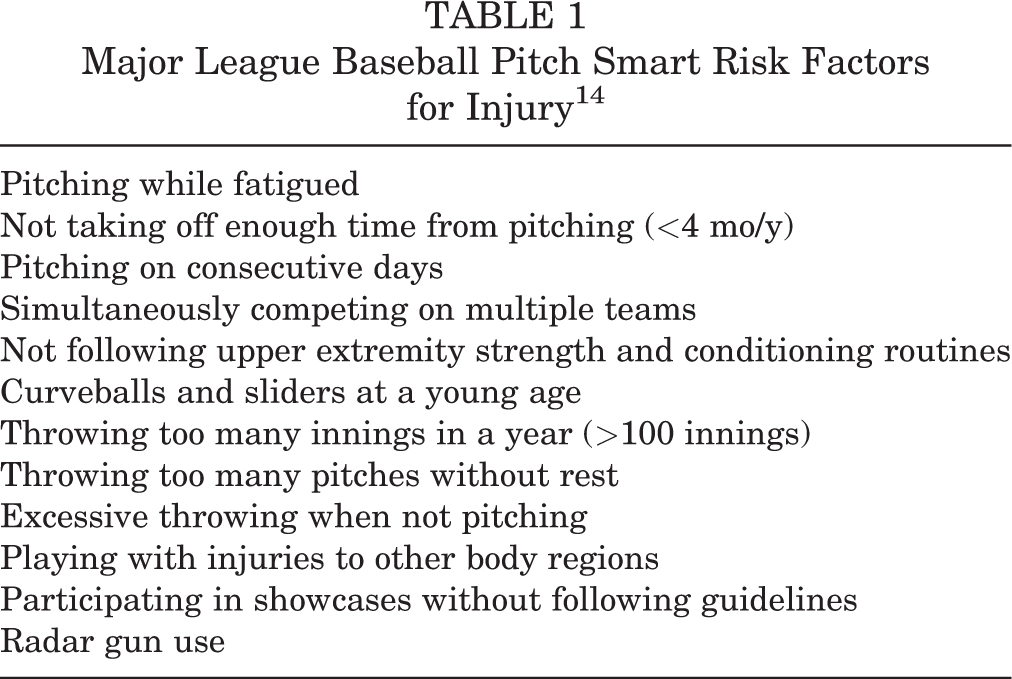
Pitch Smart outlines the major epidemiological factors for youth arm injury. The guidelines were acquired through years of basic and clinical research and are widely supported by medical communities (eg, American Sports Medicine Institute, American Orthopaedic Society for Sports Medicine, Kerlan-Jobe Orthopaedic Clinic, and Hospital for Special Surgery) and athletic communities (eg, MLB, USA Baseball, Little League International, and National Federation of State High School Associations). 14 We then classified websites based on their adherence to these concepts. Website landing pages that recommended or supported behavior aligning with 1 or more risk factors (eg, participation in a yearlong throwing program) were automatically classified as discordant. Medically advisable websites were those that opposed or contrasted at least 1 Pitch Smart risk factor (eg, avoid participation in overhead throwing activities for at least 4 months per year) and did not support engaging in any risk factors. Finally, websites with an absence of discordant and advisable information were classified as neutral. Furthermore, direct negations of advisable keywords, phrases, or concepts were considered discordant and vice versa. Common judgment was used to ensure that keywords from MLB’s Pitch Smart found on other websites were not taken out of context.
Statistical analyses were performed using SPSS Statistics Version 27.0 (IBM). Chi-square tests of independence and z tests of independent proportions (Bonferroni corrected) were used to compare column proportions among categories of website content quality (discordant, neutral, and advisable) for each type of website source (COM, ATH, and EDU). However, given the small sample sizes in some instances, the Fisher-Freeman-Halton exact test was performed to assess the relationship between website source type and quality of information. 4,7 All tests were evaluated for significance using a P value < .05.
Results
A total of 100 websites were reviewed for medical advisability of the information presented on the landing page. One COM website was excluded as a result of incomplete information, as it required a paid subscription to obtain the pitching guidelines. A total of 99 websites were included in our statistical analyses.
Of the 99 websites analyzed, 42 were classified as COM, 38 as EDU, and 19 as ATH. There were a total of 76 advisable websites, 16 discordant websites, and 7 neutral websites. Of the 38 EDU websites, 35 (92.1%) were advisable while the other 3 (7.9%) were neutral. No EDU website was discordant. Of the 42 COM websites, 23 (54.8%) were advisable, 15 (35.7%) discordant, and 4 (9.5%) neutral. Of the 19 ATH websites, 18 (94.7%) were advisable and 1 (5.3%) was discordant. No ATH websites were neutral. These results are summarized in Table 2.
Distribution of Website Source Type by Medical Quality of Information

a One website in this category did not offer complete information owing to access restrictions and was therefore excluded from analysis.
There was a significant association between website source type and medical quality of information (Fisher-Freeman-Halton exact test, P < .001). Specifically, while EDU websites showed a significantly higher proportion of advisable (92.1%) and neutral (7.9%) content as compared with 0% discordant information, COM websites were significantly predictive of discordant content (35.7%), with barely more than half (54.8%) of the information on these sites categorized as advisable. Similar to EDU websites, >90% of content on ATH websites was advisable.
To better understand which discordant concepts are perpetuated most frequently, we recorded the occurrences of discordant concepts and summarized the results in Table 3. Training to increase throwing velocity was the most common discordant concept, occurring on 6 websites. Proclaiming pitch counts to be mere guidelines that need not be followed and promotion of yearlong throwing programs were tied for the second-most frequently encountered discordant concept, with 4 occurrences each.
Frequency of Discordant Concepts a

a Some websites are included more than once across the categories.
As internet users often evaluate only the first few pages or results of a search, we divided the results into the first and second 50 websites (n = 50 and 49) to better characterize the content featured on websites appearing earlier and later in the search results. Among the first 50 websites, 19 were EDU, 18 COM, and 13 ATH. Of these, 42 (84%) were advisable, 6 (12%) discordant, and 2 (4%) neutral. The second 50 websites featured the same number of EDU websites but more COM websites (n = 24) and fewer ATH websites (n = 6). Predictably, the quality of the second 50 websites was lower, with 34 (69.4%) advisable, 10 (20.4%) discordant, and 5 (10.2%) neutral websites. Although there was not a significant association between website position (first 50 or second 50) and quality of information or website source type (P = .226 by Fisher-Freeman-Halton exact test and P = .179 by chi-square test of independence, respectively), we did ascertain a trend in which the first 50 websites were more likely than the second 50 to feature ATH websites and overall advisable content, whereas the second 50 websites include more COM websites as well as greater frequency of discordant and neutral content. The results of this analysis are summarized in Table 4.
Distribution of Data Across the First and Second 50 Results of the Internet Search

a In the order populated according to Google’s search algorithm.
Discussion
In our analysis of pitching-related websites for the medical advisability of information contained therein, we found that 92% of EDU websites and 94% of ATH websites provided exclusively advisable content, as compared with 55% of COM websites. Nearly 36% of COM websites contained discordant information regarding youth pitching recommendations. Interestingly, of the first 50 populated websites, 84% were exclusively advisable and 12% were discordant, while the second half featured fewer advisable (70%) and more discordant (20%) websites.
The internet is a readily available resource for players, parents, and coaches regarding youth sports safety. The quality of information, however, is highly variable and lacks a peer-reviewed process. Studies have consistently shown the pitfalls of relying on internet searches for medical information.
For example, Shai et al 15 showed that an internet search for information on platelet-rich plasma therapy for knee osteoarthritis could be misleading to the general public, specifically examining whether the information was provided by private or nonprivate websites. Bernard et al 1 reviewed 42 websites regarding nutrition and diabetes management and concluded that the quality of information was extremely variable and could confuse patients. As the internet continues to become a more popular resource for patients, it is crucial for physicians to be aware of their patients’ source of information.
As the rates of shoulder and elbow injuries in youth baseball players have dramatically increased over the years, there exists legitimate concern about overuse as the cause thereof. 6,9,11,12,13 Despite efforts to educate players, parents, and coaches, misinformation continues to be perpetuated, a great deal of which is easily accessible via the internet, as this study has demonstrated. Most significantly, this study shows that the source of online information is the most important factor that determines its reliability. Of the 16 discordant websites, 15 were categorized as COM, and about 36% of the total COM websites analyzed were found to be discordant. These websites included pages produced by individuals or groups for advertisement purposes and often comprised blogs produced by former professional baseball players, current youth baseball coaches, or parents of youth baseball players. Though all websites were forthcoming about their background, their reliability could be misleading, as a former player posting advice on his blog might seem credible to the average parent. Interestingly, we frequently found discordant concepts on websites with otherwise sound advice. In fact, these may be some of the most misleading websites in that they build reputability by presenting plenty of medically supported advice but bury a discordant concept within.
The most common discordant concept encountered was for youth players to focus on velocity. Studies from the American Sports Medicine Institute have consistently shown that high pitch velocity and use of radar guns, especially during practice, increase the risk of elbow injuries in youth baseball players. 5,13 Still, despite this evidence, websites continue to advertise pitching programs designed to measurably increase throwing velocity for youth players. With the ever-growing competitive nature of youth baseball, parents and coaches seeking to give their players an edge might consider implementing these programs. Yearlong throwing programs were also commonly encouraged, even though the current recommendation for youth baseball players is to refrain from competitive pitching for at least 4 months per year. 5,13 Most disturbing was the claim that adherence to pitch limits is optional. As overuse continues to be the most common cause for elbow injuries in youth baseball pitchers, pitch counts have helped to keep players safe and decrease the risk of injury. 5,13
Despite the presence of pitch counts, however, it should be noted that in most youth leagues, players compete at multiple positions. Overuse injuries are not solely observed in pitchers, and rarely are youth players considered pitchers only. After an appearance on the mound, many players will switch to positions that also require particularly strenuous throws, such as shortstop, third base, or outfield. MLB Pitch Smart provides guidance for pitch counts and recommends against players competing at pitcher and catcher, but little guidance exists for arm care in position players. Our study did not assess recommendations provided for position players, but it is a concept worth further study and investigation, as rates of shoulder and elbow injuries in all youth baseball players continue to increase.
Our analysis divided the first 50 websites from the second 50 websites in an effort to demonstrate patterns in type and content of websites likely experiencing differing levels of browsing traffic. The search algorithm for Google determines the order in which websites appear after a search, and it considers factors such as relevance, quality of content, and usability of webpages. Thus, we reasoned that more EDU and ATH websites, as well as more advisable content overall, would likely be featured in the first 50 websites as compared with the second 50 websites. 8 Though we did not observe a significant association between website position (first or second 50 websites) and either website source type or quality of website information, slightly more of the overall advisable websites (55.3%) were nested within the first 50 search results, whereas 37.5% of the total observed discordant websites fell within the first 50 results. This pattern seems to indicate that websites with higher indexing power (ie, websites featured earlier in the search results) are more likely to contain medically advisable content. However, we noted that within the first 50 websites, COM websites were just as prevalent as EDU websites, as 18 were categorized as COM and 19 were EDU. Of these 18 COM websites, 5 (27.8%) within the first 50 search results were classified as discordant. This finding is obviously concerning as misinformation and discordant pitching concepts can be found among the very first websites from an engine search.
One of the pitching concepts that remains unclear is the potential impact of breaking pitches (primarily curveballs and sliders) on youth baseball player injuries. Lyman et al 10 showed a higher risk of arm pain in youth players who threw breaking pitches. Specifically, those who threw sliders had a higher risk of elbow pain, and those who threw curveballs had a higher risk of shoulder pain. However, Olsen et al 13 failed to show a correlation between the age at which breaking balls were first thrown and injury or surgery. Fleisig et al 6 also failed to show an association between the age at which curveballs were first thrown and arm injury, although these studies may be limited by too few participants to demonstrate statistical significance. In our study, we did not include breaking pitches at a young age (age <13 years) to be a discordant concept, as no consensus appears to be established. For the majority of youth athletes, however, it is recommended that they abstain from throwing breaking pitches until the age of 13 years. 13 More studies are required examining the association of age at which breaking pitches are first thrown and arm injury.
We recognize that our small sample size limits the application of the chi-square test of independence and z tests of independent proportions in assessing column proportions between categories of website type and quality of information. The proportional patterns reported reflect the data set as it stands now, and we accounted for their limitation by utilizing the Fisher-Freeman-Halton exact test for overall statistical assessment of our model. Additionally, a potential limitation to the methods is the shared analysis and classification of websites, half by an orthopaedic resident and half by a medical student. This may affect interrater reliability. This is unlikely, however, given that website source type and content quality classifications were mutually agreed on, straightforward, and clearly operationalized into 3 well-defined and distinct levels within each category. Additionally, discrepancies were resolved by the resident cross-checking the classifications of the medical student and vice versa.
Conclusion
The study findings indicated that websites of an EDU nature were predictive of medically advisable content, while COM websites such as blogs were associated with discordant information. Thus, the source of information is critical. It is especially important to convey this concept to coaches and parents, who may be inclined to adopt any advice or throwing program that claims to offer their players a competitive edge. But for youth players, the competitive edge is longevity. Sports medicine physicians can play a role in their community by educating players, coaches, and parents. The internet is a valuable tool, but as this study shows, a simple Google search for arm-care advice may be misleading and predispose young athletes to injury.
Footnotes
Final revision submitted April 6, 2021; accepted May 13, 2021.
One or more of the authors has declared the following potential conflict of interest or source of funding: B.D.O. has received consulting fees from DePuy Synthes, Linvatec, and Musculoskeletal Transplant Foundation and royalties from Linvatec. He is also a paid associate editor for The American Journal of Sports Medicine. AOSSM checks author disclosures against the Open Payments Database (OPD). AOSSM has not conducted an independent investigation on the OPD and disclaims any liability or responsibility relating thereto.
Ethical approval was not sought for the present study.