




Abstract
Background:
The understanding of pediatric anterior cruciate ligament (ACL) injuries and optimal treatment has evolved significantly. Influential articles have been previously evaluated using article citations to determine impact.
Purpose:
To identify and characterize the 50 most cited and recent influential articles relating to pediatric and adolescent ACL injuries, to examine trends in publication characteristics, and to evaluate correlations of study citations with quality of evidence.
Study Design:
Cross-sectional study.
Methods:
The top 50 most cited articles on pediatric and adolescent ACL injuries were gathered using the Web of Science and Scopus online databases by averaging the number of citations from each database. Articles from recent years were also aggregated and sorted by citation density (citations/year). Publication and study characteristics were recorded. Level of evidence and methodologic quality were assessed where applicable using the modified Coleman Methodology Score (mCMS), modified Jadad scale, and Methodological Index for Non-Randomized Studies (MINORS). Spearman correlation was used to evaluate the association between citation data and level of evidence or methodologic quality scorings.
Results:
The top 50 cited papers had a mean of 117.5 ± 58.8 citations (range, 58.5-288.5 citations), with a mean citation density of 9.4 ± 5.4 citations per year (range, 2.9-25.8 citations/year); 80% were published in 2000 or later, and 6% were considered basic science. Articles were mainly level 4 evidence (27/42; 64.3%), and none was level 1. There were moderate, significant associations between publication year and level of evidence (r S = −0.45; P = .0030) and citation density and publication year (r S = 0.59; P < .001). Mean methodologic quality scores were as follows: mCMS, 53 ± 7.2 (range, 39-68); modified Jadad scale, 3.2 ± 1.1 (range, 2-6); and MINORS, 11.2 ± 3.2 (range, 6-20). There was a significant, strong correlation between rank of mean citations and modified Jadad scale (r S = 0.76; P < .0001), suggesting poorer score associated with more mean citations.
Conclusion:
Influential articles on pediatric and adolescent ACL injuries were relatively recent, with a low proportion of basic science–type articles. Most of the studies had a lower evidence level and poor methodologic quality scores. Higher methodologic quality did not correlate positively with citation data.
Keywords
Pediatric and adolescent anterior cruciate ligament (ACL) injuries necessitate different considerations than do similar injuries in adults. Although this population also may endure tibial spine avulsion injuries, there has been increasing recognition of ACL ruptures in recent years. To minimize the risk of growth disturbance and deformity, surgical treatment of ACL tears in skeletally immature patients historically was delayed until physes were closed or nearly closed.
However, natural history studies 5,34,53,64,65,70,80 have demonstrated poor return-to-sports outcomes and increased incidence of meniscal and chondral injuries with delayed reconstruction or conservative management in those returning to high-risk activity. Therefore, advances in techniques such as combined intra- and extra-articular reconstructions using the iliotibial band 45 and other physeal-sparing techniques have gained popularity in those with substantial years of growth remaining.
Similarly important to the consideration of growth disturbance is the high rate of reinjury. Despite appropriate reconstruction, pediatric patients have a substantial rate of graft reinjury after reconstruction, owing in part to their return to high activity levels. 13,84 Furthermore, understanding of graft selection and notably the poor outcomes using allograft in young cohorts have guided utilization of autograft tissues. 38 The understanding of the unique considerations in managing ACL injuries in pediatric and adolescent patients, and in particular those who are skeletally immature, continues to develop with further research and outcome data.
To continue progression of understanding and optimization of outcomes, it is beneficial to evaluate previous literature and previous advances in treatment strategies. In orthopaedics, there has been recent emphasis on evaluating influencial articles. While several approaches have been undertaken to identify top articles, the number of citations for a study has been recently utilized as a surrogate for influence. 17,31,40,42,59,77,81,82 By evaluating individual study citations, limitations of using a journal’s impact factor are avoided. 14 Aggregating commonly cited and influential studies also provides insight into foundational literature for learners.
In addition to guiding further topics of research, evaluating influential articles demonstrates the types of studies and quality of the top cited papers. It is notable, however, that in orthopaedics, authors have highlighted the poor correlation or lack thereof between quality of evidence and number of citations. 77 Elucidating further details of article characteristics of the highly cited articles may also help guide future study designs after identifying gaps in the highly cited literature. Although some have evaluated influential articles on ACL injuries 31,81,82 and pediatric orthopaedics, 40,67 there have been no similar studies on pediatric and adolescent ACL injuries specifically.
The purpose of the present study was to identify and characterize the 50 most cited and recent influential articles relating to pediatric and adolescent ACL injuries, to examine trends in publication characteristics, and to evaluate correlations of study citations with quality of evidence. We hypothesized that the top 50 cited articles would contain few high-level evidence studies as well as citations that would have poor correlation with methodologic quality.
Methods
The methods for this bibliometric analysis were adapted and modified from previous studies. 2,77 An online search query was performed using the (1) Web of Science (all databases) and (2) Scopus online databases. These databases were selected because of their ability to search independent terms and present the number of citations per article. The following search terms and Boolean operators were utilized to identify articles with titles relating to pediatric and adolescent ACL reconstruction: ((pediatric) OR (adolescent) OR (skeletally immature)) AND ((anterior cruciate ligament) OR (ACL)). The search was performed using each database on September 5, 2020. All included articles were exported from the databases for initial review.
The articles were sorted on each database from highest to lowest number of citations. Four authors (S.A., D.A.L., N.K.P., B.T.F.) evaluated 100 articles from each database for inclusion with the topic relating to pediatric and adolescent ACL reconstruction. Articles referring to other topics were excluded. All study types were included, including laboratory and animal studies. The number of citations from each database was averaged for each study, and the articles were re-sorted to generate a top 50 list from the average number of citations from most to least.
Rank was assigned, with 1 being the most cited and 50 being the least cited in the list. The terms “better” or “higher” rank refer to those articles with more citations, while the terms “worse” or “lower” rank refer to those with fewer citations. In addition to citations and rank, the following data were collected from each study: digital object identifier or PubMed ID, title, authors, publication year, journal, and country of origin. The approximated citation density (citations/year) was calculated from the average citations divided by the number of years since publication. Each article was assigned a publication decade based on publication year.
The search was repeated using the databases on the same date, limiting the years to between 2010 and 2019 to generate a top 10 list of recent publications, ranked and sorted by citation density. Furthermore, the top cited article from each individual year between 2010 and 2019 was noted.
For the top 50 articles, the authors reviewed each study to classify study type (ie, survey, case series, cohort study, case-control, randomized controlled trial, animal study, biomechanical/cadaveric, imaging/diagnostic, meta-analysis/systematic review, technique/review), and they assigned and agreed on retrospective versus prospective evaluation, study category (diagnostic, prognostic, therapeutic), and level of evidence. Level of evidence was defined based on the Center for Evidence-Based Medicine guidelines. Retrospective versus prospective evaluation, study category, and level of evidence were not assigned to animal studies, or biomechanical/cadaveric studies. Meta-analysis/systematic review articles were assigned a level of evidence, but technique or narrative review articles were not.
Methodologic quality of studies was evaluated using a variation of the modified Coleman Methodology Score (mCMS), a variation of the modified Jadad scale, and Methodological Index for Non-Randomized Studies (MINORS). 19,36,76 The mCMS has a minimum score of 0 and maximum score of 100. 58,71 The version of the modified Jadad scale utilized is an 9-point scale, with a minimum score of 0 and a maximum score of 8. 18,75,86 The MINORS criteria has a scoring range of 0 to 16 for noncomparative studies and 0 to 24 for comparative studies. 76 Scoring using mCMS was applied only to studies focusing on surgical treatment, and MINORS was not applied to randomized studies. Animal, biomechanical/cadaveric, case report, cross-sectional, imaging/diagnostic, meta-analysis/systematic review, technique/review, and survey studies were not assessed for methodologic quality.
Data were aggregated and presented utilizing descriptive statistics. The Spearman correlation coefficient (r S) was used to evaluate the association between citation data (rank of mean number of citations, citation density) and level of evidence and methodologic quality scorings. Correlation was also assessed between publication year and level of evidence. The strength of correlation was determined using the absolute value of r S: weak, <0.4; moderate, 0.4 to 0.7; and strong, >0.7. 20 One-way analysis of variance was performed to evaluate the differences between citations and citation density by level of evidence. Independent-samples t test was performed to compare the citation density of the top 10 from the overall top 50 cited articles list and the top 10 between 2010 and 2019. Significance was set at P < .05 for 2-tailed testing.
Results
The initial database searches revealed 463 titles using Web of Science and 478 titles using Scopus. The top 50 most cited articles were published between 1986 and 2017 and are listed in Appendix Table A1. The mean ± standard deviation (SD) difference in citation numbers for individual articles between the Web of Science and Scopus databases was 28.4 ± 19.6 (range, 1-89 citations). The Scopus database yielded a larger number of citations for all articles except 1. 23 The mean number of citations was 117.5 ± 58.8 (range, 58.5-288.5 citations). The mean citation density was 9.4 ± 5.4 citations per year (range, 2.9-25.8 citations/year).
Eighty percent (40/50) of the top 50 articles were published in the year 2000 or later (Figure 1). Articles were published in 15 different journals. The most common journal was the American Journal of Sports Medicine, representing 13 (26%) of the articles. Together, the American Journal of Sports Medicine, the Journal of Bone & Joint Surgery, and Arthroscopy represented the majority (32; 64%) of the articles (Figure 2). The most common country of origin was the United States (41; 82%) (see Appendix Table A1).

Number of 50 most cited articles relating to pediatric and adolescent anterior cruciate ligament reconstruction by decade of publication.

Number of 50 most cited articles relating to pediatric and adolescent anterior cruciate ligament reconstruction by journal of publication. Journal titles are listed according to PubMed abbreviation.
Of the 42 studies assigned a level of evidence score, the majority (27; 64.3%) were level 4, and no studies were level 1 (Figure 3). Nineteen (38%) were classified as case series (Figure 4). Only 3 (6%) were considered basic science (1 animal, 69 2 biomechanical/cadaveric 11,43 ). Moreover, 76.5% (26/34) applicable clinical studies were retrospective. Thirty-seven studies were classified into categories, of which fifteen (40.5%) studies were prognostic, 13 (35.1%) were therapeutic, and 9 (24.3%) were diagnostic in nature (see Appendix Table A1).

Number of 50 most cited articles relating to pediatric and adolescent anterior cruciate ligament reconstruction by assigned level of evidence. Articles classified as animal studies, biomechanical/cadaveric studies, or technique/review articles were excluded from level of evidence analysis (n = 8 excluded; total n = 42 included in level of evidence analysis).

Proportion of 50 most cited articles relating to pediatric and adolescent anterior cruciate ligament reconstruction by study design type.
In total, 27 studies were assessed for at least 1 methodologic quality scoring in total (Appendix Table A1). The 23 studies not evaluated for methodologic quality included 1 animal study, 69 2 biomechanical/cadaveric, 11,43 1 case report, 50 1 cross-sectional, 24 2 descriptive epidemiology, 22,74 5 imaging/diagnostic, 12,23,46,55,72 5 meta-analysis/systematic review, 27,30,66,73,80 5 technique/review, 4,26,45,54,62 and 1 survey. 48
The mean ± SD mCMS was 53 ± 7.2 (range, 39-68). The mean ± SD modified Jadad scale was 3.2 ± 1.1 (range, 2-6). The mean ± SD MINORS was 11.2 ± 3.2 (range, 6-20). There was a significant, strong correlation between rank of mean citations and the modified Jadad scale (r S = 0.76; P < .0001), demonstrating a trend of poorer modified Jadad scores associated with better ranks or larger mean number of citations. The modified Jadad score was not significantly associated with citation density, however (P = .67). Neither the mCMS nor the MINORS criteria had significant correlation with rank of mean citations or citation density.
Rank and citation density had a weak correlation, with better rank associated with greater citation density (r S = −0.39; P = .0055). There was a moderate, significant association between year of publication and level of evidence, with more recent years being associated with improved level of evidence (r S = −0.45; P = .0030). Citation density and year of publication also had a moderate, significant association, with more recent years having greater citation density (r S = 0.59; P < .001). There was a significant difference in average citations by level of evidence group (P = .043) but no significant difference in citation density by level of evidence group (P = .19).
Tables 1 and 2 demonstrate the Spearman correlation coefficients for number of citations and citation density, respectively.
Spearman Correlations Between Citations (Rank) and Level of Evidence and Methodologic Quality Assessments a

a Bolded P values indicate statistical significance (P < .05, 2-tailed). mCMS, modified Coleman Methodology Score; MINORS, Methodological Index for Non-Randomized Studies
Spearman Correlations Between Number of Citation Density and Level of Evidence and Methodologic Quality Assessments a

a Bolded P value indicates statistical significance (P < .05; 2-tailed). mCMS, modified Coleman Methodology Score; MINORS, Methodological Index for Non-Randomized Studies.
b Measured as citations per year.
The top 10 articles ranked by citation density between 2010 and 2019 are noted in Table 3. ‡ There was no significant difference in the mean citation density of these recent top 10 articles (18.9 ± 4.0; range, 13.6-25.8) compared with that for the top 10 citations from the overall top 50 list (18.3 ± 4.3; range, 13.4-25.8) (P = .82). Only 3 new articles were introduced by evaluating the recent 10 years ranked by citation density. 10,29,41 The top cited articles from each year between 2010 and 2019 are highlighted in Table 4. §
Ten Most Cited Articles by Approximate Citation Density Between 2010 and 2019
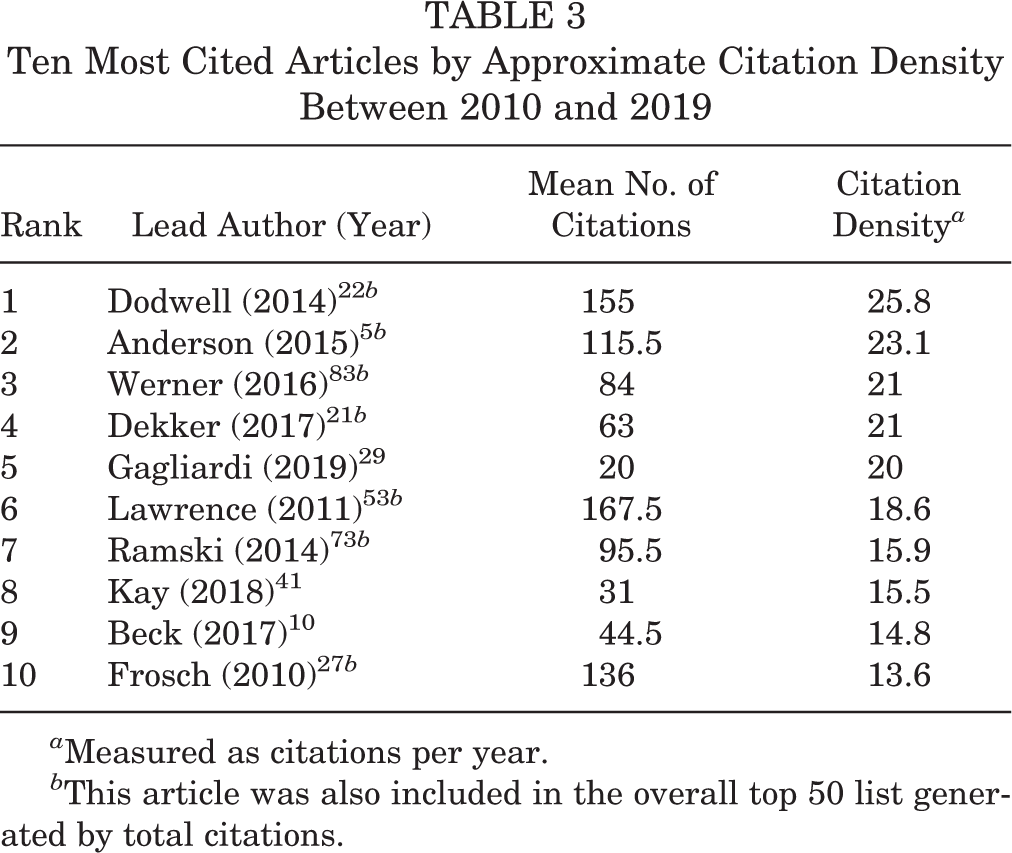
a Measured as citations per year.
b This article was also included in the overall top 50 list generated by total citations.
Individual Top Cited Article From Each Year Between 2010 and 2019
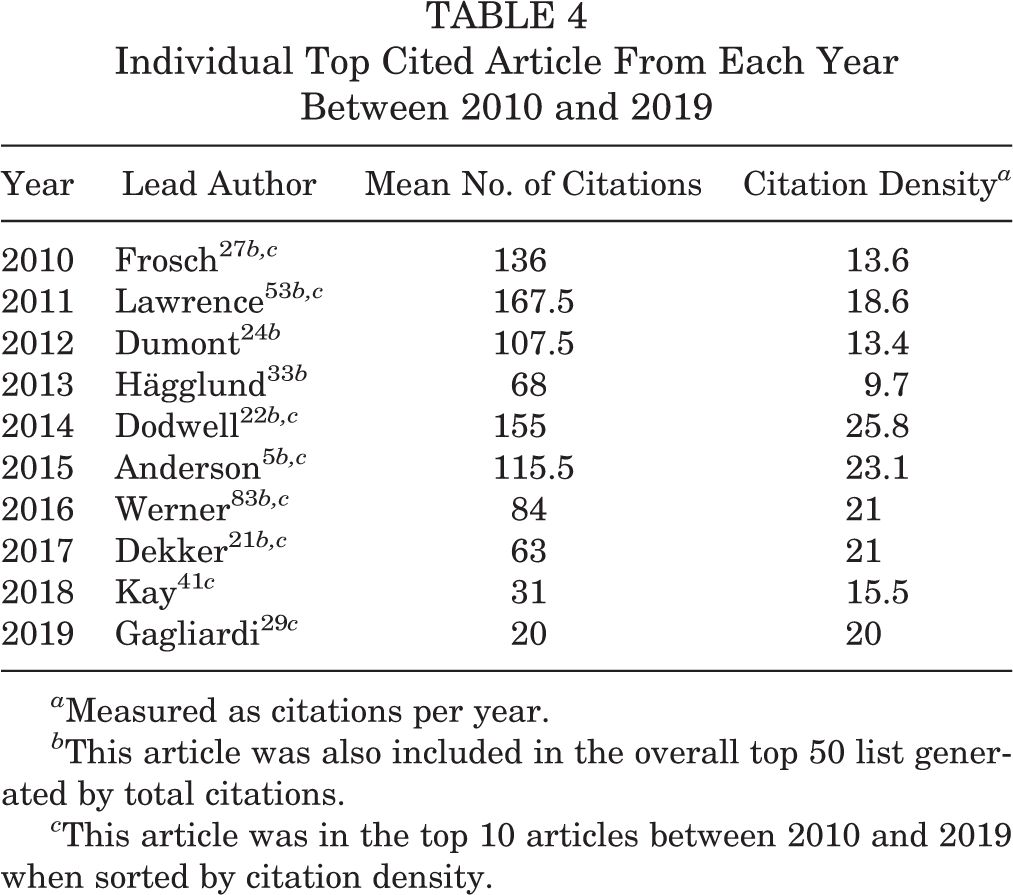
a Measured as citations per year.
b This article was also included in the overall top 50 list generated by total citations.
c This article was in the top 10 articles between 2010 and 2019 when sorted by citation density.
Discussion
The present study identified the 50 top cited articles on pediatric and adolescent ACL injuries and reconstruction. The majority of these studies were of low-level evidence, with no studies included that were deemed level 1 evidence. Furthermore, there were no significant correlations between higher methodologic quality and number of citations or citation density. In fact, a better or higher modified Jadad score was associated with worse ranking of mean citations.
Previous investigations 31,81,82 have evaluated bibliometrics relating to ACL injuries. Vielgut et al 81 and Voleti et al 82 each identified the top 50 most cited articles in ACL research, while Goljan et al 31 identified the 30 most cited articles in the 20 years before publication. Although the search method varied among these articles, none specifically looked at pediatric and adolescent ACL injuries. Furthermore, none of the titles of the top-cited articles in these previous papers were directly related to pediatric ACL pathologies specifically, and none of the titles in those studies overlapped with those included in the present study. The search method utilized to generate these lists utilized specifically a title search; it is possible that articles that focus on care of younger patients would not be captured using our search terms in the title. However, it appears that overall, management of pediatric and adolescent ACL injuries has been examined less frequently than has management of ACL injuries in adults have been.
While the initial database search yielded 463 results using Web of Science and 478 using Scopus (average 470.5), removing the terms “pediatric,” “adolescent,” and “skeletally immature” from the search to search for (anterior cruciate ligament) OR (ACL) yielded 20,355 results using Web of Science and 18,275 using Scopus (average 19,315). Therefore, approximately only 2.4% of the articles on ACL using these unfiltered search means were related to pediatric or adolescent patients. Several studies 15,35,60,79 have demonstrated an increasing rate of ACL reconstruction particularly in children and adolescents in recent years, especially in the early 2000s, and soon, an increased proportion of studies in this population may be expected with more data available.
Interestingly, 80% of the articles in the top 50 total average citations list were published after the year 2000, and only 2 were published in the 1980s. An increased rate of older articles would typically be expected in a bibliometric analysis like this given that there has been more time to cite articles, articles may have been cited for historical effect, and a “snowball” effect can occur. 51 This bias was evident in this data set where a better rank (ie, more citations) was correlated moderately with earlier year of publication. Several studies 1,37,65 on the natural history and prognosis of management of ACL tears in this population were published in the 1990s and early 2000s, and a plurality of the articles included were prognostic in nature. When examining the top 10 between 2010 and 2019 by citation density, only 3 new articles 10,29,41 were introduced. However, the moderate correlation between greater citation density and later year of publication demonstrates that more contemporary studies have had a stronger and immediate influence in recent years. The relative recency of included articles highlights the youth of pediatric sports medicine as a field, particularly with respect to ACL tears. Previous examination of the top 100 articles in pediatric orthopaedics as a whole demonstrated that 65% of the articles were published in the 1980s or earlier. 40 Furthermore, none of the articles in the present study was noted in other previous studies on the top articles in pediatric orthopaedics. 9,40
Although the topics included were vast, there were relatively few basic science--related studies, with only 1 animal study 69 and 2 biomechanical studies 11,43 included. This is a smaller proportion (6%) than those previously cited in top articles in ACL injuries in general, with 1 study citing 42% basic science 82 ; 1 study, 26.7% 31 ; and 1 study, 36%. 81 The present study included articles specific to pediatrics, and it is possible that animal and biomechanical studies include principles that can be applied to both pediatric and adult patients and that therefore fewer of these studies would be captured using the current methodology.
Furthermore, there were no included level 1 studies; the top-cited study 48 was expert opinion (level 5 evidence); and the majority were level 4 evidence, with the most common study type being case series. In pediatric orthopaedics, it has been previously shown that most articles are level 4 evidence, with a significantly greater proportion of level 1 studies in adult-based orthopaedic journals. 16,67 The lower-level evidence in pediatric orthopaedics may be expected given the ethical and institutional barriers faced in enrolling pediatric patients in clinical trials and blinding and randomizing treatments. As such, the lack of correlation between top-cited articles and higher methodologic quality is also not surprising. A higher modified Jadad scale score was significantly associated with worse rank (ie, closer to rank 50 or cited fewer times) on the list, which is a relationship in the opposite direction than may be desirable. The ability to draw conclusions on the true effect of the modified Jadad scale utilized may, however, be limited further by the narrow range of this scoring system. It is reassuring that there was a moderate association between later publication year and stronger level of evidence, suggesting improving level of evidence studies over time. More recent comparison studies among outcomes of various pediatric reconstruction techniques may have higher level of evidence and methodologic quality and may be expected to have larger numbers of citations in the future. Furthermore, additional recent topics of interest such as bridge-enhanced ACL repair 68 may be better captured in similar lists in future years. Ultimately, evaluation of trends of popular articles, including their topics and study types, can guide future directions in research to areas of interest or to topics less studied.
Several limitations exist with this style of study. The selected number of most cited 50 articles was arbitrary, and many influential and groundbreaking studies exist outside of this top 50 list. There is an inherent bias toward to earlier-published studies because of longer time to cite and the possibility of a snowball effect. 51 Therefore, some older studies may have less current clinical relevance. Although citation density in recent years was also examined in this study, another way to measure the immediate and short-term influence of studies could be to evaluate citation density in the first 5 to 10 years after year of publication. The number of citations is also in flux, and the list may change further over time. Different search techniques and methods may have yielded different included articles. Although there were no significant correlations with higher methodologic quality, these findings do not imply that the studies were poorly performed; particularly in pediatric orthopaedics, study designs may be limited by external ethical and institutional factors. Furthermore, many studies included were not assessed for methodologic quality.
Conclusion
Influential articles on pediatric and adolescent ACL injuries were relatively recent with a low proportion of basic science–type articles. Most studies were lower-level evidence with poor methodologic quality scores. Higher methodologic quality does not correlate positively with citation data.
Footnotes
Final revision submitted September 22, 2020; accepted February 9, 2021.
One or more of the authors has declared the following potential conflict of interest or source of funding: D.A.L. has received research and education payments from Arthrex and Smith & Nephew, education payments from Medwest, and hospitality payments from Wright Medical. N.K.P. has received consulting fees from OrthoPediatrics and education payments from Evolution Surgical. B.T.F. has received consulting fees from Kalibur and education payments from Zimmer Biomet. AOSSM checks author disclosures against the Open Payments Database (OPD). AOSSM has not conducted an independent investigation on the OPD and disclaims any liability or responsibility relating thereto.
Notes
APPENDIX
Top 50 Most Cited Articles Pertaining to Pediatric and Adolescent Anterior Cruciate Ligament Reconstruction

| Rank | Lead Author (Year) | Country | Study Type | Mean No. of Citations | Citation Density b | LOE | mCMS | Modified Jadad Scale | MINORS Score |
|---|---|---|---|---|---|---|---|---|---|
| 1 | Kocher (2002) 48 | USA | Survey | 288.5 | 16.0 | 5 | N/A | N/A | N/A |
| 2 | Aichroth (2002) 1 | UK | Cohort study | 259 | 14.4 | 2 | 56 | 2 | 14 |
| 3 | Millett (2002) 64 | USA | Case series | 231.5 | 12.9 | 4 | 43 | 2 | 10 |
| 4 | Lipscomb (1986) 56 | USA | Case series | 229 | 6.7 | 4 | 46 | 2 | 10 |
| 5 | Graf (1992) 32 | USA | Case series | 227.5 | 8.1 | 4 | 49 | 2 | 10 |
| 6 | Mizuta (1995) 65 | Japan | Case series | 214 | 8.6 | 4 | N/A | 2 | 10 |
| 7 | Shea (2004) 74 | USA | Descriptive epidemiology | 183 | 11.4 | 4 | N/A | N/A | N/A |
| 8 | Kocher (2005) 44 | USA | Case series | 181 | 12.1 | 4 | 68 | 3 | 8 |
| 9 | Andrews (1994) 6 | USA | Case series | 176 | 6.8 | 4 | 54 | 2 | 10 |
| 10 | Lawrence (2011) 53 | USA | Cohort study | 167.5 | 18.6 | 3 | N/A | 3 | 17 |
| 11 | Anderson (2003) 3 | USA | Case series | 166 | 9.8 | 4 | 57 | 2 | 10 |
| 12 | Koman (1999) 50 | USA | Case report | 155.5 | 7.4 | 5 | N/A | N/A | N/A |
| 13 | Dodwell (2014) 22 | USA | Descriptive epidemiology | 155 | 25.8 | 4 | N/A | N/A | N/A |
| 14 | Lo (1997) 57 | USA | Case series | 147 | 6.4 | 4 | 50 | 2 | 10 |
| 15 | Kocher (2007) 49 | USA | Case series | 146.5 | 11.3 | 4 | 59 | 3 | 9 |
| 16 | Frosch (2010) 27 | Germany | Meta-analysis/systematic review | 136 | 13.6 | 4 | N/A | N/A | N/A |
| 17 | Janarv (1996) 37 | Sweden | Case series | 123 | 5.1 | 4 | 47 | 4 | 10 |
| 18 | Angel (1989) 7 | Australia | Case series | 121.5 | 3.9 | 4 | N/A | 3 | 10 |
| 19 | Anderson (2015) 5 | USA | Cohort study | 115.5 | 23.1 | 3 | N/A | 4 | 10 |
| 20 | Dumont (2012) 24 | USA | Cross-sectional | 107.5 | 13.4 | 3 | N/A | N/A | N/A |
| 21 | Lee (1999) 55 | USA | Imaging/diagnostic | 102.5 | 4.9 | 4 | N/A | N/A | N/A |
| 22 | Aronowitz (2000) 8 | USA | Case series | 101 | 5.1 | 4 | 49 | 3 | 9 |
| 23 | Ramski (2014) 73 | USA | Meta-analysis/systematic review | 95.5 | 15.9 | 3 | N/A | N/A | N/A |
| 24 | Lawrence (2010) 54 | USA | Technique/review | 95 | 9.5 | N/A | N/A | N/A | N/A |
| 25 | Anderson (2004) 4 | USA | Technique/review | 94 | 5.9 | N/A | N/A | N/A | N/A |
| 26 | Kocher (2002) 47 | USA | Cohort study | 93.5 | 5.2 | 2 | N/A | 4 | 12 |
| 27 | Vavken (2011) 80 | USA | Meta-analysis/systematic review | 92.5 | 10.3 | 4 | N/A | N/A | N/A |
| 28 | Woods (2004) 85 | USA | Case-control | 89.5 | 5.6 | 3 | N/A | 3 | 10 |
| 29 | Fabricant (2013) 26 | USA | Technique/review | 89 | 12.7 | N/A | N/A | N/A | N/A |
| 30 | Murray (2009) 69 | USA | Animal study | 88 | 8.0 | N/A | N/A | N/A | N/A |
| 31 | Werner (2016) 83 | USA | Cohort study | 84 | 21.0 | 3 | N/A | 3 | 19 |
| 32 | McIntosh (2006) 63 | USA | Case series | 82.5 | 5.9 | 4 | 54 | 4 | 10 |
| 33 | Fuchs (2002) 28 | USA | Case series | 80.5 | 4.5 | 4 | 52 | 3 | 11 |
| 34 | Karageanes (2000) 39 | USA | Case series | 78.5 | 3.9 | 4 | N/A | 6 | 13 |
| 35 | Kocher (2006) 45 | USA | Technique/review | 78 | 5.6 | N/A | N/A | N/A | N/A |
| 36 | Steadman (2006) 78 | USA | Case series | 75.5 | 5.4 | 4 | 54 | 3 | 10 |
| 37 | Domzalski (2010) 23 | Poland | Imaging/diagnostic | 75 | 7.5 | 3 | N/A | N/A | N/A |
| 38 | Behr (2001) 11 | USA | Biomechanical/cadaveric | 72.5 | 3.8 | N/A | N/A | N/A | N/A |
| 39 | Engelman (2014) 25 | USA | Case-control | 71 | 11.8 | 3 | 59 | 4 | 14 |
| 40 | Prince (2005) 72 | USA | Imaging/diagnostic | 69 | 4.6 | 4 | N/A | N/A | N/A |
| 41 | Mohtadi (2006) 66 | Canada | Meta-analysis/systematic review | 68.5 | 4.9 | 4 | N/A | N/A | N/A |
| 42 | Hägglund (2013) 33 | Sweden | Cohort study | 68 | 9.7 | 2 | N/A | 6 | 20 |
| 43 | Matava (1997) 61 | USA | Case series | 66.5 | 2.9 | 4 | 54 | 3 | 10 |
| 44 | Kocher (2004) 46 | USA | Imaging/diagnostic | 66 | 4.1 | 3 | N/A | N/A | N/A |
| 45 | McCarthy (2012) 62 | USA | Technique/review | 64.5 | 8.1 | N/A | N/A | N/A | N/A |
| 46 | Gagnier (2013) 30 | USA | Meta-analysis/systematic review | 63 | 9.0 | 3 | N/A | N/A | N/A |
| 47 | Dekker (2017) 21 | USA | Case series | 63 | 21.0 | 4 | 39 | 4 | 6 |
| 48 | Kumar (2013) 52 | UK | Case series | 60.5 | 8.6 | 4 | 64 | 4 | 10 |
| 49 | Kennedy (2011) 43 | USA | Biomechanical/cadaveric | 60 | 6.7 | N/A | N/A | N/A | N/A |
| 50 | Bickel (2008) 12 | USA | Imaging/diagnostic | 58.5 | 4.9 | 4 | N/A | N/A | N/A |
LOE, level of evidence; mCMS, modified Coleman Methodology Score; MINORS, Methodological Index for Non-Randomized Studies; N/A, not available.
b Measured as citations per year.