




Abstract
Background:
Recently, participation in contact and/or collision youth sports has received attention due to concern over exposure to repetitive head impacts. However, few studies have examined the relative risks and benefits of participation in contact and/or collision sports among young athletes currently engaged in these sports.
Purposes and Hypotheses:
We sought to examine whether participation in contact and/or collision sports during adolescence would be associated with quality of life (QOL) among a sample of healthy adolescent athletes undergoing a pre-participation examination. We hypothesized QOL domains scores would be similar between contact/collision and no/limited contact sport athletes.
Methods:
We conducted a cross-sectional study of adolescent athletes undergoing a pre-participation physical examination. During the assessment, participants completed a sport participation questionnaire and the Patient-Reported Outcomes Measurement Information System (PROMIS) Pediatric-25 Profile, a measure of health-related quality of life. We grouped patients based on reported organized contact/collision or limited/non-contact sports participation in the past year, as delineated by Rice (2008). We compared PROMIS domain scores between groups using Mann-Whitney U tests, and used multivariable linear regression to identify the association between PROMIS domains scores and contact/collision sport participation while adjusting for covariates (sex, age, height, history of bone, muscle, ligament, or tendon injury, history of acute fracture or dislocation) in separate models.
Results:
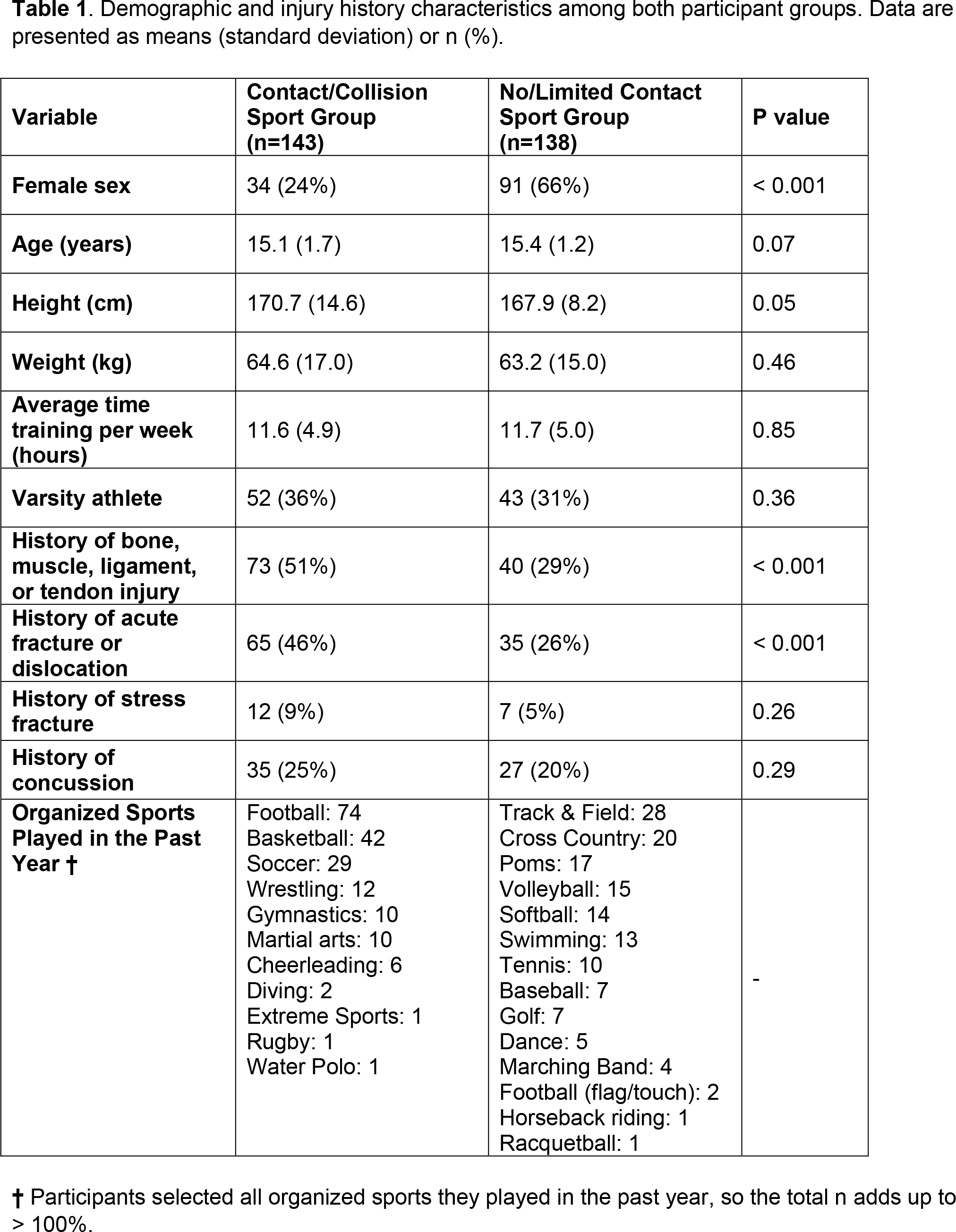
A total of 281 adolescents participated: 143 (51%) reported contact or collision sport participation in the year prior to the study. There was a significantly greater proportion of females in the no/limited contact sport group compared to the contact/collision sport group (Table 1). There was a significantly greater proportion of contact/collision sport athletes who reported past bone, muscle, ligament, or tendon injuries and acute fracture or dislocation injuries compared to no/limited contact sport athletes (Table 1). Upon univariable comparison, those in the contact/collision sport group reported significantly lower anxiety and depressive symptom domain scores than the no/limited contact sport group (Table 2). After covariate adjustment, contact/collision sport participation was significantly associated with lower anxiety and depressive symptom domain scores (Table 3).
Conclusion:
Adolescents participating in organized contact/collision sports reported lower anxiety and depressive symptoms than adolescents participating in no/limited contact sports. These results reinforce the need to re-examine assumptions that youth contact/collision sports are necessarily associated with negative quality of life. Future prospective studies will be required to better understand any causal relationship between contact sports and psychological well-being in young athletes, both in the short- and long-term.
Demographic and injury history characteristics among both participant groups. Data are presented as means (standard deviation) or n (%).
|
|
|
|
|
|---|---|---|---|
| Female sex | 34 (24%) | 91 (66%) | < 0.001 |
| Age (years) | 15.1 (1.7) | 15.4 (1.2) | 0.07 |
| Height (cm) | 170.7 (14.6) | 167.9 (8.2) | 0.05 |
| Weight (kg) | 64.6 (17.0) | 63.2 (15.0) | 0.46 |
| Average time training per week (hours) | 11.6 (4.9) | 11.7 (5.0) | 0.85 |
| Varsity athlete | 52 (36%) | 43 (31%) | 0.36 |
| History of bone, muscle, ligament, or tendon injury | 73 (51%) | 40 (29%) | < 0.001 |
| History of acute fracture or dislocation | 65 (46%) | 35 (26%) | < 0.001 |
| History of stress fracture | 12 (9%) | 7 (5%) | 0.26 |
| History of concussion | 35 (25%) | 27 (20%) | 0.29 |
| Organized Sports Played in the Past Year † | Football: 74 Basketball: 42 Soccer: 29 Wrestling: 12 Gymnastics: 10 Martial arts: 10 Cheerleading: 6 Diving: 2 Extreme Sports: 1 Rugby: 1 Water Polo: 1 |
Track & Field: 28 Cross Country: 20 Poms: 17 Volleyball: 15 Softball: 14 Swimming: 13 Tennis: 10 Baseball: 7 Golf: 7 Dance: 5 Marching Band: 4 Football (flag/touch): 2 Horseback riding: 1 Racquetball: 1 |
- |
Univariable PROMIS domain comparisons between contact/collision and no/limited contact sport groups.

| PROMIS Domain | Contact/Collision Sport Group | No/Limited Contact Sport Group | P value | |||
|---|---|---|---|---|---|---|
| Median [IQR] | Mean (95% CI) | Median [IQR] | Mean (95% CI) | |||
| Mobility | 0 [0, 0] | 0.09 (0.03, 0.15) | 0 [0, 0] | 0.21 (0.12, 0.31) | 0.013 | |
| Anxiety | 0 [0, 2] | 1.55 (1.15, 1.94) | 2 [0, 6] | 3.26 (2.69, 3.83) | < 0.001 | |
| Depressive symptoms | 0 [0, 1] | 0.82 (0.53, 1.12) | 0 [0, 2] | 1.88 (1.34, 2.41) | 0.005 | |
| Fatigue | 1 [0, 3] | 1.67 (1.27, 2.06) | 1 [0, 3] | 2.16 (1.69, 2.62) | 0.087 | |
| Peer relationships | 15 [13, 16] | 13.6 (12.9, 14.2) | 15 [12, 16] | 13.0 (12.3, 13.7) | 0.183 | |
| Pain Interference | 0 [0, 2] | 1.32 (0.91, 1.73) | 0 [0, 2] | 1.53 (1.04, 2.02) | 0.81 | |
| Pain scale | 0 [0, 2] | 1.08 (0.82, 1.33) | 0 [0, 1] | 0.89 (0.60, 1.18) | 0.06 | |
Effect of contact/collision sport participation on patient reported quality of life outcome measures, adjusting for sex, age, past history of bone, muscle, ligament, tendon injury, bone fracture or dislocation, and height.

|
|
|
|
|
|
|---|---|---|---|---|
|
|
-0.106 | 0.065 | -0.235, 0.022 | 0.10 |
|
|
-1.072 | 0.387 | -1.834, -0.310 | 0.006 |
|
|
-0.807 | 0.344 | -1.484, -0.130 | 0.020 |
|
|
-0.187 | 0.346 | -0.868, 0.494 | 0.59 |
|
|
0.434 | 0.576 | -0.700, 1.568 | 0.45 |
|
|
-0.118 | 0.369 | -0.845, 0.610 | 0.75 |
|
|
0.185 | 0.221 | -0.251, 0.621 | 0.40 |
*Those in the contact/collision sport participation group reported significantly lower anxiety and depressive symptom scores than those in the limited/non-contact sport participation group after adjusting for potential confounders.