




Abstract
Background:
There are 60 million US youth who participate in organized athletics, with large increases in both sport participation and specialization during the past 2 decades. There is some evidence that increased sport specialization and training volumes may be associated with increased injuries in adolescent populations. This study examines these variables in a population of elite college athletes.
Hypothesis:
Early sport specialization (ESS) and a high training volume are risk factors for injury and/or surgery in National Collegiate Athletic Association (NCAA) Division I athletes.
Study Design:
Cross-sectional study; Level of evidence, 3.
Methods:
All Division I athletes at a single institution were surveyed regarding demographics, scholarship status, reason for specialization, age at specialization, training volume, and injury history. Chi-square and Mann-Whitney U tests were performed to identify significant differences.
Results:
Athletes who specialized in their eventual varsity sport before age 14 years were more likely to report a history of injuries (86.9% vs 71.4%), multiple injuries (64.6% vs 48.8%), multiple college injuries (17.2% vs 6.0%), a greater number of total injuries (2.0 vs 1.0), and require more time out for an injury (15.2 vs 6.5 weeks) than those who did not. They were also more likely to be recruited (92.9% vs 82.1%) and receive a scholarship (82.8% vs 67.9%). Athletes who trained for greater than 28 hours per week in their eventual varsity sport before high school were more likely to report multiple injuries (90.0% vs 56.3%), multiple college injuries (40.0% vs 12.5%), a surgical injury (60.0% vs 22.9%), multiple surgical injuries (30.0% vs 4.7%), a greater number of total injuries (2.5 vs 2.0), and more time out for an injury (36.5 vs 11.0 weeks) than those who did not (all P < .05). However, these athletes were not more likely to be recruited (90.0% vs 89.8%) or receive a scholarship (80.0% vs 74.5%).
Conclusion:
NCAA Division I athletes with ESS and/or a high training volume sustained more injuries and missed more time because of an injury, but those with ESS were more likely to be recruited and receive a college scholarship. This knowledge can help inform discussions and decision making among athletes, parents, coaches, trainers, and physicians.
An estimated 60 million US youth aged 6 to 18 years participate in organized athletics. 11 Increases in sport participation across all age groups over the past 2 decades have been documented, 25,30 mirrored by a concomitant increase in high school sport specialization. 5,9 The impetus for this shift toward specialization is likely multifactorial, perhaps stemming from the desire for a competitive advantage, the possibility for scholarships, the positive public perception of elite athletes, or pressure from coaches 33,43 or parents. 6 –8,32
The concern with this trend of early sport specialization (ESS) and an increased early high training volume (HTV) in youth athletes is that there may be a potential for an increased risk of overuse/overload injuries 12,13,16 as well as acute injuries requiring surgery. ESS and the injuries that can accompany it may also lead to burnout, fear of reinjuries, difficulty returning to preinjury skill levels, and early sport retirement. 1 –4,10,14,15,20,41,43 These concerns have led to multiple medical societies (American Academy of Pediatrics, American Medical Society for Sports Medicine, and the American Orthopaedic Society for Sports Medicine) issuing position statements and editorials on this topic. Such recommendations include that young athletes should not train in a single sport for greater than 8 months out of the year or train for more hours per week than their age. Sport-specific guidelines, such as pitch count recommendations, have also been issued. 7,11,18,21,24,29,38 Despite the prevalence of these safety recommendations, there is limited evidence to support or refute them. Further, no strict definition of “sport specialization” exists. However, to date, most studies have utilized a similar set of questions to assess an athlete’s degree of specialization. The most widely known measure of sport specialization is an athlete's training in a particular sport for greater than 8 months out of the year. 31,36 The natural counterargument is that ESS may be necessary to achieve elite skill levels, thereby achieving opportunities for collegiate and professional careers.
Most studies examining sport specialization and injury risk have utilized self-report surveys in high school students or younger. It is intuitive to examine this population because sport specialization typically occurs in this age group, and these athletes are particularly susceptible to injuries due to increased training demands during a period of rapid growth. However, relatively little is known about the impact of sport specialization and training volume on the elite college athlete. Studying this older population has the benefits of a longer term follow-up on injury rates years after sport specialization occurs and also provides the opportunity to examine whether ESS affords a competitive advantage in attaining a more elite athletic skill level.
The purpose of this study was to determine whether associations exist between sport specialization, training volume, and injury history in a population of National Collegiate Athletic Association (NCAA) Division I athletes. A secondary aim was to assess whether sport specialization and an HTV are necessary to achieve elite athletic status. We hypothesized that ESS and an HTV would be associated with increased injury rates but not increased rates of recruitment and/or scholarship acquisition.
Methods
Participants
All current NCAA Division I athletes at a single institution aged ≥18 years were emailed the voluntary survey link and an explanation of this institutional review board–exempt study.
Questionnaire
Consenting participants were allowed 1 month to complete the 10- to 20-minute electronic questionnaire. All survey responses were collected and managed using REDCap electronic data capture software (CTSI grant UL1TR001881). 17 In exchange for participation, athletes were sent anonymized study results and entered into a gift card raffle.
Athletes were surveyed regarding demographics, scholarship status, reasons for sport specialization, age of specialization, training volume, and injury/surgical history. Sport specialization was determined using the previously utilized question, “At what age, if any, did you begin to train greater than 8 months out of the year for your primary sport?”
Athletes’ reasons for sport specialization were obtained by asking their primary reason for specialization, followed by the next most important reason until the athlete selected the option “no further reasons.” The first through third selections were weighted by a factor of 3, 2, and 1, respectively.
Data were also collected on training volume for the athletes’ sports. For each sport played (up to 8), the athlete was asked to estimate the hours per week and months per year spent training during 3 separate time periods (before high school, high school, and college).
Finally, athletes were asked to document all injuries sustained in their sporting history (up to 8). Instructions specified including all injuries that precluded sport participation for at least 1 week and omitting any injuries not attributable to sport play/training (ie, injuries sustained during recreational activities). For each injury, athletes specified the injured body part, time period in which it occurred, time missed from sport because of the injury, and whether surgery was required.
ESS was defined as narrowing participation to 1 primary sport before age 14 years by training for greater than 8 months of the year in that sport. This age was chosen because it is a natural time point before skeletal maturity in most boys and girls when many adolescents begin high school and choose to specialize in sport and allows for a comparison with prior studies. An early HTV was defined as training for greater than 28 hours per week in their eventual varsity sport before age 14 years (high school age). We chose a higher threshold than prior studies (28 vs 16 hours, respectively) because we assumed that Division I athletes would have a significantly higher pre–high school training volume than average athletes (∼1.5-2 times) and wanted to capture only the highest risk athletes with excessive training volumes (sports with twice-a-day practices, additional weight training, long competition times, and/or tournaments with multiple games per weekend). Elite athletic status was defined as being recruited and/or receiving an athletic scholarship of any amount.
Statistical Analysis
Chi-square, Fisher exact, and Mann-Whitney U tests were performed to identify significant differences between groups. Comparisons were deemed statistically significant at the P < .05 threshold. Odds ratios (ORs) were calculated with 95% CIs to demonstrate the effect size. Statistical analyses were performed using SPSS 24 software (IBM).
Results
A total of 232 athletes completed some portion of the survey (36% response rate). There were 30 athletes excluded because of incomplete or incorrect survey completion, leaving 202 surveys available for analysis (31% completion rate). There were 61 male and 141 female participants, with a mean age of 20.1 years (Table 1). There was an approximately even distribution of responses among academic years, with each comprising around a quarter of the total participants. Additionally, 63.3% of participants were white, and 90.6% were single-sport NCAA athletes. Furthermore, 70.3% did not take a redshirt year; 73.3% received a scholarship, of whom 40.5% received a full scholarship. Before college, 67.8% participated in youth athletics in California, 19.3% in other states, and 12.9% outside the United States. These figures, besides sex, are generally similar to publicly available NCAA data on 2018 Division I athletes (www.ncaa.org). Our institution did have a higher proportion of female athletes (51.5%) than the overall NCAA Division I athlete population (47.0%) (Table 1).
Athlete Demographics a

a Data are reported as n (%). NCAA, National Collegiate Athletic Association.
The average study athlete was first recruited at age 15.9 years, played 3.1 sports, had 2.1 injuries, and spent 21.7 cumulative weeks away from sport because of an injury (Table 2). Moreover, 80.7%, 57.9%, and 34.2% of athletes reported a history of at least 1, 2, and 3 injuries, respectively (Table 3). The most frequent injury locations were the ankle (16.8%), back/spine (10.6%), knee (9.7%), and head (9.5%).
Athlete Sporting History

Athlete Injury History
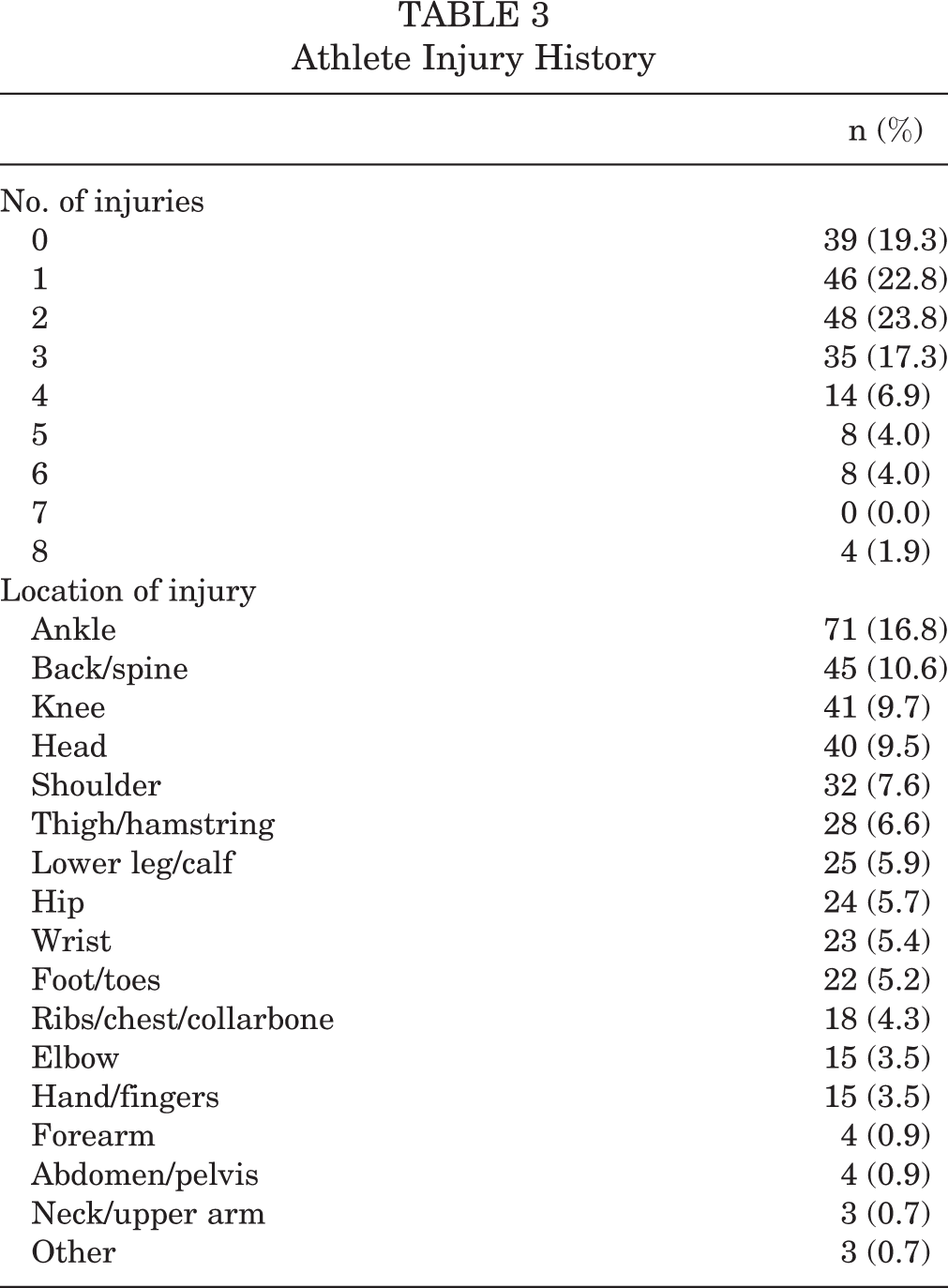
Demographic Data and Injury History
Female athletes were more likely to complete the survey than male athletes (42.0% vs 19.2%, respectively; P < .05) (Table 4). The 2 notable low-response groups were men’s tennis and football (0.0% and 12.4% completion rates, respectively). However, apart from these groups, there was substantial representation across nearly every varsity sport, with completion rates ranging from 13.3% to 50.0%. High-response groups for female participants were swimming/diving (56.1%), cross-country (57.1%), and golf (62.5%). Low-response groups for female athletes were track and field (19.1%), basketball (28.6%), and gymnastics (29.2%).
Survey Completion Rates by Sport a

a Data are reported as No. Dashes refer to sports that are not available at our institution.
b All cross-country athletes who completed the survey also participated in track and field and were therefore deemed nonspecialized.
Sport Specialization
Participants were queried on their reasons for sport specialization (Figure 1). The primary reason that athletes cited for specializing was enjoyment of that sport (33%). The next most common reasons cited were to obtain a scholarship (23%) and professional career aspirations (17%). An additional 6% of athletes sought a competitive advantage, and 3% specialized to avoid injuries. Parent/coach pressure was cited as a reason for sport specialization in only 4% of this cohort.

Athletes’ reasons for sport specialization.
To investigate whether ESS was associated with injuries or achievement of elite athletic status, 183 athletes were analyzed (Table 5). Dual-sport athletes (n = 19) were considered nonspecialized and therefore excluded. Athletes with early specialization were more likely to report a history of injuries (86.9% vs 71.4%; OR, 2.65), multiple injuries (64.6% vs 48.8%; OR, 1.92), multiple college injuries (17.2% vs 6.0%; OR, 3.28), a greater number of total injuries (2.0 vs 1.0; U = 3251), and more time out for an injury (15.2 vs 6.5 weeks; U = 3377) than those without. They were also more likely to report being recruited (92.9% vs 82.1%; OR, 2.86) and receiving a scholarship (82.8% vs 67.9%; OR, 2.29). When athletes were compared at later specialization age cutoffs of 15, 16, 17, and 18 years, there were no statistically significant differences in injury or surgery rates.
Athletes With Early Versus Late Sport Specialization a

a Bold data represent P values that are significant at the α = 0.05 level. OR, odds ratio.
Training Volume
Similar analyses were performed to compare athletes who had an HTV at an early age (<14 years) (Table 6). Athletes who trained for greater than 28 hours per week in their eventual varsity sport before high school were more likely to report a history of multiple injuries (90.0% vs 56.3%; OR, 7.00), multiple college injuries (40.0% vs 12.5%; OR, 4.67), an injury requiring surgery (60.0% vs 22.9%; OR, 5.05), multiple injuries requiring surgery (30.0% vs 4.7%; OR, 8.70), a greater number of total injuries (2.5 vs 2.0; U = 486), and more time out for an injury (36.5 vs 11.0 weeks; U = 424) than those who did not. However, these athletes were not more likely to be recruited (90.0% vs 89.8%) or receive a scholarship (80.0% vs 74.5%). All athletes with an early HTV reported a history of injuries versus 80.2% of those without an early HTV, although this difference did not reach statistical significance. There were no significant differences in injury rates observed with comparisons at lower training volume cutoffs.
Athletes With Early Versus No Early HTV a

a Bold data represent P values that are significant at the α = 0.05 level. HTV, high training volume; OR, odds ratio.
All athletes who had an early HTV also had ESS. When athletes with an HTV were omitted, 173 athletes remained to assess the effect of sport specialization independent of training volume (Table 7). Athletes with ESS who trained at more moderate levels were still significantly more likely to report a history of injuries (85.4% vs 71.4%; OR, 2.34) and a greater number of total injuries (2.0 vs 1.0; U = 3021) than those without ESS. They were still more likely to be recruited (93.3% vs 82.1%; OR, 3.01) and earn a scholarship (83.1% vs 67.9%; OR, 2.34).
Athletes With Early Versus Late Sport Specialization, With Those With an Early High Training Volume Omitted a

a Bold data represent P values that are significant at the α = 0.05 level. OR, odds ratio.
Sport Stratification Analysis
After stratification by sport, differences emerged in the mean specialization age between sports (Table 8). Athletes in gymnastics, men’s golf, men’s soccer, and women’s tennis specialized particularly young at age ≤9 years, while athletes in women’s rowing, men’s volleyball, and football specialized relatively late at around age ≥15 years. Athletes in essentially all sports were prone to injuries with ESS; only men’s golf, men’s volleyball, men’s basketball, and women’s swimming/diving had injury rates ≤75% (Table 8). Notably, despite ESS, men’s volleyball, men’s track and field, baseball, and women’s rowing had scholarship rates ≤50%, and men’s volleyball, men’s basketball, and men’s golf had injury rates ≤50%. All athletes with an early HTV had a history of injuries, although not all athletes in gymnastics and women’s swimming/diving received a scholarship.
Injury/Scholarship Rates of Athletes With ESS and an HTV by Sport a

a Data are reported as mean ± SD unless otherwise indicated. ESS, early sport specialization; HTV, high training volume; N/A, not applicable.
b Sports in which athletes with late specialization had higher injury/scholarship rates.
Earlier specialization ages were strongly correlated with higher pre–high school training volumes, and after outlier removal (soccer had early specialization but a relatively low training volume), this association was even more robust (R 2 = 0.76) (Figure 2). Remarkably, soccer had high injury rates (≥92%) despite a lower training volume.
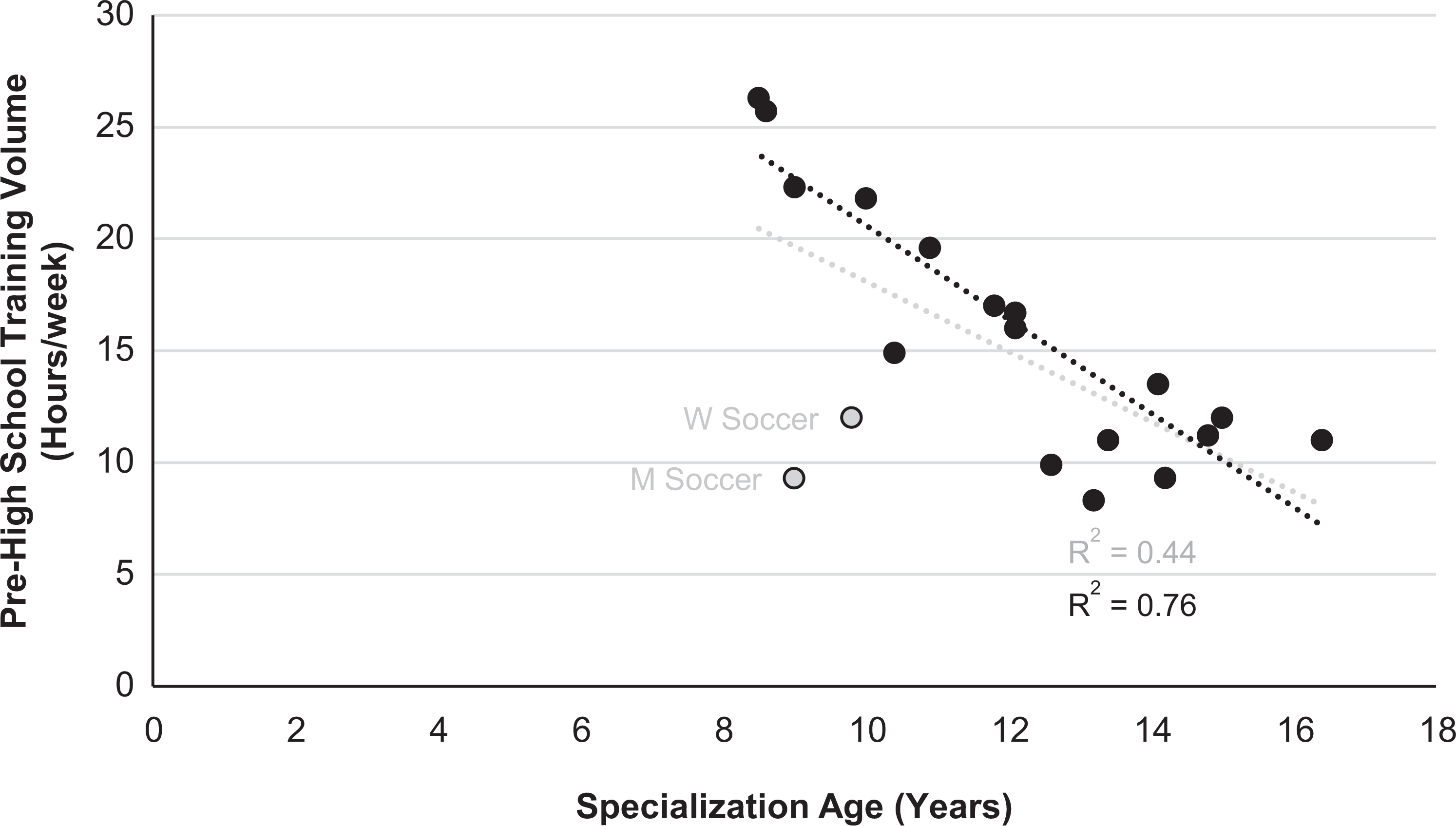
Correlation between specialization age and pre–high school training volume by sport. Gray shading represents R 2 correlation analysis for line of best fit with the outliers of men’s/women’s soccer athletes included. Black shading represents this analysis with men’s/women’s soccer athletes omitted.
Discussion
To our knowledge, this is the first study to examine sport specialization, training volume, and injury history in a population of NCAA Division I athletes. This study has the advantages of a longer term follow-up compared with prior studies of high school athletes, allowing for a more robust injury history and assessment of elite athletic achievement. This study demonstrated that both sport specialization and an increased training volume before high school were associated with higher injury rates, while specialization after age 14 years and training for less than 28 hours per week before high school were not. Athletes who specialized in sport at a young age but did not have an HTV still reported higher injury rates than their counterparts who trained at similar volumes without ESS and higher rates of NCAA Division I recruitment/scholarship.
Factors Driving Specialization
Several studies have examined athletes’ motivation for sport specialization. 8,25,32,33 Padaki et al 33 found that 22% and 30% of youth athletes were told by parents and coaches not to play sports besides their primary sport. They also found that more than half of parents encouraged specialization or desired a collegiate/professional career for their children. 32 Another study found that 67% of youth athletes believed that specialization increased their chances of making a college team, and highly specialized athletes were twice as likely to believe that they would receive a college scholarship. 8 In our study, NCAA athletes most commonly cited enjoyment of the sport as the reason for sport specialization. However, nearly half (46%) cited professional careers/scholarship aspirations, and a minority reported specializing because of parent/coach pressure (see Figure 1). Our study gives credence to the belief that early specialization increases the chances of receiving a scholarship. Of note, our study examines NCAA athletes, which does not capture the opinions of athletes who quit before high-level competition (ie, because of loss of interest, inadequate skill, burnout, fear of injuries, reinjuries, etc).
Early Sport Specialization
This study demonstrates an increased risk of injuries and time missed because of an injury with ESS. We defined sport specialization as “year-round, intensive training in a sport at the exclusion of others,” as utilized in other studies, 5,19 further specifying this as before age 14 years. The tight correlation observed between specialization age and training volume validates our definition of specialization by mitigating potential concerns that some athletes choose a sport early but train modestly in it, thus not truly specializing (Figure 2).
Previous studies have similarly found associations between injuries and ESS. For instance, Bell et al 5 found that high school athletes who trained for greater than 8 months of the year had significantly higher odds of hip/knee injuries (OR, 2.32-2.93) and overuse injuries of the upper extremity (OR, 1.66) and lower extremity (OR, 1.68). A study of late adolescent pitchers found that those who pitched for greater than 8 months of the year had higher rates of elbow/shoulder surgery (OR, 5.05). 31 Other studies have demonstrated that highly specialized youth athletes are more likely to report a prior lower extremity injury (OR, 2.58), 35 a history of injuries (OR, 1.59), 37 and a greater number of injuries prospectively over 1 year (hazard ratio, 1.85). 27 In our study, those who trained for greater than 8 months of the year in their eventual varsity sport before age 14 years had an OR of 2.65 for history of injuries.
Athletes who specialize at a young age likely train at higher volumes as well. Consequently, the potential increased injury risk from ESS may be confounded by an accompanying increased number of exposure hours for possible injuries. To control for this, we compared injury rates by specialization status after removing all athletes with an HTV (a group found to have increased injury rates) (Table 7). Nevertheless, athletes with ESS were more likely to report an injury history (OR, 2.34) and more total injuries. Jayanthi et al 19 also found sport specialization to be an independent risk factor for injuries (OR, 1.27) and overuse injuries (OR, 1.36) in adolescents after accounting for hours/weeks of sport activity. It should be noted, however, that there is likely a difference in exposure between athletes who play a single sport for 8 months of the year and those who also train in multiple additional sports the remainder of the year.
There is evidence in the literature that sports have different patterns of specialization. For instance, Post et al 36 found that Division I football athletes were less likely to be highly specialized in high school than nonfootball athletes, correlating with these athletes specializing third latest in our study at 14.8 years (Table 8). Others have demonstrated that sports including tennis, gymnastics, and soccer have early specialization ages, 34 which was mirrored in our data in that these sports were among the 5 earliest in specialization (Table 8).
High Training Volume
Previous studies have sought to establish guidelines for safe training volumes in adolescent athletes. For instance, Rose et al 39 demonstrated increasing proportions of Canadian high school students reporting an injury with increasing weekly training hours, specifically when exceeding 16 hours per week. Another study reported that female adolescents with activity for greater than 16 hours per week had 1.88 greater odds of a stress fracture than those with less than 4 hours per week. 22 Also, 2 studies have demonstrated that adolescents with primary sport participation for more hours per week than their age had higher injury rates (OR, 2.07 and 1.34). 19,37
Our study shows a significantly increased proportion of athletes reporting a history of multiple injuries, surgical injuries, and more time missed from an injury in those with pre–high school training for greater than 28 hours per week. Every athlete in this group reported a history of at least 1 significant injury. Given our findings and those of the existing literature listed, it seems that a threshold of training volume exists beyond which young athletes may experience significantly increased injuries. We chose a higher figure than prior studies because we assumed that NCAA Division I athletes would have had a significantly higher training volume than typical youth athletes at the same age and thus have a higher training volume threshold at which increased injuries would occur. This may be explained by our population representing a more elite studied group compared with high school athletes. Thus, youth athletes who go on to become NCAA athletes may inherently have or eventually develop a higher tolerance to HTVs and only sustain increased injuries at extremely HTVs.
Elite Athletic Status
Our data indicate that ESS was associated with the achievement of elite athletic status in Division I athletes (Table 6). While ESS may increase the chance of attaining a scholarship, the vast majority of high school athletes will not be offered scholarships despite ESS and will likely still have the same (or higher) injury risk. Certainly, some level of specialization is necessary to obtain the athletic skill required to merit Division I recruitment/scholarship, but the degree is unclear. A study of high school, college, and professional athletes found that a significantly higher proportion of college athletes played a single sport during adolescence than high school athletes (67.7% vs 45.2%, respectively), and the majority believed that specialization helps athletes play at a higher level (80.6%). 9 A survey of National Basketball Association players found that 85% reported being single-sport high school athletes. 40
While ESS was found to be associated with elite athletic status in this study, notably, HTV was not (Table 7). Intuitively, an HTV would lead to increased skill acquisition and higher recruitment/scholarship rates, but this may be counteracted by higher injury rates because of increased fatigue 23 or simply more exposure hours, which may derail recruitment depending on injury timing and severity. A study of Danish CGS athletes (sports measured in centimeters, grams, and seconds) found that elite athletes trained less during childhood than near-elite athletes but intensified training during late adolescence. 28 It should be noted, however, that the 2 sports common to our study (swimming/diving and track and field) comprised 36% of that study’s total participants. An examination of sport specialization patterns in Division I athletes at a Midwest institution found that less than 20% were highly specialized starting at high school, but this figure increased over time (41% at 12th grade). 36
Sport Stratification Analysis
In this study, specialization age and training volume were different between sports, but virtually all sports with an early HTV and ESS experienced increased injuries (Table 8), consistent with nonstratified analysis results. While the low sample size precludes absolute conclusions, our findings suggest that certain sports may be resistant to the detrimental effects of ESS in terms of injuries, while others may see less benefit from ESS in terms of scholarship acquisition. There was an HTV in greater than a third of the sports (36.8%) in this study (gymnastics, men’s golf, women’s golf, women’s tennis, women’s swimming/diving, softball, and men’s water polo), but all these athletes sustained injuries, and an HTV was associated with decreased scholarship acquisition in certain female sports (gymnastics and women’s swimming/diving). This subject certainly requires further investigation.
Strengths and Limitations
The strengths of this study include it providing detailed injury and specialization data for a large diverse population of NCAA Division I athletes. Compared with previous studies largely composed of high school students, it offers a longer term follow-up and isolates only high-achieving athletes. We attained a reasonable completion rate within the average for all survey mediums and above average for internet surveys, 26 especially acceptable given the survey length. Most similar studies in the literature do not report a response rate 5,9,17,27,28,34 –37 ; however, 1 that did was similar to ours (41.6%). 42
A major limitation of this study is recall bias, given that athletes were asked to estimate training volumes and injuries from several years prior. Nevertheless, highly skilled athletes would arguably be uniquely adept at recalling training regimens from previous time points in their lives. Additionally, while it may be easy to forget minor injuries from prior years, we believe that it is unlikely that athletes failed to recall a significant injury that kept them from sports. Conclusions regarding HTVs are, however, limited by the small number of athletes with an HTV included in the study by our definition. Our findings may be less generalizable, given the skewed response rates by sex/sport, possible geographical bias due to a predominantly Californian athlete pool, and institutional characteristics including higher level athletes compared with non–Power Five conference/Division I institutions, high school athletes with a serious injury history less likely to be recruited, and several NCAA sports not fielded here (fencing, bowling, lacrosse, wrestling, and ice/field hockey).
Conclusion
Our study suggests that ESS and an HTV are associated with increased injury rates in a population of NCAA Division I college athletes. Specifically, athletes who trained for greater than 28 hours per week or dedicated more than 8 months of the year to their eventual varsity sport before age 14 years had increased odds of an injury. However, only early specializing athletes were more likely to be recruited and/or receive a scholarship, suggesting that an HTV at this age may not confer additional benefit. There is an inherent risk in any sporting participation, and the acceptable risk profile varies for the individual athlete. The findings of this study should be taken in context for the broader sporting audience. Because these risk factors are present in NCAA Division I athletes, we recommend that all athletes avoid an HTV and ESS before high school, but given the association of ESS with higher scholarship rates, ESS must be an individual decision for athletes and parents to make.
Footnotes
Final revision submitted November 6, 2019; accepted November 19, 2019.
One or more of the authors has declared the following potential conflict of interest or source of funding: S.A. has received research grant support from UCLA’s Department of Surgery. B.M.C. has received research grant support from UCLA’s Department of Orthopaedic Surgery. S.L.H. has received hospitality payments from Arthrex. AOSSM checks author disclosures against the Open Payments Database (OPD). AOSSM has not conducted an independent investigation on the OPD and disclaims any liability or responsibility relating thereto.
Ethical approval for this study was waived by the University of California, Los Angeles (No. 16-001691).