




Abstract
Objectives:
To describe outcomes, including failure rates, following a pediatric ACL reconstruction (ACLR) employing combined trans-physeal technique with hamstring autograft (TPH) and a hybrid extra-articular technique using iliotibial band autograft (ITB).
Methods:
Consecutive skeletally immature patients undergoing combined TPH/ITB ACLR from 1/2012 to 4/2017 were reviewed. With the goal of decreasing ACL graft re-injury in this high-risk group; this technique employed anterior-medial portal drilling for TPH, with an extra-osseous femoral ITB technique and intra-articular combined TPH/ITB grafts fixed within the tibial bone tunnel (Figure 1). Inclusion required a minimum 12 months follow up; exclusions were prior knee surgery and multi-ligamentous injury. Demographics, bone-age (hand), standing alignment XR for growth and mechanical axis grade, and PROs were documented. T-tests, Mann-Whitney tests, and Spearman’s correlation coefficients were employed.
Results:
60 knees in 59 adolescents underwent the combined TPH/ITB ACLR, with 49 knees meeting inclusion criteria with a mean follow up = 23 months (r = 12-48 m). Only 1/49 knees (2%) sustained ACL re-injury. Mean age was 12.9y (11-16y) with 29 males (mean bone-age = 14.1) and 19 females (mean bone-age =13.3). There was a high level return to pre-operative sport. No families reported cosmetic, functional alignment or length concerns, and no clinical deformity was diagnosed. Outcome measures at final follow up indicated a high functional level with a mean Pedi-IKDC = 90.39 and mean Pedi-Fabs = 22.66. To critically assess growth, a cohort of 22 knees (mean age = 12.8y) with > 18 months of growth remaining at surgery were evaluated at maturity. No difference was seen in mean operative and non-operative leg growth (54.1 mm and 53.0 mm). One patient, 1/22 (4.5%), had a final LLD > 10 mm (12 mm), and peri-operative alignment difference [0-GII (central compartment) valgus]. Growth and alignment were not significantly associated with age, bone age, height, weight, demonstrated growth, or pre-operative alignment.
Conclusion:
Combined TPH/ITB ACLR in adolescent patients resulted in return to high activity levels (Pedi-Fabs = 22.66), and a low (2%) re-injury rate at an average of 23 months. A novel pediatric ACLR employing combined trans-physeal hamstring and extra-osseous iliotibial band grafts merits further study as a technique for reducing re-injury in high-risk, growing adolescents by maximizing articular graft size while adding anterior-lateral rotational knee control.
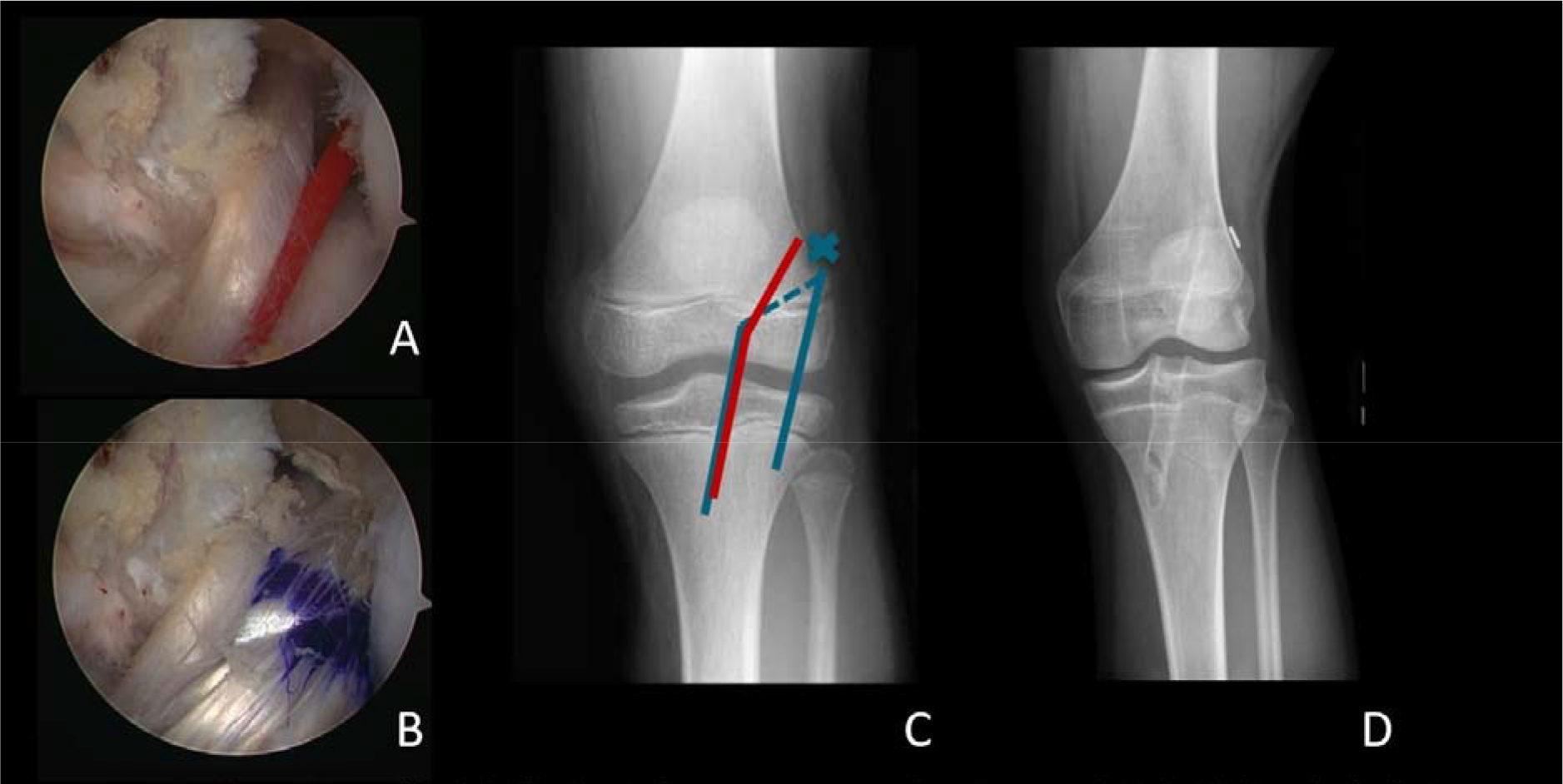
A-Arthroscopic image of the iliotibial band coming from an extraosseous notch position superiorly into the tibial tunnel with red suture passer in the transphyseal femoral position. B- Arthroscopic position of transphyseal hamstring (lpar;purple mark) and iliotibial band in place. C- Line drawing of the transphyseal hamstring (red) with combined iliotibial band hybrid (blue) positions. D- Radiograph taken 33 months post combined procedure.