




Abstract
EFFECT OF PENALTY MINUTE RULE CHANGE ON INJURIES AND GAME DISQUALIFICATION PENALTIES IN HIGH SCHOOL ICE HOCKEY
Background:
Ice hockey has experienced a 44% increase in participation among 6 to 17-year-old players from 2009-2014 in the United States. Body checking remains legal among male youths at bantam through junior levels and in high school (HS) hockey. In the U.S., nearly 45,000 players (35,210 boys and 9,599 girls) participate in HS ice hockey, with ˜12,000 players 19 years and younger seeking care in emergency departments (ED) for ice hockey-related injuries annually. Recent efforts have focused on reducing dangerous hits and fighting at all levels of ice hockey. Rule changes such as Fair Play have proven successful in reducing injury risk, but have not been widely implemented at state, regional, or national levels. The purpose of our study was to determine the effect of a penalty minute (PIM) rule change in HS boys’ ice hockey on injuries and game disqualification penalties.
Methods:
Retrospective cohort study. Injury data were collected from 2 hospital systems in Rhode Island (RI), and game/penalty data were collected through the RI Hockey Coaches Association website. Participants included HS boys’ hockey varsity players ages 13-19 years presenting to 5 RI hospital emergency departments (ED) for hockey-related injuries during 6 seasons (December 2012 to April 2018). Rule change for 2015-16 season implemented varying suspensions for players accumulating = 50 PIM and = 70 PIM during regular season and playoffs. Injuries were classified as body checking-related or non-body checking related, and injury rates pre- vs. post-rule change were compared using the Cochran-Mantel-Haenszel Chi-square test. Multivariable logistic regression was used to derive odds ratios. A sample of 18,000 emergency department visits prior to the rule change and 18,000 emergency department visits after the rule change provides over 90% power to detect a 15% reduction in the odds of sustaining body checking injury requiring ED visit, assuming a body checking ED injury rate of 5% prior to the rule change, a correlation between study period ED visit rates of 0.5, and a two-sided alpha level of 0.05. Power analyses were performed in nQuery Advisor version 8.2.0 (Statistical Solutions Ltd., Cork, Ireland).
Results:
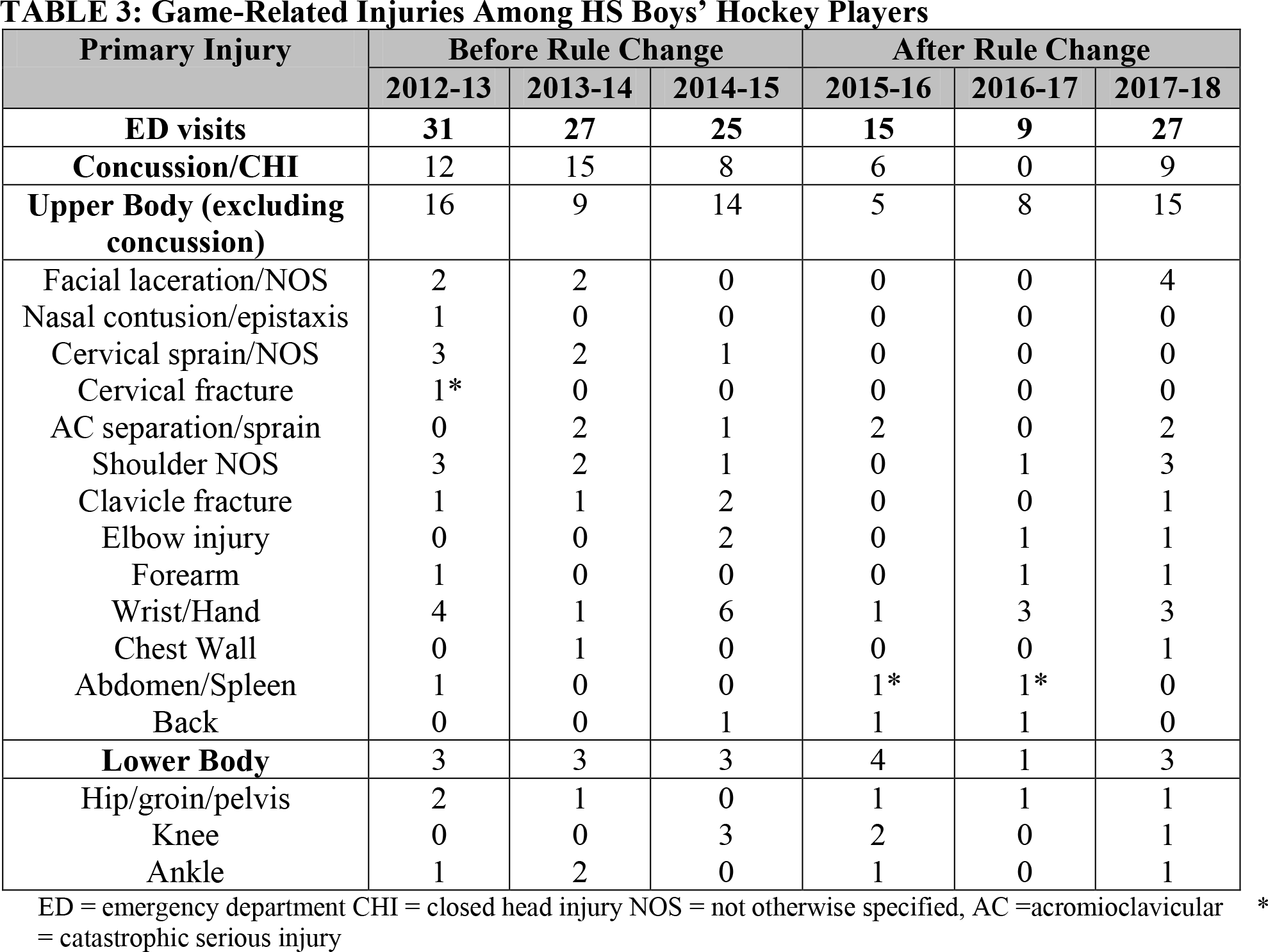
During the study period, a total of 1,762 boys’ HS varsity hockey games were played. Of 134 HS varsity game-related injuries presenting to the ED, 82 (61.2%) were attributable to body checking. Most (67.2%) injured players presented to Level I trauma centers, while 17.2% received transport by Emergency Medical Services. Regarding injury severity, 97.8% of injuries were non-catastrophic, while 2.2% were categorized as catastrophic serious (1 type 3 C2 dens fracture, non-displaced; 2 splenic lacerations, 1 requiring splenectomy). Three catastrophic serious injuries occurred, two of which occurred post-rule change (both splenic lacerations).
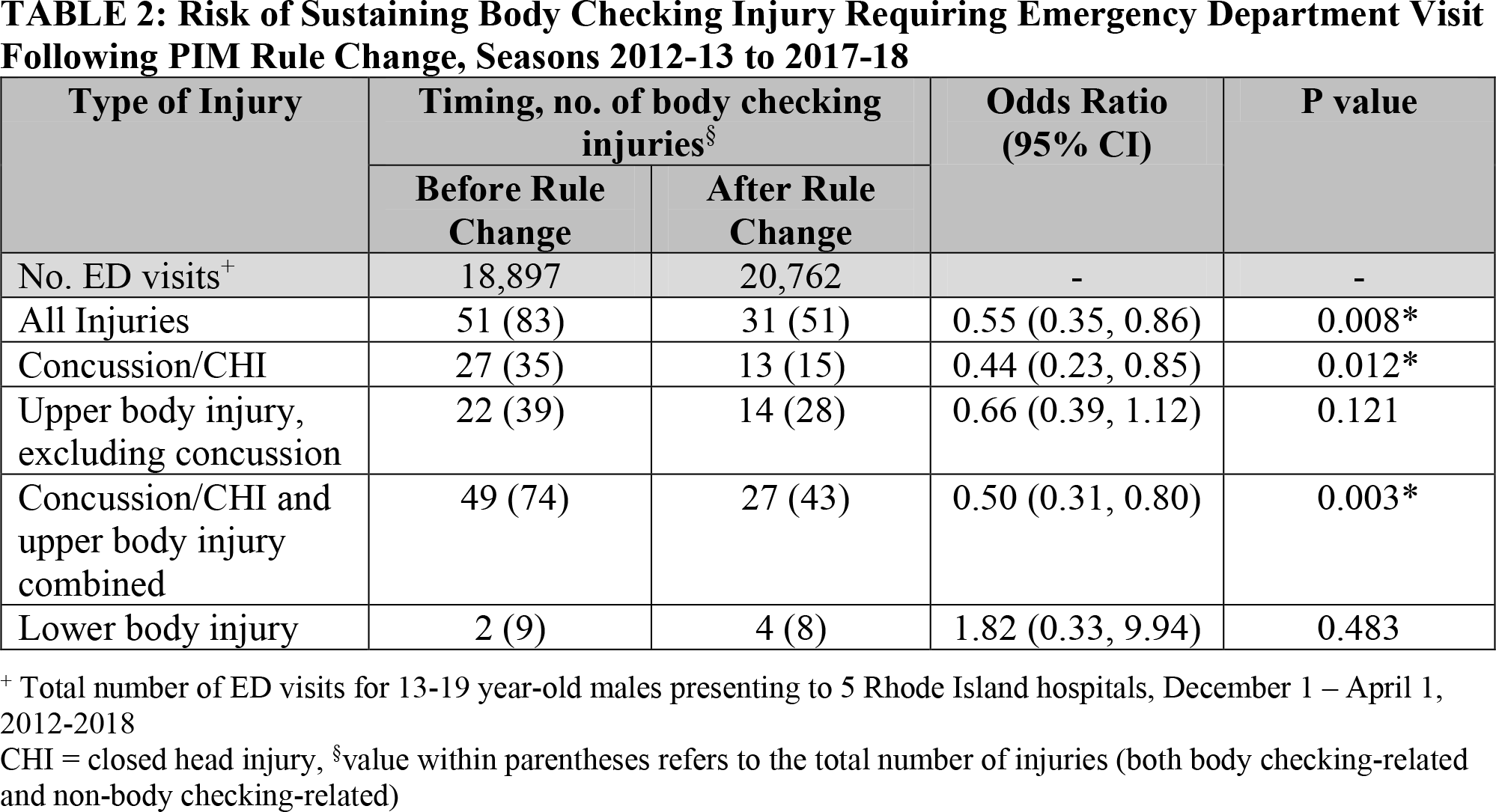
The penalty minute rule change was associated with a significant reduction in all injuries (OR 0.55; 95% CI, 0.35-0.86; P = 0.008), concussion/closed head injury (OR 0.44; 95% CI, 0.23-0.85; P = 0.012), and concussion/closed head injury and upper body injury combined (OR 0.50; 95% CI, 0.31-0.80: P = 0.003). Game disqualification penalties per season were not significantly reduced following the rule change, occurring in 5.2% of games before and 4.4% of games after the rule change (OR 0.84; 95% CI, 0.54 – 1.31; P = 0.440).
Conclusion/Significance:
Implementation of a statewide PIM restriction rule change effectively reduced the mean number of game-related injuries per season in HS boys’ hockey varsity players. To our knowledge, this is the first study to demonstrate a statistically significant reduction in concussion/closed head injury following implementation of a Fair Play rule change at any level of ice hockey. Despite implementation of strategies to reduce intent-to-harm hits in recent years, the potential for serious head, neck, and spinal injury remains in high school boys’ ice hockey as body checking remains legal. Current opinion among sports medicine experts remains that rule changes designed to reduce injury risk are among the most effective ways to decrease traumatic injuries such as concussion. Rule changes in collision sports can effectively mitigate injury risk without fundamentally changing the sport. Implementation of PIM rule change in HS boys’ ice hockey in other states/provinces would allow assessment of significance of rule mandate as it relates to injury reduction. Future research utilizing prospective, longitudinal study designs and data collection by certified athletic trainers can provide state high school associations and other governing bodies of sport essential data to develop policy changes targeting injury reduction. Our study design could be extrapolated to other high school collision sports such as football, lacrosse, and rugby to determine the effects of rule change on collision sport injury rates.
Rhode Island Interscholastic League Ice Hockey Rule Change (2015-16)*

|
Any player who has accumulated 50 or more penalty minutes will be suspended for two (2) league games and any games in between. In addition, any player who accumulates an additional 20 penalty minutes (70 or more) will be suspended for the remainder of the hockey season (including playoffs). If the player accumulates 50/70 minutes and it is the last game, he will sit out the first two (2) league games in the next year or if a senior, two (2) league games in the next sport season. Game misconduct – 10 minutes Major penalty – 5 minutes Double minor – 4 minutes Game Disqualification = 15 minutes (5-minute major and 10-minute game misconduct) Must sit out next league game and counts as a “game ejection”. 4 minor penalties = game misconduct (10 minutes) and must sit out the next league game. (Does not count as an ejection) 2 double minors = 4 minutes 2 major penalties= a game disqualification 15 minutes plus 10 minutes = 25 minutes All penalties and penalty minutes for all players must be listed on the hockey game sheet and recorded on the RIHCA website. Any player who attains 50/70 minutes in penalties must be reported to the RIIL office. If a player (who accumulates 50/70 minutes in penalties) plays without being suspended, the game will be forfeited. |
* based on a range of 18-22 games/season for boys’ high school hockey
Risk of Sustaining Body Checking Injury Requiring Emergency Department Visit Following PIM Rule Change, Seasons 2012-13 to 2017-18
| Type of Injury | Timing, no. of body checking injuries§ | Odds Ratio (95% CI) | P value | |
|---|---|---|---|---|
| Before Rule Change | After Rule Change | |||
| No. ED visits+ | 18,897 | 20,762 | - | - |
| All Injuries | 51 (83) | 31 (51) | 0.55 (0.35, 0.86) | 0.008* |
| Concussion/CHI | 27 (35) | 13 (15) | 0.44 (0.23, 0.85) | 0.012* |
| Upper body injury, excluding concussion | 22 (39) | 14 (28) | 0.66 (0.39, 1.12) | 0.121 |
| Concussion/CHI and upper body injury combined | 49 (74) | 27 (43) | 0.50 (0.31, 0.80) | 0.003* |
| Lower body injury | 2 (9) | 4 (8) | 1.82 (0.33, 9.94) | 0.483 |
+ Total number of ED visits for 13-19 year-old males presenting to 5 Rhode Island hospitals, December 1 – April 1, 2012-2018
CHI = closed head injury, §value within parentheses refers to the total number of injuries (both body checking-related and non-body checking-related)
Game-Related Injuries Among HS Boys’ Hockey Players
| Primary Injury | Before Rule Change | After Rule Change | ||||
|---|---|---|---|---|---|---|
| 2012-13 | 2013-14 | 2014-15 | 2015-16 | 2016-17 | 2017-18 | |
|
|
|
|
|
|
|
|
|
|
12 | 15 | 8 | 6 | 0 | 9 |
|
|
16 | 9 | 14 | 5 | 8 | 15 |
| Facial laceration/NOS Nasal contusion/epistaxis Cervical sprain/NOS Cervical fracture AC separation/sprain Shoulder NOS Clavicle fracture Elbow injury Forearm Wrist/Hand Chest Wall Abdomen/Spleen Back |
2 1 3 1* 0 3 1 0 1 4 0 1 0 |
2 0 2 0 2 2 1 0 0 1 1 0 0 |
0 0 1 0 1 1 2 2 0 6 0 0 1 |
0 0 0 0 2 0 0 0 0 1 0 1* 1 |
0 0 0 0 0 1 0 1 1 3 0 1* 1 |
4 0 0 0 2 3 1 1 1 3 1 0 0 |
|
|
3 | 3 | 3 | 4 | 1 | 3 |
| Hip/groin/pelvis Knee Ankle |
2 0 1 |
1 0 2 |
0 3 0 |
1 2 1 |
1 0 0 |
1 1 1 |
ED = emergency department CHI = closed head injury NOS = not otherwise specified, AC =acromioclavicular * = catastrophic serious injury
Penalty and Performance Data, Rhode Island Interscholastic League

| Variable | Before Rule Change | After Rule Change | ||||
|---|---|---|---|---|---|---|
| 2012-13 | 2013-14 | 2014-15 | 2015-16 | 2016-17 | 2017-18 | |
|
|
652 | 675 | 703 | 659 | 704 | 698 |
|
|
338 | 288 | 297 | 295 | 275 | 269 |
|
|
17 | 14 | 17 | 6 | 21 | 10 |
|
|
52 | 45 | 57 | 56 | 53 | 49 |
|
|
5 | 2 | 8 | 5 | 3 | 7 |
|
|
0 | 0 | 0 | 1 | 0 | 1 |
|
|
9 | 9 | 10 | 10 | 10 | 11 |
|
|
1913 (32) | 1775 (30) | 1791 (29) | 1672 (28) | 1547 (26) | 1626 (27) |
*Includes playoffs. Value within parentheses refers to the total number of teams

Number of Injuries and Game Disqualification Penalties, Pre-/Post-Rule Change