




Abstract
Background:
There has been a growing emphasis in orthopaedics on providing patient-centered care. The US National Institutes of Health launched the Patient-Reported Outcomes Measurement Information System (PROMIS) initiative that incorporates patient-reported outcome measures across a number of medical domains. The relationship between PROMIS domains and the impact of patient demographic factors in those undergoing upper extremity surgery remains unclear.
Purpose/Hypothesis:
The goal of this study was to investigate the correlation between physical function, pain interference, and depression in patients undergoing shoulder and elbow surgery as measured by PROMIS computer adaptive testing (CAT) forms and to determine the impact of patient demographic factors. We hypothesized that there would be a significant negative correlation between physical function and both pain interference and depression in this patient population.
Study Design:
Cross-sectional study; Level of evidence, 3.
Methods:
All patients who underwent elective shoulder or elbow surgery by 3 shoulder, elbow, and/or sports medicine fellowship–trained orthopaedic surgeons were included in the study. Preoperative PROMIS–Upper Extremity (PROMIS-UE), PROMIS–Pain Interference (PROMIS-PI), and PROMIS-Depression (PROMIS-D) CAT scores were analyzed. Pearson correlations were calculated between PROMIS domains as well as between PROMIS outcomes with patient demographic factors.
Results:
Preoperative PROMIS CAT scores for all 3 domains were collected and analyzed from 172 unique patients (516 individual CAT forms) with shoulder and elbow injuries. A negative correlation of moderate strength was found between the PROMIS-UE and PROMIS-PI (R = –0.61; P < .001), and a negligible correlation was found between the PROMIS-UE and PROMIS-D (R = –0.28; P < .001). When stratified by patient demographic factors, the correlation between the PROMIS-UE and PROMIS-PI was stronger in female patients compared with male patients (R = –0.77 vs –0.46, respectively; P < .001 for both), stronger in black patients compared with white patients (R = –0.72 vs –0.56, respectively; P < .001 for both), and highest in current tobacco users (R = –0.80; P < .001).
Conclusion:
Before shoulder and elbow surgery, patients demonstrated impairments in physical function and pain interference as measured by CAT forms, with a moderate negative correlation between baseline upper extremity physical function and pain interference scores. In certain subpopulations, such as female patients, black patients, and current tobacco users, the correlations between these tested domains were stronger than in other groups.
Recently, health care has placed a growing emphasis on providing patient-centered care. In orthopaedics, patient-reported outcome (PRO) measures have been incorporated into clinical and research applications to assess clinical outcomes from the perspective of the patient. In patients undergoing treatment for shoulder and elbow conditions, a number of different PRO measures have been validated and used. However, the variability of utilization of these particular forms has made data aggregation and standardization very challenging. 18 –21,32,33
Recently, the United States (US) National Institutes of Health launched the Patient-Reported Outcomes Measurement Information System (PROMIS) initiative. This system incorporates traditional PRO “short forms” as well as new computer adaptive testing (CAT) forms across a number of medical domains. Among patients treated for shoulder and elbow conditions, PROMIS CAT forms have demonstrated favorable psychometric profiles and shorter times required for administration compared with traditional “legacy” PRO measures. 1,4,11,12,23,30 One additional advantage with the utilization of PROMIS CAT forms is the ability to efficiently and effectively measure nonfunctional domains and association with the recovery of physical function. For example, 2 commonly utilized PROMIS CAT domains in patients with upper extremity injuries include the PROMIS–Pain Interference (PROMIS-PI) and PROMIS-Depression (PROMIS-D). 8 –11,14 Studies have demonstrated a correlation between depression and physical function in patients with upper extremity injuries. 3,9,28,29
The goal of this study was to investigate the correlation between physical function, depression, and pain interference in a cohort of patients undergoing shoulder and elbow surgery as measured by PROMIS CAT forms. The secondary goal of the study was to determine if patient demographic factors (such as age, sex, and demographic and clinical information) affect not only these scores but also the relationship between these domains. We hypothesized that there was a significant negative correlation between physical function and depression and pain interference in this patient population.
Methods
Included in this study were all patients who underwent elective shoulder or elbow surgery by 3 fellowship-trained orthopaedic surgeons in shoulder, elbow, and/or sports medicine at a multisite integrated health care system. The study period was between July and November 2017. Before surgery, patients completed an intake questionnaire assessing the location of their presenting condition, followed by 3 PROMIS CAT forms: PROMIS–Upper Extremity (PROMIS-UE), PROMIS-PI, and PROMIS-D (Table 1). Surveys were completed on a tablet computer (iPad; Apple) utilizing a secure web-based application system (REDCap; Vanderbilt University). All preoperative CAT surveys were included and retrospectively analyzed. Exclusion criteria included those who refused participation or those with the inability to read or write in English. Before survey administration, institutional review board approval was obtained from our institution.
Description of PROMIS Domains 13, a

a PROMIS, Patient-Reported Outcomes Measurement Information System.
Patient demographic factors were retrospectively collected from electronic medical records (EMRs). This included age, sex, race, ethnicity, body mass index (BMI), tobacco use, employment status, estimated median household income (MHI), and diagnosis and chronicity of the upper extremity injury. Each patient was documented as a never, current, or former tobacco user. If patients had recorded employment in their EMR, they received an employed designation, while those without documented employment received a designation of “unknown.” Utilizing the US Census Bureau website for MHI estimations (https://factfinder.census.gov/faces/nav/jsf/pages/community_facts.xhtml?src=bkmk) and the patient’s ZIP code, an estimated MHI value was assigned to each patient. The upper extremity diagnosis and chronicity were evaluated utilizing the medical record and date of the preoperative appointment. A diagnosis of ≤6 weeks was considered acute, while that of >6 weeks was considered chronic.
Statistical Analysis
Using Stata version 14 (StataCorp), 1-way analyses of variance and independent t tests were utilized for the comparison of PROMIS domains by patient demographic factors. Pearson correlations were calculated between PROMIS domains as well as between PROMIS outcomes with patient age, BMI, and MHI. Correlation coefficients were categorized by strength: 0.00-0.30 (negligible), 0.31-0.50 (weak), 0.51-0.70 (moderate), 0.71-0.90 (strong), and 0.91-1.00 (very strong). 24 A P value of ≤.05 denoted statistical significance. All statistical analyses were conducted by a trained psychometrician. The Benjamini-Hochberg method was employed on all generated P values from the analyses of variance, t tests, and correlations to control for type I errors as a result of running multiple tests. The significance of all values did not change after correction.
Results
Preoperative PROMIS CAT scores for all 3 of the study domains were collected and analyzed from 172 unique patients with shoulder and elbow injuries, for a total of 172 questionnaire sets (516 individual CAT forms). The demographics of the patient cohort are described in Table 2. The mean age of the patients surveyed was 54.0 ± 17.9 years (range, 14-90 years) with a male predominance (60%). The mean BMI and estimated MHI of the cohort were 30.0 ± 6.2 mg/kg2 (range, 19.3-51.2 mg/kg2) and US$64,596 ± US$25,262 (range, US$21,415-US$157,536), respectively. Moreover, 70% (n = 120) of the patients identified as white and 83% (n = 143) as non-Hispanic or Latino. Additionally, 44% (n = 75) of the questionnaire sets were completed by patients with documented employment, and a majority of patients had never been tobacco users (56%). The most frequent presenting diagnoses were rotator cuff injuries (54%), followed by osteoarthritis and instability/labrum injuries of the shoulder (Table 3). A total of 23 patients presented for an elbow-related condition, with the most frequent diagnoses being distal biceps injuries (n = 4) and lateral epicondylitis (n = 3).
Patient Demographic Characteristics (N = 172) a

a Values are expressed as n (%) unless otherwise indicated. BMI, body mass index; MHI, median household income.
Most Common Preoperative Diagnoses a

a Values are expressed as n (%).
The number of questions completed per PROMIS domain is shown in Table 4. The PROMIS-D required the most questions (6.1 ± 3.3), followed by the PROMIS-UE and PROMIS-PI.
Number of Questions Required for PROMIS CAT Forms a
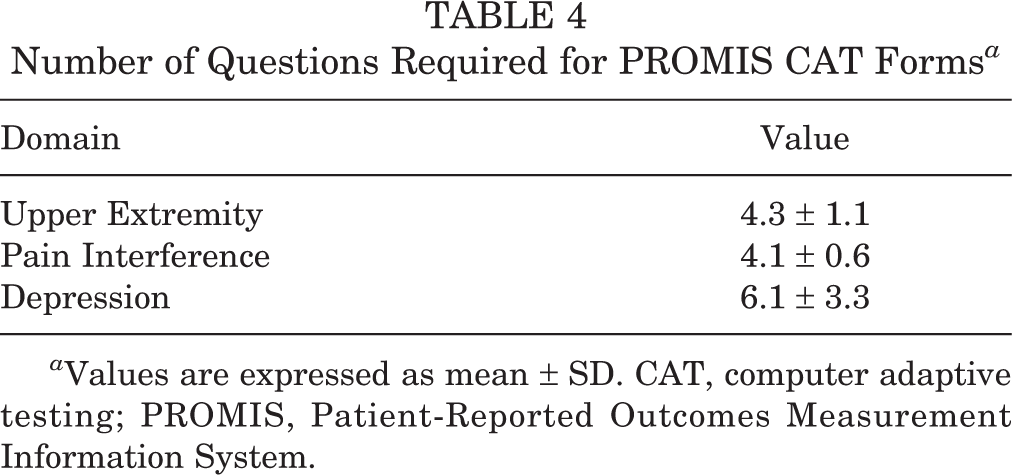
a Values are expressed as mean ± SD. CAT, computer adaptive testing; PROMIS, Patient-Reported Outcomes Measurement Information System.
Table 5 summarizes PROMIS correlations as each domain relates to one another as well as to patient age, BMI, and MHI. The PROMIS-UE was found to have a moderate negative correlation with the PROMIS-PI (R = –0.61; P < .001) and negligible negative correlations with the PROMIS-D (R = –0.28; P < .001) and patient age (R = –0.19; P < .05). The PROMIS-PI was weakly correlated with the PROMIS-D (R = 0.33; P < .001). The PROMIS-D was found to have a statistically significant but negligible correlation with patient age (R = 0.17; P < .05). All PROMIS domains were found to have nonsignificant correlations with patient BMI and MHI.
Correlations Between PROMIS Domains a

a BMI, body mass index; MHI, median household income; PROMIS, Patient-Reported Outcomes Measurement Information System; PROMIS-D, PROMIS-Depression; PROMIS-PI, PROMIS–Pain Interference; PROMIS-UE, PROMIS–Upper Extremity.
b Denotes a statistically significant finding (P ≤ .05).
Male patients were found to have higher PROMIS-UE scores when compared with female patients (31.6 vs 26.9, respectively; P < .001) while having lower PROMIS-PI scores (61.3 vs 64.8, respectively; P < .001). The PROMIS-D was found to differ by age quartile, with the youngest patients (14-43 years) having the lowest scores (P < .05). Those with acute diagnoses were found to have higher PROMIS-UE scores than those with chronic diseases (30.6 vs 27.9, respectively; P < .05). There were no statistically significant differences in baseline PROMIS-UE, PROMIS-PI, or PROMIS-D scores by patient race, tobacco use, BMI quartile, or MHI quartile. These outcome scores are presented in Table 6.
Impact of Patient Demographic Factors on PROMIS a

a Values are expressed as mean ± SD unless otherwise indicated. BMI, body mass index; MHI, median household income; PROMIS, Patient-Reported Outcomes Measurement Information System; PROMIS-D, PROMIS-Depression; PROMIS-PI, PROMIS-Pain Interference; PROMIS-UE, PROMIS–Upper Extremity.
b Denotes a statistically significant finding (P ≤ .05).
When stratified by patient sex, the PROMIS-UE was found to be strongly negatively correlated with the PROMIS-PI in female patients (R = –0.77; P < .001) while only weakly correlated in male patients (R = –0.46; P < .001). The PROMIS-PI and PROMIS-D were weakly correlated in female patients (R = 0.35; P < .01) and had a negligible correlation in male patients (R = 0.29; P < .01). The correlation between the PROMIS-UE and PROMIS-D was negligible in male patients (R = –0.28; P = .002) and female patients (R = –0.22; P = .04).
With regard to racial background, white patients had a moderate negative correlation between the PROMIS-UE and PROMIS-PI (R = –0.56; P < .001) (Table 7). This correlation was strong in black patients and those of other or unknown race (R = –0.72 and R = –0.75, respectively; P < .001). White patients were the only race found to have statistically significant correlations between the PROMIS-UE and PROMIS-D (R = –0.37; P < .001) and between the PROMIS-PI and PROMIS-D (R = 0.41; P < .001).
Current tobacco users were found to have a strong negative correlation between the PROMIS-UE and PROMIS-PI (R = –0.80; P < .001). This correlation was of moderate strength in former and never tobacco users (R = –0.66 and R = –0.51, respectively; P < .001). Furthermore, when stratified by tobacco use, current users were found to have a moderate negative correlation between the PROMIS-UE and PROMIS-D (R = –0.60; P < .01) and a strong positive correlation between the PROMIS-PI and PROMIS-D (R = 0.78; P < .001). This correlation between the PROMIS-UE and PROMIS-D was found to be nonsignificant in former tobacco users and negligible in never tobacco users (R = –0.23; P = .01). The correlation between the PROMIS-PI and PROMIS-D was negligible in both former and never tobacco users (R = 0.24; P = .04 and R = 0.21; P = .02, respectively).
Those patients with an acute diagnosis had a moderate negative correlation between the PROMIS-UE and PROMIS-PI (R = –0.62; P < .001) and a weak positive correlation between the PROMIS-PI and PROMIS-D (R = 0.34; P < .001). Those with a chronic diagnosis were found to have weak correlations between the PROMIS-UE and PROMIS-PI (R = –0.49; P < .001) and between the PROMIS-UE and PROMIS-D (R = –0.33; P < .05).
Correlations Between PROMIS Domains Stratified by Patient Demographic Factors a

a PROMIS, Patient-Reported Outcomes Measurement Information System; PROMIS-D, PROMIS-Depression; PROMIS-PI, PROMIS–Pain Interference; PROMIS-UE, PROMIS–Upper Extremity.
b Denotes a statistically significant finding (P ≤ .05).
Discussion
In patients undergoing shoulder and elbow surgery, there was a negative correlation between upper extremity physical function and pain interference as demonstrated by PROMIS CAT scores. This correlation was strongest in female patients, nonwhite patients, and current tobacco users. Current tobacco users were also found to have a strong correlation between the PROMIS-PI and PROMIS-D.
Our original study hypothesis was that significant negative correlations would be found between the PROMIS-UE and PROMIS-PI as well as between the PROMIS-UE and PROMIS-D. Negative correlations of statistical significance were found between these domains; however, the correlation between the PROMIS-UE and PROMIS-D was of negligible strength. In this patient population, the correlation between the PROMIS-UE and PROMIS-PI was –0.61 (moderate strength), while the correlation between the PROMIS-UE and PROMIS-D was –0.28 (negligible).
The correlation we found between the PROMIS-UE and PROMIS-PI was similar to that previously reported in patients with upper extremity injuries (R = –0.60 and –0.65, respectively). 11,16 However, aiming for more generalizable results, those studies included all new, returning, and postoperative patients. The relationship between upper extremity physical function and depression found in our study is unlike previous reports that found depression and patient distress to negatively affect preoperative PROs in patients with rotator cuff injuries. 7,27 Those studies utilized legacy measures rather than PROMIS CAT forms and focused on a single corrective operative procedure. In an evaluation of PROMIS CAT forms in a patient population with upper extremity injuries, Overbeek et al 26 found a weak negative correlation (R = –0.35) between the PROMIS–Physical Function (PROMIS-PF) and PROMIS-D, and Beleckas et al 6 found that only 9.5% of patients with upper extremity injuries exceeded the depression symptom threshold as measured by PROMIS CAT forms. Unlike the study by Overbeek et al, 26 our study utilized the PROMIS-UE, a physical function measure specific for upper extremity musculoskeletal conditions, rather than the PROMIS-PF. Our findings suggest a possible limited relationship between preoperative upper extremity physical function and depression in patients with shoulder and elbow injuries.
In addition to the standardization of a PRO collection system, the appeal of the PROMIS lies partly in the user-friendly interpretation of its scoring. Outcomes are standardized across a reference population in which all domains have a mean score of 50 points with a standard deviation of 10 points. Our study was useful in establishing preoperative values of PROMIS CAT scores in patients undergoing shoulder and elbow surgery. In this cohort, the mean PROMIS-UE score was just over 2 SDs lower than the reference population (28.9), while the mean PROMIS-PI score was over 1 SD higher (62.6). These values were similar to those previously published in patients with upper extremity injuries, with PROMIS-UE scores ranging from 34 to 37 and PROMIS-PI scores ranging from 57 to 59. 5,11,16 Baseline PROMIS-UE and PROMIS-PI scores in our study showed higher impairment, as only preoperative scores were considered, which provides a clearer picture of what an impaired patient with upper extremity injuries may demonstrate compared with the other cross-sectional correlation studies. The mean PROMIS-D score in this cohort was 48.4, approximately the mean score across the normative population and similar to previously reported PROMIS-D outcomes in patients with upper extremity injuries. 6
When taking into consideration the influence of patient characteristic factors on baseline PROMIS outcomes and correlations, female patients had lower PROMIS-UE scores compared with male patients (26.9 vs 31.6, respectively), a difference previously found nonsignificant (P = .08) in an analysis of 84 patients with operative and nonoperative upper extremity injuries. 11 At the same time, our study found female patients to have higher PROMIS-PI scores compared with male patients (64.8 vs 61.3, respectively). This is not the first suggestion of a sex-based difference in patient-reported pain. In a recent analysis of patients after arthroscopic knee surgery, despite having lower inflammatory markers as measured by synovial fluid analysis, female patients reported higher pain severity on a visual analog scale. 31 In patients undergoing rotator cuff surgery, Razmjou et al 28 reported lower outcomes on the Western Ontario Rotator Cuff Index evaluating emotion in female patients compared with male patients. We found the correlation between the PROMIS-UE and PROMIS-PI to be stronger in female patients (R = –0.77) compared with male patients (R = –0.46).
Similar to the differences when stratified by sex, racial distinctions in PROMIS outcomes were noted, with lower preoperative PROMIS-UE scores (28.8 vs 30.2, respectively), higher preoperative PROMIS-PI scores (64.6 vs 62.1, respectively), and a stronger correlation between these 2 domains (R = –0.72 vs –0.56, respectively) in black patients compared with white patients. Additionally, stronger correlations were seen across all PROMIS domains in current compared with never and former tobacco users. Surgeons should be aware of the higher baseline pain interference scores and amplified correlations in these populations. While the postoperative recovery trajectory is unknown, we do see higher impairment preoperatively in these select patient populations.
Understanding preoperative PROMIS scores and the relationship between domains provides useful insight into the patient burden of upper extremity injuries. Specifically, awareness of the impact of sex, race, and tobacco use on physical function and pain interference in patients undergoing upper extremity surgery can help guide preoperative decision making and patient counseling. This information, combined with the practicality and efficiency of collection, demonstrates the utility of PROMIS CAT forms in this patient population. 15,17
Limitations
Our study does have limitations. We did not include traditional “legacy” PRO measures or objective metrics in our outcome reporting. Several prior studies have already demonstrated a good correlation between PROMIS physical function scores and these legacy PRO measures. 1,2,4,12,16,22,23 Second, baseline MHI data were estimated based on the patient’s ZIP code of residence. These aggregate income data are commonly used because household income is not commonly reported in the EMR. 25 Third, only the English-language version of PROMIS CAT forms were utilized. Our study also included a high number of patients of unknown employment status with limited ethnic group representation. Therefore, the study may not be generalizable to non–English-speaking populations, those of varying degrees of employment, or a nonrepresented ethnic group. However, wide socioeconomic diversity was seen in this study, as reported by estimated baseline MHI data, which does improve the generalizability of the study across a diverse patient population. Finally, there was no standardized technique in survey administration. In our practice, a tablet computer is provided to the patient to complete before the clinical evaluation. We afford patient flexibility in how they answer the questions on the tablet with respect to assistance from friends or family members who accompany them to the visit. Therefore, it is possible that some patients may have received additional assistance in completing the PROMIS forms.
Conclusion
Before shoulder and elbow surgery, patients demonstrated impairments in physical function and pain interference as measured by PROMIS CAT forms, with a moderate negative correlation between baseline upper extremity physical function and pain interference scores. In certain subpopulations, such as female patients, black patients, and current tobacco users, the correlations between these tested domains were stronger than in other groups.
Footnotes
One or more of the authors declared the following potential conflict of interest or source of funding: S.M. has received consulting fees from DePuy and Exactech; educational support from Arthrex; and hospitality payments from Conventus Orthopaedics, Smith & Nephew, Tornier, and Zimmer Biomet. V.M. has received educational support from Arthrex and Pinnacle and hospitality payments from Stryker. E.C.M. has received educational support from Pinnacle and Smith & Nephew, hospitality payments from Stryker, and publishing royalties from Springer. AOSSM checks author disclosures against the Open Payments Database (OPD). AOSSM has not conducted an independent investigation on the OPD and disclaims any liability or responsibility relating thereto.
Ethical approval for this study was obtained from the Henry Ford Health System Institutional Review Board (No. 10820).