




Abstract
Background:
Use of the Patient-Reported Outcomes Measurement Information System (PROMIS) instrument has not yet been validated in patients undergoing operative treatment for patellofemoral malalignment and chondral disease.
Purpose:
To evaluate the PROMIS Physical Function Computer Adaptive Testing (PF CAT) instrument in a population of patients with patellofemoral malalignment and chondral disease relative to established patient-reported outcome (PRO) instruments.
Study Design:
Cohort study (diagnosis); Level of evidence, 2.
Methods:
Eligible patients were prospectively enrolled at the time of indication for surgery and completed 5 PRO instruments preoperatively: 36-Item Short Form Health Survey (SF-36); Western Ontario and McMaster Universities Osteoarthritis Index (WOMAC); Marx activity rating scale (Marx); EuroQol 5-dimension, 5-level instrument (EQ-5D-5L); and PROMIS PF CAT. Convergent and discriminant validity was assessed by measuring correlations between PROMIS PF CAT and other PRO instruments, including the Knee injury and Osteoarthritis Outcome Score (KOOS). Strength of correlation was measured by use of Spearman correlation coefficients.
Results:
In total, 37 patients (40 knees) were enrolled in the study. All knees underwent Fulkerson osteotomy and concomitant cartilage procedure (29 chondroplasty, 6 allograft, 5 microfracture). Mean patient age was 33.4 years, and 73% of knees were in female patients. Correlations (r) between PROMIS PF CAT and knee PRO instruments were as follows: SF-36 PF (r = 0.80; P < .01); KOOS Pain (r = 0.74; P < .01); KOOS Symptoms (r = 0.47; P < .01); KOOS Quality of Life (r = 0.68; P < .01); KOOS Sports and Recreation (r = 0.72; P < .01); KOOS Activities of Daily Living (ADL) (r = 0.80; P < .01); WOMAC Function (r = 0.80; P < .01); WOMAC Pain (r = 0.72; P < .01); WOMAC Stiffness (r = 0.38; P = .02); Marx (r = 0.22; P = .31); and EQ-5D-5L (r = 0.72; P < .01). Neither floor nor ceiling effects were observed in PROMIS PF CAT or KOOS ADL. Mean (±SD) question burden with PROMIS PF CAT was 5.6 ± 0.6 questions.
Conclusion:
In patients with patellofemoral malalignment and chondral disease, PROMIS PF CAT is an efficient and reliable PRO instrument to preoperatively assess patients across a spectrum of knee function without floor or ceiling effects.
Patellofemoral malalignment is often associated with chondral damage and resultant anterior knee pain that significantly limits activity. 5,8,26 Additionally, patients with patellofemoral malalignment experience abnormal joint contact and chondral stresses within the patellofemoral compartment. 3,9,10,17,19 In patients with excessive lateralization of the tibial tubercle, tibial tubercle osteotomy aims to correct malalignment and can be performed in conjunction with cartilage restoration or repair procedures. 26
Numerous patient-reported outcome (PRO) instruments exist for examining general health and daily function as well as pain, disability, and joint-specific function 1,2,4,7,11,20,23,25,28 (Table 1). Such instruments are useful in assessing a patient’s perceived functional capacity, symptom burden, and overall quality of life. 1,2,4,7,11,20,23,25,28 However, numerous barriers to completion of PROs exist, including paper administration, instrument complexity, and increasing question burden. 11,16,24 In 2004, the National Institutes of Health established the Patient-Reported Outcomes Measurement Information System (PROMIS) 21 in order to develop more standardized PROs. PROMIS instruments may be administered via a computer adaptive test (CAT) in which 4 to 12 questions are drawn from a central question bank of 121 questions (PROMIS Physical Function [PF] CAT v 1.2) or 165 questions (PROMIS PF CAT v 2.0). Electronic administration and reduction of question burden are factors demonstrated to improve completion rates of PROs; PROMIS CAT uses both factors. 6,11,15,16,24
Patient-Reported Outcome Instruments Commonly Used in Patients With Knee Pain or Abnormality a
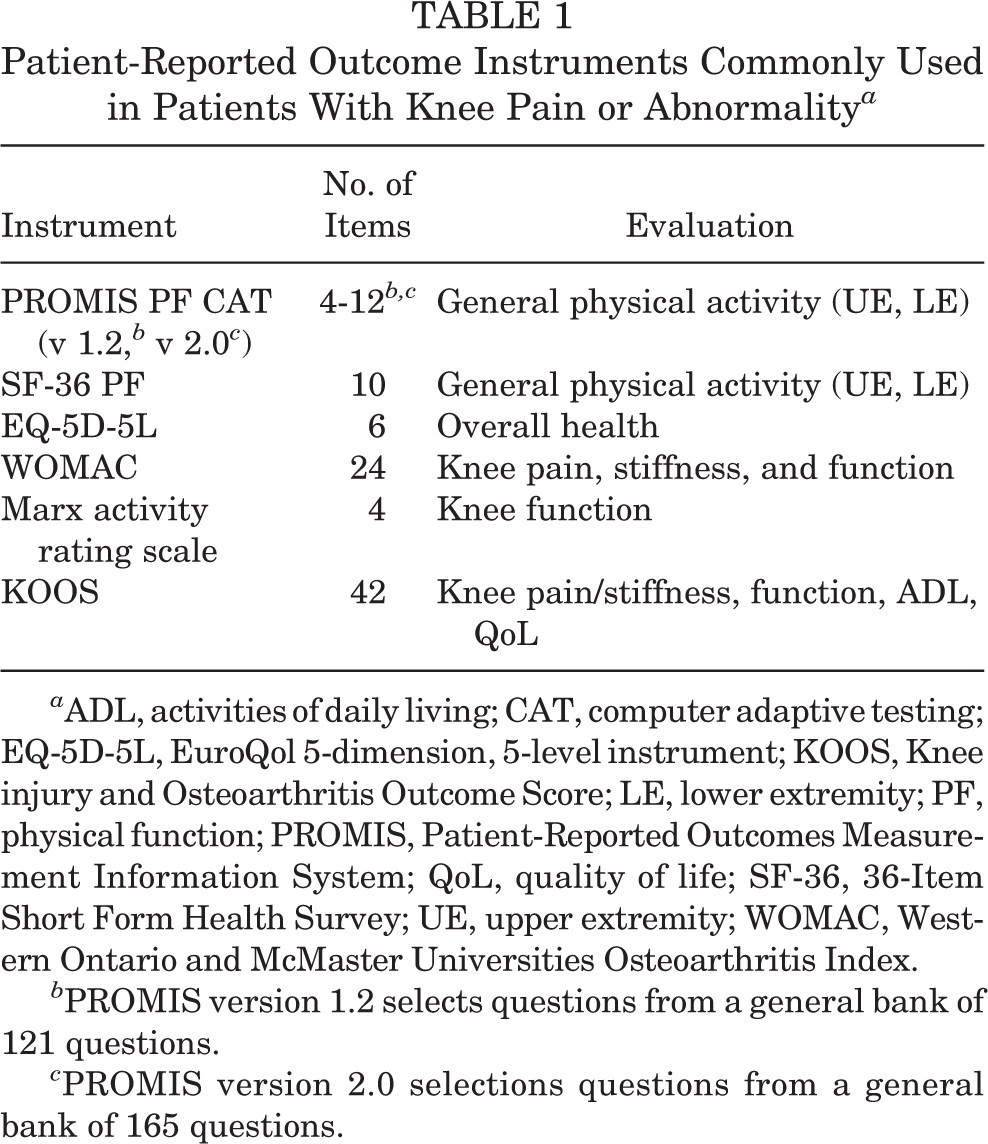
a ADL, activities of daily living; CAT, computer adaptive testing; EQ-5D-5L, EuroQol 5-dimension, 5-level instrument; KOOS, Knee injury and Osteoarthritis Outcome Score; LE, lower extremity; PF, physical function; PROMIS, Patient-Reported Outcomes Measurement Information System; QoL, quality of life; SF-36, 36-Item Short Form Health Survey; UE, upper extremity; WOMAC, Western Ontario and McMaster Universities Osteoarthritis Index.
b PROMIS version 1.2 selects questions from a general bank of 121 questions.
c PROMIS version 2.0 selections questions from a general bank of 165 questions.
Although PROMIS PF CAT has been proven to be an efficient outcome tool and validated for a variety of upper and lower extremity musculoskeletal conditions, 1,2,7,11,22,25 it has not been validated in patients undergoing surgical intervention for patellar malalignment. The purpose of this study was to investigate the PROMIS PF CAT instrument in patients undergoing patellar realignment surgery with concomitant cartilage procedures. We hypothesized that (1) PROMIS PF CAT would have high levels of correlation with established knee PRO instruments, (2) completion of PROMIS PF CAT would require fewer total items relative to completion of established knee PRO instruments, and (3) minimal floor and ceiling effects would be observed in PROMIS PF CAT.
Methods
Patients were prospectively enrolled in the study at the time of surgical indication at our clinic. Patients were eligible for study enrollment if they were older than 18 years and scheduled to undergo tibial tubercle osteotomy and patellofemoral cartilage procedure (chondroplasty, juvenile particulated cartilage allograft, or microfracture). These procedures were performed by 1 of 5 board-certified, sports medicine fellowship–trained orthopaedic surgeons. Patellofemoral chondral lesions were identified on preoperative magnetic resonance imaging studies. All patients were indicated for cartilage procedures prior to surgery. Patellofemoral malalignment was diagnosed by physical examination and with use of the tibial tubercle–trochlear groove distance and Caton-Deschamps index on preoperative imaging. Patients with the primary issue of patellofemoral instability based on physical examination and/or those indicated for medial patellofemoral ligament reconstruction were excluded from the study. Patients undergoing concomitant anterior cruciate ligament (ACL) reconstructions were also excluded from the study.
Enrolled patients completed a total of 5 preoperative PRO instruments via a computer kiosk: 36-Item Short Form Health Survey (SF-36), 20,28 specifically the Physical Function subscale (SF-36 PF); Western Ontario and McMaster Universities Osteoarthritis Index (WOMAC) 4 ; Marx activity rating scale 18 ; EuroQol 5-dimension, 5-level instrument (EQ-5D-5L) 14 ; and PROMIS PF CAT (v 1.2 or v 2.0). The order of instrument administration was randomized between participants. Of note, PROMIS PF CAT version 2.0 was released during the study period, and the decision was made to transition from version 1.2 to version 2.0 as soon as it was available. Per the administration manual for the PROMIS PF, scores from version 1.2 are comparable with scores from version 2.0, with differences in T-score points being negligible. 13 Knee injury and Osteoarthritis Outcome Score (KOOS) results were derived from patient responses to the administered WOMAC instrument 23 and were subdivided into the following categories: KOOS Quality of Life, KOOS Activities of Daily Living (ADL), KOOS Pain, KOOS Symptoms, and KOOS Sports and Recreation. Collected patient data included age, sex, date of surgery, body mass index (BMI), and smoking status.
An a priori power analysis for a 2-tailed test with α and β set at 0.05 and 80%, respectively, demonstrated that 40 knees would be needed to detect a difference between correlations of moderate (0.6) and weak (0.2) strengths. Descriptive statistical analysis was performed. Shapiro-Wilk tests were performed on all study variables to assess for the presence of normality. Convergent and discriminant validity was assessed by measuring correlation between PROMIS PF CAT and other PRO instruments. Strength of correlation between PRO instruments was measured by use of Spearman correlation coefficients. Correlation strength was categorized as follows: high (≥0.7), high-moderate (0.61-0.69), moderate (0.4-0.6), moderate-weak (0.31-0.39), and weak (≤0.3). 11,12 Floor and ceiling effects were defined in accordance with previous studies, with effect being present if more than 15% of respondents scored the highest (ceiling) or lowest (floor) possible score for physical function PRO instruments. 1,2,11,12,27 Statistical significance was set to P < .05. Statistical software (SAS version 9.4; SAS Institute Inc) was used for statistical analysis.
Results
In total, 37 patients (40 knees) were enrolled in the study. All knees underwent a Fulkerson osteotomy and a concomitant cartilage procedure (29 chondroplasty, 6 juvenile particulated chondral allograft, 5 microfracture). Within the cohort, 29 knees were in female patients (73%), and the mean (±SD) patient age was 33.4 ± 11.1 years. Mean (±SD) BMI was 31.6 ± 7.8 kg/m2. Of the participants enrolled in the study, 22% were current smokers, 14% were former smokers, and 64% were nonsmokers. During administration of the PROMIS PF CAT, a mean (±SD) of 5.6 ± 0.6 items were administered. Mean T score of the PROMIS PF CAT was 40.7 (range, 24.5-57.8; SE, 3.4).
The Spearman rank correlation coefficients (r) between PROMIS PF CAT and the established knee PRO instruments are demonstrated in Table 2.
Correlation Between PROMIS PF CAT and Established Knee Patient-Reported Outcome Instruments a
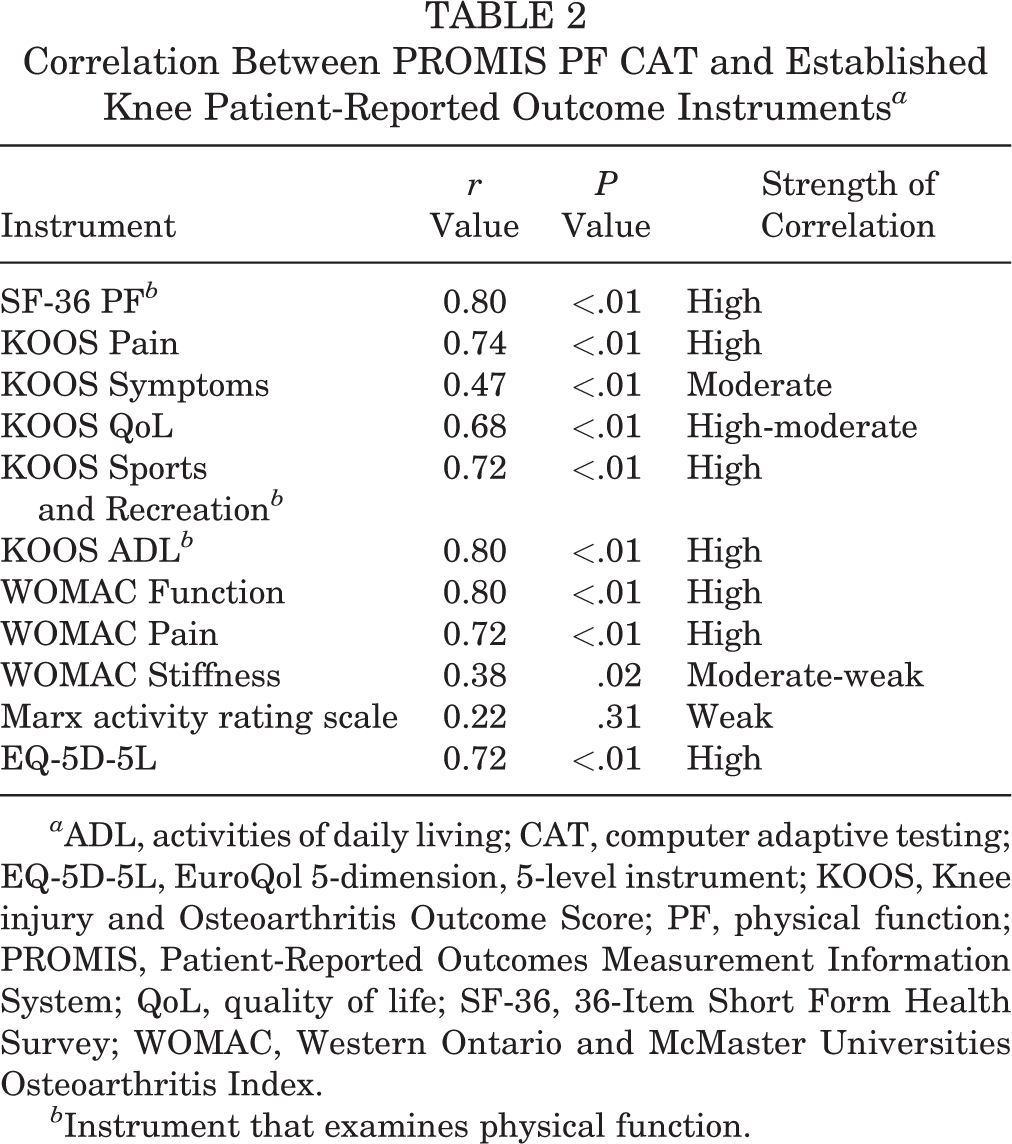
a ADL, activities of daily living; CAT, computer adaptive testing; EQ-5D-5L, EuroQol 5-dimension, 5-level instrument; KOOS, Knee injury and Osteoarthritis Outcome Score; PF, physical function; PROMIS, Patient-Reported Outcomes Measurement Information System; QoL, quality of life; SF-36, 36-Item Short Form Health Survey; WOMAC, Western Ontario and McMaster Universities Osteoarthritis Index.
b Instrument that examines physical function.
Floor and ceiling effects were measured for the PRO instruments examining physical function, including PROMIS PF CAT, SF-36 PF, KOOS Sports and Recreation, and KOOS ADL. Neither floor nor ceiling effects were observed in PROMIS PF CAT or KOOS ADL. We observed 1 instance (2.2%) of floor effect in the SF-36 PF instrument and 8 instances of ceiling effect (20.0%) in the KOOS Sports and Recreation instrument (Table 3).
Floor and Ceiling Effects in Patient-Reported Outcome Instruments Examining Physical Function a

a ADL, activities of daily living; CAT, computer adaptive testing; KOOS, Knee injury and Osteoarthritis Outcome Score; PF, physical function; PROMIS, Patient-Reported Outcomes Measurement Information System; SF-36, 36-Item Short Form Health Survey.
Discussion
Data from the present study suggest that the PROMIS PF CAT instrument strongly correlates with scores from previously established PRO instruments examining knee abnormality in patients with patellofemoral chondral lesions and malalignment. Additionally, PROMIS PF CAT demonstrates a decreased question burden relative to other PRO instruments, with a mean (±SD) of 5.6 ± 0.6 items necessary for completion versus a range of 4 to 42 items necessary for completion of established PRO instruments. PROMIS PF CAT also demonstrated no floor or ceiling effect, in contrast to the SF-36 PF and KOOS Sports and Recreation instruments. PROMIS PF CAT is a valid functional outcome instrument in patients with patellofemoral malalignment and associated chondral disease.
High to high-moderate correlations were observed between PROMIS PF CAT and the majority of the knee PRO instruments studied. PRO instruments with moderate to weak correlation with PROMIS PF CAT included KOOS Symptoms, WOMAC Stiffness, and Marx activity rating scale. Notably, none of these PRO instruments specifically examine physical function. Conversely, all PRO instruments examining physical function (SF-36 PF, KOOS Sports and Recreation, KOOS ADL) demonstrated high correlation with PROMIS PF CAT. Hancock et al 11,12 demonstrated a similar trend of high correlation between PROMIS PF CAT and other PRO instruments that included physical function components among a cohort of otherwise healthy patients undergoing meniscal surgery and ACL reconstruction. In both studies, the authors concluded that the PROMIS PF CAT maintains construct validity without sacrificing clinical relevance and while allowing decreased question burden. The results of the present study are in agreement with these findings, providing further evidence that PROMIS PF CAT is a valid measure of knee-specific function in patients with patellofemoral malalignment and patellofemoral chondral disease.
Hung et al 15 demonstrated an average time of 44 seconds required for a cohort of orthopaedic trauma patients to complete 4 items of the PROMIS PF CAT. In the same study, it took patients approximately 10 minutes to complete the short Musculoskeletal Functional Assessment (sMFA), a 46-item instrument. The authors found no difference in reliability between the 2 measures. 15 Although the sMFA was not examined in this study, instruments of similar length, including KOOS, were examined. As clinical volume increases, the need for reliable PRO measures will not be lost; however, greater priority may be given to more efficient instruments. In the present study, patients answered a mean (±SD) of 5.6 ± 0.6 items to complete the PROMIS PF CAT. Other instruments require answering 4 to 42 items for completion. The present study is in agreement with findings of previous studies 11,12 which noted that PROMIS PF CAT is a much more efficient instrument to administer relative to KOOS (42 items) or SF-36 PF (10 items), while maintaining a high degree of reliability and correlation relative to other knee PRO instruments.
In concordance with previous studies, 11,12,15 we found no floor or ceiling effects with the PROMIS PF CAT. Illustration of floor and ceiling effects is important to determine the ability of an instrument to assess patients over a spectrum of function as well as to accurately measure change over time. 15 Floor effect was not observed in the PROMIS PF CAT, KOOS ADL, or KOOS Sports and Recreation instruments. Ceiling effect was not observed in the PROMIS PF CAT, SF-36 PF, or KOOS ADL instruments. Ceiling effect was observed in the KOOS Sports and Recreation instrument, suggesting poorer levels of instrument coverage at higher levels of knee function. Scott et al 25 also demonstrated a high ceiling effect rate with the KOOS Sports and Recreation instrument in a cohort of patients who underwent ACL reconstruction. The current study suggests that the PROMIS PF CAT is a precise PRO instrument at all levels of knee physical function and is without ceiling effect even in populations of otherwise healthy patients with patellofemoral abnormality.
This study has several limitations. The study population was limited to patients with patellofemoral chondral lesions and malalignment and cannot be generalized to patients with patellofemoral instability or other patellofemoral abnormality. Although the sample size of the study was deemed sufficient to provide appropriate power, the sample size is smaller than in similar studies evaluating the preoperative performance of PROMIS PF CAT in patients with knee abnormality. 11,12,25 Further, time to complete the PROMIS PF CAT or the other PRO instruments was not assessed in this study. Instead, the average number of items required for completion of PROMIS PF CAT was recorded. Using the number of items necessary for completion instead of overall time to completion limits the influence of interruptions during instrument completion, as instruments were administered as part of a busy clinic visit. Although the lack of floor and ceiling effect during PROMIS PF CAT administration suggests a sensitivity to change in instrument scores over time, patients in this study were examined at only a preoperative time point, and the actual performance of PROMIS PF CAT at multiple time points (including postoperatively) for patients with patellofemoral abnormality is unknown. Last, we were unable to assess the performance of PROMIS PF CAT against Kujala scores, a previously validated PRO specific to patellofemoral abnormality.
Conclusion
In patients with patellofemoral malalignment and chondral disease, PROMIS PF CAT is an efficient and reliable PRO instrument that is able to assess patients across a wide range of knee function. Use of PROMIS PF CAT may allow for quicker assessment of patients while maintaining a high degree of correlation with established PRO instruments. PROMIS PF CAT demonstrated no floor or ceiling effect in the selected patient population, making it a valuable tool for assessing patients with various activity and functional levels.
Footnotes
One or more of the authors has declared the following potential conflict of interest or source of funding: M.J.B. has received nonconsulting fees from Arthrex. B.R.W. has received nonconsulting fees from Arthrex and Smith & Nephew, is a paid consultant for ConMed Linvatec, has received research support from the OREF, has received educational support from Wardlow Enterprises, and has received hospitality payments from Arthrex and ConMed Linvatec. K.R.D. has received educational support from Smith & Nephew and has grants/grants pending from DJO. R.W.W. has received educational support from Smith & Nephew and has received hospitality payments from Medical Device Business Services. AOSSM checks author disclosures against the Open Payments Database (OPD). AOSSM has not conducted an independent investigation on the OPD and disclaims any liability or responsibility relating thereto.
Ethical approval for this study was waived by the University of Iowa Human Subjects Office/Institutional Review Board.