




Abstract
We read with interest the article titled “Fixed- Versus Adjustable-Loop Femoral Cortical Suspension Devices for Anterior Cruciate Ligament Reconstruction: A Systematic Review and Meta-analysis of Biomechanical Studies,” 3 which was published in the October 2018 issue of The Orthopaedic Journal of Sports Medicine. First, we congratulate the authors for publishing their study in this journal. Second, we would like to express some of our opinions on their article.
We note some deficiencies in this study regarding the aspect of literature retrieval. In their review, the authors searched only 3 databases. The deadline for the literature search was November 20, 2017. So, why did this meta-analysis include a study 1 published in 2018? If the authors searched unpublished studies such as gray literature, this should be further clarified.
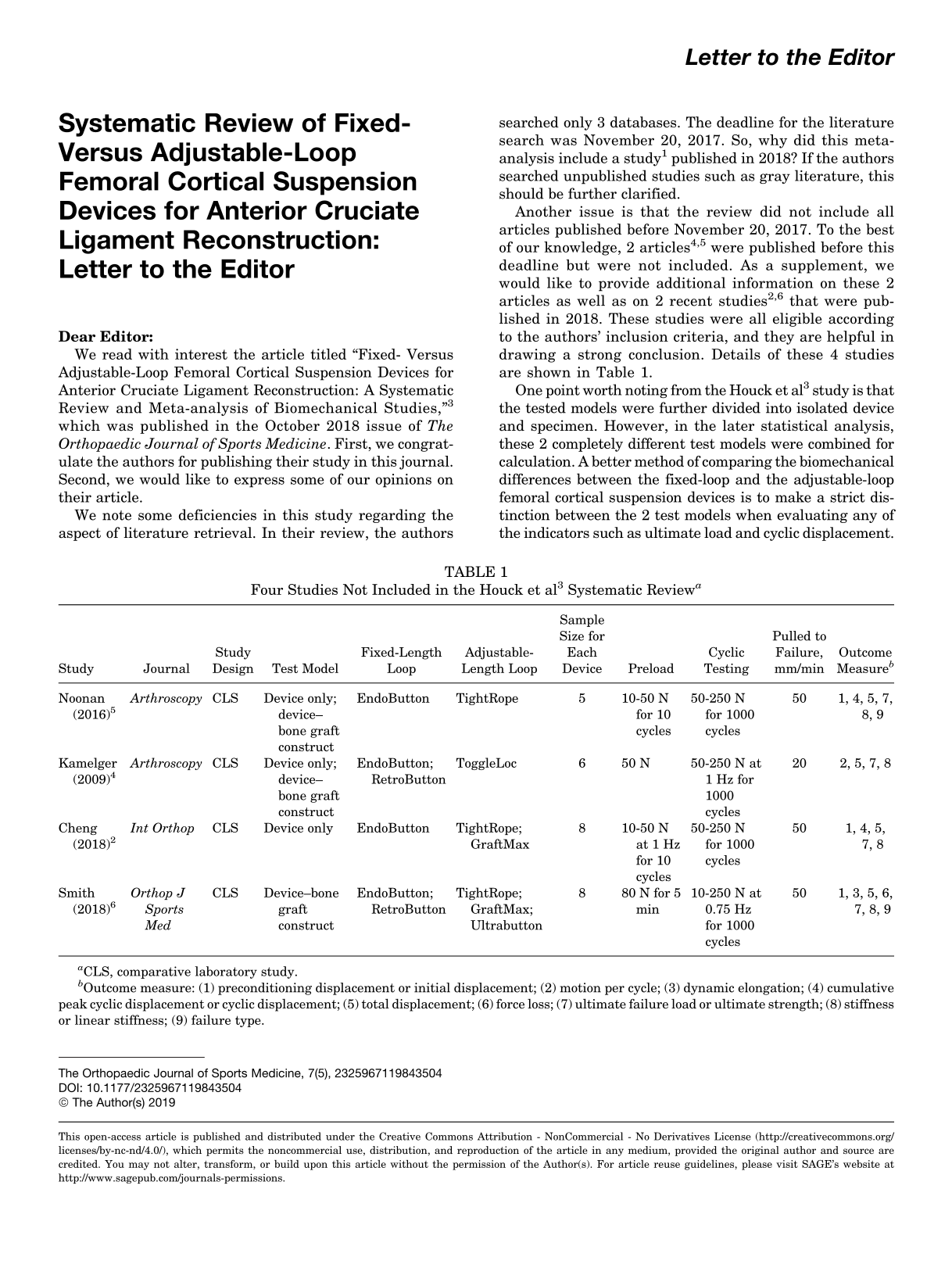
Another issue is that the review did not include all articles published before November 20, 2017. To the best of our knowledge, 2 articles 4,5 were published before this deadline but were not included. As a supplement, we would like to provide additional information on these 2 articles as well as on 2 recent studies 2,6 that were published in 2018. These studies were all eligible according to the authors’ inclusion criteria, and they are helpful in drawing a strong conclusion. Details of these 4 studies are shown in Table 1.
Four Studies Not Included in the Houck et al 3 Systematic Review a

a CLS, comparative laboratory study.
b Outcome measure: (1) preconditioning displacement or initial displacement; (2) motion per cycle; (3) dynamic elongation; (4) cumulative peak cyclic displacement or cyclic displacement; (5) total displacement; (6) force loss; (7) ultimate failure load or ultimate strength; (8) stiffness or linear stiffness; (9) failure type.
One point worth noting from the Houck et al 3 study is that the tested models were further divided into isolated device and specimen. However, in the later statistical analysis, these 2 completely different test models were combined for calculation. A better method of comparing the biomechanical differences between the fixed-loop and the adjustable-loop femoral cortical suspension devices is to make a strict distinction between the 2 test models when evaluating any of the indicators such as ultimate load and cyclic displacement.
The results of the authors’ meta-analysis showed a high degree of heterogeneity, which affected the credibility of the results. In addition, sensitivity analysis was lacking, so the stability of the conclusions is also questionable. The authors did not further analyze the reasons for the heterogeneity of the data. We believe that it may have been caused by multiple factors, including research methods, data processing, and the diversity of the included devices.
Once again, we thank the authors for their hard work. The comparison between fixed-loop and adjustable-loop femoral cortical suspension devices is a hot topic in sports medicine. We are confident that there will be more studies on this subject. More rigorously designed studies are needed to provide clinicians with more reliable conclusions.
Footnotes
The authors declared that there are no conflicts of interest in the authorship and publication of this contribution. AOSSM checks author disclosures against the Open Payments Database (OPD). AOSSM has not conducted an independent investigation on the OPD and disclaims any liability or responsibility relating thereto.