




Abstract
Background:
Club sport participation is increasingly common among high school athletes. Sport participation characteristics may vary widely between the high school and club sport settings. However, there have been no large-scale comparisons of sport participation volume between high school and club teams from similar sports.
Purpose/Hypothesis:
The purpose of this study was to compare the sport participation characteristics of high school and high school–aged club teams. We hypothesized that club team athletes would participate in more months per year and hours per week and would take more overnight trips than high school athletes and that club team coaches would be less likely to track their athletes’ sport volume than high school coaches.
Study Design:
Cross-sectional study.
Methods:
A total of 769 coaches (266 female; 34.6%) from 3 sports (basketball, volleyball, soccer) completed an anonymous online questionnaire regarding their team’s sport volume and their knowledge, attitudes, and beliefs regarding sport specialization. Coaches were eligible to participate if they had served as the head or assistant coach of a high school sport team or high school–aged club sport team in the past 12 months.
Results:
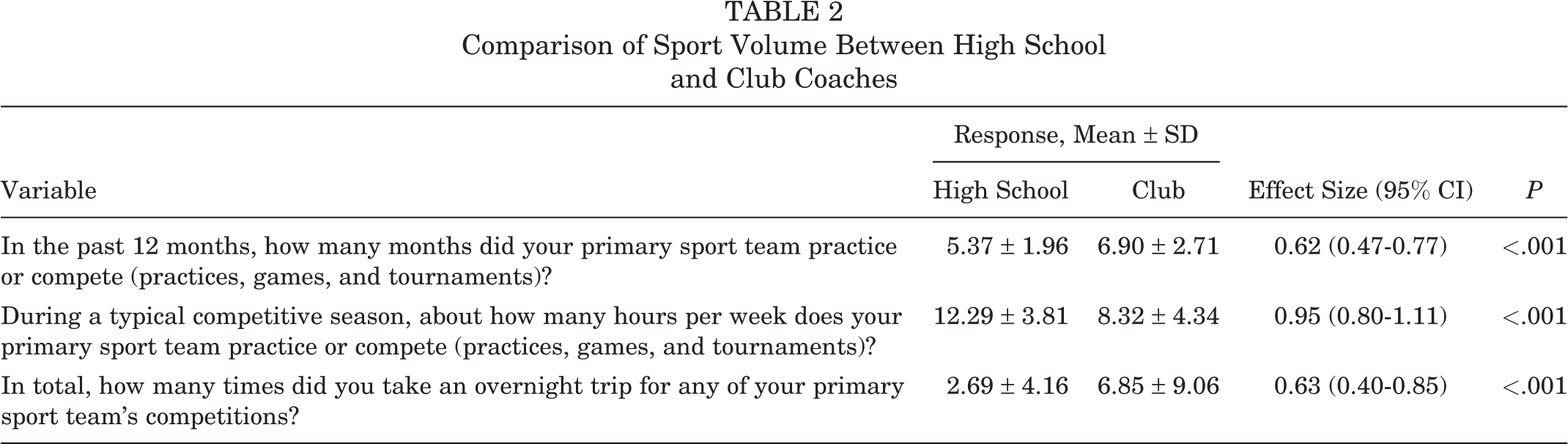
Overall, 64.6% (n = 497) were coaches of a high school team, and 35.4% (n = 272) were coaches of a club team with high school–aged athletes. Club coaches’ teams played more months out of the year and took more overnight trips for competitions than high school coaches’ teams but participated in fewer hours per week of practices or competitions during their season. There were no differences between club and high school coaches in tracking their athletes’ sport volume, with most coaches in both settings reporting that they do not track the amount of time that their athletes participate in other sports.
Conclusion:
Significant differences in sport participation volume exist between the teams of high school and club coaches.
Keywords
High school sport participation in the United States is at record levels, with nearly 8 million adolescents participating during the 2016-2017 school year. 10 While there are numerous important benefits associated with high school sport participation, high school athletes are increasingly encouraged to participate in a single sport year-round. 4,5,9 As part of this trend toward increasing specialization, high school athletes often join club teams in addition to their high school team to train year-round in their chosen sport. 3,15 One recent study of over 1500 high school athletes found that nearly 50% of athletes participated on a club team and a high school team at the same time. 9
Simultaneous participation on high school and club teams can result in increased sport participation volume throughout the year for an adolescent athlete. 2,6 There is significant evidence that participation in excessive months per year, sport competitions per year, and/or hours per week increases the risk of overuse injuries for adolescent and youth athletes. 1,5,11,15,17 In particular, participating for more than 8 months a year in a single sport or participating in more hours per week than the athlete’s age has been shown to increase the risk of injuries in youth athletes. 4,8,17 Therefore, the increasing trend of participation in both club and high school teams is potentially problematic, as it may increase the risk of overuse injuries.
A recent study of a limited sample of youth sport coaches found that most coaches are concerned about sport specialization, believing that specialization increases the risk of overuse injuries and that playing multiple sports is more beneficial for athletic development. 18 However, most of the coaches in the study were not aware of any sport volume recommendations for reducing the risk of injuries. 18 This study indicates that coaches are concerned about the current trends toward year-round participation among adolescent athletes but may not be aware of the importance of tracking sport participation volume. With more adolescent athletes participating on multiple teams, effective management of sport participation volume and clear communication between high school and club coaches are vital to limit the risk of overuse injuries among their athletes. To our knowledge, there has not been a comparison of sport participation volume, awareness, or behaviors in a broad sample of high school and club coaches.
Therefore, the purpose of this study was to compare the sport participation characteristics of high school and high school–aged club teams. We hypothesized that club team athletes would participate for more months per year and hours per week, would take more overnight trips, and would be less likely to have league limitations regarding competition volume than high school athletes. A secondary purpose was to examine the differences in coach awareness and behaviors regarding their athletes’ sport participation; we hypothesized that high school coaches would be more likely than club coaches to be aware of the other sports that their athletes participate in, track their athletes’ sport volume, coordinate with parents and other coaches regarding their athletes’ schedules, and be more aware of sport volume recommendations.
Methods
Participants
This study was exempted from institutional review board approval. Coaches of high school teams and club teams with high school–aged athletes from 3 sports (basketball, soccer, volleyball) were invited via email to complete an anonymous electronic questionnaire regarding their team’s sport volume and their knowledge, attitudes, and beliefs regarding sport specialization. These 3 sports were chosen because of their popularity both in the high school and club settings. This questionnaire was part of a larger project examining emergency preparedness among high school and club coaches, which has been previously described. 16 Coaches were eligible to participate if they had served as the head or assistant coach of a high school sport team or high school–aged club sport team in the past 12 months. Coaches were asked to respond based on their primary sport coaching responsibility, which was defined as the organized sport that was most important to them and that they would choose if they were forced to coach only 1 sport. Potential respondents were provided with an informational sheet in the distribution email that supplied details regarding the study but were not required to sign a consent form before participating because of the anonymous nature of the survey.
Emails were distributed to high school coaches through the Michigan High School Athletic Association and to club coaches via email addresses gathered from club sport organizations in Michigan, Wisconsin, Illinois, and Minnesota. Coaches were recruited from these organizations because of previous relationships and familiarity of the organizations with the study investigators and because of geographical constraints. We chose to recruit club coaches from multiple nearby states to ensure sufficient responses for comparison because of the difficulty in recruiting club coaches in Michigan. However, we limited club coach recruitment to only 3 additional nearby states within the Midwest to maximize comparability between the 2 groups.
A total of 11,248 emails were sent, with 1156 total responses (10.3% response rate). Of the total responses, 769 coaches fully completed the questionnaire and were used for data analysis (66.5% completion rate, 6.8% effective response rate). The effective response rate for high school coaches was 17.4% (497 fully completed questionnaires, 2852 emails sent), and the effective response rate for club coaches was 3.2% (272 fully completed questionnaires, 8396 emails sent). Email invitations to participate in the survey were resent twice after 7 and 14 days, respectively, in an effort to improve the response rate among coaches.
Questionnaire
The questionnaire consisted of 4 major sections: (1) coach and team demographics, (2) sport volume information (months per year, hours per week, number of overnight trips in the past 12 months), (3) knowledge of general sport volume recommendations (months per year, hours per week, simultaneous leagues), and (4) awareness and behaviors regarding their athletes’ sport participation. Feedback from the University of Wisconsin Survey Center was given on previous surveys, and this feedback was utilized in the development of the questionnaire for this study. The specific questions of interest for each section of the questionnaire are presented throughout the tables and figures.
A panel of 6 content-area experts determined the content validity index (CVI) of the questions within each section of the survey. This panel consisted of 2 youth sport coaches with 10 and 12 years of coaching experience, 1 strength and conditioning coach (certified strength and conditioning specialist and registered strength and conditioning coach with 8 years of experience), and 3 athletic trainers with graduate-level education (2 MS, 1 PhD) and between 2.5 and 15 years of experience. The relevance of each item to its corresponding research aim was rated on a 4-point ordinal scale, based on the method by Polit and Beck. 14 The CVI for each item was calculated by dividing the number of raters who ranked an item as “quite” or “highly” relevant by the total number of raters. Based on the recommendations of Lynn 7 for a panel with 6 members, only items with a CVI ≥0.83 were included in the final questionnaire.
Statistical Analysis
Data were summarized by frequencies with proportions and means with standard deviations. Independent t tests were used to compare sport volume measures (months per year, hours per week, number of overnight trips) between high school and club coaches, and effect sizes with 95% confidence intervals were calculated. Assumptions of normality for the independent t tests were determined via visual inspection of histograms and the calculation of skewness/kurtosis values for the sport volume measures in both the overall sample and for high school and club coaches.
Chi-square analyses were used to compare the frequency of responses between high school and club coaches for knowledge of sport volume recommendations and awareness and behaviors regarding athlete sport participation. Statistical significance was set 2-sided a priori at P < .05, and all analyses were performed with R statistical software (R Foundation for Statistical Computing).
Results
Coach and team characteristics are presented in Table 1. A total of 769 coaches (n = 266 [34.6%] female; mean age, 41.0 ± 11.5 years) completed the questionnaire and were used for data analysis. Overall, 64.6% (n = 497) were coaches of a high school team, and 35.4% (n = 272) were coaches of a club team with high school–aged athletes. Coach sport responsibility was split nearly even between basketball, volleyball, and soccer (basketball: n = 290 [37.7%]; volleyball: n = 256 [33.3%]; soccer: n = 223 [29.0%]). While the majority of coaches were male, the majority of the teams consisted of female athletes (n = 451 [58.6%]).
Participant Demographics a

a Data are reported as n (%) unless otherwise specified. GED, General Education Development.
Comparisons of sport volume between high school and club coaches are presented in Table 2. Club coaches’ teams played more months out of the year and took more overnight trips for competitions than high school coaches’ teams. However, club teams participated in fewer hours per week of practices or competitions during their season compared with high school teams. High school coaches were much more likely than club coaches to report having limitations on the number of games per day (χ2 = 237, P < .001), games per week (χ2 = 212, P < .001), and games per season (χ2 = 437, P < .001) that are mandated by their league or sport governing body (Figure 1).
Comparison of Sport Volume Between High School and Club Coaches
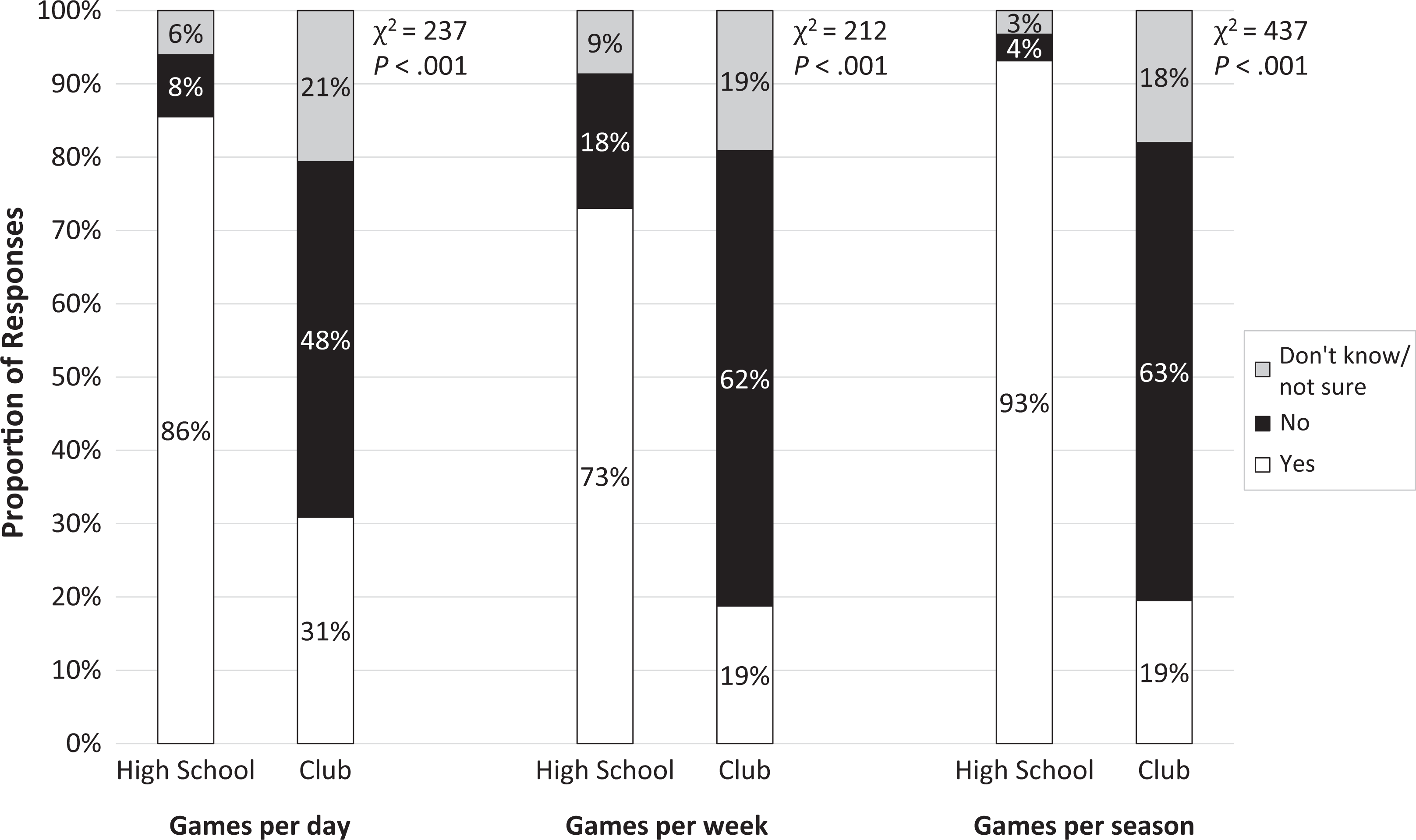
Are there limitations on the number of games for the athletes in your primary sport league?
Comparisons of sport participation awareness and behaviors between high school and club coaches are presented in Table 3. Club coaches were more aware of the other sports that their athletes are playing compared to high school coaches, while high school coaches were more likely to report that they do not allow their athletes to participate on other teams of the same sport during their season. There were no differences between club and high school coaches in tracking their athletes’ sport volume in other sports, with most coaches in both settings reporting that they do not track the amount of time that their athletes are participating in other sports. The majority of coaches in both settings reported coordinating with parents and other coaches about the scheduling demands of their team and the other sports that the athlete is playing. Similarly, the majority of coaches in both settings reported that they believed sport specialization to be “quite a bit” to “a great deal” of a problem in youth sports and that participating in a single sport year-round is “very” or “extremely” likely to increase an athlete’s chances of overuse injuries. High school and club coaches were equally unaware of recommendations regarding the number of months per year or hours per week to participate in organized sports to reduce injuries, but high school coaches were more likely to report being aware of recommendations against participating in simultaneous leagues at the same time (Figure 2).
Comparison of Sport Participation Awareness and Behaviors Between High School and Club Coaches

a Respondents were asked this question only if they answered “yes” to being aware of other sports that their athletes are playing.
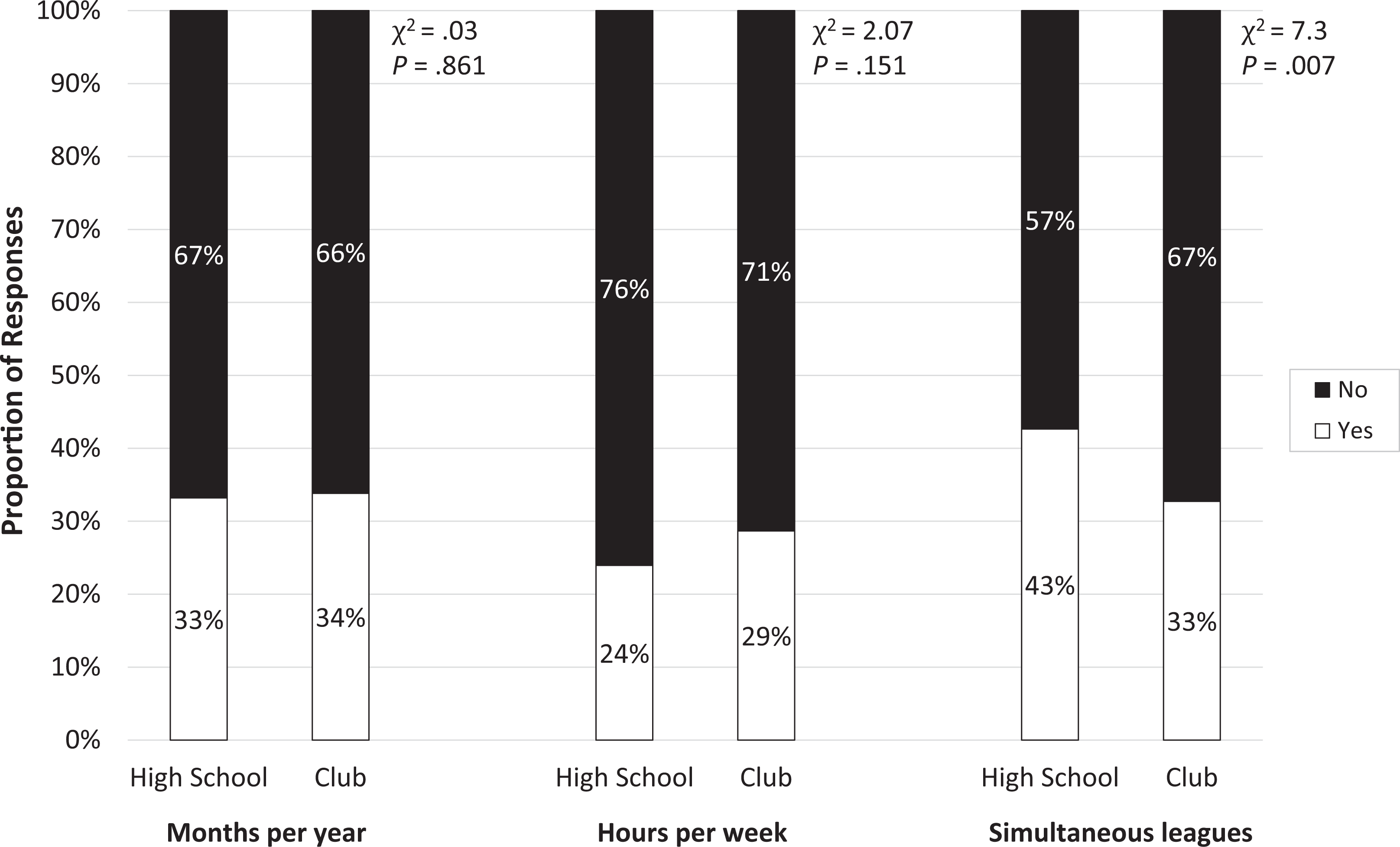
Are you aware of any recommendations about the following sport volume measures that youth athletes should follow to reduce the risk of overuse injuries?
Discussion
The most important finding of this study was that significant differences in team sport participation exist between club and high school coaches. High school teams participate for fewer months and go on fewer overnight trips per year but participate for more hours per week than club teams. Additionally, both club and high school coaches reported that they do not track their athletes’ sport volume for other teams that the athletes play on. To our knowledge, this is the first study to examine differences in sport volume, attitudes, and behaviors between club and high school coaches.
There is significant evidence that excessive sport volume is a risk factor for overuse injuries in youth and adolescent athletes. Participating in a single sport for more than 8 months out of the year has been identified as a risk factor in several studies of youth baseball pitchers 11 –13,19 as well as in broader samples of youth athletes from different sports. 1,17 Current recommendations suggest that youth athletes should not participate in more hours per week than the athlete’s age. 5,17 Additionally, participation of more than 16 hours per week of organized sport has been identified as increasing the risk of injuries. 17,20 Finally, Post et al 15 recently found that athletes who participated in either 30 to 60 competitions per year or more than 60 competitions per year were more likely to report a lower extremity injury compared with athletes who participated in fewer than 30 competitions per year. In the current study, club coaches were less likely to report being in a league with limits on the number of games per day, games per week, or games per season. This lack of competition volume regulation may be one reason why club team participation has been found to be associated with lower extremity injuries. 15
Neither coach type exceeded the current recommendations for months per year or hours per week of team sport participation. However, with many athletes choosing to participate on both high school and club teams, the combination of sport volume from the 2 settings has the potential to exceed recommendations unless there is strong communication between coaches. While most coaches in both settings were generally aware of the other sports that their athletes play, roughly 90% of coaches in both settings reported that they do not track the number of months per year or hours per week that their athletes are participating in their other sports. Additionally, most coaches in both settings did claim to be coordinating with parents and other coaches about scheduling demands. If the extent of the communication is simply to inform parents and other coaches of practice and competition times, it will most likely not be successful at reducing excessive sport participation volume among youth athletes.
Despite these limits in communication, coaches in both settings appeared to be aware and concerned about the potential consequences of sport specialization. Many coaches in both settings believed that sport specialization is a significant problem in youth sports and that participating in a single sport year-round increases the chances of overuse injuries, but there was low awareness of sport volume recommendations among coaches in both the club and the high school settings. The overall rates of awareness for the various recommendations were similar to a previous study in a much smaller sample of youth sport coaches, which found that between 20.6% and 22.4% of coaches were aware of months per year, hours per week, or simultaneous league recommendations. 18 Without awareness of recommendations for months per year and hours per week of sport participation, coaches will have difficulty justifying the need to track sport volume and identifying important measurements of sport volume to track. Therefore, increasing awareness of sport volume recommendations may be a key strategy for improving communication between high school and club coaches and limiting excessive sport volume among adolescent athletes. However, it is unfeasible for coaches alone to be responsible for understanding and implementing safe sport participation recommendations. Parents and children must also be educated on this topic and take responsibility for tracking sport volume.
This study has several limitations that are important to note. First, the overall response rate for this study was low. Despite distributing the survey using specific email lists provided by the Michigan High School Athletic Association and various club organizations, and sending 2 follow-up emails, the overall response rate was around 7%. This low response rate may have created a selection bias in terms of the coaches who ultimately decided to respond. We also only surveyed coaches from a small sample of states (Michigan, Wisconsin, Illinois, and Minnesota), which may limit the generalizability of these findings to coaches from different states or regions. Additionally, the recruitment of club coaches from multiple states and high school coaches from a single state may have resulted in geographical differences between the 2 groups. However, a post hoc subanalysis examining differences between the high school coaches and club coaches just from Michigan found similarly significant differences in all of the primary analyses in this study, indicating that the differences between club and high school coaches, and not differences in geography, were responsible for our findings. Finally, we limited our survey to only coaches of basketball, soccer, and volleyball teams. We chose these teams because of their popularity in both the high school and the club settings. Therefore, comparisons of sport volume, awareness, and behaviors between club and high school teams in other sports may differ from the results seen in this study.
Conclusion
Significant differences in sport participation volume existed between the teams of high school and club coaches. While most coaches in both settings were concerned about specialization and excessive sport volume, most coaches were not tracking the amount of time that their athletes are participating in other sports. With the increasing popularity of club sport participation among high school athletes, efforts are needed to increase awareness of sport volume recommendations among coaches, youth athletes, and parents and to encourage communication between these stakeholders.
Footnotes
One or more of the authors has declared the following potential conflict of interest or source of funding: M.A.B. has received research funding from DJO Global and AnthroTronix and has received a consulting fee from the National Basketball Association–GE Healthcare. AOSSM checks author disclosures against the Open Payments Database (OPD). AOSSM has not conducted an independent investigation on the OPD and disclaims any liability or responsibility relating thereto.
Ethical approval for this study was waived by the University of Wisconsin–Madison Health Sciences Institutional Review Board.