




Abstract
Background:
Pitching-related elbow injuries remain prevalent across all levels of baseball. Elbow valgus torque has been identified as a modifiable risk factor of injuries to the ulnar collateral ligament in skeletally mature pitchers.
Purpose:
To examine how segmental energy flow (power) influences elbow valgus torque and ball speed in professional versus high school baseball pitchers.
Study Design:
Descriptive laboratory study.
Methods:
A total of 16 professional pitchers (mean age, 21.9 ± 3.6 years) and 15 high school pitchers (mean age, 15.5 ± 1.1 years) participated in marker-based motion analysis of baseball pitching. Ball speed, maximum elbow valgus torque (MEV), temporal parameters, and mechanical power of the trunk, upper arm, and forearm were collected and compared using parametric statistical methods.
Results:
Professional pitchers threw with a higher ball speed (36.3 ± 2.9 m/s) compared with high school pitchers (30.4 ± 3.5 m/s) (P = .001), and MEV was greater in professional pitchers (71.3 ± 20.0 N·m) than in high school pitchers (50.7 ± 14.6 N·m) (P = .003). No significant difference in normalized MEV was found between groups (P = .497). Trunk rotation time, trunk power, and upper arm power combined to predict MEV (r = 0.823, P < .001), while trunk rotation time and trunk power were the only predictors of ball speed (r = 0.731, P < .001). There were significant differences between the professional and high school groups in the timing of maximum pelvis rotation velocity (42.9 ± 9.7% of the pitching cycle [%PC] vs 27.9 ± 23.4 %PC, respectively; P < .025), maximum trunk rotation (33 ± 16 %PC vs 2 ± 23 %PC, respectively; P = .001), and maximum shoulder internal rotation velocity (102.4 ± 8.9 %PC vs 93.0 ± 11.7 %PC, respectively; P = .017).
Conclusion:
The power of trunk motion plays a critical role in the development of elbow valgus torque and ball speed. Professional and high school pitchers do not differ in elbow torque relative to their respective size but appear to adopt different patterns of segmental motion.
Clinical Relevance:
Because trunk rotation supplies the power associated with MEV and ball speed, training methods aimed at core stabilization and flexibility may benefit professional and high school pitchers in reducing the injury risk and improving pitching performance.
With the risk of pitching-related injuries reportedly linked to improper pitching mechanics, an examination of the kinematics and kinetics of segmental body motion during pitching is critical to understanding the cause and prevention of these injuries. 7,17 The elbow joint, in particular, is exposed to tremendous valgus torque that has been shown to lead to injuries to the ulnar collateral ligament, flexor pronator mass, ulnar nerve, and other structures in the medial elbow in professional pitchers 9 as well as injuries to the lateral side in younger players. 26,30 Emerging research into modifiable risk factors has demonstrated that there are specific biomechanical patterns related to segmental motion that can predispose baseball players to these pitching-related injuries. 2,4,6,22,23,54,55 Thus, achieving segmental body motion that can optimize pitching performance and minimize the injury risk provides the basis on which efficient pitching mechanics are defined. From this perspective, pitching performance and injury risk are compatible aspects of throwing that can be determined by how well a pitcher can maximize ball velocity while minimizing the energy from higher torques at the throwing shoulder and elbow. 1,2,34 Efficient throwing mechanics are, therefore, predicated on the flow of mechanical energy through the kinetic chain via the motion of body segments that ideally follows a sequence governed by the “summation of speed principle,” which states that a segment will initiate its rotation when the segment proximal to it reaches its peak velocity. 8,13,42
Because of its segmental mass, the trunk segment could be the primary contributor to total angular momentum for the pitch, with the proper timing of trunk rotation ensuring optimal contribution to and minimizing the work of the throwing arm. 1,35,40 In a previous study, it was found that pitchers who rotated their upper torsos before front foot contact exhibited significantly greater valgus torque at the elbow than those who rotated afterward. 2 This finding suggests that pitchers tend to generate more internal rotation torque at the throwing arm to compensate for the loss of rotational energy as a result of poor sequential body motion. 1,2,34 However, the specific mechanisms by which the flow of mechanical energy (power) across moving body segments influences elbow valgus loading during pitching remain unclear.
While the relationship between intersegmental dynamics and elbow valgus loading during baseball pitching has been well examined using traditional inverse dynamics and statistical approaches, 2,41,55 only a few investigators have attempted to partition the causal components of segmental motion in relation to acceleration induced at the throwing arm. 19,20,35,36 Induced acceleration analysis, however, does not directly address the flow of energy between segments in the system. Consequently, previous investigators have attempted to define the energy transfer mechanisms using segmental power analysis, which examines the flow of energy through the kinetic chain during such sports-related movements as the tennis serve 31 and table tennis backhand. 24 The mechanical power of segmental motion could serve as a basis on which pitching efficiency is further delineated, as exhibited in other human movement analyses. 25,33,57 However, to date, the patterns of energy flow through the kinetic chain during pitching have not been compared between different levels of baseball pitchers.
The purpose of this study was therefore to conduct segmental power analysis to examine the energetic contributions of net torques across body segments to elbow valgus torque and ball velocity during baseball pitching in professional and high school pitchers. It was hypothesized that mechanical power of the trunk and shoulder would significantly predict elbow valgus torque and ball velocity. Furthermore, we hypothesized that professional and high school baseball pitchers would differ in the timing of trunk rotation, trunk power, shoulder power, elbow valgus torque, and ball velocity during pitching based on previous studies that have shown significant differences in trunk kinematics and joint kinetics between these 2 groups. 1,16
Methods
Participants
The pitching motions of 16 professional and 15 high school baseball players were included in this analysis. Based on a statistical power analysis performed with a freely available stand-alone program (G*Power 3.1), 12 a total of 21 participants was computed as the minimum sample size for detecting a significant relationship between independent and dependent variables at a power of 0.80 and an effect size of 0.70, which was calculated from previously reported regression data. 2 The professional pitchers who participated in this study were members of Minor League Baseball and Major League Baseball clubs and were in off-season strength and conditioning programs at the time of testing. The high school pitchers were recruited from local high school teams. All players as well as the parents of high school players provided written informed consent to participate in this study, the protocol of which was approved by the university’s institutional review board. The mean age, height, weight, and body mass index (BMI) of the professional participants were 21.9 ± 3.6 years, 1.89 ± 0.05 m, 89.4 ± 10.0 kg, and 25.0 ± 2.3 kg/m2, respectively; the respective values for the high school participants were 15.5 ± 1.1 years, 1.78 ± 0.09 m, 72.2 ± 14.9 kg, and 22.7 ± 4.1 kg/m2. All pitchers were actively playing organized baseball in their respective leagues and were considered healthy, with no significant injuries that would disqualify them from participating in practices or games.
Protocol and Testing
A set of 38 reflective markers (1.4 cm diameter) were placed on the skin overlying specific anatomic landmarks according to the link segment rigid-body model described by Aguinaldo and Chambers. 2 The marker set allowed for the estimation of 3-dimensional joint motion during throwing using an automated motion capture system of 8 near-infrared cameras (Raptor-4S; Motion Analysis) at a sampling rate of 300 Hz. The motion capture cameras were specifically positioned around an outdoor bullpen mound to allow the optimized capture of pitching motion. 1 Ball speed was monitored using a speed radar gun (Bushnell).
After a preparation routine of marker acclimation and warm-up throwing, each pitcher threw 15 fastballs off the bullpen mound to a netted strike zone 18.4 m away from the pitching rubber, while 3-dimensional marker data were captured. Three of the fastest pitches that hit the strike zone were analyzed for each participant, and the fastest of the 3 pitches was ultimately selected for further analysis, in agreement with previous studies that have employed similar methods. 2,32 Marker tracks were processed using marker identification techniques and digital signal processing that incorporated a fourth-order zero-lag Butterworth filter at a cutoff frequency of 18 Hz using commercially available motion capture software (Cortex 7.1; Motion Analysis).
Data Extraction
The joint kinematics and kinetics of each participant’s throwing motion were estimated based on the previously described link segment model, 1,2 which was scaled to each participant by the global locations of the motion-captured markers. For the purposes of this study, only the kinematics of the pelvis, trunk, shoulder, and elbow joints were extracted. While the forces and torques of all the segments in the inverse dynamics model were estimated, valgus torque at the throwing elbow was the primary kinetic variable of interest, which was defined as the bending moment about the elbow joint that would cause an increase in tensile force on the medial structures and an increase in compressive force on the lateral side. 2,55 The flow of mechanical energy (power) between the pelvis, trunk, upper arm, and forearm segments was calculated as the time rate of change in kinetic energy delivered into or out of each segment during pitching using previously described methods. 3,45 All pitching-related kinematic and kinetic computations were performed with a specialized biomechanics software application (PitchTrak; Motion Analysis).
To assess the proximal-to-distal sequence in segmental body motion during the pitch, we collected the time points at which the maximum values of pelvis rotation velocity, trunk rotation, trunk rotation velocity, elbow valgus torque (MEV), shoulder external rotation (MER), and shoulder internal rotation velocity (MIRV) of the throwing shoulder occurred during the pitching cycle (PC), normalized from front foot contact to ball release.
Statistical Analysis
Measurements of MEV, ball speed, maximum trunk rotation time, and mechanical power of the pelvis, trunk, upper arm, and forearm were extracted from each processed trial for subsequent statistical analysis. In addition, normalized MEV was computed by dividing the extracted MEV by body weight (N) and height (m). The mean differences in these variables between the professional and high school groups were compared using independent t tests at a Bonferroni-corrected significance level of .008. The extracted measurements along with MER were entered as independent variables into a multiple stepwise regression analysis to determine the linear model that best predicts MEV. Ball speed was also evaluated to determine its relationship with these predictor variables using linear regression.
Regression analyses were performed on the entire sample of pitchers as well as separately on each group of professional and high school pitchers. In all multiple regression analyses, the assumptions of multicollinearity and normality were assessed using tolerance and Shapiro-Wilk tests, respectively. The differences in the timing of the maximum kinematic and kinetic events between groups (professional vs high school) and across the PC were examined using 6 × 2 repeated-measures analysis of variance. As such, the Mauchly test was used to determine whether the assumption of sphericity was tenable, and the degrees of freedom were adjusted using the Greenhouse-Geisser correction when this assumption was violated. Linear regression analyses and repeated-measures analysis of variance were performed at an a priori significance level of .05 using commercially available statistical software (SPSS Statistics v 21; IBM).
Results
Demographic data revealed significant differences between the professional and high school pitchers in mean age (21.9 ± 3.6 vs 15.5 ± 1.1 years, respectively; P < .001), height (1.89 ± 0.06 vs 1.78 ± 0.09 m, respectively; P < .001), and weight (89.4 ± 10.0 vs 72.2 ± 14.9 kg, respectively; P < .001). The mean BMI was not statistically different between professional pitchers (25.0 ± 2.3 kg/m2) and high school pitchers (22.7 ± 4.1 kg/m2) (P = .058).
Table 1 lists the mean values for absolute MEV, normalized MEV, ball speed, trunk rotation time, trunk power, upper arm power, and forearm power for the professional and high school groups. The mean difference in MEV between professional pitchers (71.3 ± 20.0 N·m) and high school pitchers (50.7 ± 14.6 N·m) was statistically significant (P = .003). MEV and the peak mechanical powers of the trunk, upper arm, and forearm segments all occurred during the arm-cocking phase for both professional and high school pitchers as exhibited in the representative data plotted in Figures 1 and 2, respectively. However, when normalized by body weight (bw) and height (h), the mean MEV for both professional and high school players was statistically equivalent (0.04 ± 0.01 bw-h; P = .497). Moreover, professional pitchers threw at a faster ball speed (36.3 ± 2.9 m/s) versus high school pitchers (30.4 ± 3.5 m/s) (P = .001), who threw with an earlier onset of maximum trunk rotation (2 ± 23 %PC) compared with professional players (33 ± 16 %PC) (P = .001). The mean maximum values of trunk power for professional and high school pitchers were 34 ± 14 W/kg and 40 ± 11 W/kg, respectively, the difference between which was not statistically significant (P = .179). The mean maximum values of upper arm power for professional and high school pitchers were –15 ± 9 W/kg and –14 ± 5 W/kg, respectively, the difference between which was also not statistically significant (P = .708). Likewise, the mean maximum values of forearm power for professional pitchers (–24 ± 10 W/kg) and high school pitchers (–17 ± 7 W/kg) were not significantly different (P = .034). The power generated at the trunk and absorbed at the upper arm and forearm peaked during the arm-cocking phase, defined between front foot contact and MER, for both professional pitchers (Figure 1) and high school pitchers (Figure 2).
Comparison of Maximum Values of Kinematic and Kinetic Parameters a
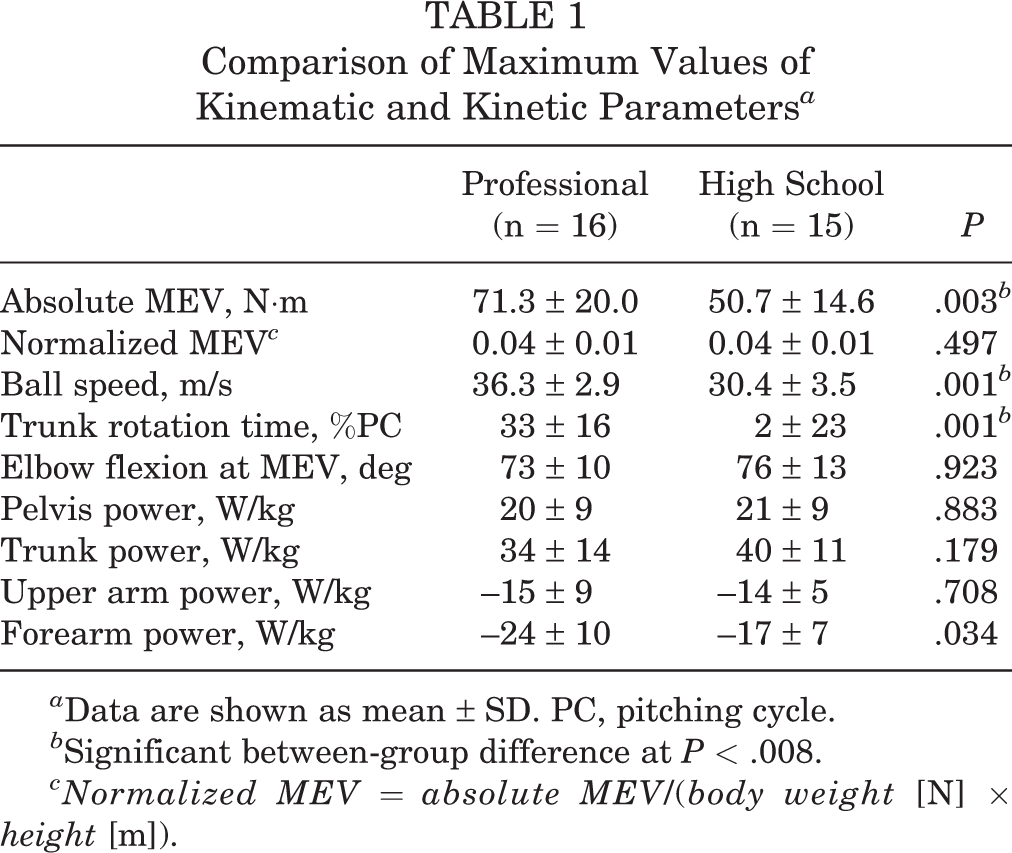
a Data are shown as mean ± SD. PC, pitching cycle.
b Significant between-group difference at P < .008.
c Normalized MEV = absolute MEV/(body weight [N] × height [m]).
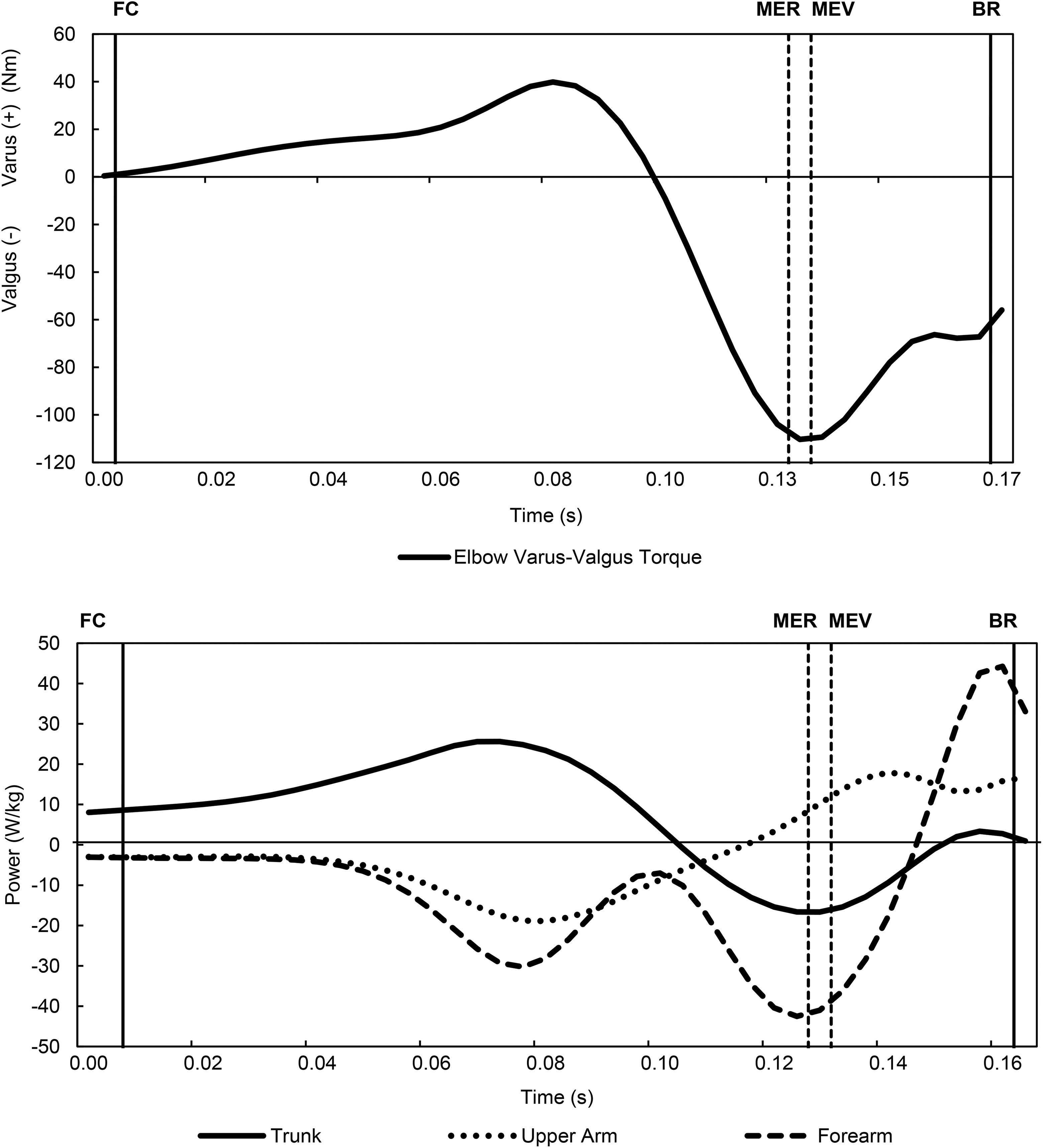
Elbow valgus torque (top) and mechanical power (bottom) of the trunk, upper arm, and forearm during the pitching cycle, defined from front foot contact (FC) to ball release (BR), for a representative professional pitcher in the study. MER, maximum shoulder external rotation; MEV, maximum elbow valgus torque.

Elbow valgus torque (top) and mechanical power (bottom) of the trunk, upper arm, and forearm during the pitching cycle, defined from front foot contact (FC) to ball release (BR), for a representative high school pitcher in the study. MER, maximum shoulder external rotation; MEV, maximum elbow valgus torque.
The multiple regression analyses showed that MEV was significantly influenced by a linear combination of trunk power, upper arm power, and trunk rotation time (r = 0.823, P < .001), which accounted for 67.7% of the variance in MEV. When analyzed by competitive level, only trunk power and MER explained 78.4% (r = 0.886, P < .001) and 69.8% (r = 0.835, P < .001) of the variance in MEV in professional and high school pitchers, respectively. A total of 53.4% of the variance in ball speed could be attributed to a combination of trunk power and trunk rotation time (r = 0.731, P < .001). Among professional pitchers, only trunk power was determined to be responsible for 88.3% (r = 0.916, P < .001) of the variance in ball speed. Trunk power accounted for 37.5% (r = 0.612, P = .015) of the variance in ball speed among high school pitchers. All other factors entered into the regression analyses were found not to be significant predictors of MEV or ball speed. Regression coefficients for the MEV and ball speed prediction models are listed in Tables 2 and 3, respectively.
Variables Included in MEV Multiple Regression Analyses a

a β, standardized regression coefficient; B, unstandardized regression coefficient; MER, maximum shoulder external rotation; MEV, maximum elbow valgus torque.
Variables Included in Ball Speed Multiple Regression Analyses a

a β, standardized regression coefficient; B, unstandardized regression coefficient.
The relationship between professional/high school groups and the timing of maximum kinematic and kinetic events was significant (P = .016) (Figure 3). The timing of maximum pelvis rotation velocity, maximum trunk rotation, maximum trunk rotation velocity, MEV, MER, and MIRV was significantly different (P < .001 for all). Among all pitchers, the timing of maximum pelvis rotation velocity and maximum trunk rotation did not significantly differ (P = .194). However, for high school pitchers, maximum trunk rotation appeared significantly earlier than maximum pelvis rotation velocity (P < .001) (Figure 3). Maximum pelvis rotation velocity also appeared significantly earlier in high school pitchers (27.9 ± 23.4 %PC) than in professional pitchers (42.9 ± 9.7 %PC) (P = .025). MER, which is the point at which the throwing shoulder begins its acceleration in internal rotation, occurred significantly later than maximum trunk rotation velocity (P < .001) (Figure 3). The timing of MEV and MER was not significantly different (P = .999). MIRV occurred at 99.9 ± 1.9 %PC for all pitchers but appeared significantly earlier in high school pitchers (93.0 ± 11.7 %PC) than in professional pitchers (102.4 ± 8.9 %PC) (P = .017) (Figure 3).
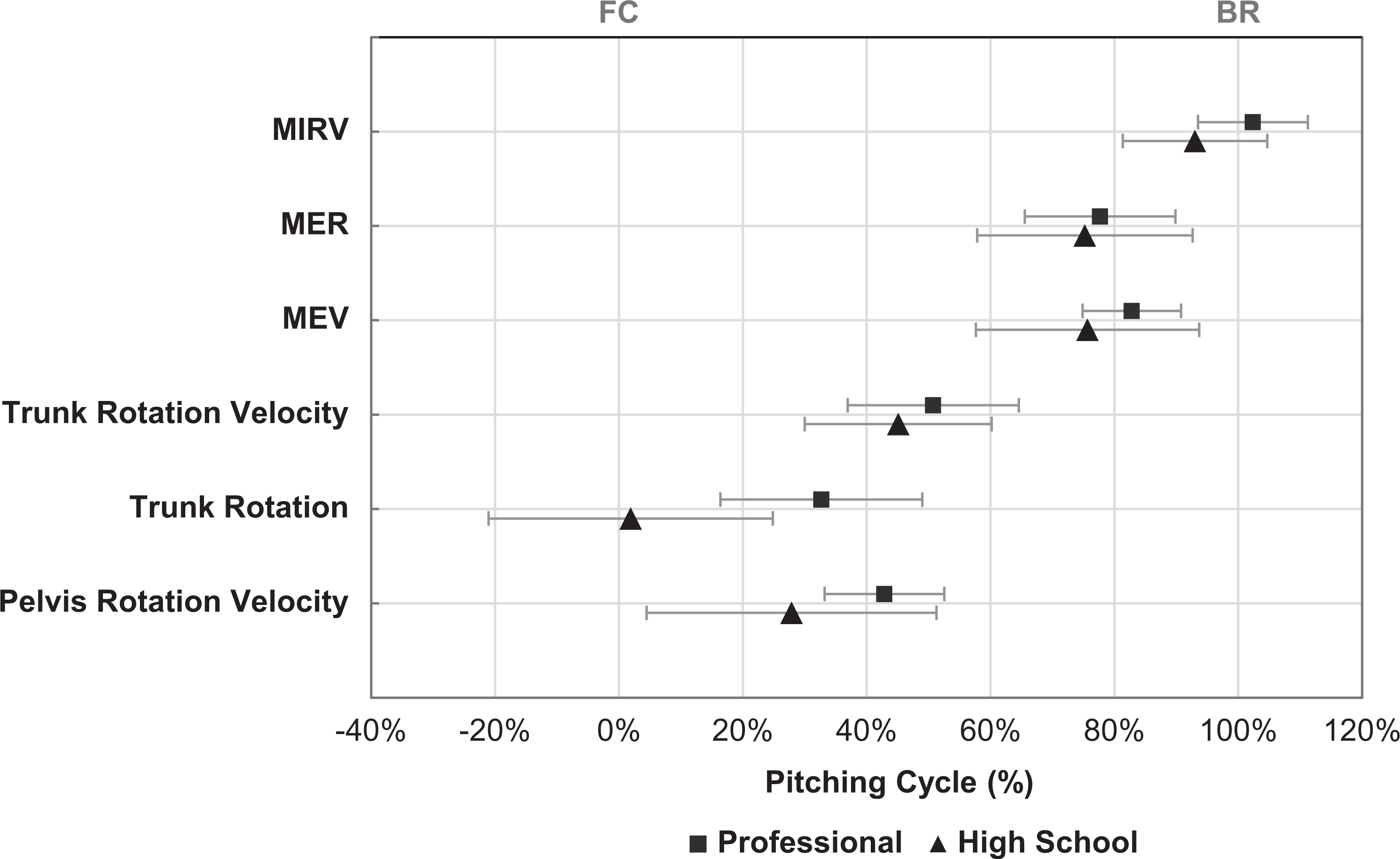
The timing of maximum values of pelvis rotation velocity, trunk rotation, trunk rotation velocity, elbow valgus torque (MEV), shoulder external rotation (MER), and shoulder internal rotation velocity (MIRV) was statistically different across events (P < .001) and between professional and high school pitchers (P = .008). The timing of a specific event is expressed as a percentage of the pitching cycle, where 0% and 100% correspond to front foot contact (FC) and ball release (BR), respectively.
Discussion
This study aimed to understand the flow of mechanical energy through the kinetic chain and the energetic contributions of net torques across body segments to elbow valgus torque and ball velocity during baseball pitching in professional and high school pitchers. The energy generated by the net torques at the trunk and shoulder, along with the timing of trunk rotation, was found to significantly contribute to elbow valgus torque, while ball speed was most affected by the timing and power of trunk rotation. This finding suggests that trunk motion is critical to the development of valgus torque at the elbow and ball speed. These findings have implications for both the risk of elbow injuries and pitching performance, and they agree with previous studies that demonstrated the influence of trunk motion on throwing arm kinetics 1,2,7,40 and ball speed. 43,53,56 In the current study, MEV occurred when the shoulder reached MER, which was found to be a significant predictor of MEV in both professional and high school pitchers. This analysis supports the general belief that shoulder external rotation has a substantial effect on the generation of elbow valgus torque. 2,37,47,55 As the power absorbed by the upper arm was found to be a significant predictor of MEV in all pitchers, it is plausible that this power absorption represents the storage and release of elastic energy that subsequently powers the rapid internal rotation of the shoulder during the acceleration phase. 14,44
The current results also suggest that trunk rotational torque acts as the primary source of power production for the development of both ball velocity and elbow valgus torque. Hence, a change in trunk movement during the act of pitching will consequently influence this energy transfer mechanism and ultimately affect throwing arm kinetics and pitching performance. 39,43 However, the mechanism by which changes in trunk motion affect elbow valgus torque is not fully explained. In a previous study, 1 it was shown that high school pitchers exhibited earlier trunk rotation time and significantly higher normalized rotational torque at the shoulder compared with professional pitchers. The results of the current analysis are not completely consistent with this directional relationship, as high school pitchers in this study also rotated their trunks earlier in the PC (at front foot contact) than professional pitchers did, but both groups of pitchers threw with the same level of normalized elbow valgus torque.
The reason for this inconsistency is unclear, but one possible explanation is the difference in somatotypes. Although BMI was not significantly different between professional and high school pitchers, it has previously been shown that body composition and segmental mass have a significant effect on throwing kinetics, particularly in younger pitchers. 11,18 As expected, absolute MEV and ball speed were significantly higher in the professional pitchers than in the high school pitchers in our study, which agrees with the analysis by Fleisig and colleagues, 16 who reported that throwing kinetics increased significantly with age. Thus, the difference in absolute MEV was offset by the differences in height and weight, both of which were significantly different between professional and high school pitchers, and resulted in similar loads at the elbow relative to their respective body size. Conversely, in a recent study, 27 high school pitchers exhibited higher normalized elbow valgus torque at MER than did professional pitchers. However, elbow valgus torque at MER was a different value than MEV, which was defined as the peak elbow valgus torque during the arm-cocking phase in their analysis. 27 In the present study, MEV did in fact occur at MER, and therefore, it was the only elbow valgus torque extracted for analysis, which when normalized was also found to be similar between professional (0.04 ± 0.01 bw-h) and high school pitchers (0.04 ± 0.01 bw-h). Therefore, the exposure of elbow valgus torque relative to body size appears to be comparable between professional and high school pitchers. However, other factors such as pitch counts, playing time, and skeletal maturity determine the difference in the level of risk of elbow injuries between these 2 groups. 28,38,49
The absolute MEVs were significantly different between professional pitchers (71.3 ± 20.0 N·m) and high school pitchers (50.7 ± 14.6 N·m) in this study, which agrees with the findings of previous studies that reported MEV as being significantly higher in professional pitchers than in high school pitchers. 16,27 However, in the study by Fleisig et al, 16 no significant differences in temporal parameters between professional and high school pitchers were reported, while the current study findings showed that maximum pelvis rotation velocity, maximum trunk rotation, and MIRV all occurred significantly earlier in the PC in high school pitchers compared with professional pitchers. It is unclear how these differences in temporal patterns influence the injury risk (ie, elbow joint kinetics), as normalized MEV did not differ between professional and high school players. Nonetheless, trunk power and the timing of maximum trunk rotation were found to be significant predictors of MEV as well as ball speed, which was significantly lower in high school pitchers. Hence, it is plausible that high school pitchers adopt a throwing pattern in which early trunk rotation leads to an energy flow through the kinetic chain, which subsequently powers comparable levels of relative MEV with professional pitchers but with a lower pitching output (ie, ball speed). This less efficient pitching pattern could be partly responsible for the increase in incidence rates of ulnar collateral ligament injuries recorded in high school pitchers in the past 2 decades. 5,10,15
Limitations
This study adds valuable information to the limited body of research on the flow of mechanical energy during pitching, 34,43,50 however it is not without its limitations. Although the segmental power analysis employed in this study has been used by previous investigators to examine the energy flow in other human movements, 24,31,51 this approach is limited by the assumption that the mechanical power of a segment is generated (or absorbed) by torques about joints adjacent to this segment and does not take into account the power of anatomically distant segments to which these torques are not applied. 45,46 Baseball pitching is frequently referred to as a “whip-like” motion to describe the kinetic chain through which segmental energy flows, and the contribution of motion-dependent interactive torques within this kinetic chain is not decomposed in segmental power analysis. 21,37 Hence, this study utilized regression analyses as a compromise to determine the power contributions of proximal segmental motion on elbow valgus torque, similar to the correlational methods used in gait analysis. 48 Future research should examine more precisely the energy redistribution mechanisms among multiple segments involved in the development of elbow valgus loading during baseball pitching.
Another limitation is that the model used in this analysis did not include the lower body segments, which reportedly contribute to the transfer of energy up the kinetic chain. 8,29 However, our study found that the kinetic energy of the system increased substantially after front foot contact, which implies that internal work by the trunk muscles during the arm-cocking phase contributes greater energy than the forward push of the legs, as previous researchers have shown. 34,39,52 Last, the cross-sectional design of the study was a limitation, as this analysis was restricted to professional and high school pitchers only. Thus, it is unknown how the energy flow and joint kinetic patterns reported in this study apply to other competitive levels of baseball pitching. Given that previous studies have indicated that youth and collegiate pitchers exhibit differences in joint velocities and kinetics, it is possible that segmental energy flow differs across various levels and influences the injury risk and pitching performance in distinct ways. Future investigations are warranted to test these hypotheses.
Conclusion
Using segmental power analysis, the energetic contributions of segmental motion to the development of MEV and ball speed were examined and compared between professional and high school pitchers. In both levels, the timing and mechanical power of trunk rotation significantly influenced MEV and ball speed, which lends support to the notion that trunk motion can play a crucial role in minimizing the injury risk and improving pitching performance. While absolute MEV was significantly higher in professional pitchers, owing to differences in height and weight, professional and high school pitchers did not differ in MEV relative to their respective body size. However, differences in ball speed and temporal parameters between both levels were found. Thus, high school pitchers appear to adopt a unique pattern of segmental motion that supplies a segmental energy flow and induces valgus torque at the elbow comparable with professional pitchers but at slower ball velocities.
Footnotes
The authors declared that there are no conflicts of interest in the authorship and publication of this contribution. AOSSM checks author disclosures against the Open Payments Database (OPD). AOSSM has not conducted an independent investigation on the OPD and disclaims any liability or responsibility relating thereto.
Ethical approval for this study was obtained from the institutional review board of Point Loma Nazarene University.