




Abstract
Objectives:
The purpose of this study is to describe the clinical, functional, and patient-reported outcomes of distal triceps tendon repairs, as well as to describe perioperative risk profile and re-rupture rates among those with or without pre-existing enthesopathy.
Methods:
Patients who underwent surgical repair of traumatic triceps tendon injuries between 2008 and 2016 were identified from the surgical database at a single institution. The electronic medical records were queried to determine demographic information, time from injury, mechanism of injury, extent of tear, pre-existing enthesopathy, and postoperative complications. Patients with arthritis, concomitant ligament surgery, and/or secondary rupture following previous elbow surgery were excluded. Follow-up outcome measures included the Mayo Elbow, Disabilities of the Arm, Hand, and Shoulder (QuickDASH), Veterans RAND (VR/SF-12), and Kerlan-Jobe Orthopaedic Clinic (KJOC) scores with a minimum of 1-year follow up.
Results:
A total of 88 patients (83 males, 5 females) with mean age of 47 years (range, 14-74) were identified with distal triceps tendon repairs at an average of 49 days (range, 1 to 3650 days) after injury. Sixty-nine patients (76.1%) returned for follow-up at average 3.99 years post-operatively (SD, 2.51). The most common mechanisms of injury were direct elbow trauma (45.4%), extension/lifting exercises (18.1%), overuse (13.6%), and hyperflexion or hyperextension (14.8%). Twenty patients were identified with pre-existing, symptomatic enthesophytes, and 68 tears were caused by acute injury; A total of 42 and 46 partial tendon tears were identified (Table 1). Bone tunnels were most commonly used (n=42, 47.7%), while direct sutures (n=31, 35.2%) and suture anchors (n=12, 13.6%) were also used. Postoperative complications occurred in 23.9% of patients, but no patients experienced re-rupture at time of final follow-up. Final postoperative patient-reported outcome measures are noted in Table 1. No statistically significant correlation was found between patient age (p=0.750), degree of tear (p=0.870), or surgical technique (p=0.740) and presence of perioperative complications.
Conclusion:
Despite heightened risk of perioperative complications after primary repair of distal triceps tendon injuries, the current series identifies favorable functional outcomes and no cases of re- rupture at short- to mid-term follow-up. Furthermore, age, surgical technique, and extent of tear were not associated with adverse patient outcomes in this investigation.
Outcomes by Presence of Enthesophytes
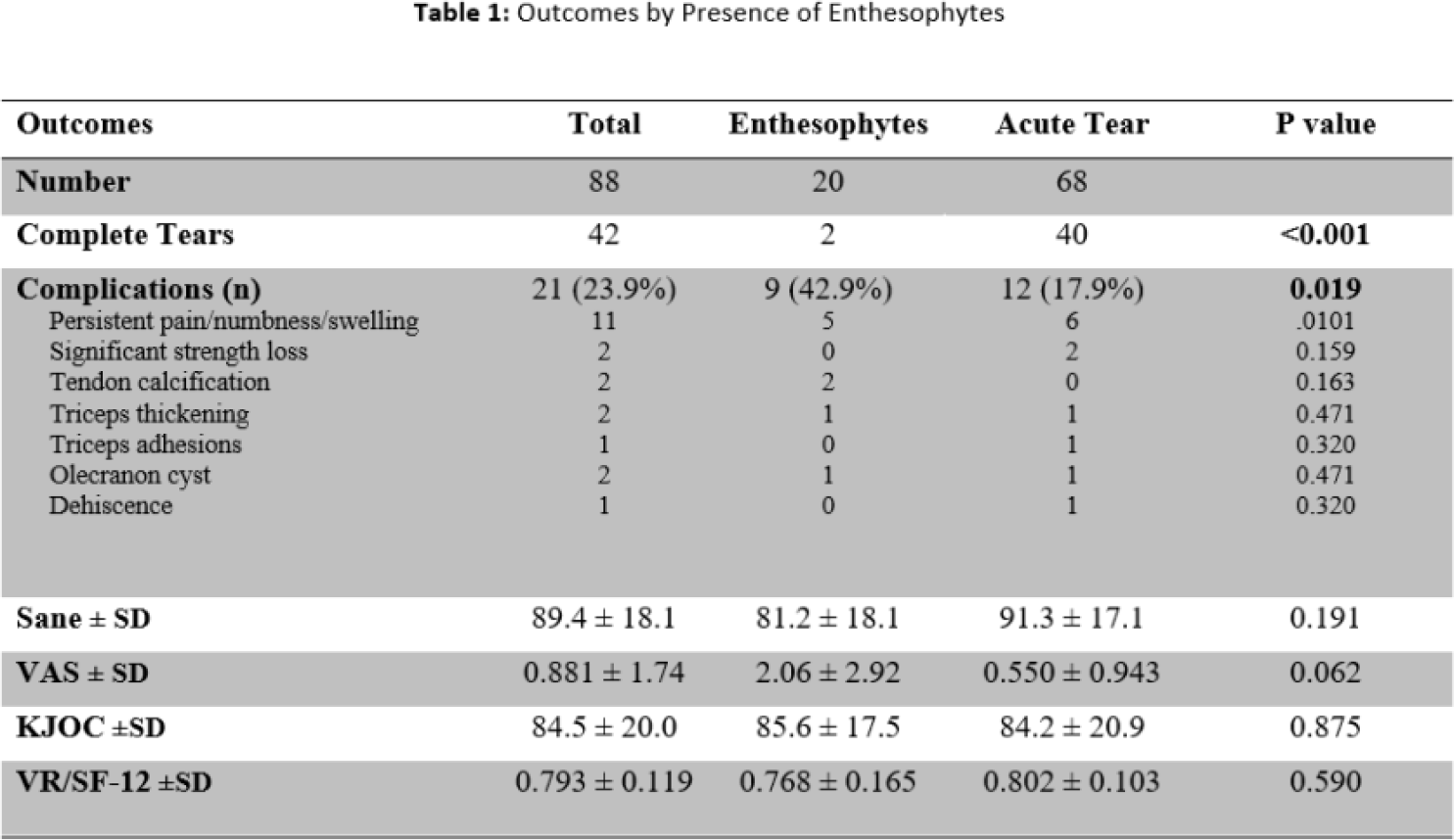
| Outcomes | Total | Enthesophytes | Acute Tear | P value |
|---|---|---|---|---|
|
|
88 | 20 | 68 | |
|
|
42 | 2 | 40 |
|
|
|
21 (23.9%) | 9 (42.9%) | 12(17.9%) |
|
| Persistent pain/numbness/swelling | 11 | 5 | 6 | .0101 |
| Significant strength loss | 2 | 0 | 2 | 0.159 |
| Tendon calcification | 2 | 2 | 0 | 0.163 |
| Triceps thickening | 2 | 1 | 1 | 0.471 |
| Triceps adhesions | 1 | 0 | 1 | 0.320 |
| Olecranon cyst | 2 | 1 | 1 | 0.471 |
| Dehiscence | 1 | 0 | 1 | 0.320 |
|
|
89.4 ± 18.1 | 81.2± 18.1 | 91.3 ± 17.1 | 0.191 |
|
|
0.881 ± 1.74 | 2.06 ± 2.92 | 0.550 ± 0.943 | 0.062 |
|
|
84.5 ± 20.0 | 85.6 ± 17.5 | 84.2 ± 20.9 | 0.875 |
|
|
0.793 ± 0.119 | 0.768 ± 0.165 | 0.802 ± 0.103 | 0.590 |