




Abstract
Background:
Previous studies have examined the most cited articles in orthopaedic sports medicine research and the journals in which they were published.
Purpose:
To analyze the manuscript submission patterns of authors who published manuscripts in various orthopaedic sports medicine journals.
Study Design:
Cross-sectional study.
Methods:
All articles published in the March 2017 and April 2017 issues of Arthroscopy, the American Journal of Sports Medicine (AJSM), Knee Surgery, Sports Traumatology, Arthroscopy (KSSTA), and the Orthopaedic Journal of Sports Medicine (OJSM) were searched. In addition, the past 50 sports medicine–related articles published in the Journal of Bone and Joint Surgery (JBJS) dating back from April 2017 to May 2015 were searched. The corresponding author of each article was asked whether the publishing journal was the first journal of submission. If the article was previously submitted elsewhere, authors were asked which other journals, the dates of submission, and the order of submission. The proportion of articles that were initially submitted to each journal, the mean number of submissions prior to publication, and the mean duration from initial submission to date of publication were calculated for each journal.
Results:
A total of 298 articles were included in this study, and 221 (74%) corresponding authors responded to the survey. The mean number of submissions before acceptance was 1.05 for AJSM, 1.18 for JBJS, 1.20 for KSSTA, 1.38 for Arthroscopy, and 2.19 for OJSM. The percentage of articles that were submitted to their accepting journal first (ie, not previously submitted elsewhere) was 95% for AJSM, 85% for JBJS, 82% for KSSTA, 68% for Arthroscopy, and 13% for OJSM.
Conclusion:
Among the orthopaedic sports medicine journals included in this study, articles published in AJSM have the highest percentage of first submissions.
The impact factor (IF) of a journal is a commonly used measure of its prestige within the scientific community. 6 The American Journal of Sports Medicine (AJSM) was the highest-rated orthopaedics journal according to the 2017 Journal Citations Report, 15 with an IF of 5.67. This was followed closely by the Journal of Bone and Joint Surgery (JBJS; IF, 4.84), Arthroscopy (IF, 4.29), and Knee Surgery, Sports Traumatology, Arthroscopy (KSSTA; IF, 3.23). The Orthopaedic Journal of Sports Medicine (OJSM) has not been published long enough to have an IF, although it is indexed in PubMed. Previous studies have found that the most cited articles within various orthopaedic sports medicine topics are published in these same journals. 1,7,9,12,13,16 Additionally, studies presented at major orthopaedic sports medicine meetings—such as the American Orthopaedic Society for Sports Medicine (AOSSM) Annual Meeting, 5,8 the Arthroscopy Association of North America (AANA) Annual Meeting, 2,10 and the American Shoulder and Elbow Surgeons Open and Closed Meetings 4 —were often eventually published in AJSM, JBJS, Arthroscopy, or KSSTA. Although these studies highlighted the reputation of key orthopaedic sports medicine journals, no previous studies have examined the journal submission patterns of the authors publishing within this field. Knowledge of authors’ journal submission patterns in the field of orthopaedic sports medicine may help guide journal submissions for future authors. The purpose of this study was to analyze the manuscript submission patterns of authors who published manuscripts in various orthopaedic sports medicine journals.
Methods
All articles published in the March 2017 through April 2017 issues of AJSM, Arthroscopy, KSSTA, and OJSM were searched. In addition, the past 50 sports medicine–related articles published in JBJS dating back from April 2017 to May 2015 were searched to include a comparable sample size of sports medicine–related studies from this general orthopaedics journal. All original research articles, systematic reviews, meta-analyses, narrative reviews, and case reports were included. Editorials, letters to the editor, responses, and corrigenda were excluded. An email was sent to the corresponding author of each article asking whether the publishing journal was the first journal of submission or if the manuscript had previously been submitted to another journal. If submitted elsewhere, authors were asked which other journals, the dates of submission, and the order of submission.
Calculations were based on the authors’ responses. First, the proportion of articles that were initially submitted to each publishing journal and not previously submitted elsewhere was calculated. In addition, the mean number of submissions prior to publication acceptance was calculated for each journal. Finally, the mean duration from initial submission to date of paper publication (or online publication for OJSM) was calculated for each journal.
One-way analysis of variance was performed to compare the mean number of submissions before acceptance and the mean time from initial submission to eventual publication across journals. A P value < .05 was considered statistically significant.
Results
Overall, 298 articles were included in this study (Table 1). Responses were received from 221 of 298 (74%) corresponding authors.
Number of Articles Included per Journal a
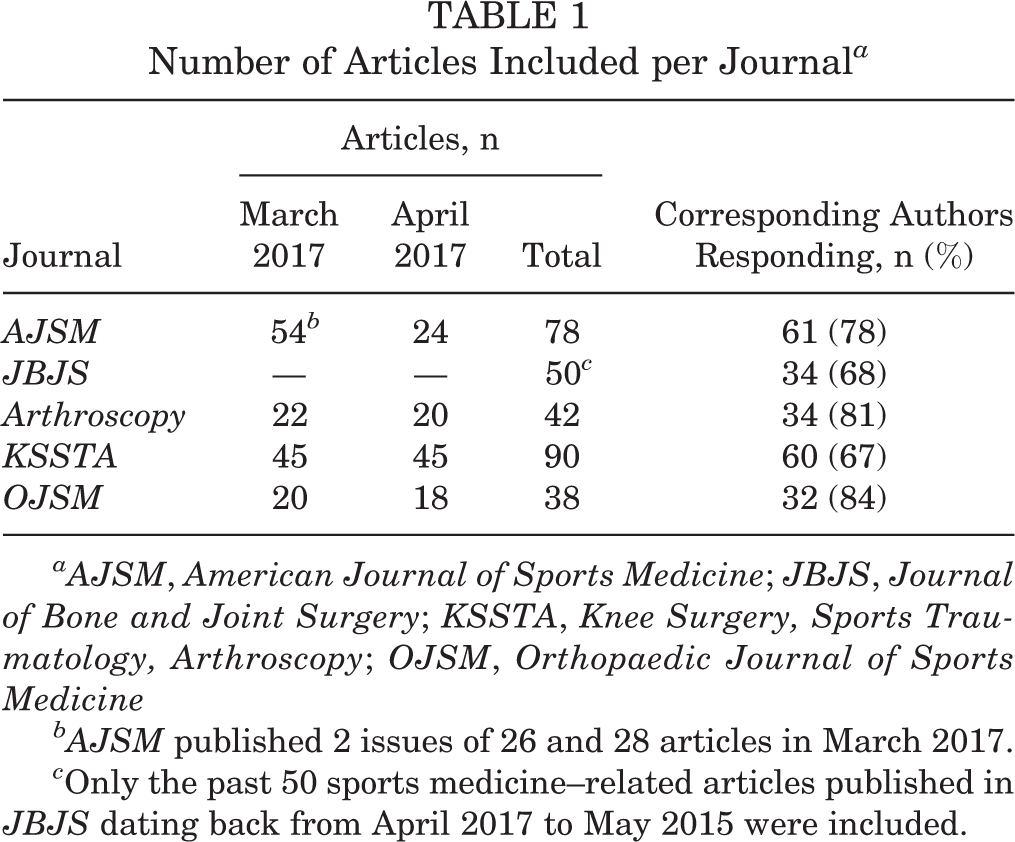
aAJSM, American Journal of Sports Medicine; JBJS, Journal of Bone and Joint Surgery; KSSTA, Knee Surgery, Sports Traumatology, Arthroscopy; OJSM, Orthopaedic Journal of Sports Medicine
bAJSM published 2 issues of 26 and 28 articles in March 2017.
c Only the past 50 sports medicine–related articles published in JBJS dating back from April 2017 to May 2015 were included.
The mean number of submissions before acceptance (including the accepting journal) for articles published in AJSM was 1.05, followed by JBJS (1.18), KSSTA (1.20), Arthroscopy (1.38), and OJSM (2.19) (P < .0001) (Table 2). The percentage of articles that were submitted to the accepting journal first (ie, not previously submitted elsewhere) was 95% for AJSM, 85% for JBJS, 82% for KSSTA, 68% for Arthroscopy, and 13% for OJSM. The mean time from initial submission to publication was shortest for JBJS and AJSM and was significantly different across the 5 journals (P = .01).
Journal Submission Patterns a

a Values are presented as mean ± SD (range) or percentage. AJSM, American Journal of Sports Medicine; JBJS, Journal of Bone and Joint Surgery; KSSTA, Knee Surgery, Sports Traumatology, Arthroscopy; OJSM, Orthopaedic Journal of Sports Medicine.
Of the 3 articles that were initially submitted to another journal prior to publication in AJSM, 1 was submitted to JBJS first (Table 3), while the other 2 were initially submitted to the British Medical Journal and the British Journal of Anaesthesia. Four of the 5 articles published in JBJS that were initially submitted elsewhere were submitted to AJSM first, while the last was initially submitted to the Journal of Biomechanics. For articles previously submitted to a separate journal prior to publication, AJSM was the first journal of submission for 80% of JBJS articles, 64% of Arthroscopy, 36% of KSSTA, and 82% of OJSM.
First-Choice Journal of Initially Rejected Articles a

a Table shows articles published in each journal (rows) that were initially rejected from a separate journal (columns). For example, of the 5 articles eventually published in JBJS that were initially rejected by another journal, 80% (4 of 5) were initially submitted to AJSM, and 1 was submitted to a journal not included among those listed here. AJSM, American Journal of Sports Medicine; JBJS, Journal of Bone and Joint Surgery; KSSTA, Knee Surgery, Sports Traumatology, Arthroscopy; OJSM, Orthopaedic Journal of Sports Medicine.
Discussion
The results of this study suggest that, among the orthopaedic sports medicine journals included in this analysis, articles published in AJSM have the highest percentage of first submissions.
There are many factors that influence the journal to which an author chooses to submit. Oftentimes, authors are interested in submitting to journals with a high IF, as these journals are most frequently read and cited, and academic promotion decisions are often biased toward authors who publish in journals with the highest IFs. Another factor that is not often discussed is the submission fee or manuscript processing fee that some journals have implemented. Among the journals included in this study, JBJS imposes a submission fee for all original research articles and systematic reviews submitted, and OJSM imposes a manuscript processing fee for all articles that are accepted for publication in the journal. Numerous studies have reported on the most cited articles within various orthopaedic sports medicine topics. 1,7,9,12,13,16 These studies found that the most cited articles on these topics are often published in AJSM, JBJS, Arthroscopy, and KSSTA. For example, Voleti et al 16 found AJSM to be the top publishing journal of the 50 most cited articles on anterior cruciate ligament research (23 of 50; 46%), followed by JBJS (15 of 50; 30%).
In the field of orthopaedic sports medicine, there has been an increase in the quality of articles in the literature in recent years. 3,11 Grant et al 3 found that the proportion of studies with evidence levels 1 and 2 that were published from 1995 to 2010 increased significantly in AJSM (9.4% to 30.1%; P < .0001) and JBJS (4.1% to 27.8%; P < .0001). However, the same study also found no significant change in the proportion of such studies published in Arthroscopy (6.3% to 10.4%; P = .50) during the study period. This certainly bolsters the reputation of AJSM and JBJS and may make them more desirable journals for authors of high-quality studies to submit their work. In contrast, another study 14 found no difference in the proportion of studies with level 1 evidence published among various orthopaedic journals. Therefore, authors can submit their work to any of the many journals that publish orthopaedic sports medicine research and be reassured that it is accompanied by other high-quality research.
In addition to IF, authors are frequently interested in rapid publication to allow their research to reach readers quickly. 17 Time to publication can be affected by several factors, such as the number of issues per year and the number of printed pages per issue. Highly reputable journals such as AJSM and JBJS often attract a high volume of submissions, which makes publication in these journals more competitive. Despite this, we found that articles published in AJSM and JBJS had the fastest time from initial submission to eventual publication. However, it should be noted that OJSM, in contrast to the other journals included in this study, is an open access journal that receives no income from print advertising and is reliant on a processing fee from each accepted manuscript to cover the editorial costs. Furthermore, many manuscripts that are deemed to be of value but not suitable for publication in AJSM are offered the option of a “cascade” to OJSM, in which a rapid decision is made following a revision in response to the AJSM reviewers’ comments. This in part accounts for the higher number of previous submissions for OJSM in comparison with the other journals studied in this analysis.
Studies presented at major orthopaedic sports medicine meetings, such as the AOSSM Annual Meeting, 5,8 the AANA Annual Meeting, 2,10 and the American Shoulder and Elbow Surgeons Open and Closed Meetings, 4 were often eventually published in AJSM, JBJS, Arthroscopy, or KSSTA. Note that for studies presented at AOSSM, AJSM has the right to first refusal, whereas these guidelines are not enforced by Arthroscopy for studies presented at AANA. Therefore, this may have had some effect on the large proportion of manuscripts from this study that were submitted to AJSM first.
The strengths of this study include analysis of a large sample size of articles published in recent editions of AJSM, JBJS, Arthroscopy, KSSTA, and OJSM. The limitations should also be noted. First, 26% of authors could not be reached. Only articles in 5 journals were included; therefore, the submission patterns of other orthopaedic sports medicine journals and the publication of rejected articles in other general orthopaedic journals were not evaluated. Additionally, only the March and April 2017 editions of the journals were included. These restrictions potentially limit the conclusions that can be drawn from the results of this study. Finally, authors were not asked why they chose to submit to one journal over another.
Conclusion
Among the orthopaedic sports medicine journals included in this study, articles published in AJSM have the highest percentage of first submissions.
Footnotes
One or more of the authors has declared the following potential conflict of interest or source of funding: E.C.M. receives royalties from Biomet and Elsevier; is a consultant for Biomet; and receives research support from Biomet, Mitek, Smith & Nephew, Stryker, and DePuy.
Ethical approval was not sought for the present study.