




Abstract
Background:
Various biomechanical properties of adjustable-loop cortical suspension devices have been observed among previous studies in which different experimental conditions were used to test each of these devices. However, no studies have investigated the biomechanical properties of single adjustable-loop cortical suspension devices under different cyclic loading protocols. It is necessary to clarify the problems associated with using this device and detect the best method of using it in the clinical setting.
Hypothesis:
The elongation of the loop of an adjustable-loop cortical suspension device with cyclic loading would be smaller with (1) an increase in the lower force limit and (2) lower speeds of cyclic loading.
Study Design:
Controlled laboratory study.
Methods:
Eighteen anterior cruciate ligament (ACL) adjustable-loop cortical suspension devices were tested under the following 3 cyclic loading protocols in a device-only model. Protocol A included cyclic loading between 10 and 50 N at 50 mm/min for 500 cycles. The upper force limit was then increased by 25-N increments every 500 cycles up to 250 N, for a total of 4500 cycles. Protocol B included cyclic loading between 30 and 50 N at 50 mm/min for 500 cycles. The upper force limit was then increased to 250 N, for a total of 4500 cycles, in the same manner as protocol A. Protocol C included cyclic loading between 30 and 50 N at 25 mm/min for 500 cycles. The upper force limit was then increased to 250 N, for a total of 4500 cycles, in the same manner as protocol A.
Results:
The elongation after 4500 cycles was 36.1, 18.5, and 8.6 mm for protocols A, B, and C, respectively. There were significant differences among the 3 protocols, with protocol C showing the smallest elongation with cyclic loading. The elongation in each group progressed with each 25-N cyclic load increment.
Conclusion:
The adjustable-loop cortical suspension device showed a smaller elongation of the loop with increases in the lower force limit and with lower cyclic loading speeds.
Clinical Relevance:
Care should be taken during rehabilitation after anatomic ACL reconstruction using adjustable-loop cortical suspension devices with a low initial tension at graft fixation. Slow and less intense exercises may be more desirable in the early stages of healing.
Keywords
Anterior cruciate ligament (ACL) reconstruction is widely performed, with good clinical outcomes. 1,8,16 The key factors responsible for successful reconstruction include graft fixation, tunnel position, and graft materials used. 3,4,9,10,12,15,17 It is critical that the fixation device maintains graft tension until graft-tunnel healing has been achieved. Cortical suspension devices have been widely used for ACL reconstruction because of sufficient failure loading and the simplicity of fixation. 1,5,8,16 The loop length is decided after accurate measurement of the tunnel length in cases of fixed-loop cortical suspension devices. Adjustable-loop cortical suspension devices have been recently developed; these devices enable adjustment of the loop length after inserting the graft into the tunnel without previous measurement of the tunnel length. However, the elongation of this adjustable-length loop device was larger than that of the fixed-length loop device during cyclic loading and had a wide range (1.1-42.5 mm) under various experimental conditions using device-only models. 2,6,7,13,14 Therefore, it was considered that experimental conditions could affect loop lengthening. However, no previous studies have investigated the biomechanical properties of single adjustable-loop cortical suspension devices under different experimental conditions. Therefore, the purpose of this study was to evaluate the influence of the (1) load and (2) speed of cyclic loading on the mechanical properties of single adjustable-loop cortical suspension devices. We hypothesized that the elongation of the loop of adjustable-loop cortical suspension devices would be smaller with (1) an increase in the lower force limit and (2) lower speeds of cyclic loading.
Methods
Eighteen ACL adjustable-loop cortical suspension devices (TightRope RT; Arthrex) were used for biomechanical testing (Figure 1). Because this study was designed to evaluate the mechanical properties of adjustable-loop cortical suspension devices, the following simple design without a graft was employed to avoid the influence of graft and bone quality: a custom-made steel apparatus with a 5 mm–diameter hole on the upper surface was mounted to a materials testing machine (AUTOGRAPH AG-IS; Shimadzu). A button was positioned under the apparatus through the hole after hanging the end of the suture loop on a metallic rod attached to the crosshead of the testing machine 2,6,7,14 (Figure 1).

(A) A button was positioned under the testing apparatus through a 5 mm–diameter hole on the upper surface. (B) The end of the suture loop was hung on a metallic rod attached to the crosshead of the materials testing machine.
The loop was then adjusted to a length of 35 mm under 1-N loading according to the manufacturer’s instructions. The following 3 protocols were performed after preloading at 20 N for 30 seconds to remove slack from the construct. (1) Protocol A: Cyclic loading was begun between 10 and 50 N at 50 mm/min for 500 cycles. The upper force limit was then increased by 25-N increments every 500 cycles up to 250 N, for a total of 4500 cycles. 2 (2) Protocol B: Cyclic loading was begun between 30 and 50 N at 50 mm/min for 500 cycles. The upper force limit was then increased to 250 N, for a total of 4500 cycles, in the same manner as protocol A. (3) Protocol C: Cyclic loading was started between 30 and 50 N at 25 mm/min for 500 cycles. The upper force limit was then increased to 250 N, for a total of 4500 cycles, in the same manner as protocol A. Loop lengthening after 4500 cycles was calculated while recording the load-elongation curve of the entire test. Six devices were tested for each protocol. The actual lower force limit approached 0 N in group A, 5 N in group B, and 15 N in group C because of the limitation of the mechanical controls.
Statistical Analysis
Power analysis (power, 0.8; alpha, 0.05; detectable difference, 14.0; SD, 4.1) indicated a sample size requirement of 6 per group for valid comparisons. One-way analysis of variance was used for comparison of the 3 protocols. When statistically significant differences were demonstrated with 1-way analysis of variance, a post hoc Tukey test was performed to assess the statistically significant means among the groups. A significant difference was determined at P < .05.
Results
With regard to elongation after 4500 cycles, there were significant differences among the 3 protocols, with protocol C showing the smallest elongation (Table 1). The elongation in each group progressed with each 25-N cyclic load increment (Figure 2).
Loop Elongation After Preloading and Cyclic Loading a

a Values are presented as mean ± SD.
b Significant difference between protocol A and protocol B (P < .05).
c Significant difference between protocol A and protocol C (P < .05).
d Significant difference between protocol B and protocol C (P < .05).
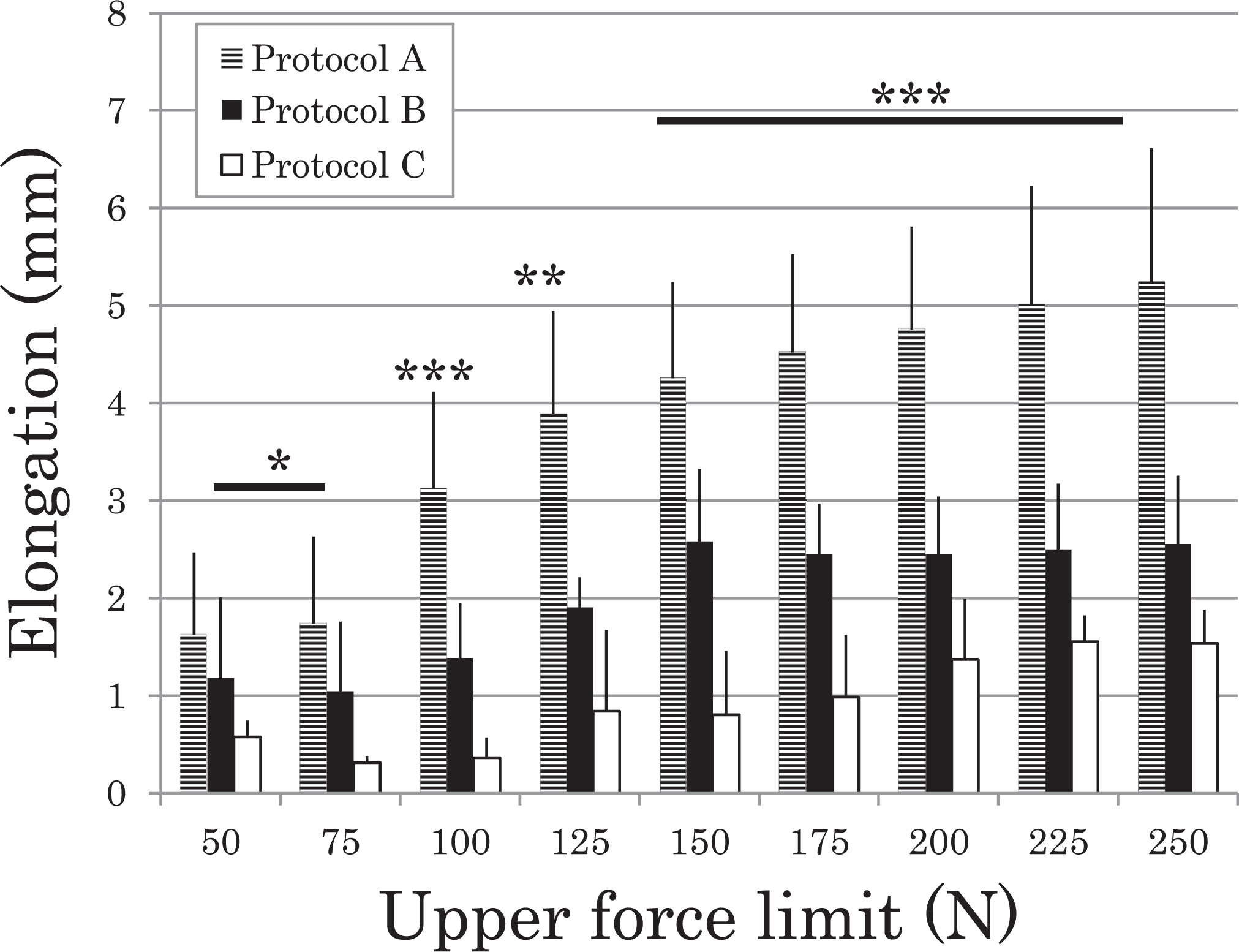
Elongation after 500 cycles at each 25-N load increment. Elongation in each group progressed with each 25-N cyclic load increment. *Significant difference between protocols A and C (P < .05). **Significant difference between protocols A and B and between protocols A and C (P < .05). ***Significant difference between each protocol (P < .05).
Discussion
It is critical whether a fixation device can maintain graft tension until graft-tunnel healing has been secured. However, various elongations after cyclic loading of adjustable-loop cortical suspension devices have been observed among previous studies in which different experimental conditions were used to test each of these devices. Petre et al 14 showed that the elongation after cyclic loading between 50 and 250 N at a frequency of 0.5 Hz for 1000 cycles was 1.1 mm, while Eguchi et al 6 reported that the elongation after cyclic loading between 50 and 250 N at a frequency of 2 Hz for 2000 cycles was 4.1 mm. Barrow et al 2 started cyclic loading testing between 10 and 50 N at 1 Hz for 500 cycles and increased the upper load in 25-N increments every 500 cycles up to 250 N, and demonstrated that the elongation was 42.5 mm. There have been no previous reports investigating the biomechanical properties of single adjustable-loop cortical suspension devices under different experimental conditions. Therefore, this study was conducted to investigate the reason for the difference in results among previous reports. Our study showed that an increase in the lower force limit and a lower speed during cyclic loading tests resulted in a smaller elongation of the loop, which was in accordance with our hypothesis. On the other hand, the amount of elongation under all 3 conditions in this study was too large to use this device in the clinical setting. However, this study was conducted to clarify the problems associated with using this device and detect the best method of using it in the clinical setting. Thus, we followed the step-by-step loading condition because Barrow et al 2 showed the largest elongation after cyclic loading among previous reports.
With regard to the influence of load magnitude during cyclic loading, the elongation in protocol B (lower force limit, 30 N) was smaller than that in protocol A (lower force limit, 10 N) after a total of 4500 cycles. The loop of this device is fixed using the Chinese finger trap mechanism; this mechanism can operate the locking function once tension exceeds a certain amount of load and can rigidly maintain the length while more than this amount of load is maintained. Johnson et al 7 reported that the elongation of the TightRope RT was 2.2 mm after 1000 cycles with a lower force limit of 100 N in a device-only model, despite a high upper force limit of 400 N. Therefore, this device can rigidly maintain the loop length when the lower force limit is set above a certain level. In contrast, the locking mechanism in this device cannot maintain the length when the lower force limit is very low; hence, we saw a large elongation (36.1 mm) with protocol A in this study. In addition, elongation showed the same tendency with every 25-N increment of the upper force limit in all the protocols.
Overall, the elongation was the largest in every loading condition in protocol A. Thus, cyclic loading between the low lower-force limit and high upper-force limit must yield loop lengthening. The tension in the intact ACL has been reported to be less than 10 N from 10° to 120° of knee flexion, which increases to 50 to 100 N at full knee extension. 11 Mae et al 8 reported good clinical outcomes after anatomic ACL reconstruction using fixed-loop cortical suspension devices with a low initial tension of 20 N at 20° of knee flexion in graft fixation. Even if a higher initial tension is applied to the graft, graft tension after anatomic ACL reconstruction would likely decrease because of load relaxation of the femur-graft-tibia complex. On the other hand, an excessive initial tension at the time of ACL reconstruction might increase the contact force in the femorotibial joint and produce deleterious effects on the articular surface. 9 Thus, these data suggest that in the early phase after anatomic ACL reconstruction using adjustable-loop cortical suspension devices, care may need to be taken during rehabilitation by incorporating range-of-motion exercises, including full extension in which graft tension is likely to increase, to help yield the largest loop elongation. Further investigation is necessary to detect the precise minimum amount of initial tension to rigidly operate the locking mechanism.
Adjustable-loop cortical suspension devices can provide better outcomes at lower speeds of cyclic loading, as evidenced by the smaller elongation in protocol C (25 mm/min) than in protocol B (50 mm/min). The higher speed of tensile loading could have made the Chinese finger trap mechanism work abnormally, which may have led to slippage. Thus, motion exercises should be performed at slow speeds using this device, particularly in the early phase after ACL reconstruction. Slower and less intense exercises may be more desirable when using this device until bone-tendon healing can occur to some extent.
This study has some limitations. First, it was conducted using a device-only model, whereas the fixation device is connected to a graft in ACL reconstruction. When connected to an ACL graft, the device will be affected by creep behavior or load relaxation of the graft itself. It is impossible to completely reproduce these in vivo conditions in an experimental setting. On the other hand, we were able to evalutate the effect of cyclic loading conditions on the device without having to account for any other factors. Thus, the biomechanical properties of the adjustable-loop device shown in this study are useful for the clinical setting. A second limitation is that there was no comparison with other cortical suspension devices. The TightRope RT is frequently tested as an adjustable-loop device, and elongations after cyclic loading have been varied in previous studies. 2,6,7,13,14 Therefore, this study was conducted to determine a suitable condition for using this device in the clinical setting. Further research is needed to test other devices and to compare the biomechanical properties of various devices.
Conclusion
The TightRope RT showed a smaller elongation of the loop with an increase in the lower force limit and with a lower speed of cyclic loading.
Footnotes
One or more of the authors has declared the following potential conflict of interest or source of funding: T.M. received sponsorship for this study from Arthrex.
Ethical approval for this study was waived by the institutional review board of Osaka University Hospital.