Abstract
Objectives:
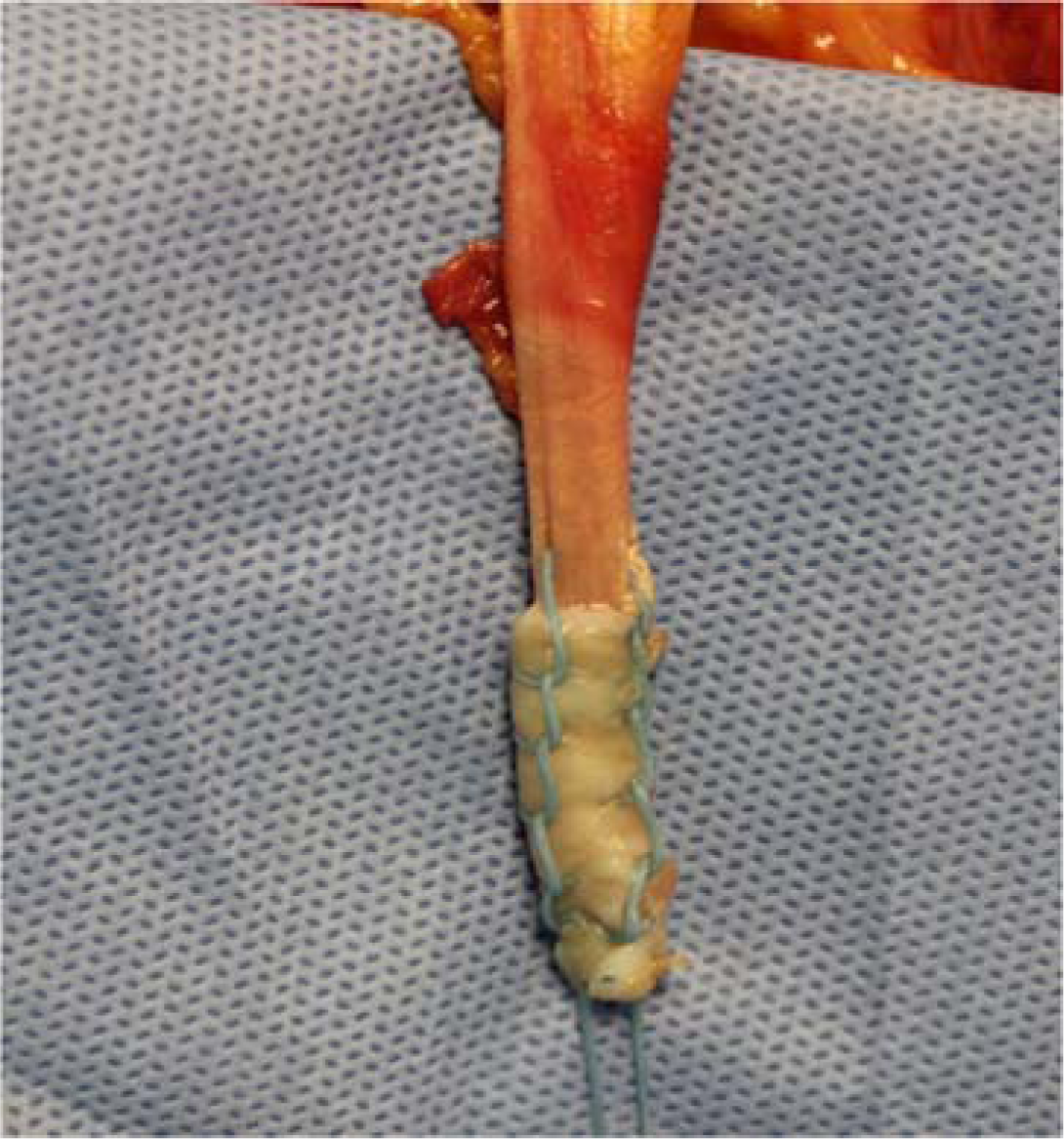
The majority of distal biceps tendon injuries can be repaired primarily. In contrast, chronic tears with severe tendon substance deficiency and retraction often require tendon-graft augmentation. In cases with extensive partial tears of the distal biceps, human dermal allograft may be used as an alternative to restore tendon thickness and biomechanical integrity. The objective of this study was to investigate if dermal graft augmentation of an attritionally thinned distal biceps repair improved load to failure and gap formation compared with a non-augmented repair in this same tendon deficient model.
Methods:
18 matched specimens were organized into one of four groups - native tendon, native tendon with dermal graft augmentation, attritional defect tendon, and attritional tendon with graft. To mimic a chronic attritional biceps lesion, a defect was created leaving 30% of the tendon width intact. The repair technique in all groups consisted of a cortical button and interference screw fixation. All specimens underwent cyclical loading for 3000 cycles and were then tested to failure; gap formation and peak load at failure were documented.
Results:
Mean load to failure (320.9N vs. 343.8N, p=0.38) and gap formation (1.6mm vs.1.8mm, p=0.38) did not differ between the native tendon groups with and without graft augmentation. Stiffness for the repairs with the graft was 22.3 N/mm vs.19.6 N/mm (P=0.16). In the tendon deficient model, mean load to failure was significantly improved by graft augmentation (282.1N vs. 199.7N, p=0.004), whereas mean gap formation was significantly reduced (1.2mm vs. 2.7mm, p=0.04). Mean stiffness for the repairs with the graft was 11.8 N/mm vs. 7.7 N/mm (P=0.04).
Conclusion:
In a tendon deficient distal biceps rupture model, acellular dermal allograft augmentation restored the native tendon’s biomechanical properties. The grafted tissue deficient model demonstrated no significant differences in load to failure and gap formation compared to intact tendon. As expected, dermal augmentation of the attritional tendon repair increased the load to failure and stiffness, as well as decreased displacement compared to an un-grafted tissue deficient model. Intact native tendon showed no statistical difference or negative biomechanical consequences of dermal augmentation.