




Abstract
Background:
In alpine ski racing, typical loading patterns of the back include a combined occurrence of spinal bending, torsion, and high peak loads. These factors are known to be associated with high spinal disc loading and have been suggested to be attributable to different types of spine deterioration. However, little is known about the effect of standing height (ie, the distance between the bottom of the running surface of the ski and the ski boot sole) on the aforementioned back loading patterns.
Purpose:
To investigate the effect of reduced standing height on the skier’s overall trunk kinematics and the acting ground-reaction forces in giant slalom (GS) from an overuse injury prevention perspective.
Study Design:
Controlled laboratory study.
Methods:
Seven European Cup–level athletes skied a total of 224 GS turns with 2 different pairs of skis varying in standing height. Their overall trunk movement (frontal bending, lateral bending, and torsion angles) was measured based on 2 inertial measurement units located at the sacrum and sternum. Pressure insoles were used to determine the total ground-reaction force.
Results:
During the turn phase in which the greatest spinal disc loading is expected to occur, significantly lower total ground-reaction forces were observed for skis with a decreased standing height. Simultaneously, the skier’s overall trunk movement (ie, frontal bending, lateral bending, and torsion angles) remained unwaveringly high.
Conclusion:
Standing height is a reasonable measure to reduce the skier’s overall back loading in GS. Yet, when compared with the effects achievable by increased gate offsets in slalom, for instance, the preventative benefits of decreased standing height seem to be rather small.
Clinical Relevance:
To reduce the magnitude of overall back loading in GS and to prevent overuse injuries of the back, decreasing standing height might be an efficient approach. Nevertheless, the clinical relevance of the current findings, as well as the effectiveness of the measure “reduced standing height,” must be verified by epidemiological studies before its preventative potential can be judged as conclusive.
Overuse injuries are a frequent complaint among athletes in competitive sports. 1,2,4,7,13,30 For athletes in alpine ski racing, as in many other sports, the back has been reported to be a body part most susceptible to overuse injuries. 3,11,22 Competitive alpine skiers aged ≤17 years were found to demonstrate a significantly higher rate of anterior endplate lesions compared with nonathletic controls. 20 Similar findings were reported for young competitive mogul skiers, who had significantly more spinal abnormalities (eg, disc degeneration) compared with age-matched controls. 28 Moreover, adolescent competitive alpine and mogul skiers were shown to have more prevalent type I spines, 29 a spinal curvature known to be attributable to disc degeneration. 21 In view of such long-term adverse health effects, and with knowledge of the previously documented increased risk for developing low back pain at follow-up, 12,19 the prevention of structural deterioration/abnormalities in the adolescent spine appears to be an important mission.
Recent studies in giant slalom (GS) and slalom (SL) have illustrated that during the turn phase in which the total ground-reaction force was the greatest, the highest values of frontal bending, lateral bending, and torsion in the trunk occurred. 22,23,25 Because a combination of these factors is known to be associated with high spinal disc loading, 9,15,31 as well as with different types of spine deterioration, 10,20 they may be considered important mechanisms leading to overuse injuries of the back in alpine ski racing. 22,23,25 While GS was found to be characterized by higher frontal and lateral bending angles after gate passage, in SL, higher total ground-reaction force peaks occurred after gate passage. 23 Accordingly, recent studies have led to the recommendation that prevention measures in GS should particularly aim to control and/or reduce the magnitude of frontal and lateral bending in the loaded trunk, 22,23,25 whereas prevention measures in SL might especially need to mitigate the short and high total ground-reaction force peaks. 23 In that regard, course setting (ie, increased gate offset) has been suggested to be an effective prevention measure for overuse injuries of the back in SL, 23 whereas for GS, no reasonable prevention approach has been revealed.
One potential but unexplored approach for reducing the magnitude of overall back loading might be found in the reduction of standing height (ie, the distance between the bottom of the running surface of the ski and the ski boot sole). Accelerated by the introduction of carving skis to alpine ski racing in the 1990s, increased standing height was recognized as a performance-relevant factor, and additional riser plates between the skis and bindings were introduced. Together with the smaller side-cut radii of carving skis, such riser plates allowed the skier to perform higher maximum edge angles before the boot contacts the snow surface and therefore complete tighter turns. However, because of major safety concerns, in the winter season of 1998-1999, the International Ski Federation (FIS) started to regulate standing height in its equipment rules, 17 a process that finally resulted in the current FIS equipment specifications of <50 mm for the distance between the bottom of the running surface of the ski and the ski boot sole (Table 1).
Evolution of the Standing Height Regulation for Giant Slalom Within the Equipment Specifications of the FIS

a Information approved by International Ski Federation (FIS) officials.
b According to the FIS. 6
The determinants of overall back loading potentially affected by the approach of reduced standing height are the overall trunk movement components (frontal bending, lateral bending, and torsion angles) and the occurring ground-reaction forces. Reducing the magnitude of any of these determinants while keeping the others unchanged would decrease spinal disc loading. 9,15,31 In relation to this, an earlier case study demonstrated that measured acting ground-reaction forces decrease with reduced standing height, while the total run times increase. 18 However, as this case study was conducted in the late 1990s, and equipment regulations have changed markedly within the past 2 decades, it is not a priori clear whether this general trend is still valid for alpine ski racing equipment in use today.
Regarding the overall trunk movement components (ie, frontal bending, lateral bending, and torsion angles), the effects of reduced standing height are so far completely unexplored, and the hypotheses of the expected effects might go in different directions. First, more body angulation resulting in larger trunk movement components might be expected based on the theoretical derivation that for a decreased standing height (ie, for an altered standing height [SH]–width [d] relationship of the ski-plate-binding unit, see Figure 1), the angle α between the longitudinal axis of the tibia and the skier’s resultant force vector must be larger. 17 When intending to ski a certain turn radius at a particular speed, the resultant force vector needs to have a clearly defined and unalterably given inclination angle θ to maintain the dynamic force equilibrium. Accordingly, the increase of α is conceivable to be primarily related to a larger amount of body angulation.

Free-body diagram illustrating the altered height-width relationship of the ski-plate-binding unit for different standing heights. θ: skier’s inclination angle; α: angle between the longitudinal axis of the tibia and the resulting ground-reaction force; SH: standing height; d: ski width. For unalterably given values of θ and d, and if SH1 > SH2 , then α1 < α2 .
Second, less body angulation, and therefore smaller trunk movement components, might be expected when assuming that decreased standing height markedly limits the highest possible edge angle before the ski boot contacts the snow surface. In such a case, the maximum possible amount of body angulation also might be substantially restricted. Finally, it is also entirely plausible that reduced standing height has no effect on the skier’s overall trunk movement components because continual regulation of the dynamic force equilibrium might be achieved by angulation in other anatomic regions than the trunk.
Therefore, the aim of this study was to assess the effect of reduced standing height on the overall trunk kinematics and occurring ground-reaction forces in alpine GS from an overuse injury prevention perspective. As derived in the preceding paragraphs, it was hypothesized that reduced standing height decreases the acting ground-reaction forces, while for the overall trunk kinematics, based on the current stage of knowledge, different effects of reduced standing height were expected.
Methods
This study was approved by the Ethics Committee of the Department of Sport Science and Kinesiology at the University of Salzburg.
Measurement Protocol and Data Collection
During a biomechanical in-field experiment, each of the participating 7 European Cup–level athletes skied 2 runs on 2 different randomized ski-plate-binding systems, varying only in standing height (50 mm vs 40 mm). All other equipment components used were in accordance with the specification criteria of the FIS. 6 For each run, an 8-gate section with constant slope inclination (19°) and course setting (linear gate distance: 25 m; offset: 6.5 m) was considered for further data analysis, resulting in a total of 224 analyzed turns. A schematic overview of the experimental on-hill setup is presented in Figure 2.

Experimental on-hill setup.
Two inertial measurement units (500 Hz; Physilog IV; Gait Up) located on the sacrum and sternum were used for measurements of the skiers’ overall trunk movements. For determination of the total ground-reaction force, pressure insoles (100 Hz; PEDAR; Novel) were applied. The measurement systems were synchronized electronically by the use of an external trigger connected to both systems.
Parameter Calculation and Postprocessing
To compute the 3-dimensional (3D) orientations of the sacrum and sternum, a 3D angular velocity–based and acceleration-based skiing-specific algorithm was used. 5 This algorithm, dedicated to highly dynamic movements, has been demonstrated to calculate a skier’s trunk segment inclination with an accuracy and precision of –3.1° and 2.1°, respectively. 5 As was conducted in earlier studies, 23,25 the relative 3D orientations between the sacrum and sternum inertial measurement units (ie, the anatomic 3D trunk movement components of frontal bending, lateral bending, and torsion angles) were calculated following the standard joint convention by Grood and Suntay, 8 which was anatomically adjusted to be applicable to the trunk. Moreover, its numerical implementation was designed to be stable even at high magnitudes of lateral bending and torsion, as they are characteristic for movements in the trunk. The total ground-reaction force was determined based on the summed-up signals of the capacitive sensors of the left and right pressure insoles and was subsequently normalized with the skier’s body weight (BW). Depending on the situation and the skier’s skill level, this methodology was reported to underestimate the absolute ground-reaction force during the outside ski phase by 0.23 to 0.40 N/BW. 16 Corresponding precision values were found to be between 0.11 and 0.15 N/BW. 16
All data were low-pass filtered using a second-order Butterworth filter with a cut-off frequency of 6 Hz, cut into separated turn cycles based on automatically detected minima in the total ground-reaction force curve at the turn switch, and time normalized to 100% of the turn cycle. The turn cycle duration was calculated as the time that it took to perform 1 turn cycle (ie, between 2 adjacent turn switches). Parameter calculations and postprocessing steps were performed in MATLAB.
Specific Turn Phase Definition
In accordance with previous studies, 23,25 COM Direction Change II represented the turn phase from gate passage until the last point where the center of mass (COM) markedly changes its direction. Based on earlier findings, it was defined to last from 51% to 84% of the turn cycle 26 and was considered to be the turn phase in which the highest spinal disc loading is expected to occur. 23,25
Statistical Analysis
The following steps of statistical analysis were performed: (1) for each participant, each standing height, and each variable (ie, frontal bending, lateral bending, and torsion angles as well as total ground-reaction force and turn cycle duration), an individual representative average curve/value was calculated based on 16 turn cycles; (2) using these representative participant/ski average curves/values, corresponding group average curves/values were computed; (3) for each variable (except turn cycle duration), the differences between the 2 investigated standing heights were visualized by plotting the areas of uncertainty around the estimate of the mean (±SE); (4) entire turn cycle averages, maximum values, specific turn phase (COM Direction Change II) averages, and turn cycle durations were reported as the group mean ± SD; and (5) potential differences between the 2 different standing heights were tested for significance using paired-sample t tests (P < .05), and P values and effect sizes (Cohen d) were reported.
Results
Variables’ Turn Cycle Progression for the 2 Analyzed Standing Heights
The group mean curves of the selected variables related to spinal disc loading over 1 turn cycle are illustrated in Figure 3. During the turn phase in which the acting ground-reaction force was the greatest (ie, COM Direction Change II), for both skis varying in standing height, a combined occurrence of high frontal bending, lateral bending, and torsion angles in the trunk was observed.

Areas of uncertainty around the estimate of the mean (±SE) for selected biomechanical variables related to spinal disc loading. Black: giant slalom skis with a 50-mm standing height; gray: giant slalom skis with a 40-mm standing height. BW, body weight; COM, center of mass.
Specific Parameter Differences Between the Skis Varying in Standing Height
Table 2 shows the results of the descriptive and inferential statistics when comparing 2 different pairs of skis varying in standing height regarding selected variables related to spinal disc loading. During COM Direction Change II, the total ground-reaction force significantly differed by –2.5% between the skis with a 50-mm and 40-mm standing height. Moreover, the 40-mm standing height skis were characterized by a trend toward 2.2% lower total ground-reaction force peaks than observed for the 50-mm standing height skis (P = .068). Additional analysis revealed a significant difference in the turn cycle durations between the skis with a 50-mm and 40-mm standing height (50-mm ski: 1.42 ± 0.09 seconds; 40-mm ski: 1.45 ± 0.09 seconds; P = .001; Cohen d = 2.352). Accordingly, the duration of the specific turn phase COM Direction Change II (defined to last from 51% to 84% of the turn cycle) 26 was also marginally but significantly longer for the 40-mm ski than for the 50-mm ski (50-mm ski: 0.47 ± 0.03 seconds; 40-mm ski: 0.48 ± 0.03 seconds; P = .001; Cohen d = 2.352). For an entire run with 50 GS gates and a run time of 75 seconds, this would be a difference of 0.50 seconds (ie, +0.7%).
Selected Variables Related to Spinal Disc Loading for 2 Different Pairs of Giant Slalom Skis Varying in Standing Height a
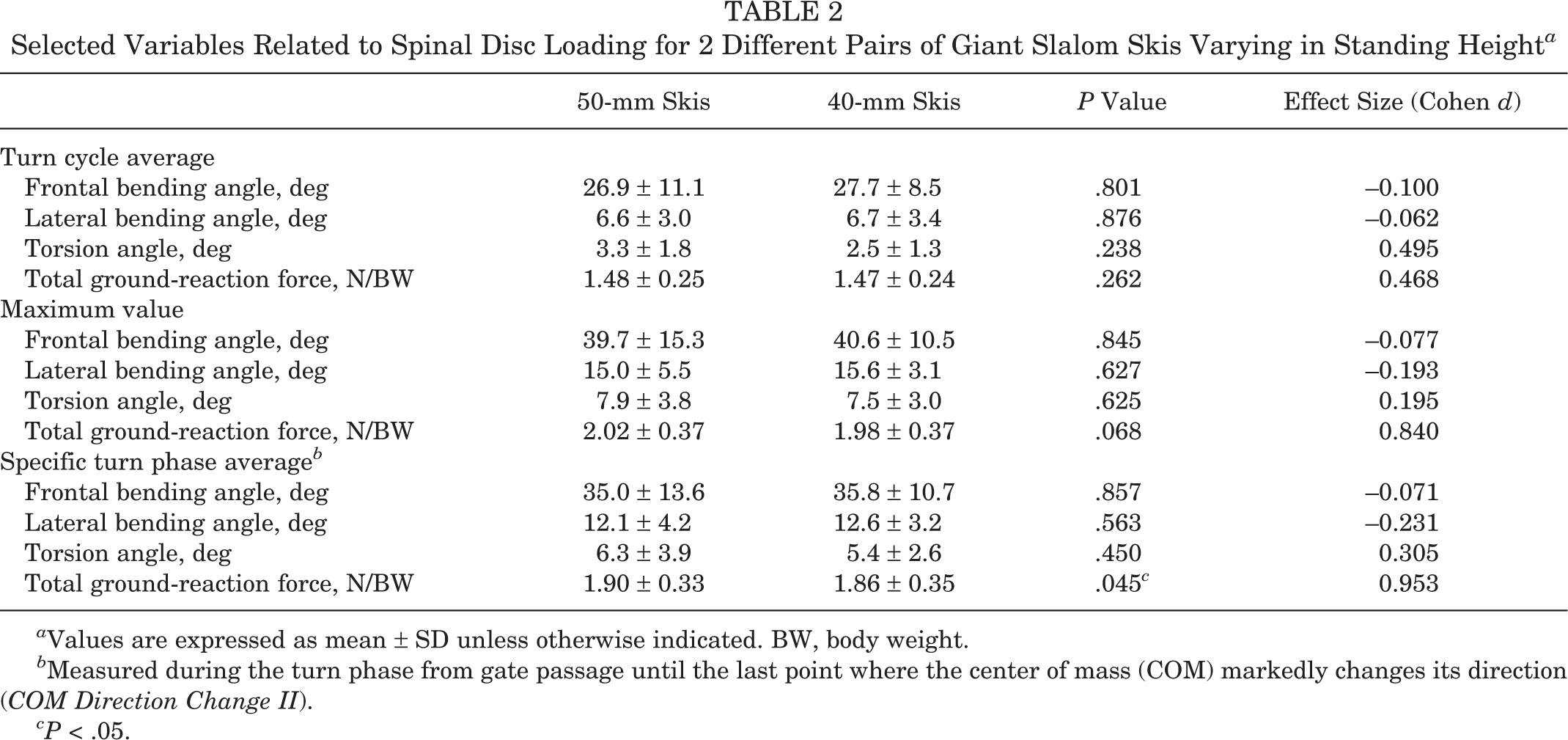
a Values are expressed as mean ± SD unless otherwise indicated. BW, body weight.
b Measured during the turn phase from gate passage until the last point where the center of mass (COM) markedly changes its direction (COM Direction Change II).
cP < .05.
Discussion
Typical Loading Patterns of the Back in Alpine Ski Racing
The overall back loading patterns observed in this study coincide with the findings of earlier experiments 23,25 : during the turn phase in which the acting ground-reaction force was the greatest (ie, COM Direction Change II), a combined occurrence of frontal bending, lateral bending, and torsion in the trunk was observed (Figure 3). Because a combination of these adverse factors is known to be associated with high spinal disc loading, 9,15,31 as well as different types of spine deterioration, 10,20 they may be important mechanisms in the development of overuse injuries of the back in alpine ski racing, as it has been suggested previously. 22,23,25 Thus, the results of this study reinforce the recommendation that prevention measures in GS should aim to control and/or reduce the magnitude of frontal bending, lateral bending, and torsion in the trunk as well as the high loads acting while skiing. 22,23,25
Standing Height as a Prevention Measure for Overuse Injuries of the Back
In view of the aforementioned aims of potential prevention measures in GS, the findings of the current study indicate that skis with a decreased standing height might help to reduce overall back loading. During the back loading–relevant turn phase COM Direction Change II (ie, the turn phase in which the greatest magnitudes of variables related to spinal disc loading are expected to occur), 23,25 mean total ground-reaction forces were observed to be 2.5% lower on skis with a decreased standing height (Table 2). Regarding the overall trunk movement components of frontal bending, lateral bending, and torsion, no significant differences were found. As lower total ground-reaction forces at almost identical trunk angles plausibly reduce resulting spinal disc loading, decreased standing height might be considered an efficient measure for reducing the risk of developing back overuse injuries in alpine GS. However, the question remains open as to what extent the positive effect of the 2.5% lower total ground-reaction forces during COM Direction Change II is diminished by the 0.7% longer duration, with which back loading–relevant forces act over an entire GS run. Because of the so far unexplored mutual relationships among the influencing parameters (ie, frontal bending angle, lateral bending angle, torsion angle, ground-reaction force magnitude, and turn cycle duration), these parameters cannot directly be offset against each other. Thus, these fundamental interrelationships need to be further investigated, and/or the effectiveness of the investigated measure “reduced standing height” must be verified by epidemiological studies, before its preventative potential can be judged as conclusive.
Regarding the a priori unclear effects on the overall trunk movement components, standing height was found to have had no substantial impact on frontal bending, lateral bending, and/or torsion angles (see Table 2). This might be explained by 2 different hypotheses. First, the theoretically expected greater body angulation was primarily achieved by anatomic regions other than the trunk, such as the hips and knee joints. In this context, a recent study reported that increased ski width brings the knee unfavorably closer to the end of the range of motion in the transverse and frontal planes. 32 As increasing the ski width will reasonably affect the height-width relationship of the ski-plate-binding unit in a similar manner to decreasing standing height, 17,32 the aforementioned findings arguably support the hypothesis of body angulation being achieved by anatomic regions other than the trunk. However, further studies should investigate the effect of decreased standing height on the kinematics and kinetics of the knee and hip joint more specifically.
Second, the observed kinematics of the trunk must be considered to be unalterable and inherent in the sport of alpine ski racing, as they might be inherent features of functional discipline-specific skiing techniques. In this and other studies, 25,26 for quite radical interventions regarding the skis’ standing height, skis’ side cut, and course setting, only marginal or no effects were observed. The only significant difference regarding the trunk kinematics reported was between the competition disciplines of GS and SL.
Finally, it must be pointed out that standing height as a reasonable prevention measure for overuse injuries of the back can only be effective if it is anchored in the FIS equipment specifications. Because of the longer turn cycle durations observed for skis with a reduced standing height in the current study and therefore lower overall skiing performance, skiers would most likely not use plates with a decreased height to minimize long-term spine degeneration on their own initiative.
Comparison With Alternative Measures
Even if statistically significant and potentially clinically relevant, the preventative effect of decreased standing height (ie, the reduction in total ground-reaction force observed in this study) should not be overestimated. For most extreme side-cut interventions in GS, for instance, total ground-reaction force reductions of approximately –4.8% to –7.0% during COM Direction Change II were reported. 14,24 In SL, total ground-reaction force reductions due to radical course setting interventions or slope inclination changes were even higher (>10%). 23,27 Compared with these magnitudes, the reductions in total ground-reaction force observed in the current study as a result of the analyzed standing height intervention seem to be rather small. Nevertheless, in view of the high forces typically acting during the entire COM Direction Change II phase (ie, up to 2.89 times the BW according to a previous study), 25 even a reduction of only 2.5% might be of clinical relevance.
Methodological Considerations
This study may be relevant to current knowledge regarding the effect of decreased standing height on the biomechanical variables related to spinal disc loading in the sport of alpine ski racing. However, when interpreting the study findings, there are some limitations that should be kept in mind: first, analyzing selected variables that are known to be related to spinal disc loading (instead of directly measuring spinal disc loading) only allows for the derivation of first clues about the effect of decreased standing height on the exact loading patterns of the back. Moreover, it cannot provide information about the 3D spinal motion at compartment levels. However, in view of the current possibilities regarding measurement technology, the complex in-field measurement conditions, and the early stage of knowledge, the approach used can be argued to be adequate.
Second, the current study only included a sample of 7 participants, with each of them performing 2 runs on an 8-turn analyzed section per standing height. At a first glance, this might be seen as a limitation of the current study, as a certain amount of variability information is missing, and therefore, the generalizability of the study findings may be restricted. However, at a second glance, the 224 representative turn cycles that were used to calculate the 14 participant/ski average curves can be considered an appropriate sample size for biomechanical in-field measurements. Under in-field conditions, the time window, as well as the maximal number of analyzable trials, is strongly limited (eg, because of changing snow conditions when performing repetitive runs on the same ski track). Thus, the current data sample represents a reasonable compromise between increasing the sample size while ensuring the validity of the outcome measures.
Third, based on the current findings, the effect of decreasing standing height even further than was done in this study remains unclear. For achieving standing heights <40 mm, riser plates between the skis and bindings would have to be entirely removed. However, removing one component of the ski-plate-binding system might affect the functionality of the entire system substantially, and unpredictable adverse side effects may occur.
Conclusion
This study explored whether decreased standing height might be a reasonable prevention measure for overuse injuries of the back in GS. Compared with the standing height actually regimented by the FIS (ie, 50 mm), skis with a 10-mm lower standing height were found to reduce occurring ground-reaction forces by 2.5%. The skiers’ trunk kinematics were not affected. Accordingly, it is also plausible that skiers’ overall back loading was effectively reduced. Even though compared with the effects of alternative measures, the preventative benefits of decreased standing height appear to be rather small, in view of the high force magnitudes present in alpine ski racing, they still may be considered clinically relevant. Nevertheless, the effectiveness of the investigated measure “reduced standing height” must be verified by epidemiological studies before its preventative potential can be judged as conclusive.
Footnotes
One or more of the authors has declared the following potential conflict of interest or source of funding: This study was financially supported by the International Ski Federation.
Ethical approval for this study was obtained from the Ethics Committee of the University of Salzburg.