




Abstract
Background:
No studies have been reported on how strength, agility, and flexibility training reduce the occurrence of hamstring injuries in sprinters. Therefore, a program for preventing hamstring injury in these athletes has not been established.
Purpose:
To document the incidence of hamstring injuries during times when different prevention strategies were employed to see whether a particular prevention program reduced their occurrence.
Study Design:
Descriptive epidemiology study.
Methods:
The study subjects were a total of 613 collegiate male sprinters trained by the same coach over 24 seasons. Tow training was used throughout the research period as a normal sprint training method. The hamstring injury prevention program evolved over time. From 1988 to 1991 (period 1), prevention focused on strength training alone; from 1992 to 1999 (period 2), a combination of strength and agility training was used; and from 2000 to 2011 (period 3), the program incorporated strength, agility, and flexibility training. The incidence of hamstring injuries was compared for each of the 3 prevention strategies.
Results:
The incidence of hamstring injuries per athlete-seasons was 137.9 for period 1, 60.6 for period 2, and 6.7 for period 3. A significant difference was observed in the incidence of hamstring injury according to the different prevention programs (χ2(2) = 31.78, P < .001, effect size: Cramer V = 0.23, 1 − β = 0.999). Residual analysis showed that the number of hamstring injuries for period 1 was significantly greater than the expected value (P < .01), whereas that for period 3 was significantly lower than the expected value (P < .01).
Conclusion:
The incidence of hamstring injuries in sprinters decreased as agility and flexibility were added to strength training.
The incidence of hamstring injury has remained about the same in recent years. 38 Hamstring injuries are particularly prevalent in football, soccer, and sprinting. 38 In a study investigating the epidemiology of hamstring injuries among student athletes in 25 types of National Collegiate Athletic Association (NCAA) championship sports over 5 seasons, 15 the incidence during competition (per 10,000 athlete-exposures) was highest for men’s indoor track (15.70), followed by outdoor track (15.39), soccer (14.69), and football (10.67). During practice sessions, the highest observed incidence was from men’s indoor track (5.93), followed by soccer (5.01), outdoor track (3.91), and football (3.82). The majority of hamstring injuries occur while the athlete is running at maximal or close to maximal speeds. 7 Of 109 runners (joggers, middle-distance runners, distance runners, and sprinters) reported by Brubaker and James, 12 hamstring injuries occurred in 12 cases; there were 9 injuries in sprinters and 3 in runners. These authors also found that 50% of all injuries in sprinters involved the hamstrings. Sprinters show a high incidence of hamstring injury. 28
In 1985, Agre 2 discussed hamstring injuries occurring while running or sprinting. He listed several possible etiological factors relating to injury to the hamstrings, including (1) inadequate flexibility of the muscles, (2) inadequate muscle strength and/or endurance, (3) dyssynergic muscle contraction, (4) insufficient warm-up and stretching before activity, (5) an awkward running style, and (6) a return to activity before complete rehabilitation. These factors are broadly accepted in the fields of practice and research. In a theoretical model, Worrell 55 suggested that a combination of abnormalities related to strength, flexibility, warm-up method, and fatigue increases the risk of hamstring injury. Devlin 17 suggested that there is a threshold above which the number of risk factors produces an injury; therefore, some factors may be more predictive of injury than others. According to Sugiura et al, 49 not only strength deficits but also neuromuscular control and flexibility problems contribute to the incidence of hamstring injuries. Since the occurrence of hamstring injury is complex and common, it has been difficult to accumulate evidence for the best method of preventing such injuries.
Most investigations of prevention of hamstring injury have focused on ball sports (soccer and football). 6,37,41,52,53 These studies have demonstrated the effectiveness of eccentric strength training of the hamstring muscles and a combination of measures to prevent hamstring injury. On the other hand, no studies have reported on the effect of hamstring injury prevention programs for sprinters.
The purpose of this study was to document the incidence of hamstring injuries in a single athletic program over time as different prevention strategies were employed, examining whether a particular prevention program could reduce the occurrence of hamstring injuries.
Methods
Subjects
The study subjects comprised 613 collegiate male sprinters (age range, 18-24 years) over 24 athletic seasons. Most of the subjects were top-ranked sprinters in intercollegiate or national championships in Japan. The sprint training program was supervised by the same coach throughout all 24 seasons. The coach also had the final decision on the sprinters’ participation in training and athletic meets. Records for training and meets of each sprinter were maintained every season. Informed consent was obtained from all subjects.
Study Periods
The total study period was the 24 seasons beginning in 1988, when supramaximal running was first introduced as a type of sprint training, through the 2011 season. One season is defined as the period from April of one year through March of the next year. The 24-year study period was divided into 3 periods according to changes in the training program. As is typical in athletics, new training methods and machines were developed and introduced, particularly in Olympic years. Period 1 covered 4 seasons (1988-1991), period 2 covered 8 (1992-1999), and period 3 covered 12 (2000-2011) (Figure 1).

Study design.
Tow training was used throughout all 3 periods. The objective of tow training with repeated episodes of supramaximal running is to improve sprint ability by producing a higher stride frequency. Supramaximal running was performed on the day after a rest day or in individual practice when muscle fatigue was considered to be the lowest. Each sprinter engaged in 2 to 5 supramaximal runs per day for 15 to 25 days per season. The number of runs for each sprinter over a season was limited to a maximum of 50.
To provide appropriate injury prevention, the coach modified the program through repeated trial and error on the field while investigating causative factors for injuries that were sustained.
Hamstring Injury Prevention Program
The injury prevention program followed by the sprinters evolved over time as established by the coach based on his judgment of the most effective strategies to prevent hamstring injuries (Table 1). Period 1 consisted only of concentric hamstring strengthening using a traditional leg curl weight machine. In period 2, agility training such as ladder and mini-hurdle exercise was incorporated into the program. Halfway through this period, a newly developed weight machine providing a concentric hip extension exercise was also introduced. In period 3, in addition to the programs taken place in period 2, eccentric hamstring strengthening exercises (Nordic hamstring lower exercise 6,37 and gluteus-hamstring raise 16 ) and dynamic stretching exercises were added. The dynamic stretching exercise consisted of walking lunge, hurdle walking forward, and hurdle walking backward. The practice of flexibility training through dynamic stretching is believed to have an effect that smoothens the sprinting motion by rehearsing the movement specific to the motion.
Description for Preventive Standard Program in Hamstring Injury

The strength exercises were performed as a part of a general weight-training program. The agility and flexibility training were performed during individual warm-ups.
Definition of Hamstring Injury
The occurrence of a hamstring injury during supramaximal running was confirmed and documented by the coach, trainers, and sports medicine doctors. Hamstring injuries were diagnosed by local tenderness, pain, and reduced range of motion on the straight-leg raise test as well as by evaluating for pain and reduced strength during resisted knee flexion while prone. 39 We defined an incident of hamstring injury as one that caused the sprinter to refrain from training or competition for at least 1 week. 11
Statistical Analysis
The number of sprinters who experienced hamstring injury for each of the 3 periods according to prevention strategy was recorded. On the basis of previous studies, 4,5,22 the injury incidence in each period was calculated as the number of hamstring injuries per athlete-seasons. The difference between the types of prevention and hamstring injury incidence was investigated using a chi-square test and residual analysis. The significance level was set at 1%.
Results
A steady decline was seen in the number of hamstring injuries over the study period (Figure 2). The incidence of hamstring injuries per athlete-seasons was 137.9 for period 1, 60.6 for period 2, and 6.7 for period 3, with the incidence decreasing significantly for each of the 3 periods (χ2(2) = 31.78, P < .001; effect size: Cramer V = 0.23, 1 − β = 0.999). Residual analysis showed that the number of hamstring injuries for period 1 was significantly greater than the expected value (P < .01), and the number for period 3 was significantly lower than expected (P < .01).
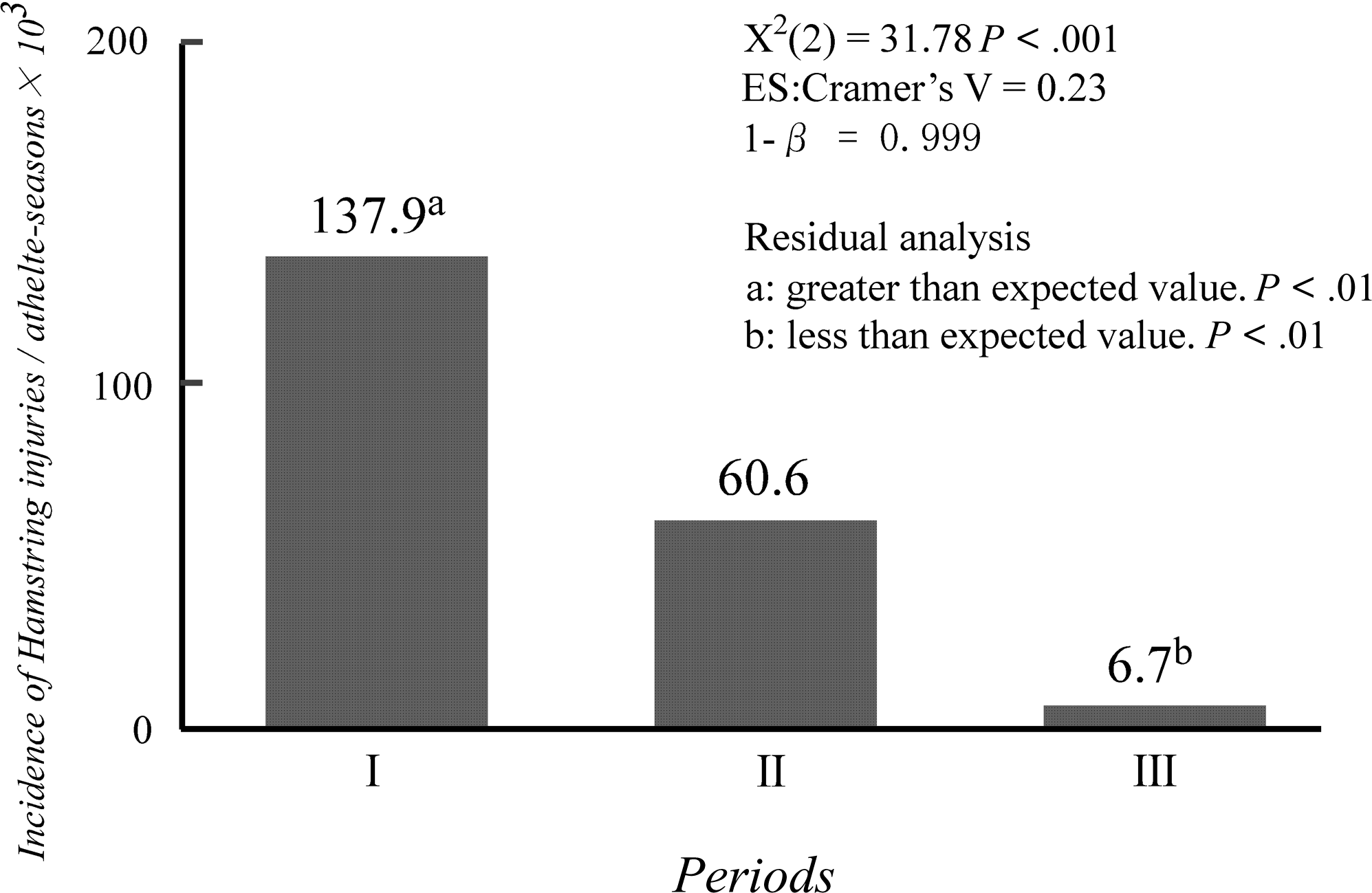
Effects of a combined prevention program on incidence of hamstring injuries. Period 1 consisted of only a strength training program. In period 2, agility training was incorporated into the strength training. In period 3, flexibility training was added to strength and agility training. The number of hamstring injuries was 16 out of 116 sprinters in period 1, 12 out of 198 in period 2, and 2 out of 299 in period 3.
Discussion
Strengths of the Study
A significant strength of this study is that all athletes were trained by the same coach over the entire 24-year study period. Therefore, with the exception of changes in the injury prevention program, all 613 sprinters were treated similarly. Also, the continued competitiveness of the team indicates that the content of the sprint training was of excellent quality.
Summary of Risk Factors for Hamstring Injuries
Understanding individual risk factors for hamstring injury is vital to developing a hamstring injury prevention program. 40 These factors are traditionally divided into internal and external categories. 40 Recently, a more appropriate grouping has been suggested, that is, modifiable and nonmodifiable, representing the complex interaction of multiple risk factors. 8,40 The most common modifiable factors are the 6 described by Agre. 2 The most common nonmodifiable factors are anatomy, previous injury, age, and race. 27
Effects of Adding Agility Training and Hip Extension Exercise on Hamstring Injury Rate
From the late-swing phase to the early-contact phase during running at full speed, the hamstring is required to switch rapidly from eccentric to concentric contraction in the stretch-shortening cycle 45 –47 while under the influence of the contractile activity of the quadriceps femoris muscle. Therefore, neuromuscular coordination plays an important role in this activity. A hamstring muscle injury is conjectured to occur when there is muscular dyssynergy such as a disorder in the timing of the contraction from the late-swing phase to the early-contact phase. 2
During supramaximal running, it is possible to achieve a higher stride rate than with maximal running. However, the excessive stride rate increases the possibility of hamstring injury. Mero and Komi 34 –36 have pointed out that adequate neuromuscular performance is important for supramaximal running. Agility training is practiced to “learn” the rapid motion required at a supramaximal level of running. Sprinters who practiced with ladders and mini-hurdles exhibited rapid stepping at a rate equivalent to or faster than the stride rate observed (4.00-4.76 steps/s) during supramaximal running. 48 Moreover, it is reported that the activity of the cerebellum, which plays a primary role in motor learning, is correlated with movement velocity. 20,30 It is likely that muscle synergy adapted to high-level sprinting can be acquired by sprinters through the use of ladders and mini-hurdles. This could explain why we observed a decrease in the number of hamstring injuries during supramaximal running when agility training was added in period 2.
When sprinting, the function of the hamstrings in the late-swing phase is that of concentric hip extension to quickly swing the thigh back 1,29 while also contracting eccentrically in flexing the knee to decelerate the forward swing of the lower leg. 1,29,45 In the early-contact phase, the hamstring functions to minimize the loss of running speed by acting as a concentric knee flexor and hip extensor, enabling the body’s center of gravity to shift forward smoothly. 29,45 The hamstrings must generate a large amount of power in these phases to maximize speed during sprinting. 1,13,29 These high forces have been postulated to relate to the hamstring injuries commonly seen in sprinters.
There are many studies investigating the causative factors of hamstring injuries from the perspective of leg strength. The relationship between insufficient hamstring strength during eccentric contraction and the occurrence of hamstring injury has been highlighted. 42,46 However, Sugiura et al 49 reported that insufficient muscle strength in the concentric action of the hip extensors may also contribute to hamstring injury. It may be important to assess the concentric strength of the gluteus muscles, as they work with the hamstrings to extend the hip. 33
The aim of strength training is to improve the muscle’s ability to respond to high-intensity (force) activity when the hamstring contracts concentrically. During periods 2 and 3, all sprinters in our study strengthened their hamstrings by hip extension exercises. This facilitated adaptation to supramaximal levels of power during supramaximal running. As a result, it is likely that the number of hamstring injury cases that occurred decreased.
Effects of Adding Nordic Hamstring and Dynamic Stretching Exercises on Hamstring Injury Rate
Epidemiological evidence suggests that the actual injury often takes place during eccentric contraction of the hamstring muscles. 18,25,47 More specifically, it has been suggested that it is the portion of eccentric hamstring contraction occurring during the descending limb of the muscle’s length-tension relationship that results in injuries. 11 Sprinting requires multiple episodes of eccentric contraction in the late-swing phase, during which the hamstring muscles generate tension while lengthening (eccentric contraction) to decelerate knee extension. 19,43 Increasing the eccentric contraction strength of the hamstrings, achieved by lengthening the hamstring complex while it is loaded and contracting, has therefore been proposed as a method to prevent hamstring injuries. 10,14,51
Nordic hamstring exercises have been shown to be effective in increasing eccentric hamstring strength, developing higher maximal eccentric hamstring torques than is possible with leg curls. 37 The aim of this type of strength training is to increase the strength of muscles that can respond to high-intensity (force) activity with eccentric hamstring contraction. As with strengthening concentric contraction, strengthening eccentric contraction may also contribute to a decrease in injuries.
Flexibility is an intrinsic property of body tissue, and it determines the range of motion at a joint or group of joints achievable without injury. 21 Increases in joint ranges of motion are associated with decreases in passive resistance to stretching. This decrease in resistance can be described as a decrease in muscle stiffness or an increase in muscle compliance. 32 Alonso et al 3 reported that when hamstring flexibility decreases, the length of the hamstring during generation of peak torque becomes shorter. Also, Brockett et al 10 proved that short muscle length during the generation of peak torque is a risk factor for hamstring injury. Therefore, a decrease in flexibility can contribute to hamstring injury.
The purpose of stretching before an athletic event or training is to ensure that the individual has sufficient range of motion in his joint to perform the athletic activity optimally and to decrease muscle stiffness (or increase muscle compliance). Theoretically, risk of injury is thereby decreased. Stretching is therefore intended to enhance performance while decreasing the risk of injury. 32,50
There are several methods by which to improve flexibility, including static and dynamic stretching. Although there is a difference in degree, flexibility improves with whichever kind of stretching is used. Bandy et al 9 described improved hamstring flexibility with dynamic stretching. However, there are almost no studies demonstrating the relationship between improved flexibility through stretching and a decrease in the incidence of injury. 23,24 Stretching has not yet been demonstrated to decrease injury.
Meanwhile, in research investigating the effects of stretching on performance, the practice of static stretching has been demonstrated to have a potentially negative impact on performance directly after stretching. 44,54 In contrast, dynamic stretching has been considered to have a positive effect on performance and has recently been endorsed as a replacement for static stretching. 26,31 It is recommended that dynamic stretching be done “as fast as possible” before the performance. 56
With respect to the effect of stretching on injury risk, McHugh and Cosgrave 32 suggested that decreased passive resistance to stretching and hamstring injuries were somewhat interrelated. Dynamic stretching is conjectured to prevent hamstring injury while also assisting athletes to achieve a high level of performance. The practice of dynamic stretching is potentially effective as a method of preventing hamstring injuries.
Comparison With Other Studies on Prevention Programs in Soccer and Football Players
Recent studies have demonstrated the effectiveness of Nordic hamstring exercises. Mjølsnes et al 37 examined the effects of the simple eccentric Nordic hamstring lower and compared it to leg curls in well-trained soccer players. They found a remarkable increase in eccentric torque production after 10 weeks of eccentric strength training. Petersen et al 41 investigated the preventive effect of eccentric strengthening of the hamstring muscles using the Nordic hamstring exercise compared with no additional hamstring exercise on the rate of acute hamstring injuries in professional and amateur male soccer players. These authors concluded that Nordic hamstring exercises decreased the rate of hamstring injuries. However, it is still unknown whether these results can be generalized to other sports. The majority of hamstring injuries occur while the athlete is running at close to maximal speeds. 7 In our study, the supramaximal running speeds in sprinters were certainly higher than those required in other sports. The hamstring in sprinters contracts very rapidly to generate a large amount of power during full-speed running. 49 Therefore, the similarity of our findings to those performed in soccer players may suggest that this type of Nordic hamstring exercise in an injury prevention program can be useful in any sport with a high risk of hamstring injuries.
Arnason et al 6 concluded that eccentric strength training with Nordic hamstring exercises combined with warm-up stretching in top-league soccer teams appears to reduce the risk of hamstring injuries, yet no effect was detected from flexibility training alone. Verrall et al 53 observed a significant reduction in the incidence of hamstring injuries in Australian rules football with a 3-component prevention program including anaerobic interval training, stretching while the muscle is fatigued, and implementing sport-specific training drills. However, these authors cautioned that the reduction in injury should not be attributed to any particular component. Their program was accompanied by the concept that the athletes should train as if they were playing the game, and they believed that this was largely responsible for decreasing injuries. Likewise, our final program of hamstring injury prevention in period 3 employed 3 particular strategies, that is, strengthening, agility, and flexibility for hamstring muscles. Although each component of our prevention program might potentially have decreased the hamstring injury rate, we do not believe a single exercise in isolation was the reason for the beneficial effect we observed. Along with Verrall et al, 53 we agree that it is not possible to determine which factors are directly responsible for the observed effect. Nevertheless, the marked decrease in injuries we observed with modification of the program over the 24-year study period is very encouraging.
Limitations
This study focused on addressing only 3 of the 6 modifiable factors described by Agre 2 to be involved in hamstring injury, namely inadequate strength, dyssynergic contraction, and inadequate flexibility. The other 3 factors were not specifically addressed in this study, even though they may have been taken into consideration during practice. Our study was unable to address nonmodifiable factors possibly contributing to hamstring injury, such as anterior pelvic tilt, fiber-type distribution, and previous injury, 38 as well as other potential confounders. In addition, the introduction of several prevention strategies at the same time did not allow us to determine the relative effect on injury reduction of each element of the prevention program.
Conclusion
The incidence of hamstring injuries in sprinters decreased as agility, further strength exercises, and flexibility were incorporated into a prevention program that already included strength training. Future study of risk factors and prevention program should be prospective, particularly aiming to establish a cause-and-effect relationship. Such studies should control for nonmodifiable risk factors and ideally should include both control and experimental groups.
Footnotes
The authors declared that they have no conflicts of interest in the authorship and publication of this contribution.
Ethical approval for this study was obtained from the human ethics committee of Juntendo University.