




Abstract
Background:
There has been a significant amount of research in the prevention of throwing injuries. However, one area of research that is lacking is geographic location of play. Warm climates may permit year-round play and increased exposure to throwing arm injury risk.
Hypotheses:
(1) Pitchers from southern institutions would have greater rates of ulnar collateral ligament reconstruction (UCL-R) compared with pitchers from northern institutions. (2) Pitchers originating from high school teams in warm weather states would have a greater risk of undergoing UCL-R while in college.
Study Design:
Descriptive epidemiological study.
Methods:
This study was completed by reviewing publicly obtained records of male collegiate baseball players during the 2008 through 2014 seasons. Data were accessed through online search engines, online baseball media guides, and school websites.
Results:
A total of 5315 player-years and 2575 pitcher-years were identified. Fifty-eight UCL-R cases were found in collegiate pitchers, 40 of which occurred in the Southeastern Conference (SEC) and 18 in the Big Ten. More injuries (36/58) occurred in pitchers who participated in high school baseball in southern states as compared with northern states (22/58), regardless of location of collegiate participation (χ2 = 28.8, P < .05). The injury rate for pitchers who participated in high school baseball in southern states was 25.3 per 1000 player-years versus 19.1 per 1000 player-years in northern states, with a risk ratio of 1.32 (χ2 = 0.89, P = .35). The injury rate for the SEC versus Big Ten pitchers was 13.3 per 1000 player-years versus 7.8 per 1000 player-years, with a risk ratio of 1.71 (χ2 = 1.45, P = .23).
Conclusion:
There is a greater likelihood of undergoing UCL-R in the SEC compared with the Big Ten. There is also an increased risk for UCL-R for pitchers who played high school baseball in southern states versus northern states, irrespective of collegiate play location.
Clinical Relevance:
Pitchers originating from high schools in a warm weather climate may be more likely to undergo UCL-R.
There are over 10,000 baseball players on nearly 300 teams in National Collegiate Athletic Association (NCAA) Division I baseball 14 and nearly 500,000 high school–aged baseball players in almost 16,000 schools in the United States. 15 Rates at which adolescent baseball players sustain shoulder and/or elbow pain ranges from 17% to 45% 1,10 in a single season. Additionally, the elbow is the second most common joint to be injured in adolescent baseball players. 20
There has been a significant increase in the number of ulnar collateral ligament reconstruction (UCL-R) surgeries (commonly termed “Tommy John surgery”) in adolescent and high school–aged baseball players in the past 15 years. 4,18 Much of the increased UCL-R trend has been attributed to overuse due to excessive volume of pitching and throwing. 11,18 The culture of baseball has evolved to include year-round training, simultaneous participation on multiple teams, and participation in showcase events, all of which contribute to the etiology of overuse injuries. Overuse injuries are detrimental to young pitchers as these injuries can lead to surgery, missed playing time, and can affect career potential. 17 In a 10-year retrospective study, investigators quantified the cumulative incidence of throwing injuries in youth baseball pitchers (N = 481; age range, 9-14 years) on the basis of cumulative innings thrown per year. Participants who pitched more than 100 innings in 1 year were 3.5 times more likely to suffer an overuse throwing injury. 5 Other research has shown an association of throwing arm injuries with range of motion deficits in comparison with the nondominant arm in the shoulder and elbow. 8,21,23 UCL-R carries significant functional and career implications as well. A recent study showed that more than half of Major League Baseball pitchers who underwent UCL-R returned to the disabled list and that their performance declined across multiple pitching performance parameters compared with preinjury levels. 12 While there has been a significant amount of research in the prevention of throwing injuries, 1 factor that may contribute to the incidence of overuse throwing injuries is geographic location where a pitcher played high school baseball prior to pitching at the collegiate level. Warm climates may permit year-round play and increased exposure to throwing arm injury risk, whereas northern climates may restrict the participation in throwing and have lower injury risk. The purpose of this study was to perform an exploratory comparison of UCL-R prevalence in collegiate pitchers from institutions in southern and northern climates. We hypothesized that pitchers from southern institutions would have greater rates of UCL-R compared with pitchers from northern institutions. We also hypothesized that pitchers originating from high school teams in warm weather states would have a greater risk of undergoing UCL-R while in college.
The significance of this study lies in its potential to reveal geographic climate factors that may predispose collegiate pitchers to an increased risk for incurring UCL-R.
Methods
Study Design and Population
This is an exploratory retrospective study of male collegiate baseball pitchers that was approved by our institutional review board. Publicly obtained records of male Division I collegiate baseball pitchers in the Big Ten and Southeastern (SEC) conferences during the 2008 to 2014 seasons were reviewed for this study. Data were accessed through online search forums (www.google.com and www.bing.com), university websites, and online annual baseball media guides. Key terms used for the search included elbow, injury, Tommy John, ulnar collateral ligament, and surgery. Additionally, cross-referencing was performed by using university athletic websites, university baseball annual media guides, online newspaper aricles, and media publications occasionally. Data points chosen for this analysis included the following: institution, conference, year of UCL-R, hand dominance, total players and pitchers per season, and the state in which the player completed high school. The pitcher’s residence for high school baseball was reviewed and classified into “north” or “south.” For consistency, only the Division I institutions that were part of the 2 conferences since 2008 were included in the study. The data search was performed by 2 of the authors (J.L.Z., R.M.D.). The 2 reviewers were blinded to each other’s data and arrived at similar conclusions.
Definition of North Versus South States
Northern versus southern state delineation was based on a mean temperature of >12.8°C (55°F) (the only exception was New Mexico at 11.8°C [53.2°F], which was considered a southern state). Southern states included Alabama, Arizona, Arkansas, California, Delaware, Florida, Georgia, Hawaii, Kentucky, Louisiana, Mississippi, New Mexico, North Carolina, Oklahoma, South Carolina, Tennessee, Texas, and Virginia. Temperature data were based on the National Oceanic and Atmospheric Administration (NOAA) Climate Diagnostic Center (Figure 1). The authors chose this method to delineate northern versus southern states as an objective method given that temperature, as well as ice and snow, play a major role in the ability to play baseball outside and for a longer period of time each calendar year. 16 Erickson et al 3 defined north versus south based on where the average January temperature was above 0°C (32°F). Thus, our study had 18 warm-weather states as opposed to the study by Erickson et al, 3 which had 13 warm-weather states but included areas outside the United States (eg, Domincan Republic). States considered as warm-weather states in our study not included in the previous study were Delaware, Kentucky, North Carolina, Tennessee, and Virginia. The mean annual temperature (using NOAA data) is 16.8°C (62.2°F) in the SEC versus 9.1°C (48.4°F) in the Big Ten conferences (P < .001) (Figure 2).

Map of northern versus southern United States based on climate criteria.

Mean annual temperature between the Southeastern Conference (SEC) and the Big Ten conferences.
Definition of Player- and Pitcher-Years
The number of listed players per year was summed and resulted in the total number of player-years. The same procedure was performed for pitchers. A subset analysis based on geographic listing of high school play was used to divide baseball players into northern or southern groups based on our north versus south definition, as stated above.
Statistical Analysis
Statistical analyses were performed by using the Statistical Package for the Social Sciences (v 21.0; IBM Corporation) software. Descriptive statistics and frequencies were obtained to characterize the study groups. A chi-square test was used to determine whether a difference existed between the proportion of pitchers from warm weather climates that underwent UCL-R and the proportion of pitchers from cold weather climates that underwent UCL-R. Significance was established for statistical analysis a priori at an alpha level of .05.
Results
Population Characteristics
A total of 3002 and 2313 player-years were identified from the SEC and Big Ten conferences, respectively. There was a total of 1457 and 1118 pitcher-years in the SEC and Big Ten, respectively, used in this analysis. In the SEC, 87.7% of the pitchers played their high school baseball in southern states (1279/1457 pitcher-years), whereas in the Big Ten, 87.2% (975/1118 pitcher-years) played high school baseball in northern states. There were a total of 1153 pitcher-years that were listed from players as participating in high school baseball in northern states and 1422 in southern states, irrespective of which conference they pitched in in college (Table 1).
Player-Years From Each Conference With Subsets of Total Pitcher-Years in College and Total Pitcher-Years Based on Geographic Play in High School a

a There are 12 schools in the SEC conference and 10 schools in the Big Ten. HS, high school; SEC, Southeastern Conference.
Identification of UCL-R
There were a total of 40 pitchers from the SEC who underwent UCL-R while pitching in college compared with 18 pitchers from the Big Ten. In addition, more players originating from southern high schools underwent UCL-R than players originating from northern high schools, regardless of location of collegiate participation (36 vs 22 UCL-R; χ2 = 28.8, P < .05) (Table 2).
Chi-Square Analysis of UCL Reconstruction of Collegiate Pitchers Based on Geographic Location of Play in High School a
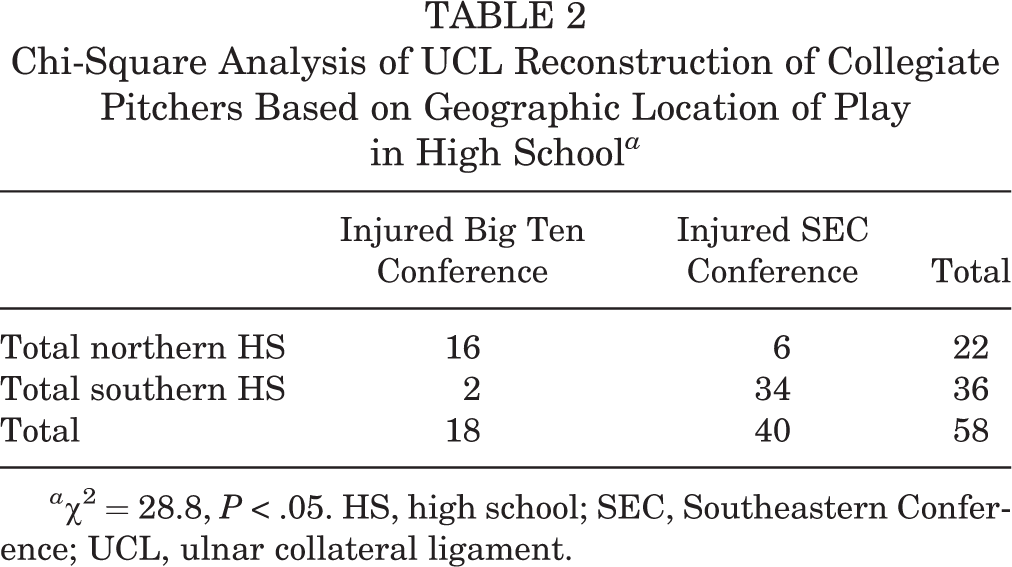
a χ2 = 28.8, P < .05. HS, high school; SEC, Southeastern Conference; UCL, ulnar collateral ligament.
Injury Risk by Geographic Climate
Injury risk by conference was 13.3 per 1000 player-years in the SEC versus 7.8 per 1000 player-years in the Big Ten. The risk difference between the 2 conferences was 5.5%, with a risk ratio of 1.71 (χ2 = 1.45, P = .23) (Table 3). The total injury rate among the dataset is 58 per 5315 player-years, or 10.9 per1000 player-years. Regardless of location of high school play, there was an increased risk of undergoing UCL-R in the SEC compared with the Big Ten. Furthermore, regardless of location of conference play, there was an increased risk of undergoing UCL-R if high school baseball was played in a southern state versus a northern state (Table 2). The risk difference pitching in a southern state in high school is 6.2% higher compared with pitching in a northern state in high school, with a ratio of 1.32 times increased rate of UCL-R (χ2 = 0.89, P = .35) (Table 4).
Injury Risk by Conference a
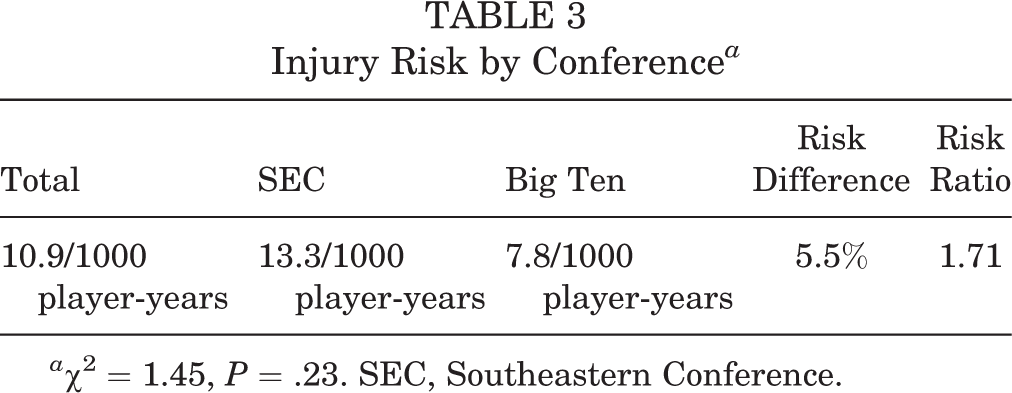
a χ2 = 1.45, P = .23. SEC, Southeastern Conference.
Injury Risk Based on Location of High School Play a
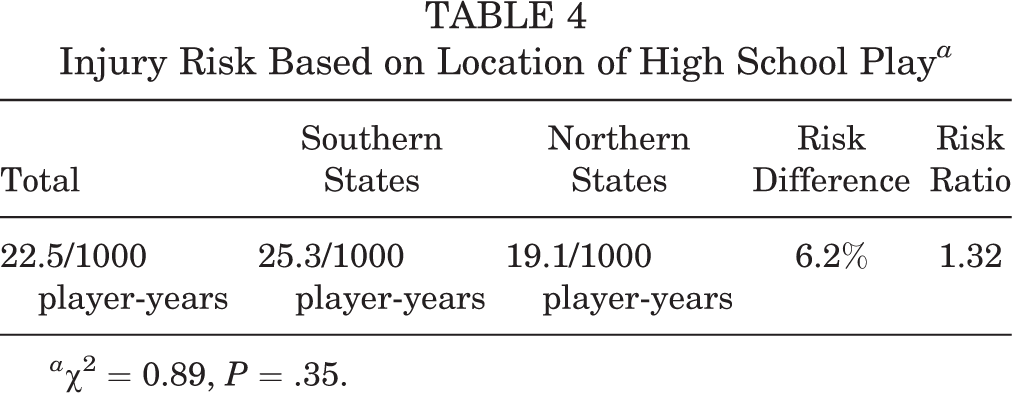
a χ2 = 0.89, P = .35.
Discussion
There is an emerging epidemic of UCL rupture at all levels of play, including professional, high school, and youth baseball. 11 We sought to determine whether playing high school baseball in warm weather areas led to an increase in the likelihood a pitcher would undergo UCL-R once in college. Additionally, it was our goal to determine whether playing collegiate baseball in the south would lead to an increase in the likelihood a pitcher would undergo UCL-R, irrespective of geographic location of high school play. The data collected in this study supported our hypotheses that the geographic location of the athlete is a risk factor in UCL injury and subsequent UCL-R. Pitchers who played high school baseball in warm climates were more likely to undergo UCL-R than pitchers who played high school baseball in cold weather climates.
Risk factors for overuse throwing injury include pitches per game, innings pitched per season, months pitched per year, pitching for multiple teams at the same time, lack of rest periods, and pitching while fatigued. 4,5,9,19 Fleisig et al 5 followed 481 youth pitchers for 10 years and noted that players who pitched more than 100 innings in 1 calendar year had a 3.5 times greater chance of sustaining a serious injury. Another study analyzing shoulder and elbow pain in youth pitchers revealed that pitch counts greater than 75 resulted in a 50% increase in dominant elbow pain. 10 Given that there is an increased ability to play baseball year-round in warmer climates, we examined differences in prevalence of UCL-R in major NCAA Division I collegiate conferences between programs of northern and southern climates and determined whether different rates of UCL-R exist in collegiate pitchers based on their geographic location of high school play.
As a retrospective study, we did not have access to the number of pitches thrown, innings pitched, or rest periods during high school or travel team seasons. Thus, we cannot conclusively state that pitchers from the southern institutions threw more in a single calendar year than pitchers from northern institutions. Our and others’ data raise the question of whether a pitcher has a finite number of innings he can throw before he is predisposed to an elbow injury. 3 Erickson et al 3 suggested that conserving these innings as an adolescent and high school pitcher may reduce the likelihood of a UCL injury. However, our data indicate that even in high school, if one is pitching in a warm weather climate, he is at an increased risk of having a UCL-R. One possibility is that there is an increased likelihood of pitching while fatigued in warm climates. Pitching with arm fatigue increases the risk for injury up to 36 times in adolescent pitchers compared with pitching with no fatigue. 17 These findings have been available for almost a decade, and yet the 2014 study by Makhni et al 12 has shown that these findings have not influenced our young athletes. Adolescent pitchers continue to pitch with pain, with nearly half of all pitchers in this study being encouraged to keep throwing despite having arm pain. This pain may be indicative of a precursor to potentially significant throwing injuries. 13,17
Data on the topic of climate and overuse throwing injuries are scarce. One study has found evidence of the impact climate has on range of motion. 7 Another study has assessed glenohumeral range of motion in professional baseball pitchers, noting that pitchers with differences in shoulder range of motion had a significant increase on the risk for elbow injuries in pitchers. 23 The most recent and comparable study to ours by Erickson et al 3 included more “southern” data as they included a population of players outside the United States (eg, Dominican Republic) whereas our study focused on the United States only. Thus, some borderline states might have had an increase in UCL-R numbers in our study that would not be included in the study by Erickson et al. 3
As baseball has become a year-round sport, especially in warmer parts of the United States, the USA Baseball Medical and Safety Advisory Committee developed youth baseball pitching guidelines to help reduce throwing injuries. The committee made position statements on recommendations for pitch counts, innings pitched, and rest periods in adolescent and high school–aged throwers. 22 More recently, Major League Baseball has endorsed these guidelines and developed an online website to assist parents, players, and coaches to reinforce the principles of overuse injury prevention in throwers by providing information on the aforementioned pitching guidelines, risk factors, frequently asked questions about Tommy John surgery, and resources for all. 11
Limitations
Our study has several limitations. We used publicly available data and we acknowledge that there may have been injuries and reconstructions that occurred and were not included in this study. However, reporting on this topic using this method has been shown in recent studies to be reliable. 2,3 We used the high school listed to define north versus south for participation in high school baseball; however, it is possible that a pitcher changed residences during their high school playing career. UCL injuries from 2008 to 2014 that did not require reconstructive surgery would be absent from the sources queried, thus limiting our dataset. Another potential nonvalidated presumption is that based on longitudinal success of baseball in the SEC versus Big Ten, there is a perception that pitchers being recruited to SEC schools may throw harder than pitchers at Big Ten schools. If the presumption is true, then peak and average throwing velocity may be another contributing factor and may have inadvertently biased the data on injury rate. Finally, we do not have an accurate count on participation exposures in terms of pitches thrown per game and season during high school and/or college competition.
Conclusion
This initial analysis revealed that collegiate pitchers from the SEC may be more likely to sustain an injury resulting in a UCL-R compared with the Big Ten. Additionally, pitchers who played high school baseball in southern states were more likely to undergo UCL-R than pitchers who played high school baseball in northern states. Practitioners, athletic trainers, and coaching staff that coach and care for pitchers need to be aware of these findings when designing pitching and throwing programs based on location of high school play. It is our contention that previous playing exposure should be considered when designing throwing and strengthening programs for pitchers, especially in starting pitchers where volume of pitches and innings thrown is increased compared with their relief pitcher counterparts. In fact, a recent study has looked at this exact question and revealed that after UCL-R at the Major League level, relief pitchers were able to resume 50% of their preinjury pitch workload, while starting pitchers only reached 35% of their prior workload. Relievers also demonstrated better earned run average, strikeouts per 9 innings, and walks per 9 innings when compared with starters. 6 This suggests that starting pitchers may be at greater risk for treatment failure given the increased demands of the number of pitches thrown as a starting pitcher. Consequently, reducing the volume of throwing, especially at younger ages, may prevent UCL injuries in pitchers.
Footnotes
The authors declared that they have no conflicts of interest in the authorship and publication of this contribution.