




Abstract
Background:
The perception high school athletes have regarding concussions may influence their injury-reporting behavior, and if their perceptions are based on incorrect or incomplete information, they may be at risk for subsequent head injuries.
Purpose:
To determine whether the recent influx of concussion information has had a positive impact on high school athletes’ knowledge of concussions, to determine their perceptions regarding the severity of a concussion injury, and to determine whether receiving correct information will potentially alter their future reporting behavior.
Study Design:
Cross-sectional study; Level of evidence, 4.
Methods:
A total of 454 high school athletes (212 females, 242 males; mean age, 15.7 ± 1.15 years) from 6 different schools participated in an anonymous survey. The researchers met with teams individually at their high schools to collect data and provide an educational intervention regarding sports-related concussions. The survey questions assessed the athletes’ personal injury histories and perceptions and knowledge of the severity of concussion injuries.
Results:
There was a difference in the number of athletes who reported having their “bell rung” (n = 297) versus the number of athletes reporting at least 1 concussion (n = 172) (t (453) = −11.60, P = .000, d = −0.54). There was also a difference in the number of athletes who reported a history of at least 1 concussion at the beginning of the study session (n = 172) versus the number of athletes who reported at least 1 concussion at the end of the session (n = 292) (t (453) = −12.018, P = .000, d = 0.732). Fifty percent of athletes also stated that the importance of a game/event should dictate when they return to play.
Conclusion:
High school athletes continue to fail to realize when they have sustained a concussion. Additionally, athletes lack understanding regarding the severity and seriousness of a concussion. A better effort at formalized education must be made if the culture of sports is to change.
Clinical Relevance:
Allied health care professionals need to continue to put forth a great effort in educating all student athletes on what a concussion is and the dangers of a concussion injury. Preseason meetings should be used as an opportunity to provide formalized education to all student athletes.
During the 2012-2013 school year, an estimated 7.7 million athletes participated in high school athletics in the United States. 26 This figure continues to increase every year, and as the numbers continue to rise, so will injury rates. For the age group of 15- to 24-year-olds, sports are the second leading cause of traumatic brain injuries, making up approximately 9% to 15% of all high school athletic injuries. The most common sport associated with concussions is football, constituting 40% to 50% of all concussion injuries. Football is typically followed by women’s and men’s soccer, respectively. 11,19,23 The high incidence rates of concussion and the dangerous potential consequences have resulted in a public outcry for better protection for youth athletes.
There is a vast body of knowledge currently available on sports-related concussion ranging from mainstream media to high-caliber research conducted by medical researchers. There is a general consensus that the number of overall concussions sustained must be reduced. Articles are published via mainstream media outlets daily; however, the information may be incomplete or inaccurate. Providing partial or incorrect information may lead to a poor understanding of concussion management among athletes, coaches, and parents. Little has been done to assess whether this influx of information has had a positive effect on high school athletes’ perceptions, knowledge, and attitudes toward concussions.
The perceptions high school athletes have regarding concussions should be of critical importance because of their increased susceptibility to second-impact syndrome, 5,29,35,39 the potential for short- and long-term complications, 4,27,28 and their lengthened recovery time when compared with the adult population. 10,31,33 Athletes must be educated on proper concussion management to ensure a safe return-to-play (RTP) protocol is followed from the immediate onset of injury until they return to the field of play. This increase in knowledge has the potential to promote a more safety-conscious environment in the world of sports.
Previous research has suggested high school athletes have a poor understanding of the severity of concussions and the potential associated sequelae. 22 In a 2004 study, McCrea et al 20 found that 53% of high school football players did not report their concussions. This anonymous survey, evaluating high school football players’ rationales for their lack of concussion reporting, revealed 66% of these athletes did not report because they did not believe it was serious enough to warrant medical attention. 20 Sye et al 36 found that approximately 50% of their participants would RTP following a concussion without physician consent, and 22% would RTP against physician orders. This same study revealed that 27% of high school athletes believe the importance of a game should affect RTP decisions. 36 What we have seen, based on previous research, is a lack of understanding on the athletes’ part regarding the severity of a concussive injury. 8,16,20,22,36,41 However, since concussions have become more mainstream, has the perception high school athletes have regarding concussions and their serious nature changed? The purpose of our study was to determine high school athletes’ current attitudes and beliefs regarding sport-related concussions, to determine whether they understand the critical nature of this injury, and to determine whether receiving correct information regarding concussive injuries will alter their reporting behavior.
Methods
Participants
We collected data on 454 (212 females, 242 males; mean age, 15.7 ± 1.15 years) high school athletes from 1 school district. The data for athletes who were involved in multiple sports throughout the school year were not included for analysis if they attended a second session. For example, if a football player was also a basketball player, only the data collected from their football session were included for analysis. The 10 different sports for which data were collected included football, cheerleading, boys’/girls’ soccer, boys’/girls’ basketball, wrestling, volleyball, and boys’/girls’ lacrosse.
Parental/guardian consent was obtained for minor athletes, and all participants signed an approved informed consent document before data collection. Our study was approved by our university’s institutional review board, the high school district, and the high school district’s traumatic brain injury team.
Procedures and Data Collection
We scheduled individual team meetings with the high school coaching staffs and traveled to the different schools to collect data and provide an educational lecture. These meetings were held in either classrooms or team rooms at the high school.
Participants were randomly provided an iClicker (Macmillan), an audience polling system, for data collection purposes. To ensure anonymity, iClickers were not assigned to specific students. The iClickers allowed students to submit a response (A, B, C, D, or E) to the questions asked, and all responses were totaled and collected in the primary investigator’s computer.
The customized survey questions were asked to obtain background information, previous medical history (PMH), and inquiry into the athletes’ personal perceptions and knowledge of concussions. Following the questions regarding concussion perception, we provided a brief educational summary regarding specific aspects of concussions. The construct validity of our survey was determined by providing our survey to 2 different groups for comparison analysis: a group of college students with no formalized education in concussion injuries and a group of senior-level athletic training students with formalized concussion education and training. The survey scores were compared between the 2 groups using a t test, and the senior-level athletic training students had a significantly higher mean rank (t (19) = 5.0, P = .000, d = 0.88).
The reliability of the instrument was assessed using a test-retest Pearson coefficient, r. A group of 15 college students participating in an introductory human movement science course were asked to complete the survey and were asked to take the same survey 12 days later. The educational lecture was not given to this population; however, students did score slightly higher on the retest (7.1) compared with the original test (6.9). There was still a high correlation between testing dates (r = 0.656).
Educational Lecture
The educational lecture was conducted via PowerPoint (Microsoft Corp) presentation, and the same information was provided for all teams. The entire educational session lasted approximately 25 minutes. The questions for data collection purposes were included directly into the PowerPoint lecture, thus allowing for better audience engagement. All sessions began with collection of background information from participants. Following these baseline questions, participants were asked their personal perceptions/knowledge regarding specific areas of concussion. Following specific questions, we provided basic information regarding that specific topic area of concussion. For example, after participants answered the question “Do you believe concussions would have an impact on your learning/education?” we provided basic information on how concussions may impact their academic performance. The following topic areas were included in the educational lecture: mechanism of injury, signs/symptoms, long-term side effects, impact on education/learning, baseline testing, and RTP protocols. Information for the educational lecture was derived from current research and position/consensus statements.
Statistical Analysis
We analyzed data using SPSS software v18 (SPSS Inc). Descriptive statistics were used to analyze a majority of the variables collected. Separate t tests were performed to determine whether there was a significant difference between athletes who reported having their “bell rung” (referring to when someone receives such a large blow to the head that a ringing noise is perceived or he/she feels as if in a foggy state) and a previous concussion injury and to determine whether there was a difference between the total number of concussions participants believed they sustained at the beginning of the lecture and the number they believed they sustained at the end of the lecture. An analysis of variance and t tests were also used to determine whether sex, age, or sport correlated with the belief the importance of a game should dictate RTP. Statistical significance was established a priori as α ≤ .05.
Results
The descriptive statistics are presented in Table 1. A paired-samples t test determined that there was a significant difference between the number of athletes who reported having their “bell rung” and the number of athletes who sustained a concussion (t (453) = −11.60, P = .000, d = −0.54). A paired-samples t test also determined that there was a significant difference between athletes’ self-reported PMH of concussions at the beginning of the educational lecture and their PMH at the completion of the lecture (t (453) = −12.018, P = .000, d = 0.732). Table 2 describes concussion history by sport. Tables 3 and 4 illustrate the breakdown of teams’ beliefs regarding the importance of a game/event on RTP decisions. A majority of athletes believed that the importance of game should have an impact on the RTP decision, whereas a smaller percentage indicated a game is not an important factor in making RTP decisions.
Descriptive Statistics on Concussion Perspectives

Reported Number of Sustained Concussions by Sport a
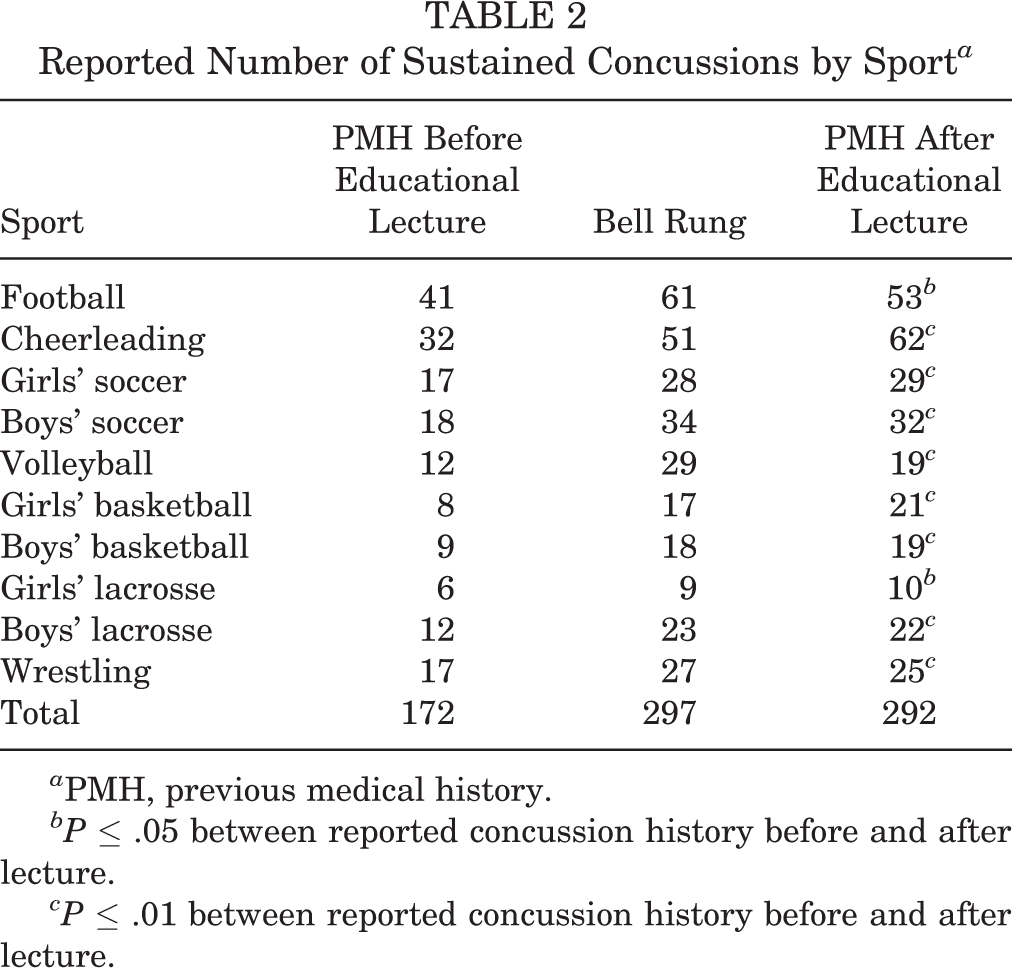
a PMH, previous medical history.
bP ≤ .05 between reported concussion history before and after lecture.
cP ≤ .01 between reported concussion history before and after lecture.
Comparison by Sport Regarding the Importance of a Game on Return-to-Play Decisions

aP ≤ .01.
Comparison by Sport Regarding the Importance of a Game on RTP Decisions: 1-Way ANOVA Summary a

a ANOVA, analysis of variance; MS, mean squares; RTP, return to play; SS, sum of squares.
Discussion
Our study highlighted that although sports-related concussions have become an often-discussed topic among mainstream media outlets, high school athletes are still unaware of when they have sustained a concussion. At the beginning of our sessions, 38% (n = 172) of the athletes reported having a PMH of a concussion. At the completion of our session, the same question was asked; 64.3% (n = 292) of athletes reported having a PMH of at least 1 concussion. This does coincide with previous literature suggesting there is a dramatic underreporting of concussions due to lack of knowledge, failure to recognize symptoms, and failure to receive medical attention.2,8,16,20,24,32,36,37,40,41 If athletes do not know they have sustained a concussion, they believe there is no injury to report. This lack of appropriate injury recognition increases the athletes’ susceptibilities to further injury. Guskiewicz et al 13 found that athletes with a concussion history are 3 times more likely to sustain a subsequent concussion within the same season.
Along a similar line of questioning, participants were asked at the beginning of the session if they ever had their “bell rung,” and 65.4% (297) answered “yes” while only 38% (172) reported a PMH of a concussion. This significant difference and lack of knowledge regarding what a concussion is has continued over the years. Valovich et al 37 found a similar discrepancy in results from their 2008 study, finding 25% of their athletes reported having their “bell rung” while only 8.5% reported a PMH of concussions.
An additional disturbing statistic was found when our participants were asked if the importance of a game/event should dictate when they are allowed to RTP, and 50.9% stated “yes.” This is a dramatic increase over the 27% statistic Sye et al 36 found in 2006. This statistic may indicate athletes will lie about a concussion injury if there is an important upcoming game/event in an attempt to RTP. There was no difference between sexes (P = .096) or age (P = .189), stating the importance of a game should dictate RTP; however, there was a difference between football, girls’ and boys’ soccer, and boys’ basketball (Tables 3 and 4), with 73.5% (n = 50) of football players stating games should affect RTP decisions.
There were positive findings within this study that may be attributed to the increased attention sport-related concussions have been receiving over the years. A majority of the athletes (79%, n = 359) believe there are long-term effects due to sustaining multiple concussions, and 95.6% (434) do not believe they are immune to these effects. Knowledge of the potential sequelae associated with multiple concussions may encourage athletes to be more honest regarding their injury reporting. We informed our participants of studies now linking multiple concussions to numerous pathologies including, but not limited to, amyotrophic lateral sclerosis, 6,7 attentional deficits, 38 chronic traumatic encephalopathy, 17,21 clinical depression, 12 and most concerning with the adolescent population, second-impact syndrome. 5
Our study also found 91.9% (417) believe their education and learning capabilities will be compromised following concussion. Knowledge of this educational deficit is critical for athletes to understand and to ensure proper recovery. Majerske et al 18 reported that cognitive demands could increase symptom severity as well as length of recovery time. An athlete’s return to the classroom is an individualized process, but research has shown this process cannot be rushed, and cognitive rest is just as critical as physical rest. At this age the brain is in a critical stage of development, and concussive injuries may have a negative impact on the brain’s plasticity. Typical cognitive deficits our participants were made aware of included slowed thinking, mental haze, poor concentration, easy distraction, and difficulty with memory. 1,14,15,25,30
The final question asked of all athletes at the completion of the lecture was: will this session make you more likely to report future concussions? A majority (67.4%, n = 306) replied they would be more likely to report, 26.9% (122) reported no change in their reporting behavior, and 5.7% (26) would be less likely to report future concussions. Previous research also supports the implementation of concussion education programs to youth athletes. Echlin and associates found a positive trend regarding concussion education and knowledge acquisition on junior-level ice hockey teams. 9 Recently, Bagley et al 3 published their results on the effectiveness of the SLICE program for youth concussions. They found students’ concussion knowledge scores significantly improved following an educational session. 3 These results suggest having mandatory educational sessions for all high school athletes. While some states mandate a form of education for all high school athletes, the education should be formalized and conducted by a trained concussion educator. Future research should assess the effectiveness of educational programs and reporting behaviors following the implementation of formalized educational programs.
Table 2 outlines reported concussion history by sport, and our findings were similar to previously reported percentages with football and soccer players reporting a high number of concussions. 19,20,38 However, our study suggests that cheerleaders are experiencing a greater number of concussions when compared with other teams. Previous research has shown cheerleaders are at a high risk for concussions due to falls from stunts. 34 This information supports the notion for greater safety regulations to assist in the reduction of this number.
As with all studies, our study had its limitations. We confined our study to 1 school district but did not receive the desired turnout. All team coaches at all the high schools within the school district were contacted, but several of the teams opted not to participate in the study. Reasons for not participating included not wanting to interrupt their athletes’ daily schedules, did not believe the study was important, or were unable to schedule a convenient block of time.
Conclusion
Based on our findings, high school athletes continue to fail to understand exactly what a concussion is, when they have sustained one, and the seriousness of this injury. Educating athletes formally on proper concussion management may assist in improving reporting and decreasing the total number of concussions sustained by athletes. Changing the culture of athletics to a more safety-conscious environment will only serve to benefit athletes and their long-term health.
Footnotes
The authors declared that they have no potential conflicts of interest in the authorship and publication of this contribution.