



Abstract
The health and economic burdens of HIV/AIDS in low-and-middle-income countries are enormous despite global and local efforts to prevent and mitigate its effect. This study seeks to assess cadres’ (or people living with HIV [PLHIV]) health-seeking behavior and its effects on their quality of life (QoL). We collected cross-sectional data from 218 HIV community cadres and 255 noncadres in 11 out of the 16 political regions in Ghana based on a modified WHOQOL-HIV-Brief and EQ-5D questionnaires. We used descriptive statistics to describe the sample and calculate the QoL scores. We also used regression analysis (ordered logit and ordinary least squares) to analyze the factors associated with the QoL of our respondents. We found that women (77%) are still disproportionally affected by HIV. Similarly, the youth, less educated and informal sector employees continue to be affected most by HIV. Factors related to QoL of PLHIV include being a community cadre, health-seeking behavior, comorbidities, and employment type. We recommend that alternative health providers be educated on the basic science of HIV/AIDS to help them offer appropriate support to PLHIV who visit them for care. Additionally, PLHIV should be supported to engage in less energy demanding employment options.
Introduction
HIV/AIDS is a disease of public health concern. Its health and economic burdens in low-and-middle-income countries, are daunting. 1 Despite tremendous global and local efforts to prevent and mitigate its effect, HIV continues to infect people and influence their quality of life (QoL). According to a recent Lancet report, the scale-up of access to antiretroviral treatment (ART) from 2.98 million people in 2006 to 21.8 million people in 2017 saw a 51% reduction in HIV mortality from 1.95 million in 2006 to 0.95 million in 2017. Nonetheless, over 39 million people have died to date, and over 36 million others are currently living with the disease, with approximately 2 million new infections every year. 2 Sub-Saharan Africa (SSA) bears an enormous part of the global burden of the disease with 69% of persons living with HIV/AIDS. 3 Interventions have reduced the HIV burden in many countries and have contributed to improving the QoL of the people living with HIV (PLHIV) in SSA.2,4 In Ghana, the HIV prevalence rate in 2016 was 2.4% representing an increase of 0.6% from 2015. This situation also represented an increasing trend from the 2014 prevalence rate of 1.6%. Currently, Ghana's HIV prevalence stands at 1.7%. In addition to preventive measures and the provision of ART to PLHIV, the Ghana Health Service introduced HIV peer educators or peer support groups (often referred to as community cadres). The introduction of community cadres serves 2 purposes: a task-shifting approach to dealing with the health workforce shortage 5 and ensuring effective HIV/AIDS education, psychosocial support aimed at ART adherence and retention in care. 6 Together with previous interventions, these additional measures are expected to improve the QoL of PLHIV. Indeed, studies in SSA1,3,4,7 have subsequently examined the QoL of PLHIV. These studies have concluded that the QoL of people with HIV is low compared to the general population, even though HIV clients under ART have a better QoL than people with HIV who are not on ART. 8 Since the introduction of community cadres to support HIV service delivery at the health facility and community levels, various peer support groups have emerged targeting different subgroups of people living with HIV. 9 They include Mentor Mothers who support HIV-infected pregnant and lactating mothers, Community Adolescent Treatment Supporters who support adolescents and young adults (10-24 years), Models of Hope who support HIV-infected persons who are not pregnant or lactating mothers or adolescents and, Community Peer Paralegals who support knowledge, awareness, access, and use of human rights services to PLHIV. Community cadres assume that HIV-positive peers will significantly encourage knowledge and experience sharing, address existing health, and community barriers confronting peers, support treatment adherence, provide psychosocial support, break human rights barriers to HIV services, and improve retention in care among PLHIV. Support groups are instrumental in increasing retention in care, improving quality of life, and reducing morbidity and mortality. 7 They have also successfully contributed to improving treatment outcomes in adolescents and young people living with HIV by increasing access to care and improving treatment adherence.10,11 As community cadres deliver services to their peers, they may be neglected since healthcare providers are likely to unintentionally think that the cadres should know better about HIV and require little or no support due to their work in supporting their peers. Yet, it is unclear if community cadres’ additional role in supporting their peers affects their QoL. It is also unclear if these cadres’ (or PLHIV) health-seeking behavior affects their QoL. This study seeks to fill this yearning gap.
Methods
Study Design and Sampling
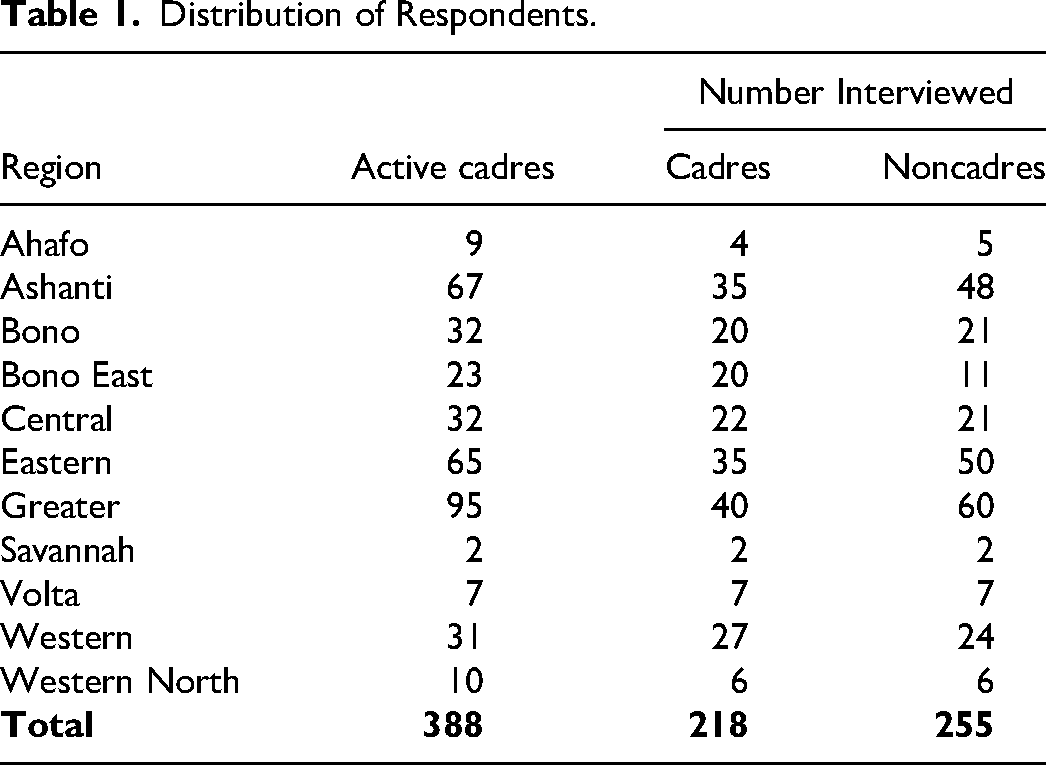
This study employed a cross-sectional survey of HIV community cadres and noncadres who work from health facilities and communities in 13 regions of Ghana. The main target group was HIV community cadres; however, PLHIV who were not community cadres were also included for comparison. At the time of the study there were 388 active community cadres providing support for their peers throughout the country. This is according to data available at the HIV/TB Community Systems Strengthening program implemented by the Christian Health Association of Ghana (CHAG). The sample size for the study was estimated using the sample size for 2 independent samples, that is cadres versus noncadres (see formulae below)(12).

Distribution of Respondents.
Sampling of Cadres
To be eligible for inclusion as a cadre, the cadre must have worked in this capacity for at least 1 year prior to the study (active cadres). Active cadres were assembled at the regional level for the study. The interviewers explained the purpose of the study to them, the risks and benefits to the scientific community and the cadre community. Subsequently, each cadre was asked to willingly speak to an interviewer privately. The interviewer gave adequate information about the study. Cadres who agreed to participate were taken through the informed consent process and enrolled after signing the informed consent form as described in Ethical Approval and Informed Consent section.
Sampling of Noncadres
PLHIV who are noncadres were approached at the ART center while seeking care. Using a purposive sampling technique, the noncadres were approached privately to establish eligibility (ie, PLHIV who have known their status and have been on ART for at least a year). Eligible cadres were taken through the consent process as described in Ethical Approval and Informed Consent section.
Data Collection
The study employed face-to-face interviews using a computer-assisted personal interview to collect data from July 2021 to December 2021. The questionnaire was based on the WHOQOL-HIV-BREF and EQ-5D questionnaires. These instruments have been used in studies on the QoL of PLWHA in Asia 12 and SSA1,3,4 including Ghana. 7 The questionnaire has 7 sections based on 6 domains: physical, psychological, level of independence, social relationships, environment, and spiritual/religion/personal belief, and a section on sociodemographic characteristics. Each of these domains has some items (facets) that come together to define the value obtained. We recruited enumerators with a minimum qualification of a bachelor's degree who have demonstrable experience in data collection, especially related to HIV/AIDS. The enumerators translated questions into the local dialect of a particular community where they were assigned. Before this, a session was devoted to translating specific keywords into local dialects in training enumerators.
Data Analysis
We employed descriptive analysis to describe our sample. Then QoL scores were calculated for each facet of each quality domain, in line with the scoring and coding for the WHOQOL-HIV-Instrument. For example, in calculating the QoL for the physical domain, we added each of the 4 Likert-type scores questions under each facet and divided by 4. Thus, for the pain facet, we summed the responses to the 4 questions under pain and divided them by 4. Then, to calculate the QoL score for the physical domain, all scores for each of the 4 facets were summed, divided by 4, and multiplied by 4. Still, in cases where there are 5 facets (eg, the psychological domain), the sum of the facets is divided by 5 and then multiplied by 4. Each of the domains should score not <1 and not more than 20. When calculating the overall score, the scores for all 6 domains were summed, divided by 6, and multiplied by 4. The overall score should not be <1 and not more than 100. In addition, we categorized the scores as low or high using the mean QoL and used this categorization as the outcome for the regression analysis. For robustness checks, we estimated 2 models: ordinary least squares (OLS)—for the overall score and the ordered logit—for the categorical outcome. For policy relevance, we interpreted results from the ordered logit. We included age, gender (male = 1), level of education (no education as the base comparator), community cadre status (whether a respondent is a community cadre or not), partner support (1 = those married or cohabiting; 0 = all else), employment type (not employed as the base comparator, monthly income, self-reported health (very poor as base comparator), herbal treatment (whether a respondent uses herbal treatment intending to cure HIV), religious/spiritual healers (whether a respondent visits a religious/spiritual healer to cure HIV), comorbidity (those who have comorbidities), sexually active (1 = Yes, 0 = No), disclosure of status (1 = if disclosed HIV status to partner), and have a child (1 = those who have a child(ren); 0 = those who do not have children). All analyses were performed using Stata Corp LLC Stata (version 15.1).
Ethical Approval and Informed Consent
Participation was voluntary and consented to by all respondents. A participant information and consent form were given to respondents to read, ask for clarifications, and, if satisfied, signed, and witnessed by a person of their choice. For respondents who could not read, the information on the form was interpreted to them in the language they understood before they offered a thumbprint. The information and consent form contained, among other things, information on participants’ right to withdraw from the study at any stage without fearing any consequence. The study protocol was granted ethical clearance from the institutional review board of CHAG with number CHAG-IRB02072021.
Study Results
Socioeconomic and Demographic Characteristics
As presented in Table 2, about 77% of respondents were females, 23% were males, and 46% were cadres (78% females compared to 22% of males). On average, they are aged 39 years. Over 95% reported being heterosexual and distributed similarly across cadres and noncadres. The majority (a little over 55%) of PLWHA interviewed do not have partner support (ie, they are neither married nor cohabiting). These people are single (never married, widowed, separated, or divorced). Notably, the majority of the cadres (about 55%) do not currently enjoy partner support compared to noncadres (36%). Respondents are employed in sewing, farming, petty trading, and peer mentorship and earn an average of GHS 560.00 (USD 94.9) 1 , per month ranging from 0 to GHS4,200.00 (USD 711.86). Cadres make, on average, higher monthly income (GHS 654.00 or USD 110.85) than noncadres (GHS 473.00 or USD 80.17).
Sociodemographic Characteristics of Respondents by Cadre Status.

Health Status, Health-Seeking Behavior
From Table 3, majority of the respondents self-rated their health status as either very good (46.61%) or good (47.46%) when considering the entire sample. Over a little above 2% rated their health as either poor or very poor. When distributed by cadres and noncadres, the results show similar ratings for both groups. The majority of PLHIV did not seek alternative medicines to cure HIV.
Health Status and Health-Seeking Behavior by Cadre Status.

Abbreviations: COPD, chronic obstructive pulmonary disease; TB, tuberculosis.
HIV/AIDS-Related Behavior
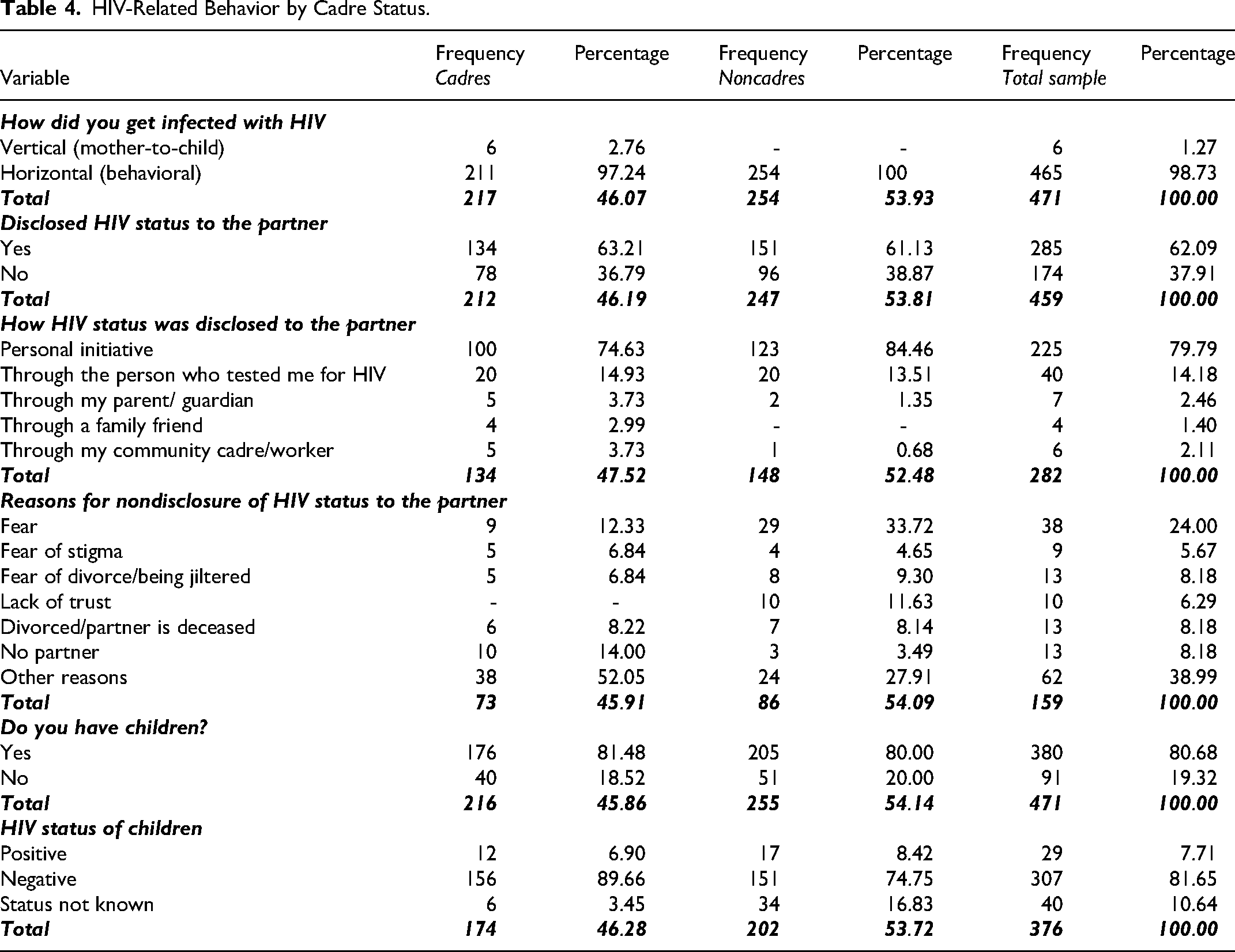
Table 4 presents how respondents got infected with HIV, whether they have disclosed their status to their partners, how the disclosure was done, and if not, why they did not disclose it. Those who disclosed their status did so through various means such as personal initiative (74.63% cadres vs 84.46% noncadres), and the HIV service provider assisted disclosure (14.93% cadres vs 13.51% noncadres). Reasons for no-disclosure have also been reported. Fortunately, <8% (6.9% cadres vs 8.42% noncadres) said their children were HIV positive.
HIV-Related Behavior by Cadre Status.
Determinants of Quality of Life of PLHIV
The results on the QoL of PLHIV are presented in Table 5. The overall QoL for the entire sample was scored about 61 out of 100. When we categorized QoL as high and low, over 75% of cadres had high QoL compared to about 62% of noncadres.
Quality of Life of HIV Cadres and Noncadres.

The regression results analyzing the factors associated with the QoL for PLHIV are presented in Table 6. The loglikelihood chi square of 106.75 was significant even at the 1% level, indicating the model is correctly fitted and that the selected variables significantly explain the QoL of PLHIV. The results show that demographic factors such as age, gender, education, and income were not associated with the QoL for our study sample. Rather, factors such as being a cadre (odds ratio [OR] = 2.567: p = 0.003), and being sexually active (OR = 2.047: p = 0.073) are associated with the QoL of PLHIV. Similarly, resorting to the religious/spiritual healers (OR = 0.070: p = 0.005) and comorbidities (OR = 0.424: p = 0.025) significantly reduce the QoL of PLWHA at the 1% and 5% levels, respectively.
Determinants of Quality of Life.

***Significant at 1% level; **significant at 5% level; *significant at 10% level.
Abbreviations: CI, confidence interval; OLS, ordinary least squares; JSS, junior secondary school; JHS, junior high school; SHS, senior high school; TEC and VOC, Technical and Vocational.
Discussion
We find in this study that women (77%) continue to be the most affected by HIV. We also find the PLHIV are relatively young, less educated, and mostly employed in the informal sector. These characteristics give credence to the assertion that HIV is a disease of poverty and social exclusion. 13 Sexually active young people who are less educated with limited economic opportunities, especially girls, are likely to engage in commercial sex as means of livelihood, thereby increasing the risk of HIV infection. Recent studies have shown that engaging in commercial sex is associated with sexually transmitted infections in Ghana 14 and HIV in other countries in SSA. 15 Unfortunately, stigma and fear of divorce continue to serve as barriers for people to disclose their HIV status to their partners. Not doing so increases the risk of spreading the disease as partners may not see the need to practice safe sex. In terms of QoL, our results show that PLHIV in Ghana is above average. The psychological QoL domain was scored highest, while the environment domain was scored lowest. It implies that majority of PLHIV are less depress, possibly due to the support they get from HIV community cadres or by virtue of being cadres. Evidence elsewhere 16 shows that without support PLHIV are more likely to be depressed which in turn decreases their QoL. Our regression results show that being a cadre, health-seeking behavior, comorbidities and employment type affect the QoL of patients with HIV. For example, we find that being an HIV peer improved the QoL of PLHIV while being employed in energy-demanding jobs such as petty trading and farming and having comorbidities harm one's QoL. Our findings are consistent, with the literature. Previous studies have largely focused on socioeconomic effects17,18 and clinical factors 19 on the QoL of patients with HIV/AIDS. Those that included cadres have focused on the role of cadres in improving the QoL of patients with HIV/AIDS in general. 20 For example, a meta-analysis of the effects of socioeconomic factors on the QoL of HIV/AIDs, which included 19 studies that met the eligibility criteria, found stigma, low socioeconomic status, and being younger than 35 years to be negatively associated with QoL of PLWHA. This means that these factors tend to worsen the QoL of patients with HIV. 18 Another meta-analysis on the effects of clinical factors on the QoL of patients with HIV 19 found comorbidities to harm QoL, similar to our findings and studies in Ethiopia. 17 We make a novel contribution to the growing literature on the role of cadres in improving the QoL of PLHIV by disaggregating the QoL for community cadres and noncadres and exploring how being a cadre affects the QoL of PLHIV. This disaggregation is important because by volunteering to offer support services to their peer, community cadres run the risk that these support engagements could mean less time to attend to their own health needs thereby harming their QoL. On the other hand, the motivation and inspiration to offer support to their peers could lead to more treatment adherence and psychological fulfillment which tend to improve their QoL. While previous studies 20 found that the role of community cadres improved the QoL of women living with HIV/AIDS, such studies did not consider how the cadre role affects the person's QoL. This is an important contribution to the literature and policy. The finding that being a cadre significantly improves one's QoL could be understood from 2 perspectives: (1) self-selection— patients with HIV who are well motivated to face the challenges of their disease status self-select to support their peers as cadres. Being self-motivated predisposes them to accept their situation and take appropriate scientific steps such as adherence to the ART treatment protocols and making the best out of their lives. (2) Lessons from being a cadre—cadres are more likely to benefit from capacity building and training to prepare them to support their peers cope with HIV/AIDS. In line with previous findings, 21 such support services would probably equip them with life adjustment skills and increase their sense of contribution to society and improve their self-worth. Therefore, it was not unexpected that the QoL of cadres was slightly higher in all domains than in their noncadre counterparts. However, the overall above-average QoL observed for the entire sample could be because through the support of cadres, adherence to ART treatment probably increased among patients with HIV in general, leading to the observed high QoL. 22 This notwithstanding, it is important to acknowledge that treatment adherence was not explicitly considered in this study.
Conclusion
This study provides novel evidence by being among the first to have disaggregated the QoL scores for HIV community cadres and noncadres and to have examined how being a cadre affects ones QoL. The study relied on the WHOQOL-HIV-Instruments to build a composite QoL score based on the 6 quality domains. While the study found that the QoL of PLHIV in Ghana was generally good, the environment QoL score was the lowest. Health-seeking behavior, comorbidities and being a cadre are key factors that influence the QoL of PLHIV. We recommend that attention is paid to safety in the living environment, physical security, the quality of homes of PLHIV, financial challenges, and access to social and health services and the quality of these services. These parameters collectively constitute the environment domain which contributed the lowest score to the QoL of PLHIV. Alternative, care providers such as religious and spiritual leaders and herbalists should also be educated on the basic science around chronic diseases such as HIV and TB. This education will empower them to help PLHIV who visit them cope well rather than giving false hopes of cure (particularly in the case of HIV). Once they delay manifesting, such false hopes lead to anxiety and harm the QoL of PLHIV. Communities should also be educated to offer more acceptance to PLHIV. Acceptance will engender trust and allow these people to disclose their status to their partners. Partners should also be educated to accept their HIV partners and practise safe sex. This gesture will improve the QoL of victims and prevent the potential unintended spread of the disease due to lack of disclosure by HIV sex partners for fear of being rejected. PLHIV should be supported to engage in less energy demanding jobs since energy demanding employment activities tend to harm their QoL. Attention should also be paid to PLHIV who have comorbid conditions like hypertension and TB. Such conditions tend to impair the QoL of victims.
Footnotes
Acknowledgements
We thank all the staff of Christian Health Association of Ghana under the HIV/TB Community Systems Strengthening program who contributed to the data collection and analysis. We also thank all people living with and affected by HIV/AIDS, the Ministry of Health/Ghana Health Service, the Ghana AIDS Commission, community-based organizations and partners like the WHO and UNAIDS who have supported HIV epidemic control in Ghana.
Authors’ Contribution
BSNC conceived and initiated the research; BSNC, NK, and PKN contributed to the design, methodology, and data collection; NK and PKN led the analysis and interpretation of the results with contribution from BSNC, PY, and JD. JKA, ITAN, KS, BSNC, NK, and PKN contributed to the discussion of the results. NK, PKN, and BSNC drafted the manuscript. All authors reviewed and approved the final version.
Declaration of Conflicting Interests
The author(s) declared no potential conflicts of interest with respect to the research, authorship, and/or publication of this article.
Funding
The author(s) received no financial support for the research, authorship, and/or publication of this article.
