




Abstract
This study was conducted on patients with thalassemia and HIV-infected patients to determine the frequency of diarrheagenic Escherichia coli in Kerman, Iran. We analyzed 68 and 49 E coli isolates isolated from healthy fecal samples of patients with thalassemia and HIV-infected patients, respectively. The E coli isolates were studied using a multiplex polymerase chain reaction to identify the enterotoxigenic E coli (ETEC), enterohemorrhagic E coli (EHEC), and enteropathogenic E coli (EPEC) groups. Statistical analysis was carried out to determine the correlation of diarrheagenic E coli between HIV-infected patients and patients with thalassemia using Stata 11.2 software. The frequency of having at least 1 diarrheagenic E coli was more common in patients with thalassemia (67.64%) than in HIV-infected patients (57.14%; P = .25), including ETEC (67.64% versus 57.14%), EHEC (33.82% versus 26.53%), and EPEC (19.11% versus 16.32%). The results of this study indicate that ETEC, EHEC, and EPEC pathotypes are widespread among diarrheagenic E coli isolates in patients with thalassemia and HIV-infected patients.
Keywords
Introduction
AIDS caused by the HIV is the most significant public health issue in the world. The infection is alarming due to the pathogenesis of the virus, which decreases the CD4 counts, enabling the emergence of opportunistic infections in the host. Among the opportunistic infections, gastrointestinal dysfunction has been recognized as a major manifestation of HIV infection. 1,2 Thalassemia is the most common single-gene disorder worldwide and has seen the implementation of various successful treatments, including blood transfusion, hematopoietic, management of deferoxamine, and cord blood stem cell transplantation. Despite these treatment successes, infection is the predominant cause of death. 3 Diarrheagenic Escherichia coli (DEC) pathotypes are one of the major etiological agents of diarrhea in both developing and industrialized countries. 4 Several types of DEC have been classified according to their virulence traits, phenotypic assays, and serotypes including enterotoxigenic E coli (ETEC), Shiga toxin-producing E coli (STEC) or enterohemorrhagic E coli (EHEC), enteropathogenic E coli (EPEC), enteroinvasive E coli, enteroaggregative E coli, and diffuse adherent E coli. Enterotoxigenic E coli is the most common bacterial cause of diarrhea in all age groups in regions with poor sanitation. This pathotype isolates cause diarrhea by producing heat-stable (ST) and/or heat-labile (LT) enterotoxins. 5 Shiga toxin-producing E coli isolates are characterized by the production of 2 potent cytotoxins including Shiga-like toxin 1 (Stx1) and Shiga-like toxin 2 (Stx2). The presence of the stx2 gene in the infecting isolate is associated with severe disease in humans. In some STEC isolates, the presence of the eaeA gene, related to the intimate attachment of bacteria to the host cell, is mediated by the binding of intimin. The eaeA gene in STEC shares considerable homology with the eaeA gene in EPEC. 6,7 Characteristic of EPEC isolates is the induction of attaching and effacing (A/E) lesions on intestinal epithelial cells. The ability to produce A/E lesions is encoded by genes located on the locus of enterocyte effacement, which contains the genes encoding eae (intimin), the translocated intimin receptor, a number of secreted proteins (E coli secretion protein), and a type III secretion system. 8
Our goal was to investigate the prevalence of the ETEC, STEC, and atypical EPEC in HIV-infected patients and patients with thalassemia. A further aim was to determine the correlation of DEC between HIV-infected patients and patients with thalassemia. To the best of our knowledge, this study is the first report of DEC in HIV-infected patients and patients with thalassemia in Iran.
Materials and Methods
Studied Patients
In this cross-sectional study, the HIV-positive patients were studied at the Voluntary and Counseling Testing Center in Kerman, Iran. The HIV samples were from 43 males and 6 females. We also surveyed patients with thalassemia at the Charity Foundation for Special Diseases in Kerman, Iran. There were 42 males and 26 female patients. All fecal samples were obtained from September to December 2014.
Bacteria
This study included 68 and 49 E coli isolates isolated from healthy fecal samples of patients with thalassemia and HIV-infected patients, respectively, in Kerman, Iran. Each sample was streaked on MacConkey agar and eosin–methylene blue plates (Biolife Laboratories, Milan, Italy) and incubated overnight at 37°C. From each plate, 1 colony, detected as E coli on the basis of its morphology, was inoculated in 5 mL tryptic soy broth and incubated overnight at 37°C. The overnight bacterial culture was subjected to a biochemical API 20E identification system (BioMérieux, Marcy-l’Étoile, France). Escherichia coli isolates were stored at −70°C in Luria-Bertani broth (Invitrogen, Paisley, Scotland) with 30% glycerol for later use.
Polymerase Chain Reaction and DNA Extraction
DNA was extracted using the lysis method and was stored at −20°C. 9 Amplification of bacterial DNA was performed using 25 μL volumes containing 5 μL of the template DNA; 0.2 mmol/L of each deoxyadenosine triphosphate, deoxyguanosine triphosphate, deoxycytidine triphosphate, and deoxythymidine triphosphate; 1.5 mmol/L MgCl2; 1× reaction buffer; 0.5 μmol/L of each primer; and 1.2 U of Taq DNA polymerase (CinnaGen Co, Karaj, Iran). The polymerase chain reaction (PCR) products were electrophoresed via a 1.5% agarose gel and visualized with an ultraviolet (UV) transilluminator after ethidium bromide staining.
Identification of DEC Genes
For each isolate, a multiplex PCR assay was done to detect the presence of genes LT and ST (ETEC) 10 and genes stx1, stx2, and eaeA (STEC and atypical EPEC). 11 Escherichia coli strain MG1655 was used as the negative control. Positive controls for PCR were E coli 10407 (ST+/LT+) and E coli Sakai (stx1+/stx2+/eaeA+). The E coli strain MG1655 was used as a negative control for virulence genes. The reference strains were from the bacterial collection of the Microbiology Department of École Nationale Vétérinaire Toulouse, France. Details of the primers, the specific reference, and the length of the expected amplification product are listed in Table 1.
Oligonucleotide Primers Used in this Study.

Abbreviation: bp, base pair.
Statistical Analysis
Data were described using descriptive statistics and 95% confidence interval (CI). A χ2 test was used to estimate the difference between different pathotypes (ETEC, EPEC, and EHEC) and different health disorders (HIV and thalassemia). A Mantel-Haenszel χ2 statistic was used to estimate the correlation of the presence of different genes after verifying the health disorder and checking for interaction. Data management and analysis were carried out using Stata 11.2 (StataCorp LP, College Station, TX, USA).
Results
The PCR assay of 117 E coli isolates revealed that 74 isolates (63.3%; 95% CI: 53.8-72.0) had at least one of the examined virulence-related genes. The frequency of having at least 1 DEC was more common in patients with thalassemia (67.7%) than in HIV-infected patients (57.2%), but there was no significant difference (P = .25).
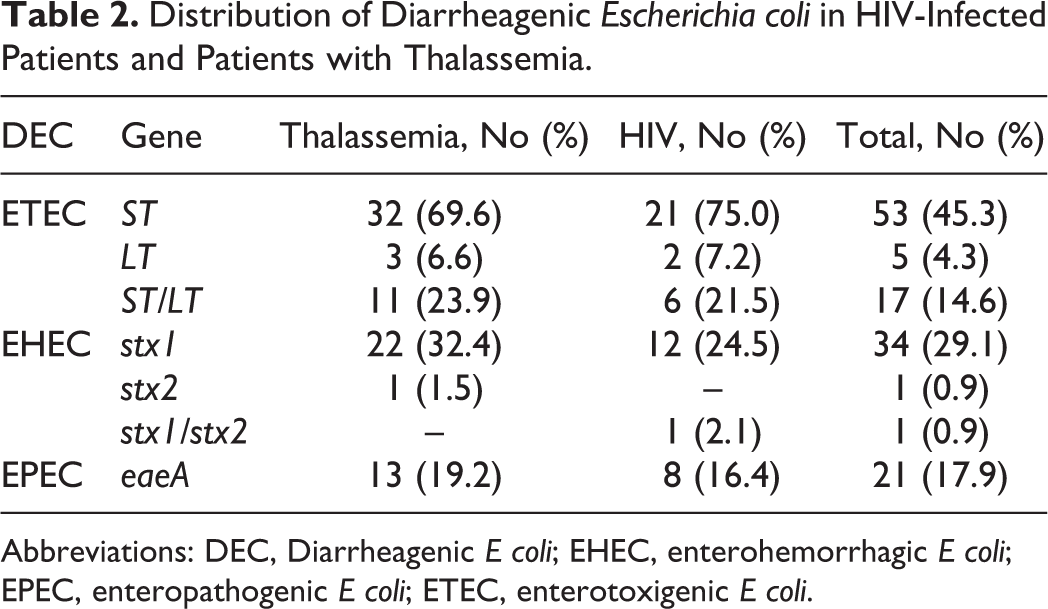
The ETEC pathotype was detected in 74 isolates (63.3%; 95% CI: 53.8-72.0); this pathotype was more common in patients with thalassemia (67.7%) compared to HIV-infected patients (57.1%), but this difference was not significant (P = .24). Of the 46 ETEC isolates from patients with thalassemia, 32 (69.7%) isolates were positive for ST gene, 3 (6.6%) isolates were positive for LT gene, and 11 (23.9%) isolates showed both ST and LT genes. Among 28 ETEC isolates from HIV-positive patients, 21 (75.0%) isolates and 2 (7.2%) isolates were positive for ST and LT genes, respectively. Six (21.5%) isolates from HIV samples possessed both ST and LT genes (Table 2 and Figure 1).
Distribution of Diarrheagenic Escherichia coli in HIV-Infected Patients and Patients with Thalassemia.
Abbreviations: DEC, Diarrheagenic E coli; EHEC, enterohemorrhagic E coli; EPEC, enteropathogenic E coli; ETEC, enterotoxigenic E coli.

The multiplex polymerase chain reaction (PCR) results for LT and ST genes. 1 indicates the marker 100 base pair (bp); 2, the positive isolate for LT gene; 3, positive control Escherichia coli 10407; 4 and 6, the positive isolate for ST gene; 5, negative control E coli MG1655.
The prevalence of EHEC in total samples was 30.8 (95% CI: 25.6-40.0). Enterohemorrhagic E coli was more frequent in patients with thalassemia than in HIV-infected patients (33.9% versus 26.6%), but it was not significant (P = .4). The stx1 gene among EHEC genes was the most prevalent gene in both patient groups (29.1%). This gene was detected in 32.4% and 24.5% of thalassemia and HIV isolates, respectively. The Stx2 coding gene was detected in 1 isolate from the patients with thalassemia. One of the isolates from the HIV-infected patients produced both stx1 and stx2 genes (Table 2 and Figure 2).

The multiplex polymerase chain reaction (PCR) results for stx1, stx2, and eaeA genes. 1 indicates positive control Escherichia coli Sakai; 2, the marker 100 base pair (bp); 3, negative control E coli MG1655; 4, the positive isolate for stx2 gene; 5, the positive isolates for stx1 and eaeA genes.
The prevalence of EPEC was 17.9% (95% CI: 11.5-26.1) in all isolates. Of the 68 isolates examined from patients with thalassemia, 13 (19.2%) isolates were positive for the atypical EPEC pathotype coding genetic marker eaeA. The prevalence of this gene in HIV-positive patients was 16.4% (Table 2). There was no significant difference in the prevalence of EPEC in HIV-infected patients and thalassemia (P = .7). Several combination patterns of the DEC genes were detected in isolates (Table 3 and Figure 2).
Combination of Diarrheagenic Escherichia coli Genes in HIV-Infected Patients and Patients with Thalassemia.

Discussion
Infection is a major complication and the leading cause of death in patients with thalassemia and HIV-infected patients. 12 According to a review by Wanachiwanawin in Thailand, E coli was responsible for 26.0% of all severe infections in patients with thalassemia. 12 Musiime et al 13 found that E coli, Salmonella, and Shigella species significantly cause acute diarrhea in HIV-infected and HIV-uninfected children in Uganda.
According to the results, DEC as a group were the most common isolated pathogens in HIV-infected patients and patients with thalassemia with healthy fecal matter. This finding is similar to a study by Medina et al, 14 in which it was reported that the prevalence of DEC was the most common pathogen in HIV-infected children with or without diarrhea (19.0% versus 26.0%). The interpretation of pathogen frequency in healthy fecal matter is complicated. A high frequency may be owing to host susceptibility to infection and is determined by nutritional status, cell immunosuppression, prior exposure, and acquired immunity and/or genetic susceptibility.
Enterotoxigenic E coli is related to 2 major clinical syndromes: diarrhea among children in developing countries and travelers’ diarrhea. 15 In this study, ETEC was the most frequent DEC in patients with thalassemia (∼67%) but was also found in HIV-infected patients (∼57%). Cárcamo et al 16 in Lima found that 4% of the investigated HIV-infected patients with diarrhea tested positive for ETEC. In a previous study of HIV-infected infants from Zaire, ETEC was isolated in 11% of diarrhea cases. 17 Another study of HIV-infected children in Brazil revealed that none of the isolates were positive for ETEC. 18
Among patients with thalassemia, 33.4% had EHEC. This pathogen was found in 26.6% of HIV-infected patients. Enterohemorrhagic E coli isolates are a major cause of gastroenteritis, which is in turn responsible for serious human infections such as hemolytic uremic syndrome and hemorrhagic colitis. 7 Previous studies showed discrepancies in the frequency of STEC in different countries due to this pathogen not being isolated from diarrhea samples. 19,20 A survey of 158 isolates obtained from HIV-positive patients with frequent watery stools in Senegal showed that none of the isolates were positive for STEC genes. 21 In agreement with the results, Okeke et al 22 reported the prevalence of STEC in 20.0% of acute diarrhea cases in a study conducted in Nigeria. In this regard, Salmanzadeh-Ahrabi et al 23 showed that STEC is a significant cause of acute diarrhea in Iran.
For many years, EPEC isolates have been known to be a major pathogen in the pediatric population because of the high morbidity and mortality rates, and now, this pathotype has emerged as being significant enteropathogen in immunocompromised adults. 21 The prevalence of EPEC in our study (16.4%) was close to another report (15.0%) of HIV-infected patients from Zaire. 17 In a study of HIV-infected children less than 13 years of age in Brazil, EPEC accounted for one isolate among all the diarrhea cases. 18 Previous studies in Brazil, 24 Peru, 25 and Australia 26 reported that the prevalence of typical EPEC isolates has decreased and that they are gradually being replaced by atypical EPEC. This suggests that atypical EPEC is an emerging diarrheagenic pathogen not only in developing but also in industrialized countries. 27 Asadi Karam et al 28 in Iran evaluated the presence of virulence genes in 321 E coli isolates from children ≤5 years hospitalized with diarrhea and found that 5.3% of the isolates possessed EPEC. In a study conducted in Tehran, Iran, of patients referred to hospitals, there were 12 EPEC isolates isolated from acute diarrhea samples. 29
The main limitation of this study is the small sample size of patients. Other studies reflect low frequency of ETEC genes (LT and ST) across the E coli isolates from HIV-infected patients. 16 –18 However, findings of the current study indicated high percentage of ETEC genes among HIV-infected patients in Kerman, Iran. Environmental factors including poor sanitation and fecal contamination of water and food may result in frequent exposure to enteric pathogens in HIV-infected patients and patients with thalassemia in developing countries. This emphasizes the need to educate these patients about better sanitation and personal hygiene and in using boiled or properly filtered water.
Conclusion
To our knowledge, this is the first study in which DEC isolates were identified in healthy fecal samples from HIV-infected patients and patients with thalassemia in Iran. The results of this study indicate that DEC pathotypes such as ETEC, EHEC, and EPEC were the most commonly isolated enteropathogens in patients with thalassemia and HIV-infected patients. Further studies of other DEC pathotypes and genetic antibiotic-resistance patterns would be very useful in evaluating the role of the different DEC pathotypes and ultimately help in establishing new strategies to reduce morbidity and mortality related to infectious diseases in HIV-infected patients and patients with thalassemia.
Footnotes
Acknowledgments
The authors would like to thank the Research Center for Tropical and Infectious Diseases, Kerman University of Medical Sciences, Iran, for funding assistance with this project. Without the support of this research center, this work would not have been possible.
Declaration of Conflicting Interests
The author(s) declared no potential conflicts of interest with respect to the research, authorship, and/or publication of this article.
Funding
The author(s) disclosed receipt of the following financial support for the research, authorship, and/or publication of this article: This study was funded by grant number (93/429).