




Abstract
Introduction:
This community-based cross-sectional epidemiological study was performed to assess the awareness and attitude of youths toward AIDS in a rural area of West Bengal in India.
Methods:
Study population included 190 individuals (15–24 years). Data were collected using a semistructured, pretested questionnaire and analyzed using SPSS version 17 by logistic regression model.
Results:
It was revealed that older youths and particularly men compared to women had more comprehensive knowledge of AIDS than adolescents. Education, media exposure, marriage, and possessing above poverty level (APL) status, all had stronger positive association with youths (more in men) having comprehensive knowledge of AIDS. Older, never married youths, and particularly men were more likely than adolescents to have accepting attitudes toward people living with HIV/AIDS. Education, media exposure, and not having below poverty level card, all had stronger positive association with youths having accepting attitudes toward women than toward men. Surprisingly among the male APL population, this association was negative.
Conclusion:
Educational and socioeconomic setbacks should be overcome in order to impose a better and justified attitude toward HIV/AIDS. Improved health conditions, proper counseling, and knowledge are essential to break the barriers of communication and ignorance toward HIV/AIDS in these parts of the developing countries.
Introduction
AIDS is one of the most dreaded diseases that modern medicine ever had to tackle. The emerging trends of the new HIV-positive cases in India show that nearly two-fifth of new infections are reported among young people of less than 25 years of age. 1
Knowledge of AIDS and sexual behavior among youths are of particular interest because the period between sexual initiation and marriage is, for many young people, a time for sexual experimentation, which may involve high-risk behaviors. Further, ignorance or misinformation on sex-related issues can put sexually active youths at a higher risk of sexually transmitted infections, including HIV itself.
An equally important concern is the narrowing gender gap in new infections, suggesting an urgent need to address the issues and concerns of youths. Knowledge and beliefs about HIV/AIDS in population are likely to affect the treatment of people living with HIV/AIDS (PLWHA). Youths, being relatively better informed about HIV/AIDS and having greater access to education and the media compared to their elders, are expected to be more accepting of persons infected with HIV/AIDS.
With this background, the present study was carried out with the following objectives: to assess the level of awareness about HIV/AIDS among the youths (15–24 years); to elicit the attitude of the youths (15–24 years) toward PLWHA; and to find out the association, if any, between the different sociodemographic variables and the comprehensive knowledge of HIV/AIDS.
Method
A community-based cross-sectional epidemiological study was conducted at Singur in Hooghly district of West Bengal in India. The area comprised of 2 union health centers, each having 2 subcenters with a total population of 103 562. The study was done over a period of 3 months among youths aged 15 and 24 years.
The calculated sample size was 171, based on the proportion of lack of comprehensive knowledge among the rural male youths as 71%, according to National Family Health Survey 3 (NFHS-3) and United Nations Children Fund (UNICEF) data, 2,3 with relative precision of 10% and a confidence interval of 95%. After adding 10% nonresponse error, the final sample size was 190.
A multistage cluster sampling design was employed to arrive at the household. The first stage involved selection of 2 subcenters. Under these 2 subcenters, all villages were listed for selection; of which only 10 villages were included in the study. Then all the households (having eligible population) in the selected villages were listed and a random selection of households was done using proportionate sampling depending on the number of households in each village. From each of the selected households with more than 1 eligible person, 1 eligible respondent was selected using the lottery method. The information was obtained using a semistructured, pretested questionnaire. During home visits, the purpose and nature of the study were explained to the participants, and informed consent was obtained. After obtaining their consent, a face-to-face interview was conducted to fill up the questionnaire. The obtained data were analyzed using SPSS version 17 by logistic regression model.
Results
Table 1 provides a profile of female and male respondents by age, education, media exposure, marital status, and the possession of below poverty level (BPL) card.
Distribution of Number and Percentage of Studied Population According to Selected Background Characteristics.

Abbreviation: BPL, below poverty level.
Among the youths aged 15 to 24 years, slightly more than half were teenagers. Almost equal proportions of women were never married and ever married; however, due to the later age of marriage among men, only 18% of young men were married. The distribution of the population by education revealed low overall educational attainment among young women and men in this part of India. Among the youths, only 33% of women and 45% of men had completed 10 or more years of education. The distributions of women and men according to the possession of BPL card were more or less similar.
Using background characteristics, Table 2 enumerates the distribution of number and percentage of studied population who had heard of AIDS, who, in response to prompted questions, said that people could reduce the risk of getting HIV/AIDS by using condoms every time they had sexual intercourse, who knew that the risk of HIV/AIDS could be reduced by limiting sex to 1 uninfected partner, who had a comprehensive knowledge about HIV/AIDS, and who knew that HIV/AIDS could be transmitted from a mother to her child.
Distribution of Number and Percentage of Studied Population Who Had Heard of AIDS and Who, in Response to Prompted Questions, Said that People Could Reduce the Risk of Getting HIV/AIDS by Using Condoms Every Time They Had Sexual Intercourse, Who Knew that the Risk of HIV/AIDS Could be Reduced by Limiting Sex to One Uninfected Partner, Who had a Comprehensive Knowledge about HIV/AIDS, and Who Knew that HIV/AIDS Could be Transmitted from a Mother to Her Child, by Selected Background Characteristics.

Abbreviation: BPL, below poverty level; NFHS-3, National Family Health Survey 3.
aRespondents with comprehensive knowledge said that the use of condom for every act of sexual intercourse and having just 1 uninfected faithful partner could reduce the chance of getting HIV/AIDS, said that a healthy-looking person could have HIV/AIDS, and rejected the 2 most common misconceptions in NFHS-3, namely that HIV/AIDS could be transmitted by mosquito bites and by sharing food.
bExposure to radio, television, newspapers, or magazines at least once a week.
Around more than 80% of women and 90% of men were aware of AIDS. Knowledge of HIV/AIDS prevention was more widespread among young men than among young women. About 3 of 4 men knew that the risk of HIV/AIDS could be reduced by condom use or by limiting sex to 1 uninfected partner. However, only 39% to 48% of young women knew about these ways of preventing HIV/AIDS. Comprehensive knowledge among men and women about HIV/AIDS was very low (only 32% among young women and 47% among young men). Almost 70% of young men and 55% of young women knew that HIV infection could be transmitted from a mother to her child.
Using selected background characteristics, Table 3 provides the distribution of the number and percentage of studied population who had heard of AIDS and expressed specific accepting attitudes toward PLWHA.
Distribution of Number and Percentage of Studied Population Who Had Heard of AIDS and Expressed Specific Accepting Attitudes Toward People with HIV/AIDS (PLWHA), by Selected Background Characteristics.

Abbreviation: BPL, below poverty level.
Both women and men tend to express more positive attitudes in response to the questions concerning willingness to care for a family member with HIV/AIDS (76.75% and 76%, respectively), for a female teacher with HIV/AIDS who was not sick to continue to teach (77.7% and 76.4%), about buying fresh vegetables from a shopkeeper with HIV/AIDS (65.5% and 63.5%), and not wanting to keep secret that a family member was infected with HIV/AIDS (63.5%). The percentage expressing accepting attitudes on all these 4 indicators listed in the table remains low even among youths (only 37%-39%). Although the proportions with a positive attitude on all 4 indicators increased with education and economic status, even among youths with 10 or more years of education or those from above property level (APL) households, less than one-half have accepting attitudes on all 4 indicators.
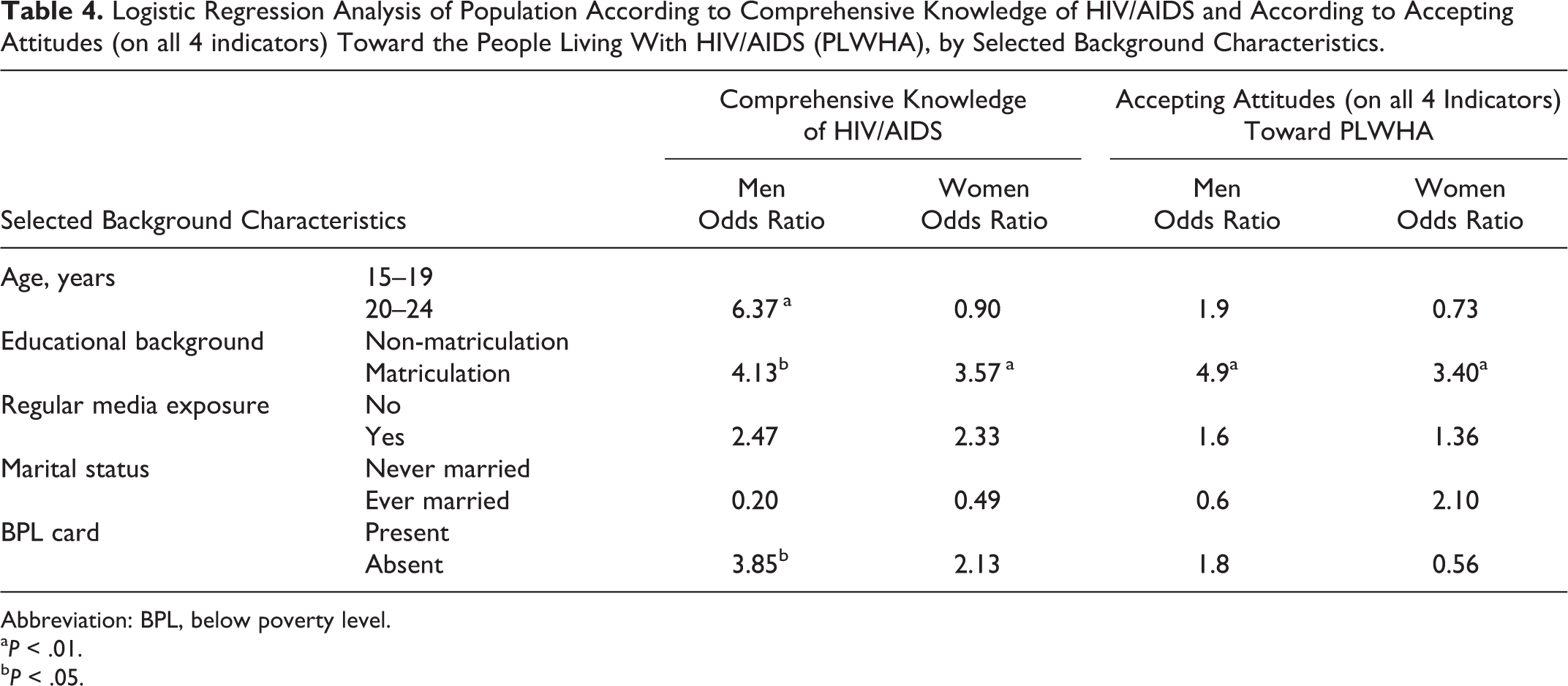
Table 4 provides the logistic regression analysis of population according to comprehensive knowledge of HIV/AIDS and according to HIV/AIDS accepting attitudes (on all 4 indicators) toward the PLWHA.
Logistic Regression Analysis of Population According to Comprehensive Knowledge of HIV/AIDS and According to Accepting Attitudes (on all 4 indicators) Toward the People Living With HIV/AIDS (PLWHA), by Selected Background Characteristics.
Abbreviation: BPL, below poverty level.
a P < .01.
b P < .05.
In order to better understand the factors that contribute to increasing comprehensive knowledge of HIV/AIDS, logistic regressions were run separately for women and men. For each regression, the dependent variable coded women/men who had comprehensive knowledge as 1 and those who had only partial or no knowledge as 0. Age, marital status, education, regular media exposure, and possession of BPL card (as shown in Table 1) were included as explanatory variables. Odds ratios of greater than 1 show a positive association and those less than 1 show a negative association.
The proportion of youths who agreed with all 4 indicators for accepting attitudes toward those living with HIV/AIDS varied by age, marital status, education, regular media exposure, and BPL/APL status. To understand the net effects of these background characteristics, 2 logistic regressions were run, 1 each for women’s and men’s accepting attitudes on all 4 indicators toward those living with HIV/AIDS.
Discussion
Comprehensive knowledge about HIV/AIDS was very low (only 32% among young women and 47% among young men, as compared to 20% and 36%, respectively, according to NFHS-3). 2 Comprehensive knowledge means that youths know that a healthy looking person can have HIV/AIDS, that HIV/AIDS cannot be transmitted through mosquito bites or by sharing food, and that condom use and having only 1 faithful, uninfected partner can help prevent HIV/AIDS. Almost 70% of young men and 55% of young women knew that HIV infection can be transmitted from a mother to her child.
More than 80% of women and 90% of men were aware of AIDS. Knowledge of HIV/AIDS prevention is more widespread among young men than among women. This result is consistent with the NFHS-3 and UNICEF data 2,3 for men (88%), but only around two-thirds of women were aware of AIDS. A study of awareness about HIV/AIDS among senior secondary school children of Delhi, India, showed that all the students have heard of HIV/AIDS. Among senior secondary school children of Delhi, only 15% had knowledge about condoms as a means of protection. 4 However, higher levels of awareness had been observed among school children in Haryana, India. 5 It was observed in a study of coastal Karnataka, India, that 11% of the participants considered PLWHA as a threat to the society and about 61% felt sympathetic toward the infected. 6 In another Indian study, 57% felt that PLHWA should be isolated. 7
The key findings of the logistic analysis of population according to comprehensive knowledge of HIV/AIDS are as follows:
Older youths were more likely than adolescents to have comprehensive knowledge of HIV/AIDS in case of men, but in case of women, this was reverse. However, controlling for age, education, and other relevant characteristics, ever married youths were less likely than never married youths to have a comprehensive knowledge of HIV/AIDS.
These data also suggest that education, media exposure, and not having BPL card all had a stronger association with youths having comprehensive knowledge, which is more among men than among women.
A study in Mozambique demonstrated significant knowledge deficits among women in the study, and higher scores were associated with higher HIV testing probability. 8 A study of knowledge, attitudes, and practices of voluntary HIV counseling and testing (VCT) among rural migrants conducted in Shanghai, China, demonstrated that 80% of the population knew HIV infection was diagnosed through a blood test, 46.5% had heard of VCT ever before, but only 3.5% felt that they were likely to be HIV infected now or in the future and only 2.3% had ever had HIV testing, with a few of them getting tested at a VCT site. 9 A study in Pakistan revealed gaps in the knowledge of females regarding AIDS and its transmission. The results indicated an urgent need to include health education syllabi emphasizing AIDS and other sexually transmitted diseases in the curriculum of schools/colleges to convey the message adequately to the youth. 10 Another study from the United States showed that the incarcerated youth are less aware of HIV risk-reduction behaviors, report markedly higher rates of HIV risk behaviors, and are at substantially increased risk of HIV infection. 11
The key findings of the multivariate analysis of population according to comprehensive knowledge of HIV/AIDS accepting attitudes (on all four indicators) toward the PLWHA are as follows: Older youths were more likely than adolescents to have accepting attitudes toward PLWHA in case of men, but in case of women, this is reverse. However, controlling for age, education, and other relevant characteristics, ever married youths were less likely than never married youths to have accepting attitudes toward PLWHA in case of men, but in case of women, this was reverse. Education and media exposure had a strong positive association with youths having accepting attitudes. These data also suggest that education, media exposure, and not having BPL card all had a stronger association with youths having accepting attitudes toward women than toward men. And surprisingly, among the male APL populations, this association was simply negative.
Conclusion
Finally, it may be concluded from the above-mentioned study that educational and socioeconomic setbacks are needed to overcome in order to impose a better and justified attitude toward HIV/AIDS, particularly by the youths. Improved health conditions, proper counseling, and knowledge are essential to break the barriers of communication and ignorance toward HIV/AIDS in these parts of the developing countries.
Footnotes
Declaration of Conflicting Interests
The author(s) declared no potential conflicts of interest with respect to the research, authorship, and/or publication of this article.
Funding
The author(s) received no financial support for the research, authorship, and/or publication of this article.