



Abstract
This article examines factors pertaining to the development of Indian emerging market multinational companies (EMNCs) in African countries. India is a member of the BRICS grouping of developing countries, the others being Brazil, China, Russia and South Africa. Therefore, understanding its role, scale and dynamics of internationalising in the African context is particularly important. The following key areas are examined: the historical and socio-economic context, internationalisation strategies of Indian MNCs in African countries, home and host country factors, labour markets in host countries and human resource management (HRM) approaches of selected Indian EMNCs in particular African countries. Most work on international business and international HRM in Africa focuses on the Sino-Africa nexus. Both China and India are members of the BRICS grouping but have followed different trajectories in internationalising in the African context. This analysis helps fill a gap by evaluating the Afro-Indian relationship in business, particularly EMNCs from India. The analysis finds the following abiding themes in the historical connections and relationships of Indian EMNCs: the role of family-owned businesses, human resource development and long-term host country commitment.
Introduction
With 54 countries, Africa is culturally and ethnically diverse, socio-economically heterogenous and a politically complex continent, offering significant opportunities for foreign direct investment increasingly from Asia as well as research in international business and management. Whilst some observers argue that Africa has been relatively neglected particularly in international business (e.g., Nachum et al., 2022; Zoogah et al., 2015), others point to significant developments in related management fields (Kamoche & Wood, 2022). Traditionally, the dominant interest has been Western MNCs and the suitability of western management practices. The more recent ‘turn to the east’ has focused largely on China (e.g., Geary & Nyiawung, 2021; Jackson & Horwitz, 2018; Kamoche & Siebers, 2015). However, Indian firms have had a much longer tradition of investing in Africa, and relations between India and Africa go farther back due to historical British colonial ties. Much of the research on Chinese firms has raised concerns which have also been identified in the limited research so far on Indian business firms, such as work conditions and employee relations (e.g., Akorsu & Cooke, 2011). These findings are consistent with other studies that found that compared to Western firms, Indian firms in Africa make more use of temporary labour, resulting in higher labour costs, which subsequently results in relatively less training (Gomes et al., 2015). These challenges suggest the need for further research in the human resource and business practices of Indian firms in Africa.
Africa has a number of regional economic blocs. These include the East African Economic Community, the Southern African Customs Union (SACU), the Southern African Development and Economic Community (SADEC), the Economic Community of West African States (ECOWAS) and the African Union (AU). These seek better coordination of socio-economic and trade policy coherence between countries on common socio-economic policy, trade and taxation approaches. Nachum et al. (2022, op cit. 2–4) argue that certain African countries have had high GDP growth between 2010 and 2020. Examples include countries such as Ethiopia (9.6%), Rwanda (7.2%) and Ghana (6.7%). Africa accounted for some 2.9% of global FDI stock in 2019, compared with 25% for Asia and 8% for Latin America (UNCTAD 2021). India’s investment is approximately $13 billion in African countries; this is in relation to its total FDI of $46 billion (The Economist, 2021). It is the sixth-largest trading partner of South Africa, with China being the largest (Vandome, 2017).
A feature of labour markets in most African countries is the paradox of skills shortages despite high unemployment. These emerging markets reflect volatile, uncertain, complex and ambiguous (VUCA) contextual factors. This is consistent with Kim et al. (2022) and Holland et al. (2022), who note increasingly disruptive business environments in both developed and emerging markets. Horwitz and Cooke (2022) assess the impacts of particular disruptive trends on human resource management (HRM) and business effectiveness in the African context. These disruptions include socio-economic disruptions, institutional weakness and poor governance in some countries, technological and labour market change and associated changes in the nature of work, a need for improved education and training outcomes including management development as well as effects of pandemics such as Covid (Horwitz, 2013; Mills et al., 2020; Skuza et al., 2016). Given the complex and diverse context in Africa, a single or grand theory of international business and international human resource management (IHRM) cannot explain the complexity and political and socio-economic dynamics of this continent. For example, institutional theory, springboard strategies, cross-cultural management, human capital theories and resource-based views on their own, offer some insight. This presents a special opportunity to evaluate the development and growth of Indian MNCs in Africa. Theoretical and managerial challenges and opportunities as well as human resource practices are evaluated.
Socio-Historical Context
Historically, colonial regimes did not invest significantly in Africa, resulting in institutional and skill voids after independence. Though language and ethnic diversity enrich the cultural fabric of African countries, the withdrawing colonial regimes arbitrarily drew up political borders and boundaries within and between countries with little consideration for the diverse ethnic and religious groups in individual countries. This has resulted in regional ethnic and religious conflicts manifesting in the identity politics of ethnic fragmentation, contestation of territory and resources, and deep political and social tensions in some regions, and crucially for our purposes, significant challenges for intra-Africa trade and investment.
It is estimated that there are some 3 million individuals in the African Indian diaspora living mainly in East and Southeast Africa. Although a relatively small number, it is a community which has had an outsized economic and political influence both domestically and in building ties between African countries and India (Nachum et al., 2022). Some of this diaspora arrived in the nineteenth century from colonial British India as indentured labourers, working on the Kenya-Uganda railway and sugar industry in Kwa-Zulu Natal, South Africa. Today, they are a relatively affluent community with strong business contributions.
Table 1 shows the relative size of the Indian diaspora in Southeast African countries.
Indian Diaspora Population in Southeast Africa.
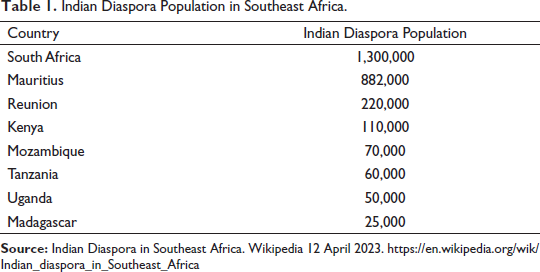
Smaller Indian communities are found in Zambia (13,000), Botswana (10,000), Zimbabwe (9,500), Seychelles (5,000), Malawi (4,000) and Lesotho (4,000). By comparison, over the past 20 years, with China’s fast-growing investment and loan provision presence in Africa, it has a population of over 1 million in a larger number of African countries (Barnard et al., 2018). However, people of Indian descent have been present in Africa for far longer. Following independence, Indian people in countries such as Kenya and Uganda found themselves bearing the brunt of often violent local xenophobia, as a result of being perceived as controlling the economy without fully integrating socially, with many forced to leave these countries. The Indian population of these countries may therefore have been higher. McCann (2010) argues that Kenya has had a problematic engagement with its Indian population due to historical colonial tensions and that Indian firms seek opportunities largely without the aid of ‘Kenyan Asian’ and Indian state networks.
Most of Africa’s product and labour markets are based on (1) the resource extractive sector, (2) large informal economies with small business and micro-enterprises predominating, (3) a more recent rise in manufacturing and financial services sectors and (4) FDI in countries such as South Africa, Nigeria and Kenya, as well as Chinese investment and loans for infrastructural development. Chinese investment includes loans for building and construction projects in countries such as Kenya, Ethiopia and Ghana. The internationalisation of these markets initially attracted foreign small entrepreneurs, that is, individual capital and MNCs from other emerging markets such as India and more latterly China but also bigger resource-motivated firms from both Western countries, that is, oil and energy, lithium, coal and copper mining companies from the UK and Europe. Angola, for example, exports over 90% of its oil to China. South Africa exports coal to China and India. Fluctuations in global demand and pricing for these resources have, however, had adverse impacts on the local economies and employment.
Long-Term Investment, Development and Local Embeddedness
The role of the home country’s economic policies and political objectives plays an important part in the internationalisation of emerging market multinational companies (EMNCs). For instance, China’s Belt and Road initiative in Africa reflects a stronger state-directed internationalisation strategy for large state-owned enterprises, with private and smaller firms building on this momentum. In contrast, the Indian state has not played a strategic role but a more voluntarist one in the internationalisation of Indian business. Here, it has largely been left to the agency and strategic choice of Indian firms to use a springboard strategy (Hennart, 2018; Luo & Tung, 2018) to pursue their own internationalisation with their particular firm-level managerial intentionality (Hutzschenreuter et al., 2007), core competencies and business capabilities. Research shows that the key drivers of Indian FDI into Africa are no different from those from other countries, and include resource seeking, availability of labour, the institutional environment and trade openness, the foreign exchange situation and so forth (Kudaisi, 2014; Varma et al., 2020). Varma et al. (2020) found that Indian firms are not discouraged by corruption as they are used to operating in conditions of poor governance and have learned to handle institutional uncertainties by leveraging relations between governments as well as joint ventures to mitigate business risks.
Indian people’s earlier economic engagement and embeddedness within African countries tended to be as individuals, either as indentured labour in the agricultural sectors, such as sugar farming in Kenya, South Africa and Uganda or as small commercial traders and small business owners in these and other countries. They therefore occupied roles as both workers in larger firms in the agricultural sector or as small enterprise owners and later entered the professions. Chakrabarty (2017) notes that the past two decades have seen significant Indian investment in African countries. This is attributed to a number of factors including high growth in a number of African economies, changing perceptions that the continent was no longer perceived as ‘the hopeless continent’, but one of opportunity, India’s liberalising political economy, resource requirements and opportunistic entrepreneurial strategies of Indian EMNCs seeking new markets and growth through internationalisation. Both private and state-owned Indian EMNCs became active in African countries in the oil and energy sector, for example. By 2016, India was the eighth largest investor in Africa, with these investments forming 21% of India’s total FDI flows, according to Chakrabarty (2017 op. cit: 2–6). Some 597 Indian companies were invested in Africa by 2016, though interestingly 11 companies accounted for around 80% of this investment. Table 2 shows the geographical spread of selected large Indian companies in Africa.
Geographical Spread of Selected Major Indian Companies in Africa (Excluding Mauritius).
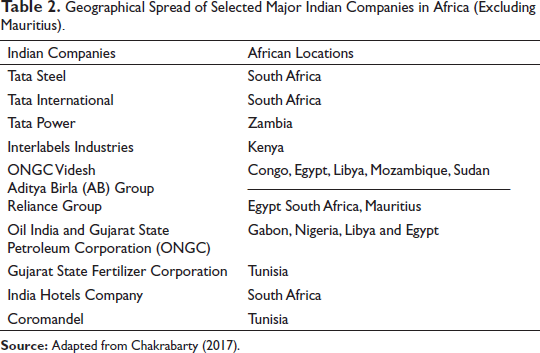
By 2020, Indian companies had invested a cumulative total of $13.8 billion in 36 of Africa’s 54 countries (Matano, 2020), and across many sectors. The main examples of Indian EMNC investments in Africa include Kenya (pharmaceuticals), Ethiopia (fabric and apparel aluminium cookware), South Africa (financial services, iron and steel, textiles), Morocco (automotive and aircraft parts), Tunisia (manufacturing, phosphate fertilisers, chemicals), as well as resource development in Mozambique (offshore energy) (Matano, 2020, op. cit: 3–4). Mauritius, a tax haven, attracts a large proportion of this FDI with some $12.9 billion, though it is considered that some of these investments are used as a springboard strategy for diverting to projects and operations in other African countries. Countries such as Nigeria, Mozambique, Ghana and Tanzania consider India their biggest export trading partner, whilst South Africa is India’s largest trading partner on the continent (Buss, 2022). Bilateral trade is augmented by Indian EMNC business operations in African countries. Buss (2022, op. cit: 3) argues that one of the key features of Indian investment in African countries is a focus on ‘patient capital’ rather than extracting quick wins. Indian EMNCs make long-term commitments to the development of their operations on the continent.
Stages of Internationalisation, Geopolitical Factors, EMNC Strategies and Organisational Configurations
Gross (2022) presents a two-stage theory of emerging market MNCs development. They first compete successfully in domestic markets. Once attaining a threshold stage, they target a host country’s market and industry based on their own emerging market experience and capabilities. This coincides with two temporal phases discussed by Thite (2016a), Kumar (2007) and Ramamurti and Singh (2009). In the pre-1991 phase, socialist-oriented Indian government policies restricted growth of the private sector both domestically and internationally with restricted foreign competition in domestic markets and limited expansion to neighbouring countries. The post-1991 era was marked by market liberalisation permitting foreign companies to compete in India and simultaneously motivating domestic companies to innovate and grow globally, including into other emerging markets. It is the latter period in which the development of Indian EMNCs in African countries occurred. Hence, home and host country factors are an important constraints or enablers in the internationalisation process (Sengupta et al., 2023). Others, such as managerial intentionality, or firm-level agency, and path-dependency are important too (Hutzschenreuter et al., 2007). Barnard et al. (2018) argue that international business, political economy, HRM theory and practice individually offer some insights and explanations. This is discussed further in the conclusion of this article.
One of India’s first overseas investments was in Africa, a textile mill built by the Birla Group in Ethiopia in 1959 (The Economist, 2021, p. 54). This EMNC expanded to several other emerging economies internationally. A continuing feature of Indian firms in African countries is their strong family business orientation, family networks and ties as a diaspora community (Barnard et al., 2019; Ray et al., 2018). They make financial remittances back to family members in their home country. Early Indian EMNCs sought joint ventures with host country firms. More recently, with economic growth and increased market share and profitability, wholly-owned subsidiary companies were established in Africa and other emerging markets (Nair & Demirbag, 2015). Nair and Demirbag (2015, op cit: 159–161) argue that international ventures have enabled globalising Indian firms to mitigate home-country limitations, such as regulatory and institutional constraints in domestic markets.
They have developed strategies seeking locational advantages, which in some cases include lower labour costs, greater flexibility given family structures and governance and dual aggressive and defensive strategies leveraging locational advantages and avoiding disadvantages. Although not as aggressive or as expansionist as Chinese EMNCs in commodity resource seeking, India’s state-owned energy company ONGC has undertaken operations in Africa as well as other emerging market regions. Indian EMNCs are more geographically dispersed compared to other BRICS countries. Amongst developing countries, one of the internationalising strategies of Indian firms is mergers and acquisitions (M&As) of host country firms. These are located mainly in China (2%), South Africa (1.3%), Brazil (1.3%), Egypt (1.3%) and Thailand (1.3%).
In the last century, the internationalisation of individual Indian EMNCs was part of a much wider globalising process not only to Africa and Southeast Asia but also to Europe and the United States. Some 83% of Indian international M&As have been in developed economies and 17% in developing countries (Nair & Demirbag, 2015, op cit: 61). In the African context, this saw Indian EMNCs, such as the Tata Corporation (with its diversified business and organisational structure), Arcelor Mittal, Tata Steel (with operations in vehicle manufacturing and assembly steel) and in other sectors, ranking quite highly in ease of doing business (38th globally). Mauritius, with its strong tourism industry and tax advantages, has grown at more than 8% in the past decade.
A case example of diversification strategies is Tata Motors, whose lorries are used in Zambia for several purposes including building and construction, transportation of mining products and waste removal. Communications between drivers is done over a mobile network provided by Bharti Airtel, an Indian telecommunications company. Tata Motors has large assembly plants in several emerging markets, including South Africa. Bharti Airtel is one of the largest telecommunications operators in Africa. The Aditya Birla (AB) Group produces carbon black, a substance used in car tyres. It is one of Egypt’s largest investors and exporters (The Economist, 2021, pp. 53–54).
Geopolitically, India is not viewed to be strategically seeking a hegemonic or socio-politically dominant position in relation to other countries investing in African countries, ‘That is one of the selling points for India’ (Price, 2021, p. 53). India’s presence in Africa is considered part of a ‘South-South’ strategic cooperation with emerging market firms from India investing in other emerging markets and is consistent with the cooperative spirit of the BRICS grouping. It does not appear to compete (directly) with Chinese businesses on the continent and Indian EMNCs have avoided the sort of controversy that surrounds Chinese investments in Africa (e.g., Kamoche & Siebers, 2015). In host countries. As mentioned earlier, a strategy of large Indian firms is to establish diversified local subsidiaries in multiple industries in emerging markets (The Economist, 2021). In contrast to privately owned and managed Indian EMNCs, Chinese EMNCs are largely state-owned enterprises, many of which enter into partnerships with local firms and host country governments including the negotiation of loans which are arguably as part of a larger geopolitical strategy and foreign policy aims.
From the above discussion, Indian EMNCs do not appear to have one clear or single internationalising strategy (Aharoni, 2015; Contractor, 2015). Their individual distinctiveness even with a strong family orientation and culture is also a function of their core business and firm-specific assets, competencies/capabilities, industry, entrepreneurial orientation (Javalgi & Todd, 2011) and attendant strategic aims (Sengupta et al., 2023). EMNCs variously seek locational advantage, product and labour market benefits such as lower wages, cost advantages and a weak institutional regulatory environment in a host country. In some instances, they utilise niche strategies or diversify their operations (e.g., the Tata group), and in a few cases also have resource-seeking motives (e.g., ONGC). Hence, one single theoretical explanation for Indian EMNC internationalisation strategies in other emerging markets would be inadequate. An emphasis on institutional effects has led to a systematic lack of appreciation of the effects of home-country political and economic factors’ (Sengupta et al., 2023, op cit., p. 8). These variations appear to be apt in relation to the internationalisation of several Indian EMNCs, such as the Tata Corporation and Infosys. Indian EMNCs in African countries have tended to establish local subsidiaries with ties to an Indian headquarters and in some cases, negotiated M&As. A springboard approach (Hennart, 2018; Luo & Tung, 2018) is often used by EMNCs. Indian and Chinese companies have invested in Mauritius with its tax advantages and used it as a base for further forward investments in East African countries.
Local Employment, Labour Markets and Human Resources
As established previously, Indian diaspora families have conducted business in Africa for generations. Indian traders settled in Africa, especially in countries in the Indian Ocean area, such as Mauritius, Kenya and South Africa. Many became citizens of African countries such as Kenya and South Africa. All of these factors have given them credibility in African markets. In human resource terms, Indian companies have arguably tried harder to recruit and train local labour than Chinese firms, thus enhancing their local labour market credibility. Indian EMNCs have employed less than 10% of their employees from India in contrast to Chinese firms who have employed around one-fifth of their employees as expatriates from their home country (The Economist, 2021, p. 54).
The private, family-owned and managed business approach is more distinctive of Indian firms, from small enterprises to large EMNCs such as the Tata and Birla Groups. By contrast, Chinese EMNCs in Africa have largely been state-owned enterprises. The independence of Indian EMNCs from their home government brings certain benefits of agency or autonomy, and not being subject to host country institutional compliance, control, legal and policy regulation. An example is Bharti Airtel, which has had a large share of the African telecommunications market since acquiring Zain Africa in 2010.
Thite et al. (2016) argue that Indian EMNCs are known for their highly localised approach to HRM, effective ICT operations, cost-effectiveness and financial prudence, cross-cultural adaptability of skilled and trained employees, reverse engineering capabilities and expertise in offshore outsourcing services such as call centres in both India and African countries. He further finds localisation and the use of contextually relevant HR development of the workforce, rather than simple adoption of ethnocentric home country and Western HRM practices. Developing a global mindset amongst employees has been associated with a performance-centric organisational culture with talent management programmes for leadership pipeline development. That said, Indian EMNCs have struggled to develop a global leadership pipeline (Thite, op. cit: 115). Whilst most Indian EMNCs have had a benign and positive presence in African countries and created employment, there have been some exceptions, such as the Gupta brothers who moved to South Africa in the 1990s and were party to corruption and crony schemes with the former president of South Africa, Jacob Zuma. They fled the country to avoid trial and more recently faced a failed extradition order to return to South Africa from Dubai to face trial. Another company, Vedanta Resources, has been in dispute with the Zambian government over its copper mines.
Organisational and personal resilience together with flexibility are key enabling factors in dealing with local business conditions, diverse labour markets, idiosyncrasies in African countries, skills and talent scarcity, cross-cultural diversity and communication, and indigenous cultural features, such as the collectivist notion of ubuntu in sub-Saharan Africa (Jackson & Horwitz, 2018; Kamoche & Siebers, 2015). These are key to the effective development, growth and sustainability of EMNCs in emerging markets. This combination of both flexibility and resilience, and an ability to improvise in turbulent, institutionally ambiguous—even dysfunctional and weak—regulatory environments in Africa, is supported by the work of Cooke et al. (2015), Kamoche and Wood (2022), Munene (1991) and Nachum et al. (2022), and has been identified as a fruitful avenue for further research (Cunha et al., 2022).
Relational Advantages and Key Attributes of Indian EMNCs in Africa
Cultural adaptiveness or agility (Caligiuri & Caprar, 2022), social capital, relational networks and institutional differences are important in determining ways in which people perceive and respond to changes in the environment, especially one of high uncertainty and complexity (Horwitz & Cooke, 2022; Kwong et al., 2021). The uncertainties faced by organisations and individuals in the African context include those identified by Kwong et al. (2021) as political, government policy, macroeconomic, social and natural environment. Flexibility and resilience are shown by Indian firms and their employees in their decision-making and agility for example by viewing uncertainties as opportunities. This occurs especially where organisations, individuals and families have shown resilience and are culturally integrated into local environments. It reflects how Indian cultures have become part of the cultural fabric of certain African regions such as Kwa-Zulu Natal in South Africa and in Kenya. In this sense, it is evident that with their long-term orientation, engagement and embeddedness over generations in African countries, many have indeed become citizens rather than expatriates of African countries, suggesting an influence beyond their relatively small population on the African continent. The widespread use of mobile telecommunications and mobile banking in African countries such as Kenya, South Africa and Nigeria are examples of the impacts of innovative technologies adapted for local contexts and the development of relevant skills.
As mentioned, the HRM of Indian EMNCs has reflected their willingness to recruit, train and develop local employees. Following Kwong et al. (2021, op cit: 3587) and Tasavori et al.’s (2021) notion of dynamic capabilities in HRM, this longer-term commitment to a country may also reflect in a higher propensity to adapt to changing environmental conditions, including HRM policy and practices and employment relations. HRM practices have been rooted in India’s colonial past, though more recently they have adopted Western HR practices. Studies have shown, however, that the strong role of national culture, societal hierarchy, social capital, political affiliations and institutional factors (especially in host countries—our emphasis), strongly influence HRM practices such as staffing, selection and rewards in Indian multinational companies’ HR departments (Budhwar et al., 2017; Dasgupta et al., 2022). Whilst some idiosyncratic and contextualised HR practices occur in Indian EMNCs, Holland et al. (2022) observe that there are certain global and widely common disruptive trends affecting HR work and strategic issues. These include the impacts of pandemics, new technologies and the accelerated changing nature of work. Although labour markets may vary widely, organisational responses to how they deal with these issues differ in different regional contexts.
Thite (2016a, 2016b) have provided a comprehensive analysis of Indian EMNCs’ development, growth and human resource strategies. Their research found that Indian EMNCs use a mix of internationalisation and human resource strategies, rather than one preferred approach. Finding a viable balance or mix between the need to develop local skills and leadership, and the use of expatriates is considered by these EMNCs. Indian EMNCs may arguably be better in learning and internalising knowledge and information, have a keenness to learn, and take a long-term view. Indian EMNC IT sector firms are a good example Thite’s (2016a) case study research of notable Indian EMNCs such as Wipro, Infosys and Tata Motors, variously identifies the following features:
Greater cross-cultural connectivity between home and host country employees, especially in other emerging markets such as Southeast Asia and Africa. The leadership and cultural styles of emerging market managers (Contractor, 2015) reflect greater tolerance of ambiguity, a relationship-based culture that confers an advantage on EMNCs, a propensity to learn from alliance partners and stakeholders, a servant leadership style, and a cost-conscious mindset but a global orientation (Contractor, 2015, op cit. p. 49). Corporate social responsibility (CSR) and a willingness to consult and listen to host country stakeholders. Willingness to localise staffing in African countries (e.g., Tata Corporation, Wipro Technologies). The state in several African countries legislatively requires all firms to recruit, develop and increase local representation in senior positions by promoting local employees. Countries like South Africa, for example, have employment equity and Black economic empowerment legislation. Here, employers are required to set targets and timetables which have to be submitted and evaluated by the Department of Labour. The policies are variously referred to as localisation, indigenisation or Africanisation and are also found in Namibia, Botswana, Ghana and Zambia. There is a sense that country-of-origin effects, such as national culture, familial culture and traditions create synergies whilst leveraging host-country firm resources where M&As or international joint ventures occur. India’s largest EMNCs, such as the Tata, AB and Bajaj Groups, are family-owned businesses which stretch back over three or more generations (The Economist, 2011). India’s economy has been described as a form of ‘family capitalism’ with their patriarchs investing billions of dollars in seeking to develop India (The Economist, 2011). The familial culture may arguably promote longer-term thinking and flexible decision-making and business practice. The strength of a family orientation has, however, been questioned by Bhaumik (2016) and Fleury et al. (2016), who argue that the literature tends to overstate the competitive advantages of family-owned Indian EMNCs. They suggest that the notion of agility or flexibility may be mitigated by being wedded to particular business models and organisational structures that do not readily transfer to international operational contexts, family conflict over leadership succession (e.g., in the Reliance Group), and family-owned firms investing in some emerging markets where the rule of law and institutions are weak, or political uncertainty or instability occur (e.g., Uganda, during the time of Idi Amin’s rule). Wood et al. (2014) found that EMNCs prefer environments characterised by corruption and poor governance. The less directive or hands-on role of the Indian state in industrial strategy compared to China enables firm-specific business models, flexibility and cross fertilisation of local and EMNC managerial styles. This is important especially where M&A and international joint ventures occur and in African countries which have strong cultural and ethnic diversity and complexity (e.g., Ethiopia, Nigeria and South Africa). There is a sense that standardisation through building a unified culture, employer brand, values framework and organisational culture and structure supported by HR processes, is necessary to integrate into different host-country contexts. Mahindra & Mahindra’s HR practices are considered a good example. Although state capitalism has seen an increased role of government in the domestic Indian economy, for example in employment law and workers’ rights, Indian EMNCs have tended to be both quite strategic and opportunistic in identifying locational opportunities. They acquire assets abroad which utilise existing local advantages, such as human resources and local skills. Indian EMNCs such as the AB Group have identified the need to focus more strongly on developing a future pool of local talent for senior positions and building better coordination or consensus in global operations around a common vision.
Lessons from Case Studies
Nankervis et al. (2014) provide a detailed analysis of three Indian EMNCs, namely the AB Group, Tata Group and the Reliance Group. They all have operations in African countries, HR policies and practices with features of both Western and Indian family founder philosophies, and social values that they practice in their local African contexts.
AB Group
The AB Group, like several large Indian EMNCs, is a diversified organisation operating in textiles, energy, chemicals, fertilisers, tea, aluminium, shipping, engineering, insulators, palm oil refining and viscous staple fibre sectors. Nankervis et al. (2014, pp. 126–127) note that, similar to other Indian EMNCs, the AB Group has strong CSR imperatives through the Centre for Community Initiatives and Rural Development. Amongst its international operations in other emerging markets and Australia, it operates in African countries such as Egypt. In seeking to shift from a paternalistic culture to a more professionally managed one, the company has seen significant restructuring with divisional and product-focused organisational structures and the development of HR practices. It has created an AB Management Corporation to integrate and coordinate the activities of the Group, for example by sharing best practices and also seeking to ensure its operations in each business sector entity is a centre of excellence in its own right. It has sought a transformation of its traditional culture from a less command-and-control and hierarchical structure to a consultative culture of delegating and decentralised power (Nankervis et al., 2014; Som, 2010). This is reflected in its operations in Africa.
The realignment of HR practices at AB Group reflects a shift from family-based recruitment and promotion to a professional staffing approach, and from a lifelong employment model to establishing a talent pool and a compulsory retirement scheme. Policies now promote upward and horizontal mobility of employees identified as having senior management potential with structured career planning and management development training, together with clear job bands and external recruitment. A challenge for the company in implementing these changes is to ensure a balance between the expectations and traditional bond and identification and engagement of employees with the domestic home country firm given its globalisation and the global vision needed. This reflects the need for flexible mindsets to make sound strategic business choices and a new, more internationalised HR architecture in an African context.
Tata Group
The Tata Group is the largest Indian EMNC in Africa, with seven major operations in multiple sectors on the continent and in countries such as Kenya, Nigeria, South Africa and Ethiopia. These include Tata African Holdings, Tata Consulting Services, Tata Motors and Tata Power. Like the AB Group, it has a strong family history and social values that have been embedded into its culture over decades. These include a commitment to CSR through corporate trusts in the countries of operation and core values of commitment, integrity, responsibility and excellence (Nankervis et al., 2014). It seeks to take a hybrid approach with strong social values and business imperatives of entrepreneurship and innovation. Like other Indian EMNCs, Tata has had to address competing challenges of restructuring, professionalising its businesses, and adapting to local host country cultures, institutions and legal requirements (e.g., minimum wages and conditions of employment).
The strategy of diversification may mitigate risk but it also has the paradox of requiring greater coordination and integration by the centre. In terms of talent management, it has modernised its HR practices, such as staffing policies and succession planning. In recent years, non-family members have been recruited, trained and promoted into top management roles. Tata has a well-developed HR architecture with sound employee benefit and retirement schemes, and fair practices in terms of salaries, working hours and leave. Other benefits include subsidising school fees for employees’ children, paternity leave and minimum wage policies, which are important in African countries that have legislation on employment conditions which might in some instances be weakly monitored by regulatory institutions.
Like other Indian EMNCs in Africa, Tata has had to ensure that its HR policies and practices are relevant to local culture, customs, practices and regulatory requirements. This does create the paradox that company policies and practices may not necessarily be applied the same way across its operations, both sector-wise and internationally. The company gives high priority to talent management through intensive internal and externally provided training (Nankervis et al., 2014, op cit: 131-132). They provide career planning and development and recruit future talent from international business schools. Tata has also more recently put a strong emphasis on gender equity in recruiting, developing and promoting professionally qualified women for middle and senior roles within its African subsidiaries.
Reliance Group
The Reliance Group, founded in 1958, is one of India’s largest EMNCs. It was ranked 100 in the Fortune 500 ranking of global companies in 2022. It is a family-owned global conglomerate operating in over 100 countries in industries such as oil and gas, energy, retail telecommunications, media, textiles, ICT research and dairy foods. In terms of its footprint in Africa, it acquired the South Africa T20 cricket franchise in 2022. In the same country, it has offices which underwrite insurance policies. The dispute between the Ambani brothers, descendants of the founder has led to conflict, splitting the company into different entities and raising uncertainty about the direction and future governance of the Group. This seems, for example, to have had an adverse impact on its negotiation to purchase a share or merge with South Africa’s MTN, one of the largest African telecommunications companies on the continent. In 2016, the Reliance Group sold its 72% stake in Gulf Africa Petroleum to Total SA of France. The company has operations in African countries such as South Africa, Mauritius and Kenya.
The Reliance Group has had a strategy of backward vertical integration (Kazmi, 2008). It has shifted emphasis from organic growth to a strong M&A approach in internationalising, with a mix of local and international expansion, and cost competitiveness—including employee downsizing and retrenchment. The corporate structure reflects a ‘set of legally independent firms who are bound together by a constellation of formal and informal ties, and accustomed to taking co-co-ordinated action’ (Nankervis et al., 2014, op. cit: 128–129; Kedia et al. 2006, p. 559). This is consistent with Storey and Nyathi (2016, pp. 79–80), who find that although Indian EMNCs abroad tend not to have home-country state control, they are characterised by a type of federal structure with large federations of multiple divisions or subsidiary companies, for example, Mahindra & Mahindra.
In spite of employee disputes regarding redundancies, the company espouses a commitment to its vision and values of a global focus and competitiveness, value chain integration, trust and loyalty. This appears to reflect what Nankervis et al. (2014, p. 129) argue is a ‘halfway house between old-fashioned paternalism and state-of-the-art HRM’. The company has a detailed set of HRM systems similar to the AB and Tata groups. It puts resources into HR manager development, offers competitive, above-market rate remuneration (including share options) and conducts external recruitment and selection, including from competitors. It has CSR programmes, including healthcare, education sponsorship and infrastructure such as sanitation and water.
Conclusions and Challenges
The Indian EMNCs discussed here espouse similar corporate values and missions variously rooted in their historical origins, strategic capabilities, espoused commitments to CSR and HRM, and often benign paternalistic family-based culture. These qualities are reflected in others operating in African countries, such as Infosys, Wipro and Mahindra & Mahindra. However, they vary in their integration into different host country contexts. Notwithstanding espoused values of employee loyalty and commitment, they have all had to deal with changing and complex host country cultural environments, economic downturns and cost reduction measures, social and political turbulence, and disruption. As previously discussed, they collectively have quite long histories of operating in African countries and most of their employees are embedded in these countries, often taking up citizenship. At the same time, there is a ‘double dynamic’ in that their home country may be experiencing economic and socio-political change, which Indian EMNCs abroad have to be mindful of (Nankervis et al., 2014, p. 135).
Labour markets are different in different emerging markets (Pereira et al., 2022). A further ‘double dynamic’ or duality, and an abiding theme in African emerging markets, is the paradox of skills and talent shortages alongside high levels of unemployment. There is a recognition that talent management challenges are more acute and complex in emerging markets (Cooke, 2018; Horwitz & Cooke, 2022). This is exacerbated by a brain drain of highly qualified talent with high status and often heterogenous career expectations (Orlando et al., 2022) from countries such as South Africa, Nigeria, Kenya, Ghana, Zimbabwe and others, seeking better economic and career opportunities and remuneration in developed countries. South Africa, for example, has an unemployment rate of over 30% with particularly acute levels amongst the youth. A positive attribute of most Indian EMNCs in African countries, such as the Tata and Infosys groups, is their recognition of this paradox and attendant efforts to develop human resource capabilities by recruiting, selecting, training and advancing people from the host country labour market, often promoting them into senior management roles. Pereira et al. (2019), Meyer and Peng (2016) and Luo and Zhang (2016) find that a key feature of emerging market enterprises is ‘institutional fluidity’, meaning that businesses rely more intensely on a relational-based strategy and invest in developing relationships and business networks with host country stakeholders. This appears consistent with the type of organisational cultures found in the Indian EMNCs discussed in this article and the African cultural notion of ubuntu, which is based on collective relations and decision-making, rather than Western individualism.
The balance between global standardisation and centralisation, versus local adaptation and decentralised decision-making with local empowerment of managers, is a key factor in the business models and organisational architecture of EMNCs (Pereira et al., 2022). Indian EMNCs in Africa have positively focussed on the development of host country employee skills and senior potential talent. The competition for scarce talent in African markets, especially in the same sectors, can be intense (Ellis et al., 2016). The theme of talent management not only has to do with attraction, development and promotion but also with the retention of skilled and educated employees, and the human capital, knowledge, learning and skills a company may have invested in to ensure its competitiveness. Hence, knowledge management, talent management and reward systems are closely connected constructs. Human capital theory, resourced-based theory and social exchange theory appear particularly pertinent in evaluating the human and relational aspects of Indian EMNCs in Africa, as are theories and analyses applying cross-cultural management and institutional theory. In terms of both theory and research, a more nuanced approach is needed to understand the heterogeneity of the EMNC internationalisation process (Sengupta et al., 2023). Triangulated multi-theoretical or hybrid analytical frameworks, for example applying institutional theory and cross-cultural frameworks, human capital theory, firm-level entrepreneurial orientation (Javalgi & Todd, 2011), or the resource-based view, may provide more comprehensive and deeper critical analyses of the development EMNCs operating in VUCA contexts such as Africa (Horwitz et al., 2021).
This article addresses an important research gap by exploring the particular qualities of Indian EMNCs that pursue internationalisation strategies in Africa. Case studies of three prominent Indian EMNCs operating in different sectors and countries highlighted three key shared qualities: their history as family-owned businesses, their prioritisation of human resource development, and their long-term commitment to their host countries. As the research shows, these values and qualities manifest in a variety of different policies, practices and structures, even within the same EMNC. Indian EMNCs may therefore present critical models for successful internationalisation strategies on the African continent.
Footnotes
Declaration of Conflicting Interests
The authors declared no potential conflicts of interest with respect to the research, authorship and/or publication of this article.
Funding
The authors received no financial support for the research, authorship and/or publication of this article.
