




Abstract
Drawing upon the conservation of resource (COR) theory, the purpose of the article is to explore how the two dimensions of job insecurity, that is, quantitative, and qualitative insecurity relate to unethical pro-organisational behaviour (UPB). The study further aims to investigate if job embeddedness moderates the relationship between two forms of insecurity and UPB. The hypotheses were tested with three wave survey data collected from 354 employees during the period of strict lockdown in India when all the employees were working from home. The main and interaction effects were analysed with regression analysis on PROCESS v 3.0 macro. Quantitative job insecurity was seen to influence UPB positively, whereas no significant relation was found between qualitative insecurity and UPB. The two dimensions of job insecurity and UPB were moderated by job embeddedness such that the association was greater for employees who were more embedded. The results point towards the ‘dark side’ of embeddedness which may have deleterious effects for the organisation in the form of UPB.
Keywords
Introduction
The COVID-19 pandemic has not only resulted in millions of deaths worldwide but has also posed a grave threat to the global economy. The impact has been catastrophic in India (Behl & Mishra, 2020) where GDP is likely to crash by over 10.3% for FY 2020–2021 as per IMF projections (Lakshman, 2020), the highest slide in the world. One of the most visible consequences of this economic crisis can be seen in the rising number of job losses. Centre for Monitoring Indian Economy (CMIE) calculated that over 21 million salaried jobs were lost just between April–August 2020 (Krishnan, 2020). Further, a Confederation of Indian Industries (CII) survey projects that due to long term recovery concerns, such job losses can extend to over a 100 million. Since the formal sector accounts for only about 20% of the jobs in India, the CII survey projections seem realistic (Chapman & Sonne, 2020). Even where jobs have not been actually lost, many employees have been forced to take pay cuts or normal benefits like annual increments, perks, and entitlements have been held back. This has added a new dimension to job security concerns where, although the job per se may not be threatened, the nature, benefits and quality of job is adversely impacted. Given the context, job insecurity is one of the biggest concerns among the employees at present and situation appears to be becoming desperate indeed.
Job insecurity refers to a person’s subjective evaluation regarding the continuity of his or her job in the future (Greenhalgh & Rosenblatt, 1984). Apart from experiencing the insecurity about termination of their job (quantitative job insecurity), employees may also be wary of losing important characteristics of their job (qualitative job insecurity; Hellgren et al., 1999). Job insecurity may lead to decreased well-being (De Witte et al., 2010; Richter et al., 2014), increased stress (Tu et al., 2020), reduced performance (Qian et al., 2019) and low job satisfaction (Sender et al., 2017). Anxiety that comes with job insecurity and looming loss of job has been related to unethical acts on part of the employees (Kouchaki & Desai, 2015). Even though extensive research has been conducted on understanding the effects of job insecurity, it is relevant to study how employees cope with job insecurity, especially in these turbulent times. Do they put in extra effort to be perceived as more effective contributors thereby improving their chances of job retention? Are they willing to break the moral barriers to save their jobs? Do all employees behave in a similar way in response to this insecurity or is it impacted by how connected an employee is with the organisation? These are some important questions which are sought to be explored as job insecurity may push employees to commit unethical actions presumably benefitting the employer. Such behaviour, called unethical pro-organisational behaviour (UPB) (Umphress et al., 2010; Umphress & Bingham, 2011) is however counterproductive for the organisations in the long run as it tarnishes their reputation and exposes them to expensive litigation and punitive damages, apart from being a moral hazard for the larger society (Umphress & Bingham, 2011).
Although unethical behaviour at workplace is an age-old problem and has been researched exhaustively (Lawrence & Kacmar, 2017), the phenomenon of UPB has rapidly gained attention especially since the turn of the century due to scandals like Enron, Lehman Brothers, Volkswagen, Nissan and most recently Boeing where unethical acts of employees were encouraged or overlooked as these were benefitting the organisation. UPB often involves falsification of documents, bribery, and lying to investors and customers and many countries have enacted specific legislation to criminalise such acts by companies as well as individual employees. For example, Foreign Corrupt Practices Act of the USA prohibits offering gifts or monetary inducements to get business contracts abroad (Kaikati et al., 2000; Weismann 2009). Similarly, lawmakers in India have also come up with stringent punishments in the wake of high-profile corporate fraud scandals. The SEBI (Prohibition of Insider Trading Regulations), 2015 provides for confiscation of illegal profits through insider trading in addition to other punishment. The Companies Act 2013 too, provides for imprisonment of the officers of the company in case of corporate fraud.
The present study aims to achieve dual objective: First, it aims to understand how job insecurity (both quantitative and qualitative) relates to UPB. Second, to develop a nuanced understanding of this relationship, the study seeks to investigate if the components of being connected with the job impact this relationship. The employees’ extent of connectedness is assessed using the construct of job embeddedness in the present study. Job embeddedness is defined as the collection of forces that tie people to their job and organisation (Crossley et al., 2007; Holtom et al., 2008) and includes both on-the-job and off-the-job embeddedness, each having three key dimensions, namely, fit, links and sacrifices (Mitchell et al., 2001).
The construct of embeddedness has increasingly come into focus in the recent times as it influences a numerous individual and organisational outcomes like improved attitudes (Jiang et al., 2012), innovation related behaviours (Ng & Feldman, 2010), performance (Lee et al., 2004), and employee retention (Peltokorpi et al., 2015; Zhang et al., 2012). Recent studies have indicated that job insecurity may lead to better performance by employees having high levels of embeddedness (Qian et al., 2019).
However, it needs to be seen that embeddedness may act as a double-edged sword. Apart from its positive consequences listed above, it may give employees a feeling of being trapped in the workplace especially when coupled with adverse organisational environment. This is because being embedded leads to ‘inertia’, and an embedded individual may feel ensnared in a ‘net or a web’ and getting out of this trap becomes difficult (Mitchell et al., 2001, p. 1104). Unfavourable work conditions have been seen to have deleterious effect on health, emotional exhaustion, and sleep deprivation for embedded employees (Allen et al., 2016) since these employees are not able to leave the job despite feeling miserable. On similar lines, embeddedness has a potential to magnify the link between job insecurity and UPB. Highly embedded employees may commit unethical acts to benefit the employer in the face of job insecurity since they feel ‘stuck’ with the organisation and must retain their job at any cost. These employees may think of quitting the job but are not able to do so due to their embeddedness (Mitchell et al., 2001). The fit with the job, the links they have developed within the organisation and the things they may have to sacrifice on leaving the job, make them overly dependent upon the job. We anticipate that the combination of two factors—high embeddedness with high job insecurity interact to create a desperate situation for the employees since they cannot afford to lose their job. In this state of desperation, they may break the moral and ethical barriers to benefit the organisation.
In order to explain the importance of embeddedness in employees’ decision to engage in UPB when they perceive job insecurity, we draw upon conservation of resources theory (COR; Hobfoll, 1989). The basic premise of COR is that individuals attempt to retain, protect, and build resources that they value. Resources here are ‘those objects, personal characteristics, conditions, or energies that are valued’ (Hobfoll, 1989, p. 516). Stress is experienced when people encounter a danger of resource loss or actual resource loss (Hobfoll, 2001). In the face of experienced or actual loss of resource, effort is made by individuals to gain additional resources or minimise the loss of existing resources.
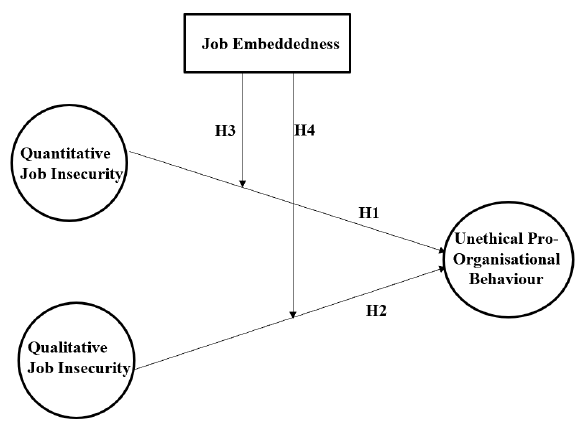
The study contributes to the extant literature in multiple ways. First, the focus on quantitative and qualitative job insecurity enhances our understanding of the concept of job insecurity and its consequences. Second, by studying embeddedness in combination with two forms of job insecurity, the study heightens our understanding of how relationship between two forms of insecurity and UPB is moderated (Figure 1). In doing so, we challenge the prevalent assumption that job embeddedness is always virtuous. The focus is expected to be shifted to the ‘dark side’ of embeddedness which may lead to state of desperation among the employees, pushing them to participate in behaviours which they otherwise are unlikely to exhibit. Although the moderating role of embeddedness between job insecurity and UPB has been previously researched (Ghosh, 2017), the study adds value by distinguishing between quantitative and qualitative job insecurity when examining the role of embeddedness as a moderator.
Theoretical Framework and Hypotheses Formulation
Job Insecurity
Job insecurity is defined as ‘the perceived powerlessness to maintain the desired continuity in a threatened job situation’ (Greenhalgh & Rosenblatt, 1984, p. 483). Hellgren et al. (1999) further differentiated job insecurity into two dimensions according to the specific area under threat. According to them, quantitative job insecurity is the threat of losing the job as a whole while qualitative job insecurity is concerned with the perceived threat of losing important job features like opportunities for promotion, salary development, job conditions, and so on.
Despite voluminous research in the topic of job insecurity, the researchers are divided regarding the differences in predictive power of these two forms insecurity. While some researchers argue that both forms of insecurity are important stressors and do not vary much with respect to their relationship with employee outcomes (e.g., De Witte et al., 2010), others are of the opinion that quantitative insecurity is a better predictor of employee consequences (Reisel & Banai, 2002). Some other studies assert that qualitative insecurity predicts employee outcomes better since it is more proximal (Callea et al., 2019).
These differences regarding the forecasting power of quantitative and qualitative insecurity may be due to the fact that the strength of relationship between the two forms of insecurity and employee outcomes is dependent upon the specific consequences or outcomes under study. Recent research has shown strong effect of quantitative insecurity on stress related responses and qualitative insecurity on employee engagement and motivation related response (Tu et al., 2020).
Although harmful effect of job insecurity on individual and organisational outcomes has been studied extensively, research is still in infancy regarding the impact of job insecurity on ethical conduct of the employees (Lawrence & Kacmar, 2017). Further, till date, concurrent effect of quantitative and qualitative job insecurity on ethical outcomes has not been examined. This gap is filled by the present study which explores the impact of both quantitative and qualitative job insecurity on the UPB.
Job Insecurity and UPB
Unethical pro-organisational behaviours are the ‘actions that are intended to promote the effective functioning of the organisation or its members and violate core societal values, mores, laws, or standards of proper conduct’ (Umphress & Bingham, 2011, p. 622). In order to boost the reputation of the employing organisation or to sustain its competitive edge over the competing firms, the employee may concoct or embellish the organisation’s accomplishments (Cialdini et al., 2004). Extant research has revealed various antecedents of UPB such as job satisfaction (Zhang, 2020), identification with the organisation (Chen et al., 2016; Umphress et al., 2010), psychological entitlement (Lee et al., 2019) and transformational leadership (Effelsberg et al., 2014).
Studies have highlighted the vital role played by emotions in the process of decision making (e.g., Damasio, 1994) with recent researchers demonstrating their impact on ethical decisions and behaviours (Horberg et al., 2011; Pizarro et al., 2011). On similar lines, it has been shown that emotional state of anxiety, resulting from job insecurity, may lead people to engage in selfish and unethical acts in an attempt to reinstate their endangered self (Kouchaki & Desai, 2015). In order to mitigate their feelings of anxiety, these individuals are more likely to focus inward and acquire more resources in the form of money and other benefits.
In accordance with the principles of COR theory, both the job and the important job features such as rewards and development opportunities, are categorised as valued resources (Halbesleben et al., 2014). The danger of losing actual job or job features is perceived as a potential resource loss by the employees and they strive to protect these resources. In their struggle to protect their valuable resources, the employees are likely to push the moral boundaries and make a conscious decision to exhibit unethical behaviour that promotes the organisation. In the hope that the organisation will reciprocate their loyalty with continued employment with the organisation, engaging in UPBs is their desperate attempt to protect their valued resources. Based on the above rationale, we propose the following hypotheses:
Job Embeddedness—A Potential Moderator of Job Insecurity and UPB Relationship
Job embeddedness denotes the forces, in form of links, fit and sacrifices, that tie an employee to the organisation (Mitchell et al., 2001). According to Mitchell et al. (2001), job embeddedness includes on-the-job and off-the-job embeddedness with each having three key dimensions, namely, fit, links and sacrifices. Individual will remain embedded in an organisation if they experience higher levels of any one or all of these dimensions restricting their movement from the organisation (Mitchell et al., 2001). Extant research has shown that job embeddedness is positively related to work attitudes and behaviours like job satisfaction, organisational commitment, and creative performance (Collins et al., 2014; Lyu & Zhu, 2019) and negatively associated to turnover intentions and actual turnover (Crossly et al., 2007; Peltokorpi et al., 2015; Zhang et al., 2019). However, it also entails that embeddedness leads to an increased dependence upon the organisation since the inertial powers of various links, strong fit, and numerous sacrifices exert pressure on the employee to stay with the organisation. Therefore, job and job features are more important to the employees who are embedded in their job. Applying the COR theory, Kiazad et al. (2015) rationalised that embedded employees are bestowed with more resources and they are motivated to ‘retain resources that hold intrinsic (sacrifices) or instrumental (fit and links) value, as resource loss is distressing’ (p. 642). This denotes that job embeddedness is a crucial factor in influencing the employees’ reaction to insecurity. The threat associated with two forms of job insecurity will be more for the embedded employees to protect their valued resources. Therefore, to save these resources, engagement is behaviours that may protect their job and concomitant job features is more expected from highly embedded employees. Their high dependence on the job paves way for them to exhibit unethical behaviours for the organisation so as to be seen in positive light.
In contrast, low embeddedness signifies reduced dependence upon the organisation. When experiencing quantitative and qualitative job insecurity, employees low on embeddedness may start focusing their efforts on other opportunities which may arise from the situation rather than consider engaging in unethical behaviours to stay with the organisation, for example, rather than trying to save their current job, these employees may search for alternate job opportunities, since they have less motivation to continue their employment. Therefore, they refrain from engaging in unethical behaviours since doing so may taint their reputation and adversely affect their long-term career path. Therefore, we propose the following hypotheses:
Methodology
Participants and Procedure
The data for the research was gathered during in the period ranging from end April to middle of May 2020. During this period there was strict lockdown in India and all the respondents who participated in the study were working from home. The sample for the present study comprised of the managers and executives working in diverse Indian organisations, who were recruited from the alumni database of a reputed business school. They were sent an invitation to participate in the survey, which was voluntary and was based on the participants’ consent. The respondents were apprised about the academic nature of the study and were ensured confidentiality of the results. In order to mitigate the issues associated with common method variance (Podsakoff et al., 2003), a three-wave research design was employed by the authors. According to Dormann and Griffin (2015), shorter time lags are methodologically more advantageous than longer ones since they help reduce respondent attrition and minimise the effect of contaminating factors that may disguise the relationship between variables. Therefore, in line with the previous research (Singh, 2019; Tu et al., 2020), a time lag of one week was chosen. At T1, independent variables and controls were measured. At T2, the respondents who participated in the first survey received a questionnaire having the questions related to the moderator. At T3, the respondents who successfully completed the second survey were invited to complete a third survey consisting of the questions related to dependent variable. In all, 712 respondents agreed to participate in the first survey and 619 filled questionnaires were received (response rate 86.9%). Of these 619 respondents who completed the first survey, 492 completed the second questionnaire (response rate 79.5%). Finally, 379 respondents completed the third wave of study (response rate 77%), generating 354 usable questionnaires (response rate 93.4%). Of the 354 respondents, 245 were males and 109 were females; 42 participants belonged to top management, 216 were middle managers and 96 were executives. Their age ranged from 24–65 years (mean age 35.37 years and SD 10.95) and their tenure with the present organisation ranged from 2–32 years (mean tenure 5.39 and SD 6.66).
Measures
All the survey items were presented in English and the responses to all the items ranged from strongly disagree (1) to strongly agree (5).
Analyses and Results
Confirmatory Factor Analysis (CFA)
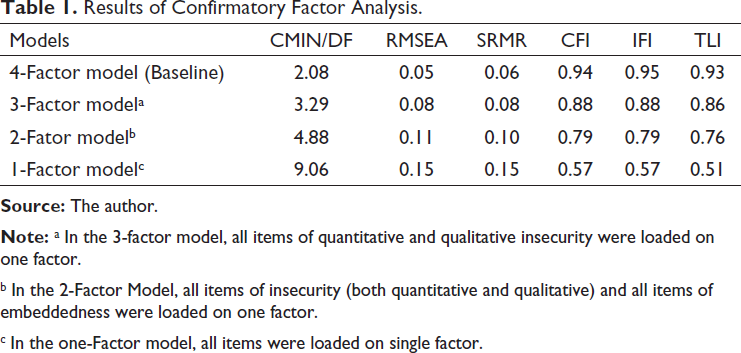
CFA was conducted to evaluate proposed model-data fit as well as to confirm the reliability and validity of the main variables. As suggested by researchers (e.g., Hair et al., 2010; Mc Callum et al., 1996), the evaluation of the model fit was assessed with the effect size of goodness of fit indices based on the established criteria. Consistent with the past research, the specific scale items were predicted to load on their corresponding latent variables creating an expected 4-factor model (quantitative insecurity, qualitative insecurity, job embeddedness, UPB loading on separate constructs). This 4-factor model yielded an acceptable fit (CMIN/DF = 2.08, CFI = 0.94; IFI = 0.95; TLI = 0.93; RMSEA = 0.05; SRMR = 0.06) and all items loaded on their respective factors at a statistically significant level (p < .05).
Results of Confirmatory Factor Analysis.
b In the 2-Factor Model, all items of insecurity (both quantitative and qualitative) and all items of embeddedness were loaded on one factor.
c In the one-Factor model, all items were loaded on single factor.
To see if the variables shared commonalities (suggesting factor grouping), the hypothesised 4-factor model was compared to several alternate models. Amongst all the measurement models, baseline 4-factor model achieved the best fit on all indices (Table 1). These results suggested that the variables under study namely quantitative job insecurity, qualitative job insecurity, job embeddedness and UPB could be distinguished from each other empirically and it was appropriate to treat them as separate constructs for further analysis. The standardised factor loadings were found to be acceptable and significant on their respective constructs.
Common Method Bias
Since the data was gathered using self-report measures from the same source, threat of common method bias could not be ruled out. In order to reduce this threat, certain procedural and statistical steps recommended by Podsakoff et al. (2003) were followed. The respondents were assured about the confidentiality of results and were told that there were no right or wrong responses. Harman’s single factor test was employed to statistically see if common method bias was indeed a threat in this case. The total variance explained by a single factor was 24.93%, which is less than 50%. Further, since the 1-factor model did not fit well with the data (CMIN/DF = 9.06, CFI = 0.57; IFI = 0.57; TLI = 0.51; RMSEA = 0.15; SRMR = 0.15) the possibility of common method variance in the present study was ruled out.
Descriptive Statistics
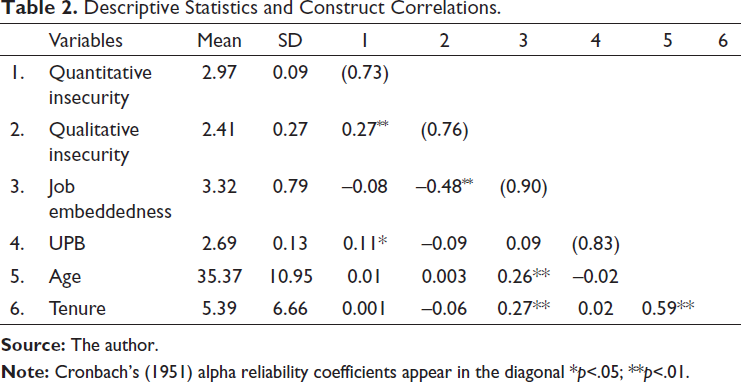
Table 2 shows the descriptive statistics (means and standard deviation), correlations and Cronbach’s (1951) coefficients. As can be seen from Table 2, all scales demonstrated good internal consistency.
Descriptive Statistics and Construct Correlations.
Hypotheses Testing
The hypotheses were tested using PROCESS v 3.0 macro (Hayes, 2013), which has been widely used for the analysis of moderation, mediation and conditional effects. Since the study deals with moderation, Model 1 of PROCESS macro was used. All the control variables were added as covariates.
Hypothesis 1 stated that quantitative insecurity was positively related to UPB. As can be seen from Table 3, quantitative insecurity is positively and significantly related to UPB (B = 0.22, t = 2.23, p < .05), thus supporting H1. Hypothesis 2 stated that qualitative insecurity was positively related to UPB. As can be seen from Table 4, qualitative insecurity is not significantly related to UPB (B = –0.03, t = –0.29, ns). Therefore, H2 is not supported and is rejected.
Moderating Role of Job Embeddedness Between Quantitative Insecurity and UPB.
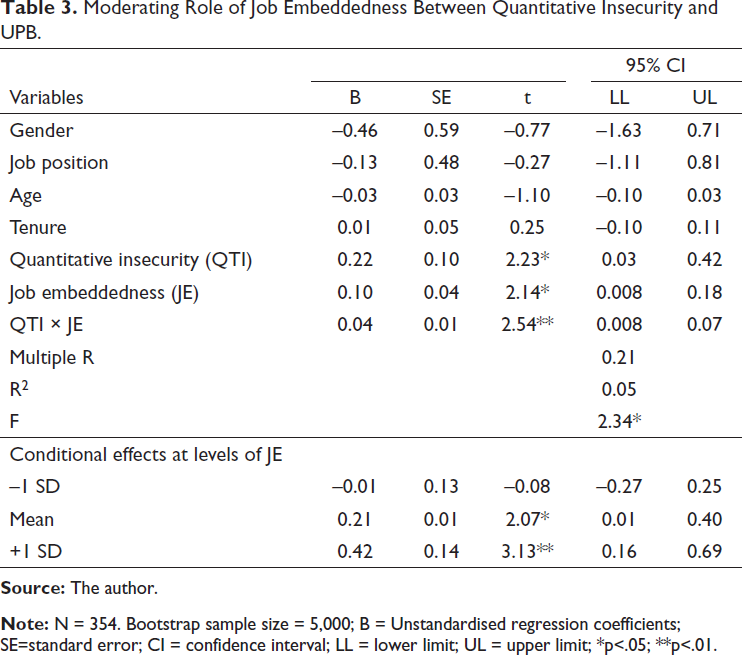
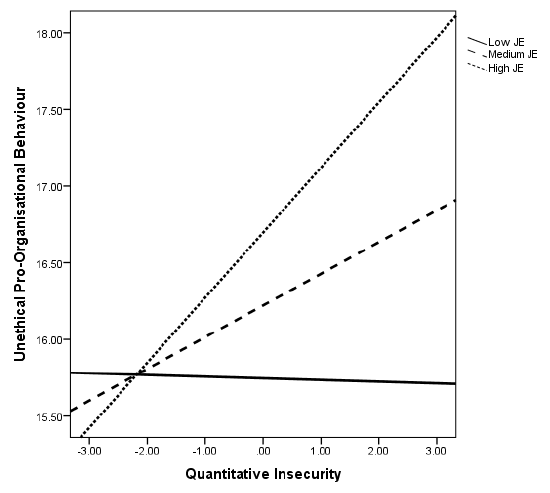
Hypothesis 3 stated that job embeddedness moderates the association between quantitative insecurity and UPB such that the association is stronger for employees who are more embedded that those who are less embedded. As is evident from Table 3, the interaction effect between quantitative job insecurity and embeddedness on UPB was significant (B = 0.04, t = 2.54, p < .01)., Conditional slopes were plotted at high, medium and low levels of embeddedness (+1 SD, mean and –1 SD) to facilitate the interpretation of interaction terms. As is evident from Table 3 and Figure 2, there is a positive and significant relationship between quantitative insecurity and UPB for employees high on embeddedness (B = 0.42, t = 3.13, p < .01) whereas the relationship between quantitative insecurity and UPB for the employees low on embeddedness is not significant (B = –0.01, t = –0.08, ns), thus supporting H3.
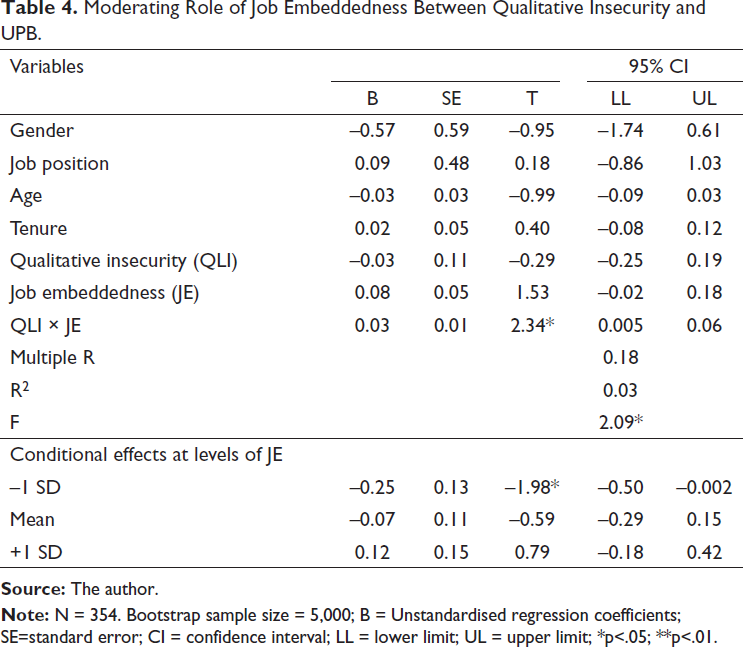
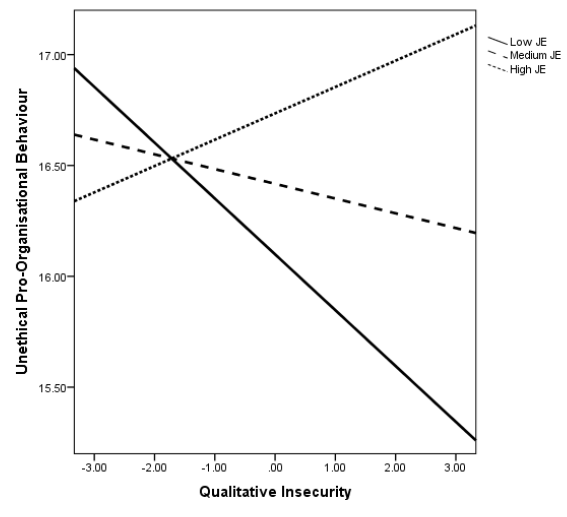
According to hypothesis 4, job embeddedness moderates the relationship between qualitative job insecurity and UPB such that the relationship is positive and stronger for employees who are more embedded that those who are less embedded. As can be seen from Table 4, the interaction effect between qualitative job insecurity and job embeddedness on UPB was significant (B = 0.03, t = 2.34, p < .05). The conditional effects at different levels of embeddedness, as is evident from Table 4 and the plots in Figure 3, present quite interesting results. There is a negative and significant relationship between qualitative job insecurity and UPB for employees low on embeddedness (B = –0.25, t = –1.98, p < .05). whereas for employees high on embeddedness, the relationship between qualitative job insecurity and UPB is not significant (B = 0.12, t = 0.79, ns). These results support H4.
Moderating Role of Job Embeddedness Between Qualitative Insecurity and UPB.
Discussion
Due to the current pandemic situation leading to economic downturn and huge job losses, the issue of job insecurity and the resultant employee behaviour seems extremely relevant. Applying COR theory as a framework, it was argued that both quantitative and qualitative job insecurity will be related to UPB. Additionally, it was proposed that the relationship between the two forms of insecurity and UPB will be stronger for the employees who are more embedded in their jobs.
The results of the study showed differential impact of two forms of job insecurity on UPB. While quantitative insecurity was positively and significantly related to UPB as predicted, the association between qualitative insecurity and UPB was found to be insignificant. It seems plausible that the perceived fear of losing one’s job may force a person to go to any extent to help the organisation and to be seen in positive light. In the hope that their allegiance will be rewarded with continued employment, they may make a conscious effort to engage in behaviours, which even though unethical, are beneficial for the organisation. In an attempt to conserve their treasured resources, little consideration is given to the fact that these behaviours may lead to hazardous consequences for the organisation in the long run. However, the perception of qualitative job insecurity may not garner similar kind of response from the employees. The threat of loss of important job features may not be seen as that severe so as to warrant engaging in UPB. Therefore, this study provides support for the fact that the two forms of job insecurity have differential impact on employee outcomes and is dependent upon the particular outcome of interest (Hellgren et al., 1999; Tu et al., 2020), which in this case was UPB.
The present study provides overarching evidence regarding the moderating role of job embeddedness between both forms of job insecurity and UPB. Overall, it was seen that when facing high job insecurity, the propensity to engage in UPB is more for employees who are embedded in their jobs. Validating the previous research (Ghosh, 2017; Lawrence & Kacmar, 2017) these results provide support to the conservation of resource theory. Previous research has shown that when employees encounter adverse work situations like job insecurity, those with high job embeddedness enhance their in-role performance and organisational citizenship behaviours to escape being the victim of that adverse situation (Burton et al., 2010; Qian et al., 2019). It needs to be understood that job embeddedness may perform a positive or a negative role during adverse work situations.
However, the results show divergent patterns with respect to the two forms of job insecurity. In case of quantitative insecurity, the results show that the relationship between job insecurity and UPB is positive and significant for the employees who are more embedded whereas this relationship becomes insignificant for employees whose embeddedness is low. In contrast, when it comes to the threat of losing vital job features (qualitative job insecurity), the results reveal a distinct pattern. The prospect of losing the job features may lead to exasperation and increased disengagement with the organisation rather than being seen as a threat. For less embedded employees, this withdrawal of engagement may be more pronounced and they are not likely to behave unethically when they perceive that organisation is withholding their valued job features. However, for employees high on embeddedness, the threat of losing important job features does not garner enough justification and desperation to engage in unethical behaviour.
Theoretical Implications
The present study has various theoretical contributions. First this study broadens the scope of literature by studying the impact of two forms of job insecurity on UPB during COVID-19 pandemic. While most of the previous research has focused on understanding the consequences of quantitative job insecurity, research is still scant in the area of qualitative job insecurity and its impact (Stynen et al., 2015). Further, while investigating the boundary conditions of job insecurity, previous studies have not differentiated between quantitative and qualitative job insecurity. The present study investigates the effect of job insecurity, both quantitative and qualitative, on UPB.
Second, the study expands the embeddedness literature by focusing on the dark side of embeddedness. Managers have been encouraged to find ways to enhance embeddedness because it is considered a desirable construct (e.g., Jiang et al., 2012) and extant research has shown that embeddedness leads to numerous individual and organisational benefits. The present study throws light on the deleterious effect of embeddedness which may lead to a sense of comfort, complacency and change aversion in the employees resulting in an increased dependence upon the organisation. Coupled with anxiety arising out of job insecurity, this state of ‘stuckness’ leads to a desperate situation which may push them to do anything to avoid losing their job. The study provides support for the contention that ‘although embeddedness itself is value neutral, the environment in which one is embedded must be considered’ (Allen et al., 2016; p. 1680). Being embedded in a favourable environment provides a person with a safety cover whereas it leads to a vicious tangle for people stuck in unfavourable conditions.
Third, the study makes contribution to the COR theory especially in the backdrop of COVID-19 pandemic during which there was immense job insecurity among the employees. The study provides credence to the fact that the anxiety arising from potential job loss may trigger a ‘loss spiral’ leading to UPB by the employees. Thus, the study provides empirical evidence for such ‘loss spiral’ postulated by COR theory which has so far been inadequately researched (Brummelhuis et al., 2011).
Finally, the research adds to the existing understanding of the concept of UPB by studying it in an Indian context thereby widening the spatial and cultural applicability of the concept. It is important to distinguish the understanding of the unethical behaviour in the sub-continental conditions which are markedly different than those in the western world. Amartya Sen’s (Sen 1980, 2002) work has shown that in most South Asian countries the power differential between the employees and the management is so much that workers may have no choice but to indulge in unethical behaviours. In addition, the job insecurities can lead to a constant effort by the employees to ingratiate themselves to the organisation through possible UPB (Ghosh, 2017). Further, since regulatory mechanisms are ineffective or non-existent in these countries, the organisations can easily ignore or be complicit in the process. This understanding of the UPB is noticeably different from the western context where it is largely seen as a free willed choice by an employee whether to engage in it or not. The study provides a layered exploration of the UPB and enriches the extent literature.
Practical Implications
UPB, although seemingly beneficial for the organisation in the short run, can have serious consequences not only for the employing organisation but for the larger society. Managers can however device appropriate mitigation strategies to curb this menace in light of the present results. It becomes extremely important for the employers to be mindful and reduce the feelings of uncertainty and anxiety associated with a perception of job insecurity. Positive organisational communication may reassure the anxious and insecure employees who are especially vulnerable during crisis situations. Previous research (Jiang & Probst, 2014) has also shown that such positive and clear communication mitigates the harmful effect of job insecurity on workplace accidents. According to them, fear of job loss combined with the absence of organisational communication plays havoc with ‘an already compromised resource reservoir’ (p. 564). The ethical standards in an organisation can be maintained by creating a psychologically safe environment where employees are free to speak up and raise their concerns (Dollard & Bakker, 2010).
The results of the study emphasise that perceived job insecurity results in UPB by the employees high on embeddedness. Managers need to be more vigilant and provide additional support to such vulnerable employees through counselling or employee assistance programs (EAPs).
The carrot of reassurance has to be supplemented with a stick of punitive consequences which may follow a violation of policy. A clear code of ethics, objective standards and conducive organisational culture reinforced by demonstrable action can help reduce, if not totally eliminate UPB. Research shows that communication of ethical guidelines by managers has a significant impact on reducing unethical behaviour by employees (Hassan et al., 2021). Moral sensitivity trainings through hands-on methods like role-plays, simulation or real-life examples of situations about how to tackle ethical issues in different contexts can be utilised profitably.
Limitations and Scope for Future Research
The study has some limitations which can be taken care of by the future researchers. First, the threat of common method bias cannot be ruled out since the data was collected from same respondents. However, it has been established that the data related to emotions, attitudes and perceptions is best captured through self-report measures (Spector, 2006). The threat of common method bias was managed following certain steps recommended by Podsakoff et al. (2003). Respondents were ensured about the confidentiality of the results and were assured that there were no correct responses. Moreover, the findings of CFA also showed that common method variance did not pose a problem in the current study.
Second, the cross-sectional nature of the present study prohibits making causal inferences. Future studies may examine the above relationship by using longitudinal studies which may help in bringing out the causal role of study variables in influencing the willingness to engage in UPB.
Third, the study used embeddedness as a moderator which was measured through the global measure (Crossley et al., 2007). Although this measure has been used extensively (e.g., Peltokorpi et al., 2015; Zhang et al., 2019), it would be interesting to see how each of the three dimensions of embeddedness (i.e., links, fit and sacrifice) moderate the relationship between job insecurity and UPB.
Fourth the data for the study was collected during the period when there was severe lockdown in India. These were the unprecedented conditions where uncertainty among the working class was looming high. Although the sample of the study comprised of the managers and executives working in different sectors in India, it raises concerns regarding the generalisability of the results to different situations and cultural contexts. Future researchers can validate the results in varying situations and cultural contexts.
Conclusion
Drawing on the conservation of resource theory, the study supports the relationship between quantitative job insecurity and UPB. Job embeddedness was seen to moderate the relationship between two dimensions of job insecurity and UPB with embedded employees showing higher propensity to engage in UPB. The results of the study provide evidence of the ‘dark side’ of embeddedness which, when coupled with perceived job insecurity, may lead to the state of desperation among the employees pushing them to engage in UPB. In light of these results, the managers may do well to evolve robust systems to address employee anxieties related to job security. It is said that sunlight is the best disinfectant. Therefore transparency, open flow of information and positive two-way communication may be most effective tools for managers to ameliorate the situation. Finally, a strong ethical culture and exemplary behaviour of the managers can go a long way in reducing the incidences of UPB.
Footnotes
Declaration of Conflicting Interests
The author declared no potential conflicts of interest with respect to the research, authorship and/or publication of this article.
Funding
The author received no financial support for the research, authorship and/or publication of this article.
