




Abstract
Understanding employees’ attitude towards the practice of exclusive talent management (ETM) has become increasingly important for ethical concerns. Despite its significant importance, this study is one of its kind, which first aims to examine the positive and negative attitude arising from the practice of ETM and also checks for the difference between the talented and non-talented employees. Based on social exchange and signalling theories, past studies have conceptually proposed that there may exist a difference in talented and non-talented employees because of their perception of justice and support, as this practice follows workforce discrimination in the organisation. Second, this article also aims to analyse how perceived justice and perceived support affect the attitude of employees towards ETM practices. Data was collected through the questionnaire method by applying convenience sampling technique, and responses of 735 employees were collected across 15 luxury hotels in New Delhi. Structural equation modelling and mediation analysis were conducted in AMOS to test various relationships. The findings suggest that ETM practices significantly affect both positive and negative attitude of employees. Also, talented employees perceive higher levels of positive attitude than non-talented employees, whereas no significant difference was found in their perception of negative attitude. Further, it was proposed that the differences in the attitude of the employees are because of their perception of justice and support towards ETM practices. It was found that perceived justice mediates the relationship of ETM with both positive and negative attitudes, but perceived support only mediates the relationship of ETM practices and the negative attitude.
Keywords
Introduction
Talent management (TM) allows organisations to identify high-performing and high-potential employees and retain them in the firm to ensure long-term strategic success. Identifying and retaining talented employees makes organisations follow the practice of workforce discrimination, which is considered fundamental to TM (Ledford & Kochanski, 2004). Workforce discrimination suggests that organisations should identify employees with significant contribution and invest disproportionately in them in order to generate maximum returns. The exclusive approach of TM also practises workforce discrimination and segmentation, wherein firms, first, identify the critical job positions in the organisations and, second, identify high-performing and high-potential candidates and finally later adopt discriminated HR practices to generate their long-term commitment (Collings & Mellahi, 2009). Firms follow the Pareto principle, wherein they invest 80 per cent of their resources in just 20 per cent of the individuals to whom they regard as talent. Talents are considered a source of competitive advantage which eventually promotes firms’ performance; therefore, a huge investment in developing and retaining them is justified from the organisational point of view.
Disproportionate investment in talented employees induces them to perform better and attain positive employee outcomes such as motivation, satisfaction, engagement, psychological contract fulfilment and self-esteem. However, this is an assumption which is being made that talented employee always react favourably to TM practices (Gelens et al., 2013; Malik & Singh, 2014) and organisations can only expect positive employee outcomes from them. It is argued that too much expectations and high-performing pressure may lead to stress and burnout among the talented employees (De Boeck et al., 2018). However, this is just a belief, and it is not clear whether talented employees showcase only positive attitude and no negative outcomes in the organisation. Further, it is also proposed that the practice of workforce discrimination under the exclusive talent management (ETM) will lead to dissatisfaction, stress, insecurity and so on even among the non-talented employees. Till date, there is no empirical study which says with certainty that the practice of ETM tends to generate negative reactions from the non-talented employees (De Boeck et al., 2018; Swailes, 2013). The way talented and non-talented employees perceive the practice of workforce discrimination under the exclusive approach of TM is not determined, and there is little knowledge about their reaction towards it (O’Connor & Crowley-Henry, 2017).
Second, it is also assumed that the ETM practices have larger consequences on employees’ perception of fairness as against the inclusive strategy of TM which pays more attention to justice and ethics by treating all employees equally. However, it has been stated that those organisations which follow the inclusive approach of TM also create a difference in their HR processes for high-potential employees but refrain from communicating the talent status to the employees with the fear of giving rise to the perception of negative reactions (Sonnenberg et al., 2013). This basic assumption which states that ETM creates a difference in the attitude of talent and non-talent from the perception of their ethical consideration and the support received from the organisation still continues to exist. It becomes even more important to verify that whether the differences in the attitude and behaviour of employees are because of their perception of justice and extent of organisational support received. Not many studies have been conducted to examine the effects of TM, and moreover, research on employees’ perception of justice towards ETM is also scarce (De Boeck et al., 2018). Hence, studies assessing the effect of ETM practices on employees’ attitude are an important avenue of research.
Moreover, the studies of TM in tourism and hospitality industries are mostly conceptual and lack empirical evidences (Johnson et al., 2019). Hospitality and tourism industries are extensively human centric, which are dependent on their employees for providing quality services, ensuring customer satisfaction and enhancing organisational performance. The hotel industry not only in India but across the globe deals with the attraction problem of manpower, along with the difficulty in retaining employees (Bharwani & Butt, 2012). To deal with the problems of talents and their management, large and multinational hotel organisations usually follow the practice of the ETM strategy, where the focus is only on high-performing executive and managerial employees (Baum, 2008; CIPD, 2006). But it is still unknown that how talented and non-talented employees perceive and differ in their attitude towards this ETM.
Although research in TM is progressing, it still demands for empirical evidences for the assumptions and theories which have been put forward (Gallardo-Gallardo & Thunnissen, 2019). Further, most of the outcomes of the TM practices were studied only once, which did not lead towards rigorous conclusion and generalisation (Aljbour, 2021), and moreover, researchers while assessing the positive variables have not taken into consideration all the components of attitude (i.e., affective, behaviour and cognition) together. Academicians suggest the need for investigating multiple TM outcomes simultaneously (Aljbour, 2021). Therefore, this article proposes a model which aims to investigate the relationship between ETM practices and attitude of hotel employees in New Delhi by relying on social exchange theory, organisational justice (OJ) theory and signalling theory.
Literature Review
ETM and Its Relationship with Attitude of Employees
The exclusive approach of TM views those employees as talents who can create a significant impact in the organisational performance either through their immediate contribution or by proving themselves to be a potential source in the long run (Tansley & Chartered Institute of Personnel and Development, 2007). Employees who are neither high-performing nor high-potential are considered as non-talented or inferior (Painter-Morland et al., 2019). Organisations segment employees in different groups on the basis of their performance and follow differentiated HR techniques under the exclusive approach of TM. Practitioners widely use the exclusive approach of TM because of its advantages (Ready et al., 2010). First, segmenting the workforce allows firms to invest most of their resources on the talented employees, who in return guarantee maximum benefits to the organisation. This is also known as the Matthew effect of generating high returns by investing on the most promising employees. Second, disproportionate allocation of resources actually helps firms to enjoy a sustainable competitive advantage and faster strategic success. Third, it gives rise to the Pygmalion effect, where high expectations of the managers actually induce talented employees to perform better and achieve positive or favourable outcomes such as motivation and self-esteem. Similar beliefs and expectations even in non-talented employees can give rise to self-fulfilling prophecies and lead to high performances. Lastly, the privileges given to talented employees act as motivation to the non-talented or average performers to either perform better or leave the organisation, and in both the situations, it benefits the organisation to build a high-performing culture. Employees are motivated to not only perform better than others but also develop skills that the organisation values (Höglund, 2012).
TM practices allow organisations to fulfil their financial goals and also generate desired employee outcomes or attitude. Organisations can influence the level of motivation, commitment and extra-role behaviour of the employees by undertaking effective TM practices (Collings & Mellahi, 2009). Talent development and talent retention practices have a positive impact on various outcomes such as job satisfaction, motivation, commitment and trust (Bethke-Langenegger et al., 2011). It is also true that attraction and retention of talent actually induce organisations to foster a culture of high performance, which ultimately leads to positive outcomes such as job satisfaction, commitment and motivation (Kontoghiorghes, 2016). Organisations, by building a culture of talent mindset, can indirectly affect the job performance and can directly bring a positive effect on the satisfaction level of the employees (Luna-Arocas & Morley, 2015).
TM practices not only generate positive affective attitude for the employees but also bring positive implications on their behavioural and cognitive aspects. Investment in talents and their leadership development leads towards higher level of affective commitment along with the greater intention to remain with the firms (Chami-Malaeb & Garavan, 2013). The practice of TM not only has a positive bearing on just one aspect of behavioural attitude but also positively affects the organisational citizenship behaviour of talented employees (Mensah & Bawole, 2018). A large number of TM practices targeted to talented employees with differentiation strategies also have statistically proven to positively impact the psychological contract fulfilment in the organisations (Sonnenberg et al., 2013). Inclusion or exclusion of an employee in the TM practices not only affects psychological contract but also positively affects the levels of organisational commitment for employees (Seopa et al., 2015).
Organisations are able to generate positive attitude of talented employees as they invest more resources in them. Providing sufficient resources as per the demand of the job results in favourable attitude of talented employees (Malik & Singh, 2020). In other words, talented employees showcase positive attitude in the organisation when they see more job resources at their dispersal. Talented employees also want differentiated HR practices to continue in order to acknowledge their significant contributions in the organisation. The display of these workplace behaviour and employment relationships in an organisation is guided by the theory of social exchange. This theory suggests that employees enter into an interdependent relationship with the employers where both commit to follow the norms of reciprocity and action of one party leads to the reaction of other (Cropanzano & Mitchell, 2005). In the practice of the exclusive approach of TM, firms disproportionately invest their resources towards high-potential and high-performing employees and consequently these talented employees also reciprocate the corporate investment done in them by showcasing positive outcomes (Björkman et al., 2013; De Boeck et al., 2018; Khoreva et al., 2017).
Employees identified as talent tend to generate positive outcomes which are considered favourable by the organisation. However, talented employees may also perceive unfavourable or negative attitude such as stress and burnout in the organisation under three different instances. First, expecting talented employees to outperform in every task may arise a feeling of persistent pressure among them to achieve higher excellence (Dries & Pepermans, 2008; Tansley & Tietze, 2013). Higher expectations can actually develop a fear of failure within them and may result in job stress (Höglund, 2012). Second, poor performance of talented employees may force the organisation to remove the status of talent from them, and this may lead to further loss of opportunities, privileges and resources. Such ‘loss spiral’ can negatively affect the talented employees, rising stress and burnout (Malik & Singh, 2018). Third, it has been argued that after a certain period of time, talented employees reach a saturation level, where the elitist or preferential treatment fails to motivate them (Malik & Singh, 2018). There may also arise a situation where talented employees feel that they deserve more, but this desire of ‘gain spiral’ may become unfeasible because of limitations of financial resources (Dries & De Gieter, 2014; Gelens et al., 2015).
In either of these situations, talented employees will be frustrated and will develop negative attitude like stress. This phenomenon has been termed as ‘talent paradox’ by Daubner-Siva et al. (2018) and ‘talent curse’ by Petriglieri and Petriglieri (2017) because identification of talent may lead to both positive and negative outcomes. In a systematic review of literature by De Boeck et al. (2018), it was found that talented employees perceive positive affective, behavioural and cognitive reactions towards the practice of ETM, along with unfavourable affective reaction such as burnout and stress. Apart from talents, the non-talented employees may also experience disappointment and frustration and therefore display unfavourable attitude in the organisation (Malik & Singh, 2014, 2018; Swailes & Blackburn, 2016). This is because as ETM practices work on the underlying principle of workforce discrimination, these non-talented employees may perceive injustice from the preferential treatment and unequal distribution of resources (Gelens et al., 2013, 2014).
The process of linking TM practices to employees’ attitude still remains a black box (Gelens et al., 2014). Most of the studies conducted to examine the employee-level outcomes from the practice of TM are conceptual studies involving review of literature from the secondary sources. Very few researchers have adopted empirical studies focusing on the employee-level outcomes from the practice of TM perspective (Björkman et al., 2013; De Boeck et al., 2018 Dries & Pepermans, 2008). Those empirical studies which have been conducted so far have adopted the interview method, which involves very few participants and therefore suffers from the problem of generalisation. Also, there are very few studies which take into consideration the potential negative reactions of the employees which may arise from the practice of ETM (De Boeck et al., 2018; Krebs & Wehner, 2021). Therefore, this study aims to explore both positive and negative attitude of employees by hypothesising that
H1: ETM practices will result in (a) positive and (b) negative attitude of employees.
In contrary to the Pygmalion effect within the talented employees, the Golem effect leads to adverse consequences with regard to motivation and performance of the non-talented employees. This is because majority of the employees perceive lower expectations from their managers and receive lesser amount of financial investment for their growth and development because of their insignificant contribution in the organisation. As a result, non-talented employees in the organisation tend to differ in their attitude from the talented employees. Differential treatment undertaken in an organisation on the basis of the talent status leads to the differences in the perception of employees towards the practice of ETM, and this affects the motivational level of employees differently working in various MNCs (Höglund, 2012). Identifying talent also provides support for better performance, higher commitment, greater support for strategic priorities and lower turnover intention of talented employees than other employees in the organisation (Björkman et al., 2013). Even organisational identification of potential status enables high-potential employees to perceive positive psychological contract as compared to non-high-potentials (Dries et al., 2014). A study comparing the difference between employees (n = 203) on the status of talent found that job satisfaction and work effort from the practice of TM are more for high-potentials than non-talents (Gelens et al., 2014). The practice of ETM also allows talented employees in an organisation to display higher levels of engagement than non-talented employees (O’Connor & Crowley-Henry, 2017).
A study conducted for 521 talented employees holding managerial and non-managerial positions at various levels in 54 five-star hotels in 6 cities in Saudi Arabia for hotel industry found significant support for the positive impact of TM on various outcomes such as organisational commitment, talent retention and talent engagement (Alferaih et al., 2018). Although non-talented employees have not largely been taken into consideration in TM research, a study by Kichuk et al. (2019) explores the experiences and behaviour of those employees who are not the part of the talent pool by interviewing 15 employees and managers in a small hotel chain of England. TM strategies were the key priorities of this hotel chain, where they followed workforce segmentation and found out that the non-talented employees experienced frustration and mistrust in the hotel. Further, they also had least expectations of career development and possessed higher intention to quit the hotel.
Research examining employee outcomes from TM is an underexplored topic (Björkman et al., 2013; De Boeck et al., 2018; Dries & Pepermans, 2008; Meyers et al., 2019; Meyers & Van Woerkom 2014). Studies focusing on the employee outcomes have not paid attention to differentiate between employees, that is, talent and non-talent, to assess the effectiveness of TM (De Boeck et al., 2018; Krebs & Wehner, 2021). Therefore, we propose that there exists a difference between talented and non-talented employees with respect to both positive and negative attitude and hypothesise that
H2: There is a difference between talented and non-talented employees with respect to their (a) positive attitude and (b) negative attitude.
Employees’ Attitude and Role of Perceived Justice
The difference in the attitude of talented and non-talented employees is significantly attributed to the OJ theory (Gelens et al., 2014). The OJ theory which evolves from the Adams’ equity theory states that individuals compare their relationship with others in the organisation and any deviation from the equal treatment between them and other(s) could potentially lead to negative outcomes (Greenberg, 1990). Since workforce differentiation and segmentation is the core of ETM practices, the OJ theory explains how TM practices can differently affect the attitude and behaviour of talented and non-talented in an organisation. High-potential and non-high-potential employees will also perceive such differentiation differently and react differently (Gelens et al., 2014). High-performing and high-potential employees who are included in the TM practices of an organisation will view the distribution and procedures of ETM practices to be fair and consequently show positive behaviour and attitude towards work. However, employees who fail to become a part of such exclusive practices will develop a perception of organisational injustice and hence showcase negative attitude in the organisation.
The concepts of workforce differentiation and perceived OJ have been combined together to comprehend the difference in the attitude of employees towards the ETM practices. A study envisaged that as the firm spends large amount of its limited resources in the growth and development of the talented employees, these employees sense higher distributive justice and therefore display greater positive reactions than others in the organisation (Gelens et al., 2013). To provide empirical support, a survey with 203 respondents from an organisation was conducted to explore the perception of distributive and procedural justice of those identified as high-potential and to determine its impact on job satisfaction and work effort (Gelens et al., 2014). This study revealed that both job satisfaction and work effort were significantly higher for high-potentials as compared to non-talent. Within the high-potential employees, senior high-potentials statistically reported higher work effort in comparison to junior high-potentials, but there was no difference between them with respect to job satisfaction. The findings further revealed that the perception of distributive justice was higher in high-potential employees in comparison to low-potential employees, and the perception of distributive justice fully mediates the relationship between those identified as high-potential employees and their level of satisfaction. The study also stated that when employees perceive workforce differentiation procedures to be fair, they report higher distributive justice as well as exert lot of work efforts unlike those who find the procedures to be unfair. In other words, procedural justice moderates the association between distributive justice and work effort. Moreover, the study outlined the need of future multi-level research to examine the causality and to generalise the findings because the study might have been influenced by the factors such as organisational culture and organisational communication of potential status.
A study by O’Connor and Crowley-Henry (2017) also aimed to investigate the employees’ belief about the fairness involved in the practice of the exclusive approach of TM and the resultant on their engagement. The study emphasised that those identified as talented employees will possess higher levels of engagement unlike non-talented employees. However, the study was in the form of a conceptual paper, and the findings suggested in the study merely remain conceptual, which have not been tested empirically. Another study conducted by Narayanan, Rajithakumar and Menon (2019) theoretically evaluated the role of OJ in determining employee retention from the practice of TM. The study highlighted that different components of OJ directly affect ETM practices and employees’ retention in an organisation. However, there still remains a research gap to empirically validate the ideology that OJ plays an important role in retaining employees from the practice of ETM.
To gather the theoretical understanding behind different employees’ reaction towards the practice of ETM, Bhatia and Baruah (2020) conducted an in-depth review of literature, and based on the existing literature, the study proposes that the perception of both procedural and distributive justice within employees plays a mediating role which can possibly explain different employees’ reactions. Further, the study provides direction for future research to validate this proposition through empirical findings. Malik and Singh (2020) also classify different employee outcomes from the inclusive–exclusive perspective, where they suggest that combining the TM approach with equity perception will have a bearing on the effectiveness of TM. It has been hypothesised that ETM practices will lead to favourable attitude (such as engagement, less burnout, satisfaction and commitment) only when employees perceive higher equity and justice in the organisation and employees will have unfavourable attitude when they perceive higher inequity and injustice. The propositions put forward have not been tested and require further validation through empirical studies.
Another critical review of literature conducted by Kwon and Jang (2021) highlights various downsides of ETM from the point of view of ethics and OJ. The study envisages that very few empirical studies have been conducted which examine the relationship between ETM practices and ethics and therefore suggests the need to conduct future research in this direction. A study conducted for profit organisations in France revealed that ETM practices result in perceived injustice within employees with regard to distributive and procedural justice (Peterson et al., 2022). It is because of the perception of justice that employees react or behave differently towards such ETM practices. However, the findings could not be generalised for a larger population because the data were collected from few participants through the interview method.
The field of TM fails to establish and generalise the role of perceived justice in the relationship between ETM practices and the attitude of employees. A large number of studies conducted so far are either reviews of existing literature or conceptual studies or studies whose findings are based on the interviews conducted with very few number of respondents. It is not clear whether perceived justice plays a crucial role in determining the attitude of the employees. Therefore, this study aims to empirically study the role of perceived justice in shaping the attitude of employees towards ETM practices by hypothesising that
H3: Perceived justice mediates ETM and (a) positive attitude of employees and (b) negative attitude of employees.
Employees’ Attitude and Role of Perceived Justice
Lindenberg formulated the relational signalling theory which assumes that an individual behaves according to the predetermined goals, and this behaviour depends on the context of its goals (Six, 2007). In an organisational setting, this theory signifies that the behaviour and actions of an employee originate from what they receive from the organisation. Desired behaviour or outcome will be generated only when employees will perceive organisational support and attention. The perception of organisational support will develop a firm conviction in the minds of the employees that in the unwanted and difficult situations, the organisation will help them to effectively carry out their job (Rhoades & Eisenberger, 2002). Moreover, organisational goals will only be accomplished when employees perceive that their supervisors acknowledge their work and care about their well-being (Eisenberger et al., 2002). However, if employees perceive less/no organisational and supervisor support, the practices of TM will fail to achieve their intended target.
Organisations consider talented employees a source of competitive advantage and even go over and beyond their duties in retaining them by extending support in all directions. Talented employees also perceive the amount of support extended to them by both the organisation and the supervisor and therefore direct their energies in attaining financial and HR goals for the organisation. However, non-talented employees perceive that the organisation extends greater support to the talented employees as compared to them. As a result, these employees feel demotivated and less important and thereby display negative attitude and behaviour in the organisation. Du Plessis et al. (2015) determined the effect of managerial support in TM practices on the turnover intentions of employees (n = 135) and revealed that though there is a significant positive relationship of TM practices with both perceived organisational support (POS) and perceived supervisor support (PSS), neither of the support variables affects TM practices and turnover intentions.
Another study by taking samples from two different populations, that is, managers (203) and managerial trainees (195), aims to study the interdependence of POS and affective commitment of talented and non-talented employees in Belgium organisations (Gelens et al., 2015). These studies concluded that high-potentials/ talents perceive higher organisational support as compared to non-high-potentials in both the populations. Further, the designation of an employee as talented and the levels of affective commitment are mediated by the employee’s perception of organisational support. However, the difference between talented and non-talented employees with respect to their affective commitment could be established in just one study involving the population of managers. Further, Swailes and Blackburn (2016) conducted a study in chemical industry in Northern Europe to analyse how employees who are a part of the talent pool differ in their work attitude from those who are not by adopting a mixed method research. The employees (n = 17) were first interviewed and then asked to participate in a survey through the questionnaire method, but the sample size for the study is actually considered inadequate to generalise the findings. However, the study reported that those who are not considered as talented indeed perceive lower organisational support and unfairness and expect least interest from the organisation in them. On the other hand, employees in the talent pool look forward for the positive future prospects and are quite satisfied with their growth and development. Moreover, they also perceive greater organisational as well as supervisor support.
Both De Boeck et al. (2018) and Bhatia and Baruah (2020) have framed a conceptual model wherein they propose that perceived support from the organisations as well as the superiors bridges the relationship of employees’ attitudes towards the ETM practices. The mediating role of perceived support in the field of TM has been explained through the social exchange theory and signalling theory. Both the studies stress the need of exploring the role of perceived support in the ETM practices and call for future research in this direction.
Gupta (2020) in a study aims to explore the casual relationship of TM dimensions such as POS and PSS on the turnover intentions of Generation Y employees by undertaking survey from 284 employees working in five-star hotels across India. The Pearson correlation analysis found positive association of TM practices with both POS and PSS, whereas there was a negative association of employees’ perception of TM practices and their intention to quit. Further, POS and PSS do not affect the association of perceived TM practices with the intention to quit. However, such results challenge the findings of other empirical studies in this direction, and it is difficult to establish the role of perceived support.
Many studies propose that POS has the tendency to mediate the relationship between TM practices and employees’ attitude in an organisation (Bhatia & Baruah, 2020; De Boeck et al., 2018; Mensah, 2015; Mensah et al., 2016). But studies evaluating the role of perceived support as the mediating variable between ETM practices and attitude of employees have been very limited and have failed to quantitatively test the relationship. Therefore, this study aims to determine the mediating role of perceived support by hypothesising that
H4: Perceived support mediates ETM and (a) positive attitude of employees and (b) negative attitude of employees.
Research Methodology
Sampling and Data Collection
A quantitative research design was selected to collect data through the questionnaire method. As per the Ministry of Tourism, Government of India, 43 hotels in New Delhi have been listed as five-star deluxe, five-star and four-star. HR managers of these 43 hotels were contacted and asked to participate in the research, and 15 of these hotels agreed to participate. A preliminary study was conducted with the HR managers and the respective line managers to identify talent in their hotel by assessing the past year performance of the employees. Those employees were labelled as talent who were the high performers and whom the managers considered as potential talent. This is because managers are in a better position to analyse the abilities, skills and motivation of employees and regard them as talent (Silzer & Church, 2009). Moreover, past studies suggest that organisations largely rely on management judgement to identify and spot talent (Campbell & Hirsh, 2013, pp. 1–40). A similar methodology has also been used in related studies of TM (e.g., Chami-Malaeb & Garavan, 2013; Mensah et al., 2016).
A total of 1,200 questionnaires were distributed to the employees in 15 five-star and four-star hotels, out of which 735 questionnaires were completely filled and were considered suitable. Data was collected within the time span of six months, that is, from December 2020 to May 2021. These employees were selected on the basis of the convenience sampling technique depending on who were available on the days of data collection. The sample so collected represented employees from all levels, that is, managerial, supervisory and staff. The overall response rate was 61.25 per cent, and the sample size is favourably considered suitable in comparison to similar empirical studies in the area of TM and assessment of employees’ attitude (e.g., Björkman et al., 2013) and TM in the hotel industry (Alferaih et al., 2018). Also, according to the Roscoe’s rule of thumb, a sample size between 30 and 500 is justified in behavioural research because, first, a sample size above 30 qualifies the criterion of the advantages of the central limit theorem and, second, the sample error for 500 samples does not exceed 10 per cent of standard deviation approximately 98 per cent of the time (Hill, 1998).
Measures
Multiple items were used to reflect various constructs, and all the items were measured using six-point Likert scale ranging from strongly disagree (1), slightly disagree (2), disagree (3), agree (4), slightly agree (5) and strongly agree (6). The six-point Likert scale has been preferred over five-point Likert scale because it offers the researcher the benefits of approaching normal distribution with no neutral points (Leung, 2011). Moreover, the five-point Likert scale has also been criticised from the viewpoint that such a scale cannot be considered as an interval scale.
Twelve items were adopted from the integrated TM scale developed by Jayaraman et al. (2018). Various variables were used to measure affective, cognitive and behavioural components of positive attitude of employees such as affective organisational commitment, job satisfaction, engagement, work motivation, trust, psychological contract fulfilment, intention to remain with the organisation, organisational citizenship behaviour and work effort, and each variable was measured using three items. Affective commitment scale was adopted from Allen and Meyer (1990), job satisfaction was measured by adopting items from the study of Fernandes and Awamleh (2006), engagement was measured using Utrecht Work Engagement Scale (Schaufeli & Bakker, 2006), work motivation items for hotel employees were adopted from Chiang and Jang (2008), items to measure trust were adopted from Tzafrir and Dolan (2004), items for psychological contract fulfilment were adopted from Rousseau (2008), the intention to remain with the organisation and organisational citizenship behaviour were measured by adopting items from the study of Kehoe and Wright (2013) and work effort scale was adopted from De Cooman et al. (2009). Negative attitude, that is, job stress, was measured by adopting four items from Gok et al. (2017), which were considered suitable for the study. Two dimensions of perceived justice (procedural and distributive) were adopted from the OJ scale of Colquitt (2001), whereas POS items were adopted from Rhoades et al. (2001).
Common Method Bias
It might be possible that systematic error variance might occur among the variables because of same source and method of data collection. The presence of common method variance creates a threat to the validity of the data when the respondents fill in the questionnaire in a single setting. Therefore, a common method bias test was conducted using the common latent factor method as explained by Podsakoff et al. (2003). A latent variable was introduced in the measurement model of confirmatory factor analysis (CFA). The standard regression weight of the model with and without latent factor was computed, and delta was calculated by measuring the difference in the estimates of two models. The difference between the two was less than 0.2, which suggests that the data is free from the issue of common method bias (Podsakoff et al., 2003). The factor scores range from –0.047 to 0.172, which lies within the acceptable limit.
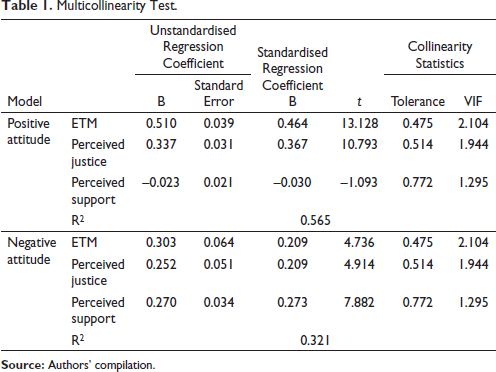
Multicollinearity
Multicollinearity Test.
Reliability and Validity
Reliability and Validity.
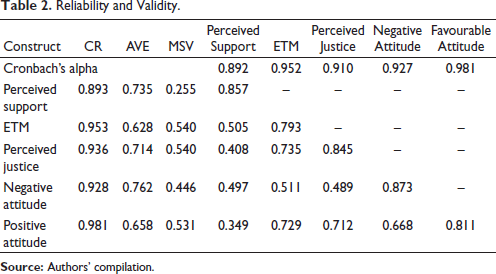
Convergent and discriminant validity was established using Fornell–Larcker testing system. According to Fornell and Larcker (1981), the value of average variance extracted (AVE) above 0.7 is categorised as very good, and a value between 0.5 and 0.7 is considered acceptable. Also, the CR value must be 0.7 and above to establish convergent validity. Here, the observed scores of AVE and CR are within the acceptable range and there are no concerns for convergent validity. Moreover, the AVE should be higher than maximum shared variance (MSV) and the square root of AVE should be higher than its respective inter-construct correlations to establish discriminant validity (Hair et al., 2014). Here, all the dimensions of the scale have met the aforementioned criterion, and therefore the discriminant validity is also achieved.
Analyses and Results
Sample Demographics
Primary data has been collected from 735 respondents through the questionnaire method, and the respondents are characterised on the bases of age, gender, education, department, job position and the status of talent. A large number of participants in the study were male (79.7%) who largely fell under the age group of 25–31 years, followed by 32–38 and 39–45 years. There was a total of 15 hotels, out of which 8 were labelled as five-star deluxe, 4 as five-star and 3 as four-star hotels. Data collected from these hotels represented a mix of both operational and functional departments. From the operations, a total of 25.7 per cent respondents were working with the food and beverage department, 23 per cent of respondents with the front office and 19 per cent with the housekeeping department. Also, a large number of respondents from the functional head were found to be working with the sales and marketing department (14.4%), followed by human resources (10.5%) and finance (6%). 38.6 per cent of the participants in the study were found to be working at a staff level or lower management, 33.3 per cent at supervisory or middle level of management and 28 per cent at top managerial level. A total of 38.5 per cent were identified as talent and 61.5 per cent as non-talent for the study. The sample distribution is considered adequate keeping total population characteristics in mind.
Exploratory Factor Analysis
The presence of a large number of variables in the study calls for the simplification of the inter-correlated variables to few constructs or factors. As a result, the principal component analysis was conducted with varimax using Kaiser normalisation rotation, and an eigenvalue greater than 1 was selected to identify the factors. It is a prerequisite to check the suitability of the data with Kaiser–Meyer–Olkin (KMO) and Bartlett’s tests before analysing the factors. The value of KMO must be above 0.7, whereas a value between 0.8 and 1 is considered marvellous (Kaiser, 1958). The Bartlett’s test should be significant (p < 0.5), indicating equal variances of the samples. The KMO test value turned out to be very good (0.9584), and the Bartlett’s test was also significant. Therefore, the data was considered suitable to perform exploratory factor analysis (EFA). Further, the EFA generated five factors which together explained the variance of 70.815 per cent.
Confirmatory Factor Analysis
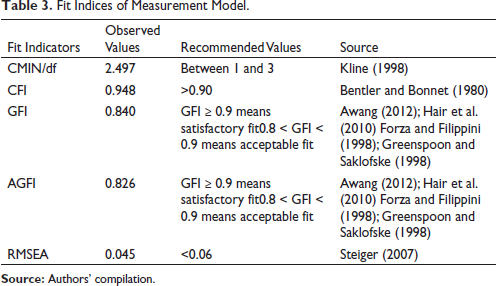
Fit Indices of Measurement Model.
Structural Equation Model
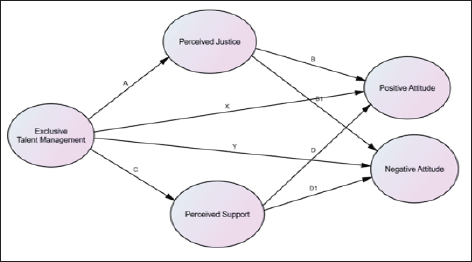
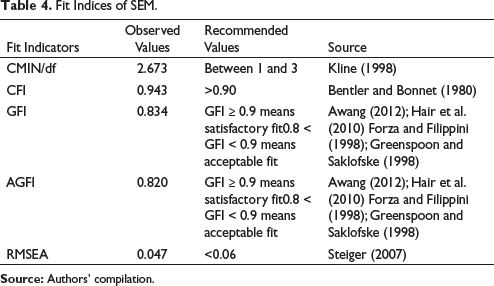
After the CFA model was found to be a good fit, a structural equation model (SEM) was built (Figure 1) to test the different hypothesis proposed for this study. The estimates were calculated in AMOS using maximum likelihood estimation method. The goodness of fit estimates represented in Table 4 indicate that the model meets the prescribed criterion and can be used for further analysis.
Fit Indices of SEM.
Regression Analysis
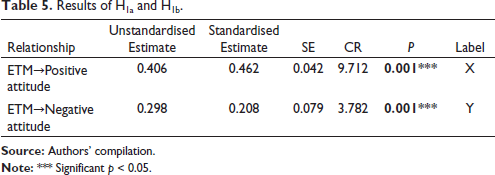
Results of H1a and H1b.
Multigroup Analysis
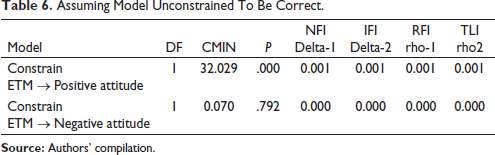
Further, multigroup analysis was also conducted to examine the status of talent (i.e., talent and non-talent) on two different paths (i.e., ETM↓Positive attitude and ETM↓Negative attitude) in AMOS. The fit of the two models, that is, unconstrained (where path allowed to vary) and constrained (paths forced to be equal across group) can be compared directly from the nested model comparisons statistics. For the path ETM↓Positive attitude, the chi-square difference value for the two models is 32.029, with 1 degree of freedom as represented in Table 6. Since the value is significant at the 0.05 level (p < .05), therefore, the two groups, that is, talented and non-talented employees, differ significantly in the path from ETM to positive attitude. However, for the path ETM↓Negative attitude, the chi-square difference value for the two models is 0.070, with 1 degree of freedom and the corresponding p value is not significant. Thus, the two groups do not significantly differ from each other in the path from ETM to negative attitude.
Assuming Model Unconstrained To Be Correct.
Chi-Square Group Difference.
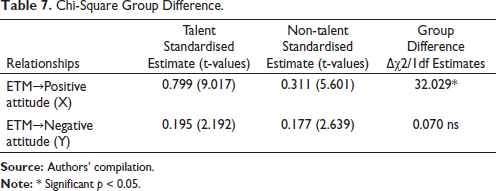
The chi-square group difference on the path ETM↓Positive attitude (X) was significant. Therefore, the hypothesis H2a was accepted, and it is found that there is a significant difference between talented and non-talented employees with respect to their positive attitude. Further, the chi-square group difference test statistics resulted that the talented employees (0.799) exhibit greater levels of positive attitude towards ETM as compared to the non-talented employees (0.311).
Moreover, the chi-square group difference on the path ETM↓Negative attitude (Y) was not significant. Therefore, the H2b could not be supported, and it can be said that there is no significant difference between talented and non-talented employees with respect to their negative attitude.
Mediation Analysis
Direct and Indirect Effects.
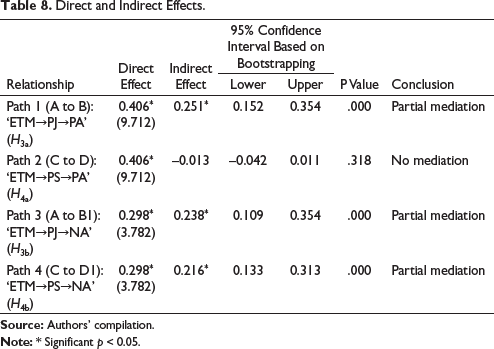
Zhao et al.’s (2010) decision tree has been used to determine the type of mediation analysis. Full mediation is found when the indirect effect estimate is significant and direct effect estimate is insignificant; partial mediation is found when both indirect and direct effect estimates are significant; and no mediation is found when only direct effect estimate is significant and indirect effect estimate is insignificant.
From Table 8, the direct effect from ETM to positive attitude is significant along with the indirect effect from ETM to positive attitude through perceived justice implying partial mediation, whereas the indirect effect from ETM to positive attitude through perceived support is not significant implying no mediation effect. The direct effect from ETM to negative attitude is significant along with the indirect effect through perceived justice and perceived support which signifies the partial mediation type. The test suggests that there is a significant specific effect for all paths except for Path 2. This is because the zero is included in the confidence interval of Path 2 (Macho & Ledermann, 2011; Preacher & Hayes, 2008). Therefore, hypotheses H3a, H3b and H4b are supported, whereas H4a is not supported.
Discussion of Findings
The first aim of this article was to validate the relationship of the exclusive approach of TM with the attitude of hotel employees and in this regard two hypotheses were proposed. The first hypothesis (H1a) which proposes that ETM practices have a significant relationship with the positive attitude of employees has found support in this study. This implies that the practice of ETM generates desired affective, behavioural and cognitive outcomes for employees. The intent for which TM practices are implemented in the organisation achieves its aim for desired HR or positive employee outcomes. The result of this study is in conformity with previous empirical studies pertaining to different variables of positive attitude (Björkman et al., 2013; Chami-Malaeb & Garavan, 2013; Höglund, 2012; Seopa et al., 2015; Sonnenberg et al., 2013; Tymon et al., 2010). Further investigation as to how the status of talent affects this relationship has also been explored in this study. The results from the chi-square group difference provide support for the evidence that there is a significant difference between talents and non-talents in their positive attitude towards the practice of ETM (H2a). It has been established in the study that talented employees showcase higher levels of positive attitude as compared to non-talented employees. The difference between the employees is directly linked to the notion of workforce discrimination and the Pareto principle of disproportionate investment which is based on the status of talent in the organisations. This divide between the employees which is created by the practices of the ETM results in the generation of high level of positive attitude for the talented employees in comparison to non-talented employees. Such a difference exists between the employees because talented employees feel that the organisation by identifying their positions is more concerned towards their growth and development. On the other hand, non-talented employees do not perceive similar things to that extent in the organisation and therefore showcase lower level of positive attitude.
The second hypothesis (H1b) proposes to validate the relationship between ETM practices and the negative attitude of hotel employees. This study has empirically found out that ETM practices manifest the formation of negative attitude for hotel employees. The possible reason for the presence of stress within all employees can directly be attributed to the nature of the hotel industry, which is associated with the challenging work roles, direct customer handling and sometimes longer working hours. Further, the study could not find any significant difference in the negative attitude between the two groups of employees towards the ETM practices (H2b). In other words, negative attitude like stress was predominant for both the groups of employees in the hotel industry. It is speculated that talented employees perceive job stress because they are always expected to outperform and achieve higher success every time, whereas the practice of workforce segmentation under the exclusive approach of TM may cause stress in the non-talented employees because of the differential treatment that leads to lesser extent of support and higher injustice for them. It might also be possible that the nature of the hotel industry is such that it leads to stress among the employees.
The second aim of the study was to test whether perceived justice affects the attitude of hotel employees towards the practice of ETM. Two hypotheses were framed: The first proposes that the perceived justice mediates the relationship between ETM and positive attitude (H3a), and the second proposes that the perceived justice also mediates the relationship between ETM and negative attitude (H3b) of employees in the hotel industry. This study found support for both the hypotheses where perceived justice partially mediates the relationships. It is inferred that employees portray different attitude because of the differences in the perception of justice towards the practice of ETM in hotels. Talented employees perceive workforce segmentation and unequal distribution of resources as just and fair because of their supreme contribution towards the competitive advantage and long-term success of the firm. Also, talents want differential treatment to continue in the organisation because of their significant contribution, and as a result, this practice of differentiated techniques under ETM makes them perceive higher procedural and distributive justice. On the other hand, non-talented employees perceive workforce discrimination under ETM as unjust and unfair because of which they may perceive lesser procedural and distributive justice towards ETM practices. Therefore, the hypothesis that the perception of justice mediates the relationship between ETM and attitude of hotel employees has been empirically supported.
The third aim of the study was to determine the mediating role of perceived support in understanding the attitude of hotel employees towards the ETM practices. Two hypotheses were proposed for this objective: first, the perceived support mediates the relationship between ETM and positive attitude (H4a) and, second, the perceived support mediates the relationship between ETM and negative attitude (H4b). The study found that perceived support partially mediates the association of ETM and negative attitude and hence H4b was supported. No mediation effect was found for perceived support in the relationship between ETM and positive attitude and therefore H4a could not be supported. Thus, it is inferred that when both talents and non-talents perceive no organisational support, it does not affect their positive attitude. But the absence of organisational support leads to the manifestation of negative attitude within all employees. Talented employees want the organisation to support them in accomplishing long-term competitive advantage, and the absence of support will definitely give rise to the negative attitude. Even the non-talented employees tend to develop negative attitude as they are excluded from the ETM practices. Also, negative attitude arises within non-talented employees when they perceive no support from the organisation towards their personal growth and development.
Contributions and Implications
This study has significantly contributed to the field of TM by bringing employees to the limelight and examining the effect of ETM practices on them. This study is first of its kind which has combined the affective, behavioural and cognitive components for empirically studying the different attitude of hotel employees towards the practice of ETM. This study takes into account the positive attitude of not only talented employees but also non-talented employees who have been largely ignored in the past studies. So far, only the conceptual studies have been conducted for assessing negative reactions like stress from the practice of ETM (De Boeck et al., 2018; Tansley & Tietze, 2013), and no empirical study was found in this direction. This article significantly contributes to the TM field by investigating positive as well as negative employee outcomes of both talented and non-talented employees in the hotel industry from the practice of ETM. Very few comparative studies exist in the field of TM which examine the attitude of talented employees in connection with the non-talented employees. Moreover, no such study has been conducted in the hotel industry which takes into account the difference in the attitude of talented and non-talented employees, and this study by taking large number of samples has attempted to examine this difference. This study also adds to the field of TM by enhancing knowledge towards employees’ perception of justice and support in the practice of ETM. This study by evaluating the role of perceived justice and perceived support has also significantly contributed towards the ethical perspective of TM literature.
The findings of the study suggest that perceived justice and perceived support are the two important mediators which shape the attitude of hotel employees towards the ETM practices. HR managers must direct their energies in building an effective system to enhance support and provide justice to all employees. However, employees in different countries may either perceive injustice from the exclusive approach of TM practices or consider exclusive strategies more appropriate and ethical to regard and reward their significant contribution depending on the prevailing societal culture in their country. For instance, hotels operating in the high power distance dimension of national culture hold the viewpoint that power is distributed unequally in the society and therefore the resources must be unequally distributed in the organisation based on the performance of the employees. There is a general acceptance of inequality within the employees, and individuals do not question the people at power. The rule of equality also holds relevance from the context of individualistic and collectivistic culture. In collectivistic societies, organisations prefer more egalitarian or equal allocation of resources, and any deviation from such egalitarian culture will lead to the perception of lower level of justice or injustice, as compared to organisations operating under individualistic culture, who prefer differential allocation of resources based on the contribution of the employees.
With special reference to South Asian countries, the cultural dimensions have different implications for managerial actions for TM approaches. Countries such as India and Bhutan are highly power distance countries and have an intermediate culture of both collectivism and individualism (Hofstede Insights, 2018). Hotels in such countries can easily adopt the exclusive approach towards their TM practices. Indian hotels in fact are following the exclusive approach towards their TM practices (Reji George, 2021). Because of high power distance dimension, employees perceive justice from such practices and also have favourable attitude in the organisation. However, countries such as Bangladesh, Bhutan, Nepal and Sri Lanka are high on power distance dimension of national culture but do not show individualistic traits in their societal culture (Hofstede Insights, 2018). As a result, no single approach will be beneficial in these countries, and hotels can choose to adopt mixed (i.e., inclusive and exclusive) or blended approach towards TM practices. This can ensure organisations to manage their financial constraints by adopting exclusive strategies in their expensive growth and development practices and adopting inclusive strategy by providing equal opportunities to all employees to display their potential and higher performances to such an extent that they can be considered for expensive trainings, development or preferential rewards. On the other hand, Pakistan scores low on both of the dimensions of national culture, that is, power distance and individualism (Hofstede Insights, 2018), and therefore the exclusive approach may fail to generate positive attitude for employees in such a culture because of the perception of injustice from the unequal distribution of resources.
The findings reveal that perceived justice and perceived support mediate the relationship between ETM and employees’ attitude in the hotel industry, but there is still a greater need for future research to examine this relationship from the context of different industries across different geographical locations because organisational and national culture are important factors affecting this relationship. Further research can also be carried out to examine the difference between the two groups of employees in their perception of justice and support by moderating the status of talent. It is also necessary to conduct more empirical studies in assessing the negative attitude of employees in other industries so as to find out the negative consequences of implementing ETM practices.
Limitations
The present study is one of its kind which aims to simultaneously assess the attitude of talented and non-talented employees in the hotel industry and, as a result, the study has some limitations in it. First of all, to identify talent from each hotel, the study has relied upon the archival data of past one-year performance assessment, whereas the dependent, independent and mediator variables were measured with cross-sectional self-reported data. Till date, there has hardly been any longitudinal study in the field of TM which has collected data over a period of time. Since the study was designed to be cross-sectional, it was statistically tested for the common method bias and found no concerns which could affect the measurement model. Second, the possibility of reverse causality cannot be eliminated in the study, that is, to say that the presence of higher level of positive attitude identifies the talented employees in the hotel. But it is believed to be cyclical causality, where theories such as resource-based view (RBV), social exchange, signalling and OJ explain that the status of talent/non-talent actually determines the attitude of employees at the time of data collection. Third, setting the study in the context of hotel industry may have influenced the findings of the study. This is because this industry is highly characterised by longer working hours, involving challenging work roles and directly handling customers which creates a lot of pressure, stress and burnout within the employees. Lastly, the data has been collected post three months of the COVID-19 pandemic situation of uncertainty and persistent turmoil, and it is assumed that this factor may have also resulted in the formation of negative attitude of employees.
Conclusion
In summary, the exclusive approach of TM helps to generate desired positive employees outcomes such as commitment, engagement, motivation, psychological contract fulfilment and organisational citizenship behaviour, but this positive attitude is higher among talented employees as compared to non-talented employees of the hotel. This approach, however, also leads to negative consequences such as job stress within the hotel employees. Talented employees are overburdened with job responsibilities of achieving continued success because of which they experience stress. Moreover, the practice of workforce differentiation under ETM leads to the generation of negative attitude among non-talented employees. Further, this relationship between ETM and positive attitude is mediated by the perception of justice within the hotel employees, whereas both perceived justice and perceived support mediate the relationship between ETM practices and negative attitude of hotel employees. A comparative study can also be conducted to assess the attitude of employees towards the inclusive and exclusive approach of TM in different industries and from the context of different nationalities.
Footnotes
Declaration of Conflicting Interests
The authors declared no potential conflicts of interest with respect to the research, authorship and/or publication of this article.
Funding
The authors received no financial support for the research, authorship and/or publication of this article.
