



Abstract
The purpose of this study is to determine the effect of organisational culture on the commitment of officers in the Bangladesh Civil Service (BCS; Administration) cadre. The study examines the relationships between four organisational cultural characteristics and a three-component commitment model. The quantitative data analysis was conducted using data collected via a survey from 211 respondents. The research findings indicate that mission, one of the organisational cultural traits, has a significant impact on the affective, normative and continuing commitment of the BCS (Administration) cadre. Only normative commitment is strongly influenced by involvement, another organisational cultural characteristic. This study’s findings will contribute to the body of knowledge about organisational culture and employee commitment in public organisations. This result can be used to increase officer commitment by top management or the responsible departments. If officers remain committed to the service, this will ultimately result in an increase in productivity, performance and efficiency, as well as a decrease in absenteeism and an increase in officer morale. This will ultimately add value to the services provided to the general public in Bangladesh, as the administration cadre is critical in formulating and implementing public policies.
Introduction
In today’s world, organisational culture is gaining attention as a lesser-studied factor in fostering employee commitment to the organisation (Ashikali & Groeneveld, 2015; Lok & Crawford, 2001; McCaul et al., 1995; Mueller et al., 1992; Y. I. Kim et al., 2017). Organisational culture can be defined as a set of shared values which define the critical issues to consider within the organisation and norms which define how employees should feel and behave within the organisation (O’Reilly & Chatman, 1996; Sharma et al., 2016). Organisational culture has received significant attention in private organisations, particularly multinational corporations (Kulkarni & Mishra, 2021; Taylor et al., 2008). It has received scant attention in order to comprehend empirically the organisational culture of public organisations (Sharma et al., 2016; Sinclair, 1991). As a result, there is a risk of a lack of compassion towards the cultural characteristics of public organisations (Parker & Bradley, 2000). Additionally, we noted that this lack of sensitivity influences both the authority and formulation and implementation of public policy.
Over the last three decades, researchers have defined and assessed employees’ organisational commitment in a variety of ways (Camilleri, 2006). Regardless of how employee commitment is defined and assessed, these definitions and assessments imply that employee commitment is viewed as a bond between an employee and the organisation. Organisations value employee commitment because it is believed to reduce withdrawal behaviours such as postponement, non-attendance and turnover (Fukami & Larson, 1984; Garg, 2017; Kengatharan, 2021; Kulkarni & Mishra, 2021; Nishanthi & Kailasapathy, 2018; Porter et al., 1974; Steers, 1977).
There is a lack of understanding of organisational culture in the public sector, although it is critical for change and is frequently subject to change as strategic objectives change (Bluedorn & Lundgren, 1993; Mahmmud et al., 2019). Some studies in this field were published. A study was conducted to gain a better understanding of the organisational culture in six Australian public organisations through the lens of the competing value frameworks of internal/external orientation and control/flexibility (Parker & Bradley, 2000), but it omitted the employees’ commitment. Camilleri (2006) conducted a study to ascertain the organisational commitment of public service employees in Malta, and Lambert et al. (2017) investigated the Indian Police’s commitment, but organisational culture was not integrated into those studies. There is empirical research on how multinational corporations develop employee commitment and the influence of organisational culture and other organisational factors (Dutta et al., 2021; Lepak & Snell, 2002; W. Kim et al., 2017). However, no empirical research has been conducted on the effect of organisational culture on employee commitment in the public sector. This research will add a new dimension to this field of study by examining the commitment of Bangladesh Civil Service (BCS; Administration) cadres, who play a critical role in the formulation and implementation of the government’s public policies. This will open up new avenues of research in organisational culture and commitment. To accomplish the research objective, this study used Denison and Mishra’s (1995) theoretical model of culture trait (mission, adaptability, involvement and consistency) in conjunction with the Denison organisational cultural survey (Denison & Neal, 2000) and Meyer and Allen’s (1991) three-component conceptualisation of organisational commitment. The application of the Denison organisational cultural survey model and the three-component model of commitment for public organisation perspectives will add new value to the field of organisational culture empirical research.
This research aims to shed light on a vital segment of the public service which contributes significantly to the country’s governance. Cadre service is a highly regarded government position, and admission requires strenuous competition (Suk Kim & Monem, 2009). This research gains knowledge about the BCS (Administration) cadre, which comprises officers recruited by the Bangladesh Public Service Commission (BPSC, Bangladesh Public Service Commission, 2017). The Ministry of Public Administration is the cadre’s parent ministry (MoPA, 2018). These officers serve the government in a variety of capacities. They are appointed to the position of ‘assistant commissioner’. They are gradually promoted to the positions of senior assistant secretary, deputy secretary and joint secretary, as well as additional secretary, secretary and senior secretary. The job is varied in nature. To accomplish the research objective, the following research question was developed: What effect does organisational culture have on employee commitment among Civil Service (Administration) cadre officers in Bangladesh?
This research will contribute to a better understanding of the BCS (Administration) cadre’s commitment. It will aid the Cabinet Division and the Ministry of Public Administration in acquiring information about the officers. The findings of this study can increase the level of commitment among administration cadre officers, and possible adjustments can be made by the government to provide officers with a more positive organisational culture. Additionally, it will assist the supervising authority in increasing officers’ commitment to their jobs, which will result in improved performance. This research will advance our understanding of organisational culture, employee commitment and the impact of organisational culture on employee commitment in public organisations. The relationship between four organisational cultural characteristics and a three-component commitment model is examined in this study. The quantitative data analysis was conducted using 211 respondents’ responses to a survey. The findings of this study can ascertain the employee commitment of other public organisations in Bangladesh. Understanding organisational culture and its impact on employee commitment from the standpoint of a public organisation, as well as implementing recommendations based on the findings, will benefit governments from other countries. This research will aid academics and practitioners interested in conducting future research in this area. This investigation will be aided by a review of the extensive academic literature discussing organisational culture, organisational culture traits, commitment and employee commitment components. The following section, research method, will discuss the overall research methodology used to test the hypothesis and accomplish the research’s objectives and goals. The analysis section will examine how the data analysis was conducted and the rationale for selecting a particular method of analysis. This section will discuss the findings from the data analysis and hypothesis testing processes. It concludes with a discussion of the findings and recommendations for additional research and practices.
Research Context
Bangladesh Civil Service (Administration) Cadre
Bangladesh is a country with a high population density in South Asia. It recently became a ‘developing country’, after meeting all requirements (Byron & Mirdha, 2021). ‘Vision 2021’ is a long-term strategic objective that the government has adopted to guide its operations (Planning Commission of Bangladesh, 2015). Bangladesh’s government is implementing a plethora of public policies and programmes to achieve ‘Vision 2021’. Legislators and administrators collaborate to carry out these public policies and programmes in both ministries and field administration (Rashid, 2014). Bangladesh has 28 cadres (MoPA, 2018). Among them, officers of the BCS (Administration) cadre are to organise, administer and carry out development projects (Ali, 1982). BCS (Administration) cadre officials serve in a variety of capacities within ministries and the field. Additionally, they are adopting and implementing innovative ideas for establishing a ‘Digital Bangladesh’, as mandated by the current government, and are playing a leading role in coordinating these activities across the country (A2i Bangladesh, 2018). Thus, it is critical for the government to understand the officers’ commitment and the organisational culture’s influence on it.
Bangladesh’s total administration system permits colonial inheritance (Huque, 1995). British rituals aided the bureaucracy in becoming a significant component of the government. Since independence, the government has strengthened the constructive engagement and application of administration to advance in all spheres of life (Jahan, 2006). The constructive engagement and application of administration to advance in all spheres of life. Thus, the administration serves as both a regulator and a facilitator. Additionally, because public administration serves as the primary functional unit for policy implementation, it must function effectively.
Bureaucracy operates as an ‘open’ system, interacting with and being influenced by the local, economic, political and social environment in which it is located (Jahan, 2006). Additionally, it faces international threats and opportunities because of its activities. According to Welch and Wong (2001), it is difficult for Bangladesh’s colonial-inherited bureaucracy to balance these phenomena.
The Government of the People’s Republic of Bangladesh operates on a two-tier administrative structure (Ahmed, 2002). The higher tier is the Secretariat, which is composed of ministries and divisions charged with facilitating policies and carrying out specific housing activities, while the lower tier is composed of line departments/directorates adjacent to ministries and divisions which are responsible for general administration, citizen services and execution of various government development programmes. Additionally, BCS is divided into four classes. Officers classified as ‘Class I’ and some officers classified as ‘Class II’ are recognised as ‘Gazetted officers’. BCS (Administration) cadre officers are gazetted as ‘Class I’ officers.
Conceptual and Theoretical Background
Commitment
Allen and Meyer (1990) proposed a three-component model of organisational commitment in which commitment is divided into three dimensions: affective, normative and continuance commitment. Kehoe and Wright (2013) confirm that these dimensions are linked to distinct prior circumstances and significances. Meyer and Allen (1991) and Meyer and Herscovitch (2001) define commitment as the force which binds an individual to a goal or course of action, which is classified into the three commitment dimensions mentioned previously (Kam et al., 2016). These three dimensions have distinct implications for attitude or behaviour, with affective commitment interpreted as desire, normative commitment interpreted as obligation and continuance commitment interpreted as perceived cost. Meyer and Allen (1991) believed that they collectively influence behaviour, such as turnover, performance and organisational citizenship. A desirable attitude results from a high level of commitment, whereas the least desirable behaviour results from uncommitted employees. Most studies examined their effects on their own or in combination. This added a new dimension to the landscape and consequences of commitment, serving as a catalyst for further development of recent studies of commitment theory.
Commitment components serve as distinct yet connected bases or motivations for employees to behave appropriately both within and towards the organisation. Among these components, affective, normative and perceived sacrifice commitment are similar in that they are influenced by job or socialisation experiences, whereas some of the alternative commitments are motivated by external factors such as job prospects (Powell & Meyer, 2004; Vandenberghe et al., 2011).
Affective commitment can be defined as an emotional attachment to a goal followed by identification with it. It can be transferred to communities, such as organisations and managers (Meyer & Herscovitch, 2001). It relates to a desire to remain a member of an organisation, to agree on its goals and values, and to contribute to the organisation’s success (Mowday et al., 1979). Affective commitment receives more research attention than other components of commitment, because it results in significant organisational outcomes, such as turnover, job performance and citizenship behaviour (Vandenberghe et al., 2017). Several studies have been conducted to determine whether affective commitment acts as a motivator or an arbitrator of work stressors. These studies have revealed that affective commitment is partially influenced by an employee’s work experience (A. Bakker et al., 2003; A. B. Bakker et al., 2003, 2010; Glazer & Beehr, 2005; Tucker et al., 2005). Existing work resources, for example, supervisor support, social support and autonomy (A. Bakker et al., 2003; A. B. Bakker et al., 2003), interpersonal conflict (Tucker et al., 2005) and role stressors, all influence affective commitment (Meyer et al., 2002).
Continuance commitment, which has two sub-constituents, refers to an employee’s perception of (a) the cost of leaving the organisation, for example, apparent sacrifice commitment, or (b) the scarcity of substitute jobs (Lapointe & Vandenberghe, 2018). Employees with less marketable skills may not encounter the commitment to continue unless the period for market assessment arrives (Meyer & Allen, 1991). Continuance commitment occurs when costs are recognised.
Normative commitment refers to an employee’s sense of obligation to remain with the organisation (Meyer & Allen, 1991; Meyer & Herscovitch, 2001). According to Wiener (1982), this commitment may result from the internationalisation of normative pressure. This sense of obligation may begin at ‘home’, where children may discover their parents work for the same organisation, leading the children to behave similarly (Meyer & Allen, 1991). On a macro level, culture acts similarly to its members, emphasising collective rather than individual importance. Additionally, the organisation may assist new recruits by providing socialisation experiences to help them understand and transfer the organisation’s expectations to them, as well as how the organisation values employee loyalty.
A manager’s primary responsibility is to assist employees in performing their jobs to the best of their abilities, even during the probationary period (Nohria et al., 2008). Internationally, capacity development is becoming a priority for organisations (Bhatnagar, 2007). Organisational culture is critical in assisting the organisation in carrying out managerial activities (Gray & Allegritti, 2003). Additionally, the employer or management may take initiatives to foster a more positive organisational culture, which is recognised by the organisation’s employees. Commitment is organised by the organisation’s values (Miroshnik, 2013) and helps employees maintain a connection with the organisation’s values (Sinha et al., 2017).
Organisational Culture
The term ‘organisational culture’ originates with the concept of ‘culture’ (Miroshnik, 2013). Culture is enriched by anthropological, historical, sociological and psychological perspectives. Kroeber and Kluckhohn (1952) published a list of 160 definitions of culture, demonstrating the diversity of the term ‘culture’. Geert Hofstede (2011, p. 18) defines culture succinctly as ‘culture is the collective programming of the mind that differentiates members of one group or category of people from others.’ ‘A people’s total way of life’, ‘the collection of values for adjusting to both the external environment and other workers’ and ‘the behaviour map or matrix’ are just a few of the definitions published by Kroeber and Kluckhohn (1952, p. 225). As a cross-generational aspect of culture, it has been discovered to be a super organic entity which exists beyond its single human transporters (Miroshnik, 2013).
The 1980s and 1990s saw the development of works on organisational culture which remained within the purview of measurement and control mechanisms (Ates, 2004). Additionally, this researcher stated that the authenticity is debatable, despite the popularity of popular research on organisational culture. Currie (1996) defined organisational culture as a ‘contested terrain’ because its definition is ambiguous and its capacity to change easily or rapidly is debatable. Organisational culture can be defined by Schein (1989) as a shared pattern of basic assumptions that the organisation used it in outer adaptation and internal integration and which is assumed as valid and when fresh recruits are taught as the correct way to identify, consider and sense in relation to those problem (Ates, 2004). Haberberg and Rieple (2008) identified organisational culture as the ‘glue’ that directs behaviour and affects organisational decision-making.
Artefacts such as icons, stories, heroes, rites and rituals serve as a reminder of an organisation’s culture and convey its perspective to the public. It provides a means of assessing performance and taking corrective action when certain employees’ actions are deemed unacceptable by the organisation (Heskett, 2011). It can be used as an operational tool to help enumerate business activities which are determined either by the organisation’s employer or by the authority’s deliberate effort to improve enactment and efficiency (Gray & Allegritti, 2003). Regardless of the approach taken, organisational culture must be detectable by the people associated with it.
Numerous studies have been conducted on the relationship between organisational culture and employee commitment in a variety of business sectors. Lahiry’s (1994) study of the relationship between employee commitment and organisational culture provides organisational development professionals valuable lessons focusing on the three cultural types: constructive cultures, passive/defensive cultures and aggressive/defensive cultures. Dwivedi et al. (2014) conducted a study of 15 BPO units in and around Chandigarh—Chandigarh, Panchkula and Mohali—which included three strata of BPO units based on employee count and from all three employee levels, that is, top, middle and lower. The findings of their study indicate that employees of smaller BPOs have a slightly more favourable perception of their culture than employees of medium- or large-sized BPOs. In the Vietnamese information technology industry, Nguyen et al. (2019) examined the relationship between organisational culture (as defined by mission, involvement, consistency, adaptability and well-being), employee organisational commitment and employee innovation. However, there is still a need for further research into this relationship in the context of the public sector (Dutta et al., 2021; Mahmmud et al., 2019; W. Kim et al., 2017).
Social Exchange Theory and Theoretical Model of Organisational Culture
Social exchange theory (SET) has been used to explain organisational behaviours for a long period of time (Cropanzano & Mitchell, 2005). Blau (1964) defined social exchange as voluntary interactions motivated by obligations and contingent on the actions of others. Unlike some psychological and sociological perspectives which attribute behaviour to exogenous social norms, SET maintains that social behaviour is dominated by reciprocal incentives which influence individuals’ actions in social relationships (Gächter et al., 1996). In other words, the reciprocity principle, which requires the exchange of benefits over time, has been viewed as the critical point in the process of social exchange (Moore & Cunningham, 1999). Employees frequently seek to elude an unsatisfactory work environment (A. Bakker et al., 2003). Reciprocity has been viewed as a cultural mandate, owing to the fact that the degree of reciprocity varies according to cultural differences (Shore & Coyle-Shapiro, 2003). The relationship between perceived organisational support and absenteeism is stronger in employees with a high exchange ideology than in employees with a low exchange ideology, according to organisational researchers (Eisenberger & Stinglhamber, 2011). Exchange ideology also bolsters the organisational effects of equitable opportunities and attitudes such as job satisfaction and justice (Witt, 1991).
Denison and Mishra (1995) presented a framework for relating organisational culture and performance which is based on Denison’s related theory (1989). Another study conducted by Pavett and Morris (1995) discovered no relationship between organisational culture and commitment or productivity because of limited data and inadequate statistical analysis (Miroshnik, 2013). Under the influence of organisational culture, the outputs of commitment are lower costs, fewer errors, increased productivity and a higher rate of return, as evidenced by research (Cutcher-Gershenfeld, 1991).
Schein (1989, 2010) proposed an all-inclusive model of organisational culture, dividing it into three layers based on values, behaviours and artefacts. These three layers of organisational culture are referred to as artefacts, values and basic assumptions, and the organisation’s top leadership should consider the employees’ basic assumptions when pursuing any change (Miroshnik, 2013). The fundamental assumption is the most pervasive and difficult element of organisational culture to change in terms of employee attitude. Hofstede et al. (1990) assert that while societal culture is defined by values, organisational culture is defined by practises (Messner, 2013). However, Hanges and Dickson (2004) asserted with evidence that the cultural dimension can apply to both the societal and organisational cultural levels.
To ascertain the relationship between an organisation’s cultural type and its effectiveness, the cultural value framework (CVF) (Cameron et al., 2006; Quinn & Rohrbaugh, 1983) is a taxonomy which represents another organisational culture’s theoretical model (Hartnell et al., 2011). Three dimensions, namely focus, structure and means–ends, were proposed in this model to represent competing values regarding an organisation’s performance. The focus and structure dimensions denote the four cultures which comprise CVF: clan, adhocracy, market and hierarchy. The third dimension, means–ends, establishes a theoretical foundation for why each culture is associated with a distinct strategic thrust and a distinct set of effectiveness criteria.
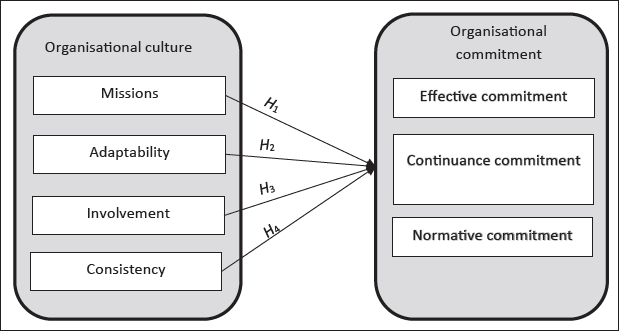
Another significant model of organisational culture is Denison’s and Mishra’s (1995) theory of organisational culture and effectiveness, which is based on four characteristics of organisational culture: involvement, consistency, adaptability and mission (Taylor et al., 2008). This research article will use this theoretical model of organisational culture as the foundation for its analysis. Denison and Mishra (1995) developed this model of organisational culture based on two related studies: First, qualitative case studies were conducted to ascertain the relationship between organisational traits and effectiveness; and second, an exploratory analysis based on quantitative data was conducted to ascertain the relationship between the four cultural traits and subjective and objective measures of effectiveness (Denison & Mishra, 1995). We develop a hypothetical model (see Figure 1), dubbed the Denison organisational culture survey, which is based on four cultural characteristics: involvement, consistency, adaptability and mission (Denison & Neal, 2000). They contended that involvement and adaptability served as interpreters of growth and indicators of flexibility, openness and responsiveness, while consistency and mission served as predictors of profitability and indicators of integration, direction and vision.
Literature Reviews and Hypotheses Development
Organisational Mission and Employee Commitment
The clarity of mission, highlighting the organisation’s vision and goals, is one of the organisational cultural characteristics which gives employees a sense that the organisation cares about them (Lambert et al., 2017). Additionally, the authors state that it increases employees’ level of commitment. Denison and Neal (2000) support this by stating that short- and long-term commitment can be achieved when employees understand the organisation’s mission. Clarifying and committing to a shared mission is the prerequisite for gaining organisational commitment, as a mission provides a focal point to which employees can devote their efforts (Dessler, 1999). Empirical research has demonstrated that providing employees with a clear understanding of their role and critical tasks results in increased commitment (Gould-Williams, 2003). Affective commitment erodes individuals’ belief in their internal control over their job actions and objectives (Meyer et al., 2004).
A high level of planning for organisational goals and member roles and responsibilities enables members to commit to difficult tasks and improves personal interactions (Nishimura & Okamuro, 2018). A strong sense of mission and a coherent vision bind the organisation together, acting as an adhesive, and ensuring that employees understand the organisation’s significance and direction (O’Reilly & Chatman, 1996). Denison and Mishra (1995) concurred that this characteristic helps the organisation and its members in developing a precise course of action and a pathway for accomplishing tasks. When employees can identify with and co-opt the organisation’s mission, it results in both short- and long-term commitment to the organisation (Denison & Neal, 2000). Achievement occurs when both the employee and the organisation have a goal in mind. We thus propose that a clear mission will be beneficial to the employees’ commitment.
H1: An organisational mission has a positive effect on employees’ affective, continuance and normative commitment.
Adaptability and Employee Commitment
The adaptability characteristic enables an organisation to fluctuate to reorient itself in response to a changing environment and provides the opportunity to generate change (Taylor et al., 2008). It demonstrates the extent to which an organisation is adaptable to promote customer orientation, risk-taking, learning from mistakes and ability to change (Fey & Denison, 2003). To become a well-established organisation, a business must develop rules and beliefs which assist it in acquiring and interpreting signals from its environment and converting them into reasoning, behavioural and structural changes (Kanter, 1983).
Adaptability is an organisational characteristic which affects an organisation’s capacity to rebuild and re-institutionalise in response to a changing environment. It also inspires innovation, increases knowledge and advances capabilities (Denison & Neal, 2000). The threat of lost time, non-transferable skills, job loss and resettling a family are all associated with the cost of leaving the organisation (Meyer & Allen, 1991). We presuppose that organisational culture has a beneficial effect on commitment and thus propose that the adaptability within an organisation will enhance employees’ commitment.
H2: Adaptability improves an employee’s affective, continuance and normative commitment.
Organisational Involvement and Employee Commitment
‘Involvement’ is a term that refers to the process of enhancing human capability, ownership and responsibility (Denison & Neal, 2000). The authors discovered that an organisational culture that values employee involvement fosters employee involvement, and employees rely on informal, deliberate and implicit control mechanisms. This sense fosters a greater sense of commitment to the organisation, and the authors define the involvement trait in terms of three components: empowerment, team orientation and capability development.
Numerous studies (Barnes & Collier, 2013; Chughtai, 2013; Zhang et al., 2015) examined the effect of commitment on engagement using adaptability as a research variable. Barnes and Collier (2013) also found that work engagement mediated the relationship between affective commitment and adaptability in the service sector. Organisational commitment has an affective component which reflects identification, emotional involvement and a sense of belonging to the organisation (Cohen, 2007). We can begin by asking employees to identify ways to improve the productivity, safety and efficiency of their daily tasks. This strategy increases employee engagement and eventually fosters a sense of belonging, allowing employees to identify with the organisation and its goals (Benkarim & Imbeau, 2021).
Similarly, employee participation in decision-making increases their sense of involvement (Price & Mueller, 1986) and thus increases commitment. Normative commitment occurs when an organisation provides an employee with a ‘reward in advance’ or invests significant resources in ensuring employment like training costs (Meyer & Allen, 1991). This study proposes that organisational involvement has a beneficial effect on employees’ commitment.
H3: Employee involvement increases their affective, continuance and normative commitment.
Organisational Consistency and Employee Commitment
Consistency is an organisational characteristic which denotes normative integration or the breadth of a consensual system of behavioural control (Denison & Mishra, 1995). The authors discovered that it manifests itself in many organisations as a coherent set of behaviours, systems and connotations, which entails discrete conformity despite deliberate participation. It refers to organisations which have a defined thought process and a set of organisational systems which can emerge in critical and difficult situations, and this characteristic contributes to the development of a ‘strong’ culture.
Consistency enables an organisational culture to become ‘strong’ by providing a shared organised system of beliefs, values and icons that can be comprehended by an organisation’s stakeholders (Denison & Neal, 2000). Coordination and integration, agreement, and core values, all contribute to consistency. This study thus hypothesises that there is a positive relationship between organisational consistency and employees’ commitment.
H4: Consistency aids in the development of employees’ affective, continuance and normative commitment.
Methodology
Data Collection
This research gains a realistic understanding of the effect of organisational culture on the level of commitment of BCS (Administration) cadre serving in various capacities within the Government of the People’s Republic of Bangladesh. The deductive approach was used in this research, which began with an extensive review of the literature, progressed to the formulation of hypotheses and concluded with the development of a research strategy to test the hypothesis’s validity (Saunders et al., 2019). This research embraced the quantitative research design to enable testing the influence of the traits of organisational culture on the different components of commitment of the BCS (Administration) cadre officers.
This study used a survey to collect a large volume of standardised data from a sufficiently large population in a cost-effective manner. This strategy enables you to collect data to make suggestions about possible causes of a particular relationship between variables, creating a model for that relationship (Saunders et al., 2019). The data is being collected to ascertain the effect of organisational culture on the commitment of the BCS (Administration) officers who serve in various capacities for the Bangladesh government. They include the senior secretary, secretary, additional secretary, joint secretary, divisional commissioner, additional divisional commissioner, deputy commissioner, additional deputy commissioner, senior assistant commissioner, upazila nirbahi officer, assistant commissioner (land) and assistant commissioner. The survey questionnaire was created using Google Forms and distributed to respondents online. It is a free online tool which allows you to collect information easily and efficiently. We chose Google Forms for a variety of reasons. We can create surveys in a matter of minutes to gather information about your products or services from your clients or collaborators. The interface is extremely simple to use, as is the assistant. Google Forms saves the feedback we receive so that we can analyse it in detail; the forms are integrated with Google Sheets, which gives us access to a spreadsheet view of the collected data; and the general configuration of forms or surveys enables us to limit the responses. Advanced users can customise the type of data which can be inserted into a field using regular expressions. We can send the form via email, embed it in our website, or distribute the link via social media or another method. We can obtain an unlimited number of questions and responses for free with this tool, whereas other survey tools charge based on the number of questions and recipients. To invite officers to participate in the survey questionnaire, the researcher shared the link to the survey on various Facebook groups frequented by 6,412 BCS (Administration) cadre officers and via Messenger. As a result, we collected 211 responses, making up a response rate of 3.3%, between 6 July and 6 August 2018 for further analysis.
Measurement Development
To ascertain the effect of organisational culture on employee commitment, a questionnaire survey was conducted. The questionnaire was distributed to officers serving in various capacities in the Bangladesh government. The organisational culture and employee commitment were assessed using a 5-point Likert scale. Although Taylor et al. (2008) used some of the questionnaire items to assess organisational cultural traits, mission and adaptability, these items to assess organisational culture were originally developed by Denison and Mishra (1995). These are excerpts from the article. Additionally, items were taken from Denison’s and Neal’s study (2000). The respondents were asked to rate their level of agreement with these statements on a scale of 1 (strongly disagree) to 5 (completely agree; strongly agree). Twelve items from the Denison organisational cultural survey model were used in this study. Items pertaining to affective commitment were culled from Kehoe and Wright (2013), which was developed originally by Meyer and Alien (1991). This article contained items relating to three components of commitment, namely affective, normative and continuance commitment. For this research, 18 items were taken from this article. Similarly, respondents were asked to rate their organisation’s level of commitment on a scale of 1 (strongly disagree) to 5 (strongly agree).
Data Analysis and Findings
Sample Description
The descriptive statistics about the respondents revealed the general information requested in the survey questionnaire. It includes information about the employee’s gender, marital status, educational background, monthly salary (in Bangladeshi taka), length of service and job title. The survey received 211 responses, with 134 male respondents and 77 female respondents. Respondents were married in 93.4% cases. They were highly educated, with 200 holding postgraduate degrees and only 11 holding undergraduate degrees. One hundred and eighteen respondents earned over 40,000 Bangladeshi taka per month. 68.2% of responses came from respondents with four–seven years of service experience. One hundred and twenty-three respondents were office managers, while 88 respondents worked under supervision.
Validity and Reliability Tests
To avoid common method bias, we used previously validated measurements (Spector, 1987). The use of self-reporting by respondents introduces the possibility of error, all the more so given the complexity of many of the measures and the need for post hoc assessment. To address this, Harman’s one-factor test was applied to all variables, and the results (33.75) indicate that the relationships between organisational culture and organisational commitment variables in this study are unlikely to be due to common method bias. To avoid measurement errors, the study used appropriate survey instruments and a construct validation test to determine the construct’s validity (convergent and discriminant) and reliability (the empirical indicators actually measure the construct). The findings establish the validity and reliability of the research measurements used.
Foddy (1994) defines validity and reliability by emphasising that respondents must understand the question in the way the researcher expected, and that the researcher must understand the answer in the manner in which the respondents expected. The questions for this study were derived from a previously conducted similar research. Apart from this, factor analysis was used to determine the validity of the research components. Factor analysis is a technique for determining construct validity. Consistency is a sign of reliability (Saunders et al., 2019). There are three methods for determining reliability: test–retest, internal consistency and alternative form (Mitchell, 1996). Internal consistency was used in this study. Internal consistency, as described by the author, enables the measurement of all the questions in the responses or a subset of the questions in the questionnaire. Cronbach’s alpha is the most frequently used method for determining reliability (Mitchell, 1996). It is used to determine the reliability in this study.
Reliability
The reliability test is critical for valid measurement (Kothari, 2004). According to the author, a measuring tool is said to be reliable if it consistently produces consistent results. While it contributes to the validity, it is not required to be a valid tool. Additionally, according to Saunders et al. (2019), reliability tests produce consistent results. The term ‘reliability’ refers to the consistency of a concept’s measure (Bryman & Bell, 2015). The reliability assessment can be conducted if the measurement tool answers the three questions, which are, respectively: Will the measurement tool produce the same result? Will other researchers arrive at a similar conclusion? And is there any transparency in the process of developing a theme from primary data? Three approaches to reliability testing are test–retest, internal consistency and alternative form (Mitchell, 1996). Internal consistency or reliability is applicable when multiple indicators are being measured (Bryman & Bell, 2015). Cronbach alpha is one of the reliability testing measurement tools. The authors argued that it is the most widely used method for determining internal reliability in the modern era. It can calculate the reliability coefficients for all possible split-half splits. The correlation coefficient results from the correlation calculation. It is distinct from 0 to 1. A value of zero (0) indicates that there is no correlation and no internal consistency, whereas a value of 1 indicates perfect correlation and total internal consistency. Cronbach’s alpha was used to test for reliability in this study. Cronbach’s alpha values of 0.70 or greater are acceptable (Hair et al., 2018). Because of the difficulty in obtaining a higher score, Devellis (2012) suggested that a Cronbach’s alpha value between 0.65 and 0.70 is acceptable, while less than 0.60 is unacceptable. Correlation coefficients of less than 0.3 are not acceptable for each item (Hair et al., 2018).
There were no items in this study with a correlation coefficient less than 0.30. As a result, no item was required to be deleted from the questionnaire. The Cronbach’s alpha value for each component is quite high. Mission has an alpha value of 0.871, adaptability has an alpha value of 0.874, involvement has an alpha value of 0.829 and consistency has an alpha value of 0.826. Affective commitment has an alpha value of 0.924, continuance commitment has an alpha value of 0.864 and normative commitment has an alpha value of 0.875. This demonstrates the greater reliability of the respondents’ data.
Validity
Validity refers to a measurement’s ability to capture a concept in the way it should be captured (Bryman & Bell, 2015). According to Kothari (2004), validity refers to the degree to which a measurement tool measures what it is expected to measure. He also discussed validity in terms of the extent to which a measuring tool recapitulates the true variance among the items under test. There are several methods for determining a concept’s validity, including face validity, concurrent validity, predictive validity, construct validity and convergent validity (Bryman & Bell, 2015). When a researcher can separate a concept from its hypothesis, this is referred to as construct validity. The construct validity test was used to determine the concept’s validity, and exploratory factor analysis was used to determine the construct validity. Exploratory factor analysis was used in this study because it confirms that certain measures require validation and that the research context and location are unique in this study (Tolmie et al., 2011). The exploratory factor analysis reveals that there is no factor loading in this study which is less than 0.5, and thus no items were required to be deleted. The factor loading score for normative commitment item 3 was 0.546 and for continuance commitment item 2 was 0.596.
Correlation
Two types of variables were proposed to investigate the relationship between organisational culture and employee commitment. The four cultural characteristics (mission, adaptability, involvement and consistency) constitute the independent variable ‘organisational culture’, while the three commitment components (affective, normative and continuance commitment constructs) constitute the dependent variable. Six control variables are considered in this study, namely gender, marital status, educational background, officer salary, length of service and job position.
Karl Pearson’s coefficient of correlation, (r), is the most frequently used method for determining the degree of relationship between two variables (Kothari, 2004). Correlation analysis revealed a significant correlation between organisational cultural traits and commitment levels. Additionally, no significant relationship was found between demographic variables (gender, marital status, educational background, monthly salary, length of employment and job position) and dependent variables (Table 1).
Correlation Analysis Among the Variables.
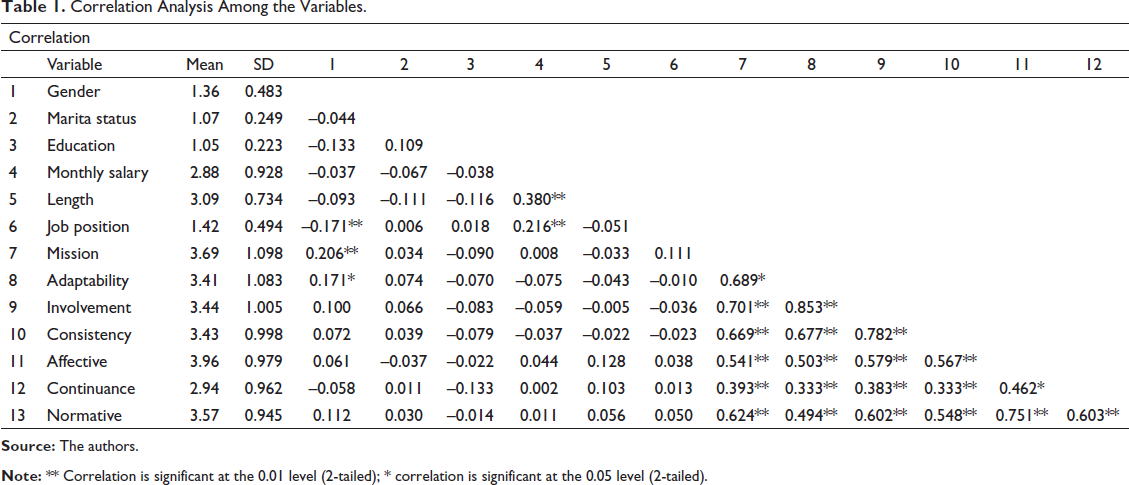
According to the correlation table, mission, adaptability, involvement and consistency, all correlate positively with affective commitment scores (r = 0.541, 0.403, 0.479 and 0.467; n = 211; p = .01). As a result, mission has the greatest positive effect on affective commitment. Organisational characteristics have a positive effect on employee retention commitment. According to the correlation table, mission, adaptability, involvement and consistency, all correlate positively with continuance commitment scores (r = 0.393, 0.333, 0.383 and 0.333; n = 211; p = .01). This indicates that the four organisational characteristics have a moderately positive effect on employees’ normative commitment. The correlation table demonstrates a significant, positive relationship between mission, adaptability, involvement, and consistency and normative commitment, with r = 0.624, 0.494, 0.602 and 0.548; n = 211; and p = .01. As a result, mission and engagement are inextricably linked to normative commitment.
Regression Analysis
Multiple linear regression analyses were used to test the hypotheses in this study because there are two or more independent variables (Kothari, 2004). Six models are developed to test the hypotheses.
Affective Commitment Model
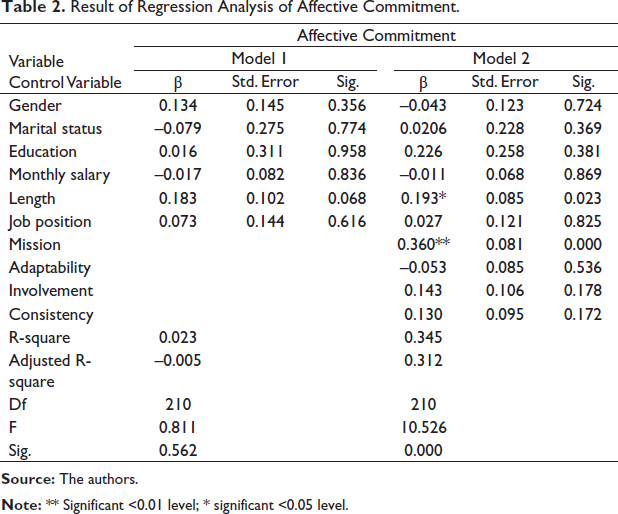
To test Hypothesis 1, Models 1 and 2 were developed (Table 2). Multiple linear regression was used to examine the relationship between control variables (gender, marital status, education, monthly salary, length of service and job position) and dependent variable affective commitment in Model 1. There is no evidence of a significant correlation. The model was determined to be insignificant. Multiple regression analysis was conducted on Model 2 using control variables, independent variables and variables with affective commitment. There is a significant relationship between job duration and affective commitment in this case. A highly significant relationship between mission and affective commitment has been discovered (0.360, p = .000). Adaptability, involvement and consistency have no significant relationship with affective commitment (–0.053, p = .536; 0.143, p = .178; 0.130, p = .172).
Result of Regression Analysis of Affective Commitment.
Continuance Commitment Model
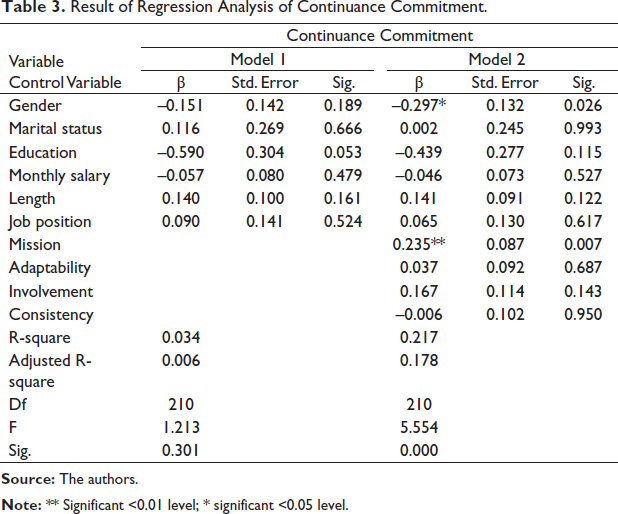
To test Hypothesis 2, Models 3 and 4 were developed. In the case of Model 3, regression analysis was conducted between the control variables (gender, marital status, education, monthly salary, length of employment and job position) and dependent variable continuance commitment; no significant relationship was discovered, and the model was determined to be insignificant. In the case of Model 4, regression analysis was conducted taking control variables and independent variables into account. This time, a significant relationship between gender and continuance commitment scores was observed (–0.297, p = .026), and a highly significant relationship between mission and continued commitment was discovered (0.235, p = .007). However, the influences of adaptability, involvement and consistency on the continuance commitment are not significant (0.037, p = .687; 0.167, p = .143; –0.006, p = 0.95; see Table 3).
Result of Regression Analysis of Continuance Commitment.
Normative Commitment Model
To test Hypothesis 3, Models 5 and 6 were developed. In the case of Model 5, regression analysis was used to determine the relationship between the control variables (gender, marital status, education, monthly salary, length of service and job position) and dependent variable normative commitment. There was no evidence of a significant relationship, and the model score was insignificant. Model 6 included regression analysis of control variables, independent variables and dependent variable normative commitment. The relationship between mission and normative commitment was highly significant (0.341, p = .000), as was the relationship between involvement and normative commitment (0.286, p = .002), whereas the adaptability and consistency do not make a significant influence on the normative commitment (–0.061, p = .414; 0.093, p = .265; see Table 4).
Result of Regression Analysis of Normative Commitment.
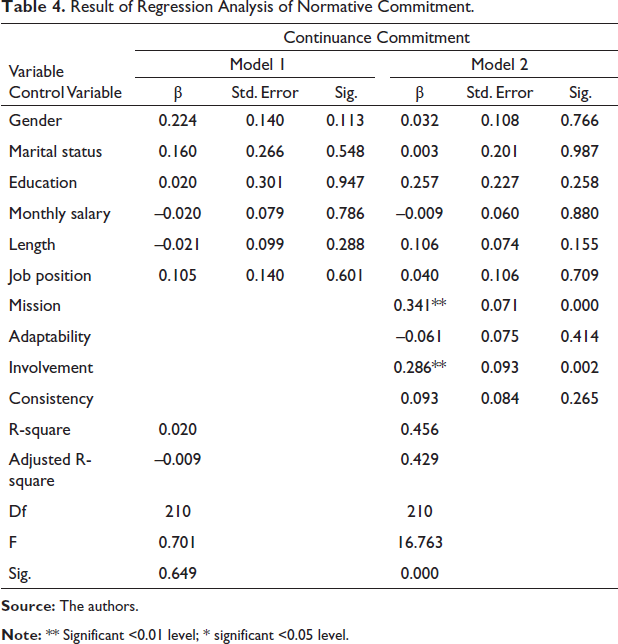
Three statistical models revealed that hypothesis H1 was fully supported, indicating that a company’s mission has a positive effect on employees’ affective, continuance and normative commitment. Hypothesis H3, which states that employee involvement increases their affective, continuance and normative commitment, was partially supported, as involvement only increased normative commitment. H2 and H4 were rejected, indicating that there is no correlation between organisational adaptability and consistency and employee commitment.
Discussions
This research was conducted to determine the effect of organisational culture on the commitment of BCS (Administrative) cadres. To accomplish the research’s objective, the first objective was to investigate the current state of commitment among officers serving in various capacities within the government. Officers were found to have a moderate level of commitment. (The mean of affective commitment was 3.9566, the mean of continuance commitment was 2.9376 and the mean of normative commitment was 3.5711.) There was no significant correlation between the various commitment components and demographic variables. In the case of affective commitment, marital status and educational background had a negative correlation (Table 1). The continuity commitment has negative correlations with gender and educational background; similarly, the correlation between normative commitment and educational background is negative. The gender distribution of officers responding to the survey was not equal. There were 134 male participants and 77 female participants. Additionally, it denotes the ratio of male to female officers employed in the administration. As a result, it can be assumed that commitment decreases with differences in educational background and decreases with gender differences.
The second objective was to examine the impact of organisational culture and the first component of commitment, affective commitment, on their own. Correlation analysis revealed a statistically significant positive relationship between them. For affective commitment, all organisational components contributed significantly to its success. Demographic factors had a negligible effect on affective commitment. Although not statistically significant, marital status and education were associated with lower levels of affective commitment. Multiple regression analysis revealed a significant relationship between mission and affective commitment. Additionally, regression analysis revealed a non-significant relationship between affective commitment and adaptability, involvement, and consistency. This demonstrates that having a long-term goal and direction fosters affective commitment. This means that officers found reasons to join the organisation when it had a strong mission. Officers feel a sense of loyalty to the organisation. It is consistent with the statement that affective commitment occurs when an organisation has a long-term management strategy (Meyer & Allen, 1991). Additionally, it demonstrates that an organisation with a weak mission is incapable of engendering affective commitment among its officers. Also, the regression analysis discovered that length has a beneficial effect on affective commitment. Thus, as the duration of the job increases, affective commitment also increases. It is comparable to the findings of research conducted on public organisations (Camilleri, 2006).
The third objective was to determine the relationship between organisational culture components and continued commitment. Correlation analysis revealed a significant positive correlation between all organisational cultural traits. Additionally, the analysis revealed a non-significant negative correlation between gender and education and continued commitment. Only mission had a significant relationship with continued commitment, according to the regression analysis. It dictates that officers who have a clear mission and a shared vision will be loyal. However, the regression analysis revealed that gender has a significant positive effect on commitment to continuing education. This is the inverse of the correlation analysis result. This means that the organisation should place a greater emphasis on gender issues to increase officers’ commitment to their careers.
The fourth objective was to establish a link between organisational cultural characteristics and normative commitment. Similarly, correlation analysis indicates that normative commitment is positively and significantly correlated with mission, adaptability, involvement and consistency. In the case of regression analysis, it was discovered that mission and involvement have a significant effect on normative commitment. All commitment components are influenced by mission. Only normative commitment has involvement-related effects. Clarity regarding the officers’ responsibilities and encouragement of innovation and input into decision-making influence an employee’s dedication. Committed employees’ involvement in ethical implications continues, and they consider the organisation’s interests besides their own (Lincoln & Kalleberg, 1990). Job involvement may be associated with officers performing more productively (DeCarufel & Schaan, 1990). Demographic variables have no effect on normative commitment in regression analysis.
Finally, based on the research findings, it can be concluded that this study corroborates the findings of O’Reilly and Chatman (1996), Dessler (1999), Denison and Neal (2000) and Gould-Williams (2003) in that the mission dimension of organisational cultural traits strengthens the three components of employee commitment, and involvement contributes to the development of normative commitment. However, we were unable to locate statistical evidence to support the school of knowledge that organisational adaptability and consistency increase employees’ commitment and that involvement is a beneficial component of affective and continuance commitment, as articulated by Cohen (2007), Denison and Neal (2000), Barnes and Collier (2013), Chughtai (2013), Zhang et al. (2015) and Benkarim and Imbeau (2021). This research contributes significant insight into organisational culture in administration. It demonstrates the importance of providing a long-term purpose and direction to officers serving in various capacities within the government to foster commitment.
Conclusions
The purpose of this study was to determine the impact of organisational culture on employee commitment in BCS (Administration) cadres. It attempted to ascertain the administration cadre’s current commitment status. It developed a model indicating that organisational culture influences affective, continued and normative commitment. However, the study’s findings suggested that mission, one of the organisation’s characteristics, has a significant effect on all three components of employee commitment.
This research suggests that the government should assist officers in acquiring authority to carry out their own duties. This will motivate officers to propose new initiatives and see them through to completion. This will help develop a sense of ‘ownership and accountability’ (Denison & Neal, 2000). Additionally, it proposed that the government should promote collaboration and assistance across functional units. This provides officers with a sense of accountability for their actions. The Government of Bangladesh recently recognised officers’ innovative contributions by rewarding them for their individual, group and institutional accomplishments through the Public Administration Award (PAA; MoPA, 2018). This initiative has already boosted morale among officers who work tirelessly for the greater good of the public. Recently, numerous officers have performed admirably and undertaken numerous ‘innovative and renovation projects’ to improve service to the public. The top management values these small innovative projects. This way, top management can attempt to motivate employees and work to develop their commitment to the organisation. According to the research, the government should invest in officers to increase their competitiveness and ability to adapt to changing environments. The government should attempt to arrange an ‘international exposure tour’ for officers performing admirably. To improve officer skill development, top management should increase training and capacity-building activities for officers. These efforts will ensure that officers remain with the organisation for the duration of their careers.
Limitations
While the study’s findings are robust, it is acknowledged that certain aspects of the research process could jeopardise the work’s validity and reliability. The sample size for this study was limited due to the limited number of officers available from the Bangladesh government. This study considered only officers who had access to the internet and were potentially connected via social media. The data collection method was an internet survey, which carries the risk of misinterpretation, but these issues were thoroughly tested in the empirical work. Additionally, respondents to the survey may exhibit a cognitive bias as a result of post hoc rationalisation. To address this, the research examined Harman’s one-factor model across all variables and discovered that this issue had no bearing on the study’s overall conclusion. Because this research focuses exclusively on BCS (Administration) cadre employees in Bangladesh, it may be unable to generalise to other sectors, non-governmental organisations and private organisations. The research findings cannot be generalised knowledge because of the non-probability sampling method used in this study (Saunders et al., 2019).
Future Research Recommendation
While this study examined cross-sectional data, additional research examining longitudinal data over a longer period of time has been suggested. It may be implied only for the administration cadre or for all cadres. It will assist in determining whether or not the commitment remains constant over time. This study took into account non-probability sampling. A future investigation is suggested to determine whether or not probability sampling produces the same result. The majority of respondents have less than 10 years of work experience. Further investigation can be conducted to ascertain the level of commitment of the top-ranking officers in supervisory positions. The Ministry of Public Administration may wish to consider this research in order to increase newly recruited officers’ commitment. The ministry may also consider what factors should be considered for further research investigation in order to achieve the highest level of commitment among officers.
In conclusion, this research has provided an empirical study in a previously unexplored area of knowledge. The research tries to conduct the study ethically, and this study will contribute to the body of knowledge in organisational culture and employee commitment. Despite some limitations, it has produced the most reliable findings. It establishes a framework for future research and expands the real-world area for implementation.
The research findings indicate that organisational culture is critical for any public organisation. It conveys the entirety of an organisation’s message. A long-term mission and vision for the organisation assist employees in conceptualising the organisation’s objectives and goals. As a result, the organisation benefits from more committed employees. Given the importance of a mission in developing committed employees, public organisations with distracted employees should place a greater emphasis on establishing a focused mission. This mission should communicate with all functional units to ensure that the employee clearly understands the organisation’s strategy. The employee should provide direction for the activities they are required to perform. Significant training and capacity development programmes should be developed to address the current situation. As a result, employees feel a sense of obligation to the organisation, a sense of commitment to the organisation and a willingness to sacrifice to accomplish organisational goals.
The most critical aspect of the research is that it will contribute to the expansion of citizen services available to the public. The administration cadre is critical in formulating and implementing public policies. If officers remain committed to the service, this will ultimately result in an increase in productivity, performance and efficiency, as well as a decrease in absenteeism and an increase in officer morale. This will finally add value to the services provided to the Bangladeshi people.
Footnotes
Declaration of Conflicting Interests
The authors declared no potential conflicts of interest with respect to the research, authorship and/or publication of this article.
Funding
The authors received no financial support for the research, authorship and/or publication of this article.
