




Abstract
This study conceptualises career maximisation and its consequences in the Indian Information Technology (IT) workforce, a globally significant non-Western talent pool. It examined how maximising tendency in career decision-making (MT-CD) mediated career satisfaction through two contrasting responses based on counterfactual reasoning―career regret (dysfunctional) and career adaptability (functional). The study comprised of two parts. In Study 1, scales for MT-CD and career regret were developed and initially validated using a 172 respondents’ dataset. In Study 2, data from 434 respondents were analysed for psychometric evaluation and further validation of scales along with determining hypothesised relationships. Two dimensions of MT-CD were identified―‘state of internal career ambiguity’ and ‘striving for career excellence’. Both attributes produced career regret (an aggregated measure of ‘corporate regrets’, ‘career choice regrets’ and ‘developmental regrets’ dimensions), decreasing career satisfaction. Only ‘striving for career excellence’ led to career adaptability, which subsequently increased career satisfaction. Altogether, career regret competed with career adaptability, supressing its positive indirect effect on maximising ITPs’ career satisfaction. This study expands the current empirical research on career maximisation into non-Western contexts, adding unique knowledge to the Indian IT workforce’s vocational literature.
Keywords
Dramatic transformations in the Indian Information Technology (IT) industry have deeply affected its workforce’ career trajectories. Hyper-competitive market makes Indian IT professionals (ITPs) invest in upskilling and technological updates (Rajthilak et al., 2021). The need to keep pace with industrial shifts and rapid career progression, considering the availability of numerous profitable avenues outside the IT sector (Munshi, 2019), propels ITPs to consistently reassess their vocational opportunities. Although career reassessment is important, some do go overboard, reflecting an inclination to seek the best, also known as maximising tendency. Such individuals set superior standards, exhaustively chase them and rigorously evaluate everything before deciding (Schwartz et al., 2002).
Outcomes, however, may not match expectations, leading to expectation disconformity. This may prompt reimagining alternatives to past factual events, generating counterfactual reasoning of ‘might have been’ (Van Hoeck et al., 2015). In maximisation literature, such counterfactual reasoning is predominantly demonstrated as a dysfunctional response of regret, lowering satisfaction and subjective well-being (Peng et al., 2018; Polman, 2010). Nevertheless, it does have a constructive side, steering people to learn from the past, and enabling planning and future preparation (Van Hoeck et al., 2015). Although Van Vianen et al. (2009) postulated maximisers to be less adaptable in careers, studies show otherwise. Maximisation’s links with intrinsic motivation, consciousness, future concerns and optimism (Lai, 2010; Misuraca et al., 2016), demonstrate building blocks of ‘career adaptability’ (Buyukgoze-Kavas, 2016)―a functional aspect of counterfactual reasoning.
Maximising tendency’s conceptualisation and operationalisation in vocational domains is still an open question. Researchers adopted general measurements of maximisation, showing its aggregated adverse impact on careers (Dahling & Thompson, 2013; Liu et al., 2015). However, upon considering maximisation at dimensional level (i.e., high standards [affiliation for best], alternative search [seeking best choices] and decision difficulty [decision-making dilemma]) different factors resulted in different job and career outcomes (Giacopelli et al., 2013). Although researchers consider ‘high standards and alternative search’ as defining components of maximisation (Cheek & Schwartz, 2016), empirical studies underscore relevance of maximisers’ ‘decision difficulty’ attribute in vocational domains (Liu et al., 2016; Shortland et al., 2020). Voss et al. (2019) developed a scale to measure individuals’ career-specific maximising characteristics. But it is essentially unidimensional, lacking comprehensive scrutiny of underlying factors. Also, it didn’t explore links with career-specific regrets. Moreover, studies capturing maximisation effects in career contexts are largely among Western people. Hence, findings may not be generalised to non-Western populace, maximisation being strongly associated with culture (Cheek & Schwartz, 2016). Therefore, further exploration is warranted to comprehend how this trait functions within non-Western vocational setups. Therefore, we attempt to investigate career maximisation phenomena within the Indian IT workforce.
Given that Indian IT employees are pivotal to the global IT industry as well as the country’s economy (Rao & Balasubrahmanya, 2017), understanding their nature and characteristics is necessary to gain competitive advantage. This aspect, amidst the changing world of work, necessitates Human Resource (HR) leaders to discern ITPs’ vocational attributes from varied perspectives; hence, exploring maximisation and its consequences is relevant. We, therefore, conceptualise maximisation in career domain of ITPs and determine its associations with other career-related constructs (career regret, career adaptability and career satisfaction). We examine how ITPs’ maximising tendency in career decision-making (MT-CD), considering expectation disconformity, shapes different responses based on counterfactual reasoning. We select career regret as a dysfunctional and adaptability as a functional response, and we investigate how they mediate relationships between MT-CD and career satisfaction.
We first define maximising tendency, career regret, career adaptability and career satisfaction, outline their associations and frame the study’s theoretical foundation. Next, in Study 1, we develop and initially validate a scale to determine ITPs’ MT-CD with dimensional level elucidation, upon which the conceptual model and hypotheses are formulated. We also create a scale to measure ITPs’ career regret pertaining to this research context, since previous studies on career maximising treated regret as a generic construct (not career-specific; Dahling & Thompson, 2013; Liu et al., 2015; Voss et al., 2019). Study 2 includes establishing psychometric properties and further validation of scales, along with hypotheses examination. Finally, findings and implications are discussed. We believe that, besides expanding empirical research on maximisation within non-Western career settings, this study adds unique knowledge to the vocational literature of the Indian IT workforce. It introduces and systematically establishes novel concepts of career maximisation and career regret, underscoring important yet largely understudied vocational notions of career adaptability and career satisfaction. It also demonstrates interesting links between ITPs’ MT-CD and career satisfaction through career regret and adaptability.
Literature Review and Theoretical Underpinning
Maximising Tendency
Maximising tendency is a decision-making behaviour where individuals tend to pursue ‘best’ choices, as opposed to settling for ‘good enough’ with satisficing intent (Schwartz et al., 2002). Maximisers set higher expectations, rely extensively on external information and engage in upward social comparisons (Schwartz et al., 2002). Upon failing to meet expectations and seeing others with more profitable choice outcomes, they ruminate over past decisions, lowering their own quality of life (Peng et al., 2018; Polman, 2010). Similar findings were also noticed in the vocational literature. Maximising tendency (as an aggregation of high standards, alternative search and decision difficulty) generated dysfunctional upward counterfactual thinking, which lowered US undergraduates’ academic performance (Leach & Patall, 2013). In Indian management students, maximising tendency amplified regret, adversely influencing decision-making behaviour (Singh & Jain, 2017). In US working adults, it resulted in higher job search (Liu et al., 2016), also led to regret and frustration, decreasing job satisfaction and hindering career progression (Dahling & Thompson, 2013; Liu et al., 2015).
Despite maximisation’s negative connotations, it is not entirely disadvantageous. Researchers found maximisers to be competent, motivated, future-focused and conscious about making choices (Misuraca et al., 2016), as well as having higher self-esteem, optimism, desire for consistency and better decision-making capability (Lai, 2010; Zhu et al., 2017). These findings featured maximisation as a summated inclination for high standards and searched for alternatives to maintain them. Regarding vocational contexts, maximisation’s dimensions exhibited varied results. Giacopelli et al. (2013) indicated that high standards in maximising US employees were related to higher salary, job satisfaction and task performance; decision difficulty reported negative links with these outcomes. Voss et al. (2019) showed career maximising as an integration of high standards and alternative search; it was positively related to decision confidence and career satisfaction in US working adults.
Vocational studies underscore Indian IT workforce’s propensity to become the best through practices and actions that stand out in market competition (Rajthilak et al., 2021; Upadhya, 2016). However, the existing literature lacks a clear focus on maximising trait. Researchers have appraised capturing career maximisation in different contextual factors (e.g., non-Western working individuals [Cheek & Schwartz,2016; Voss et al., 2019]). They also emphasise considering separate dimensions of maximisation (instead of composite score) for accurate interpretations of outcomes (Giacopelli et al., 2013; Peng et al., 2018). Therefore, we develop a scale for MT-CD based on the original measures, and we investigate how this tendency’s factors respond to expectation disconformity, manifesting opposing counterfactual reasoning responses, which differently impact career satisfaction.
Responses Based on Counterfactual Reasoning in the Career
Van Hoeck et al. (2015) defined counterfactual reasoning as a ‘hallmark’ of human thought process, from perceived factual environment to an imagined context of ‘what might have been’. Psychological envisioning of counterfactual possibilities demonstrates two responses: one linked with clinging to past, giving rise to dysfunctional reactions of regret and blame; the other based on functional preparedness for present and future (Van Hoeck et al., 2015). For this study, we choose career regret as a dysfunctional, and career adaptability as functional response of counterfactual reasoning. Apart from adding new angles to the Indian ITPs’ vocational literature, these unexplored and understudied constructs reinforce Gati and Kulcsár’s (2021) notions of making better career decisions in contemporary vocational landscapes. Career regret from disadvantageous experiences can prod maximising ITPs to irrationally evaluate career missteps, thus, hampering sound decision-making. Adaptability, in contrast, emerging from counterfactual response, illustrates their capability to cope with vocational challenges and readiness for career advancement.
In the following sections, we explain a theoretical outline and demonstrate Study 1 that involves developing CD-MT and career regret scales, along with deducing conceptual framework.
Theoretical Underpinning
According to identity status theory, developing a strong and purposeful career identity is a critical career developmental task (Laughland-Booÿ et al., 2017). In Western societies, decisions related to career identity are often individualistic, consisting of autonomy and self-containment. In the non-Western world, however, they predominantly depend on familial and sociocultural considerations (Bhalla & Frigerio, 2020). Researchers indicate that Indian young adults’ career identity formation is driven by parental and own expectations of social status, influence and prestige (Bhalla & Frigerio, 2020; Upadhya, 2016). These aspects predispose to aiming high in careers, making individuals actively reflect on choices, seeking new information and alternatives to establish their desired career identity. Such individuals evolve as career maximisers, construing that only those best options frame a meaningful career identity.
In vocational paths, maximisers may encounter various personal and professional complexities that constrain career development, and demand negotiation and compromise to accept suboptimal solutions, all going against their innate nature (Schwartz et al., 2002). This leads to expectation disconformity, generating contrasting counterfactual reasoning reactions—a dysfunctional response of career regret, and functional response of career adaptability. As per lost opportunity mindset (Beike et al., 2009), counterfactual thoughts of career regret emerge when maximisers dwell on bygones—seemingly superior vocational decisions. However, counterfactual thoughts can generate productive impulses for improvement by learning from experiences and preparing a better future (Epstude & Roese, 2011), thus shaping career adaptability resources (e.g., planning and exploration). These contrasting reactions have opposite effects on maximisers’ career success.
Study 1
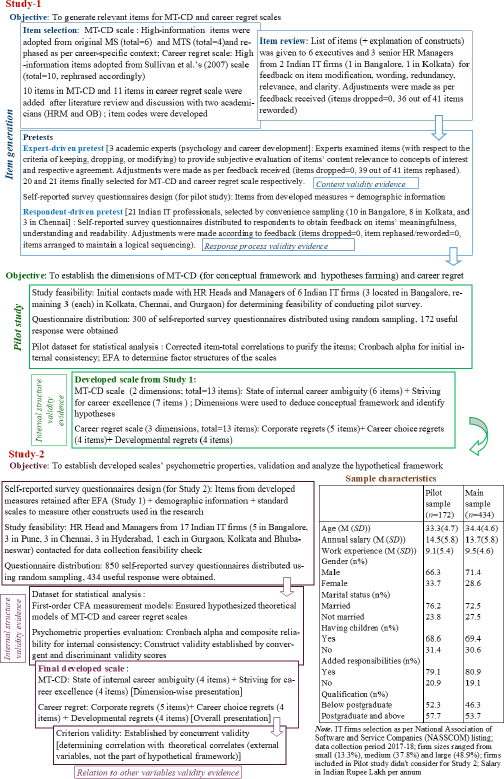
As per best practice in psychometrics (‘standard framework’), establishing evidence of validation is key to scale development; it is obtained from four sources: content, response processes, internal structure and relations to other variables (Streiner & Norman, 2008). While Study 1 renders validity evidence for content, response processes and internal structure, Study 2 focuses on internal structure and relations to other variables evidences along with hypotheses testing. Figure 1 demonstrates scale development procedures and samples characteristics.
Method
Item Generation.
Pilot Study
Self-reported pilot questionnaires, consisting of preliminary developed scales, were randomly distributed to a small sample of ITPs (n = 300), adopting a mixed-mode method (i.e., paper-pencil and web-based surveys). Respondents were assured anonymity. A total of 172 usable responses were obtained (effective response rate = 57.33%). Pilot sample was normally distributed (skewness and kurtosis ranged within −2 to +2; Kline, 2005). Using SPSS 24.0 dataset was utilised for scale development.
Results
For scale purification, corrected item-total correlations were performed, and items showing scores > 0.30 were considered (Fabrigar & Wegener, 2011). Cronbach alpha (α) scores of dimensions > 0.70 indicated scales’ initial internal consistency (Hair et al., 2010). Next, for developing scales’ structure and initial construct validity, exploratory factor analysis (EFA) with maximum likelihood (ML) and Promax rotation was conducted. Items with loading < 0.50 were eliminated to retain strongly contributing items in a factor, and those cross-loaded ≥ 0.40 on other factors were removed, thus supporting constructs’ preliminary convergent and discriminant validity respectively (Hair et al., 2010). Acceptable Kaiser–Meyer–Olkin scores of sampling adequacy (≥ 0.80) and significant Bartlett’s tests of sphericity (p < .001) suggested appropriateness in factor analysis.
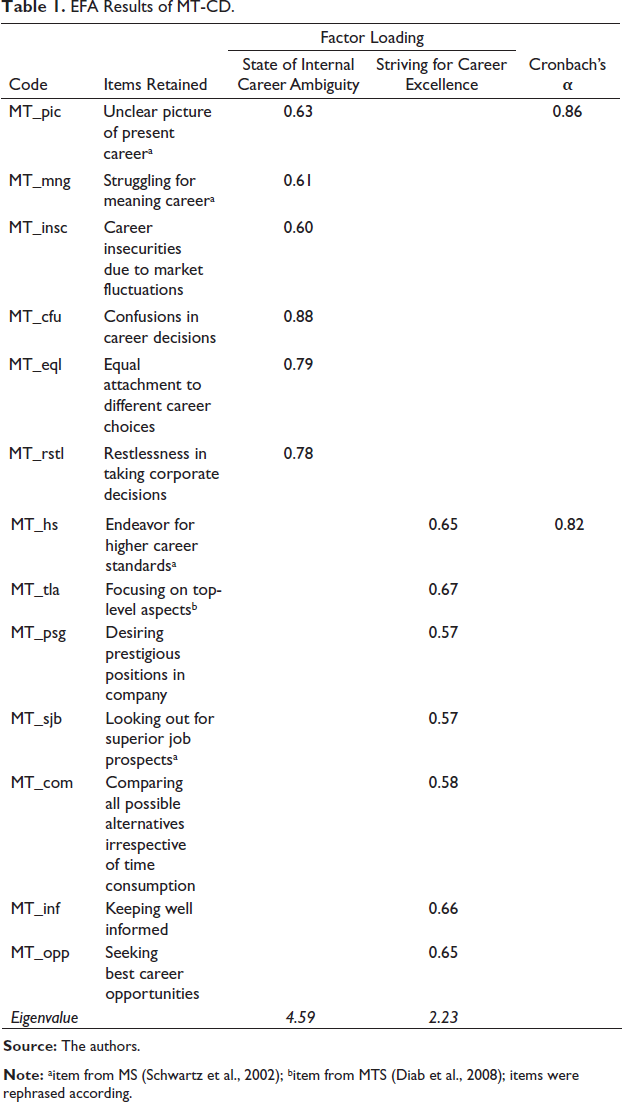
Two factors were extracted for MT-CD. The first factor, ‘state of internal career ambiguity’ (SIAm; internal ambiguity), reflected intrinsic reservations accentuated by external environmental turmoil. This factor resembled MS’s decision difficulty. The second factor, ‘striving for career excellence’ (SCEx; excelling approach), articulated aims and approaches towards a superior career, consistent with high standards and alternative search of MS and MTS. For career regret, three factors were extracted. The first factor, ‘corporate regrets’, included inaction and action regrets in corporate, similar to Sullivan et al. (2007) scale’s political behaviour regrets. The second factor ‘career choice regrets’, was similar to Sullivan et al. (2007) scale’s choice attributes, consisting of action regrets from subjective evaluations of life, hampering desirable career choice-making. The third factor, ‘developmental regrets’, comprised inaction regrets, based on objective evaluations of career development scopes.
EFA results are provided in Tables 1 and 2.
EFA Results of MT-CD.
EFA Results of Career Regret.
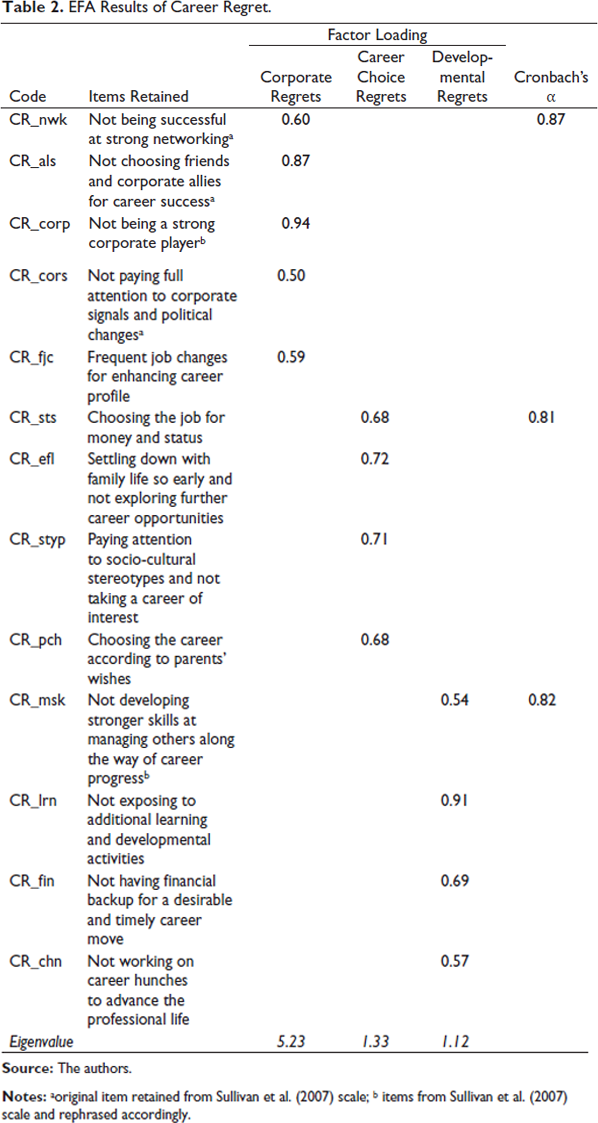
Corrected item-total correlations and EFA results provide initial evidence of internal structure validation at the statistical level by demonstrating relationships between items within the scales.
Conceptual Framework
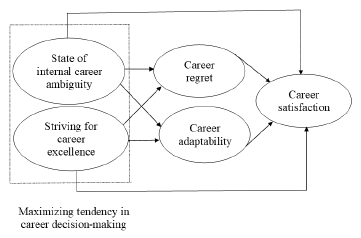
Turbulence and growth opportunities both co-exist in the Indian IT industry, influencing vocational behaviours of maximising ITPs. In an unpredictable labour market, their internal ambiguity causes distress and worry, lowering perceptions about employability and career progression. However, their excelling approach makes them gain competencies and work harder, enhancing career satisfaction. Researchers also supported psychological ambiguity’s inverse relation with career success and desire for upward mobility’s positive link to it (Bravo et al., 2017; Xu 2020). Besides, Giacopelli et al. (2013) suggested maximisation’s decision difficulty was negatively related to task performance and job satisfaction, whereas high standards increased these outcomes. Thus, we expect maximising ITPs’ internal ambiguity to negatively associate with career satisfaction while excelling approach could bring positive effect. Hence:
H1a: ‘SIAm’ is negatively related to career satisfaction. H1b: ‘SCEx’ is positively related to career satisfaction.
Employment market volatility, occupational setbacks and personal interferences can cause career goal-progress discrepancies, leading to expectation disconformity inducing counterfactual reasoning. When such factors fuel maximising ITPs’ mental ambiguity and undermine excelling approach, a dysfunction response of career regret can emerge from brooding over past vocational decisions and upwardly comparing with others (Peng et al., 2018; Polman, 2010). At the dimensional level, though at varied strengths, all factors of maximisation are positively associated with regret (Rim et al., 2011; Weinhardt et al., 2012). We, therefore, assume both internal ambiguity and excelling approach increase career regret. Hence:
H2a: ‘SIAm’ is positively related to career regret. H2b: ‘SCEx’ is positively related to career regret.
Counterfactual reasoning can also produce a constructive response in terms of career adaptability. In maximising ITPs, confused mental state of internal ambiguity diminishes adaptive ability (Xu & Tracey, 2015), but excelling approach associated with positive psychological elements (e.g., intrinsic motivation, optimism and future-oriented behaviours) accentuates career adaptability (Buyukgoze-Kavas, 2016). Researchers suggested maximisation’s high standards and alternative search, and these psychological elements are positively linked (Lai, 2010; Misuraca et al., 2016); decision difficulty is found to be negatively related to optimism and self-efficacy (Rim et al., 2011). Thus, we posit internal ambiguity decreases career adaptability, but excelling approach increases it. Hence:
H3a: ‘SIAm’ is negatively related to career adaptability. H3b: ‘SCEx’ is positively related to career adaptability.
Both ambiguity and excelling attributes in maximising ITPs possibly trigger regretful thoughts (Weinhardt et al., 2012), decreasing careers satisfaction. Studies also supported the indirect role of regret in lowering maximisers’ career-progression and job satisfaction (Dahling & Thompson, 2013; Liu et al., 2015). Hence, we hypothesise career regret’s mediating influence on the relationship between dimensions of MT-CD and career satisfaction:
H4a: Career regret mediates the relationship between ‘SIAm’ and career satisfaction. H4b: Career regret mediates the relationship between ‘SCEx’ and career satisfaction.
Maximising ITPs’ mental ambiguity could decease adaptability (Xu & Tracey, 2015), subsequently reducing its positive effect on career satisfaction. But their excelling approach amplifies career adaptability response (Buyukgoze-Kavas, 2016), thereby increasing career satisfaction (Haibo et al., 2018). Studies also provided clues for existence of similar mechanisms (Park et al., 2020; Safavi & Bouzari, 2019). We, therefore, postulate career adaptability’s mediating influence on the relationship between MT-CD’s dimensions and career satisfaction:
H5a: Career adaptability mediates the relationship between ‘SIAm’ and career satisfaction. H5b: Career adaptability mediates the relationship between ‘SCEx’ and career satisfaction.
Figure 2 represents the conceptual framework.
Study 2
We used measurement models to establish psychometric properties of all constructs and provide validation evidence for the developed scales’ internal structure. Their validation evidence of relations to other variables was obtained through criterion validity.
Method
A self-reported questionnaire survey was conducted to confirm key constructs’ theoretical model and test hypothesised relationships. The questionnaires had scales of MT-CD and career regret developed from pilot study, along with standard scales for career adaptability and career satisfaction. Two sets of external variables (not a part of the hypothesised framework) were incorporated to determine the criterion validity of MT-CD (perfectionism and conscientiousness) and career regret (regret and job frustration). A total of 850 questionnaires were randomly distributed to ITPs through mixed-mode method, assuring complete anonymity, yielding 434 complete responses (effective response rate = 51.02%). This main sample dataset was normally distributed.
Measures
Results
Measurement Model
We conducted confirmatory factor analysis (CFA) through structural equation modelling (SEM) in AMOS 26.0 using ML estimation based on variance–covariance matrix (Hair et al., 2010) to ensure hypothesised theoretical models. First-order CFA measurement models were analysed for MT-CD, career regret and career satisfaction, and a second order model was analysed for career adaptability. Measurement models were validated through holistic-fit examination. Items loading > 0.50 were retained in MT-CD and career regret scales. Holistic-fit examination showed acceptable fit for all models (relative chi-square (χ²/df) ≤ 3.0; comparative fit index [CFI] ≥ 0.90; Tucker–Lewis index [TLI] ≥ 0.90; root mean square error of approximation [RMSEA] ≤ 0.08; Hair et al., 2010).
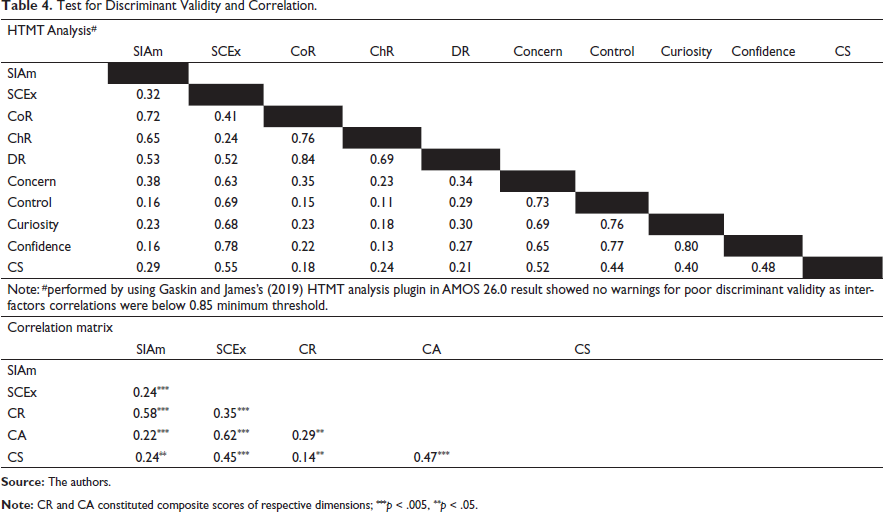
Descriptive statistics, reliability and model-fit estimates of scales are shown in Table 3. α and composite reliability (ComRe) scores of all scales were ≥ 0.70, ensuring internal consistency (Hair et al., 2010). Convergent and discriminant validity scores established construct validity. Table 3 showed career adaptability and career satisfaction having adequate convergent validity with average variance extracted (AVE) ≥ 0.50. It was slightly low for both MT-CD dimensions and two career regret dimensions but was acceptable as AVEs were not significantly smaller than 0.50 and all items’ standardised loadings were ≥ 0.50 (Cheung & Wang, 2017). The literature supported the use of such criteria (Yamak & Eyupoglu, 2021). Discriminant validity was determined using Heterotrait-monotrait (HTMT) criteria (correlation scores between two factors must be < 0.85; Henseler et al., 2015). As per Table 4, sufficient discriminant validity scores were observed between all factors.
Descriptive Statistics, Validity, and Reliability Estimates of Scales.
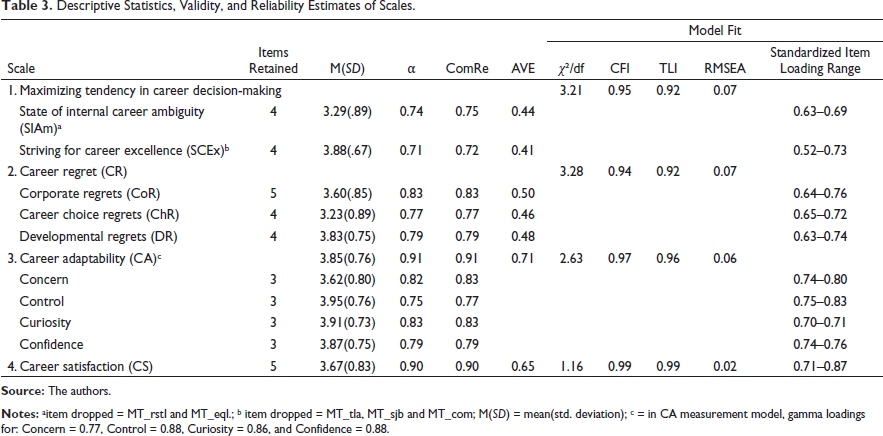
Notes: aitem dropped = MT_rstl and MT_eql.; b item dropped = MT_tla, MT_sjb and MT_com; M(SD) = mean(std. deviation); c = in CA measurement model, gamma loadings for: Concern = 0.77, Control = 0.88, Curiosity = 0.86, and Confidence = 0.88.
Test for Discriminant Validity and Correlation.
Criterion validity of developed scales was established through concurrent validity using external variables. The literature indicated these variables as theoretical correlates of developed scales (Giacopelli et al., 2013; Schwartz et al., 2002). ‘SIAm’ showed significant correlation with perfectionism scale’s ‘discrepancy’ factor (r = 0.45, p < .001) and ‘SCEx’ with its ‘standard’ factor (r = 0.51, p < .001). Furthermore, ‘SIAm’ had a weak significant correlation with conscientiousness (r = 0.12, p < .006) whereas ‘SCEx’ had a strong significant correlation (r = 0.40, p < .001). Such correlation patterns were similar to previous findings (Giacopelli et al., 2013). For career regret, ‘corporate regrets’, ‘career choice regrets’ and ‘developmental regrets’ were significantly correlated with regret (r = 0.46, 0.42 and 0.43, respectively, p < .001) and job frustration (r = 0.36, 0.33 and 0.30, respectively, p < .001). These significant correlations supported the concurrent validity of developed scales.
For determining common method variance (CMV), Harman’s test was conducted in SPSS 24.0 by using EFA. The result indicated that the one-factor model explained 24.3% of CMV, which was below the 50% threshold, thus indicating ab absence of bias (Eichhorn, 2014).
Hypothesised Structural Model
Bivariate correlations among constructs were determined to understand tentative directions of their associations (Table 4). Since all dimensions of career regret scale had relatively high correlation (> 0.65, Table 4), possibly reflecting the same theoretical overlap, we considered presenting it in a total score manner (Farrell, 2010). ‘SIAm’ was moderately positively correlated with career regret but showed weak positive correlation with career adaptability and career satisfaction. ‘SCEx’ was moderately positively correlated with career adaptability and career satisfaction while being weakly, but positively, correlated with career regret. Career regret was weakly, but positively, correlated with career satisfaction, whereas career adaptability had a moderate positive correlation. These bidirectional correlations could not predict antecedent–consequent relationships; hence, SEM using AMOS 26.0 was performed to examine the hypotheses. Figure 3 represents the hypothesised structural model.
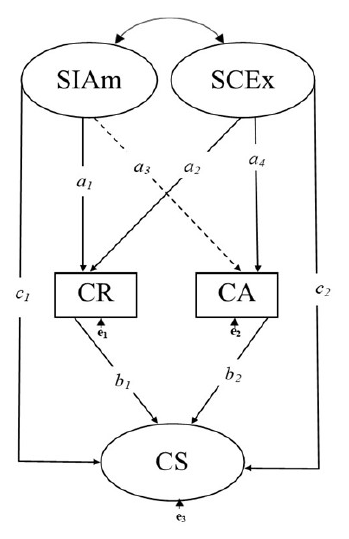
A modern approach of mediation analysis was used to determine mediators’ indirect effect between predictor and outcome, even if the total predictor↓outcome association was nonsignificant; significant indirect effects of mediators were examined by partial posterior p-value test (PPT) and Monte Carlo confidence interval (MC-CI) method (Falk & Biesanz, 2016). Results with p < .05 and non-inclusion of zero in lower limit (LL) and upper limit (UL) of MC-CI (CI = [LL, UL]) supported mediation or indirect effect. Indirect effect size was interpreted following Kenny’s (2018) directives small = 0.01; medium = 0.09; and large = 0.25. We followed Zhao et al.’s (2010) decision tree to determine types of mediation.
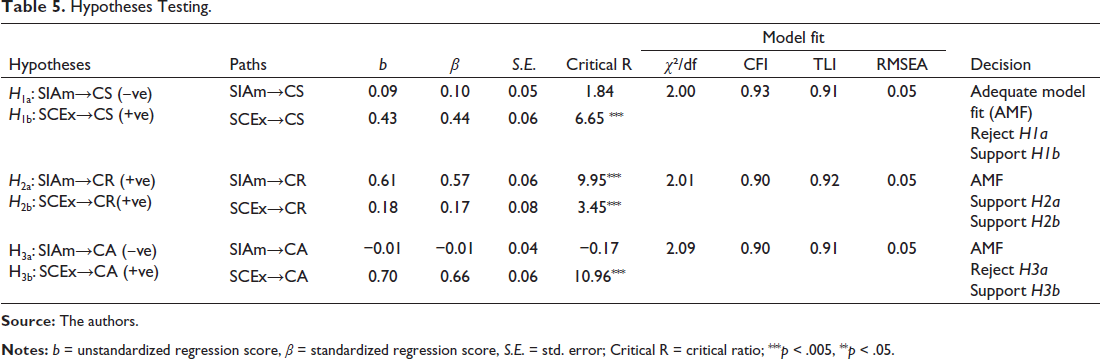
Tables 5 and 6 indicate that holistic model fits were appropriate in all cases. Table 5 showed that ‘SIAm’ had a nonsignificant relationship with career satisfaction (b = 0.09, p = .065) whereas ‘SCEx’ was significantly positively related to it (b = 0.43, p < .001). Thus, we refuted H1a but supported H1b. ‘SIAm’ (b = 0.61, p < .001) and ‘SCEx’ (b = 0.18, p = .003) both had a significant positive relationship with career regret, thus supporting H2a and H2b. ‘SIAm’ had a nonsignificant relationship with career adaptability (b = –0.01, p = .90) whereas ‘SCEx’ showed a significant positive link (b = 0.70, p < .001). Hence, we rejected H3a but supported H3b.
Hypotheses Testing.
Mediation.
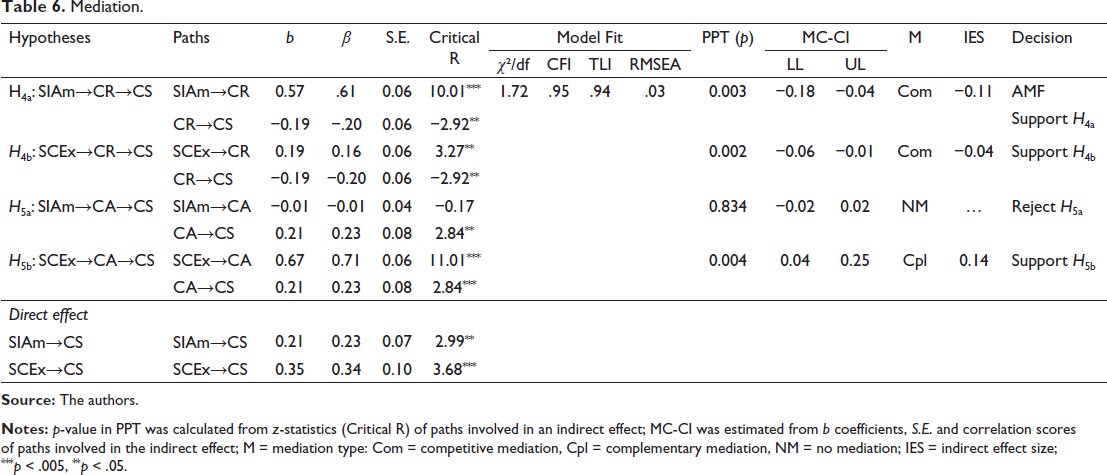
‘SIAm’ had significant positive relation with career regret (Path a1: b = 0.57, p < .001, S.E. = 0.06, z-statistic = 10.01). Career regret was significantly negatively linked to career satisfaction (Path b 1 : b = –0.19, p = .003, S.E. = 0.06, z-statistic = −2.95). Correlation between a1 and b1 was −0.05. The p-value and MC-CI of indirect path through career regret (i.e., SIAm↓CR↓CS) were p = .003 and CI = (−0.18, −0.04), indicating significant mediation, thereby supporting H4a. The opposing direction of significant direct path (SIAm↓CS; c1; b = 0.21, p = .003) and indirect path (SIAm↓CR↓CS) indicated competitive mediation. Effect size (a1.b1 = −0.11) showed career regret’s medium negative indirect effect between ‘SIAm’ and career satisfaction.
‘SCEx’ had a significant positive relation with career regret (Path: a2; b = 0.19, p = .001; S.E. = 0.06, z-statistic = 3.27). Career regret was significantly negatively linked to career satisfaction (Path: b1). Correlation between a2 and b1 was −0.07. The p-value and MC-CI of indirect path through career regret here (i.e., SCEx↓CR↓CS) were p = .002 and CI = (−0.06, −0.01), indicating significant mediation, thereby supporting H4b. The opposite direction of significant direct path (SCEx↓CS; c2; b = 0.35 p = .001) and indirect path (SCEx↓CR↓CS) showed competitive mediation. Effect size (a2.b1 = −0.04) represented a small negative indirect effect of career regret between ‘SCEx’ and career satisfaction.
‘SIAm’ had no significant relation with career adaptability (Path: a3; b = −0.01, p = .864; S.E. = 0.04, z-statistic = −0.17). Career adaptability had significant positive relation with career satisfaction (Path: b2; b = 0.21, p = .004; S.E. = 0.08, z-statistic = 2.84). Correlation between a3 and b2 was 0.14. Indirect path estimations through career adaptability (i.e., SIAm↓CA↓CS) were nonsignificant (p = .834, MC-CI comprised zero (CI = [−0.02, 0.02]) hence we rejected H5a.
‘SCEx’ had a significant positive relation with career adaptability (Path: a4; b = 0.67, p = .001; S.E. = 0.06, z-statistic = 11.01). Career adaptability had significant positive relation with career satisfaction (Path: b2). Correlation between a4 and b2 was −0.13. The p-value and MC-CI of the indirect path through career adaptability (i.e., SCEx↓CA↓CS) were p = .004 and CI = (0.04, 0.25). These results supported H5b. Both direct path (SCEx↓CS; c2) and indirect path (SCEx↓CA↓CS) were positively significant and, being in same direction, indicated complementary mediation. Effect size (a4.b2 = 0.14) showed career adaptability’s medium positive indirect effect between ‘SCEx’ and career satisfaction.
With respect to control variables, respondents with children had greater career satisfaction (b = 0.24, p = .004), reflecting parenthood’s synergistic effects in career spheres, possibly shaped by the Indian IT organisations’ employee-friendly policies (Upadhya, 2016).
Discussion
Contradicting career maximisation’s unidimensionality (Voss et al. 2019), we present its dimensional-level interpretation and operationalisation within the Indian IT workforce, extending the maximising literature from non-Western vocational perspectives (Cheek & Schwartz 2016; Voss et al. 2019). Also, unlike previous research with a generic overview of regrets in maximisers’ vocational domain (Dahling & Thompson, 2013; Liu et al., 2015; Voss et al., 2019), we depict ‘career-specific’ regrets. We show how career maximisation and career regret operationalise in ITPs and uncover understudied constructs of career adaptability and career satisfaction, therefore, adding new insights to the vocational behaviour of Indian IT workforce. Besides, we attempt to broaden career development literature by unfolding distinctive features of individuals’ maximisation strategy in career decision-making, thus, highlighting key opportunities and challenges therein. Such aspects can guide career practitioners to design and deliver effective career solutions to clients who maximise (Gati & Kulcsár, 2021).
MT-CD in ITPs is demonstrated as ‘SIAm’, a confused mind frame regarding self and surrounding (internal ambiguity), and ‘SCEx’, seeking higher aims and best outcomes strategies (excelling approach). While ‘SIAm’ had no significant link with career satisfaction, ‘SCEx’ enhanced it, showing part consistency with Giacopelli et al.’s (2013) study. Results here echo the result-oriented ideologies of Indian IT work culture (Upadhya, 2016). Such ideologies synchronise with maximising ITPs’ excelling approach, helping improve performance and enhancing visibility, thereby increasing career satisfaction. Further, occupational benefits of IT careers may uphold their career satisfaction, hence making it independent of internal ambiguity.
Both facets of MT-CD predict career regret, integration of underlying dimensions, ‘corporate regrets’, ‘career choice regrets’ and ‘developmental regrets’. Maximising ITPs tend to extensively rely on external sources, stressing out even with trivially unfavourable information amidst environmental turbulence. Internal ambiguity makes them overanalyse external situations and harbour thoughts of career threats, with retrospective assessment of past career actions or inactions, producing regrets. With their externally oriented decision-making evaluation criteria, this attribute also imposes doubts regarding present career choices and provokes upward social comparisons. Intense regretful thoughts arise seeing contemporaries become more successful. Further, their risk-aversion mentality impedes excelling approach (Lai, 2010), spurning profitable but risky options, and provoking inaction regrets.
Notably, maximising ITPs seem to be satisfied in their careers. But with career regret as mediator, their satisfaction levels diminish. Upon excluding maximisation though, career regret positively correlates with career satisfaction. Such findings highlight the societal push for compromises and adjustments in the Indian IT employees’ career decisions. Despite these, they manage to lead a fulfilled professional state by drawing satisfaction from other life spheres (Shah, 2014). Maximising ITPs, however, prefer not to compromise with career priorities. Rigid boundaries could be set between professional and non-professional domains, making drawing satisfaction from other life spheres ineffectual. Perhaps, compromises at the cost of career progression aggravate regretful thoughts, thereby diminishing career satisfaction. Negative mediating mechanism of career regret mainly falls on the relationship between maximising ITPs’ internal ambiguity and career satisfaction as it produces greater regrets than excelling approach. This supports decision difficulty’s stronger links with regret proneness than high standards and alternative search (Rim et al., 2011; Weinhardt et al., 2012).
Contradicting Van Vianen et al.’s (2009) assumption, maximising ITPs are adaptable career-wise. We found maximising ITPs’ excelling the approach to enhance career adaptability, whereas internal ambiguity had no significant effect. This is consistent with Lai’s (2010) and Misuraca et al.’s (2016) findings, specifying self-motivation, optimism, self-efficacy and future orientation as forming core resources of career adaptability. Career adaptability empowers maximising ITPs to strengthen proficiencies and advance performance, thereby, increasing career satisfaction. Further, the present IT market demands the workforce to stay competent and thrive regardless of industrial volatility; thus, maximising ITPs’ internal ambiguity gets withheld and shows no significant impact on career adaptability. Altogether, career regret competed with career adaptability, supressing its positive indirect effect on maximising ITPs’ career satisfaction. Findings here are consistent with Peng et al.’s (2018) study showing similar competing indirect pathways of hope for success and regret between maximising and subjective well-being.
Implications
Practical Implications
Maximising ITPs’ go-getter attitude, with adaptability resources, bestow distinct advantages in learning relevant competencies and developing competitive edges, but deep-seated internal ambiguities and regret mentality can weaken performance. Hence, HR leaders need to enhance maximising ITP’s professional capabilities, also addressing their internal doubts. Behavioural activation training can facilitate strengthening willpower and resilience, diminishing irrational self-doubts. Also, senior management mentorship, feedback, accurate information on future opportunities and self-advancement can help built a pragmatic attitude towards careers along with improving work performance and organisational engagement.
Theoretical Implications
The multidimensional nature of developed scales advances theoretical knowledge of career maximisation and career regret constructs, manifesting key attributes specific to the Indian IT workforce (a non-Western context). Findings substantially contribute to process-oriented career decision-making models and chaos theory of careers for guidance practice, advancing the understanding of interlinks between traits, contexts, uncertainty, thought processing, callings and career development.
Limitations
The study has a few limitations. First, scale development is an extensive process. Here, we developed tentative scales for measuring MT-CD and career regret using a specific sample; thus, further refinement and cross-validation including predictive validity test across wide-ranging samples is required. Second, being cross-sectional, absolute statements about causality cannot be derived. Hence, we call for longitudinal research to establish causality of proposed relationships, also determining whether internal ambiguity is actually maximisers’ innate factor or an outcome (Cheek & Schwartz, 2016). Besides, inclusion of other variables such as mediators (e.g., emotional intelligence and supervisor support) and outcomes (e.g., turnover intention) can reveal more about maximising ITPs’ career aspects. Third, this study was limited to the Indian IT workforce, thus, restricting the generalisability of findings. Also, effects of career stages, age, gender and satisficing intent—important variables in ITPs’ vocational and maximisation literature—were excluded. Therefore, we propose similar future research in divergent occupational groups including satisficing tendency and moderating effects of distinct career stages, age and gender. Fourth, we depicted theoretically deduced responses of counterfactual reasoning, rather than incorporating some stimuli to activate them in respondents. Thus, intervention-based research can be undertaken to better comprehend maximising ITPs’ counterfactual reasoning with respect to their career decisions.
Conclusion
This study elucidates a multi-dimensional perspective of career maximising trait in ITPs along with determining how it impacts career satisfaction through mediating effects of career regret and career adaptability, contrasting the responses of counterfactual reasoning. Scales were developed and validated to measure MT-CD and career regret constructs, revealing the following:
Two dimensions of MT-CD―‘SIAm’ (internal ambiguity) and ‘SCEx’ (excelling approach)―and three dimensions of career regret―‘corporate regrets’, ‘career choice regrets’ and ‘developmental regrets’.
Hypothesised framework indicated the following:
‘SIAm’ and ‘SCEx’ produced dysfunctional counterfactual response of career regret, subsequently decreasing career satisfaction. ‘SCEx’ led to functional counterfactual response of career adaptability, subsequently increasing career satisfaction. Career regret, altogether, competed with career adaptability, supressing its positive indirect effect on maximising ITPs’ career satisfaction.
These aforementioned findings converge to underscore the duality of career maximisation and signify how its underlying attributes, although disparate, can predominantly shape career regret, jeopardising career satisfaction by concealing career adaptability’s favourable effects. Besides broadening the existing literature on career maximisation in a sparsely researched non-Western context, this study extends the Indian IT vocational literature. It highlights novel (MT-CD and career regret) and understudied (career adaptability and satisfaction) notions that are potentially relevant to contemporary Indian IT employment market. This study also provides practical insights to individual employees, HR managers and career guidance professionals on how to optimise career decision-making outcomes. Besides, it encourages scholars to undertake theoretical and empirical research to strengthen results and explore further.
Footnotes
Declaration of Conflicting Interests
The authors declared no potential conflicts of interest with respect to the research, authorship and/or publication of this article.
Funding
The authors received no financial support for the research, authorship and/or publication of this article.
