




Abstract
The sudden, rapid and ongoing outbreak of novel coronavirus disease-2019 (COVID-19) has forced social distancing and lockdowns. Many people have already started experiencing an elevated feeling of loneliness, emotional distress, anxious and depressive thoughts related to the concerns for the disrupted social, emotional, spiritual, professional and financial wellbeing of family, friends and self. Many are feeling distressed on recurring thoughts about how long this pandemic will last, whether our family and friends will be infected and how long we will be living in this condition. Hence, the researchers of this study anticipated that the COVID-19 outbreak would be highly stressful to the people and will have psychological consequences of varying degrees. This study examines the relationship of stress, anxiety with health locus of control (HLOC) among entrepreneurs and employees serving in organisations, and the coping strategies they have adopted to overcome it. Using the quasi-experiment method, the data were collected using the perceived stress scale (PSS) and multidimensional health locus of control (MHLC) from 91 entrepreneurs and employees. The findings indicated a significant association between HLOC and stress. It was observed that respondents were aware that the current work stress is arising because of a struggle to balance personal and professional lives during the pandemic. Further, it was also observed that stress was significantly higher in employees than entrepreneurs, and HLOC types positively impacted their stress levels.
Introduction
The novel coronavirus disease 2019 (COVID-19) (World Health Organization [WHO]) has led to a health emergency across the globe. The sudden, rapid and ongoing outbreak has forced governments all over the world to introduce drastic steps for social distancing, voluntary or required quarantine, closure of many business places and enforced lockdowns. This came with the closing of all public gatherings, workstations and educational institutions as a part of the recommendations to stay at home and stay safe. These actions were being observed to have a substantial adverse impact on the economy, causing huge demand and supply shocks and leading to ‘global financial crises’ (Acharya & Steffen, 2020, p. 1). For a long time, experts have shown concern about these sudden, unexpected outbreaks and rapid spread of infectious diseases leading to health and emergency crisis. An increasing number of affected people and mortalities also lead to psychological disorders and comorbid conditions such as a feeling of distress, burnout, fear and anxiety, depression, fear of infection, anger or frustration, sad, loneliness, chronic and neurotic paranoid symptoms and post-traumatic stress disorders (PTSD). Researchers have observed a strong and severe biological and psychological impact of the epidemic on the population such as experiencing PTSD, subjective pain perception and functional impairment as a perception of locus of control appraisal and increase demand for optimisation of pain management, physical rehabilitation and cognitive promotion of self-efficacy (Mak et al., 2010). The internal locus of control is taking responsibility for the outcome of the events that are happening. External locus of control refers to the opposite of blaming one’s fate and external factors and putting blame on outside factors (or people) for the events that are happening. Tartakovsky (2018) has suggested a few ways wherein a person can reduce the experience of external locus of control and increase internal, such as focusing on all factors that can be controlled, seeking support and turning criticisms into growth for self, and in this way, we can create the life we all want to live (without blaming others). Studies suggest that a person with an internal locus of control believes that he/she can influence events and their outcomes (Phares, 1976). Life experiences and age may play a role in leading to a relationship between happiness and locus of control. Today, people are more concerned and careful about their health and they try to maintain a balance between physical and mental wellbeing and take the onus of their surroundings and actions (Lee-Kelley, 2006).
Infectious Diseases Outbreaks Over the Years and Their Psychological Impact on People
This century’s first infectious disease—severe acute respiratory syndrome (SARS) epidemic outbreak in the year 2003, was the first massive infectious disease outbreak that had emerged from an influenza pandemic in this century. It had spread rapidly affecting more than 8,000 reported cases and 774 deaths across 30 nations (Mak et al., 2010). This outbreak had recorded a long-term PTSD among SARS survivors and observed a ‘cumulative 47.8% of patients having PTSD during the epidemic, whereas 25.5% of patients were observed to continue meeting PTSD criteria even after 30 months post-SARS’ (Mak et al., 2009). The Middle East respiratory syndrome coronavirus (MERS-CoV) outbreak of 2012 had also observed a significant increase in psychological disorders such as stress and high public anxiety among the people in affected countries (Al-Rabiaah et al., 2020; Zaki et al., 2012). Similarly, other previous outbreaks such as Avian influenza, Marburg, Hantavirus and Zika (Gossling et al., 2020) have also observed post-traumatic symptoms among the affected population, of which stress, anxiety and depression are reported as the highest. The world has also witnessed a serious impact on the health and wellbeing of people during the Ebola virus disease outbreak, leading to a tremendous increase in psychological distress, risk of infection, fatigue and social isolation among the people (Lehmann et al., 2015). Researchers like Liao et al. (2014) have observed that anxiety level in people has reached to ‘highest level during the peak of epidemic and decreased with its decline’, especially during the H1N1 epidemic. Further studies have also observed a relationship between the state of psychological crisis such as the perceived probability of infection or perceived severity of illness and its impact on risk communication, behavioural changes and an increased health-protective behaviour among people during the outbreak of respiratory infectious disease epidemics (RIDEs) (Barr et al., 2008; Bish & Michie, 2010; Leppin & Aro, 2009; Tang & Wong, 2003, 2004). But the observations during these earlier outbreaks and COVID-19 pandemic is that all the earlier outbreak were largely spread into specific geographical zones unlike the current pandemic and hence the symptoms of different psychological states were observed in almost all the people across the globe creating a different impact of larger scale.
The current outbreak of COVID-19 is also showing a harmful effect on the public’s mental health, leading to a state of psychological crisis. Many countries are reporting an increase in the symptoms of stress, depression and anxiety. Here social disconnection has led to many people experiencing symptoms of emotional distress, irritability, mood swings, sleeplessness, attention deficit hyperactivity disorder, unexplained angry behaviour, fear of unknown health threats and crises, and insecurity among people across the globe (Brooks et al., 2020; Rubin & Wessley, 2020; Shigemura et al., 2020; Wang et al., 2011; Xiang et al., 2020; Zhang et al., 2020). Maaravi and Heller (2020) investigated differences in the experience of COVID-19 anxiety and have observed that ‘women are more anxious than men’ as they are more worried about health concerns than the financial wellbeing of themselves and their close relatives (Maaravi & Heller, 2020). The ongoing pandemic had increased emotional and substance abuse in the family members, particularly in the male population who has increased violent behaviour among women in their families. Women are observing severe health, social and economic impact with their unpaid domestic care responsibilities, domestic violence, violence in shelter homes, children’s exposure to family violence, child abuse, social isolation and so on (Ayittey et al., 2020; Humphreys et al., 2020; Vallejo-Janeta et al., 2021). A group of Harvard disease experts is further saying that people need to follow some form of social distancing and also need to confine into isolation until 2022 (World Economic Forum, 2020), which is further worsening the mental health conditions of the population across the world. This means that now people will need to stay distanced from each other for a longer period in the coming days. We will not see any large public gatherings, the coffee breaks in-between hectic work schedules, no more standing in long queues and no more squeezing in packed buses and trains. All these further means that people will not be engaging in social activities, for now, and will be required to keep a safe distance from others, spending time with friends and family, and no form of the outing was one of the ways for many of us to relieve anxiety arising out of our chaotic work lives.
Experience of Stress During COVID-19 Outbreak
We all are experiencing stress currently. We experience stress all the time in our lives. Stress is inevitable. Stress has always been a topic of interest to many theorists, psychologists, social scientists, medical and management professionals. Stress has been defined by many people in different ways, but Selye (1956, p. ix) defines stress as follows: ‘…it is a non-specific response of the body to a demand…’. The ongoing situation of home quarantine and strict social distancing, closure of workplaces and schools, is making people experience loneliness, psychological stressors and fear of uncertainty about the future. Some of the psychological states observed among people are feeling of frustration and helplessness; anxiety about getting affected with the disease; concerns about the health of self, family and friends; lack of sleep; struggle to balance between work, home and kids; not being able to support employees financially and high level of reliance on others during tough times (Lai et al. 2020; Limcaoco et al., 2020; Rana et al., 2020; Spoorthy et al., 2020; Taylor et al., 2010; Xiao et al., 2020). All this has led to a rise in the experience of different degrees of emotional stress and severe disruption in personal and professional lives. The experience of stress in an ongoing pandemic is also creating a negative impact on students’ communities. Factors such as familial stressors, academic delays, the spread of the virus among family members, anxiety relating to coping up with an online mode of learning and seeing their parents going through tough times are making these children’s life worsen (Dhar et al., 2020). WHO is also urging people to look after their mental health during the COVID-19 pandemic. Experts from WHO say that the new realities of remote working, homeschooling, temporary unemployment and lack of physical contact from family, friends and colleagues come with a feeling of threats, stress, uncertainty and worry about the future are the by-products of the current situation. But this fear will slow down as the spread of the virus will start reducing (World Health Organization, 2020b).
Impact of Locus of Control on the Experience of Stressors
Many stress management theories emphasised the importance of locus of control and disclosed how it can have a positive impact on people and can help them to overcome the experience of stressors in their lives. Locus of control was first defined by Rotter (1966) as ‘…referring to an individual’s belief about the extent of control that they have over things happening to them…’. The definition further states that individual who tends to possess an internal locus of control is more likely to believe that they have control over their behavioural outcomes. Whereas people who believe that their situations and their outcome are controlled by external forces or fate possess an external locus of control. Such people with an external locus of control will attribute the cause or control of events to the external environment (Rotter, 1966; as seen in Pannell’s & Claxton, 2008, p. 68). Spector (1982) has described that those individuals who believe that the events happening to them are being controlled by their selves are referred to as ascribing to an internal locus of control, whereas individuals who believe that events happening to them are forced by external factors with no control of theirs are ascribed as practicing external locus of control. Researchers in the field of psychology have stated that there is a linkage between locus of control and stress experienced by individuals (Ivancevich & Matteson, 1980). Scott (2019) said that those with an internal locus of control experience mild stress and those with an external locus of control will have more stress. The social learning theory on locus of control by Rotter (1966) explains that it is a statement on concepts of some people perceiving that the outcomes (such as rewards or punishments) of events are dependent on their actions or whether the outcomes are purely the influence of external factors.
Impact of COVID-19 on Entrepreneurs
The Merriam–Webster dictionary 1 has defined the term ‘entrepreneur’ as—‘one who organizes, manages, and assumes the risks of a business or enterprise’. Needless to add that this term also includes owners of small and medium enterprises (SMEs). In the ongoing pandemic time, entrepreneurs are facing total disruption. There is a wave of uncertainty among them. They are facing problems in all aspects of their businesses, namely, business planning, industrial disruption in the supply chain and sales channel partners, and some are also concerned about future business scenario planning and have conflicting thoughts of swift shifting in the entire business model so that they can survive in this unprecedented time (Giones et al., 2020). One study has observed that lack of financial support and retrenchment will have a long-term impact on their business turnaround and this is most concerning to them (Wenzel et al., 2020). Entrepreneurs have other concerns apart from falling off business, including to cope with global reactions to the pandemic; dedicating additional time and attention to societal needs; monitoring possible development; an equal required attention towards personal needs, health and family concerns; a cumulative loss of staffs’ productivity and so on. Many small businesses are also struggling with the fact that even after taking care of all these, their business will still die. A narrative study by Maritz et al. (2020) observed that even though the pandemic has shown an impact on the economy with closures of hundreds and thousands of SMEs, but within a matter of weeks a positive entrepreneurial spirit of these SME owners has been observed in their exhibition of ‘resilience, determination, and proficiency to seek opportunity in chaos’. Some of these small business owners have also started quickly adopting innovative and newer ways to offer their product and service, to keep employment going on for their employees.
Adapting to Challenges and Crises
These entrepreneurs have been demonstrating common characteristics such as being adaptive to changing circumstances, being proactive in analysing situations taking fast but good decisions, being action-driven and result-oriented and being visionary, determined, optimistic and innovative (Maritz et al., 2020, p. 3; Maddyness, 2020), and further they were also observed to be able to deal effectively with fear of failure arising from uncertainty and were able to balance their tolerance for ambiguity (Yagnik & Chandra, 2019). Ratten (2020) said that there has emerged a new way of understanding entrepreneurship during COVID-19 resulting in cultural, social and business changes. The physical distancing has led to a newer form of digital communication, the reduced group activities have led to increasing usage of streaming facilities. Some industries like food delivery, e-commerce, education, videoconferencing or video gaming are still booming unlike businesses like restaurants, hotels, and hospitality, sports or the entertainment industry. The positive story of these businesses has led to effectively dealing with remote working challenges. This has opened a different horizon for some business, which is booming these days while others are suffering.
From Leaders’ Desk
The current situation is creating a continuous disruption in business across the globe and its effect is being felt by economies as well. Business owners are observing severe crisis, for example, the Lime start-up (the urban mobility e-scooter start company) which has lost 80% of valorisation in 1 month (Derderian, 2020). The PwC report on a survey from 867 chief financial officers (CFOs) from 24 countries observed that this crisis is affecting finance leaders and businesses worldwide, where 85% of CFOs are expecting some decrease in profits and revenues as a result of COVID-19. While 18% CFOs said that they are planning to cut R&D and 16% have expected to scale back their investment in digital transformation. This report further states that the European Commission (EU) projected that in the month of April 2020, its economy had lost 20.5 million jobs, and unemployment rates have reached 14.7% (PwC Global, 2020). The report by International Labour Organization (ILO) observed that till March to April 2020, across the globe, 81% of employers and 66% of self-employed workers (ILO, 2020a) live and work in countries that have announced workplace closure. Further, around 436 million enterprises have been observed as facing high risks of serious disruption due to COVID-19 (ILO, 2020b). The ILO report also states that even when containment measures will be lifted in the future, they will continue to face challenges and huge cost investments will be incurred in taking care of ensuring secure and safe working environments after the lockdown will be lifted.
Impact of COVID-19 on Employees
The Cambridge dictionary 2 has defined an employee as—‘…someone who is paid to work for someone else…’ Employees are also experiencing an increase in stress levels related to keeping up with this new standard of working from home. They are now required to prove more how much efforts they are pouring into their work currently, with an equally high risk of getting more strict workloads and intermittent pressure to perform and manage everything with limited available resources. Work-from-home or telecommuting concept is nothing new to us. We have been observing many people practicing this for a long. The Cambridge dictionary 3 has defined working from home as a kind of ‘…arrangements in which employees work in their own homes, rather than in-office…’ But with the rise of the pandemic, a new perception of the workplace has evolved, which is going to be the key practice for all companies in current and coming times. Indian companies have observed that working from home has not made people less productive; there has been a positive long-term shift observed in virtual working among professionals. But remote working also leads to ‘flex time’, which is converting itself into a matter of stress for many professionals, especially those who have child care or elderly care responsibilities at their homes. These employees are compelled to stretch themselves to finish their long-pending work mostly during night time (or at other times when the family members are sleeping). They have to start work early in the morning, or many of them are finishing work during weekends or week offs to balance their parenting and job duties. Some are even feeling burnout and experiencing having less time than it is consumed to commute home to the office (Davis & Green, 2020). For others responding to calls and email communication, the entire day is becoming a new normal leading to a notion of ‘being available’ all the time (Thomas, 2020). Those who are associated with senior roles are furthermore concerned about their company’s reputation, profitability, survival, crisis management and its resultant outcomes on the company’s overall image as an employer will be hampered (Adikaram et al., 2021). Those who are working in service-for profit industries are often required to take a caring and empathetic approach during their face-to-face or voice-to-voice interactions, keeping their anxiety aside also leads to a feeling of burnout among these professionals (Chandra & Mathur, 2021, Chandra, 2021; Wanninayake et al., 2021). All this leads to an experience of stress and anxiety on the fear of losing jobs, especially for people who have financial commitments.
Research Objectives and Hypotheses
We anticipated that the current COVID-19 outbreak would be highly stressful for professional workgroups and will have psychological consequences of varying degrees. Therefore, in this article, we analysed the perception of stress and the impact of the health locus of control (HLOC) for entrepreneurs and employees serving in organisations. We anticipated that in the present situation, employees would be affected very strongly as their bread and butter are being dependent on the survival of their employer and employing organisations. Despite all odds, we believe that by their entire working scenario, entrepreneurs are being more tuned to face uncertainties and being adaptive to fluctuation in the course of their businesses and will be better off in coping with the stressful situations compared to employees in general. Of course, the HLOC will have a role to play while comparing the stress levels, irrespective of the occupation. Omeje and Nebo (2011) in their study on the impact of locus of control on adherence to treatment regimen among hypertensive patients justify their sample size of more than 30 as adequate from an analytical standpoint, while using a test of comparing means. However, they mention that with a smaller sample size, they will not be able to capture a small effect size. In our study conducted during the COVID-19 lockdown, taking into account the crisis through which the masses were going, we could, with great difficulty, manage to get 43 responses from entrepreneurs and 48 responses from employees. As we had only two levels of professional background, each having more than 30 responses, which are sufficient from the statistical viewpoint to detect a large effect, we decided not to bother other potential respondents by following up further in the given situation.
Based on the theoretical foundations and qualitative research, we assume that entrepreneurs in the course of their business become used to uncertainties and are more resilient and hence would have lower levels of stress compared to employees during the COVID-19 pandemic. Also, it was assumed that stress among respondents with internal HLOC would be lower compared to those with an external locus of control represented as a combined group of ‘Powerful others’ and ‘Chance’ types. The following are the identified objectives and hypotheses for this study:
Objectives
To evaluate the association between occupation and stress.
To evaluate the association of HLOC types and stress.
To determine the average change in stress score between entrepreneurs and employees.
To determine the average change in stress score between HLOC types.
To examine the impact of HLOC types on stress levels of entrepreneurs and employees.
Based on the above objectives, the following hypotheses were formed for testing:
Hypotheses
Methodology
Sampling
This study was conducted during the first lockdown period in India (April–May 2020). To maintain the impact of stress and other variables constant, we restricted the time frame for data collection, and the data were collected from 24 April 24 to 17 May 2020. The data collection was conducted when the first lockdown was unexpectedly announced all over India. We assumed that this unexpected lockdown would be leading to a situation of the unforeseen crisis affecting the personal and professional lives of people (here entrepreneurs and employees). During this first lockdown, there were many very well-organised campaigns also conducted by government to create an awareness among masses. These campaigns were conducted as a preventive measure to make sure that people should not get affected by fake news, rumours which were circulating through social platforms which everyone was exposed to, but the countermeasures to curb their effects were also in place. These situations and selective time frame of collection of data controlled the other influences by and large for both the types of respondents. We made an attempt to stick to a time frame for data collection assuming that the impact of this crisis leading to other longer term impacts can be considered as a part of the study. Hence, the sample size for the present study is small. Using a convenience sampling method, we tried reaching out to as many respondents. Efforts were also made through telephonic contact and the distribution of online questionnaires to garner responses during the lockdown. In the situation of the COVID-19 crisis, it was decided that the follow-up shall be continued till we get at least 40 responses in each group. After repeated follow-ups, a total of 111 respondents have shared their filled responses. After removing half-filled responses, a total of 91 complete responses were finally included in the study.
Research Design and Method
Taking into consideration the difficulty in manipulating HLOC and because of the randomisation of the sample, a cross-sectional study, quasi-experiment design (Chawla & Sondhi, 2011, p. 80) opted for this study. Data were collected using an online questionnaire developed using items from the perceived stress scale (PSS) and HLOC scale along with a few background variables, namely, age-group, gender, family size and orientation and number of children, no of children currently pursuing education and occupation classified [as Entrepreneur (n = 43) or Employees (n = 48)]. Respondents’ stress levels and HLOC types were determined based on their responses using guidelines of the instruments after reverse coding of necessary items.
Tools for Data Collection
Results
Besides univariate and bivariate frequencies, standard descriptive statistics, Fisher’s exact test of association and t-test independent samples have been used for the analysis of the collected data. Categorical variables with few observations were meaningfully clubbed for analysis. Hypothesis testing was conducted with an alpha value of 0.05. Furthermore, given the similarity in perception regarding any situation, taking into account the size of the sample, we have clubbed the ‘powerful others’ as well as the ‘chance’ locus of control types as ‘external’ for analysis in the study. The PSS, as well as the MHLC scale, had an acceptable level of internal consistencies, with Cronbach’s alpha of 0.81 and 0.695, respectively.
Profile of Respondents
Profile of Respondents.
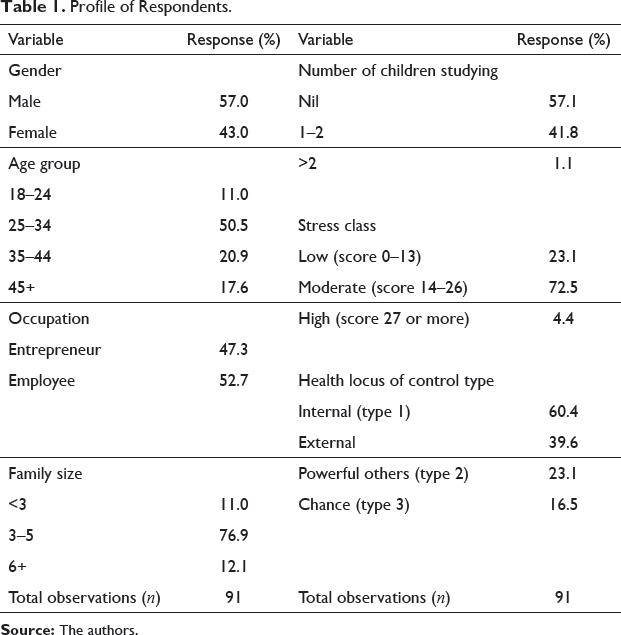
The stress level was classified into three categories based on the total score of the 10 questions as low if the total score is up to 13, medium if the total score is between 14 and 26 (both inclusive), and high if the total score exceeded 26. About 23% of respondents were found to be having a low stress level; more than 72% had a moderate stress level and a meagre 4.4% were found to be highly stressed. As regard to HLOC, more than 60% were found to be having an ‘internal’ HLOC. Almost 40% were found to have an ‘external’ HLOC, taking together 23% with ‘powerful others’ and about 17% with ‘chance’ type of HLOC.
Level of Stress by the Background of Participants
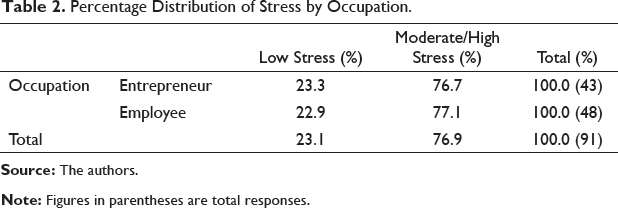
Percentage Distribution of Stress by Occupation.
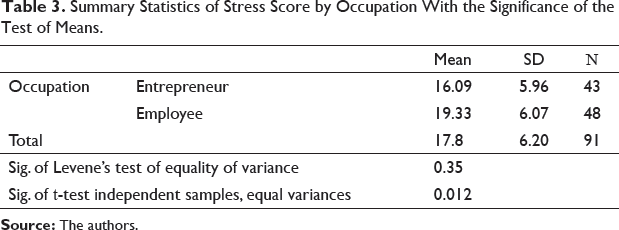
Summary Statistics of Stress Score by Occupation With the Significance of the Test of Means.
Health Locus of Control by the Background of Participants
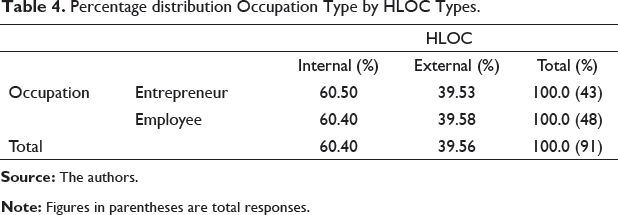
Percentage distribution Occupation Type by HLOC Types.
Locus of Control and Stress Level
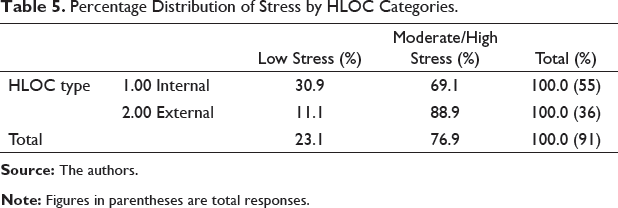
Percentage Distribution of Stress by HLOC Categories.
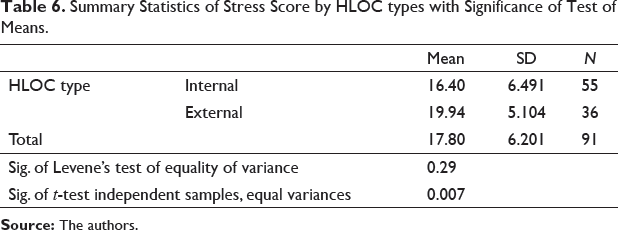
Summary Statistics of Stress Score by HLOC types with Significance of Test of Means.
Stress Scores Segregated by Occupation and Health Locus of Control Types
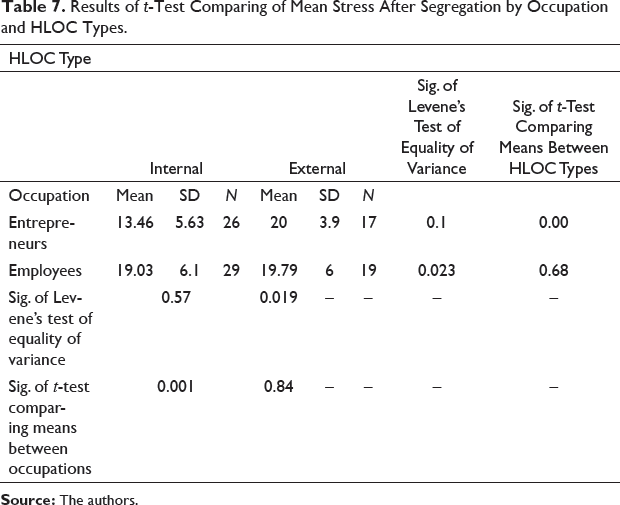
Results of t-Test Comparing of Mean Stress After Segregation by Occupation and HLOC Types.
Discussion
We observed based on the analysis presented in Table 3 that, at an aggregated level, the stress scores differed significantly by occupation and based on Table 6 that the same differed significantly between HLOC types. However, when compared in a disaggregated form as shown in Table 7, it is observed that the mean stress score remains significantly different across occupations only within the HLOC type ‘internal’; whereas the mean stress score does not significantly differ within the ‘external’ subgroup of HLOC. In the ‘external’ HLOC subgroup, the stress level remains more or less the same between the two groups of occupations. In short, among employees, the stress scores do not differ significantly between the two HLOC types. It could be due to fear related to job loss or salary-cut in the wake of COVID-19 and that the HLOC type does not become relevant in the case of employees. However, owing to past experiences of dealing with uncertainties and the confidence they can control the situation, entrepreneurs with the ‘internal’ HLOC type are better off in terms of an average score on stress.
In this article, we have appraised locus of control using the MHLC scale. The assessment of stress was conducted using the PSS. The objective of this study was to assess the perception of stress currently experienced by employees and entrepreneurs due to the COVID-19 pandemic and to identify its relationship with the HLOC and other background variables. The analysed data observed that, with relation to the occupation (entrepreneurs and employees), more than 76% of people in both the groups were found to be experiencing a moderate or high level of stress. Similarly, as regard to HLOC factor, more than 60% were found to be having an ‘internal’ locus of control and about 40% among entrepreneurs as well as employees had an ‘external’ locus of control. Statistically, a significant association was observed between HLOC types and categorically classified outcome variable stress. T-tests of independent samples demonstrate that (a) overall, the average stress score is significantly lower among entrepreneurs compared to employees; (b) individuals with ‘internal’ HLOC type have lower stress compared to those with ‘external’ HLOC type; and (c) the difference in stress score by occupation remains significant only in the ‘internal’ HLOC subgroup, this means that in the case of ‘external’ HLOC subgroup, the stress level remains more or less the same. HLOC is found to be intervening when the average stress score was compared across occupations and individuals, with HLOC type ‘external’ being observed to be more stressed, irrespective of whether they are entrepreneurs or employees. The significantly lower average stress among entrepreneurs with ‘internal’ HLOC type may be indicative of their better resilience compared to their employee counterparts in dealing with vagaries and the belief that they have control over the situation. Furthermore, the importance of HLOC type is undisputed and hence interventions to change beliefs among ‘entrepreneurs’ are warranted so those with ‘external’ HLOC can be shifted from ‘external’ orientation to ‘internal’ type on HLOC and that their stress level can be reduced. In the case of employees, it appears that interventions to build self-efficacy, confidence-building regarding quick recovery of businesses and the announcement of employment supportive financial packages will help them in regaining confidence.
We also had a telephonic discussion with some respondents. During our discussion with respondents, we understood that almost many of them have already started accepting the current pandemic situation and are making themselves mentally prepared to bear the outcomes which will arrive due to it. They know that this stress is arising due to the struggle while balancing personal and professional life during the COVID-19 pandemic, which is now an integral part of their life. Respondents said that they were already more habituated to work under stress because of the very nature of their work. But now they know how to overcome it by adopting various alternate ways to make work more flexible and interesting in their unique own ways. Many of them have already started experiencing an elevated feeling of loneliness, emotional distress, anxious and depressive feelings related to the concerns for the disrupted social, emotional, spiritual, professional and financial wellbeing of family, friends and self. Some of them shared their concerns over their family and friends’ wellbeing. Entrepreneurs have complained of experiencing a reduction in the pool of their clients and customers, many of their investors have kept investment decisions on hold, which has led to uncertainty of circulation of capital and payment of salaries to their employees. Women entrepreneurs have reported showing high concern during the pandemic, such as declining revenue and issues with work–life balance.
Some of them were experiencing serious concerns related to repayments of debts, which are coming as usual. Employees said that they are hesitant to leave their organisations to search for opportunities with a fear of not getting the desired one and cannot take risks of losing their jobs despite work is becoming unbearably stressful. Despite this, some of the respondents who were associated with the profile such as analytics and data science have more positive hopes of getting better opportunities while switching jobs. But this will be possible for only a few, some of them are still struggling to master technical skills and understanding of various technological tools (which is the only way to survive). But overall, both these groups have said that to deal with the current situation, they have to have an equal focus on their health and mental wellbeing. Ultimately, being mindful of the wellbeing of self and others is required in this current pandemic situation. A reflection of that has been observed in this article. All this is a brand new normal.
Limitations, Significance and Future Scope
Our study has limitations as it was conducted on a small sample within a short duration, measuring limited variables, and hence the results cannot be generalised on a larger population. This study will be useful to scholars, psychologists, social psychologists, change managers and health professionals and will add value in its field. Further studies can be conducted on a larger population considering varied variables from different regions. A further follow-up study can bring a detailed analysis of post-traumatic stress as now people have almost spent almost a year in isolation due to pandemics. Future studies can be focused on a larger scale including multiple variables analysing before and after the disaster.
Footnotes
Acknowledgements
We would like to thank all our respondents for agreeing to participate in this study. We would like to extend our sincere thanks and acknowledge their contribution in making this study successful.
Declaration of Conflicting Interests
The authors declared no potential conflicts of interest with respect to the research, authorship, and/or publication of this article.
Funding
The authors received no financial support for the research, authorship, and/or publication of this article.
