




Abstract
This paper offers a view of working practices within the garment and textile (G&T) industry in Bangladesh. The G&T industry accounts for over 84 per cent of Bangladesh exports and is therefore viewed as key to the country’s economic development. This importance is seen in the creation of Export Processing Zones (EPZs), which were created by that state to encourage foreign investment by offering a
congenial climate free from cumbersome procedures. Trade unions are outlawed in these areas. Health and safety are poor within the G&T industry. However, the Rana Plaza disaster of 2013, which caused 1,132 deaths and over 2,500 injuries, placed the issue of workplace safety on the international agenda. Arguably, this prompted a change of attitude within Bangladesh and the G&T industry towards health and safety. The presence of international managers appears to have played a significant role in improving health and safety in the working environment, however these international managers do face a range of cultural barriers, which include both language and a different perception of the value of health and safety in the workplace. This paper has adopted a mixed method of both qualitative and quantitative data, collected through interviews and questionnaire surveys within the G&T industry in Bangladesh.
Keywords
Introduction
The global garment and textile (G&T) industry is one of the most significant industries for developing countries. This is particularly the case in Bangladesh, both in terms of contribution to the economy and generating employment. According to 2018–19 data, total export earnings of this industry reached around US$ 34.13 billion (approximately 84.21 per cent of total exports of the country). This is a contribution of 13 per cent of the Gross Domestic Product (GDP) (Centre for Policy Dialogue [CPD], 2019). The G&T industry in Bangladesh provides 3.6 million jobs, and it is estimated that 53 per cent of employees are women (CPD, 2019). These female workers have largely migrated from rural areas to industrial conurbations such as Dhaka, Gazipur, Narayangonj and Chittagong. These workers have little knowledge or experience of human resource management (HRM)/industrial relations (IR)-related issues such as health and safety as they have both limited educational qualifications and almost no previous experience of industrial/factory working practices.
The aftermath of the collapse of the eight-storey building that killed over 1,100 people raised the profile of health and safety in the Bangladeshi G&T industry. Arguably, the Rana Plaza building collapse was a catalyst, ushering in a new era of IR/health and safety within the Bangladeshi G&T environment. It is true that several international organisations such as Accord, Alliance and the International Labour Organisation (ILO) have galvanised their activity within Bangladesh. They now provide support and continuously apply pressure upon the Bangladeshi government with a view to improve the working environment, with a particular focus on health and safety issues. It is also accurate to state that regarding health and safety, the government of Bangladesh has provided a variety of public commitments to international organisations and buyers. In addition, as part of these commitments, the industry has launched a number of initiatives designed to improve health and safety in the workplace. Consequently, there is a case upon which it can be argued that, to date, this has facilitated a safer working environment for more than four million workers, albeit an environment that is still rife with dangers. However, the realpolitik is that although the profile of health and safety in the Bangladesh textile industry rose up the agenda on the international stage, the reality of daily life for the poorest and most insecure in its workforce did not significantly improve.
Trade Unions
After the Rana Plaza building collapse in 2013, there has been a noticeable change in the approach to IR in the G&T industry within Bangladesh and increased trade union registrations. Since December 2012, there were 132 new company-level trade union registrations in the industry. The total number increased to 644 by September 2017 (European Commission, 2017). This growth of unions is observed at the company level. Currently, there is a three-tier structure of the trade union extant in Bangladesh: (a) National Level, 1 (b) Industry Level 2 and (c) Company Level. 3 According to records of registered trade unions, there are 32 national-level trade union federations representing workers in various industries, of which 23 are in the G&T industry (Bangladesh Institute of Labour Studies [BILS], 2016). The most notable trade union federations of the G&T industry include the following: Bangladesh Independent Garments Workers Union Federation, Bangladesh Textile and Garments Workers League, Bangladesh Garments, Textile & Leather Workers Federation and the Bangladesh Garments and Industrial Workers Federation. There are 644 company level trade unions in the G&T industry in Bangladesh (European Commission, 2017). These company-level unions are affiliated to the 23 nationally based garment federations. Both national- and industry-level federations are rooted in major political parties. This means that when company-level unions are established, there is an inherent support for a political party.
Export Processing Zones (EPZs) were established as part of an “open door policy” designed to attract foreign investment. The idea was to present foreign investors with a congenial climate that is free from cumbersome procedures. Clearly organised labour was viewed as an impediment to this “nurturing” environment. The EPZs continue to be exempted from legislation, which enables the formation of trade unions, and instead, workers are permitted to form Workers Welfare Associations (WWA). This kind of association is bought into existence via a ballot within the workforce. By June 2017, 232 WWAs had been formed. The majority of these were within Multinational Corporations (MNCs) operating in the G&T industry. International managers have taken a substantial role within these MNCs (Bangladesh Export Processing Zone Authority [BEPZA], 2017). Several scholars (Hossain & Semenza, 2017; Kabeer et al., 2019) have identified that WWAs have not been significant in ensuring workers’ rights in EPZs for several reasons:
Workers’ within WWAs cannot call meetings to discuss issues relating to their interests and cannot take any decisions independently. Workers’ representatives in WWAs do not represent all workers because democratic processes are not followed in order to select representatives, and Management selects their preferred individuals as representatives. These tend to be people who the management feels able to control.
Moreover, without freedom of association and an independent organisation, representatives cannot achieve any meaningful results for workers within the sphere of HRM/IR. Therefore, it is often argued by the labour movement that WWAs are a poor substitute and are not a complement to bona fide “trade unions.”
The nature and role of trade unions vary from sector to sector and from region to region. In public sector companies, the scope for collective bargaining is very limited, and plant-level bargaining is prohibited as the government unilaterally determines employment terms, conditions, pay and other benefit packages (Chowdhury & Mahmood, 2012). The public sector companies are maintained by a number of employer’s associations such as Bangladesh Textile Mills Corporation (BTMC), Bangladesh Jute Mills Corporation (BJMC), Bangladesh Sugar Mills Corporations (BSMC) and Bangladesh Chemical Industries Corporation (BCIC). The trade unions in public sector companies are well organised, but they have limited power. Their remit includes the following: industrial conflicts, working conditions, the application of labour laws and the adaptation of welfare programmes. The limited scope of collective wage bargaining enables the trade unions to develop links with the influential actors such as the government. The de facto absence of local negotiation over wages means that any impact the trade union has on the income of their members must be obtained via political representation at a “supra” level. This effectively channels interest and energy towards the political sphere, which is outside the immediate confines of the workplace.
One of the main features of the present IR system in Bangladesh is that it is highly politicised and conflicts are often rooted in political issues. For example, inter-union conflicts may result in strikes (Mahmood, 2008). Almost all trade union federations are directly linked with the major political parties in order to seek benefits from the government. The Jatia Sramik League, Jatia Sramik Dal and Jatia Sramik Parties are the labour-oriented groups within the three major political parties. These groups represent around 65 per cent of the unionised employees in Bangladesh (Rahman, 2014). Political connections play a significant role in growing the capability of trade unions. The political affiliation is seen as being crucial to the development of power and influence (Sodhi, 2013). Within this paradigm, the IR process is the cradle of interaction between political parties (especially the ruling party) and trade unions rather than the interaction between management and employers’ associations. It is largely in response to this prevailing reality that employers within the G&T industry in Bangladesh started to form a worker’s participation committee (WPC) 4 ; the intention here was to avoid political involvement and to undermine the existing unions.
The trade union leaders in the G&T industry in Bangladesh tend to maintain close relationships with the local political party, with a view to gaining financial benefits. The consequence of the trade union’s disposition is that discussion and negotiations focus upon the minimum wage, working hours and holiday entitlement. This reality is echoed in Oka’s (2016) work, which was based upon interviews with factory managers. The reported view of factory managers was that improvements in “benefits” or length of holidays placated employees. Interestingly none of them mentioned the importance of improving health and safety. It is perhaps curious from a Western perspective that workers themselves pay little attention to certain health and safety issues. The trade union leaders in the G&T industry in Bangladesh have limited capability to negotiate with employers or employers’ associations to establish their rights as they have limited educational attainment. Some also did not have sufficient knowledge of health and safety issues, and they were unable to provide a clear explanation of their role and purpose.
For the G&T industry, approximately 50 per cent of companies do not have effective, meaningful collective bargaining, and their working practices are determined by the individual companies HRM/IR policy. In the absence of any legal obligations and weak state regulations, the company owner normally determines the pay structure of managerial employees. The company’s senior manager through the consultation with employers determines the pay structure for non-managerial employees. This is possible because most senior managers come from just a few hundred families who substantively control the entire G&T industry and the national economy (Chowdhury & Mahmood, 2012). These “well connected” wealthy families have a strong relationship with all major political parties.
Within MNCs, the scope for trade union collective bargaining is limited, as individual companies have adopted their own employment terms and conditions, wages and benefits (Hayami et al., 2011). Within MNCs, the benefit packages, including house rent, transport, medical costs and childcare, is determined by company’s headquarters and implemented by international managers, especially HR managers. In some cases, the MNCs have allowed employees to form trade unions, but have curtailed their bargaining power by isolating the plant-level trade unions from mainstream political parties (Colakoglu et al., 2015). The political parties have less access to engage with trade unions and management at the plant level as MNCs have a good employer image in Bangladesh and therefore the workers do not want to involve themselves with the wider trade union movements. These workers in MNCs typically try to maintain good relationships with their factory management in order to obtain promotions for individuals and a range of other benefits. Employment by an MNC within the G&T industry in Bangladesh is considered highly desirable and is preferable to working for a local company. Wages and benefits are superior. However, the MNCs have a limited presence in comparison with the proliferation of local companies.
Health and Safety
The G&T industry has created millions of jobs for women and provided inspiration for them to receive more education. However international buyers, trade unions, and civil society groups have drawn significant attention to the local lack of regulatory oversight. Factories with poor working conditions, health and safety, and insignificant opportunities for workers to realise freedom of association and collective bargaining have been highlighted (Tighe, 2016). High levels of unemployment contribute to the low priority of occupational health and safety (Thiede & Thiede, 2015). Nonetheless, in recent years, the G&T industry in Bangladesh has been facing significant challenge regarding compliance with the international standard to ensure workplace safety and better working conditions. Issues such as industrial accidents, political turbulence, an energy crisis and discriminatory treatment by some major global buyers (Barua & Ansary, 2016) have raised the profile of working conditions. Most of the G&T factories in Bangladesh do not comply with international standards. Examples of non-compliance include ignorance of building and construction legislation, safe working conditions and labour rights. This situation has arisen and prevails because the local factory owners are powerful and many hold positions in parliament. They normally maintain close relationships with many key government officials. This group appears able to either ignore or postpone on an ongoing basis requests to improve health and safety issues. The majority of factories in the capital city of Dhaka in Bangladesh are domestically owned and small in size. The small-sized companies tend to focus on profit rather than improving health and safety issues. This may be because of limited financial reserves and inadequate infrastructure, which would in other circumstances offer scope for the regulation of working conditions. On the other hand, the large- and medium-sized companies have the ability to attend to issues of health and safety as they have the financial capacity and organisational infrastructure. The larger organisations also tend to comply with government rules and regulations.
Bangladesh continues to be a country that lacks a sufficient workplace health and safety culture, and where standards in this area typically remain low. A prevailing lack of relevant supportive and protective policies and regulations characterises the national economy. It is within this environment that this physically demanding industry has witnessed many fatal incidents in recent years (Villanueva et al., 2016). The recalcitrant disposition of some stakeholders towards structural and workplace safety compliance has resulted in a variety of occupational disasters in the G&T industries in Bangladesh, among which the Rana Plaza accident is one of the most notorious. The Rana Plaza disaster caused the greatest number of fatalities in the history of Bangladesh and remains one of the deadliest industrial disasters in the world, which resulted in 1,129 deaths and more than 2,000 injuries (Reinecke & Donaghey, 2015). Following the disaster, the international organisations such as the Workers’ Rights Consortium, the Clean Clothes Campaign and the Ethical Trading Initiative continuously raised the profile of improving health and safety within the sector. In particular, these organisations have played a substantial role in developing the “Memorandum of Understanding” (MoU). The MoU was an initiative targeted at a number of large buyers from Bangladesh to commit resources into delivering an improved safety environment in factories (Reinecke & Donaghey, 2015).
The Rana Plaza disaster had a huge impact on the international market. Companies within the international brand profiles relocated their sourcing to other countries such as India, China, Vietnam and Sri Lanka. They stopped placing any new orders and cancelled their existing orders. It should also be mentioned that Bangladesh is not the only country with unsafe working conditions. A similar pattern could be found in a number of neighbouring countries including India, Pakistan, Sri Lanka, Vietnam and Cambodia. For example, more than 300 workers were killed in garment factory fires in Pakistan in September 2012 (Sethi, 2014). The issue therefore appears to be of profile and negative publicity.
Overview of Contextual Literature
In an age of globalisation, cultural understanding has become important because it directly impacts the adjustment process of international managers in foreign countries (Patel, 2014). The concept of culture is variously defined by a multiplicity of authors, “we have known for some time now that culture is an extremely difficult concept to define” (Archer et al., 2008, p. 1). However, a set of common working definitions may be identified. Kroeber and Kluckhohn (1952) found more than 160 definitions. Among the most popular definitions of these are by Hall (1976): a sum of a people’s learned behaviour, patterns and attitudes; Hofstede (1984): the collective programming of the mind that differentiates numbers of one social group from another; and Trompenaars (1993): a shared system of meanings, the way a societal group tends to solve the problems related to relationships with others, time and environment.
The definitions allow the construction of conceptual models that can be employed, by isolating appropriate variables, for empirical investigations. In addition, regarding IR systems (Dunlop, 1958) provides a critical insight. For Dunlop, it is the focus and distribution of power in the wider society, which structures the IR system itself and defines the status of the actors. This factor is likely to be the most important within the context in terms of influencing the characteristics of individual national rules and generating cross-national differences (Black, 2005). The systems model has been further developed by Meltz (1993) to provide a broader framework for the analysis of IR. Although the Meltz approach is a development of Dunlop’s position, the Dunlop schema remains a valuable tool in the analysis and understanding of the IR systems within collectivist societies such as Bangladesh. In line with the empirical findings, certain actors such as local political parties influence the Bangladeshi IR system.
After the Rana Plaza building collapse, the IR system in the G&T industry in Bangladesh changed significantly and has taken steps to address issues, which include health and safety, but some limitations persist. The government has changed the employment regulations and has provided opportunities to the workers to be unionised or form a new trade union. The employers introduced WPCs to build up relationships between workers and management or employers rather than local political parties as local political parties influence the IR system in what is perceived to be an unhelpful way. In most of the cases, the local small-sized companies do not have any trade union or WPC. This is because employers and government are strongly connected and in some cases the employers are directly involved with major political parties. These employers also control the IR system in their own companies.
The extensive body of literature, which has focused on the relationship of culture, business systems and HRM/IR in the framework of globalisation is based on a variety of theoretical models (D’Iribarne, 1989; Hall, 1996; Harzing & Feely, 2008; Hofstede, 1991; Inglehart & Baker, 2000; Trompenaars, 1993). Whilst acknowledging the relevance of the contribution of Hofstede, Trompenaars and Inglehart, the issue of extent of applicability within the Bangladeshi context is important to raise. Considering the homogeneous nature of Bangladesh, it is important to identify which of the frameworks cut across the socioeconomic and political structures of the developing nation in Bangladesh. Reviewing the literature within the field of HRM/IR in developing countries, it appears that paradigms of individualism and of collectivism seem to provide a meaningful rubric for a discussion of cultural barriers, which international managers face in the G&T industry in Bangladesh.
Methodology
Interviews and questionnaires were designed to explore the input factors into the fabric of cultural barriers. The external streams of the political and economic in conjunction with the legal and religious structure were discussed. In addition, enquiries into the internal industrial sphere were undertaken and included employers, employees and trade union officers. This paper has adopted a mixed technique of both qualitative and quantitative data, collected through interviews and questionnaire surveys. The data from both approaches were collected concurrently, and then the two datasets were compared in order to see the differences and similarities between the two sets of results (Creswell, 2014).
The research is based on 17 companies, of which 12 were MNCs and 5 were local companies. These companies are based in major industrial areas, which are close to Dhaka, the capital city of Bangladesh. The sample included seven large=, 5 five medium= 6 and six small-sized 7 companies. Thirty-four key respondents were interviewed at the national, sectoral and company levels. At the national level, one government official, one Accord official and two ILO officials were interviewed. At the sectoral level, three trade unions officials, two employer’s association officials and two employers were interviewed. Finally, at the company level, three local employees and twenty international managers from different countries were interviewed. Two-thirds of the international managers in the sample had previously worked in two or three different countries prior to being assigned to Bangladesh. This experience is important because it equips them with a nuanced understanding of the challenges of managing a multi-cultural team within what is for the managers a foreign culture. The focus of interviews was on major HRM/IR related issues such as health and safety, trade unions, etc. The outcome of these interviews, in conjunction with the existing literature in this area, fed into the development of a questionnaire, which was to form the basis of the next phase of research.
The interviews were conducted in person, the majority taking place in the respondents’ workplace. A small number of interviews were conducted in the respondent’s residence or in a restaurant. The questions were asked and answered in a stepwise manner. The interviews were audio-recorded on site, and written notes were taken with prior consent from the respondent. Each interview lasted between 30 and 45 minutes. Not all interviews were conducted in English. A few respondents such as trade unions officials and government official were more comfortable communicating in Bangla (Bangladeshi national language). The trade union officials have limited education and tend not to be able to speak English, while the government officials considered Bangla to be their working language. After the interviewer returned from the interview sites, all recorded conversations were immediately transcribed and translated when it was necessary.
The second stage of the sample consisted of questionnaires, which were completed by international managers. 8 The 32 questionnaires were distributed to the international managers. In all, 27 completed questionnaires were received—a response rate of 84.37 per cent. Hard copy surveys were hand delivered by the researcher to international managers. In practice, each respondent took 15–30 minutes to complete the questionnaire. The sample consists of both male and female employees.
Empirical Findings
Mean and Standard Deviation
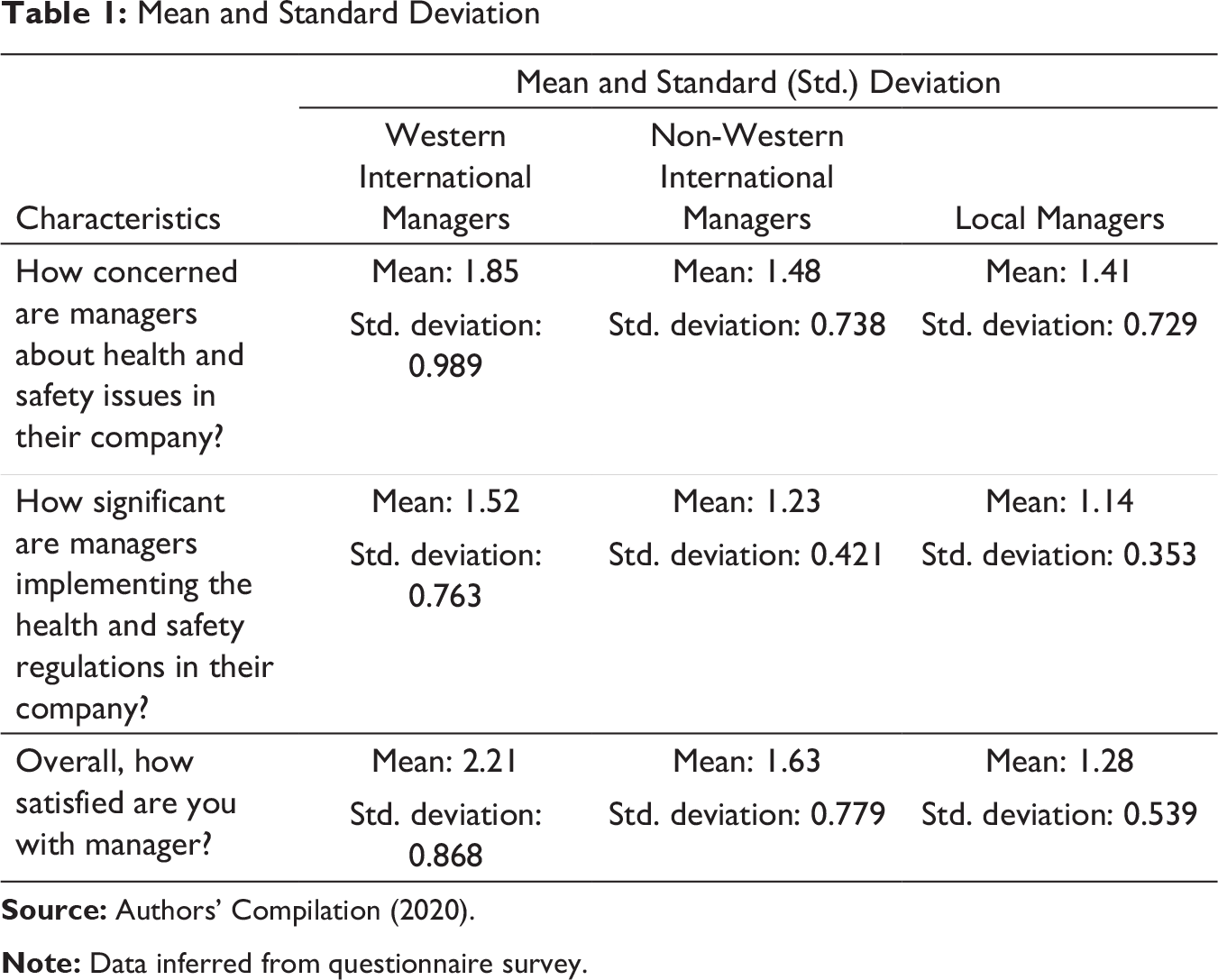
From the qualitative part of the paper, it has been demonstrated that 55 per cent of respondents have either a critical or an extremely critical attitude towards trade unions in the G&T industry in Bangladesh. This appears to be because the trade union representation at a company level does not have an effective impact on major HRM/IR related issues such as health and safety. Trade unions mainly implement the government agenda, and the local trade union branches are characterised by corruption. A Sri Lankan international manager (Executive Director) who was interviewed commented:
Factory based trade union is not concerning about health & safety issue because we are already concerning about those issues. They don’t have idea also. If they have idea it would be a big issue. They don’t have idea even which one is actually important. They are completely rubbish and corrupted.
The weight of the quantitative and qualitative results suggest that trade unions have not had a meaningful impact on working conditions within the G&T industry. This appears to be rooted in a lack of interest, an almost fatalistic acceptance of prevailing conditions because that’s “how it is.” This construct is derived from the “political” and the disposition of trade union officers. Hence both external and internal industry forces may be in play. Clearly, this embedded lack of interest in safety at work is a disposition that Western international managers’ find jarring and struggle to understand. It consequently contributes to a cultural barrier. As a consequence of this reality, the employers’ associations have created WPCs. This association, rather than the unions, is providing better support for workers. This is because this association comprises employees, employers and management, and offers a forum where employees can raise additional issues of concern. In addition, these associations are not influenced by the political sphere. In an interview held with an IR actor (senior vice-president of BGMEA), the following was stated:
Trade unions in Bangladesh are becoming very politicised as major political parties are directly involved with them and therefore they cannot address the issues. In addition, we formulated a workers’ participation committee (WPC) to avoid political involvement. I believe if workers and management are working very closely then unions are not required for this industry so creating less problems.
Another IR actor (director of admin, HR & compliance of a local company) added:
Well, I cannot really directly support this trade unions because we had a bitter experience here but trade union is guided some rules and regulations of those are ideal. Maximum of our workforce are not well educated, they don’t know the theme and they don’t know the actual aim of trade union. Those are belongs to trade unions and working in various level they are also not much aware about workers rights and benefits. Therefore, the employer’s association think that how to give them support and avoid this system. Now we develop WPC that is working in based of trade union and that is working much better than trade union.
Drawing on the conceptual model, this may be an exemplar of actors within the industry, the employers. Here there is an acceptance of the realpolitik that the external political world can impact directly on the workplace and an attempt to shield the factory from this by creating WPCs. In addition, there is a belief among employers that workers are so lacking in education that they are incapable of understanding and articulating their own interests. Clearly, a manager hailing from an advanced Western economy is likely to find these cultural “norms” difficult to understand and adjust to. It is possible to observe this dimension of industrial conduct as cultural impediment.
A survey undertaken by the Korea Labour Institute (Kim, 1992) found that approximately two-thirds of respondents from both employees and employers (from 65.3 per cent to 69.9 per cent) indicated that WPCs produced useful outcomes, whereas a very small minority of respondents (from 4.7 per cent to 10.3 per cent) said that these associations were useless. Regarding trade union membership, only 2.25 per cent of workers are estimated to be unionised, which is reportedly the lowest in Asia. This number is based on the structured and open-ended interviews with three trade union officials who participated in this study. In contrast, 58 per cent of exporting garments sector’s labour force is estimated to be unionised in Cambodia (Oka, 2016). Interestingly trade union membership growth in Bangladesh had slowed by 2015. The causes of this appear to be the following: (a) the relocation of factories from metropolitan cities such as Dhaka and Chittagong to the industrial area, and (b) the rejection rate for new union applications increasing. The following statement was made by a trade union official (Organiser of Bangladesh Garments and Industrial Sromik Federation) during an interview:
[T]he majority of factories who had trade unions were Dhaka based (capital city of Bangladesh) and when these factories relocated the trade unions had declined. The relocation was the basic requirements of Accord and Alliance and their signatory international brand companies for the improvement of health & safety of the industry.
Trade union representation at a company level might be expected to have a significant impact on major HRM/IR related issues such as health and safety. One possible reason for this is that unions can provide workers with a collective voice, independent of management, when bargaining for safety improvements (see Freeman & Medoff 1984; Gegax et al., 1991; Weil, 1999). Empirical findings of the relationship between workplace safety and union representation are typically inconclusive (Fenn & Ashby, 2004). In fact, as Nichols (1997, p. 161) points out, those industries with the highest densities of union membership also appear to have the highest injury rates. This is because the unions do not appear to prioritize HRM/IR related issues such as health and safety as their focus is predominantly on increasing wages, holidays and other benefits (Oka, 2016). They also focus on implementing an agenda as they have been linked with political parties (Ali, 2011).
Nevertheless, health and safety, and trade unions are central issues within this paper, and are an area where international managers have had a substantial impact. The empirical findings of this research suggest that the international managers aged between 35 years and 45 years are very effective within the G&T industry in Bangladesh. This impact is arguably derived from their awareness of HRM/IR-related issues such as health and safety. In an interview with an Indian international manager (IM: 8 - Head of Quality), he stated:
[A]s a company we just give a lot of importance for health & safety issues because it became mandatory from our customers for example Gap and M & S. They also take care of these aspects through the compliance so we are following these aspects very strictly.
These international managers commonly believe that every worker is entitled to a safe working environment. The occupational health and safety division takes the occupational health and safety of their employees seriously. Steps are taken to reduce the frequency of accidents at work. Team leaders and line managers participated in-house health and safety training on how to properly use machinery, and how to identify and report a hazard and first aid. During an interview with a Sri Lankan international manager (head of HR & Compliance), he stated:
From our company, we are giving three hours health & safety training to each employee in their working time. In the last couple of years, we provided health & safety training only once in a year but now we are doing the same training every month for all employees.
The findings also suggest that the Western international managers show a higher level of awareness of the health and safety issues than their counterpart non-Western international managers. Subsequently, the findings suggest that only 30.77 per cent (4 out of 13) of the MNCs have trade unions. This is because of the following: (a) trade union officials have less proficiency in English, hence there are cultural barriers; (b) workers or trade unions mainly focus on wages and other benefits rather than the health and safety issue; and (c) they do not have sufficient knowledge of health and safety issue as they have lack of understanding technical issues. A trade union official (President of Bangladesh Garments and Industrial Sromik Federation) who was interviewed commented:
Trade unions hate MNCs but like the pay and other benefits they offer. They also respect government rules & regulations and concern on health & safety issues than their counterparts local companies.
It is suggested that trade union representation at a company level does not effectively impact health and safety issues in the IR setting within the G&T industry in Bangladesh.
Limitations for the Study
The variety of international managers involved, including Chinese, Japanese and South Korean, meant that language and communication was difficult during the interview process, and the researcher’s ability to speak Bangla was useful when interviewing trade union representatives and government officials but this did necessitate the overhead of translation post interview.
This research focused on the geographical area in and round Dhaka because this location hosts approaching half of the G&T industry production within Bangladesh. This was a decision based on efficiency and efficacy. However, a consequence of this was that a small number of international managers were able to move forward to the second stage of the sample. This is because a significant number of international managers working within the G& T industry are based outside Dhaka.
Conclusions and Discussions
The focus of this research is trade unions, and health and safety in environments, which feature international managers. The findings suggest that the majority of MNCs do not have any trade unions but a few companies have WPCs. This is because (a) international managers are highly aware of HRM/IR-related issues such as health and safety, (b) trade union officials do not have sufficient knowledge of these issues as they have only primary or secondary education, and (c) MNCs do not want a trade union presence within their Bangladeshi factories. This limited educational qualification may impact on the understanding of the government regulations such as health and safety. The findings also suggest that the trade union officials are mainly focused on specific issues, which include increasing the minimum wage, reducing working hours, holidays and other benefits. As previously explained, the inability of trade unions to engage in local wage negotiations provides them with an imperative to pursue these ambitions via the political sphere. This one-dimensional approach to collective bargaining (little interest in health & safety for example) forces trade unions to develop links with the influential actors, for example the government. As a result, HRM/IR involves the interaction between political parties and trade unions rather than management, employers or employers’ association. In several instances, employers have taken the initiative to resolve industrial disputes, enabling unions and management to cooperate at the company level and avoid government intervention. Employers and employees both view this as a positive step, because the earlier tripartite nature of the conflict resolution process seems to have been ineffective owing to government involvement and concealed political motives. Therefore, the employer’s associations which are BGMEA (Bangladesh Garment Manufacturers and Exporters Association) and BKMEA (Bangladesh Knitwear Manufacturers and Exporters Association) have driven the formation of WPCs at a company level to avoid political influence, and these participation committees are working better than trade unions. Moreover, the findings suggest that the trade union officials do not have any interaction with international managers as the local managers are engaged in daily operational issues. Additionally, trade union officials have less proficiency in English, and this further contributes to cultural barriers, particularly in communication with international managers.
International managers do appear to have had a positive impact on working conditions, however, they encounter a variety of cultural impediments. The G&T industry provides for over 83 per cent of total exports, and therefore is crucial for both the economic and political environments. It is this importance that has contributed to laws, which inhibit trade union activities and unenforced workplace safety legislation. The owners of factories within the G&T industry are inveigled with political elite, and this contributes complexity and enables the perpetuation of recidivist companies. International managers are unaccustomed to this cultural norm. Similarly, the direct influence of national political parties in the workplace adds a cultural dimension, which is often new for international managers. In addition, trade union’s apparent “lack of interest” in safety in factories might seem like an anathema. These different factors contribute to the construction of a culture that provides an obstacle for the understanding and effectiveness of international managers.
The article offers a view of the economic, political and social lot of working men and women within the G&T industry of Bangladesh. It is not the job of a researcher to claim to be an oracle of future events that are to be. However, it is not unreasonable to observe that, given the ongoing status quo in this industry, any meaningful improvement in the lives of the working poor is based on hope rather than any discernible trend or action. To draw upon the words of Walter Benjamin: “It is only for the sake of those without hope that hope is given to us.”
Footnotes
Declaration of Conflicting Interests
The authors declared no potential conflict of interests with respect to the research, authorship, and/or publication of this article.
Funding
The authors received no financial support for the research, authorship, and/or publication of this article.
1
The national-level federations are a combination of industrial federations and company-level unions. It involves two or more company-level trade unions.
2
Industry-level federation is the body of unions from the same industrial sector. It deals with very common problems and demands of the sector.
3
The company-level union is based on workplace or factory created by the direct involvement of the workers at a grassroots level.
4
WPCs exist as an alternative to trade unions in the wider economy. Workers Welfare Associations (WWA) exist as an alternative to trade unions with the EPZs.
5
The large-sized companies employ over 3,000 employees.
6
The medium-sized companies employ between 1,000 and 3,000 employees
7
The small-sized companies employ less than 1,000 employees
8
These were in addition to the 20 international managers who were personally interviewed.
9
In addition 3.8 per cent (1 out of 27) of surveyed participants responded strongly agree.
