



Abstract
With the advent of the Solicitors’ Qualifying Examination (SQE), Qualifying Work Experience (QWE) allows for flexibility in the journey to qualification as a solicitor in England and Wales that was not previously permitted by the Period of Recognized Training. This development was heralded as a lever to widening access to the profession, with the potential to assist those who may not have been recruited onto traditional graduate-level training programmes in securing a qualified legal role. This paper discusses the findings of empirical research conducted by the authors with a view to understanding the perceptions of, and attitudes towards, QWE of those responsible for recruitment in UK law firms. It reveals a friction between the perceived, and actual, value of QWE obtained via non-traditional routes and exposes the threat that law firm stances on QWE pose to the regulator’s aim of widening access to the profession.
Introduction
Prior to 2021, the route to qualification as a solicitor was a linear process, as shown in Figure 1. Candidates were required to complete an undergraduate Qualifying Law Degree or another degree plus the Graduate Diploma in Law, followed by the Legal Practice Course. The Legal Practice Course or LPC comprised of core practice areas and skills, plus three vocational electives (of the student’s choice). The LPC was offered as either a postgraduate diploma or a master’s degree at providers authorized by the Solicitors’ Regulation Authority (SRA). The providers set their own curriculum and assessments in line with SRA requirements.
The route to qualification pre-SQE.
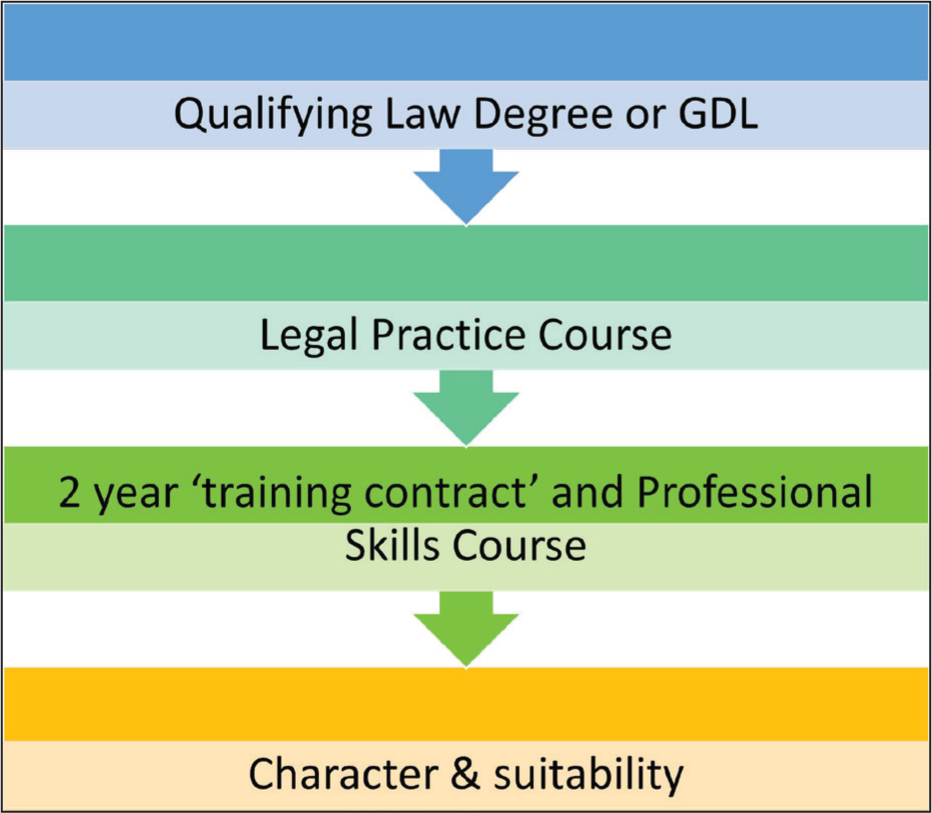
Candidates were then required to complete the Professional Skills Course 3 and undertake a two-year Period of Recognized Training (PRT) in the form of a ‘training contract’ which required carrying out both transactional and contentious legal work, under supervision, typically within one law firm.
At the end of this process, provided there were no questions around the candidate’s character and suitability to join the profession, their training contract would be ‘signed off’ by the firm’s Training Principal, who would make a judgment as to the candidate’s competence to practise. Only then could the individual apply to the SRA and be admitted to the roll of solicitors.
The SQE was introduced in September 2021, and those commencing their Qualifying Law Degree or Graduate Diploma in Law after 31 December 2021 have no option but to follow the SQE route to qualification. The rationale given by the SRA for introducing the SQE was the desire to open up access to the profession by assisting those individuals who may not otherwise have the opportunity to secure a two-year training contract with a firm of solicitors to enter the legal profession as a qualified solicitor. 4
Under the SQE route, as depicted in Figure 2, the path to qualification is more of a jigsaw than a linear progression. It requires candidates (in any order) to hold any undergraduate degree, pass the SQE and complete a two-year full time equivalent period of QWE which they must apply to be registered with the SRA. The SQE is divided into two assessments: SQE 1 and SQE 2. SQE 1 focuses on functioning legal knowledge and has two parts: Functioning Legal Knowledge (FLK) 1 and FLK 2, both assessed by single best answer multiple-choice tests. Each test comprises of 180 questions and is 5 hours in duration. SQE 2 focuses on practical legal skills and knowledge and is assessed through 16 oral and written assessments. The only element of the previous route to qualification to have migrated into the SQE is the rule stating the candidate must show there are no questions around their character and suitability that would prevent their admission to the profession.
The route to qualification post-SQE.
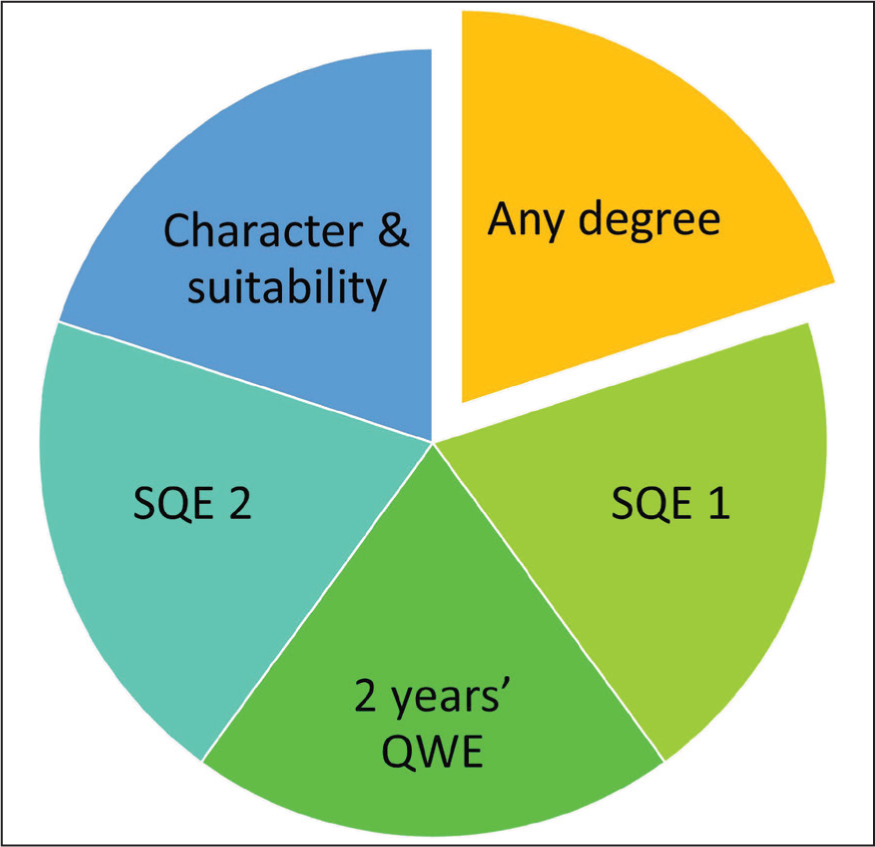
‘QWE helps aspiring solicitors by giving them experience of real-life legal work and the opportunity to develop some or all of the competences needed to be a solicitor.’ 5
QWE can be gained at any time during a candidate’s journey to qualification, including before sitting the SQE1 and SQE2 assessments. It can also be retrospectively claimed for experience gained prior to the introduction of the SQE in 2021. QWE must involve the provision of a legal service. The SRA does not define ‘legal service’ but does refer candidates to s12 Legal Services Act 2007, which provides a definition of ‘legal activity’. QWE is only concerned with developing a candidate’s solicitor competence and (in contrast to the PRT) not with confirming the candidate’s competence to practise. It can be gained in a variety of settings, including non-SRA-regulated organisations such as law centres, charities and legal advice clinics, and can be accrued via unpaid work placements as well as paid work. To achieve a total of two years’ full-time equivalent of QWE, candidates can apply to register up to four periods of experience with the SRA. Students may be unlikely to apply to register short periods of QWE (given the four placement maximum) but in theory, there is no minimum period which may be claimed. 6
QWE can be undertaken inside or outside of England and Wales, provided that there is an England and Wales-qualified solicitor or Compliance Officer for Legal Practice within that setting who can attest:
To the length of the period of QWE completed; That during this time the candidate had the opportunity to develop some or all (but as a minimum, two) of the competences contained in the Statement of Solicitor Competence
7
; and That no issues arose during this period that would raise a question as to the candidate’s character and suitability to be admitted to the roll.
The SRA proposed that QWE would reduce the ‘training contract bottleneck’, the phenomenon whereby candidates experience difficulty in finding a training contract or PRT. The number of LPC graduates has for some time far exceeded the availability of PRTs. For example, between 2013 and 2016, the number of LPC graduates rose from 5,993 to 6,961 but the number of PRTs registered with the SRA rose from 5,468 to only 5,992. 8 QWE is intended to be more flexible than the PRT with a view to tackling the bottleneck and levelling the playing field, especially as students from a widening participation background found it especially difficult to secure a PRT. However, the potential for firms to distinguish QWE confirmed internally from that confirmed externally puts the flexibility of QWE into conflict with this ambition.
If the listed criteria are met, QWE must be confirmed, irrespective of the views of an employer/organisation as to whether the candidate is intended, or suitable, for a qualified fee earner role. Whilst there is a regulatory obligation to confirm QWE, there is no requirement for the organisation to employ the candidate at the point of qualification, or to reduce their own training period to reflect any QWE gained elsewhere. There is thus the opportunity for employers to make judgments based on the perceived quality of previously accrued QWE when making recruitment decisions.
Since 2021, the authors have been engaged in empirical studies with the objective of understanding the impact of QWE on law students, university law clinics and candidates for legal roles. Following several roundtable events during 2021 and 2022 with law school clinicians 9 and representatives of the SRA, guidance was published for law school clinicians in the Clinical Legal Education Organisation (CLEO) network. 10 During summer 2022, the authors commenced a study into perceptions of QWE from the perspective of three stakeholder groups: students; law school clinicians; and law firm representatives responsible for recruitment and training.
The first phase of the study included a series of ‘pulse surveys’ distributed to clinicians and law students. The findings of these surveys were published in 2022 11 and revealed that clinicians felt ready for the impact of QWE but their clinics were not actively promoting the availability of QWE to students. Whilst student responses to the pulse survey were small in number (n = 14), they nevertheless reflected themes that had anecdotally been developed during the initial roundtable events with clinicians and the SRA. Some respondents (21% n = 3) did not know what QWE was, and of those who were aware, the majority were unsure about how (if at all) clinic work could count as QWE. Students responding to the question ‘How much time (in days, weeks or months) do you think you will be able to claim as QWE from one academic year of volunteering in clinic?’ gave a wide range of approximations, ranging from 30 hours to 6 months. The main finding from this study was that students needed certainty around how university law clinic work would translate to QWE. On the basis of this finding, the authors published a peer-reviewed guidance toolkit for students working in a law school clinic environment. 12
The third stakeholder group for the study comprised of those responsible for the recruitment and retention of trainee solicitors and paralegals within law firms. The aim of this element of the study was twofold: to establish the level of understanding of QWE within the profession; and to understand the attitudes of recruiting managers towards QWE that had been obtained outside of their organisation. This in turn would allow the authors to evaluate the extent to which the egalitarian rhetoric promoted by the regulator, which saw it describing the driver behind the SQE as ‘promot[ing] a diverse profession by removing artificial and unjustifiable barriers’, 13 would hold up to scrutiny in practice.
Methodology and Methods
The aim of this research study was to understand whether QWE would, in practice, be capable of enabling the widening of access to the profession in the way anticipated by the SRA, and thus achieving fair equality of opportunity for aspiring solicitors of all backgrounds. The authors’ hypothesis was that whilst firms are obliged by the SRA to sign off on QWE, they are not directed by the regulator as to whom they must employ in the role of solicitor, and there is thus a risk that firms may be reluctant to recognize QWE accrued elsewhere, inhibiting the SRA’s aim of widening access. The research questions to be answered were as follows:
Given that confirmation of QWE cannot be refused if a valid claim is made, will the legal profession seek to self-regulate by choosing not to employ candidates with prior QWE that may be viewed as ‘sub-standard’? In facilitating flexibility, has the SRA inadvertently set the course for a two-tier system of qualification for solicitors?
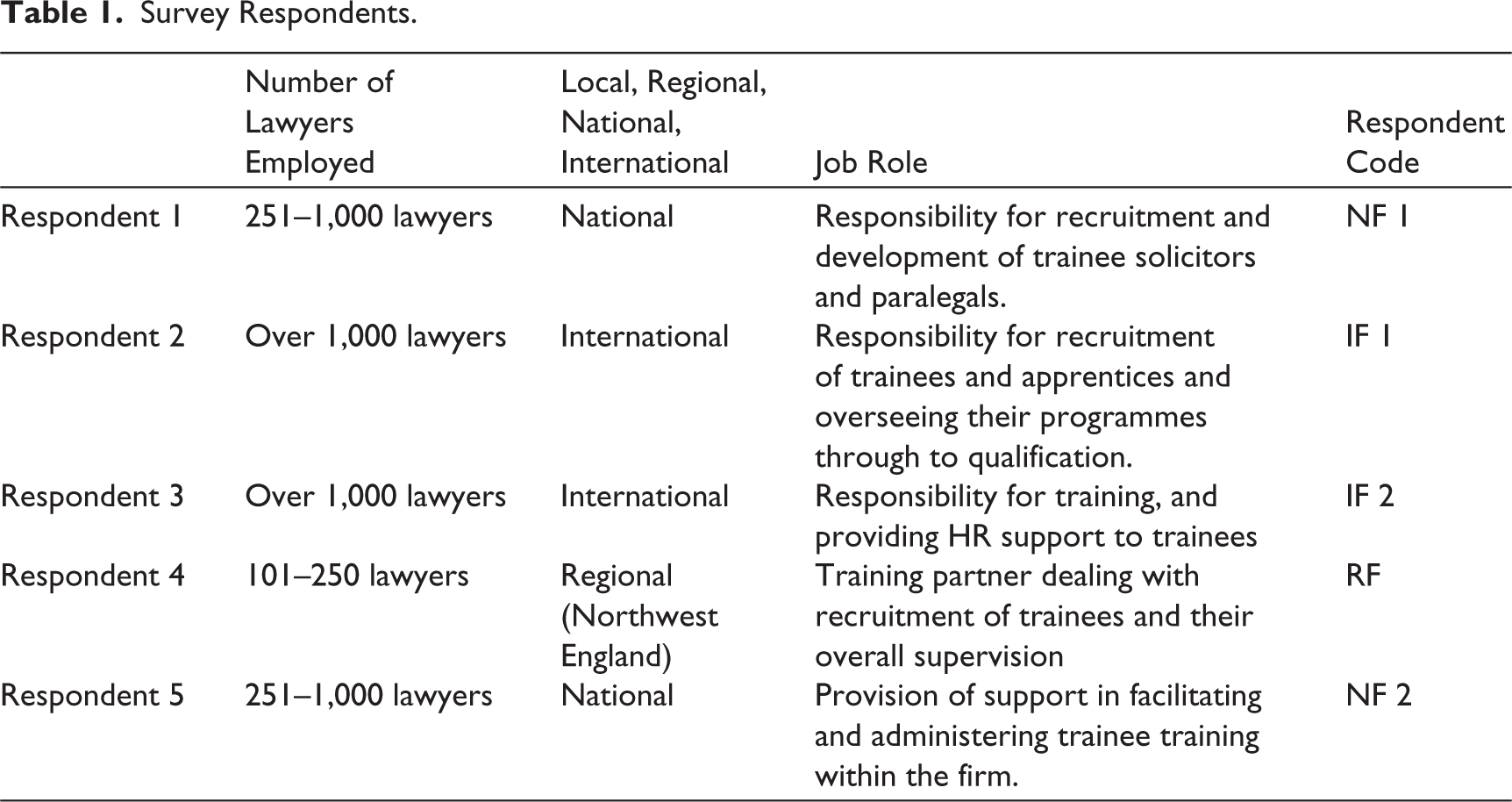
The research strategy included using a self-administered questionnaire (SAQ) distributed by email. The SAQ was chosen as a method that was straightforward to administer and to complete and would minimise the risk of respondent fatigue. 14 The survey consisted of closed questions requesting data on type of firm, number of lawyers and the involvement of the respondent with recruitment (see Table 1). Likert scale questions were asked to ascertain levels of understanding of QWE and qualitative questions were posed to reveal attitudes to QWE.
Survey Respondents.
The SAQ was distributed by email through the authors’ networks, which included:
personal contacts in local, regional and national law firms; personal contacts in local law societies who passed the survey on to their law firm members; and the trustees of CLEO based across the UK who passed the surveys to their own local law firm and law society contacts.
The SAQ was live for a period of two weeks following circulation of the distribution email. It is acknowledged that this method of distribution was indiscriminate and that the time frame for responding was short. The aim of this approach was to ‘cast the net wide’ in as short a period as possible given the vast number of potential respondents.
Findings and Discussion
The response rate represents a limitation of the study, with only five individuals responding to the survey. However, despite this very small response rate, all respondents are involved in the training and/or recruitment of paralegals and/or trainees and represent a cross-section of the legal sector: two of the five respondents are employed by international firms, two by national firms, and one by a regional firm.
Despite the limitation of the sample size, and the fact that this survey has not captured the views of small law firms and other legal service providers, it is submitted that the study’s findings remain pertinent for the following reasons:
The survey contains much rich qualitative feedback from those directly involved in the recruitment and training of trainees and paralegals; The attitudes towards QWE revealed by the survey responses resonate with the anecdotal feedback that the authors, and their fellow trustees of CLEO based across the UK, had been receiving from contacts at law firms large and small, thus providing an ethically-approved basis upon which to explore these themes; and Given the large numbers of lawyers involved in the respondents’ organizations (see Table 1), a significant number of future solicitors will be affected by the attitudes demonstrated in the survey responses.
Simple mathematical analysis was conducted on the SAQ’s closed questions and Likert scale questions, and a thematic analysis of all qualitative responses was employed to identify and analyze themes within and across free text responses to open questions. 15
Respondents were asked to rate, on a scale of 1 to 10, how well-informed they consider themselves about the rules around QWE, with 10 being extremely well-informed and 1 being not at all informed. The average response was 8.2, demonstrating that respondents consider themselves well-informed about QWE. Despite, or perhaps because of, this, all respondents expressed qualms about the rules regulating QWE. These are discussed in detail below.
Confirming the rationale behind the introduction of the SQE, all survey respondents felt the rules around QWE would, or could, prove useful for aspiring lawyers,
16
with all respondents who added free text comments referring to broadening access:
Broadening the scope of qualifying work experience can only be a good thing for aspiring lawyers, creating alternative routes and giving more choice about how and when they can qualify. (NF 1) It opens the profession up—especially to those who are not qualifying down the training contract route. (IF 1) I think it allows much more flexibility and accessibility to the profession. (NF 2)
However, four of the five respondents feel that QWE is not useful for law firms.
17
The RF respondent expressed frustration about the advent of the QWE rules:
It forces us into a position where people can use previous work which we have no knowledge of as a firm and is likely to lead to situations where employees are demanding to be treated as solicitors when we can't be sure of the quality of the training and whether they are ready to be a qualified lawyer.
So, whilst in general terms the survey respondents recognized that QWE is a ‘good thing’ for aspiring lawyers by opening up the profession, they demonstrated no appetite for playing their own part in this ‘opening up’ process, given their reservations about QWE.
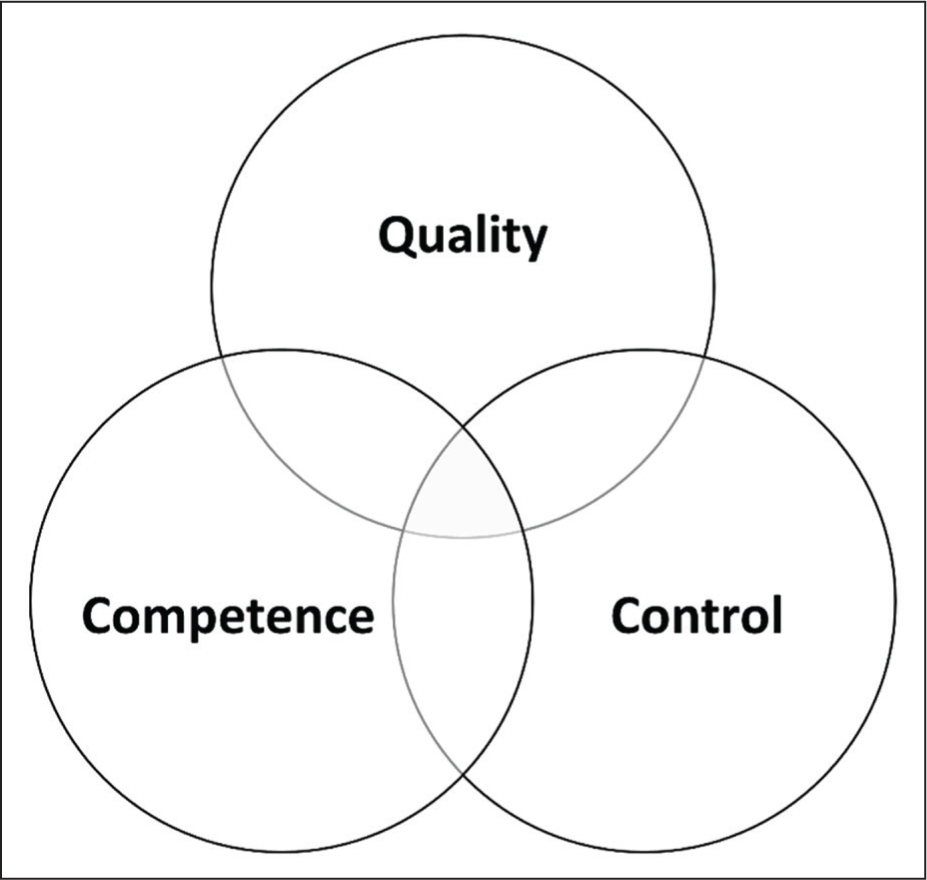
Three themes can be drawn from the responses to the survey, all of which are covered succinctly in the RF comment above: quality; competence and control (Figure 3). The themes intersect and overlap but will be critically examined separately below.
Themes Arising from QWE Law Firm Survey.
From a regulatory respective, when they seek to be admitted as a solicitor, candidates can present to the SRA a ‘patchwork’ of QWE from a variety of regulated and unregulated settings (up to a maximum of four). However, this is causing concern for firms, who must deal with what this will look like in reality. Respondents expressed concerns not about the quality of the candidates who present themselves with previously accrued QWE, but about the quality of the QWE obtained by those candidates at other organizations.
Work experience placements or volunteering at a legal advice clinic cannot be comparable to a two-year training contract where significant time and investment is made in that person’s development […] we would have concerns about giving a [newly qualified solicitor] role to someone who had various periods of time at various firms/advice clinics/work experience. (RF)
A theme arising across the spectrum of firm types responding to the survey is that of ‘proper’ training. When asked ‘Do you feel that the rules around accruing QWE are equal in quality to the “traditional” two-year training contract?’ 80% (n = 4) of respondents said ‘no’. 18
IF 1 noted that QWE is valuable to those who have ‘spent long periods of time working in an environment where they have genuinely obtained experience which is relevant and been properly trained’ which chimed with RF’s expectation that to have value, QWE needed to have been accrued ‘at a firm that has supported them properly’.
This raises the question as to what ‘proper’ training must look like to be recognized as valid by another organization. A lack of consistency across organizations offering QWE arose as a concern in the responses, demonstrating the potential for firms not to ‘trust’ experience gained outside of their organization.
We can never be sure of the quality of experience gained outside our own training programme. … [W]hilst we hope most firms will place a high importance on quality training, we are concerned about piecing together 2 years of QWE from very different experiences. (NF 1)
It … leaves things too open for interpretation meaning different firms will take multiple approaches to how they provide QWE, meaning there is no consistency. (NF 2)
[It is] likely to lead to situations where employees are demanding to be treated as solicitors when we can’t be sure of the quality of the training. (RF)
These views are in stark contrast to the SRA’s perspective, which does not distinguish between where the QWE is gained.
Two respondents expressed concern specifically about the lack of any minimum period for which QWE can be claimed and therefore the impact on the quality of that experience:
I am surprised at lack of minimum period and have serious concerns about the value of any experience that is less than 3 months. I had thought that the SRA had built a minimum period into qualifying work experience. (NF 1) It would seem to be potentially concerning that someone could use very short periods of time to count i.e. a week of work experience where there is not necessarily any clarity as to the quality of experience that provided. (RF)
It appears from these responses that the reasons advanced by the SRA to celebrate QWE—flexibility in terms of the organization from which QWE can be accrued; there being no minimum period of QWE; and QWE being obtained at any point during a candidate’s journey—are the very reasons firms are using to judge (indeed, pre-judge) the quality of previously accrued QWE. It is clear from the responses to this survey that from the perspective of recruiting law firms, not all QWE is created equal. Whilst QWE is designed to give all candidates the same opportunity to develop the competences required of a solicitor, and thus open up competition to qualified roles to those with non-traditional work experience, accruing such experience is potentially futile if law firms have ‘serious concerns’ (NF 1) about previously accrued QWE.
Concerns surrounding the quality of previously accrued QWE were echoed by respondents’ qualitative comments regarding candidates’ competence. Whilst under the PRT, the Training Principal was required to make an assessment of the individual’s competence before signing off their period of work experience, this is not the case with QWE. The SRA is unequivocal that ‘signing off QWE will not involve any assessment of competence’ 19 and that ‘confirming QWE does not involve deciding whether an individual is competent and suitable to practise’. 20
This principle is causing concern for the firms responding to this survey, with respondents noting a tension between a candidate accruing mere exposure to the competences in the Statement of Solicitor Competence and actually being competent to practise as a solicitor. Two respondents drew a comparison between the PRT and the QWE regime:
There were far more regulations around the Period of Recognized Training … We know that the SRA don’t really care about QWE, hence why they have kept the bar very low and suitably vague. (IF 1) At least with the current regime, we are responsible for ensuring a level of competence. The same cannot be said of the new QWE. (NF 1)
Some may assert that this is a moot point, as the SRA is clear that competence in the skills required of a ‘day one’ solicitor will not be tested by QWE but instead by SQE2. 21 The SAQ responses revealed little confidence in this position, with IF 2 sharing ‘[o]ur issue is around QWE not being relevant for the assessment of competence’, IF 1 noting ‘[t]he competencies listed in the Statement of Solicitor Competence are very broad’ and NF 2 concluding that ‘[i]t makes it harder for firms to assess the level of competence in a person and [we therefore take] on more risks in investing in people’.
Responses show that firms are concerned that even though they are not required to assess a candidate’s competence in order to confirm QWE, they do need to assess whether an individual is competent to succeed within their organization before making recruitment or progression decisions. The perceived risk of not separating these two issues is summed up by IF 2: ‘[i]t could leave people without proper training then being left to do qualified lawyers’ work,’ with RF taking this to a worrying conclusion: ‘we would have to let the individual go rather than take the risk of having someone given the label of a qualified lawyer when they are not sufficiently ready for that’. The latter comment reflects the potential damage that QWE could do to the prospects of individuals engaged as paralegals being retained by their employer. This is the antithesis of the effect envisaged by the SRA.
In its 2020 briefing, the SRA states, ‘throughout our stakeholder engagement, we have found wide consensus that [the skills tested by SQE2] are the appropriate core legal skills which aspiring solicitors must demonstrate at point of admission’ 22 . If, as the SRA asserts, SQE2 is to be the genuine arbiter of competence, this raises the question as to whether firms would look to start requiring candidates with previous QWE wishing to join prior to newly qualified (NQ) level to complete (and self-fund) SQE2 before they will be considered for a role with the firm. This may represent a way for firms to overcome any misgivings they may have about the quality of previous QWE and enable the candidate to demonstrate themselves as sufficiently competent to join the firm. Any requirement to self-fund in this way would, however, fly in the face of another of the SRA’s aims in introducing SQE, that of saving candidates from spending money on assessments without the guarantee of a legal role. It would also serve to undermine the SRA's aim of levelling the playing field between candidates for legal roles: it cannot be just for some candidates (perhaps those with perceived ‘substandard’ QWE from non-traditional settings) to be obliged to pay to prove their worth in order to compete for the offer of a legal role when they have already achieved what the regulator has required of them by way of QWE.
Having sounded a note of caution with regard to the perceived risks of recognizing QWE gained in settings with which the firm is unfamiliar, respondents went on to reveal the various ways in which their law firms would seek to regulate the system themselves to avoid the risk of taking on individuals who had not been ‘properly’ trained either at trainee level or NQ level. IF 2 noted: ‘There is no structure to QWE […]. [A]s a firm we have to determine our own structure.’
Trainee recruitment:
When questioned about their appetite towards deducting QWE accrued elsewhere from candidates’ training contracts, two respondents (both international) said unequivocally that they would not deduct this period to enable the individual to finish their own firm’s training contract early. This is due in part to their own business models for recruitment and training:
We will still expect them to do the full two years with us, regardless of any previous QWE. We have built this condition into their offer letters. We want to make sure they have had the best experience before qualifying and it would also be disruptive to have trainees qualifying at different points of the year and then being short of trainee resource. (IF 1) It would not suit our business model—we would require them to complete a two-year ‘training contract’ notwithstanding they could apply to be added to the roll earlier. (IF 2)
The remaining respondents noted that any decision to deduct previously accrued QWE would be fact sensitive. NF 1 reported their firm already permits early qualification for those with previous experience (time to count) subject to a maximum of six months. They anticipated a similar approach to QWE: ‘[w]e won’t be allowing anything longer than six months, to fit in with the wider development programme that we will be running for our trainees.’ For RF it would depend ‘on the role they had and what firm they had been at’, and NF 2 noted that whilst they would ‘more than likely’ deduct prior QWE from the length of the training contract, this ‘does also depend on the quality of QWE they complete with us and we may take the view to extend this period if performance isn’t to our standards’, thus reserving the right to extend the ‘training contract’ period to ensure that sufficient training by the present firm was achieved, applying their own quality assurance processes to previously accrued QWE.
NQ recruitment:
At first blush, when asked ‘Do you think your firm would accept, into a newly-qualified solicitor role, someone who has accrued two years of QWE somewhere other than your firm?’ the responses were relatively positive, with none of the respondents stating they would refuse to do so. 23 However, the qualitative reasoning behind some responses show that firms already have in place, or are planning to introduce, systems to buffer themselves against the potential impact of QWE.
IF 1 stated that they would accept somebody with QWE accrued elsewhere into an NQ role. However, this willingness becomes a moot point as the respondent went on to clarify that their ‘NQ roles are always offered out to our internal trainees first so we would only consider external candidates for any unfilled roles.’ RF, NF 1 and IF 2 reported that they would interrogate the perceived quality of prior QWE:
It depends where the experience was accrued. We would be looking for experience accrued in a similar firm doing the same sort of work. (IF 2) We currently recruit NQs into our business who have gained experience elsewhere. We run a robust recruitment process to ensure that the experience gained supported the development of the skills and behaviours that we’re looking for. That robust recruitment process will be critical. (NF 1) If they had done work at a firm that we knew would have given them a strong and solid training then we would consider it. However,… someone who had various periods of time at various firms/advice clinics/work experience… I think it is highly unlikely we would give them a role as an NQ. (RF)
It is clear from these responses that firms would require knowledge of the organizations at which the QWE was gained before deciding whether to formally recognize this experience within their own setting. It appears that if the firm was satisfied with the standing of the firm in which QWE had been gained, and had faith in their training processes, they would consider previous QWE. This is likely to be firms who are similar in size, profitability and client base to the recruiting firm. As can be seen by the RF comment above, firms see themselves as free to exercise their discretion to ignore QWE gained from backgrounds with which they are unfamiliar, or which they perceive to be of substandard quality, even though the candidate may have legitimately accrued two years’ QWE and passed SQE 1 and 2. By exercising subjective judgment as to whether previously accrued QWE is of sufficient quality to be worthy of consideration, self-regulating firms are excluding those who have accrued such experience in non-traditional settings from access to the limited pool of training contracts and qualified fee earner roles on offer.
When asked if the change to the qualification rules would make their firm more or less likely to accept individuals into trainee solicitor roles or paralegal roles, 100% of respondents noted that these changes would make no difference to how they recruit into such roles. Two of the five respondents felt QWE brought the opportunity to recognize those who have paralegal experience with either their own or another trusted firm. However, this recognition will bring with it the need for firms to manage the expectations of current paralegals, as recognized by NF 1:
It’s both a blessing and a curse. We have the opportunity to provide some great career development for our paralegals which potentially aids retention at this level. We’re keeping good knowledge and experience within the firm…. On the flip side, we have large teams of paralegals for a reason and managing expectations is going to be a challenge. We won’t want every paralegal in the business to qualify.
RF was clear that their current rules would not change: ‘our firm policy is that [paralegals] must be with us for 2 years before they can have a department sponsored training contract i.e. outside of the traditional training contract. I do not anticipate that rule changing.’
These findings show that even when the candidate has accrued QWE as a paralegal within the firm into which they wish to qualify, firms still perceive that they are at liberty to refuse progression to those who wish to have their QWE recognized. This is true from a regulatory perspective: the SRA does not have standing to intervene in matters pertaining to recruitment into qualified roles. 24 This position undermines the very purpose for which QWE was introduced, to give ‘the best candidates, from all backgrounds, a fair opportunity to qualify as a solicitor’. 25
Conclusions and Next Steps
In 2020, the SRA asserted that ‘minimising regulatory barriers and introducing flexibility gives the most talented candidates the opportunity to qualify, and thus both broadens access and raises standards’. 26 If the attitudes revealed by this survey of a cross-section of law firms are reflected in the wider law firm population, the SRA’s aim will not be achieved: the flexibility of QWE will not be afforded to candidates outside the training pool within which the recruiting firm operates, and it would not appear possible to ‘trade up’ QWE from lesser-known firms or other organizations to those who perceive themselves to be of higher standing. Firms appear mistrustful of QWE gained in non-traditional settings, such as law clinics and law centres, are reticent about QWE gained in firms outside of their own circle and even feel able to exercise discretion to prevent progression to qualification to those who have accrued QWE as a paralegal with their own firm.
The data gathered from this research project, albeit limited in scope given the small number of respondents, appear to demonstrate that a shift may be underway. Rather than the SRA regulating admission to the profession, we now see law firms, uncomfortable with the new hands-off approach to regulation, taking it upon themselves to ‘determine [their] own structure’ (IF 2) and exercising discretion, according to their own preferences and priorities, as to which QWE they will recognize and for what period. Whilst on paper the SQE route to qualification provides candidates with a simple formula to qualifying as a solicitor, with an associated ‘do it yourself’ patchwork approach to QWE, this is not the case on the ground. In reality, candidates may find that firms put in place self-protectionist measures to regulate those being admitted to the roll, which in turn may place barriers in the path of candidates wishing to qualify without following the traditional training route.
Whilst the respondents to the 2023 survey represented a small sample of potential respondents, the rich qualitative findings of this project from those responsible for the recruitment and training of tomorrow’s solicitors provide a foundation for larger-scale studies to identify whether the concerns uncovered by this project are widely held across the sector, and whether the apparent shift in the regulation of admission to the profession from the SRA to law firms identified by this study is likely to play out in practice.
This study has demonstrated that whilst QWE may provide access to skills development to those who may otherwise not be able to accrue QWE via the traditional route, law firm attitudes to QWE may threaten such candidates’ access to the profession and strike at the heart of the egalitarian ideal behind the new route to qualification as a solicitor.
Footnotes
Declaration of Conflicting Interests
The authors declared no potential conflicts of interest with respect to the research, authorship and/or publication of this article.
Funding
The authors received no financial support for the research, authorship and/or publication of this article.