



Abstract
Scientific temper in evidence processing using forensic knowledge reposes public faith in justice system. Forensic science is a blend of various disciplines, including art, pure sciences, and humanities, with experiment-oriented scientific validation. Forensics and law are intertwined precepts enabling translational impact on the legal system in pursuit of truth to ensure flawless justice. Worldwide, forensics intensely involves both doctrinal and clinical perspectives, largely converging on scientific theories and laboratory experiments to construe expert opinion, and similar pedagogy must be adopted in India as envisaged under the New Education Policy-2020. 3 In legal parlance, forensic inputs are secondary evidence, but primarily used for corroboration for exploring missing links in the chain of events. Due to multi-disciplinary content knowledge sharing during forensic studies, though fascinating, poses pedagogical challenges. Globally, imparting significance of procedural law, the backbone of forensic evidence, is largely missing from forensic education. Expert opinion is contested in courtrooms on ground of admissibility in terms of reliability and validity including protection of chain of custody necessary to avoid manipulation or tampering of samples which is prime root cause for miscarriage of justice. This article deliberates upon an entwined framework of epistemology and pedagogy for imparting holistic understanding of law and science in forensic education. We propose three verticals for forensic pedagogy: (i) crime scene management for scientific handling of articles and traces; (ii) laboratory experimentation and forensic report writing and (ii) translating expert opinion into legal evidence and its presentation during the court proceedings.
Introduction
A fair and efficient judicial system is the benchmark for a just and democratic society. Access to justice is the elixir for enjoying life with dignity and right to self-determination. Justice provides solace to victims and society against criminal injuries and deters offenders. On the global landscape, right of access to a fair trial gets a high pedestal in the hierarchy of human rights. 4 Fair trial is an epithet of justice; however, in an adversarial justice system, fair trial remains merely a utopian expectation unless evidence is collected in a neutral, fair and scientific manner. The trial proceedings largely depend on oral testimony including eyewitness description, 5 but human testimony, since inception, suffers from several defects and limitations such as personal vendetta with the accused, misrepresentation or misunderstanding of facts, duress, intimidation and faded memory resulting in miscarriage of justice resulting either in conviction of an innocent or acquittal of a real culprit. Therefore, corroboration by neutral, fair and efficient evidence is desirable, and forensic evidence as expert opinion fulfils this prerequisite.
The Indian Parliament is currently reviewing three bills for overhauling the entire set of criminal laws. Section 176 (3) of the proposed Bharatiya Nagarik Suraksha Sanhita, 2023 (Bill No. 122), directs the police to mandatorily call forensic experts to visit crime scene of an offence made punishable for seven years or more from such date, as may be notified within a period of five years by the State Government. This provision has multi-pronged impact on forensic scenario in India. It will certainly create enormous demand of forensic capacity building including trained force and laboratories. Thus, the future of forensic experts appears bright and promising in India.
The term ‘expert’ has a wider connotation in the legal framework, and forensic analyst is one tribe of experts. 6 Since beginning, defining an ‘expert’ under section 45 of the Indian Evidence Act, 1872 remained a perpetual challenge in Indian legal lexicon. Section 39 of the newly introduced Bhartatiya Sakshya Bill, 2023 (Bill No. 123) is almost replica of the old provisions on experts 7 except it includes ‘any other field’ to embrace other disciplines of expertise. Evidently this segment titled ‘Opinion on third persons when relevant’ of the Bill No. 123 necessitates revisit to remove continuing ambiguity in the procedural laws. Earlier, commenting on a legal issue ‘Who is an expert?’, the Supreme Court of India in State of H.P. v. Jai Lal held that ‘An expert witness is one who has made the subject upon which he speaks a matter of particular study, practice, or observation; and he must have a special knowledge of the subject.’ 8 The court further added, ‘Therefore, in order to bring the evidence of a witness as that of an expert it has to be shown that he has made a special study of the subject or acquired a special experience therein or in other words that he is skilled and has adequate knowledge of the subject.’ 9 An expert is not a witness of fact during courtroom proceedings and the scientific opinion evidence must be intelligible, convincing and tested. 10 To resolve the ambiguity in defining ‘expert’ in Indian procedural law, the authors of this article proposes to define expert: ‘An expert is an especially skilled person having essential education, knowledge, experience, skill, and training of the subject who provides expert opinion based on reproducible sufficient facts or data derived from reliable and accredited principles and methods’. This definition may be incorporated in the Bill No.123 of 2023.
However, forensic expertise may not be limited to courtroom proceedings or the justice system only, and forensic knowledge needs to be envisaged for a wider role in society. Forensics essentially promotes inquisitiveness, scientific vigour and a logical mindset for the exploration of truth. Forensics in wider connotation may be used as a cognitive tool in pursuit of truth which may be used in any sphere of life including justice. Forensic expertise may be desirable for various industries and processes; accordingly, pedagogy of forensic education, fundamentally needs to be designed with a wider vision and critical thinking. This approach will facilitate collaboration between forensic institutions and a variety of industries and generate funding and employability. There is a need to develop a forensic mindset to ensure probity in systems and processes focusing on (i) forensic epistemology, (ii) pedagogic strategies and (iii) research collaboration to build diversity of skills, knowledge and experience of forensic practitioners. 11
Dynamic Nuances of Forensic Science
The term ‘forensic’ is derived from the Latin word ‘forensis’, which means the ‘forum’ and refers to ‘pertaining to legal trials in open court’. Traditionally, forensic science is a discipline for defending justice by resolving legal queries pertaining to individualization, recognition, identification and evaluation of physical evidence by usage of natural science for different fields of law including criminal, civil, family and administrative law. On the basis of analysis, forensic disciplines may be either laboratory-based founded by experimental processes or pattern-matching based on skill of observation and measurement. In courtroom parlance, a forensic scientist testifies as an expert witness either for the prosecution or the defence; but in a true sense, an expert is a neutral witness for ‘exposing truth’ by scientific corroboration. Indeed, there is a need to expand the definition of forensics beyond the courtroom to explore logical solutions of various queries from different quarters. The earliest reported application of forensic science dates back to the ancient Greek and Roman societies. The first officially reported autopsy was conducted in 44
There is an appreciating trend of emphasizing forensic usage in judicial proceedings, and various jurisdictions, including India and other Asian countries, are gradually strengthening their forensic capabilities in terms of trained experts and technology in forensic laboratories. In India, initially, the discipline of forensic sciences was introduced as a corollary to criminology. In 1959, Dr Harisingh Gour Vishwavidyalaya, Sagar in Madhya Pradesh initiated exclusive education in criminology and later in forensic sciences followed by various other institutions in different states of India. The National Institute of Criminology and Forensic Sciences, New Delhi, established in 1972, has earned high repute in the global panorama for imparting skilled education. Gujarat Forensic Science University (GFSU), Gandhinagar, established in 2008, became the first university in the world to impart education exclusively on forensic disciplines. In 2020, GFSU was upgraded to the National Forensic Sciences University having the status of an institution of national importance. These institutions are producing quality experts to serve the justice system. However, a close examination of the curriculum of the courses these institutions are offering shows that forensic epistemology and pedagogy need refurbishment in order to impart knowledge of end-to-end nuances of handling evidence, scientific analysis, corroboration of facts and eloquent interpretation in the courtroom. Accordingly, this article attempts to develop forensic pedagogy to train different stakeholders mainly forensic experts to assist courts in revealing the truth, essential for the delivery of justice. The actors handling crime scenes need to know the basics of forensics to detect and preserve trace evidence. Forensic experts must be well-trained on a periodic basis. Efficient forensic lab work is not enough for the justice system unless all other stakeholders including judges are made aware of the baseline nuances of forensic inputs. This article further emphasizes connecting various industries and forensic institutions to spread forensic usage beyond the judicial system. Non-human forensic work, such as wildlife and veterinary forensics, environmental forensics, etc., needs further attention for robust research activities. Forensic inputs indeed boost logic and reasoning in argumentation and, hence, have ample potential to be used for evolving critical thinking in diverse fields.
Hypothesis of Justice Presumably Embedded in Judgment: A Stark Truth
In a society, it is inherently believed that justice is done by the judge in the court. Consequently, the judge becomes almost a synonym or embodiment of justice. Truly speaking, this legal presumption appears to epitomize the half-truth. Trial proceedings are a legal contest between inculpatory and exculpatory evidence and associated circumstances to reconnoitre truth by the judge. Indeed, a judge delivers judgment presuming justice being delivered to parties to the lis but possibilities of miscarriage of justice for various reasons cannot be ruled out completely. This unadorned reality behind a judgment justifies the existence of the doctrine of appeal in higher courts. Even a judgment delivered by the highest appellate authority including the apex court may not certify the delivery of justice with certainty. It only signifies fulfilment of the doctrine of finality for contesting a judgment. 12 Stitching together the gross reality, a judgment is not sine qua non to justice, especially in an adversarial system of criminal adjudication, where a judge plays a neutral role like an umpire who largely depends upon the evidence collected by the investigator, and legal contest between the defence lawyer and the prosecution. The fair trial remains merely a utopian proposition unless fairness in evidence is ensured. Thus, there is a dire need to explore the mechanism to eliminate adulteration from evidence, which is the root cause of miscarriage of justice.
Entwined nuances for the trilogy of ‘Justice’, ‘Truth’ and ‘Evidence’ need exploration and inclusive deliberations. Truth is the backbone of justice, but both justice and truth are abstract phenomena, and evidence indeed is a tangible legal tool in the pursuit of truth. Evidence infuses logic and reasoning to explore truth behind a fact or circumstance and also ensures procedural fairness and factual probity. In fact, adulteration in evidence processing is the root cause of miscarriage of justice, and the probity of evidence is the gateway for flawless justice. Corroboration helps to test the veracity of evidence, and forensic science provides neutral, scientific and reliable evidence to discover the truth in order to ascertain culpability or innocence. Forensic corroboration further helps to testify oral statements during the judicial process.
Construing Forensic Epistemology and Pedagogy: Three Verticals
Forensic science evolved to investigate the crime scene, detection and examination of the possible clues, and ultimately identify the culprit by engaging a bundle of scientific methodologies and justice principles. This subject was widely impacted on the global landscape by external factors such as various TV shows and movies such as CID, CSI and FBI Files. 13 Construing forensic curriculum has become a highly challenging task which must encompass processing of evidence from crime scenes, oral testimony, forensic analysis of samples, reporting of the expert opinion, translating expert reports to credible evidence for corroboration, presentation and interpretation of forensic evidence in court proceedings, etc. Crime investigation begins with receiving and lodging the first information report about a crime by the police or concerned law enforcement agency. An investigator collects basic information from the complainant and then proceeds to visit the crime scene. Forensic pedagogy must focus on actively engaging students with meaningful problems. 14
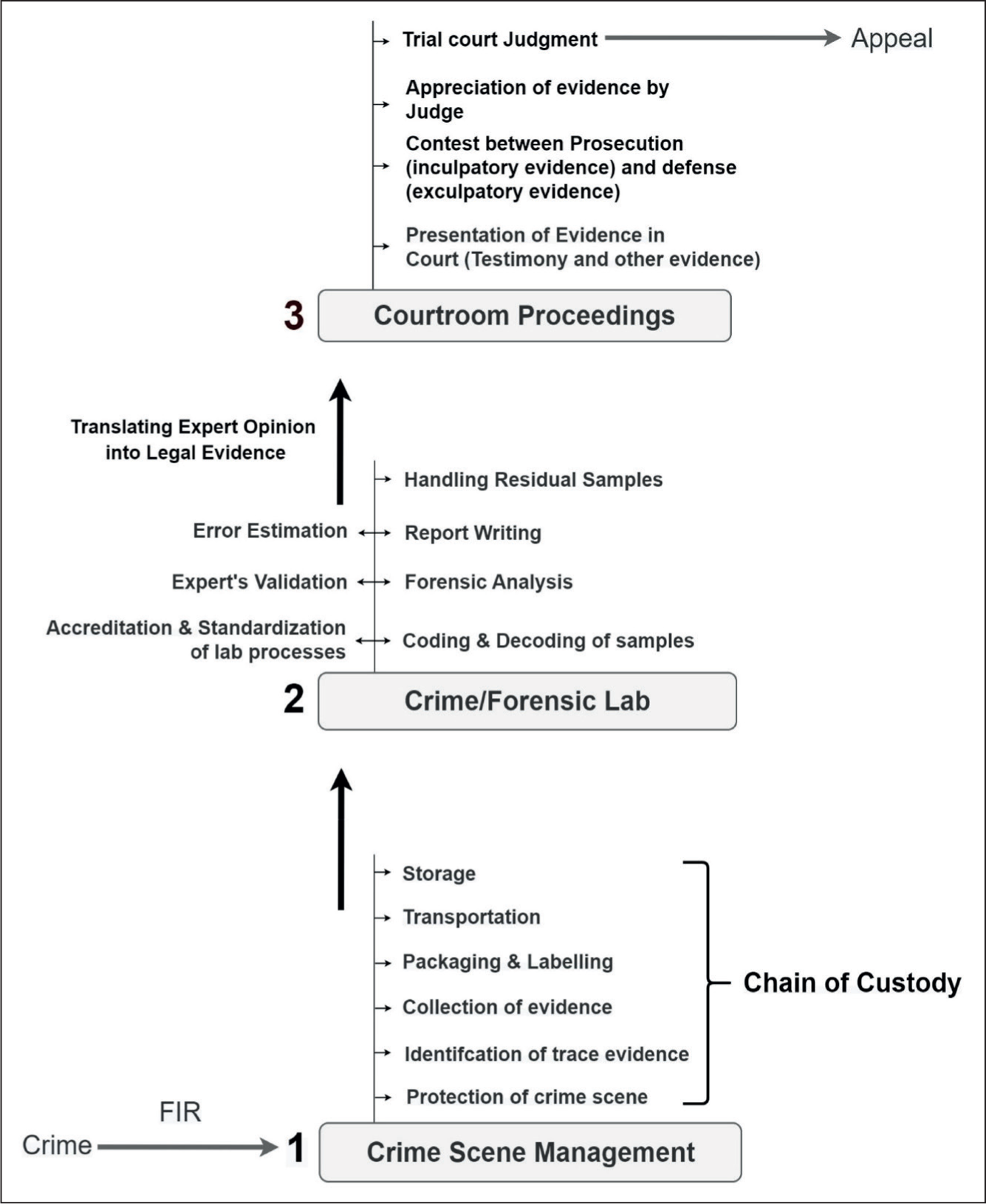
As demonstrated in Figure 1, this article proposes to broadly develop intertwined precepts of forensic epistemology and pedagogy on three verticals: (i) crime scene management, (ii) crime lab analysis and forensic report writing and (iii) translating expert opinion into credible legal evidence. Various stages and components of each vertical have been demonstrated in Figure 1, but consciously keeping brevity into consideration, each protocol has not been described in detail.
Three Verticals for Forensic Epistemology and Pedagogy.
Crime Scene Management
Crime scene management is the key to forensic investigation aiming to control, preserve, record and recover evidence and intelligence about an incident after observing legal requirements and professional and ethical standards. 15 Broadly speaking, a crime scene is the epicentre to connect links between offence and offenders. It needs scientific and professional knowledge to handle crime scenes for gathering visible and latent pieces of evidence (samples). This topic of curriculum must include several topics such as securing of crime scene, identification of trace evidence, collection of evidence, etc., as portrayed in Figure 1. Maintenance of chain of custody is yet another vital issue for securing probity of forensic samples and protecting it from any manipulation or tampering.
Crime Laboratory
This is the major segment of pedagogy for imparting forensic knowledge. The forensic laboratory or crime lab deals with the forensic analysis of questioned samples collected during investigation. As depicted in Figure 1, this domain of forensic pedagogy involves protection of chain of custody in the lab, case receipt section, case management system, coding/decoding of the samples, accreditation of process, standardization, etc. Quality management system for addressing quality assessment and quality control is the basic requisite for the admissibility of the expert opinion in court proceedings. The validation of the expertise of forensic professionals is habitually evaluated based on two yardsticks: educational qualification and experience in reporting. During a discussion with the corresponding author of this article, Peter Stout, the President and CEO of Houston Forensic Science Centre opined that for most of the forensic disciplines, basic knowledge of chemistry and statistical analysis is essential for forensic students. He further opined that knowledge of criminology is useful for forensic professionals if expert opinion is addressing the criminal justice system.
The contamination control protocol must be an essential subject for transpiring forensic knowledge. The course curriculum must further include mandatory requisites for each forensic technology; for example, DNA analysis is considered incomplete unless a statistical analysis is conducted to assign meaning and significance to a DNA ‘match’ based on the frequency of the observed DNA profile within a population. Similarly, the procedure adopted for DNA analysis by a forensic lab must be internally validated, inter alia, strict contamination control protocols for DNA must be construed and adequate equipment must be in place. Statistical analysis is the core of DNA validation, which must be adequately dealt with in the curriculum. No expert opinion is error-free; hence, the error rate must be calculated scientifically for every forensic discipline, and the potential error rate and inherent limitations of the technique must be disclosed during forensic reporting. 16 Forensic medicine, normally dealing with medico-legal examination and post-mortem, remains the subject matter of medical education. However, the pedagogy of forensic medicine needs refurbishment to address challenges.
Misconduct of forensic professionals is yet another area to be flagged honestly and dealt with iron hand. 17 Forensic frauds and misconducts are globally reported reality, responsible for a gross miscarriage of justice. 18 Various ilk of biases such as cognitive bias and confirmation bias must also be taught in detail. 19 The pedagogy must further emphasize on random blind peer review of forensic reports by a neutral and autonomous authority to ensure the authenticity of forensic procedures and results. Further reliable forensic research grounded in ethical integrity in terms of both scientific conduct and reporting needs to be promoted in these institutions. Ethics is indispensable in determining quality and validity within the profession, underpinning the values of inclusion and social justice. 20
Court Work
Translating expert opinion into legally tenable evidence is a daunting task, and the investigating officer must be specially trained for this purpose. A forensic expert must be trained in the basics of legal knowledge, especially on procedural laws and legal interpretation of expert opinion for corroboration. Ideally speaking, forensic institutions must build rapport with neighbouring law schools to conduct joint moot court proceedings with students from legal studies and forensic science. On a similar pretext, law schools must design courses on basic forensics for law students. 21 This joint approach will result in producing legal experts having expertise in forensics and forensic experts having basic understanding of legal precepts. Basic knowledge of forensic science must be imparted to both public prosecutors and judges. Section 45 of the Indian Evidence Act, 1872, necessitates that expert opinion evidence must be intelligible, convincing and tested. However, the legal framework does not create a framework for determining what constitutes ‘science’ and the manner of examining expert evidence. Consequently, the admissibility of expert evidence is determined by judges based on relevance, leading to an unguided and subjective decision-making process. There is an emergent need to construe robust scientific mechanisms to judge foundational validity and reliable application of forensic technologies. The specified ‘data and materials’ should be provided to a judge to independently review the expert findings. On the parity of legal aid, in order to ensure a level-playing field during the court proceedings, forensic aid in terms of providing services of a forensic expert, if needed, must be provided to the accused. The defence lawyer must be allowed to cross-examine the forensic experts and, accordingly, Section 293 CrPC must be amended suitably to ensure fairness during the trial. 22
Forensic Science Commission
Professional negligence or professional misconduct are prominent root cause for miscarriage of justice because it substantially affects the integrity of forensic analysis by an accredited laboratory. Forensic frauds are a globally existing phenomenon consistently challenging the judicial system. 23 An independent and professionally competent regulatory body is desirable to address this daunting challenge. In May 2005, the Texas Legislature created the Texas Forensic Science Commission to investigate complaints against forensic misconduct. 24 A nine-member commission is established to develop accreditation process, policies and practices to improve the quality of forensic analysis. The commission has developed a reporting mechanism through which accredited laboratories may report professional negligence or misconduct. In 2019, the commission initiated a licensing programme for forensic analysts and technicians to ensure proficiency. 25 It further actively engaged in various development initiatives in collaboration with the stakeholders in the criminal justice system to facilitate forensic education and capacity building in law and forensic science. Other jurisdictions must also introduce such regulatory mechanisms to ensure probity and faith in the forensic evidence system. A Forensic Council of India must be created for regulations of forensic education, protocols on ethical standards and licensing forensic experts. The forensic pedagogy must underpin the significance of regulations in the forensic ecosystem.
Collaboration Between Industry and Forensic Institutions
Forensic institutions should not limit their pedagogy to producing forensic experts only for handling crime and justice system. Every domain of forensic science must expand its wings in order to explore the usage of forensic knowledge in various industries and processes. Toxicology, for example, may be useful for several industries such as food and beverages, pharmacology, perfume, etc. CC TV forensics may help in the security of installation and building SMART cities. The students must intern with these industries to get hands-on training. This will enhance employability of the young candidates having forensic education. Educational institutions both in government and private sectors are coming up rapidly in India, annually producing nearly 8,000 experts of various forensic disciplines; hence, employability needs to be addressed carefully by the policymakers. However, as discussed in preceding paras, new laws in the making have ample scope and bright future for forensic experts.
Conclusion
Participatory pedagogy is the key to impact learning to induce innovative and creative thinking among students and to increase their willingness to learn. Students must be the master of their learning, and striving towards excellence must be the motto of education. Education is not merely dealing with specified syllabus; in a real sense, it is opening of new vistas of options for solving any challenge or query in life by developing creativity, critical and logical thinking, engaging with issues, social accountability practical learning and inculcating research aptitude. Forensic epistemology and pedagogy must essentially focus on learning and unlearning ways to impart knowledge effectively, and building partnerships among educators and practitioners with students. 26 Forensic policy in India must address issues like lack of adequate human resources, infrastructural inadequacies, organizational mismanagement and absence of quality review as the primary causes behind the subpar functioning of forensic science laboratories (FSLs). This has direct and severe consequences. Further, it may be considered by the policymakers to introduce basic knowledge of the law and forensic domains at the senior secondary level of education in order to develop better equipped and more responsive youths.
Forensic institutions must genuinely focus on activity-based learning through case studies, interdisciplinary collaboration, multi-skill engagement and learning from global best practices and failures. The battery of teaching faculties must comprise doctrinal professors and professors of practice. Problem- and case-based learning must be promoted and be the central theme of forensic pedagogy. A forensic analyst must steadily promote his knowledge to ensure and display expertise in a specific domain. Striving towards excellence through real problem-based research ensuring minimum errors in forensic results is the need of the hour. Forensics is a relatively new and growing science, which needs consistent research work to build error-free scientific validation in forensic reporting. Considering rapid advancement in forensic technology, a judge must evaluate the admissibility of forensic evidence in the current context and avoid instinctively following judicial precedent in determining the admissibility and weight of that forensic evidence. Truthfulness in forensic conduct is the essence of determining truth by a forensic fraternity. Science is the mother of reasoning and logic; hence, systematic efforts must be in place for exploring the usage of forensic inputs in different domains of life, processes and industries. 27 The role of forensics must be expanded to buttress human rights by strengthening peace, justice and strong institutions. Forensic knowledge must be used as a potent tool to promote democratic values of inclusivity, equity and diversity for achieving equal and sustainable social justice. 28
Footnotes
Declaration of Conflicting Interests
The authors declared no potential conflicts of interest with respect to the research, authorship and/or publication of this article.
Funding
The authors received no financial support for the research, authorship and/or publication of this article.