



Abstract
This study proposes experiential learning methods for delivering and assessing substantive law courses to undergraduate students. The study reviews current experiential learning methods used to teach contract law, the most common substantive law course offered to law and non-law undergraduate students. The identified methods are synthesized and mapped to Kolb’s Experiential Learning Cycle. The study follows the PRISMA-ScR checklist and explanation guidelines to report its findings. A scholarly search was conducted on Google Scholar and four online databases (ACM Digital Library, EMERALD, PROQUEST and SCOPUS). Of the 44 studies that met the inclusion criteria, 141 essential original constructs were collected, and 7 methods were derived. The study found that role-plays and simulation methods recorded the highest percentage of original constructs (38%, n = 54), followed by fieldwork and clinical methods (26%, n = 36), case-based methods (11%, n = 15), writing task methods (9%, n = 12), problem-based learning methods (7%, n = 11), street law (5%, n = 7) and seminar-based methods (4%, n = 6). The study also synthesized 23 new items for experiential learning methods that may guide the teaching of substantive law courses to undergraduate students. This scoping review adds significant value to the current body of knowledge by presenting novel items that law academics can use to adopt experiential learning methods for teaching substantive law to undergraduate students. These items can also be adapted for the development of experiential-based learning course syllabi and assessments for other substantive law courses not included as a sample of analysis.
Background
Substantive Law Core Courses
Substantive law courses that teach the fundamental theories and principles of law are mandatory in law schools. Substantive law courses are divided into two categories: those offered only to law undergraduate students, such as jurisprudence, tort, equity and trust, family law, land law, criminal law and civil law and those offered to a broader range of undergraduate students. 1 Substantive law courses, including contract law, are offered to undergraduate students in law, accounting, banking, business, economics and finance. 2 Substantive law courses are distinguished from procedural law courses, such as criminal procedures, civil procedures, mooting, advocacy and magisterial skills. The latter aims to teach students the procedures for creating, administering and enforcing substantive law. Unlike substantive law courses, procedural law courses are only taught in law schools.
The teaching of substantive law courses poses challenges, as it requires specific pedagogical approaches to help students develop their analytical and critical thinking skills. Typically, these courses have been taught through statutory provisions, rules and principles derived from judicial precedents. The conventional method of teaching substantive law courses involves large classes, often exceeding 50 students, and a frontal lecture-style delivery of content. 3 Teaching substantive law courses typically involves a combination of lectures and tutorials. Lecturing involves a teacher imparting knowledge to a large group of students, often using the doctrinal approach, while tutorials follow the Socratic-questioning method. 4 The Langdell case method is also used in substantive law courses, where students learn theory through case notes, which may exclude the practical complexity and human impact. 5
The traditional law curriculums focus on a solid classification system, with each law course treated as separate and distinct from others. 6 For instance, contract law through interconnected with banking, business, commercial and company laws; they are taught without integrating the theories and principles that apply to each other. The syllabus of substantive law courses is also confined within the traditional silos of doctrinal courses. It does not adopt an experiential learning approach that prepares undergraduate students for the complex and dynamic legal landscape of the twenty-first century. 7 As a result, law and non-law programme graduates often need help connecting the topics they studied in these isolated courses to the complex and messy problems they face in the real world.
Although experiential learning methods have been in use since 1971, it was not until a decade later that calls for formal implementation in law schools gained momentum. 8 Advocates of experiential learning argue that it promotes higher levels of thinking among law students. 9 The American Bar Association also supports this idea, with their standards mandating six credit hours of experiential coursework, or eight under the university’s quarter system, which can be satisfied by qualifying clinic work. 10 Law schools have incorporated various methods such as mediation, mooting, mock trials, clinical legal education and externships to adapt to the growing popularity of experiential learning. 11
Substantive law courses, particularly contract law, are well-suited for experiential learning, as contract drafting, management and negotiation skills are only partially graspable through lectures and tutorials alone. 12 However, despite this need to integrate experiential learning in teaching substantive law courses, most universities, including those in Malaysia, continue to teach and assess these courses using traditional doctrinal methods.
Experiential Learning
Experiential learning is an approach to education that involves learning by doing or learning through experience. This method blends theory and practice by simulating real-world scenarios through case studies, simulations, experiments or hands-on exercises. 13 Experiential learning also encompasses learning outcomes that arise from non-classroom activities related to academic coursework. Experiential learning is considered a form of active learning 14 as it involves immersing learners in an experience and promoting reflection on the experience to develop new skills, attitudes or perspectives. 15
Experiential learning aims to achieve several objectives, such as improving employability opportunities and acquiring work-related skills, applying theoretical concepts to practical situations, and enhancing student learning, personal development and community engagement. 16 In contrast to lecture-based learning, which tends to lead to passive learning, experiential learning is participatory, interactive and hands-on. It allows learners to engage with their surroundings and exposes them to highly diverse and unpredictable processes. Experiential learning bridges the gap between theory and practice, helping the students to understand what is possible in textbooks but only occasionally realized in real-world situations. 17
Experiential learning is grounded in the idea that experience is the impetus for learning and underscores the importance of diverse experiences. 18 David Kolb, an American educational theorist, developed a framework for experiential learning that outlines the process through which knowledge is constructed by experiential transformation, which involves experiencing, reflecting, thinking and acting. 19 The Kolb Experiential Learning Cycle comprises four quadrants: concrete experience (experiencing), reflective observation (reflecting), abstract conceptualization (thinking) and active experimentation (acting). Experiential learning differs from traditional black-letter methods of teaching in that it is student-centred rather than teacher-centred. It reduces the emphasis on lectures and incorporates clinical legal education, externships and other place-based learning.
Experiential learning is divided into classroom-based and field-based experiences. 20 Classroom-based activities include role-playing, games, case studies, simulations, presentations, debates, discussions, hands-on technology and group work. Field-based learning is a category of experiential learning involving students participating in real-life situations outside the classroom. These experiences include internships, field trips, clinical experiences, practical fellowships, apprenticeships, student exchanges and practicums. 21 Students can apply the concepts and skills they have learned in the academic setting to practical situations. Field-based learning can be divided into two types: work-based learning, which includes internships, practicums and clinical experiences, and service-based learning, which involves community services, voluntary work and legal aid.
Methodology
The main methodology approach of the study is scoping review. This approach involves identifying relevant studies, setting inclusion and exclusion criteria, and selecting studies for qualitative data analysis. The collected data will be charted, collated, summarized and reported in this study. The scoping review process is guided by the Joanna Briggs Institute guidelines and the Preferred Reporting Items for Systematic Review and Meta-Analyses (PRISMA) to ensure proper conduct and reporting of the study.
Research Question
A research question was developed using the population, concept and context framework to guide the scoping review process, focusing on undergraduate students, experiential learning and substantive law courses. The primary research question for this study is: ‘What are the effective strategies for delivering and assessing substantive law courses to undergraduate students using experiential learning methods?’ This study explores the approaches to teaching and evaluating substantive law courses using experiential learning methods.
Study Design
The primary goal of this study is to comprehensively review the literature on experiential learning and address the research question using the scoping review methodology. A scoping review is an appropriate approach to map a broad research area, examine its underlying principles and identify key concepts, theories, sources of evidence and research gaps. Given the diverse and extensive literature on experiential learning, this study aims to provide a comprehensive review to address the research question.
Identification of Relevant Studies
This study conducted a scoping review of articles and online materials on experiential learning published between 1971 and 2022. The year 1971 was selected as the starting point since it marked the initiation of experiential learning methods. 22 The search for relevant materials was conducted in December 2022 using UiTM Tun Abdul Razak Library (PTAR) e-resources and the Google search engine. The review focused on four reliable and up-to-date online databases accessible via PTAR E-resources, namely ACM Digital Library, EMERALD, PROQUEST and SCOPUS, which collectively contain over 175,000 articles since 1951, as well as books, case studies and other multidisciplinary research and practices in education. The search used the Boolean operators ‘OR’, ‘AND’ and ‘NOT’ for reference mining. The review encompassed a variety of published materials, including journal articles, books, conference papers, commentaries, opinion pieces, blogs and online materials. The search terms used were ‘teaching’, ‘contract law’ and ‘experiential learning’.
Study Selection
Initially, the articles and online materials were extracted based on their titles. HNMH was the sole reviewer to extract the articles and online materials from the Google search engine and four online databases. Next, AM screened the titles and abstracts for relevant variables, and only the articles and online materials with relevant titles and abstracts were downloaded. Full-text articles and online materials were then downloaded, and EndNote→ software was used to manage their references. Subsequently, ZZMZ assessed the full-text articles and online materials using predetermined inclusion and exclusion criteria. Articles and online materials that met the inclusion criteria were grouped as ‘Qualitative Analysis’, whereas those that met the exclusion criteria were removed from the reference list.
Inclusion Exclusion Criteria
In order to be included in this study, articles and online materials must meet the following inclusion criteria: (i) written in English, (ii) focus on substantive law courses for law and non-law undergraduate students, (iii) focus on undergraduate programmes (diploma and degree), (iv) address experiential learning delivery methods (seminar, workshop and tutorial) and (v) address experiential learning assessment methods (assignment, role-play, industrial training and others). On the other hand, articles and online materials that do not meet the following exclusion criteria will be excluded from the study: (i) only discuss the theoretical aspect of experiential learning, (ii) do not discuss the methodological aspect of experiential learning, (iii) not related to contract law course, (iv) focus on postgraduate study levels, (v) focus on continuous, executive or professional development programmes, (vi) focus on off-campus or distance learning programmes and (vii) focus on micro-credential programmes.
Sample of Study
The study focuses on contract law, as the substantive law course typically offered to law and non-law undergraduate students. Contract law is commonly offered as a core course during law school’s first or second year. Moreover, contract law is available to undergraduate students pursuing degrees in banking, business, accounting, economics and finance as core or elective courses. In some programmes, contract law is taught as a single course grouped with banking, business, commercial and company law and collectively identified as ‘corporate law’.
Data Synthesis
This review defines the constructs as the domains used to teach substantive law courses using experiential learning methods. The experiential learning constructs were identified verbatim by screening and transcribing the texts of the primary articles and online materials. Before synthesizing the constructs, all items were labelled according to specific item numbers from each primary study/resource. For constructs synthesis, all the extracted verbatim constructs were first sorted according to common themes. The themes were then named to form the concepts for experiential learning. The constructs within each concept were also synthesized through rewording and merging to remove duplicative constructs. The synthesis was performed by a single review author (HNMH), and the consensus was obtained via discussions with the other two review authors (AM and ZZMZ). The final framework was presented with the newly synthesized constructs under each concept.
Results
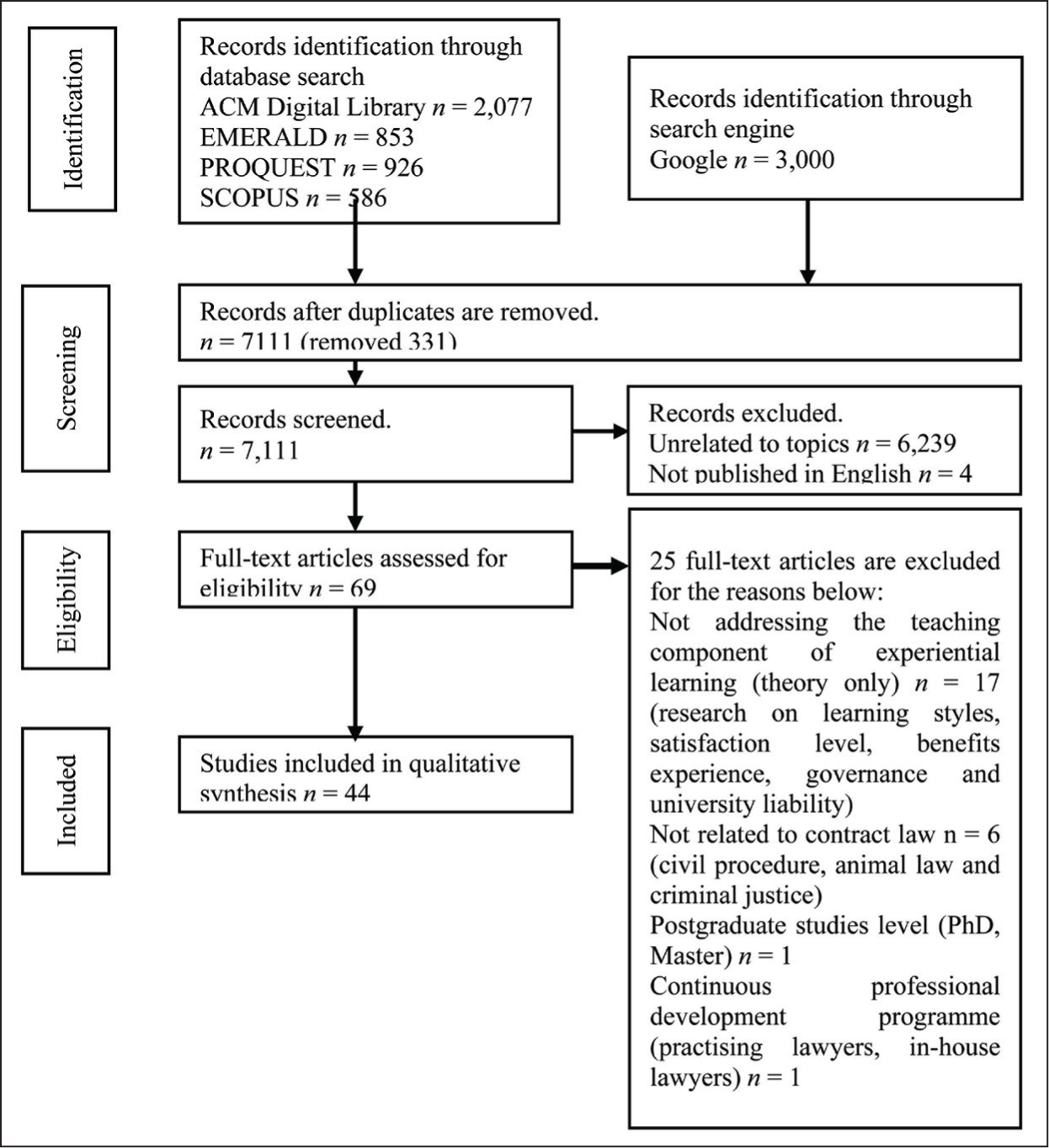
This scoping review yielded a total of 7,442 articles and online materials that were potentially relevant for the study, published between January 1971 and April 2023. The search was conducted across four databases: ACM Digital Library (n = 2,077), EMERALD (n = 853), PROQUEST dissertation and thesis (n = 926) and SCOPUS (n = 586). An additional 3,000 results were generated from a search on Google. Of these, 331 articles and online materials were excluded due to duplication. The remaining 7,111 articles and online materials underwent a title and abstract screening process, resulting in the elimination of 7,042 for being unrelated to the study (n = 6,239), not published in English (n = 4), lacking full text or abstract (n = 799). The full texts of 69 papers were reviewed against the inclusion and exclusion criteria model, resulting in the exclusion of 25 articles and online materials: not addressing the teaching component of experiential learning (n = 17), not related to substantive law courses (n = 6), postgraduate studies level (n = 1), continuous professional development programme (n = 1). The study selection process is presented in a PRISMA-ScR flow diagram illustrated in Figure 1.
Study Selection Process Based on PRISMA-ScR Flow Diagram.
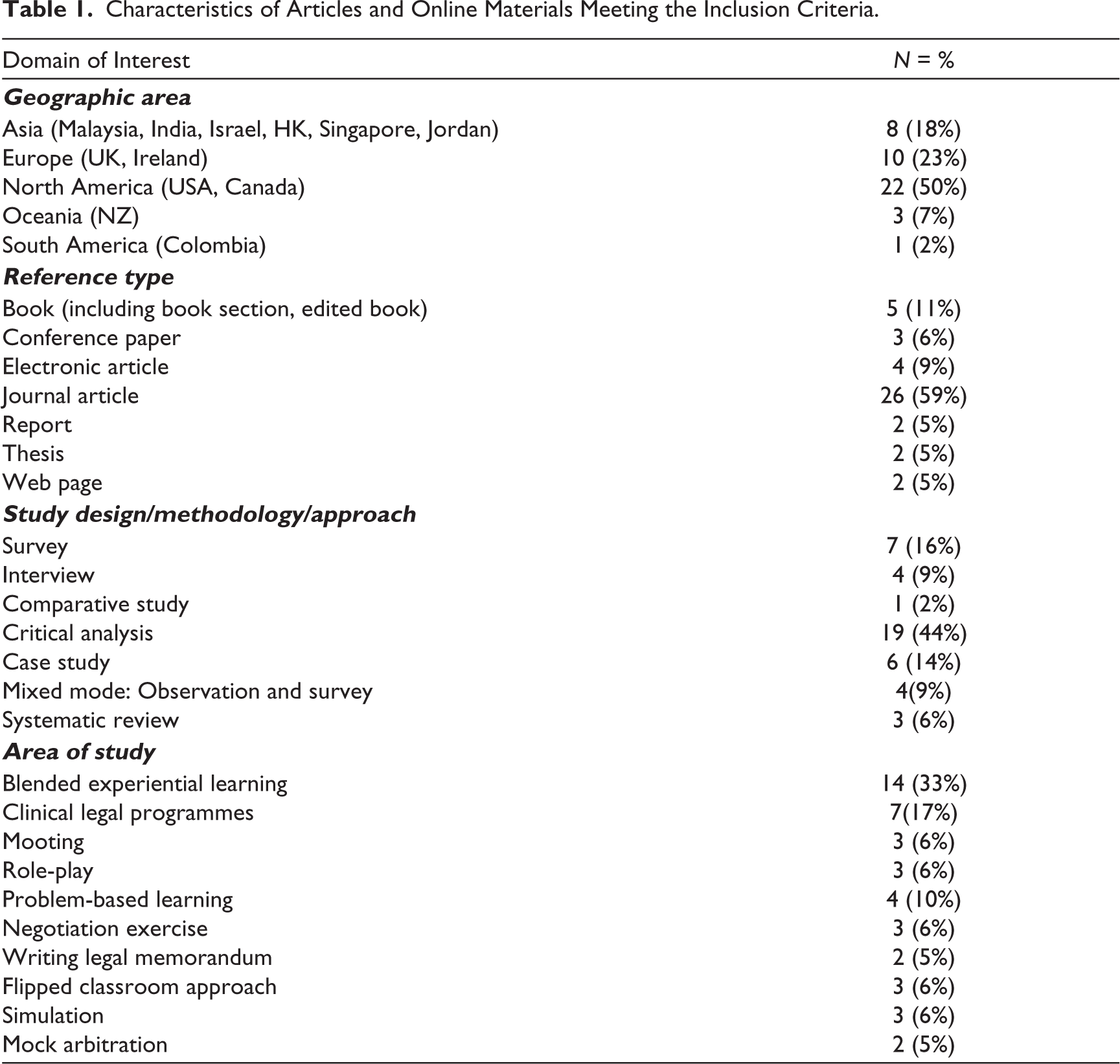
The included articles and online materials were analysed and classified based on predefined domains of interest, as presented in Table 1. Descriptive statistics were used to report the characteristics of the publications, including geographic area, article type, study design and area of study. The reference types of the publications were categorized as book (11%), conference paper (6%), electronic article (9%), journal article (59%), report (5%), thesis (5%) and web page (5%). The majority of the publications originated from North America (50%), followed by Europe (23%), Asia (18%), Oceania (7%) and South America (2%). A critical analysis approach was adopted in 44% of the publications, while others used case study (14%), surveys (16%), interviews (9%), a systematic review (6%), comparative study (2%) and mixed-mode approach (9%). The area of study covered a broad range of experiential learning methods, including clinical legal programmes (17%), mooting (6%), role-play (6%), problem-based learning (10%), negotiation exercise (6%), writing legal memorandum (5%), simulation (6%) and mock arbitration (5%). In addition, the study areas also covered the flipped classroom approach (6%) and blended experiential learning (33%). Most of the articles and online materials were authored by academic researchers. The characteristics of the included articles and online materials are summarized in Table 1.
Characteristics of Articles and Online Materials Meeting the Inclusion Criteria.
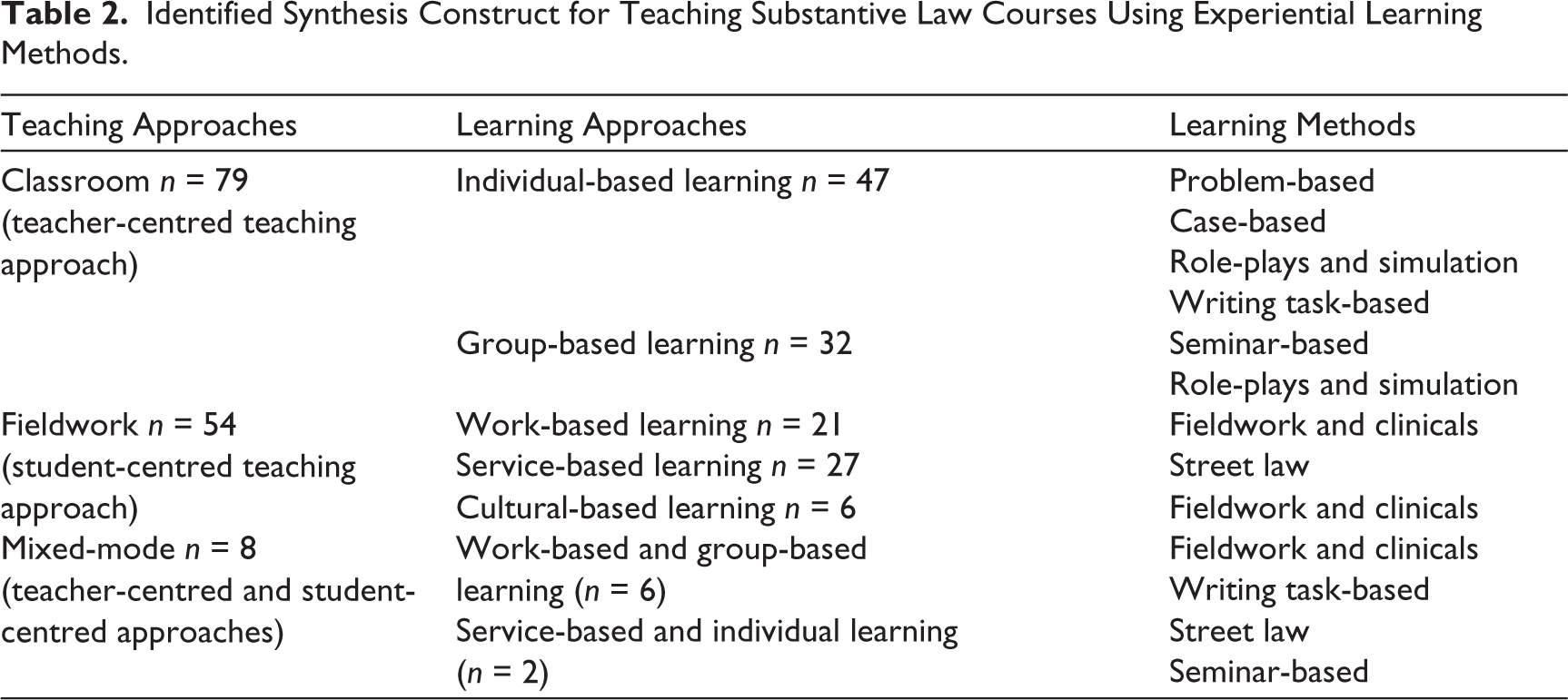
The original constructs, which refer to the experiential learning methods used in teaching substantive law courses to undergraduate students, were coded and tagged using ATLAS.ti 8 qualitative data analysis software. A total of 141 essential original constructs were collected from the 44 eligible articles and online materials. Among these constructs, 79 utilized the classroom approach, while 54 utilized the fieldwork approach. The remaining eight original constructs combined classroom and fieldwork teaching methods. The original constructs were then further categorized into two broad categories for classroom teaching: individual-based learning (n = 47) and group-based learning (n = 32). For the fieldwork approach, three experiential learning approaches were identified: work-based learning (n = 21), service-based learning (n = 27) and cultural-based learning (n = 6). In the mixed-modes teaching approach, the learning approach consisted of work-based and group-based learning (n = 6) or service-based learning and individual-based learning (n = 2).
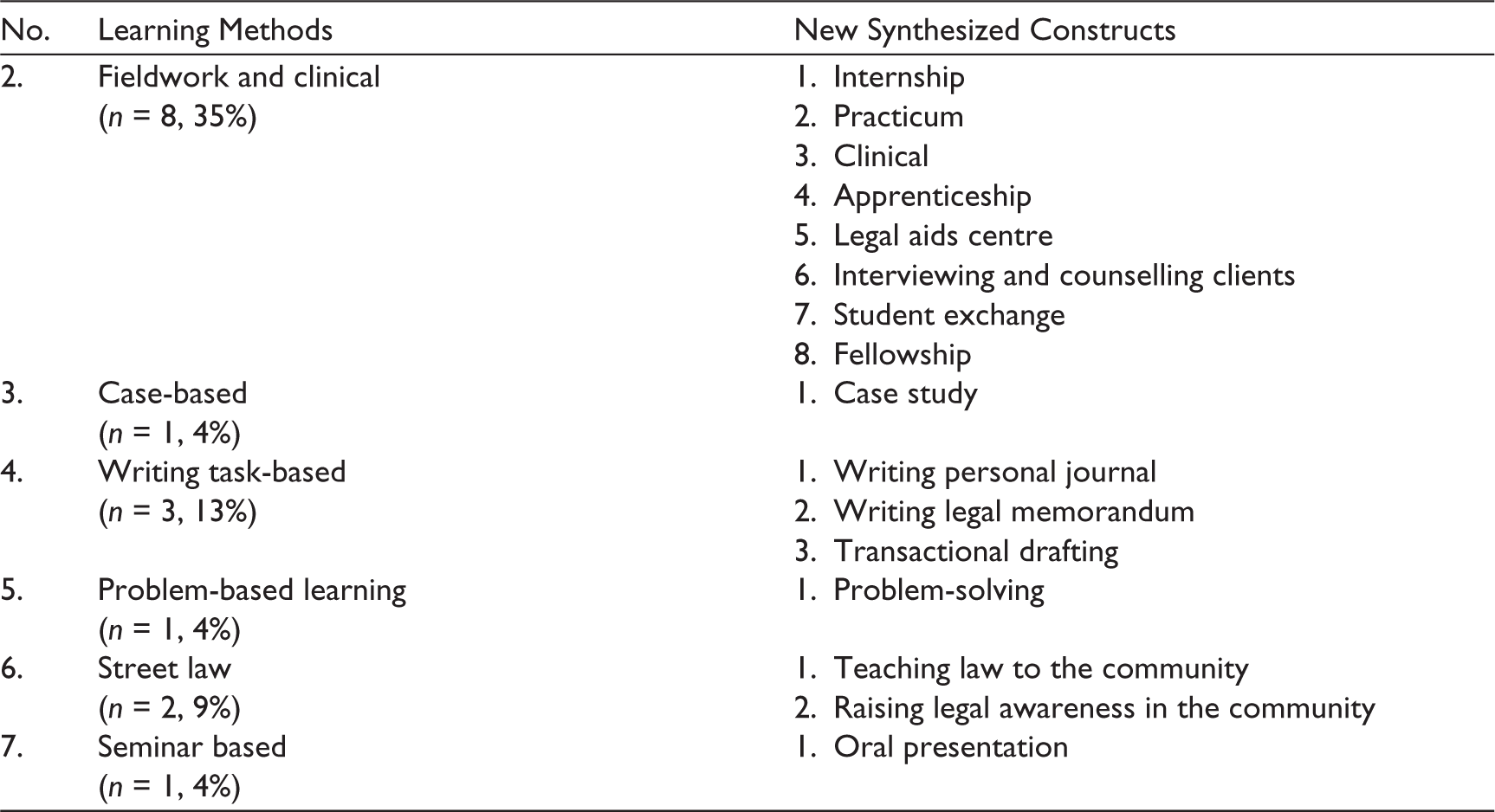
Through a process of rewording and merging, the original constructs underwent modifications, resulting in the establishment of seven experiential learning methods, namely problem-based learning, case-based, role-plays and simulation, writing task-based, seminar-based, fieldwork and clinical and street law. In total, 54 items were categorized under role-plays and simulation methods, followed by fieldwork and clinical (n = 36), case-based (n = 15), writing task-based (n = 12), problem-based learning (n = 11), seminar-based (n = 6) and street law (n = 7). Among these methods, role-plays and simulation methods had the highest percentage of original constructs (38%, 54/141), followed by fieldwork and clinical (26%, 36/141), case-based (11%, 15/141) and writing task-based (9%, 12/141). Problem-based learning (7%, 11/141), street law (5%, 7/141) and seminar-based (4%, 6/141) recorded the lowest percentage of experiential learning constructs in the literature. The synthesis of the identified constructs for teaching substantive law courses using experiential learning methods is summarized in Table 2.
Identified Synthesis Construct for Teaching Substantive Law Courses Using Experiential Learning Methods.
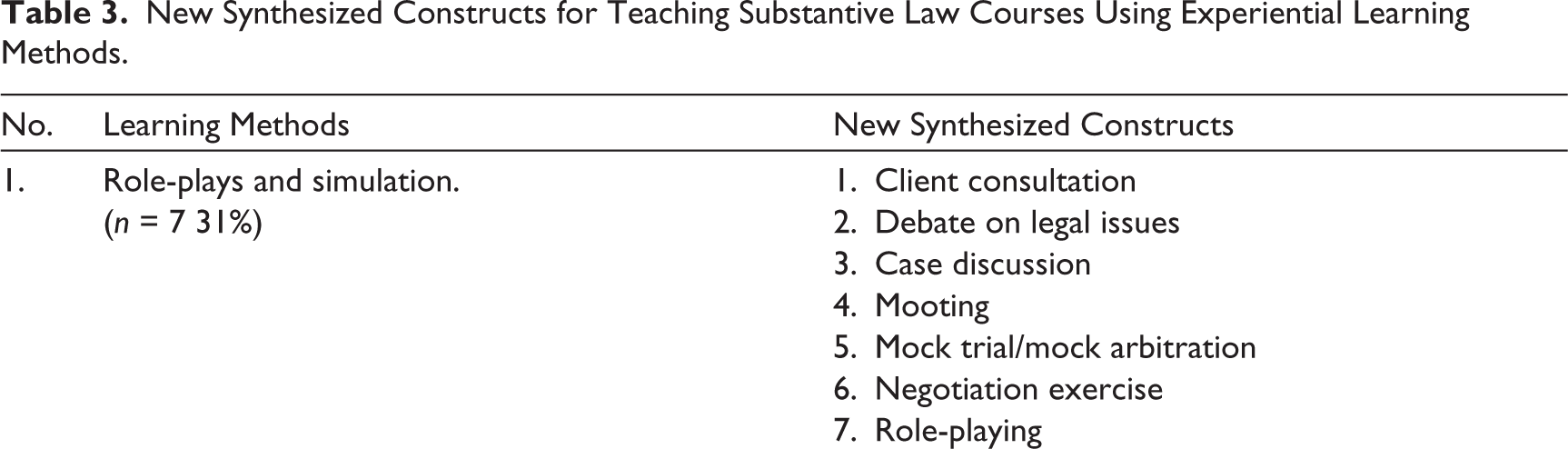
After synthesizing the identified methods, 23 new constructs were developed for teaching substantive law courses to undergraduate students using experiential learning methods. The details of these newly synthesized constructs are provided in Table 3.
New Synthesized Constructs for Teaching Substantive Law Courses Using Experiential Learning Methods.
Discussion
In this section, we will explore the delivery and assessment methods of teaching substantive law courses using experiential learning to undergraduate students and the expected learning outcomes. The learning outcomes are aligned with Kolb’s Experiential Learning Cycle. To formulate a proposition on teaching substantive law courses using experiential learning methods, we consulted resource persons and senior lecturers for substantive law courses at the faculty of law, UiTM. The consulted individuals have a wealth of experience, having taught substantive law courses to law and non-law undergraduate students for 10 to 20 years.
Role-plays and Simulation
Role-plays and simulations are effective experiential learning tools for both group-based and individual-based activities, whether online or in-person. These methods can be applied to mooting, client consultation, contract negotiation, mock trial/arbitration exercises and legal debate. 23 Students can engage in abstract conceptualization and active experimentation learning cycles through role-play and simulation learning. Students use theories, logic and ideas to comprehend complex contractual issues or situations in the former. At the same time, in the latter, they actively apply and test what they learned in lectures and tutorials. Students participating in role-plays and simulations take a practical approach and focus on finding effective solutions rather than passively observing the learning process. 24
Instructors can incorporate realistic legal issues and problems into mooting, mock trial/arbitration, client consultation or negotiation exercises to create an immersive experiential learning environment for teaching substantive law courses. Role-plays and simulations can effectively engage all students in a collaborative learning environment, utilizing the classroom and moot court as a platform for meaningful activities (Jang & Kim, 2020). Through role-plays and simulations, students can act out roles or improvise scripts to simulate hypothetical contractual issues or situations in a realistic manner. In preparation for these activities, students must conduct research and develop oral arguments supporting their client’s position on the legal dispute. The final presentations take place in a courtroom or meeting room environment, allowing students to apply and test their newly acquired knowledge and skills. 25
Experiential learning through role-plays and simulations empowers students with learner-oriented assessment opportunities. In this approach, formative feedback is generated through self-assessment and peer assessment. After each session, students can reflect on their performance and provide feedback. The lecturer, tutor or mooting/mock trial/mock arbitration judge can also offer formative feedback. This feedback can help students identify areas for improvement and reinforce their learning. To further enhance the assessment process, law practitioners with expertise in relevant substantive law courses can act as judges, supervisors, advisers, evaluators or mentors. 26
Fieldwork and Clinical Learning
Fieldwork and clinical learning provide valuable experiential learning opportunities for students to enhance their cognitive and intellectual abilities. 27 These activities typically involve work-based, service-based or cultural-based learning, allowing students to gain practical experience in real-world legal situations. Students can develop a deeper understanding of the complexities of the law and legal practice by engaging with real clients and legal scenarios. In addition, fieldwork and clinical learning foster reflective observation by encouraging students to closely observe and reflect on their mentor or supervisor’s actions and critically analyse the situation at hand.
Experiential learning through fieldwork and clinical projects can allow students learning substantive law courses to develop sound professional judgement in real-world situations through externship, clinical or apprenticeship placements. To incorporate fieldwork and clinical learning into substantive law teaching, mentors/supervisors can be assigned to work with students during client consultation and negotiation sessions. Students can participate in or observe these sessions and engage in reflective observation to enhance their learning experience. Through discussions with their mentor/supervisor, students can reflect on and analyse the lessons learned during these sessions to better understand the practical application of substantive law principles.
Fieldwork and clinical-related activities are best assessed through formative assessment methods rather than summative assessments. 28 This type of assessment involves providing feedback to the students to help them improve their performance. In addition to feedback from mentors and supervisors, client feedback can also be used to evaluate the student’s performance. 29 Self-assessment can be a valuable tool in this process, where students compare their performance with the required standard and skills needed for conducting interviews, providing legal advice or drafting contracts. Another assessment method is having students write reports about their experiences in the fieldwork and clinical projects. 30 These methods of assessment help students develop their skills, improve their performance and gain practical knowledge of the legal profession.
Case-based Method
The case method is a dynamic and participatory way of learning that develops students’ critical thinking, communication and group dynamics skills. Real or hypothetical case scenarios are used to present unresolved and thought-provoking issues, situations or questions to students. 31 This case-based approach provides students with opportunities to engage in active experimentation and reflective observation learning cycles. During active experimentation, students apply theoretical concepts to analyse the case. 32 On the other hand, reflective observation enables students to assess the information presented in the case and identify the elements related to each theory. 33 The case method also encourages abstract conceptualization as students review and critique the case further enhancing their analytical skills. 34
The use of case study activities is an effective way to teach substantive law courses, offering a range of scenarios for analysis and evaluation. Reported law cases provide real-life examples that allow for detailed analysis of the legal issues at hand. Similarly, ongoing cases that are still on trial or in the appeal stage can provide an opportunity for students to make predictions and consider the potential outcomes based on existing facts. Hypothetical case scenarios can also be used, reflecting the complexities of real-world contract situations, requiring students to critically analyse and draw conclusions. In some cases, students may engage in a lengthy, complex contract case as part of a semester-long case study method, allowing for a deeper understanding of law principles and their application in real-world contexts.
The Case-Based Assessment (CaBA) method is useful for evaluating students’ performance in the case-based learning approach. 35 CaBA exposes students to real-life case scenarios they may encounter personally and professionally. 36 , 37 A case related to a particular substantive law course can be explicitly designed to assess the target skills or learning objectives. To ensure the effectiveness of the assessment, the case should be new, and students should have yet to encounter it. Alternatively, a previously encountered case can be used, but students should be required to respond in a novel manner. The chosen case should be appropriate for undergraduate students and include sufficient facts and issues for a comprehensive case analysis. 38
Writing Task-based
Writing tasks are a form of classroom-based experiential learning that can enhance students’ ability to engage in abstract conceptualization. 39 In writing tasks, students must effectively communicate their thoughts and feelings supporting their arguments and opinions. For contract law, writing tasks involve drafting a contract for a given scenario using the principles taught in class and per contract law principles. 40 Through this task, students are expected to apply their theoretical legal knowledge and practical drafting skills, which they have learned in-person and online. The task provides opportunities for students to apply the principles and concepts of contract law to realistic scenarios.
The flipped classroom model is a practical approach to delivering writing tasks as it allows students to use more in-class time to practice practical exercises. 41 To assess students’ performance in writing tasks, formative assessments can be employed as in other experiential learning methods. The evaluation criteria for writing tasks include assigning a band score based on the students’ task achievement/response, coherence and cohesion, lexical resource and grammatical accuracy. 42 In legal writing, using correct grammar in various sentence structures is vital, and grammatical accuracy can be considered while determining band scores. For instance, if students drafting a contract or legal opinion demonstrate poor grammar, repetition of terms, confusing provisions or omit standard clauses, the instructor can provide feedback to address and rectify the errors as part of the writing task learning exercise. 43
Problem-based Learning
Problem-based learning provides a practical approach to teaching students the principles of law and the practical application of those principles in contract drafting or negotiations. 44 This experiential learning method enables students to develop critical problem-solving and decision-making skills essential for success in the legal profession. Through problem-based learning, students engage with realistic case scenarios and are challenged to propose one or more solutions to the legal issues presented. Effective problem-based learning requires students to analyse and conceptualize the legal problems at hand before devising solutions. 45
Problem-based learning engages students in abstract conceptualization and active experimentation learning cycles. When presented with a problem-based question, students are required to analyse the facts and identify the relevant issues and laws applicable to the problem. Through case-based analysis, students can connect what they learn in class to the practical application of their knowledge in identifying issues and analysing the laws relevant to contractual problems. In addition, students are expected to apply the theories and principles of contracts taught during lectures and tutorials to propose solutions or resolutions to problems presented in realistic scenarios. Before providing legal advice or a conclusion, students must apply the law and principles governing the substantive laws to the facts. This process prepares students for real-world situations and provides legal solutions to clients.
Problem-based learning can be effectively implemented through a flipped classroom approach, where students are provided with contractual problems in advance and are expected to propose solutions in class. 46 These problems can be assigned individually or in groups, encouraging collaborative problem-solving and the exploration of related concepts among peers. Formative assessment is utilized to track and monitor the student’s progress in learning substantive law through experiential learning, focusing on their problem-solving abilities. The complexity of the legal problems assigned to the students should gradually increase to encourage students to learn the legal research process. 47 Additionally, summative assessments can incorporate problem-based questions in tests or final examination papers to further evaluate students’ proficiency in applying contractual laws to real-world scenarios.
Street Law
Street law offers an active and experiential approach to learning that emphasizes the practical experience of legal advocacy. Street law clinics can be used as a means of teaching students about substantive law in a realistic way. This may involve teaching substantive law concepts and principles directly to community members or working to educate individuals on legal issues that may affect them. Students gain valuable experience interacting with people in real-world situations by participating in street law clinics. These experiences can help to improve students’ ability to communicate legal information to non-lawyers while also enhancing their oratory and presentation skills, which are essential to their professional practice in the future. 48
Formative assessment is the most effective way to evaluate the learning outcomes of the street law method. Students should be given the opportunity to reflect on the experience gained through their participation in street law activities. Additionally, their performance can be assessed through observation or recording during street law events. In addition to self-assessment, lecturers can evaluate the students’ street law performances by directly observing or reviewing video recordings. 49
Seminar-based Method
The seminar-based method involves structured group discussions in the form of oral presentations, which can take the form of dialogues, forums or class presentations on topics chosen by students or lecturers. 50 Through this method, students engage in interactive and experiential learning by receiving and responding to questions from their peers or lecturers. The seminar-based method provides opportunities for students to enhance their abstract conceptualization abilities as they present material on substantive law courses and answer questions related to the subject matter. This approach promotes active learning and encourages students to develop critical thinking skills by analysing, evaluating and synthesizing legal concepts. 51
The seminar method is a classroom-based experiential learning approach that employs diverse media to teach substantive law courses. 52 A blended and hybrid learning format can enhance the effectiveness of seminar presentations, mainly for Generation Z students, who are more engaged when learning is augmented with multimedia tools. 53 In terms of assessment, formative evaluation can be conducted by assigning grades to students based on their level of preparation as well as the clarity, comprehensiveness and persuasiveness of their presentations. 54
Recommendations
Although experiential learning has been regarded with high optimism as a way of teaching substantive law courses, specific issues need to be resolved for its smooth implementation. The main challenge is the preparedness of academic staff to employ experiential learning methods in teaching substantive law. Typically, most law faculties have a limited number of qualified lecturers with practical experience in law practice. To ensure the effective delivery of substantive law courses using experiential learning, lecturers must possess the ability to blend legal theory with practical knowledge of the legal profession. One solution to this problem is for the faculty to increase the number of lecturers with significant legal practice experience. Alternatively, the faculty can engage practising lawyers to collaborate with lecturers to deliver experiential learning.
Experiential learning presents a second challenge: the need for additional financial resources at a time when most law faculties in universities are required to achieve more with limited resources. The teaching of substantive law using experiential learning techniques necessitates the provision of additional facilities, such as a moot court and a legal office. Moreover, a realistic legal clinic environment would require access to copying machines, scanners, printing machines, telephones, computers and a designated consultation room for confidential client meetings and files. Street law learning may also require some expenses, such as organizing forums, talks or workshops. 55 Therefore, the faculty must identify ways to generate sufficient funds to run their legal clinic and street law programme. The universities may have to establish an endowment fund or consider increasing tuition fees to cover the expenses.
The third challenge experiential learning poses is its time-intensive nature, as it requires significant preparation time to create role-plays, simulations, case studies and problem-based questions. Both students and lecturers must invest more time in experiential learning, which may reduce the time usually allocated to cover numerous topics in the classroom. 56 Additionally, out-of-classroom experiential learning activities need to be evaluated equally with in-classroom activities to ensure students pay attention to the former. 57 As such, lecturers must develop out-of-classroom assessments and rubrics for formative evaluation to ensure fair assessment of students’ performance in fieldwork, clinical and street law activities. More time must be devoted to evaluating whether students have attained the intended experiential learning outcomes.
The fourth challenge presented by experiential learning relates to the academic regulations of most universities, which typically require students to sit for a specific number of examinations. This poses an additional challenge to lecturers, as traditional closed-book examinations need to be more suitable for assessing experiential learning outcomes. Therefore, universities must provide more flexibility for formative assessment and dispense with strict requirements for summative assessment. 58 A simple pass/fail assessment can be used as an alternative to grading students to simplify the formative assessment process. Additionally, universities may have regulations that require students to attend lectures for a minimum number of hours based on the course’s credit hour/contact hour. These regulations impede work-based and community-based learning as students must spend significant time inside the classroom. Hence, academic regulations must be revised to accommodate out-of-classroom experiential learning methods.
The final challenge posed by experiential learning concerns the risk of universities being vicariously liable for any breach of confidentiality committed by their students during placements at private legal firms, public prosecutors’ offices or courts. The cases that students encounter during fieldwork and clinical learning are real cases which are protected as privileged information under confidentiality and privacy laws. 59 Therefore, students who participate in work-based experiential learning at law firms or courts must observe the duty of secrecy. They may be required to sign a non-disclosure agreement to prevent the disclosure of personal data, legal issues and legal advice provided to clients. 60
Conclusion
The findings of this study indicate a growing trend in the use of experiential learning to teach law courses to both law and non-law undergraduate students. In the context of undergraduate programmes, experiential learning has been utilized as a complement to the traditional doctrinal/black-letter and Socratic methods. Instead of relying solely on frontal lectures and tutorials, experiential learning methods offer an alternative approach to delivering and assessing law courses. Field-based and classroom-based experiential learning methods can be employed to evaluate students’ comprehension and skill development in various law courses. This approach can produce practice-ready law and non-law graduates that meet the demands of their respective professions. Furthermore, experiential learning methods can potentially reduce rote learning and memorization, particularly in theoretical courses for which substantive law courses are known.
In practical terms, attempting to include all seven experiential learning methods in two semesters of teaching substantive law courses is not feasible. Instead, the incorporation of experiential learning methods in teaching substantive law courses should be viewed as an ongoing and seamless process. Specific law topics, such as contract formation, elements of a contract, breach of contracts, discharge and remedies, can be integrated into skill development courses such as mooting, trial and advocacy and professional ethics courses. In addition, it is crucial to strike a balance between the three learning methods that make up legal education: lecture-based, Socratic and experiential learning. Rather than implementing a purely instructional, inquiry-driven or experiential learning curriculum, these three approaches can be integrated into substantive law courses and across different skill development courses offered by the university. 61
While the focus of this study is limited to contract law, the findings can be extended to other areas of substantive law courses taught in law school, including but not limited to criminal law, family law, land law, tort law and jurisprudence. Additionally, these outcomes can be applied to substantive law courses offered to non-law students, such as banking, business, commercial and company laws. Consequently, more research is needed to develop a comprehensive syllabus incorporating experiential learning techniques in instructing various areas of substantive law for both law and non-law students.
Footnotes
Author Contributions
Conceptualization, Anida Mahmood and Haswira Nor Mohamad Hashim; Data curation, Haswira Nor Mohamad Hashim; Formal analysis, Haswira Nor Mohamad Hashim; Investigation, Anida Mahmood and Zeti Zuryani Mohd Zakuan; Methodology, Zeti Zuryani Mohd Zakuan; Resources, Zeti Zuryani Mohd Zakuan; Writing–original draft, Haswira Nor Mohamad Hashim; Writing–review and editing, Anida Mahmood.
Declaration of Competing Interests
The authors declared no potential conflicts of interest with respect to the research, authorship and/or publication of this article.
Funding
This study is fully funded by Universiti Teknologi MARA via research grant no. 600-RMC/GPK 5/3 (034/2020).