




Abstract
This commentary details the sweeping changes to the route to qualification as a solicitor in England and Wales brought about in September 2021 and considers the opportunities and risks presented to university law school clinics by one aspect of this route: the new system of Qualifying Work Experience (QWE). The article reflects on the opportunities for law clinic development, innovation and recognition offered by QWE and weighs these up against the potential risks that will need to be managed carefully to avoid them becoming a threat to law clinic enhancement. The article considers the results of an early data gathering exercise to garner clinician and student volunteer perspectives on QWE within its first year of operation.
Introduction
The rules regulating the route to qualification as a solicitor in England and Wales changed fundamentally in September 2021. Prior to this date, individuals wishing to qualify as a solicitor were required to demonstrate that they:
held an undergraduate qualifying law degree (or the postgraduate Graduate Diploma in Law (GDL) for those with a non-law degree); had passed the postgraduate Legal Practice Course (LPC); had completed a period of recognized training or training contract
3
; had passed the professional skills course and at the point of admission can confirm they meet the character and suitability requirements prescribed by the Solicitors Regulation Authority (SRA).
This process was linear, leading neatly in chronological order from the academic stage to the vocational stage, to in-work training and finally to admission into the profession.
Under the new Solicitors Qualifying Examination (SQE) those applying for admission as a solicitor must demonstrate that they:
possess any undergraduate degree (Law is not a prerequisite); have passed SQE 1 and SQE 2 central assessments
4
; and have completed two years’ full-time equivalent of Qualifying Work Experience (‘QWE’) with up to four organizations.
The only surviving element from the previous route to qualification is the need to meet the character and suitability requirements.
The SRAs’s rationale for introducing the new regime is expressed in their SQE briefing from August 2020. 5 In a nutshell, the wish is to open up access to the profession to those who may not have the financial means to access the GDL 6 and/or the LPC 7 ; assist those who may not otherwise have the opportunity to secure a two-year training contract with a firm of solicitors; and standardize the assessments undertaken by aspiring solicitors. 8
Anybody who had finished, started or accepted a place on a qualifying law degree by 21 September 2021 or GDL by 1 September 2021 can opt to undertake the SQE or, until 31 December 2032, can continue their path to qualification via the LPC route, subject to providers continuing to run the LPC. 9 However, those starting their degree from September 2022 will have no option but to follow the SQE to qualify as a solicitor.
The SQE allows for QWE to be undertaken in non-regulated organizations—such as a university law clinic. Whilst in practical terms it may transpire that students choose not to register a (relatively small) period of QWE accrued with their university law clinic, this is the first time that law clinics have been involved in the ‘training’ of solicitors, apart from law clinics which are registered with the SRA and have employed trainee solicitors in the past. 10
For QWE to be successfully claimed, the student must be involved in the provision of legal services (as defined in Section 12 of the Legal Services Act 2007) to a real client and the work must enable the individual to develop some or all (but as a minimum, two) of the competences required in the SRA’s Statement of Solicitor Competence. 11 QWE can be undertaken at any time, including before sitting the SQE 1 and SQE 2 assessments, and can be claimed retrospectively for experience gained prior to September 2021. As such, the SQE is best described as a patchwork rather than a linear route to qualification.
There is no minimum prescribed length of a QWE placement with the maximum being two years’ full-time equivalence. Candidates can only register up to four periods of QWE with the SRA when applying to be admitted as a solicitor, which must have been confirmed by a solicitor of England and Wales or Compliance Officer for Legal Practice. 12 If a student participates in numerous clinic activities over a number of years during their studies, the period of QWE accrued over those years would only count as one period of QWE as the university is one ‘organization’ for QWE purposes.
The SRA is very clear in its guidance that confirming QWE ‘does not involve deciding whether an individual is competent and suitable to practise’. 13 Quite simply, if the threshold for QWE has been met and even if the student has not performed competently, the period must be signed off as QWE. There is no option to refuse to sign off the QWE period. Having collected periods of QWE either before or after sitting the SQE assessments, candidates can then select their four ‘best’ periods of confirmed QWE when applying to the SRA for admission to the profession. The SRA will then contact the solicitor for verification of the period of QWE that the student has filed with them.
Opportunities Presented to Clinics by QWE
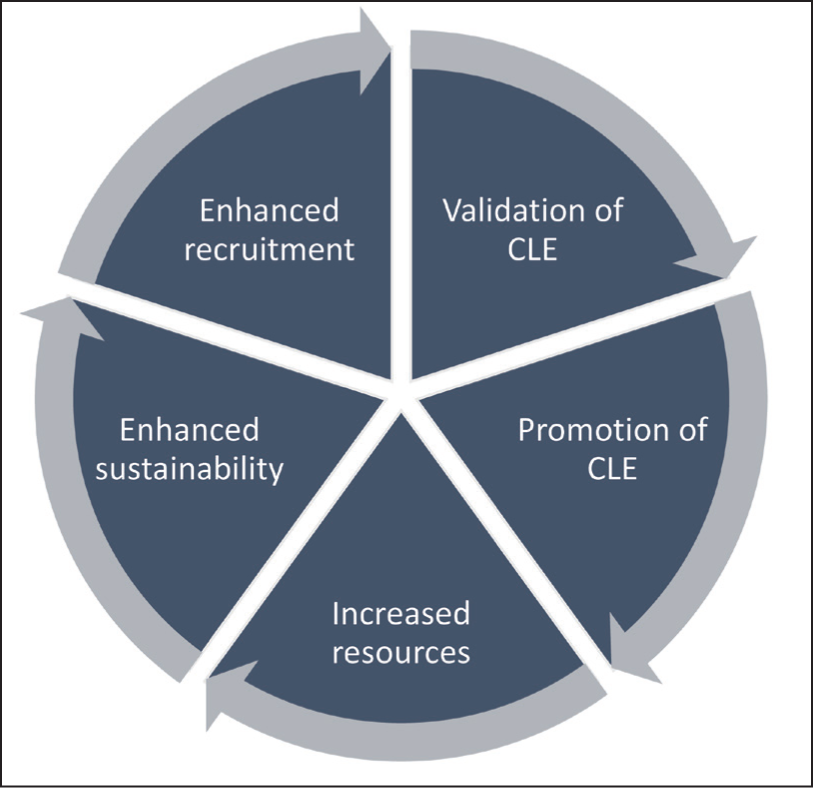
The opportunities presented by the advent of QWE have the potential to greatly augment clinic development and innovation. Figure 1, devised by the authors of this article, demonstrates five interlinked and cyclical factors linked to QWE that could serve to enhance clinical legal education (CLE) within Higher Education institutions.
Validation of CLE
Whilst CLE is an accepted teaching methodology, clinicians are still often found on the margins of the law school, a reflection of the ‘tensions between academia and practice’. 14 The inclusion of law clinics in the list of non-regulated organizations in which QWE can be claimed represents validation by the SRA of the value of the work undertaken in clinics and the worth of the contribution students can make when volunteering in clinic. This inclusion also validates clinicians’ roles in the law school, adding value to the law school via an activity endorsed by the regulator that can directly impact a student’s qualification journey.
Promotion of CLE
Prior to SQE, clinics have been a vehicle via which students can engage in access to justice and skills development. It is widely accepted that this involvement in clinic work increases students’ employability prospects. 15 , 16 As a result, universities have been keen to promote the employability advantages of clinic work both within and outside their institutions over the years. QWE has the potential to add extra value to clinic work, in addition to the benefits of enhanced employability and enabling access to justice 17 , by adding the ability for students to claim QWE for their work in the clinic and help progress their journey to qualification. The fact that QWE is confirmed by the SRA leads to the further validation of this phenomenon, as QWE stands apart from any academic credit or volunteering credit awarded internally by the university. This provides additional gravitas to clinic work and brings to the fore the value to students, schools and universities of pro bono initiatives.
Increase in Resources
The ability to claim QWE provides students with a further driver to engage in the clinic. This in turn means that university law schools offering the best value from a ‘student as customer’ 18 perspective will be those offering most opportunity to engage in QWE-attracting activities.
This is a strong incentive to faculty and management to invest resources into clinic work to satisfy both an increase in demand from students and the reputational driver to be seen to be competing with fellow providers. This investment may take the form of funding for bespoke premises, an increase in the number of staff assigned to clinic, increases in the workload allocation of staff undertaking clinic work, and even an increase in recruitment of ‘pracademics’ (former or current practitioners who transition into roles as university academics 19 ) who bring a really valuable perspective to university law schools. QWE provides clinicians, for the first time, with an opportunity to quote a measurable external driving factor (and therefore metric by which students and competitors will judge schools, faculties and thus institutions) when seeking both validation of and investment in clinic activities.
Added Sustainability
An increase in engagement with and investment in clinic for QWE reasons feeds into the crucial issue of sustainability of clinics, both in the sense of clinics being able to survive in the longer term and by way of clinics contributing to institutions’ achievement of the UN’s Sustainable Development Goals (SDGs). Clinics are resource intensive, but the confirming of QWE provides a unique selling point for clinics: the more students who want to volunteer, engage and advise in clinic reinforces and enhances the sustainability of clinics themselves and of their SDG contribution. The advent of QWE is likely to lead to those universities previously not operating a clinic service to set up one or more clinics, given that the opportunity to take part in clinic, for the first time, could be the crucial deciding factor in the decision-making process of prospective students.
Already well-established university pro bono centres and clinics may be incentivized to diversify and innovate their current clinic offering to accommodate the demand for QWE. The latter arguably has the potential to assist in alleviating the free legal advice crisis experienced across some areas of England and Wales highlighted by the Law Society’s Legal Aid Deserts campaign, 20 although it is widely accepted that law clinics should not be seen as a substitute for governmental investment. 21
Enhanced Recruitment
The final factor in the cycle of opportunity presented by QWE is the potential for it to enhance student recruitment. It is conceivable that more students will be recruited by university law schools, as the students will see the very tangible benefit of engaging in QWE activity whilst enrolled.
An enhanced take-up of clinic volunteering roles by students in turn has the potential to enhance departmental and institutional scores in the metrics by which they are judged against their competitors. Firstly, the nature of clinic work lends itself well to students responding more positively to National Student Survey questions relating to learning opportunities 22 and learning community. 23 Secondly, in terms of the Graduate Outcomes Survey, by which the Higher Education Statistics Agency collects data on graduate job roles 15 months postgraduation, it stands to reason that if students have had the opportunity to collect QWE during their studies, they will be in a better position to secure a graduate-level role by the time GOS survey season approaches.
These enhanced metrics will in turn enable universities to perform better in the numerous league tables 24 that influence potential undergraduate students weighing up the value of investing in annual fees of in excess of £9,000, thus further increasing student recruitment in later cycles. This final factor further validates, in the eyes of the university, the sector and current and potential students, the work of clinicians and their student volunteers, thus feeding directly back into the first factor discussed above and underlining the recursive nature of the opportunities presented by QWE.
Risks Presented to Clinics by QWE
Whilst it is clear that the advent of QWE presents a significant opportunity to the validation, development and innovation of clinic, there is no denying that its introduction has the potential to bring with it some undesirable side effects which can be seen as potential spokes in the wheel of clinic enhancement. Figure 2 sets out the potential pitfalls that will need to be managed carefully to prevent QWE becoming a threat to clinic innovation and development.

The Commoditization of Clinic Work
The SRA guidance on QWE clearly states that the regulator ‘will not advise as to whether an individual’s situation is QWE’, nor will they ‘prescribe what full time (or equivalent) means’ as they ‘expect QWE providers/employers to take a common-sense view’. 25 This places university clinics in somewhat of a bind, as there this the potential for tension to arise between student expectations of how much QWE clinic activity is ‘worth’ and the reality of what can be offered by clinics.
The Clinical Legal Education Organisation (CLEO) has produced guidance on QWE 26 and operates a QWE panel made up of five experienced university clinicians to provide guidance to university law clinics on whether a clinic activity can be classed as QWE. Clinicians within the CLEO network are of the view that a student working in clinic for a full academic year will only be able to claim QWE measured in days or at most weeks, and certainly not in months or years. This must be countered against students commencing their degree with an inflated and unrealistic expectation of how much QWE they will be awarded.
The SRA will only intervene in their capacity as regulator if a solicitor refuses to confirm claimed QWE. They will not intervene in matters of time claimed as QWE, even if they are aware that the time allocated for activities is being underestimated or overestimated. This opens the door for organizations to overestimate QWE ascribed to work experience and, for clinics which do not then ‘deliver’, brings the associated spectre of potential investigations by the Office for Students and/or the Competition and Markets Authority where publicly provided information to enhance recruitment does not accord with the reality of how the clinic works. Caution must be exercised in this regard as the lack of regulatory guidance as to how much QWE is likely to be attributed to clinic activities could lead to student confusion, dissatisfaction and potentially reputational damage.
The lack of certainty from the regulator in this regard speaks to the contentious notion of students as consumers. Working in a university law clinic, for the most part, affords clinicians the luxury of being cushioned from students’ consumerist attitudes because students tend to be influenced in their volunteering by altruistic motives, although of course they are not blind to the CV enhancement that pro bono work brings. 27 The advent of QWE could lead to students, in their consumer guise, shopping around and choosing their institution based on which one provides (or says it provides) the most QWE. The commoditization of clinic has the potential to develop tensions between university marketing campaigns promoting QWE and clinic staff. The latter may not have been involved in decisions on marketing campaign language but may have to deal with unrealistic projections of what can be offered by way of client experience.
Talent Pool Barriers
Only solicitors qualified in England and Wales can sign off on QWE. This requirement excludes barristers and foreign qualified lawyers. As well as being disincentivizing and demotivating to those barristers and foreign qualified lawyers currently running hugely successful clinics, this rule presents a risk that universities may be less willing to recruit barristers and foreign qualified lawyers into their clinics as they are unable to perform one of the now-necessary functions of a university clinician. Conversely, clinics based outside England and Wales may be less open to taking on England and Wales-qualified solicitors because of the administrative burden presented by QWE which the England- and Wales-qualified lawyer would bring with them. 28 Viewed through this lens, QWE could create a real barrier to the free movement of the talent pool of clinicians both within and outside England and Wales.
The Administrative Burden of QWE Confirmation
The significant administrative burden that QWE will place on clinic staff must not be underestimated. When confirming QWE, the solicitor is confirming the length of the work experience, that the experience involved providing legal services and gave the opportunity to develop at least two of the competences, and that no issues arose during the work experience that raise questions regarding the individual’s character and suitability to join the profession. Robust and transparent record-keeping systems will need to be implemented which enable clinicians both to confirm QWE internally when requested to do so by students, and to then allow external verification of the same QWE to the SRA potentially years later when the student has applied to be admitted to the roll. Additional time will need to be spent considering student records held outside of clinic to enable the clinician to sign off on the character and suitability of an individual. For this, clinic staff will need to trawl records potentially years after the student has left the university for any incidents such as academic malpractice and disciplinary matters. Further procedures will need to be enacted to deal with issues that arise postgraduation when student records may have been closed down and are not so readily available. To do all this, time will need to be found from the often already-squeezed schedule of clinic staff, many of whom also have significant other teaching and administrative responsibilities within the law department, and this presents a risk to the time that could be spent on the development of and innovation in clinic activity.
This heavy administrative burden (and associated workload) could, at its worst, discourage law schools from running clinics that engage in legal advice or assistance for a particular identifiable client, as it is only when these requirements are met that QWE bites. It is not beyond the realms of possibility to imagine a scenario where the administrative burden of a new clinic is greater than the ensuing potential benefit to the public and to students.
A further risk is presented by the fact that solicitors external to the university clinic are also permitted, indeed obliged, to sign off on QWE if requested by a student. This runs the risk of disincentivizing law firms from providing students with pro bono opportunities within their firms and/or partnering with the clinic to provide supervision due to the perceived administrative burden of doing so. This will need careful thought: student opportunities will be best structured in such a way as to enable students to gain sign off from clinic staff rather than the external solicitor. However, this in turn again places an administrative burden on clinic staff in cross-checking the information provided by the student with the external solicitor.
What About Public Legal Education and Social Justice?
Pro bono work is fundamental to the active citizenship and civic university agendas which find themselves at the forefront of today’s university strategies. 29
Some of the most valuable projects run out of law schools are street law–style community engagement initiatives which speak directly to the civic university agenda. 30 This type of activity would, in many cases, not attract QWE, as whilst it may give students the opportunity to develop some of the competences required of the Statement of Solicitor Competence, it would not necessarily involve the provision of legal advice or assistance to a specific individual. The query this raises is whether students will wish to participate in such non-QWE-bearing activities, and indeed whether universities will wish to promote such activities when resources could be funnelled into QWE-bearing experience which has a positive impact on reputation and recruitment. A resulting tension may develop at institutional, departmental and even individual student level between the ‘citizen student’ agenda and the wish to maximize QWE-bearing activity. As such, there is a not insignificant risk that the new regime could see the devaluing of these incredibly valuable community projects simply because many of them will be non-QWE bearing. 31 The pro bono community must remain vigilant that this element of pro bono provision is not sidelined by a focus on QWE.
Clinician and Student Reaction to QWE So Far
The authors are keen to understand how QWE will be received by the CLE community, students and law firms as it is rolled out over the coming years.
Following ethical approval, in early summer 2022 two very short online ‘pulse’ surveys were distributed via the CLEO membership. The purpose was to gain a snapshot, from the perspective of clinicians and students in England and Wales, of the state of play regarding QWE less than one year since its launch.
The initial results of the clinician survey revealed that:
students are asking clinics about QWE, but this does not appear to be translating into internal confirmation of QWE hours; and the SRA has contacted some clinics for external confirmation after students have submitted QWE requests, but this has not been translated into final confirmation by the solicitor: initial findings suggest the student did not provide enough evidence to substantiate the time being claimed.
Clinicians responding to the survey reported feeling prepared for QWE but, interestingly, they were not, at the time of responding to the survey, actively promoting QWE to their students. Rather, they were leaving it for the students to approach them with queries or claims.
As for the student volunteer survey, 85% of respondents stated that they knew what QWE was (and were able to provide a free text definition), but only 57% of students reported that their university clinic had provided them with any information about the link between clinic work and QWE. When asked whether they believed they would be able to use their clinic work as QWE, only 36% of students felt that they would, 32 and 64% of the survey population were unsure as to how much QWE working in clinic attracts. Those who did have a view on this provided varying figures ranging from 30 hours to 6 months. It is clear therefore that student understanding at this early stage is inconsistent, and the authors are currently collating guidance which university clinics can share with their students to enable them to better understand the rules around what constitutes QWE.
The summer 2022 pulse surveys mark the start of a three-year longitudinal study that will chart the progress and uptake of QWE within three key stakeholder groups: clinicians, students and employers.
Conclusion
Pro bono projects are designed to improve the lives of individuals in the local community and to enhance the student experience by dealing with real-world legal problems. If the advent of QWE achieves an increase in the numbers of students involved in such projects, and an enhanced appreciation of the value of clinic work, this represents a win for students, clinics, universities, local communities and the CLE community as a whole. However, QWE does not come without risks. The risks outlined above will need to be carefully managed by clinicians and their institutions to avoid them becoming threats to clinic work as we know it and outweighing the very real benefits that QWE could bring.
Footnotes
Conflict of Interest
The authors declared no potential conflicts of interest with respect to the research, authorship and/or publication of this article.
Funding
The authors received no financial support for the research, authorship and/or publication of this article.