




Abstract
This study is based on the empirical work carried out in the state of Jammu and Kashmir where the people are forcibly displaced from their ancestral homeland due to dam projects. The objective of the study is to examine the issues of compensation, land acquisition and employment among the displaced people which they faced after displacement. For conducting the research, the study was used as a sampling method particularly purposive and snowball technique with the help of semi-structure interview schedule. It has been observed that after involuntary displacement, the displaced people face lots of challenges with regards to their compensation and employment problems. The respective state government has given only monetary compensation to the displaced families according to the Land Acquisition Act, 1984.
Introduction
Compensation and Land Acquisition Act in India
Compensation is determined on the basis of the market value of the property. Market value consists of not only the land value but also other advantageous components including standing trees, etc. Section 23 of the Act lays down the matters to be taken into consideration while determining the amount of compensation. The ownership of landed property is an essential condition before one could claim compensation. Every individual whose landed property has to be acquired is entitled to get compensation. However, those who do not have property or those who are indirectly dependent on it could not claim compensation (Advani, 2009). The displaced people have been given compensation according to the Land Acquisition Act (LAA), 1894. The LAA 1894 was enacted by the British. Ninety years later, it was amended by the Indian parliament and was passed as a new Act in 1984. By and large, the new Act has the same objective and sprit as the old one. Although, few changes have been made in the new Act, but for all practical purposes, old Act continues to operate for acquisition of land in India (Advani, 2009). Under the LAA Act, 1984, both the private and government land can be acquired for national development. The displaced people have been given only monetary compensation. It has been observed that those people who depend upon the natural resources or work on land without legal title, share croppers, tenants and landless people did not get any compensation under the LAA Act, 1984. A study of LAA and the rest of the existing literature shows that the present legal system favours the state and the industrialists, and ignore the livelihood of people who depend on the common property resources (CPRs) (Ghatak et al., 2013).
In the LAA, 1984, state has the exclusive right to acquire private property in its domain for a ‘public purpose’, in other words for a specific purpose which is beneficial to the society as a whole. In India, this right is vested in each state government. State-sponsored development projects such as irrigation, roads and hydropower fall into the category of public purpose (Perera, 2000). However, when state government acquires private property for a public purpose, it has to compensate the property owners. The government used Sections 4 and 6 of the LAA, 1894. Under these sections, any state government can acquire the private land for public purpose (Ghatak et al., 2013). When the developmental projects took place, the large number of land was acquired according to the LAA, 1984. This Act did not provide any resettlement package to the displaced people. The displaced people have been given only monetary compensation (Thukral, 1992). Displaced people who are landless and depend upon CPRs are unable to start a new life from the little compensation they get for it. Large number of studies have shown that most of the tribal and marginalised society got affected. Because these people cultivated their land without legal title and under the LAA, 1984, they did not get any kind of compensation. The state and the project authority were using Sections 3 and 6 of the Act. Under this section, those people who cultivated their land without legal title could not claim compensation because they are considered as encroachers. Thukral (1996) mentions about the gender insensitivity in the cases of land acquisition in India. She writes: ‘Land Acquisition Act 1984, the main law of acquisition reveals a gender bias which seems to reinforce the existing situation of women’s lack of ownership of land and property’ (c.f. Advani, 2009). It has been observed time to time that the Indian government has changed the LAA in 2013 and 2015. In 2015, the Land Amendment Bill was passed in the Lok Sabha. The main objective of the Bill was to provide fair compensation and transparency in land acquisition. Under this Act, the resettlement and rehabilitation award for each affected family includes employment for at least one member of the family (Ghose, 2015). In India, under the new Land (Amendment) Bill, 2015, it has been seen that people who are living in the rural areas would get four times more monetary compensation for their land and property and in the urban areas people would get two times the market rate of compensation (Ghose, 2015).
Problem of Land Acquisition Act
After studying the LLA, 1984, the question arises why displaced people face problems? And why they become victims of development.
It has been found that both the central government and the state government did not pay adequate attention towards the displaced people. The attitude of the authorities was empathic. The project and government authority have paid only compensation and left the displaced people at the mercy of God. It has been observed that the tribal region was more affected by the developmental projects. These people were living in hilly areas and they were close to the nature. They cultivated common land. These people were not aware about the outside world. But when any development project took place in that particularly area (tribal region), their social life got affected because the government and the project authority used LAA, 1984.
Study found that the LAA became a huge problem for the displaced people because the Indian government did not implement it properly. After 1984, this Act remained the same. The central and the state government use the power of LAA, 1984 to grab land. As per this Act, the state government can acquire private land for public purposes any time.
Compensation and LAA in Jammu and Kashmir
In India, the Land Amendment Bill was implemented across India, except in Jammu and Kashmir in 2015. Jammu and Kashmir has its own constitution, which is Article 370. Under this Article, the Indian government cannot implemented any law without consulting the state government. This Act may be called the Jammu and Kashmir Development Act, 1970. This Act was based on the development of the city such as road, lighting, and restructure of building and sewage. But in 1990, the LAA was implemented by the state government. Under this Act, the government may acquire such land under the provision of LAA, 1990. It has been observed that under the LAA, 1990, the state government has provided only monetary compensation to the displaced people. Except monetary compensation, there was no any other provision made by the government in which the displaced people can get proper benefits.
Objective and Methodology
This article is focused on the compensation and employment issues among displaced people who faced displacement from their ancestral homeland. For this purpose, we selected Kathua and Pul Doda region of Jammu and Kashmir which was submerged by Baglihar dam and Thein Dam project. The social life of displaced people got more affected after displacement because of the lack of resettlement and rehabilitation policy.
Data was collected from the field in Kathua and Pul Doda region of Jammu and Kashmir following a purposive sampling method and snowball technique. In purposive sampling method, the researcher purposely choose person who, in this judgement about some appropriate characteristics required of the sample members, are thought to be relevant to the research topic and are easily available to him and in the snowball technique where the researcher begins the research with the few respondents who are known and available to him. Subsequently, these respondents gave other names who meet the criteria of research, who in turn give more new names (Ahuja, 2014). In the present study, semi-structured interview schedule was used to collect relevant data and responses from the respondents. The main objective of the study was to examine the compensation and employment issues in which the displaced people faced the forcible displacement from their ancestral homeland. Most of the displaced people were scattered in different locations. So it was difficult to cover maximum number of respondents. The study has taken 120 respondents in Kathua and 120 respondents in Pul Doda (total 240) out of the 700 displaced families in both places for conducting the research, which is 35 per cent of the target population.
Finding of the Study
The present study has been carried out in Jammu and Kashmir where the large numbers of people were displaced due to the dam projects. During the field study, respondents were asked the question regarding compensation problems.
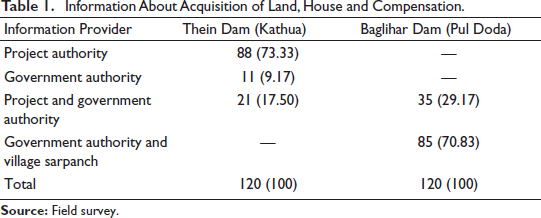
From Table 1, it has been observed that in Kathua district, 88 (73.33) per cent of the respondents were given information by project authority regarding the acquisition of land, house and compensation. A total of 11 (9.17) per cent of the respondents were given information by the government authority. The data also shows that 21 (17.50) per cent of the respondents were given information by both project and government authority. Whereas in Pul Doda, it has been found that 85 (70.83) per cent of the respondents were given information by the government authority and village sarpanch. And 35 (29.17) per cent of the respondents were given information by the project and government authority.
Information About Acquisition of Land, House and Compensation.
The study has found that in Kathua district, 23 (19.17%) respondents were satisfied with the compensation given by the state government. A total of 97 (80.83%) respondents reported that they were not satisfied with the compensation given by the government (Table 2). Majority of the displaced people were unhappy with their compensation they got under land acquisition. The displaced people stated that they have not got compensation according to the market value.
Satisfaction of Compensation of Land, House and Trees.
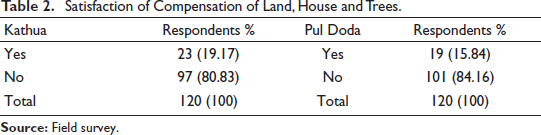
While in the case of Pul Doda, 19 (15.84%) respondents were satisfied with the compensation given by the government. A total of 101 (84.16%) respondents reported that they were satisfied with the compensation they got from the government. In Pul Doda, majority of the displaced people stated that the market rate was very high and thus were cheated by the government. The displaced people reported that they have not been given compensation according to the market value.
One of displaced person in Kathua revealed that the amount that he got as a compensation for the land, house and ancestral property, which he lost due to the displacement, was not enough and not at par with the market value. He said that his land was very fertile and was enough to fulfil his daily needs which he could get easily from the land. He further revealed that before the displacement he was totally dependent upon natural resources and agriculture and did not buy anything from the market. But after displacement, he lost everything and was now totally dependent on market economy. He said that he was not satisfied with the compensation amount which he received from the government as it was very meagre. The loss of property was very huge and irreplaceable while the compensation amount was very less (Suresh Kumar, 53-year-old).
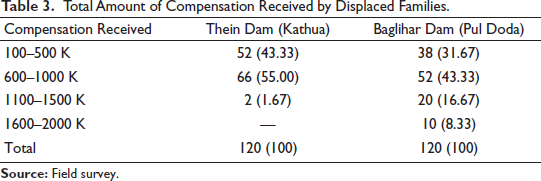
The data revealed that in Kathua district, 52 (43.33) per cent of the respondents received compensation between 100 and 500 thousands. There were 66 (55.00) per cent respondents who received 600 to 1000 thousands. Further data also indicates that only 2 (1.67) per cent respondents received compensation amount between 1600 and 2000 thousands. On the other hand, Doda (Pul Doda) data shows that 38 (31.67) per cent of the respondents got compensation amount between 100 and 500 thousand and 52 (43.33) respondents received 600 to 1000 thousands. The data also indicate that 20 (16.67) per cent respondents fall between 1100 and 1500 thousands. There were 10 (8.33) per cent respondents who received compensation amount between 1600 and 2000 thousands (Table 3).
Total Amount of Compensation Received by Displaced Families.
The study has found that in Kathua region 69 (57.50%) respondents reported that they themselves got benefits from the compensation. A total of 29 (24.17%) respondents reported that their father got compensation from the government. The study further observed that only 22 (18.33%) respondents reported that their brother got compensation after displacement (Table 4).
Who Got Benefits from the Compensation?
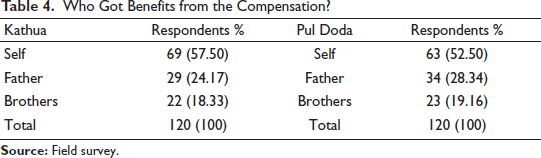
On the other hand, in Pul Doda region the study has found that 63 (52.50%) respondents reported that they themselves got compensation from the government. There were 34 (28.34%) respondents who reported that their father got compensation from the government. The study further observed that only 23 (19.16%) respondents reported that their brother got compensation after displacement.
One of the displaced persons revealed that his father got a compensation amount of 1600 thousands from the government. He distributed it equally among his five sons including me. As a result, he got only 300 thousand rupee as a compensation. He said that the amount was not enough for him to build a new house for his family after the displacement. He further said that he was thus forced to live in a rented house since 10 years. He has four children and it is very difficult for him to support his family with this little amount. Now he is working as a daily wager and living in a miserable condition with his four children (Jadgishkumar, 55 years).
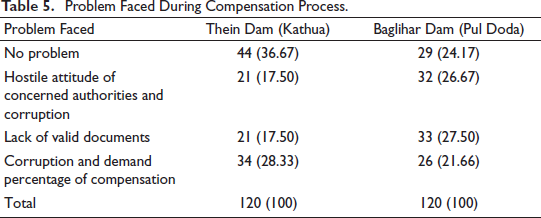
The data revealed that in Kathua district 44 (36.67) per cent respondents did not face any kind of problems during the compensation period. There were 21 (17.50) per cent respondents who faced problems during the compensation time, such as hostile attitude of authorities.
Data also show that 21 (17.50) per cent of respondents reported that they have faced problems due to lack of valid document proof of land and houses. There were 34 (28.33) per cent respondents who reported that they faced problems during getting compensation. It has been found that most of the concerned authorities did not cooperate very well with the affected persons and they were demanding the percentage of the compensation amount. Displaced family were helpless and finally they became a scape goat in front of the authority. They had no other option to move anywhere for justice because of helplessness, poverty, illiteracy and powerlessness.
While on the other hand, in Doda (Pul Doda) district 29 (24.17) per cent of the respondents reported that they have not faced any kind of problems during the compensation time. There were 32 (26.67) per cent of respondents who reported that due to the hostile attitude of the concerned authority they faced many problems. Data also shows that 33 (27.50) per cent respondents faced many problems due to the lack of valid document proof of land and houses. There were 26 (21.66) per cent respondents who reported that they have faced many problems during compensation time as the authorities were demanding a percentage of the compensation. It has been found that the Pul Doda people were getting compensation by Baglihar Land Collector of Ramban district and the displaced people were travelling more than 100 km from their native place to land collector to fulfil their formalities regarding the compensation.
One of the displaced persons revealed about the menace of corruption prevailing in the government and project authority for getting compensation. He said that the government authorities would demand bribe for settling their compensation case quickly. Further, he said that he had to travel more than 100 km to reach the concerned office to demand his compensation. As such it was not possible for him to go to the office every day to know about the status of his compensation. The concerned authority harassed him by asking him to provide more valid document or otherwise give them money to settle his case quickly. Thus, he said that he was rendered totally helpless as he was not in a position to give them money to get his compensation (Bashir Ahmed, 47-year-old).
Another displaced person reported a similar kind of problem. He said that he faced the problem of corruption and demand of percentage of compensation by the middle man. He revealed that whenever he used to go to the office to demand for his compensation, he would meet the middle man who used to ask him to give some percentage of the compensation money. The middle man told him that he would help him to get good amount of compensation from the government if he was ready to give him some percentage of the compensation amount. He further said that initially in first 7–8 months he himself followed the case and did not pay any money to anyone. But at last, he was compelled to pay 25,000 rupee to the middle man to get his compensation. At last, he said that there was a full network of corruption prevailing in the concerned department so he had no other option but to pay the bribe (Roshan Lal, 55-year-old).
The people affected by the acquisition of land, houses and trees in Kathua and Doda district were asked how they utilised the amount received by them as the compensation. Table 5 shows that in Kathua district, 49 (40.84) per cent of the respondents utilised the compensation money for house construction and land buying. And 58 (48.33) per cent of the respondents used compensation amount for house construction, livelihood consumption and land buying. The data also shows that 4 (3.33%) respondents used money for house construction, land buying and saving. Further data indicate that 3 (2.50%) of the respondents used money for livelihood consumption and marriages ceremonies. There were 2 (1.67%) of the respondents who used the compensation amount for commercial use, land buying and house construction. A total of 4 (3.33%) respondents used money for land buying. On the other hand, in Pul Doda region it has been found that 30 (25.00%) respondents used the compensation amount for house construction and land buying. There were 39 (32.50%) respondents who used it for livelihood consumption after receiving the compensation amount. The data also shows that 36 (30.00%) respondents have spent money for commercial use and also for saving. There were 8 (6.66%) respondents who used money for repayment of loan and commercial use. Further, 7 (5.84%) of the respondents used compensation amount for saving (Table 6).
Problem Faced During Compensation Process.
Utilisation of Compensation Money.
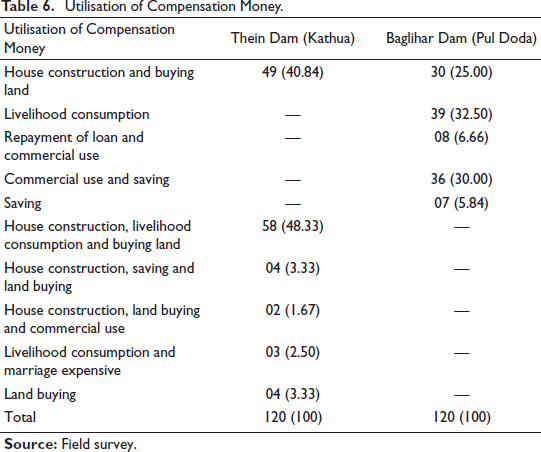
It has been observed that in Kathua region majority of the displaced people spent their compensation money in buying land and constructed their own houses. Land was easily available to them at that time though it was very costly. Whatever compensation they got, they utilised it all for purchasing land and constructing new houses. Whereas people displaced in Pul Doda region utilised their compensation amount in meeting their daily needs and for commercial purposes. It was very difficult for the people to get the land as land was not easily available. Land was available in hilly areas where there was no road connectivity. Thus, the majority of the displaced people were forced to live in rented houses and were utilising the compensation money to meet the daily needs. The displaced people also saved some amount of compensation money for the future in the hope that the respective government might provide them land for resettlement as promised before the displacement.
One of the displaced women shares her personal experience and revealed how her husband misused the compensation money that she saved for the future. She said that though she has saved some amount of money in the bank, but her husband who is a daily wager is a habitual drunkard and whatever she has saved he is using it for drinking alcohol, which is affecting their social life. She is thus very sad and depressed as she has no hope for the future.
Employment Issues Among Displaced People
The study has focused on the emerging problem of unemployment among the displaced people. Employment is a serious problem among forcibly displaced people. In spite of unemployment being a serious issue, the state government has no policy related to employment issues of the displaced people. Most of the people lose their source of earning after being displaced and face unemployment problems at the resettlement site. The state government does not pay any attention towards providing employment opportunities to the displaced people. In Jammu and Kashmir, due to dam displacement unemployment has emerged as a very serious problem among the displaced people. The state government has given only monetary compensation to the people, which is not enough to fulfil their daily needs. No provision is made by the government to provide employment to the people. Once the compensation gets finished, these people are left with nothing to feed themselves and their family. The study has focused on the employment problems in both Kathua and Pul Doda districts of Jammu and Kashmir.
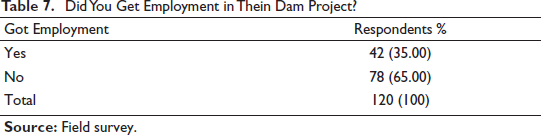
The study found that 42 (35.00%) respondents got employment in the dam project after displacement from their native place. There were 78 (65.00%) respondents who did not get any kind of employment in the dam project after displacement (Table 7).
Did You Get Employment in Thein Dam Project?
The study found that in Kathua, 19 (15.84) per cent respondents were given job in the dam project directly. There were 23 (19.16) per cent respondents who were given job after winning court case. One of the respondents reported that they struggled for nine years in court for getting job in the dam project. The data also show that 42 (35.00) per cent respondents were still struggling in the court case for getting jobs and 36 (30.00) per cent respondents did not show interest in court case (Table 8). It was found that those who were economically strong spent large amount of money to get employment directly in the Thein dam project.
How You Got Employment in Thein Dam Project After Displacement?
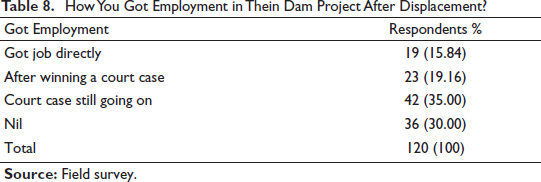
Some of the respondents reported that they got job only after winning the court case for which they had to fight the case in court for many years. The study further found that some of the displaced people are still fighting the court case from the last 20 years. These people belong to the backward caste. These people cannot spend large amount of money and thus their cases are pending in the court without decision. Even their advocates are not showing any interest in their cases as they are unable to give a large amount of money to them to fight their cases. It has also been observed that there were some displaced people who were satisfied by working as daily wagers and doing private jobs and thus did not file any court case to get job. They thought that the court cases were time consuming and required large amount of money to win the case. As such, they were least interested in getting to jobs by winning the court case.
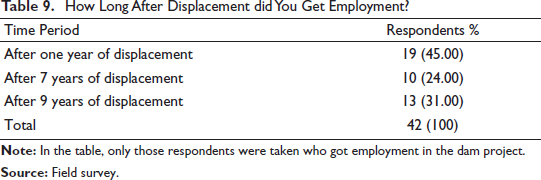
The study found that 19 (45.00%) respondents got employment in the dam project after one year of displacement. They were those who were economically strong and spent huge amount of money to get employment. There were 10 (24.00 per cent) respondents who got job after seven years of displacement. They got job after winning the court case. The study further observed that there were also 13 (31.00 per cent) respondents who got job after nine years of displacement (Table 9). They also got job after winning the court case.
How Long After Displacement did You Get Employment?
One of the displaced persons reported that he was fighting a court case since nine years to get employment for his son. He further said that he has spent more than 250 thousand rupee in the court case to get a job in the dam project. At last, only after spending such a huge amount of money he was able to get a job for his son (Dilbagh Singh, 58 years old).
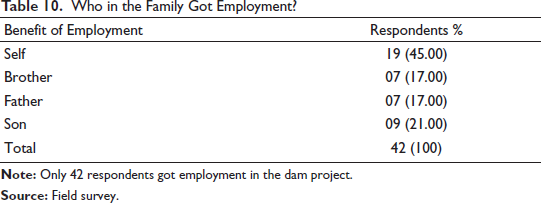
The study found that only 42 displaced persons got employment in the dam project. Some person got directly and some got employment after winning the court case. It has been observed that out of 42 displaced persons, 19 (45.00%) respondents reported that they themselves got the job after the displacement. There were 7 (17.00%) respondents who reported that their brother got job in the dam project. The study further found that 7 (17.00%) other respondents reported that their father got job in the dam project after displacement. There were also 9 (21.00%) respondents who reported that their son got job after the displacement (Table 10).
Who in the Family Got Employment?
Focus Group Discussion
The study has taken two focus group discussion (FGD), one in Kathua region and other in Pul Doda region. In Kathua region, FGD was based on inequality in employment opportunity among the displaced people. And in Pul Doda region, FGD was focussed on employment issues among the displaced people.
Inequality in Employment Opportunity in Kathua Region
In Kathua region, the study was based on the discussion among a group of 30 displaced persons and was about the inequality in employment opportunity among the displaced people by the government and the project authority. The study found some crucial fact after FGD. It has been observed that the majority of the displaced persons revealed that in the employment process inequality was existing. Those persons who were economically strong got the job easily in the dam project after spending a huge amount of money. During the employment process, there was a huge corruption among the project authority and the government officials to get jobs. The study has further observed that the higher caste group of people got job easily in the dam project as compared to the backward caste.
In the group discussion, people of different castes were present so it was difficult to gather more information as to how the people of higher caste got jobs easily as compared to the low caste. This was due to the reason that most of the displaced people present in the FGD were not ready to openly talk about inequality in employment opportunity based on caste. Nobody was ready to discuss as how the people belonging to the higher caste got job in the dam project. The researcher also did not force anyone to openly talk about such inequality. But whatever information was gathered from the FGD, it clearly reflected the fact that such inequality was present in getting employment among the displaced people. Some of the displaced persons also revealed that there are some people who are still fighting a court case since past 20 years to get employment for their children in the dam project or any other government sector.
One of the displaced persons shares his personal experience. He said that he lost each and every thing due to the dam project such as his agriculture land, ancestral property, house and source of regular income. He further said that he is also facing inequality in job even after losing everything. Thus, it can be concluded from the FGD that displaced people have to face lots of challenges such as inequality in jobs after being forcibly displaced.
Employment Issues Among Displaced People in Pul Doda
The second FGD was conducted in the Pul Doda region. It was found that unemployment emerged as a major issue among the displaced people. Most of the displaced people revealed that they are living in poverty and are dependent upon their petty business to earn their livelihood as there is no other alternative source of income. The state government also did not provide any employment package or made any such provision in its employment policy. People are forced to work as daily wagers to support their families. It has been observed that 10 years have passed and still these people are waiting for employment package from government authority. Majority of displaced people reported that the government gives only monetary compensation to the whole family and does not provide any employment to any member of the family. Since past 10 years, there was not any employment plan by the government. It was also seen that due to the backwardness of the area, lack of industries and factories, and so on, people were forced to work as daily wagers as no other alternative source of employment was available in that area. It can thus be concluded from the FGD that unemployment is a major challenge for the displaced people in the Pul Doda region. The government and the project authority also did not pay any attention to solve their problem. Since past 10 years, these people are unemployed and are forced to work as daily wagers.
Conclusion
Since independence, thousands of dam projects have been constructed and millions of people are forcibly displaced from their ancestral homeland in India, especially in Jammu and Kashmir. All these development projects have been constructed without proper policy and planning. The displaced people are given only monetary compensation and left alone. It has been observed that after displacement, majority of displaced people were facing lots of challenges such as compensation issues, employment and land acquisition. In India, the LAA is gender biased. The study has also found that in the LAA, 1984, landless and tribal people always faced discrimination with regards to their compensation, because majority of the displaced people were working on a common land and they did not get any legal land rights. The landless and tribal people were not provided any compensation. In Jammu and Kashmir, the displaced people faced lots of challenges after being forcibly displaced from their ancestral homeland. Compensation and employment have become serious issues among the displaced people. After displacement, majority of people are facing unemployment and they are forced to work as daily wagers. Neither the state government nor the project authority pays any attention towards the displaced people. It can thus be concluded that compensation, land acquisition and employment issues have emerged as serious problems among the displaced people. Dam displacement is a serious threat to human life. Displaced people not only lose their ancestral property and source of income but their entire social life gets affected. Displaced people are forced to live in miserable conditions without proper facilities.
Suggestion and Policy Recommendation
There is a special need to implement a proper land acquisition law so that the displaced people can get proper benefit and do not face any kind of problems in future.
Before constructing any development projects, resettlement land should be allotted to the displaced people, so that they can start their social life easily. Every displaced family including the adult members of the family should be given special compensation package.
In the compensation process, the state government should use digitalisation process in the distribution of compensation to the displaced people such as direct benefit transfer (DBT) process. So that no middle man is involved and there is no issue of bribe. With the DBT process, the corruption level will decrease and people will get proper benefit from the government.
In the compensation process, both the centre and the state government should work together. So that the state government does not feel any economic burden.
Every displaced family member should be provided employment by some means. So that they can earn their livelihood in future. The project authority should also adopt a small resettlement area and provide basic facilities such as health, education, road, drinking water, and so on.
The respective state government and project authority should provide special skill training programme to every displaced family members. So that they are able to earn their livelihood in different places.
Footnotes
Declaration of Conflicting Interests
The author declared no potential conflicts of interest with respect to the research, authorship and/or publication of this article.
Funding
The author received no financial support for the research, authorship and/or publication of this article.