




Abstract
The study aims at examining the disparity in crop productivity and input usage between male- and female-headed self-cultivating farm households in the coastal region of Odisha, India. Field-level data from 221 sample households are collected and analysed following a multi-stage sampling procedure. The findings reveal that the male-headed farms have both higher productivity and better use of inputs in realizing returns than the female-headed farms. Within the female-headed farms, the de facto ones have an edge over their de jure counterparts in both these respects. Since the study area is a disaster-prone area, adding further to the gender-constraints of female-headed farms in the use of inputs and realizing commensurate yield, the study suggests for measures to build capacity among women farmers to produce efficiently.
Introduction
Agricultural productivity in general is at a low level in India because a large majority of farmers here operate on a small scale. In addition, regions subject to high degree of risks due to occurrence of natural calamities like cyclone, flood, drought, etc. (which is increasing in recent years) also exhibit lower crop yield. In the above circumstances, over the last two decades, the country has witnessed rapid rise in rural male workers’ migration to urban centres in search of non-farm activities leading to significant rise in the number of women labour force into agriculture—both as cultivators and agricultural labourers (Agrawal & Chandrasekhar 2015>; Chand et al., 1985>; Ghosh & Ghosh, 2014>; Patnaik & Lahiri-Dutt, 2021>). As reported by the Census data, between 1991 and 2011, while agricultural workers (cultivators + agricultural labourers) have increased by 43.8 percent, the total number of cultivators has gone up by 10.3 per cent and that of female cultivators by 65.2 per cent. Interestingly, during this period while there has been a decline in the number of male cultivators by more than 3 million (from 85.8 million in 1991 to 82.7 million in 2011), the number of female cultivators that entered into agriculture sector has jumped up by 14.2 million (from 21.8 to 36 million).
Studies measuring women’s contribution in the Indian agriculture are very limited both in number and approaches. Unlike the large body of literature developed in case of Sub-Saharan Africa, Latin America and a few other countries measuring the disparity in agricultural productivity between male and female farms (Ali et al., 2015>; Gebre et al, 2021>; Koirala et al., 2015>; Lopez & Lopez, 2014>; UNDP-UNEP, 2015>; Yiadom-Boakye et al., 2013>), the Indian studies are extremely few—hardly two studies in this respect so far (Agarwal & Mahesh, 2021>; Mahajan, 2017). While Mahajan’s (2017) study relates to examining the gender differentials in farm productivity between men and women farm managers, the most recent study of Agarwal and Mahesh (2021)> estimates the farm productivity gap between men and women land owners at the macro-level using some socio-economic indicators. Both these two studies, though provide some relevant insight on the issue in the Indian context, are based on the data earlier collected on a wider scale—the first one by the University of Maryland and the National Council of Applied Economic Research in 2004–2005 and the second one by the International Crops Research Institute for the Semi-Arid Tropics (ICRISAT) in 2014. This study, however, is an empirical one and seeks to fill the existing research gap by examining gender differences in farm productivity and input usage between male-headed and female-headed self-cultivating farms using farm-level data. In view of the lack of homogeneity observed among the female-headed households (Agarwal, 2012>; Chen & Dreze, 1995>), intra-gender differences within the female-headed farms on these twin issues are also examined.
Data and Methodology
Data used for the study are obtained from 221 gender-headed self-cultivating farm households selected from Khordha district of the coastal region of Odisha. A multi-stage sampling technique is followed to select the sample households for the study. In the first stage, Khordha district from the coastal region of Odisha is purposively selected as the area of the present study. Despite being a progressive district in the state in terms of higher per capita income, Khordha is graded as a high-risk region because of the frequency of occurrence of natural calamities like cyclones, strong wind, flood, etc., which considerably influence the livelihoods of farmers, particularly small farm holders forcing large-scale male migration to urban centres and women managing the agriculture. In the second stage of sampling, the district is classified into two distinct sub-regions on the basis of soil, topography, and available irrigation facility—the deltaic alluvium region comprising three community development (CD) blocks (Balianta, Balipatna and Chilika), and the lateritic region consisting of seven blocks (Bhubaneswar, Begunia, Bolagad, Tangi, Banpur, Jatni and Khordha). From the point of view of topography, soil quality and availability of irrigation, the former is considered agriculturally a better region as compared to the latter. Accordingly, one block from each sub-region is chosen at random. Thus, Balipatna from the first category region named henceforth as Agriculturally Progressive Block (APB) and Begunia from the second category region henceforth named as Agriculturally Laggard Block (ALB) are selected at random for the study purpose. In the third stage, from each block five villages are chosen at random for complete enumeration of the households. With the help of Agriculture Extension Officials of the concerned blocks, all the self-operated farmers (within one hectare of holding) are enumerated separately from the selected villages. These farm holders are further classified and separated on gender basis into two categories, viz. (i) male-headed farm households (MHFs) and (ii) female-headed farm households (FHFs)—the latter category being further classified into ‘de jure’ and ‘de facto’ FHFs. The former being the customary and legal heads—the widow, divorcee, separated, single or never married women and the latter self-reported female-heads whose spouses have migrated to urban areas for off-farm occupation. A total of 99 households from the APB (67 MHFs, 14 de jure FHFs and 18 de facto FHFs) and 122 households from ALB (71 MHFs, 19 FHFs (de jure) and 32 FHFs (de facto)) are selected for the questionnaire purpose. A structured questionnaire is served to obtain the required information from the sample households.
Analytical Techniques Used
The analysis of variance is applied to calculate the differences in the crop yield between and within the gender categories. Tukey’s test is used to identify difference in the means. Multiple regression analysis is fitted to examine the input usage among the gendered farms influencing farm returns as a measure of crop productivity. The Cobb–Douglas production function technique is used in the data analysis. A two-stage estimation procedure is followed. In the first stage, regression of pooled data for all farm households irrespective of gender categories is taken. Along with six independent variables, two dummy variables such as land types and sex of the household heads are taken in the equation. In the second stage, separate functions for both MHFs and FHFs (de jure and de facto separately) are fitted. Per acre money value of gross farm return (main and by-products) taking into account farm-gate price of crops—Kharif and Rabi—is taken as a dependent variable (Y). The independent variables included in the functional equation are per acre expenses incurred in using human labour (hired and imputed value of family labour) (X1), bullock labour (X2), seed (X3), manures and fertilizers (X4), pesticides (X5), irrigation charges (X6), land types (upland: 0 and low land: 1) (X7) and gender of the household head (male: 1 and female: 0) (X8).

Profile of the Study Blocks
The two blocks selected for the study from Khordha district differ considerably from the point of view of basic agro-linked features. Balipatna CD block chosen as APB is situated in the deltaic region of the three prominent rivers of the district, the Kuakhai and its tributaries Daya and Kushavadra. As such, the block is having the alluvial soil formed from the deposition of sediments brought by the rivers and thus suitable for multiple cropping. Besides, the block has the facility of both canal irrigation and lift irrigation. Of the total net sown area, 47 per cent is exclusively irrigated by canal, 31 per cent by lift irrigation points and 12 per cent both by canal and lift points. In contrast, Begunia CD block selected as ALB is a region with laterite soil not much helpful for cultivation. There is hardly 20 per cent of the net sown area under minor irrigation (flow and lift together) with too much uncertainty in the availability of irrigation water round the year. During summer, canal water does not reach the villages at the tail-end. In view of the differences in these two basic physical features existing between the sample blocks, the former is denoted as APB and the latter as ALB for the sake of analytical comparison of data in the study.
Results and Discussion
Table 1 presents some basic farm statistics of the gender-headed farm households in the selected blocks— Agriculturally Progressive Block (APB) and Agriculturally Less-Progressive Block (ALB). Of all the sample farm households, predominantly a large proportion is found concentrated in the MHFs category accounting to 67.7 percent in number and 66.5 per cent in operated area in APB and 58.2 percent in number and 67.1 per cent in operated area in ALB, respectively. Within female-headed households, the de facto FHFs are found to be in larger proportion than the de jure ones both in terms of number and operational area. In APB, the de facto female-headed households constituting 18.2 per cent in number share 20 per cent in cropping area as compared to their de jure counterparts accounting to 14.1 per cent in number and 13.4 per cent in area. In case of ALB, the de facto female heads account for 26.2 per cent in number and 18.1 per cent in area as compared to the de jure ones accounting to 15.6 per cent in number and 14.8 per cent in area. Thus, in the distribution of farm households in relation to genders, the MHFs significantly outnumber the FHFs (in number and cropping area) and within FHFs the de facto ones outnumber the de jure ones and this is irrespective of the blocks. On the average size of farm holding, there is not much differences between and within the gender categories. In case of APB, while the MHFs are having holding size of 0.71 acre, their counterparts under FHFs de jure and de facto are having 0.70 and 0.69 farm size of holdings, respectively. In case of ALB, the holding sizes of MHFs and FHFs de jure and de facto come to 0.62, 0.60 and 0.58 acre, respectively. Area under irrigation as a percentage to operational area does not vary much across gender categories, though between the blocks we find APB having better availability of irrigation facilities than the ALB. The basic farm statistics of the gender-headed farm households as revealed thus do not show discernible differences between the male-headed and female-headed farms and within female-headed between de jure and de facto ones. The findings thus are in contrary to most of the earlier studies that have shown significant differences existing in the resources across gender-headed farms (UN Women & UNDP-UNEP, 2018>; World Bank, 2011>).
Distribution of Farm Households with Basic Farm Statistics in Relation to Gender Heads.
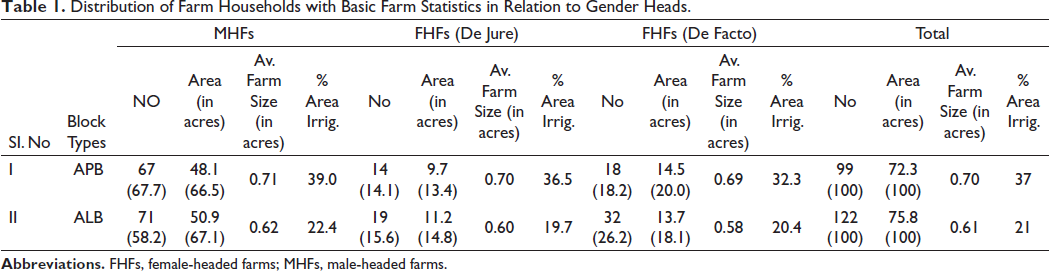
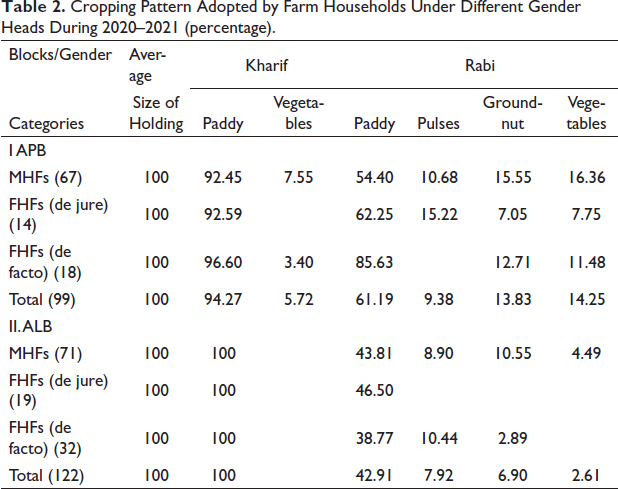
Table 2 discusses the cropping pattern in relation to gender of the farm households in the study blocks for the year 2021. As it is revealed, the farms under APB with better soil quality and relatively secured irrigation are found engaged in multi-cropping practices as compared to their counterparts in ALB which with poor soil quality and very limited and uncertain availability of irrigation water concentrate largely on the cultivation of paddy during Kharif with very limited acreages of Rabi paddy and some pulses. Across the gender categories, it is the MHFs which are found having better cropping practices than the FHFs. While the MHFs are found cultivating 2–3 crops such as groundnut, vegetables along with paddy, the major staple crop, their counterparts in FHFs are largely cultivating paddy with very little area under pulses and vegetables. Within FHFs, the de facto ones are found practicing better crop rotation than their de jure counterparts. The difference in cropping pattern between MHFs and FHFs might be due to the fact that the former because of their better mobility and access to external resources have been able to invest in the cultivation of cash crops (groundnut and vegetables) which is not the case with the female-headed households whose mobility in accessing resources is limited due to gender-specific constraints. Within FHFs, the de facto households being financially better off due to remittances received from their spouses are found investing a little more in the cultivation of cash crops (vegetables) other than paddy. In contrast, the de jure being the financially poorest households are found concentrating mostly on cultivation of paddy to meet their consumption needs.
Cropping Pattern Adopted by Farm Households Under Different Gender Heads During 2020–2021 (percentage).
Gender Differences in Crop Yield
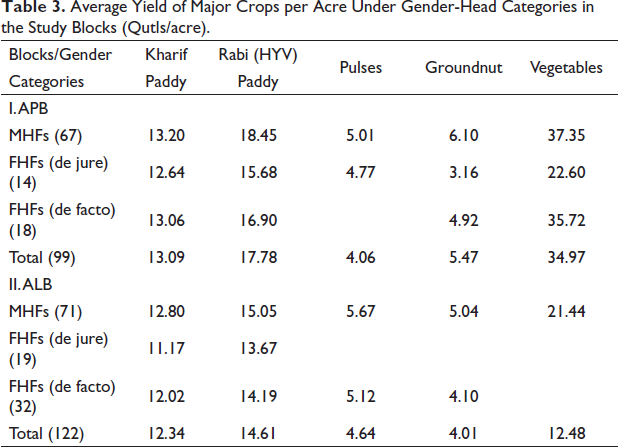
Farming performance is generally measured using partial productivity measures of output per unit of land/labour. As such, in estimating the gender differences in crop productivity and articulate policy thereof, we have estimated per acre crop yields of gender-headed farm households and compared both between and within the categories. In this context, earlier studies evaluating gender differences in crop yield have largely reported higher productivity of male farms over their female counterparts irrespective of regions and crops grown (Gebre et al., 2021>; Mahajan, 2018>; UNDP-UNEP, 2015>). In this study, we estimate the per acre yield differences in relation to gender using analysis of variance. Tukey’s test is applied to identify the difference between the means among the samples. Tables 3 and 4 provide the required data in this regard.
Average Yield of Major Crops per Acre Under Gender-Head Categories in the Study Blocks (Qutls/acre).
Analysis of Variance of Yield/Acre of Different Crops Between Sample Farms Under Gender-Head Categories.
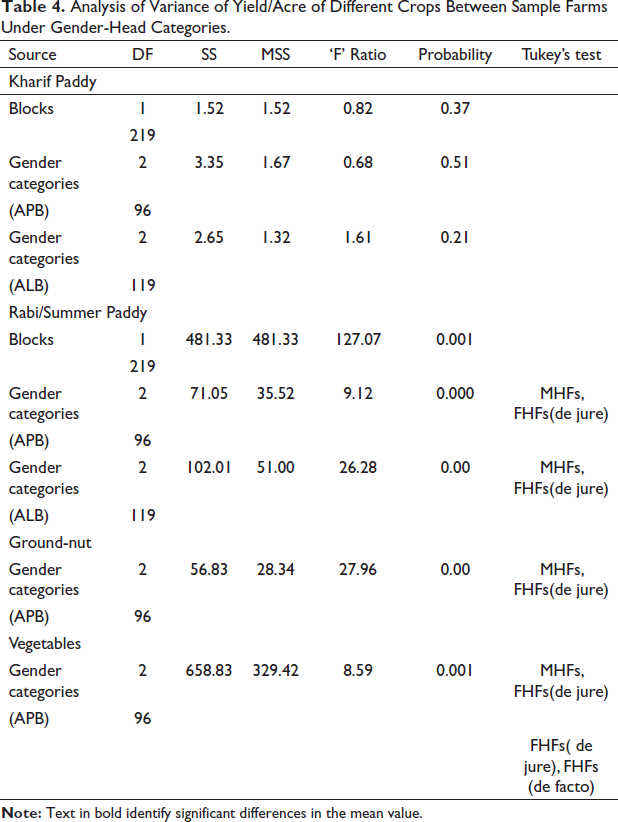
Table 3 reveals considerable differences in the crop yield between the blocks irrespective of the genders and crops grown. However, ‘F’ test indicates significant difference in mean yield rate of Rabi Paddy only. For Kharif paddy, the yield difference between the blocks is not found statistically significant.
Gender differences in crop yield give some mixed trends. In case of Kharif paddy, the MHFs of both APB and ALB are found realizing higher yield per acre over their counterparts—both the de jure and de facto FHFs. However, such differences in yield are not found statistically significant. For Rabi paddy, however, the ‘F’ test indicates significant differences in the yield rate between gender categories. The differences in the mean yields are identified between MHFs and de jure FHFs in both APB and ALB blocks (Table 4). For groundnut and vegetables, the mean yield differences are also found statistically significant between and within gender categories in case of APB only. And such yield differences are identified between MHFs and de jure FHFs for both the crops. For vegetables, we also find statistically significant difference in mean yield within FHFs—between de jure and de facto households and such yield differences are found identified between these two categories.
Gender and Input Usage
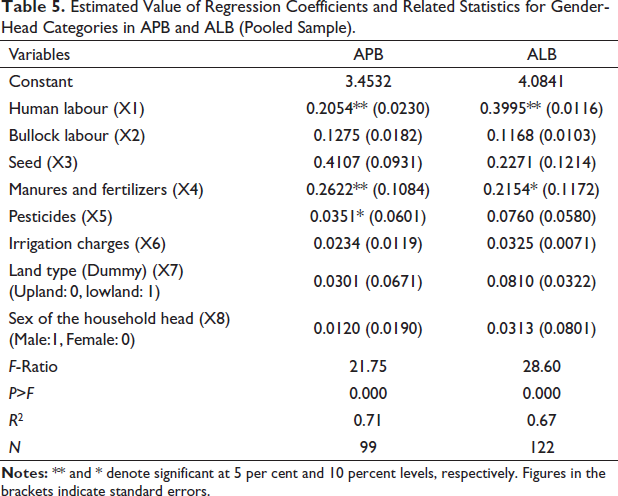
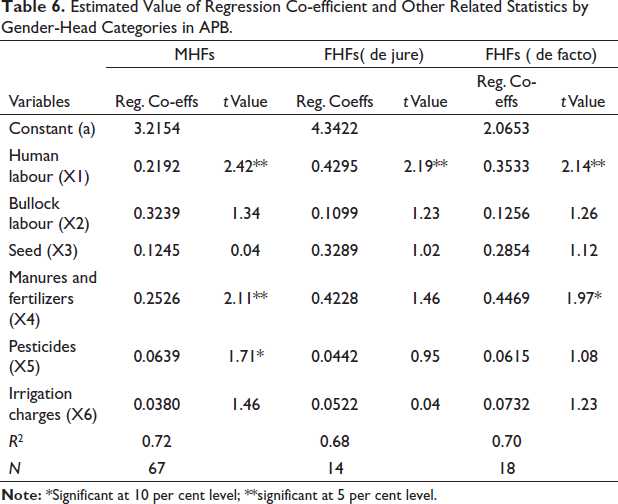
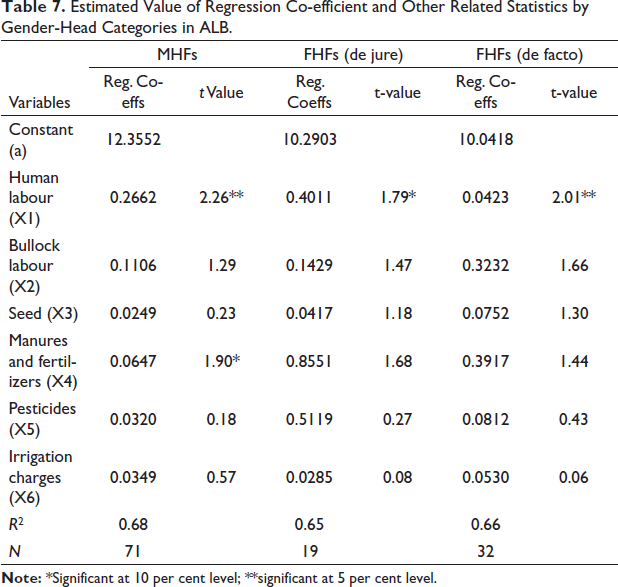
Having observed that there exists significant differences in crop yield, both between and within gender-headed farms, the input usage impacting the value of gross farm returns (a better indicator of farm performance over yield) of sampled farm categories is examined. Earlier studies analysing productivity gap between gendered farms have reported significant differences in the input usage across male and female farms. Since agricultural inputs are important for not only enhancing the yield but also for higher production and better income realization, we have here employed multiple regression analysis to identify the factors (inputs) contributing to the output performance among the sample-gendered farms (Tables 5–7).
Estimated Value of Regression Coefficients and Related Statistics for Gender-Head Categories in APB and ALB (Pooled Sample).
Estimated Value of Regression Co-efficient and Other Related Statistics by Gender-Head Categories in APB.
Estimated Value of Regression Co-efficient and Other Related Statistics by Gender-Head Categories in ALB.
The analysis of pooled data for all the farm households irrespective of gender for the two selected blocks (Table 5) indicates that the Cobb–Douglas equation reveals significant and positive influence of human labour on gross value of output in APB as well as ALB Blocks. In addition, while the variables like manures-fertilizers and pesticides turn out to have significant influence on gross value of output for APB, in case of ALB it is the manures-fertilizers only which are found to be positively influencing the dependent variable—gross value of output. Both the dummy variables such as land types and gender of the household head used in the equation are found to have no significant influence on the dependent variable in both types of blocks. The co-efficient of multiple determination (R2) estimated for the pooled data indicates that in case of APB and ALB, 71 per cent and 68 per cent of the variation in the gross value of output are explained by the selected variables, respectively.
Tables 6 and 7 present the estimation of causal effect of gender on value of gross farm output through separate functions for MHFs and FHFs data—the FHFs data are further estimated under de jure and de facto FHF households. The coefficient of multiple determination (R2) of the model indicates that the independent variables included in the equation explain 68–72 per cent of the value of gross farm return for the farms taken under gender categories in APB and 65–68 per cent for the farms taken under gender categories in ALB. The results of the production function analysis show that the regression coefficient associated with human labour is found to be the most significant variable explaining gross value of the output (the dependent variable) of both MHFs and FHFs farms (de jure and de facto) in both types of blocks. In addition, for MHFs of APB, while variables such as fertilizers-manures and pesticides turn out to be positive and statistically significant explaining the gross value of output, for MHFs of ALB it is only the manures-fertilizers which is found positively significant influencing the gross value of the output. Within the FHFs, the variable like manures and fertilizers for the de facto ones of APB are found to have significant positive effect on gross value of the output. All other regression coefficients of the variables that indicate positive effect on the value of output are found to be statistically non-significant for all the three gender-headed farms irrespective of the block types. This indicates that there lies scope for higher use of these inputs to increase crop production and gross returns by the sample farms in both the selected blocks.
Between the gender categories, the input usage of MHFs is found to be better than both the de jure and de facto FHFs. Within FHFs, the de facto ones’ input usage is seen comparatively better than the de jures. The regression coefficients of three variables such as human labour, manures-fertilizers and pesticides are found positive and significant in explaining the dependent variable for the MHFs of APB indicating that these households are using these three inputs optimally. However, among their female-headed counterparts, it is only the human labour in case of de jure FHFs and human labour and manures and fertilizers in case of de facto FHFs, these variables are found positive and statistically significant in explaining the dependent variable. In the ALB block, the MHFs also exhibit better input usage over their both FHF counterparts. While the MHFs in ALB are using human labour and manures-fertilizers optimally influencing the dependent variable, their female counterparts—both de jure and de facto FHFs—have only used human labour optimally. Within FHFs of ALB, no difference is noticed in the use of inputs influencing the gross farm returns.
Conclusion and Policy Suggestions
The study finds significant disparity in the crop productivity between and within gender-headed farms. It also shows how the intensity of input usage influencing value of gross farm returns varies according to the gender heads. Between the MHFs and FHFs, it is the former category which is found to be relatively better off in realizing higher crop yield per acre of land than the latter (both de jure and de facto) irrespective of the agri-development situations taken under study. Within the female-headed farms, the de facto female-headed households are also found reaping higher crop yield over their de jure counterparts. In the input use context, the study reveals better association of inputs with gross farm returns in case of male-headed farms than that with female-headed farms. Within female-headed households, the association between inputs and gross farm returns is found stronger among the de facto female-headed households than the de jure ones. Thus, both in respect to crop yield and input use, the female-headed farms in general and de jure FHFs in particular are found significantly at a lower level than the male-headed farms. The poorer performances of FHFs in general and de jures in particular over their counterparts might be due to their lower resource capability in investing in crop production and benefitting thereof. Since the study area is a disaster-prone area which adds further to the gender-constraints of female-headed farms in the use of inputs and realizing commensurate yield, the study suggests for measures to build capacity among women farmers to produce efficiently. Along with providing resource support, there is a need for educating the women farmers to go for resilient agricultural practices so as to achieve higher productivity and sustainable returns against the odds from the disasters.
Footnotes
Declaration of Conflicting Interests
The author declared no potential conflicts of interest with respect to the research, authorship and/or publication of this article.
Funding
The author received no financial support for the research, authorship and/or publication of this article.
