




Abstract
Agricultural-land sale prices in India exponentially increased during post-reforms period. This article studies operation of agricultural-land sale market and its implications in Andhra Pradesh during 2001–2017. It is based on primary data from six villages in three regions. The results show that sale prices of unit agricultural land have skyrocketed, and they are no way related to returns from land. The rich, non-cultivating households are increasingly buying agricultural land at higher prices for non-cultivating purposes and left fallow. They treat agricultural land as gold for store value, speculative trading, tax benefits, etc. The higher land sale prices along with depleting returns tempted distressed small farmers to sell their land. Consequently, cultivating small farmers are pushed to supply-side of land market as distressed sellers but not on the demand side of land market as buyers. Agricultural land is slowly but permanently going away from the hands of cultivator to noncultivators. Continuation of these trends has an adverse impact on equity and efficiency in agriculture land ownership in the state.
Keywords
Introduction
Property in the soil is the original source of all wealth (Marx, 1970). This statement holds true for Indian agriculture. There has been a sudden surge in demand for buying the agricultural land during the recent decades since 2000s. Surprisingly, it is not by the households from the agricultural sector but from the non-agricultural sector. The unit agricultural land prices in India across all the regions have skyrocketed during the recent decades, much above the prices in advanced nations. 1 On the other side, the agriculture sector in India during this period has been undergoing a crisis with depleting returns from land. This is a paradoxical situation in economics where the price of a commodity is increasing while its returns are decreasing. It means that the agricultural land is being demanded for other than the purpose of cultivation. Cultivating households see it as livelihood asset while the non-cultivating households see it as speculative commodity like gold, which is used for the store of value for surplus money or speculative trade or tax haven, etc. This kind of differential use of the agricultural land by different sections of households created an unhealthy atmosphere in its sale market in India during late reforms period since 2000s. This article studies these peculiar conditions in agricultural land sale market and their implications in Andhra Pradesh.
The literature reveals that the market for agricultural land sale in India was inactive in the past where it was only less than 2 per cent of total agricultural land per annum (Basu, 1986; Dreze, 1997; Saith & Tankha, 1997; Sarap, 1996; Shergil, 1986; Vijay, 2002, 2009). The land sales were mostly involuntary by the poor farmers (Coin, 1981). Unless forced by extreme circumstances, a resident villager does not sell his land (Bardhan, 1984). The reasons for sale of farmland in India were mostly led by distressed reasons such as indebtedness, random shocks caused by health, accidents, sociocultural issues of dowry, marriage, education, etc. (Dreze, 1997; Sarap, 1996; Vijay, 2009).
There were many reasons for rise in land sale prices in India. The rising land prices during 1970s and 1980s were due to impact of Green Revolution and diversification of rural economy (Sarap, 1996; Shergil, 1986). Higher price per unit land would be commanded when farmland is transacted for residential and other non-agricultural use (Saith & Tankha, 1997). The differential growth rate between rent and land price of land is attributable, inter alia, to the unregulated land market and excess liquidity at the micro level (Hirashima, 2008). Increasing money supply from expanded credit, rising incomes from white, black and foreign sources and increasing wealth inequalities are the other reasons for it (Chakravarthy, 2013). When the transactions occur within relatives, friends and same community, the price may be suppressed than the market price (Saith & Tankha, 1997; Sarap, 1996).
There were mixed views about the benefits of agricultural land sale market operations. In the initial phase of land reforms, though inactive, the land markets have worked in favour of landless, tenants and small farmers in expanding their land base in Ryotwari regions of Maharashtra (Rao, 1972). The village studies in Uttar Pradesh (Palanpur and Parhil) and Punjab have observed that the small and lower social group famers have gained land (Dreze, 1997; Saith & Tankha, 1997; Shergil, 1986). The sale markets worked in favour of smaller farmers in the better land reforms implemented state of West Bengal (Rawal, 2002). The land sale markets in India as a whole have benefited land poor and labour abundant to improve their land ownership (Deininger et al., 2007). Contrastingly, the other studies show that the land sale markets rarely provide level-playing field for the poor (Carter & Barham, 1996). It is the more of large farmers who have gained in Uttar Pradesh (Mani & Pandey, 2009). The non-cultivators emerge as large-scale buyers of land in the villages of Andhra Pradesh (Vijay, 2009).
The current operation of agricultural land sale market is different from the past because of new developments like high but skewed economic growth, which excludes the agricultural sector, increasing demand for agricultural land by rich non-cultivating households, skyrocketing of land prices beyond the reach of small cultivator, etc. The literature survey shows that there is no study which looked into the operation of agricultural land sale market in India during recent high price period. To address this research gap, this article studies the operation agricultural land sale market and its implications during late reforms period in the state of Andhra Pradesh, which have free market 2 for the agricultural land purchase.
In this context, this article frames the specific research questions such as:
What is the extent of agricultural land sale market in Andhra Pradesh during late reforms period since 2000s?
What are the levels and trends in unit agricultural land prices and income from land?
What are the reasons for the agricultural land sale transactions?
What are the factors of sudden rise in agricultural land sale prices?
What are the implications of agricultural land sale market at higher land sale prices?
Data and Methodology
The current study focused on the sale market for agricultural land in Andhra Pradesh. It was based on both secondary and primary information from village surveys. The data on area of agricultural land transactions (sales & purchases) in the villages since 2001 were obtained from Sub-Registration offices at Mandal level. Primary information on actual land sale price, occupational details of agents, reasons of transaction, cost of cultivation, output values, etc., were collected from the sample land transacting households (buyers and sellers) in six selected villages. The villages were purposively chosen from three districts in three different agricultural developmental regions in the state. The districts were selected based on the District Agricultural Productivity Index in Gurmail Singh’s study (2007). 3 The selected districts were Guntur from developed, Viziyanagaram from semi-developed and Anantapuramu from underdeveloped regions. Two villages were chosen from each district, out of which one was urban proximate and the other was remote (see the Table 1). See Appendix 1 for a brief description of socioeconomic characteristics of field survey villages.
Selection of Villages and Sample of Land Sale Transactions.
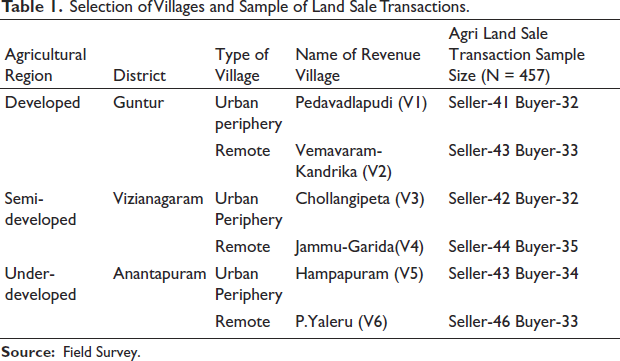
The study considered the agricultural land transaction rather than household for drawing the sampling. This was because one household may engage in multiple land sale transactions (sale or buy), but each land transaction may be distinct in terms of its reason to sell or buy. About 70 sample sale transactions were drawn from each village from the total list of agricultural land transactions during 2001–2002 to 2016–2017 based on stratified random sampling method covering all the years. Total 458 agricultural land sale transactions from all the six selected villages were selected for the study (see Table 1 for details). The questionnaires were used to collect the information on land transaction from the selected sample transaction households. Personal interviews with key informants in the village were conducted to elucidate the broad issues of agricultural land sale market in the village also to overcome the problem of recollection of old information by few households. 4 The village field surveys were conducted during February–May 2017.
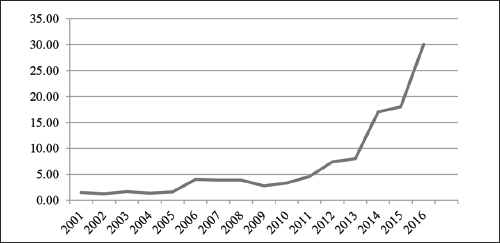
The study period covered the late reforms period from 2001–2002 to 2016–2017. To provide the comparative analysis between low and high price period, the total study period was divided into two sub-periods where first sub-period is from 2001–2002 to 2009–2010 as relatively lower price period and the second sub-period is from 2010–2011 to 2016–2017 as relatively higher price period as seen in Figure 1. The study is both empirical and analytical in nature. Basic statistics, compound growth rates and tabulation were used to analyse the quantitative data.
Trends in Agricultural Land Sale Price per Acre in Total Surveyed Villages of A.P–At Current Prices (in Rs Lakh). Source: Field Survey.
The Plan of the Study
After the introduction, ‘Operation of Agricultural Land Sale Market’ analysed operation of agricultural land sale market in terms of extent of sale, prices and income. ‘Profile of Agents’ provided details about the profile of market agents, ‘Reasons of Agricultural Land Sale Transactions’ discusses the households’ reasons for transaction, ‘Factors of Agricultural Land Sale Prices’ analyses the factors of higher land prices, ‘Implications of Agricultural Land Sale Markets and Prices’ studies the implications of agricultural land sale markets at higher prices and final section provides the conclusion.
Operation of Agricultural Land Sale Market
Extent of Sale
The extent of agricultural land sale 5 in all the surveyed villages in A.P during the study period stands at 0.98 per cent and it varies from about 0.8 per cent to 1.2 per cent across the individual years (Table 2). It is relatively low during the second sub-period (0.96 per cent) than in first one (0.99 per cent), but it varies across the individual villages where the extent is relatively high in villages of developed and semi-developed regions than that of villages in under-developed region. However, there are high levels of fluctuations in the agricultural land sales as shown by the higher standard deviation values. The extent of the agricultural land sale reported in the current study is close to earlier individual studies 6 (around 1 per cent) in other states. Total 16 per cent 7 of agricultural land was transacted in the sale market in the surveyed villages during the total study period (2001–2016), which is a considerable area share to have an influence on the operation and outcome of land sale market.
Extent of Sale and Average area of Agricultural Land Sale in Total Surveyed Villages (Per Cent).
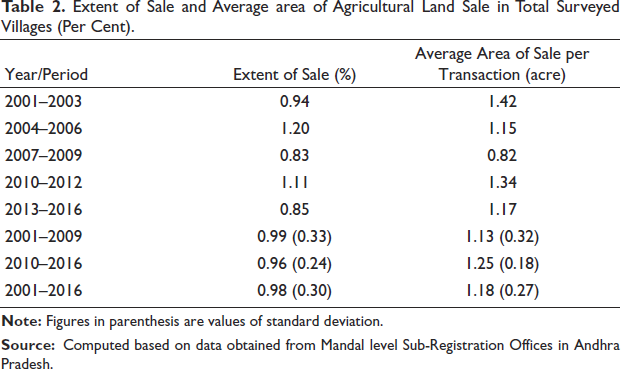
The average area of land sale per transaction stands at 1.18 acre for the total study period and ranges from 0.82 acre to 1.42 acre across the years for the total surveyed villages in A.P (Table 2). It has slightly increased from first sub-period (1.13 acre) to second sub-period (1.25 acre), indicating the increasing size of land sale per transaction. It is relatively high in villages of underdeveloped regions compared to others.
The reasons for the rise in extent of agricultural land transactions in developed and semi-developed regions are the rise in demand for agricultural land by the rich non-cultivating households who want it for the purpose of investing their surplus money in land for speculative trading. On the other hand, the prolonged distress in agriculture along with relatively higher land prices also induced the owners to sell the agricultural land. The specific reasons for the rise of average area of land per transaction in all the regions, more so in under-developed regions, are that the few rich non-cultivating households buy the land at large quantity, and this is relatively high in under-developed region compared to developed region, as the people tend to buy more quantity of land in a transaction when the unit prices are relatively low.
Prices and Income of Agricultural Land
In a normal condition, the sale price of unit agricultural land shall depend on its productivity or income. Following this, higher land sale price should mean higher income from the land. But this condition does not hold true in the agricultural land sale market in the surveyed villages of A.P for various other reasons discussed in forthcoming sections.
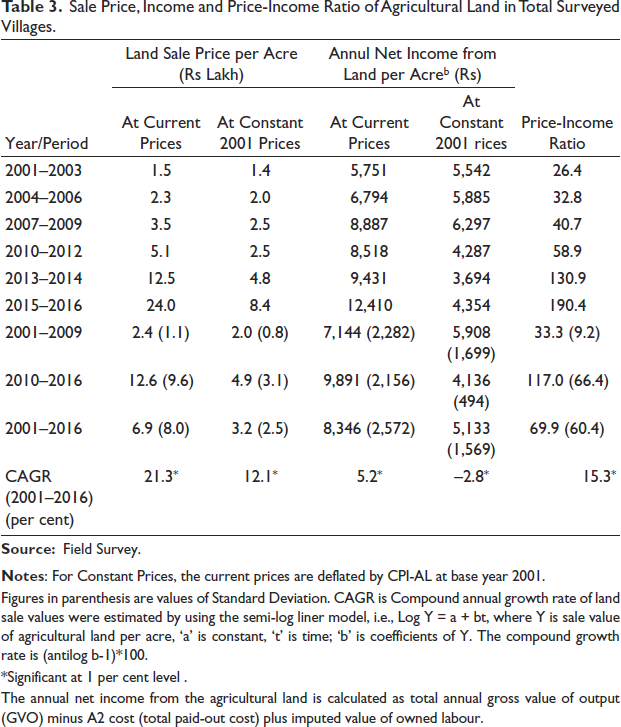
The sale price of agricultural land per acre at both current and constant prices in the total surveyed villages in A.P has witnessed fast increasing trend during the study period (Table 3). The price trend follows two phases where slow rise is observed during 2001–2009 and fast rise is observed during 2010–2016 (Figure 1). The average price per acre of agricultural land at current prices has increased from Rs 1,50,000 in 2001–2003 to Rs 2,40,000 in 2015–2016 that is more than 16 times rise with compound annual growth rate (CAGR) of 21.3 per cent. At 2001 constant prices (at 2001), it has increased from Rs 1,40,000 per acre in 2001–2003 to Rs 8,40,000 per acre in 2015–2016 that is six times rise with CAGR of 12.1 per cent. The rise was so high during second sub-period (2010–2016) from Rs 250,000 to Rs 8,40,000 per acre than the first one (2001–2009) from Rs 1,40,000 to Rs 2,50,000 per acre at constant prices of 2001. The rise was so rampant at current prices. The price is relatively very high in villages in agriculturally developed region compared to villages in the other two regions. However, the price gap between these villages has been gradually declining during the second sub-period because of fast rise in the prices of agricultural land in villages in semi and under-developed regions.
Sale Price, Income and Price-Income Ratio of Agricultural Land in Total Surveyed Villages.
Figures in parenthesis are values of Standard Deviation. CAGR is Compound annual growth rate of land sale values were estimated by using the semi-log liner model, i.e., Log Y = a + bt, where Y is sale value of agricultural land per acre, ‘a’ is constant, ‘t’ is time; ‘b’ is coefficients of Y. The compound growth rate is (antilog b-1)*100.
*Significant at 1 per cent level .
The annual net income from the agricultural land is calculated as total annual gross value of output (GVO) minus A2 cost (total paid-out cost) plus imputed value of owned labour.
The average annual net income per acre agricultural land at current prices for total surveyed villages in A.P increased from Rs 5,751 in 2001–2003 to Rs 12,410 in 2015–2016 with CAGR of 5.2 per cent. It is relatively high in assured irrigated villages such as Pedavadlapudi and Chollangipeta. But at 2001 constant prices, it has declined from Rs 5,542 in 2001–2003 to Rs 4,354 in 2015–2016 at CAGR of –2.8 per cent. This trend has prevailed across all the surveyed villages. This indicates that the real incomes are falling from the agricultural land in the study villages of A.P during 2001–2016. The main reason for the trend, as indicated in field survey, is the mismatch between the fast rise in both share and prices of market inputs such as seed, fertiliser, pesticides, machinery, labour, etc., on onside and slow rise in market prices of output in agricultural sector.
As per the conventional economic theory, the sale price of a fixed asset like agricultural land is expected to depend on the discounted flow of its annual income. The study calculated the ratio of the price of unit agricultural land to its annual income, which tells how many years of income from a unit agricultural land is needed to purchase the same unit of land. It also tells us the opportunity cost of owning agricultural land for its owners. Higher price-income ratio means higher opportunity cost of owning agricultural land. This ratio influences the decisions of landowners to sell it or not.
The results (Table 3) show that, for all the surveyed villages in A.P, the price-income ratio of agricultural land has increased from about 26.4 in 2001–2003 to 190.4 in 2015–2016 with annual compound growth rate of 15.3 per cent. It has increased from first to second sub-period about 3.5 times. This ratio tells us that it requires an average of 190 years of income from a unit agricultural land is needed to buy the same unit of land in the surveyed villages in A.P in 2015–2016. It is very high in urban proximate and highway side villages at above 250 years. These ratios are starkly higher than the best fertile lands in United States of America, which are about 50 as noted by Chakravarty (2013). It shows that at higher price-income ratio of agricultural land, it is impossible for a cultivating farmer who solely depends on agriculture to a buy a piece of additional agricultural land for cultivation in the surveyed villages of A.P during 2010s. On the contrary, the higher price-income ratio of agricultural land increases the opportunity cost of owning agricultural land and influences the cultivating landowners to sell the land at the very higher prices rather than cultivating it at lower income earning. This situation has been observed in all the surveyed villages.
Profile of Agents
The study analyses the profile of land sale market transaction agents (sellers and buyers) based on their reported principal occupation of households and farm size at the time of transaction. Among the sellers, the results (Table 4) show that out of the total agricultural land sold, majority share was sold by the cultivators (84.2 per cent) than the non-cultivators (15.8 per cent) in the total surveyed villages of A.P during the total study period. This trend has further increased from first sub-period (74.7 per cent) to the second sub-period (90.6 per cent) indicating the increasing sale of agricultural land by its own cultivators but not by the non-cultivators. This trend was observed among all individual villages with slight differences.
Area Share of Land Transacted Across Occupation and Farm Sizes of Agents (Sellers and Buyers) in the Total Surveyed Villages (%).
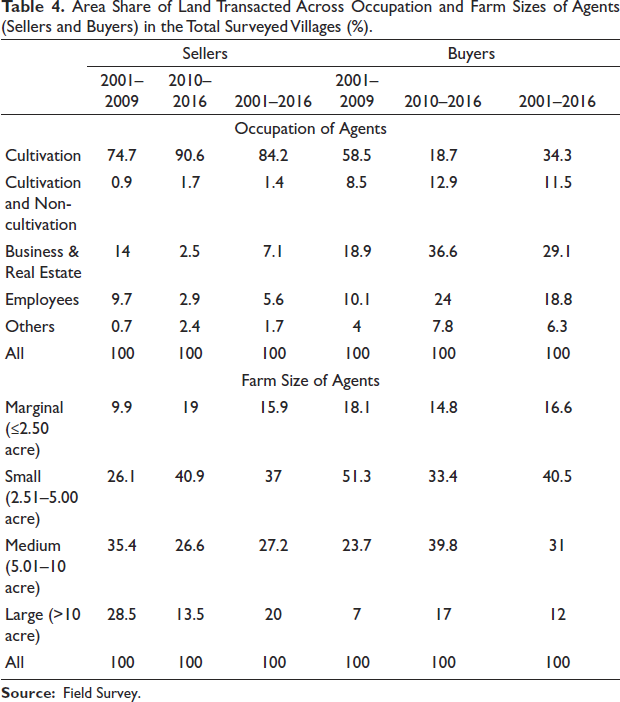
Within cultivator, it is the small size cultivator (53 per cent) than the others who are selling more of their land during high price based second sub-period (Table 4). It was observed in the field survey that it is the marginal and small farmers in the villages of developed region, small and medium farmers in the villages of semi-developed region and medium and large farmers in the villages of under-developed regions who sell more of their agricultural lands.
Among the buyers, the results (Table 4) show that of the total purchased agricultural land, the non-cultivators (business, employees and cultivation with high non-farm income households) account high area share (63.7 per cent) than the cultivators (34.3 per cent) in total surveyed villages in A.P during the total study period. It could be noticed that their total purchased area share has substantially increased from low price based first sub-period (41.5 per cent) to high price based second sub-period (81.3 per cent). They bought more land in the urban proximate and highway side villages than the remote villages in all the regions. The area share of cultivators in the total purchased land is though significant, but it has been declining at an alarming rate over the years. The households who engage in both cultivation and non-cultivation activities for the source of income also form small portion (11.5 per cent) among buyers and their share has been increasing from first to second sub-period. The rise of non-cultivators as the buyers of agricultural land is mainly due to their relatively higher surplus income, which they want to invest in land for speculative trading.
Within cultivators, it is the small (40.5 per cent) and medium (31 per cent) size farmers who are buying the major share of agricultural land in the total surveyed villages in AP during the total study period (Table 5). But the share of marginal and small farmers has been declining from low price based first sub-period to high price based second sub-period as their small income is not sufficient to buy a piece of land. On the other hand, the share of medium and large-size cultivators has been increasing during the same period. The above changes in profile of sellers and buyers will have significant effect on the issue of equity and efficiency of agricultural land sale markets discussed in the forthcoming analysis.
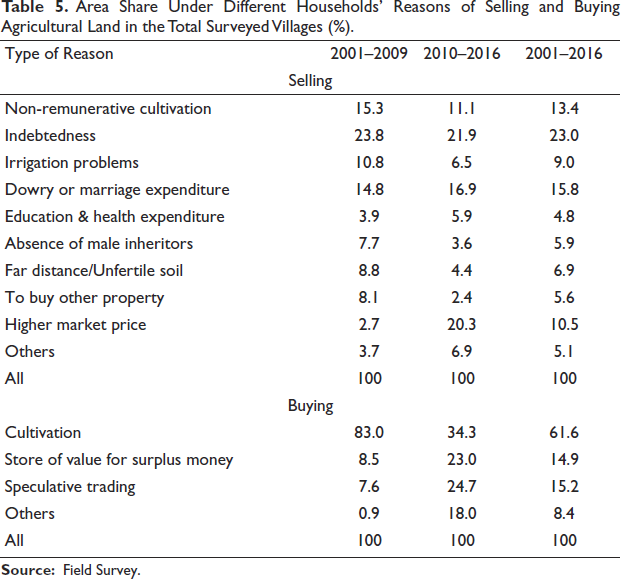
Area Share Under Different Households’ Reasons of Selling and Buying Agricultural Land in the Total Surveyed Villages (%).
Reasons of Agricultural Land Sale Transactions
Although households have multiple reasons for a land transaction (selling or buying), this study provides the analysis for the principal reasons reported by the household. The results (Table 5) show that indebtedness (23 per cent) is the principal reason for households to sell the agricultural land in total surveyed villages of A.P during the total study period followed by social expenditure on dowry & marriage (15.8), non-remunerative cultivation (13.4 per cent), availability of higher market price (10.5 per cent) and irrigation problems (9 per cent). Availability of higher market price is most important reason in urban proximate and national highway side villages. Expenditure on dowry/marriage is main reason in the remote villages in semi-developed region.
There has been a clear shift in the order of reasons for sale of agricultural land from low-price period to high-price period where the availability of higher market prices has emerged as the important reason (from 2.7 per cent during first sub-period to 20.3 per cent during second sub-period). The sudden availability of higher price for the agricultural land increases the opportunity cost of holding the ownership of it especially during when real net income from the land is falling. This situation tempted the many small landowners to sell their land to fulfil other consumption needs such as private education, health, housing, motor vehicle, etc.
Among the reasons to buy the agricultural land, the reason of cultivation (61.6 per cent) stands first in total surveyed villages in A.P during the total study period (Table 5). But surprisingly, its importance has been rapidly declining from low-price based first sub-period (83 per cent) to high-price based second sub-period (34.3 per cent) indicating increasing importance of non-cultivating reasons to buy the agricultural land in the recent times. The reasons of speculative trading (15.2 per cent), store of value for surplus money (14.9 per cent), others including tax haven 8 are significant. These non-cultivating reasons are fast increasing from low-price (17 per cent) to high-price period (65.7 per cent). These trends are witnessed across all the surveyed villages and are vibrant in the urban proximate and highway side villages in all the regions. The reason of speculative trading is prevalent more in urban proximate and highway side villages. The reasons of store of value and tax heaven are more prevalent in remote villages.
Factors of Agricultural Land Sale Prices
Skewed Economic Growth and Commodification of Agricultural Land
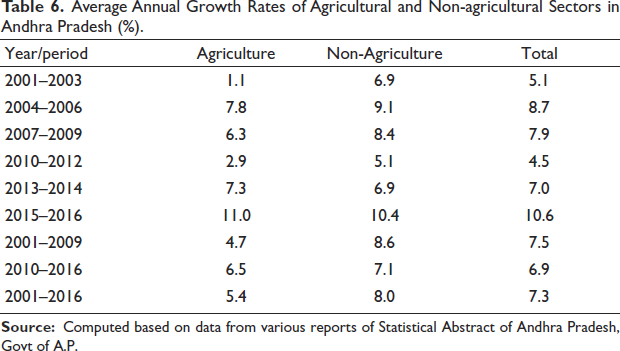
The skewed economic growth rates in favour of non-agricultural sectors in the state and country have contributed for rise in agricultural land prices when the surplus money is invested in buying agricultural land. The data show that Andhra Pradesh has witnessed a skewed economic growth pattern during the study period (Table 6). The non-agricultural sectors recorded relatively higher growth rates (8 per cent) than the agricultural sector (5.4 per cent) during the total study period (2001–2016). Slight pickup of growth by the agricultural sector during the second sub-period is not much effective given its small base effect. Given the situation of high employment dependency on agriculture sector and relatively lower dependency on non-agricultural sectors in the state, this skewed growth resulted in higher incomes (white or black) for the households in non-agricultural sectors. The agricultural land is seen as the better commodity like gold by these rich non-agricultural households for the purpose of storing the surplus money, speculative trading, tax haven benefits, etc. Because of such reasons, there is commodification of agricultural land and increasing entry of non-agriculturalists in the buyers’ markets in A.P especially during second sub-period who offers relatively higher prices for agricultural land as was seen in the forgone analysis.
Average Annual Growth Rates of Agricultural and Non-agricultural Sectors in Andhra Pradesh (%).
Spread Effects
The spread effects are the factors for the sudden rise of agricultural land sale prices in remote villages. Higher land prices in villages, located either in urban periphery or highway side, have spread to remote villages and caused the fast rise in land prices. The households, mostly cultivators in villages near to urban area or highway side, sold their agricultural lands at a higher price. The landowners who have lost their land for the infrastructural projects such as roads and real estates are paid heavy compensation and are left with huge sums of money. In order to compensate their sold or lost land, these landowners started buying agricultural lands from remote villages by offering relatively higher prices than the locally prevailing prices. In this way, their entry into these remote villages trigger the local land market and suddenly pushed the land prices up. This situation was found in all the remote villages surveyed in A.P.
Endogenous Factors
The endogenous aspects of the agricultural land such as soil quality, irrigation, location of land near to urban area, industrial location, highways, local roads, etc., all influence its price. Among these all, location of land proximity to urban area or highway plays a greater role in influencing its price mainly because of its possible use for non-agricultural purpose and speculative trading. It was found from the field survey that there are inter-region, inter-village and intra-village variations in the influence of endogenous factors on agricultural land sale prices. Generally, the lands, which are fertile and irrigated, command higher prices. Within the same village, the land, which is poor in soil fertility and irrigation, but when located near to urban area or national/state highway, may command higher price than the land, which is good in soil and irrigation but is located in interior area. This works more when the buyer is non-resident and rich non-cultivators who may want to use the land for non-cultivation commercial purpose.
Financial Conditions of Agents and Distressed Sale by the Farmers
The financial conditions of the seller or buyer also influence the land prices. The unit sale price of the high productive land owned by the household who is caught in a distressed condition like huge debt or random shocks like hospitalisation is much lesser than that of household who is in a non-distressed condition. The unit purchase price offered to an agricultural land by the household with non-agricultural occupation with high income is much higher than the price offered by the cultivating household with no non-farm income to the same land. It was observed from the field survey that many of the farmers who are selling their agricultural land are trapped in indebtedness because of depleting returns from the cultivation along with other needs such as childrens’ education, heavy expenses on hospitalisation, house construction, marriage dowry and other social expenditures. The government measures to address the farmers indebtedness are subsidised loans and inputs, loan waivers in 2008 and 2015, etc., which are inadequate, as they were meagre and were not benefitting all the farmers.
The Reasons for Higher Land Prices During Second-Sub Period (2010–2016)
As discussed in ‘Prices and Income of Agricultural Land’, there has been phenomenal rise in unit price of agricultural land in all the surveyed villages in A.P during second sub-period (2010–2016). The observed reasons from the field for this phenomenal rise of agricultural land prices are apart from the above discussed high growth of non-agricultural sector and spread effects, the other reasons include overall boom for real estate land, investment in agricultural land by the non-resident Indians (NRIs) and by rich non-cultivating households, trends of speculative trading of buying and selling the agricultural land by the investors, storing of surplus money in land, treating agricultural land as tax haven and rise in compensation for the owners of land acquisition under highways and other development projects who started buying land from other places at higher prices.
Implications of Agricultural Land Sale Markets and Prices
Emergence of Non-cultivating Rich Households and Exclusion of Small Farm Size Cultivators as Buyers
The increasing entry of rich non-cultivating households as the buyers in agricultural land sale market (as seen in ‘Profile of Agents’) with very high offer sale price and the resultant commodification of agricultural land sale (as seen in ‘Reasons of Agricultural Land Sale Transactions’) during second sub-period created a non-level playing field and unhealthy competition where the cultivators are unable to compete to buy the land. This led to exclusion of the small farm size cultivators from the market to buy the additional land. This way, the cultivators are pushed only to the supply side of the market as the sellers and excluded from the demand side of the market as the buyers. The small farmers, rather than gaining, have been losing their agricultural land. This tells that the land sale market in surveyed villages of A.P during recent decade has disfavoured the cultivators in general and the small size farmers in particular. This reflects that there is no equity in agricultural land sale market in A.P, as small size farmers cannot buy small piece of land at skyrocketing prices of land. These results are contrary to the results by the Deninzer et al. (2007) that showed the gain of land by landless poor.
Temptation to Sell the Land by the Small Cultivators
The sudden availability of very high unit agricultural land prices along with stagnant or depleting returns from the land during second sub-period (as seen in ‘Operation of Agricultural Land Sale Market’) increased the opportunity cost of holding ownership of land and tempted the small cultivating landowners to sell their land (as seen in ‘Profile of Agents’). As a result, many small size cultivators have sold their land and lost their livelihood asset permanently, which is difficult to acquire it again in future. The sudden and unexpected rise in agricultural land sale prices benefited only few sellers who have used the money for diversifying either by self or by their children, but caused loss to the households who could not diversify. In the long run, they are worse off for losing their livelihood earning property. This trend was observed in all the surveyed villages in A.P and it is more vibrant in villages near to urban area and highways where the land prices are very high.
Rise in Brokers and Transaction Cost
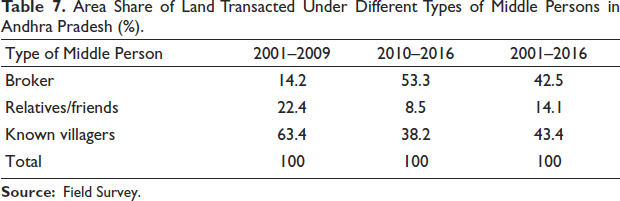
The land sale transaction includes registration cost 9 (stamp duty and registration fee), fee to middleperson (broker), etc. Unlike in the past, the current agricultural land sale markets have been witnessing the increasing role of commercial middle agent, that is, brokers in the land transaction. The results (Table 7) show that for the total surveyed villages in A.P, majority of the agricultural land sale transactions operate through the non-commercial agents (57.4 per cent) such as known villagers and relatives/friends during the total study period. But the role of commercial agents, that is, broker (42.5 per cent) is also significant for the total study period, and it has tremendously increased (53.3 per cent) during high-price based second sub-period. This is mainly because of the rise in non-resident and non-cultivating buyer in the land sale markets who face information asymmetry problems. Brokers fill up such asymmetry problem.
Area Share of Land Transacted Under Different Types of Middle Persons in Andhra Pradesh (%).
It was observed in the field survey that the role of broker has spread to land transactions even between the known villagers especially in high-price based markets. The brokers also artificially manipulate the land prices especially when the buyer is non-resident and the seller is in distressed condition. They charge commission as the percentage of total sale value of the land, which ranges from 1 per cent to 5 per cent from both the seller and the buyers. It is in the range of 1 per cent to 2 per cent in developed region and in the range of 2 per cent to 5 per cent in the semi and underdeveloped villages. Some time, they also take lump-sum amount depending on the relationship with buyer or seller. As a result, the brokers have earned huge money in the short span of time and eventually they themselves started buying the agricultural lands.
Changes in Use of Purchased Land
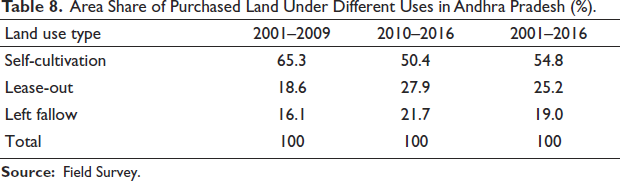
There has been a change in the use of purchased agricultural land by the buyer of rich non-cultivating and non-resident households. The data (Table 8) show that for the total surveyed villages in A.P during the total study period, a major proportion of the purchased land (54.8 per cent) is used for self-cultivation. But relatively considerable share of it is leased out (25.2 per cent) and is left fallow (19 per cent), and this trend has significantly increased during the second sub-period. It is found more in villages near to urban area and highways in all the regions. Continuation of these trends will have adverse effects on local agriculture in terms of increasing tenancy and fallow land. Rising fallow land reduces the land for cultivation, which would have implications of food security and agricultural employment in the local area. These trends are visible during the second sub-period in all the surveyed villages but at significant levels in highways side urban proximate villages and at lower levels in remote villages. The food security problem is evident at small farm size households’ level in all the surveyed villages in A.P who were compelled to sell the land for many reasons and are left with either no or small quantity of land, which is not sufficient to address their food needs.
Area Share of Purchased Land Under Different Uses in Andhra Pradesh (%).
Emergence of Non-cultivating Big Landowners
It was found in the field survey that the higher land prices have either forced or tempted the small farm size households to sell the agricultural land and helped few rich non-cultivating households to emerge as big landowners in every surveyed village in A.P during the second sub-period. In case of urban proximate village in developed region, the district-level politician had purchased more than 50 acres of agricultural land. In remote village of the same region, the two urban-based households – one is politician and another one is real estate businessperson, have bought about 20 acres each, mostly from the distressed and tempted households. In urban proximate village in semi-developed region, the urban-based businessman bought more than 50 acres of land from the poor households who sold at higher prices for constructing pucca houses. In remote village of the same region, the urban-based businessperson bought more than 70 acres of road side land to store the surplus money. In urban proximate village in under-developed region, the urban-based financier bought more than 100 acres from the tempted owners. In a remote village of the same region, the urban-based, pharmaceutical-based industrialist bought about 125 acres from the tempted owners. The software jobholder and retired police officer also bought more than 20 acres each to store their surplus money. These results indicate that that the current trends in agricultural land sale markets in A.P are causing many inequalities in land ownership, which may further lead to inequalities in income and wealth conditions in future.
Equity and Efficiency Problems in Agriculture
As shown in the above discussion, there is an increasing exclusion of small farmers from the buyer side agricultural land sale market in surveyed villages of A.P especially during the second sub-period. This is majorly because of heavy undue competition from rich non-cultivating households who treats land as gold for non-cultivating reasons such as speculation, store of value for surplus money, tax haven, land ownership prestige, etc. This poses an equity problem in agricultural land sale market in A.P where the small farmer cannot buy the piece of agricultural land with their sole income from cultivation especially when the cultivation is unremunerative. As seen in the above discussion on use of purchased land by the rich non-cultivating households, the purchased land is either given for lease or left it fallow. This increasing tenancy and fallow land cause efficiency problems in use of agricultural land. The increasing ownership of agricultural land by the non-cultivating households constrains the growth of agriculture because these households have low incentives to invest in agriculture and tend to use land for non-agricultural purposes that reduce the cropped area (Vijay, 2013). Increasing tenancy will have many problems especially when there are imperfections in lease market where the tenant is not recognised and not provided with state subsidies such as credit, seed, machinery, extension services, etc. The increasing fallow land reduces the use of land hence lead to inefficiency in use of agricultural land in surveyed villages of A.P.
Conclusion and Policy Suggestions
The market for agricultural land sale in surveyed villages in A.P has been undergoing major changes during late reforms period. The exponential rise in land sale prices is no way related to returns from the land. There is a commodification of agricultural land sale in the state where agricultural land is being increasingly bought by the rich non-cultivating and non-resident households but for non-cultivating purposes. They treat agricultural land as gold for store of value for their surplus money, speculative trading, tax haven, prestige of owning land, etc. This excludes the small farm size cultivators with no non-farm income from the demand side of the market as buyers of land. On the other hand, the owner farmers are pushed to supply side of the market as the tempted sellers of land that results in permanent loss of their livelihood earning asset in long term. The purchased land by the non-cultivating households is increasingly being left fallow or leased out. Although small, continuation of these trends pose a great challenge on equity in access and efficiency in use of agricultural land in the state.
Hence, there is a need for State’s policy intervention to control the prices and arrest commodification of agricultural land in the state. These include:
Restrictions on the purchase of agricultural land by the rich non-agriculturalist like in the states of Maharashtra, Uttar Pradesh, etc., where high taxpaying, rich, non-cultivating households cannot buy the agricultural land more than minimum quantity.
Differential stamp duty on registration of purchased agricultural land where it could be high for taxpaying, rich, non-cultivating households and low for small farm cultivating households.
Implement a suitable credit policy for small farm household for availing loans based on the market value of land to retain the land and also give concessional loans to them for purchasing the additional agricultural land.
Comprehensive agricultural policy comprising massive public investment, effective MSP system and special support to smaller famers shall be framed to address the agrarian distress, so that at least there will not be distressed sale or temptation to sell the agricultural land by the small farmers, which is important for not only for their livelihood but also for security and credit needs.
Brokers and transaction cost can be regulated by giving licenses to registered brokers and restricting the brokers’ commission from 0.5 per cent to 1 per cent of total value of land transaction based on the type of area such as urban proximate, remote area.
Appendix 1
Appendix 1. Brief Description on Socio-economic Conditions of Field Villages.
Pedavadlapudi is located in Vijayawada-Guntur-Mangalagiri-Tenali urban conglomerate. It is close (5 km) to the National Highway (Kolkata to Chennai–NH5). The village has population of 13,076. Its economy is based on both agriculture and non-agriculture. The net sown area stands at 1,862, acres which is fully irrigated by both canal and bore-wells. The major crops in the village are paddy, sugarcane, vegetables, fruits, flowers in irrigated areas and pulses in dry land area. Majority of the landowners in the villages are non-cultivators. The expansion of NH5 had initially triggered the land market and further fuelled by the establishment of new capital of Andhra Pradesh (Amaravati) since 2014.
Vemavaram-Kandrika is located 3 km away from state highway and 30 km away from Guntur city. The village has the population of 3,689. Its economy is majorly agricultural based. The net sown area is 2,283 acres out which 55 per cent is irrigated land but not assured one. Main crops in the village are cotton in dry lands and red chillies in semi-irrigated areas, paddy in irrigated areas, whenever water is available and pulses or kept vacant in the time of no water season. Majority of the land holdings are small and marginal. The outside business people have triggered the land market.
Chollagipeta is located 8 km away from National Highway and 10 km from Vizianagaram. It has the population of 1,321. Its economy is completely agrarian based. The net sown area in the village is 1,554 acres out which 49 per cent is irrigated by tanks, canal and bore wells. Paddy, sugarcane, maize are the irrigated crops and groundnut, jute, mango are the dry land crops. Most of the farmers are marginal and small sized. The rich buyers from Visakhapatnam and Vizianagaram have triggered the land market with higher prices.
Jammu-Garida is located 20 km away from Vizianagaram and 5 km from the state highway. It has a population of 3,679. Its economy is completely agricultural based. The net sown area in the village 984 acres out which 42 per cent is non-assured irrigated land by tanks. The lands are not fertile. Paddy is irrigated crop and groundnut and jute are the dry land crops. Few lands are planted mango trees. Majority of the landowners are small holdings. The land market in these villages is triggered by the rich non-cultivators from Vizianagaram and Visakhapatnam urban areas.
Hampapuram is located 20 km away from Anantapur town and falls on the Bengaluru National Highway. It has the total population of 2,187. The village economy is agrarian based. The net sown area of 4,258 acres out which 6.2 per cent is irrigated land by tanks. The crops of groundnut, red gram, jowar, etc., are cultivated in dry land and horticultural crops such as tomato, sweet lemon (Mousambi), lemon, orange, mango, etc., are cultivated in semi-irrigated areas. The expansion of the National Highway had initially triggered the land market. The entry by rich non-cultivators from Anantapuram city has triggered the recent land prices.
Padamati Yaleru is located about 30 km away from Anantapuramu city and 7 km away from state highway. It has total population of 6,051. Its economy is fully agrarian based. The net sown area is 3,634 acres out which 15 per cent is irrigated by bore-wells. It has many fallow lands. Village has been experiencing continuous severe drought since last three years. The crops such as groundnut, red gram, jowar are grown in dry land areas and the horticultural crops such as tomato, lemon, orange, etc., are cultivated in irrigated areas. The land buyers are mostly urban-settled people. A big pharmaceutical industrialist, wind-energy company have triggered the land sale market.
Footnotes
Acknowledgement
This work is a part of sponsored project to the author titled ‘Land Markets, Rising Agricultural Land Prices and Implications for Agricultural and Allied Productive Activities: A Comparative Study of Andhra Pradesh and Maharashtra’ by Indian Council for Social Science Research (ICSSR), New Delhi.
The author expresses sincere thanks to the anonymous reviewers for their valuable comments and suggestions that helped in enriching and strengthening this article.
Declaration of Conflicting Interests
The author declared no potential conflicts of interest with respect to the research, authorship and/or publication of this article.
Funding
The author received no financial support for the research, authorship and/or publication of this article.
