



Abstract
Kannauj is an historic city in northern India, which is known since antiquity for producing high quality natural ittar (natural perfume). This study explores the notion that perfume is a product of science and standardised production and marketing practices, whereas ittar is a natural product derived from traditional knowledge and craft production processes passed on through generations. The study highlights the ‘deg-bhapka’ technique of ittar production, explores the lifeworlds of the artisans, their perception of the art, discusses the main ittar varieties, and explores the role of social and cultural capital in preserving the legacy over generations. Semi-structured, open-ended interviews were used for data collection. Finally, the study examines the contemporary challenges and bottlenecks in this heritage industry and the incongruency of the art of ittar-making to the nuances of the capitalist economy. The possibilities for evolving and marketing ittar as a ‘green’, ‘organic’ and ‘indigenous’ product of traditional art and contemporary aesthetic standards are explored.
Introduction
Aesthetic grooming has been part of human existence since antiquity. Perfume, aroma, scent or ‘ittar’ are expressions of the human desire to appear presentable and attractive. Ittar is a natural oil derived from the hydro-distillation of rose (gulab), vetiver (khas), screwpine (kewda), tuberose (rajnigandha), and Arabian jasmine (bela), etc. (Handa et al., 2008). Some of the prominent ittar producing sites in India are Kannauj, Gazipur, Jaunpur, Vijaywada, Saluru, Mysore and Ganjam (Kapoor, 1991; Rao & Rout, 2003). Kannauj or the ‘Ittar Nagri’ (Perfume City), is the most prominent among these centers and has been in existence since the Vardhana dynasty of the 7th century (Padhy et al., 2016). Situated on the banks of river Ganges, Kannauj is blessed with fertile alluvial soils, ideal for the cultivation of Damask rose, jasmine, mehendi (henna or Lawsonia inermis) and bela (Arabian Jasmine). Recognising the heritage of ittar making at Kannauj, the Government of India awarded it with the Geographical Indicator (GI) label in 2014 (MSME Report, 2016–17). Presently, it is classified as ‘Ittar and Essential Oil Cluster’ under the Micro, Small and Medium Enterprises (MSME) and the state government has attempted to bolster the industry by recognising it under the ‘One District One Product’ (ODOP) scheme. The stature of Kannauj in ittar making is comparable to that of Grasse in France and the National Geographic Magazine lauds it by recognising: ‘perfumers in Kannauj have worked their alchemy to create liquid gold’ (Sachasinh, 2021). This article discusses the history of ittar making at Kannauj, the process of ittar making, and strives to understand the dynamics of the industry from a sociological standpoint.
The History of Perfume Making in Kannauj
Kannauj, also referred to as the perfume capital of India, is a city in the state of Uttar Pradesh (Sengupta, 2018). Historically, the town has been variously designated as “Kanyakubja”, “Kannaujja”, “Qannauj” and “Kusasthala” (meaning an area having a dense concentration of aromatic Khus grass) and “Kusumapura” (a place having a dense concentration of flowers) (Marwah, 2012; Smith, 1908; Tripathi, 1937). Ittar making at Kannauj can be traced back to the days of King Harshavardhan in the 7th century (Padhy et al., 2016). Parenthetically, ‘Harsha-Charit’, the biography of Emperor Harsha by his court poet Banabhatta, mentions the production of ‘agar wood oil’ during the era and generous use of perfume in the wedding of the emperor’s sister, Rajshri (Gangopadhyay, 2021; Marwah, 2012). It is said that the fame of Kannauj as an ‘ittar making hub’ reached its peak during the reign of Emperor Harsha and maintained its position until King Jaichand was defeated by Mohammad Ghori in the 12th century (Khare, 1960).
Subsequently, ittar production at Kannauj enjoyed patronage from the Mughals as well (Pathak, 2020; Ratnagar, 2014). In fact, the ‘Ain-i-Akbari’, the administrative chronicle of the court of Emperor Akbar, discusses the establishment of an ittar making centre at Kannauj (Pal, 2016; Sengupta, 2018). It is said that the Mughal emperor was so fond of ittar that copious amounts of ittar were used to adorn the doors and furniture of the Mughal court (Sachasinh, 2020). Furthermore, Akbar also established a special department ‘Khushubu-Khana’ towards the production and supply of ittar for royal use (Pal, 2016). Legend says that the ‘Gandhain Mohalla’ neighbourhood of Kannauj, was given the responsibility of supplying ittar to the Mughal court. Subsequently, Emperor Jahangir created a specific post, ‘Khushbu Daroga’, for the supervision and monitoring of ittar production and supply (Marwah, 2012).
According to another popular legend, Asmat Begum, mother of Mughal Empress Nur Jahan, pioneered ittar production from rose water and named it ‘Itr-I-Jahangiri’ (Bashir & Gray, 2015; Markel, 1999; Smith, 2012). It is believed that queen Nur Jahan developed a fascination of rose ittar by being enticed by the smell of Kannauj roses in her bath (Sachasinh, 2021).
It is often argued that the favourable geography of Kannauj also contributed to its growth as the perfume centre of India. Situated on the banks of river Ganges, Kannauj is bestowed with alluvial soils and an ideal climate for the cultivation of fragrant plants (DMO Kannauj Report, 2017).
Literature Review
The existing literature has examined the socio-economic dynamics of the MSMEs in India. Writing about the garments, electronics and auto-parts industries, Bhavani (2002) highlighted the bottlenecks faced by the enterprises in the age of globalisation and suggests mechanisation, organisational improvement and reformulation of policy measures as potential solutions. Likewise, Mukherjee (2018), in his study of the labour-intensive coir (coconut fibre) industry of coastal India, examined the infrastructural shortcomings and competition from Chinese synthetic products that MSMEs are facing.
Similarly, Sathe (2002) linked the struggle of the small-scale sectors to the slowdown of the economy and increased market competition. The industries typically deal with the crisis by downsizing the labour force and wage reduction. Examining the functionality of MSMEs in Odisha, Pradhan and Munda (2010) write optimistically that the development of the MSME sector in Orissa can potentially stem the flow of migration to urban areas and thereby relieve rural areas of their dependency on urban areas.
Maharana et al. (1993) in their study of the Kewda industry in Odisha, underlined the importance of the industry in offering seasonal employment in rural regions. Similarly, Dutta et al. (1987) shared a detailed description of the cultivation, collection, use and distribution of Kewda flower in Odisha.
In their study of Ayurvedic Cosmetic MSMEs in Mumbai, Baghel and Parthasarathy (2019) explored the link between cultural and symbolic capital in translating to the higher demands of the ayurvedic products. As ayurvedic knowledge has symbolic value, it renders the entrepreneurial knowledge worthy and legitimate.
In his study of the socio-political life of ittar artisans at Kannauj, Aseem Prakash (2021) reveals the interconnections between society, economy and politics. The article elaborates on various social networks—meshed, cluster-based and transactional networks facilitating the ittar trade. However, this research does not focus on the lifeworld of the artisans, challenges that the industry is currently facing, or possible solutions towards bolstering the sector.
Therefore, this study aimed to understand the rich heritage of ittar making at Kannauj, the lifeworld of the people engaged in the trade, their perception of the art, the craftsmanship involved in the process, how the legacy is preserved and transmitted across generations, and the challenges and bottlenecks that the industry is currently facing. Finally, the study attempts to analyse the situation of the perfumers from the standpoint of sociological perspectives and suggest ways of sustaining this creative art.
Methodology
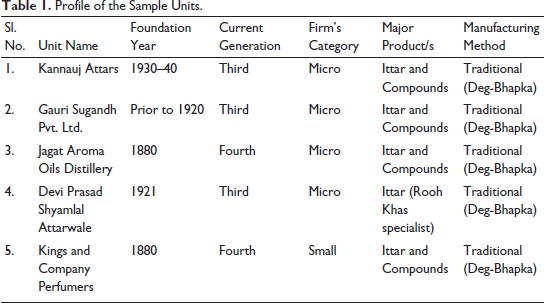
The findings are based on the narratives of 30 respondents (business owners and artisans) across five mostly micro-perfumery enterprises at Kannauj. The demographic and business profile of the sample units are provided in Table 1. The perfumery units were chosen based on purposive sampling, that is, on the basis of representativeness of the concerned units. In the process, the perfumeries that are traditionally associated with the trade across generations were chosen for the study, and the strategy was to pay close attention to their daily discursive practices for gaining in-depth understanding of knowledge and practices of ittar-makers at Kannauj. The method of data collection was observation and interview. Interviews were semi-structured, in-depth and open-ended and they started by familiarising the research subjects with the purpose of research and seeking their consent for the interview. Echoing Malinowski (1922, p. 25), the idea was “to grasp the native’s point of view of life, his relation to life, to realize his vision of his world.” Process notes were taken during the interviews and detailed observations were made of the social setting of the subjects. Following Glaser and Strauss (1967), the criteria of ‘saturation’ (i.e., the point at which no new insights were gained) was used to determine the number of interviews to be conducted. In an attempt to maintain confidentiality of the research subjects, pseudonyms were used in reporting the findings.
Profile of the Sample Units.
Findings
The study found that ittar comes in wide varieties, for example, rose, jasmine, champak (Magnolia champaca), mogra (Arabian jasmine) and kewda. This apart, there are various by-products such as rose oil, rose water, ‘agarbatti’ (incense sticks) and ‘gulkand’ (sweet preserve made of rose petals). Thus, the most important ingredient for perfume making is the flowers. The owners and artisans explained the importance of fresh flowers and the collection process in detail. More importantly, the artisans emphasised the deep commitment that the process demands and that mastery over it requires years of perseverance. As Mr. Jitendra explained:
“For making quality ittar, you need fresh flowers. For instance, the full bloom bela flower retains its fragrance for 12 hours and thereafter it starts to decline. So, it is imperative to use flowers that are fresh in perfume making … It is challenging to derive ittar out of ‘raatrani’ flower as it starts to bloom in the late evening (around 9:00 PM). If the flower is picked before it blooms, there will be no fragrance. In fact, the price of the flower is decided by its bloom quality. These are the things you need to know if you are to become a good connoisseur. Ittar making is an art and it takes years of toil and perseverance. You need to closely inspect the flower quality and understand the process in and out. People don’t have this kind of commitment. That’s why we advise anyone joining the industry to focus on synthetic perfume and spray instead of ittar making. There is no art involved in synthetic perfume making. It is mechanical and thus easier.”
An interesting fact about Kannauj ittar is that it is produced in the traditional, labour-intensive ‘Deg Bhapka’ method. The method is mentioned in the ‘Charak Samhita’, compiled around 2000 BC (Government of India, 2013). The ‘deg’ refers to the copper utensil containing water and flower petals. The deg is heated over a clay furnace or ‘Bhatti’ and is connected via ‘chonga’ (bamboo pipe) to another copper utensil (known as ‘bhapka’) containing sandalwood oil. Twine is wrapped around the chonga and it acts as a condenser. The opening of the bhapka is covered with cloth and the utensil is submerged in a water-filled cooling tank. Thus, when the deg is heated, aromatic vapours from it gather in the bhapka and mix with the sandalwood oil. This is the traditional process of ittar making and the entire production process requires close monitoring and supervision at every step. The heat at the deg should be of the right intensity, which is maintained by adding or removing fuel. Moreover, the water in the cooling tank needs to be periodically changed so as to maintain adequate temperature. The artisans believe that deg-bhapka method of production is unique in its contribution to retaining the quality of ittar. Explaining the functionality of ‘deg-bhapka’, Mr. Praveen, a third-generation perfumer, explained:
“Modern technology cannot bring the same quality. That is why it is said that “old is gold.” Can you deny that the food cooked in firewood over earthen hearth is tastier than that of the food cooked in gas?”
Once the ittar is collected, the bhapka is separated from the deg. It is then stored in a camel leather pouch or ‘kuppi’. This helps in moisture absorption. As Mr. Jitendra pointed out:
“After ittar is produced, it is stored in camel leather pouch (kuppi). Kuppi is clay sealed and placed in sunlight to trigger the moisture absorption process. The output of this process is pure ittar. In every house of Kannauj you will find 10–12 kuppis.”
Not only does ittar making require skill and precision, the equipment used has its own utility. Emphasising the unique contribution of the deg (copper utensil) in the process, Mr. Rajat Kumar explained:
“Copper vessels preserve and maintain the natural character of ittar. Specifically speaking, it has two qualities – it loses temperature fast and does not absorb the fragrance. Hence, it is widely used.”
Mr. Jitendra explained the utility of the equipment differently:
“The copper utensil has its own functionality. Please note that the natural hue (green, yellow, purple, dark red, woody white, etc.) of ittar is due to the reaction of raw materials with the copper deg. Thus, if we replace copper with glass utensils, it may lead to change in the customer’s perception and arouse suspicion.”
Similarly, the utility of the traditional furnace was explained by Mr. Nitin Tandon in the following way:
“The distillation process of ittar making requires sensitive and soft heating. Such heat can be easily maintained by using cow dung chips of appropriate quantity.”
In sum, the perfumers of Kannauj emphasised the utility of the labour-intensive technique in ittar production and they believed that substituting machinery instead of the artisanal process would make the process devoid of creativity. As perfumer Mr. Jagat Mehrotra replied:
“If machinery is used in ittar production, it no longer remains an art. If humans are substituted with machines, the creativity will be lost.”
This is a labour-intensive production process and the artisans thus toil very hard in a hot and humid climate without electricity to produce a concoction of the highest quality. Explaining the key role that artisans play in the process, Mr. Ram Naresh shared:
“The Kaarigar (artisan) plays a key role in the process. He has to be well-versed about the entire process like how much temperature to maintain, when to replace warm water from the tank, when the temperature needs to be reduced, etc. And from the smell, an experienced artisan can tell when the perfume is ready.”
Thus, perfume making might be understood as a craft process as compared to a standardised industrial process. Since perfume making is an art, consuming it requires understanding its uniqueness. Thus, it is not uncommon to find ittar shopkeepers patiently explaining the ingredients, uniqueness, production process, and benefits of perfumes to consumers in helping them to choose the right perfume. Mr. Raman, an experienced perfumer, explained:
“We attempt to explain to our customers the effort that is involved in our art. They should understand that the entire process is labor-intensive, and the artisans are not able to use their hands for a few days because of the thermal burns and bruises sustained in the process … If we replace labor with mechanization, will it remain an art?”
The price of ittar ranges from Rs. 500 to a few lakhs and the price of rose ittar is particularly high. The two other coveted specialties of Kannauj are the ‘Mitti’ and ‘Shamama’ ittar. Mitti ittar or rain ittar is produced by the distillation of clay found in dried-up wells and ponds, which smells like the earthy fragrance of soil after the first rain. This is a specialised art and is produced only by select artisan families of Kannauj. Moreover, it takes long (approximately 20 days) to produce mitti ittar and it cannot be produced in the monsoon season as the clay becomes too soft to be baked. Shamama is another unique variety of perfume produced at Kannauj. It is produced by the distillation of a variety of herbs and spices and each artisan family has its own unique method of producing it. Indeed, some of the ittar making families at Kannauj have been making Shamama ittar for two hundred years. As Mr. Iftikar Khan recalled:
“Shamama ittar is an ancient ittar of Kannauj. It was pioneered by Asgar Ali Mohammad Ali Perfumers in 1857. Their kothi still exists in the Aminabad locality of Kannauj.”
Mr. Samar Kumar, an experienced artisan elaborated:
“In shamama perfume, different herbs are mixed in a certain ratio. However, every family has its special formula of producing shamama ittar. That is their trade secret. For example, if there are four families producing shamama, each will have a different taste and flavor … Shamama perfume is used in the tobacco industry, and you must have seen that each brand of tobacco has its own unique flavor. This is because of unique blending and ratio analysis followed by each family.”
Interestingly, ittar making at Kannauj is primarily a family-based profession. The specific recipe is closely guarded by every family and is transferred across the generations. Thus, the ‘unique concoction and the process’ or ‘nuska’ represents a form of ‘cultural capital’
1
that is transmitted in the ‘habitus’
2
of the artisan families through the process of socialisation. The discursive practices and everyday social interactions within the artisan families offer the ideal nurturing ground for the novices to learn the trade. Mr. Jitendra, one of the prominent artisans at Kannauj, explained:
“There is no formal training. They observe the trade practiced in their homes since childhood. The art is rooted in the sociocultural fabric of Kannauj. Individuals learn the art at their home from their father and grandfather. There is nothing to learn; it is their livelihood, passion, and way of being.”
This succinctly captures Bourdieu’s notion of habitus in which an individual’s perceptions, experiences, and practices become taken-for-granted or common sense (Bourdieu, 1980/1990). Youth growing up in the ittar craft may not realise they are being socialised into the trade, thus there is “no formal training” and “nothing to learn.” Through the habitus they acquire their sense of place in the world.
Furthermore, each ittar making family at Kannauj seemed to have its own formula or recipe of ittar making. It is a trade secret closely guarded over the generations. As Mr. Samar Kumar highlighted:
“We produce ittar by our own ‘nuska’ (formula). That’s our trade secret. We have inherited it from our forefathers.”
Not only is ittar making generational, with its own unique family legacy, but also the equipment was found to be manufactured by particular families in the locality. According to Mr. Samar Kumar:
“Not only the method of distillation, but also the equipment has its own uniqueness and heritage. For instance, the chonga (condenser) in my unit is continuously prepared by a single family over the last four generations.”
In line with Prakash (2021), it was found that the ittar business is sustained through family-based kinship networks. The big business families outsource their orders to smaller units owned by their kith and kin, and subsequently brand the final product with their label. Furthermore, such traditional familial networks also served as a hedge against business uncertainties. For instance, the families were found to diversify into wholesale and retail units, and there was close dependency between these units for sourcing and selling of products. Even procurement of raw materials (flowers and oil) was carried out through familial kinship-based networks. Similarly, Mr. Praveen, a leading ittar manufacturer, remarked:
“Our industry survives on symbiosis. The experienced artisan trains the novice and the big business supports the smaller ones.”
The research revealed that relationships within the ittar industry of Kannauj are symbiotic, and rural Kannauj serves as a hinterland to urban neighbourhoods. It would supply flowers, ‘ittardan’ (containers), fuel (cow dung cake), aluminium and plastic drum makers and labour to the enterprises located in the city. Rural and urban Kannauj are mutually dependent, the survival of one influenced by the other. As artisan Mr. Ram Naresh pointed out:
“The rural area serves as hinterland in the ittar making process. The city serves as the hub of ittar sale, and the rural hinterland is the backstage. It (rural area) supplies raw material, labor, and acts as the backbone of the industry.”
In a similar vein, respondent Mr. Praveen shared:
“The industry runs on networking. There is close nexus between the instrument makers (deg and chonga), flower cultivators, ittar makers, cow dung cake sellers. In short, the ittar industry of Kannauj has a profound impact on employment generation in the area.”
Challenges
The industry was found to be facing several challenges and bottlenecks at present. For instance, without much financial affluence, ittar makers rely on their craftmanship and perseverance to sell their age-old art. Their lack of capital prevents them from adequately advertising and marketing their product. As Mr. Jagat Mehrotra noted, “Because the units are small, they don’t have the financial liquidity to advertise.”
Another issue closely connected to the rising cost of ittar production is the ban imposed on sandalwood trade by the Government of India (Food and Agriculture Organization (FAO) Report, 2014; Sengupta & Sen, 2015). To survive, some producers are forced to substitute sandalwood oil with cheaper synthetic ingredients such as liquid paraffin or DOP (dioctyl phthalate). Mr. Samar Kumar, a producer, explained:
“We face gross shortage of resources like sandalwood. According to the government mandate, you can plant a sandalwood tree but cannot cut it without permission. Because the government has categorized civil trade of sandalwood as an illegal activity, we are forced to use cheaper substitutes like liquid paraffin or DOP. Thus, the quality of the ittar and its medicinal uses have eroded.”
Changing consumer tastes can also be attributed to the predicament of the industry. The omnipotent force of global capitalism along with conspicuous consumption often prompts many of the middle-class to choose Western deodorants and perfumes over ittar. Derivatively, we can say that status conscious Indians shifted their allegiance to Western deodorants and perfumes. The lure of Western perfumes and deodorants along with pervasive marketing has made it difficult for the Kannauj artisans to compete. Evidentially speaking ittar has fallen out of favour among present-day youth who often prefer branded items (Borgave & Chaudhari, 2010; Rai, 2015). For many of them branded perfumes and deodorants have become status markers. The concern is far-reaching as the members of different social classes continuously engage in ‘pecuniary emulation’ of the consumption practices of their social superiors (Veblen, 1994). Describing the changing mindset of the present-day consumers, another seller reflected:
“I see Westernization playing its part in influencing the present-day consumers. The tendency is to reject anything and everything indigenous. Thus, people will appreciate and crave for synthetic, branded deodorants but not for indigenous ittar.”
This is more so because consumers are sceptical about paying a premium price for ‘unbranded’, pure ittar. The changing trend was explained by Mr. Jamil, an owner, thusly:
“Ittar is known for its purity and hence it is costly. For example, 10 ml of ittar costs Rs. 1500 and 100 ml of deodorant costs Rs. 100. Customers choose the cheaper, synthetic product instead of buying unbranded, pure ittar. They don’t however realize that as ittar is derived out of natural ingredients, it does not have any side effects.”
Likewise, one of the artisans, Mr. Praveen commented:
“Kannauj is the ittar hub of India. While metropolitan cities like Delhi and Mumbai may have famous ittar houses, they are completely reliant on us for their base fragrance. Nonetheless, they are expert in giving fancy names to their synthetic perfumes-Firdaus, Confidence, Charlie, etc. And consumers fall for such marketing gimmicks.”
Finally, the consumers often complain that the ittar industry does not have adequate variety or marketing for their product. The Kannauj artisans had an altogether different explanation to offer towards the existing trend. As Mr. Jitendra reasoned:
“People say that we don’t have variety…They don’t understand the art involved in the process. We cannot interfere with our classical note. In ittar we cannot do this because there is fixed criteria and process of blending. Such experiments are only possible in synthetic perfumes.”
Respondent Samar Kumar also posited that consumers are oblivious to the uses of ittar apart from the olfactory function. He elaborated:
“I believe that customers are not aware of our art. Take for instance shamama perfume. People earlier used to sprinkle shamama ittar under their quilts in winter to get warm effects. Similarly, ‘khas’ ittar is known to have a cooling effect on the body. Such awareness has been lacking in the present-day customers. Such unawareness coupled with unavailability of raw materials has adversely affected our industry.”
They said that economic hardship has made it challenging for microenterprises to survive. Over the years, the smaller units have made way for larger units and thus concentration of business in the hands of few. In fact, bigger units such as Malik Miyan, Pumpi Jain and Chandrabali Munnalal and Sons, were found to export their products to the Gulf nations. As Mr. Kamal Kumar highlighted:
“There has been concentration of the market in the last four/five years. Previously, 20 small units were there in the area. Now they have been replaced by 5 big units. The big players are becoming bigger. They are also expanding across various metropolitan cities and abroad.”
Interestingly, some of the sellers linked their stagnation to the current pandemic situation. They pointed to the increasing tendency of buyers to engage in online shopping, which reduces the opportunity to interact with consumers and convince them of their product. According to Mr. Deen Dayal, a young perfumer:
“The current pandemic situation is also responsible for the slack in the industry. Previously customers used to visit our outlets to buy ittar. We used to elaborately explain to them the peculiarity of ittar varieties and the detailed production process, and thereby convince them about our art. It is not possible today. Consumers buy it from e-commerce portals.”
Ittar is extensively used as a flavouring agent in ‘gutka’ (chewing tobacco) and ‘paan’ (betel leaf) masala industry. However, considering the issue of public health, the partial ban imposed by the Government of India on ‘gutka’, has been detrimental to the ittar industry. Mr. Deen Dayal, aptly portrayed the symbiotic reliance of ittar and the paan masala industry and the adverse effect of the ban in the following way:
“To be frank, the ittar industry of Kannauj is majorly reliant on the paan masala industry. If, God forbid, the pan masala industry is banned someday, all degs will be closed the very same day. Not only us, but all the subsidiary chain industries will also be affected.”
Consequently, there has been a steady fall in the number of ittar making units at Kannauj over the years (Schaffmeister, 2015). For instance, the number of ittar making units has declined drastically from 375 in 2008 to 250 in 2012 (Marwah, 2012). Nonetheless, dissociation from the trade is not easy and is akin to sacrificing one’s identity and tradition. This is because the perfumers have associated themselves with ittar making for generations and have not familiarised themselves with any other livelihood.
Interestingly, some sellers opined that the higher production cost of pure ittar should not be a deterrent to the connoisseurs. They contended that consuming ittar is an act of appreciating an art and hence the connoisseur will not be able to refrain from it despite the rising price. As Mr. Rajat Kumar justified:
“You should note that our art will only appeal to those who are connoisseurs. Wearing ittar is a luxury and not a daily necessity. Hence, we only have a segment of population whom we can cater to.”
Mr. Jitendra echoed similarly:
“People who understand ittar will buy it instantly. Inexperienced buyers require much justification and convincing.”
Discussion
This study attempted to develop a nuanced understanding of the art of ittar making at Kannauj, the lifeworld of the artisans and business owners engaged in the process, the role of social and cultural capital in sustaining the trade, and the challenges and bottlenecks that the industry is currently facing. The study found that ittar making is an art and it requires years of commitment and perseverance. It is produced out of the traditional ‘deg-bhapka’ method and the artisans play a key role in the process. This heritage art of Kannauj is primarily a family-based profession, the ‘nuska’ (recipe) is closely guarded by the family, and is transmitted across the generations. However, changing consumer preferences, the rising price and government regulation of sandalwood oil, lack of capital and overreliance on the gutka and paan masala industries, all pose formidable challenges to the industry.
It may be noted that ittar is natural and indigenous while perfume is synthetic product of the laboratory and standardised production processes. After chemistry was institutionalised in the 19th century, laboratories become the site where perfumes were analysed and various concoctions were experimented with (Kubartz, 2009). Analysis of the ingredients of perfume reveal that ethyl alcohol constitutes 78–95% of it (Conceicao, 2019). It may be said that modern chemistry institutionalised the process of perfume making and reduced its dependence on natural ingredients. Prominent perfume brands like Versace, Nautica and Dolce & Gabbana have popularised the use of synthetic ingredients in perfumes. In other words, one may contend that perfume is a product of science and standardised production, while ittar is a natural product derived through traditional knowledge and craft practices cultivated in familial networks.
Currently, consumer choice of a particular perfume brand is typically not shaped by the engagement with the perfume in question but by the prominence of the brand. So, the buyer consumes the brand and not the perfume and demand is artificially created by means of branding and marketing. Thus, consumer demographics are researched and their preferences and trends are closely monitored to appeal to the visual and olfactory senses to urge consumption tendencies. Close analysis of such trends influences the development of fragrance type, colour, bottle shape, packaging, etc. Producers work closely with fragrance suppliers, packagers and advertisers to design and invent new forms of perfume. Such reinvention of product in terms of innovation, new packaging and marketing is crucial for maintaining appeal to consumers. Products are advertised and endorsed by popular celebrities. In addition, prices are set according to the brand name and status associated with it. Consumption of branded products offer the users a sense of status and self-assurance in society. Wearing branded perfumes therefore is an act of conspicuous consumption and an attempt to belong to the “aspired league.” The idea is to become ‘equal to superiors’ and ‘superior to equals’ (Bhattacharya, 2020). In sum, perfume consumption is not merely for utility; rather it is conspicuous, functioning as a means for signalling one’s status in society (Baghel and Parthasarathy, 2019).
Derivatively, one witnesses the McDonaldization of the synthetic perfume industries in terms of product homogenisation and standardisation (Kubartz, 2009). The increasing commodification of perfume has resulted in the standardisation of products, that is, perfumes of a particular brand and make smell, weigh, look and cost the same across the world. The perfume bottles are replicas of each other, contain the same amount of mass-produced perfume, and there is little scope for uniqueness and creativity in the production process. The entire process is devoid of artisan character. Branding and standardisation allow the products to flow in global commodity networks.
Without any form of branding, advertising and associated marketing strategies, ittar is isolated in the shadows of the global capitalist economy. Echoing Castells (2000), we reason the predicament of the industry to its non-adherence to capitalist production and marketing strategies. In other words, non-adoption of the prescribed model of success (i.e., industrial modes of production) has disfranchised the skilled artisans of Kannauj and resulted in their struggle for survival. Ironically, in this age of global capitalism, the status of a person is defined more in terms of the technology that she possesses rather than the skills that she has (Braverman, 1974). Consequently, this has led to marginalisation of smaller units of ittar production and deskilling and “deconstruction” of skilled craftsmen at Kannnauj and their gradual exit from the trade.
Echoing Paterson and Kern (1996), we also contend that most modern-day consumers are ‘materialists’ who seek to fulfil the ‘false needs’ that advertising creates. In this consumerist society, there is a dearth of “savvy consumers” or those who possess knowledge about the product and are selective in their product choices. Some of these consumers prefer authentic, indigenous and creative products as compared to standardised commodities that are over-advertised and marketed. Unfortunately, in the ‘liquid modern world’ of the twenty-first century, the passion and admiration for such ‘great art’ is lost and is replaced by craze for ephemeral and fleeting trends that cater to the interests of consumer market (Bauman, 2011, p. 15).
We believe that ittar industry could reinvent itself to compete with the branded perfumes and deodorants. Echoing Schumpeterian wisdom (Schumpeter, 2008 [1911]), ittar artisans could rejuvenate their trade by inspecting the close relationship existing between innovation and entrepreneurship. One way of doing it is by evolving ittar along its strengths of being an ‘organic’, ‘green’ and ‘indigenous’ product. This could be particularly appealing in this globalised world, where consumers have a fascination for products that represent a synthesis of tradition and modernity and have a rising concern over adverse effects of chemical-based cosmetics. In other words, ittar may be projected as a blended art produced out of a fusion of traditional knowledge and contemporary aesthetic standards. Some possible models to consider are the growing alternative trade networks that emphasise values such as environmental benefit, organic, traditional artisanship and fair trade (e.g., Kharel and Middendorf, 2015). Exploring how these models might be applicable and beneficial to the artisan ittar makers will be a useful line of future research. However, the biggest epistemological question that remains unanswered at the end of the debate is: Whether it is worthy to remodel this indigenous knowledge system/traditional art in modern capitalist garb to appeal to the materialists of this liquid-modern world?
Footnotes
Declaration of Conflicting Interests
The authors declared no potential conflicts of interest with respect to the research, authorship and/or publication of this article.
Funding
Data collection part of this research work has been supported by UGC-SRF funding.
