




Abstract
In this article, we compare the Indian experience with that of some of the multinational and multi-level polities from the Global North, namely Belgium, Canada, Spain and the United Kingdom. We first summarize the essence of multinationalism. Drawing from our comparative examples of the Global North we then show how dominant narratives of state nationalism condition the extent to which the state can accommodate plurinational difference through self-rule, shared rule and ethno-symbolic recognition within these states, and then compare and contrast this with the Indian experience. Despite the stickiness of elite narratives on the meaning of the state during state formation and democratization, we highlight the ability of electoral competition to push multi-level politics into a more accommodative or majoritarian direction. We illustrate this with reference to India including the 2024 General Election Outcome.
Keywords
Introduction
India has undergone many changes to its federal system since independence. In this article, we compare the Indian experience with four multi-level and multinational states from the Global North. While the US is often held up as the yardstick of federalism in the Global North, it is not a multinational federation. It is more appropriate to compare the Indian experience with that of Belgium, Canada, Spain and the United Kingdom, not all of which are ‘constitutionally federal’.
In contrast to the US, Belgium, Canada, Spain, and the United Kingdom are multinational, even though acknowledging this fact may be problematic for many politicians in some of these countries (Basta, 2021; Burgess & Gagnon, 2010). We argue that India merits inclusion as a multinational state, but that, as in other multinational states, there may be powerful state narratives that seek to undermine such an understanding, attempting to centre the state around an overarching Indian or, more recently, Hindu majoritarian nation. This has implications for how federalism operates in practice and the recognition of multinational diversity therein.
In what follows, we first summarize the essence of multinationalism. Drawing from examples of the Global North we demonstrate how dominant narratives of state nationalism condition the extent to which the state can accommodate sub-national difference through ethno-symbolic recognition, self-rule and shared rule. We also demonstrate the dynamic nature of these narratives in light of party system change. With reference to India, we pay attention to how the displacement of the Congress with the BJP has altered the main narratives and practices underpinning Indian federalism and reflect on the extent to which the return to coalition government following the 2024 general elections may create space for a more decentralizing narrative.
Multinational Democracies and the State: State Narratives and Dynamics
Democracy famously means the will of the people, typically expressed in the modern world through elections. But, as Ivor Jennings famously said, ‘the people cannot decide until someone decides who are the people’ (1956: 56). In a multinational state, the answer to ‘who are the people’ may take different forms. A multinational state is distinguishable from a nation-state in that large sections of the population see themselves as ‘stateless nations’ who at the very least seek a degree of internal self-determination and a right of veto in key aspects of central decision-making. Sometimes members of these sub-state nations also seek external self-determination (sovereignty). By and large, citizens within such multinational states either identify with the nation-state (e.g., Belgian, Canadian, British, Indian), with a substate (and therefore stateless) nation (e.g., Flanders, Quebec, Scotland, Punjab) or with both. The strength of sub-state identities, their concurrence with a demarcated (though possibly contested) sub-state territory and the desire of many of their members to govern themselves and to receive recognition as ‘distinct nations’ sets multinational states apart from ‘mono’ national states. As Basta (2021: 5) puts it, ‘for communities whose members consider themselves to be politically distinct, the state is legitimate only insofar as it allows them to govern themselves as they see fit and only as long as it recognizes them as full-fledged nations’. In a democratic multinational state, sub-state nationalist voices are often expressed through sub-state nationalist parties, such as the Parti Québecois in Canada.
We argue that state narratives embody deeply held beliefs on the ontology of the state. These narratives are rooted in different interpretations of the process of state formation and the significance of sub-state entities therein (coming together, putting together or holding together; Stepan, 1999). How state elites ‘narrate’ or interpret the process of state formation cannot just be read from how national history is taught in schools or interrogated—for instance in entrance exams to the civil service. It is also reflected in the choice of state symbols (flag, stamps, anthem, constitutional preamble). It is also important to consider the chosen configuration of self-rule and shared rule in the constitutional set-up and the justifications given for these, for instance in constituent assembly debates or in discussions preceding subsequent constitutional change. Typically, such choices and the normative justifications underpinning them are made explicit during founding moments (Khosla, 2020), or during subsequent alterations in the balance of power between the centre and the sub-state entities.
However, although state narratives may be deeply rooted, they are not immune to change. Modification often occurs through the pressure which sub-state nationalist actors can wield in the political system, or the potential ‘majority backlash’ such pressures may provoke (Basta, 2021). In a democracy these pressures are mainly, though not exclusively, linked to electoral competition (Meguid, 2010; Swenden & Maddens, 2009). For instance, a state can ill-afford to ignore sub-state nationalist pressures where sub-state nationalism gathers a large following among the electorates in the sub-state nation concerned and where this sub-state nation carries significant weight at the centre, either because it is large relative to the overall population (and thus carries significant political representation in the central legislature) or is economically significant. Change can also occur when a sub-state nation is dealt a favourable hand by political opportunity structures: for instance, between 1980 and 2010 the rising threat of the Scottish National Party was sufficiently strong to push the central Labour Party leadership (many of whom represented Scottish constituencies) into forms of territorial accommodation (Meguid, 2010). In sum, in a democracy, narratives and resultant institutional choices may change due to party system or electoral change. In turn, such changes often reflect deeper structural dynamics linked to socioeconomic developments, demographic changes or the replacement of one set of state elites by another as will be shown in the discussion of our case studies (Broschek et al., 2018).
Based on a reading of ethno-symbols (flag, anthem, constitutional preamble, broadly ‘ethno-symbolic recognition’) and the institutional configuration of the state (broadly self-rule and shared rule), we identify different ideal types of state nationalism which correspond with different interpretations or narratives of the state. These ‘ideal types’ draw from earlier work by McGarry et al. (2008) and the authors (Table 1).
Narratives and Forms of State Nationalism.
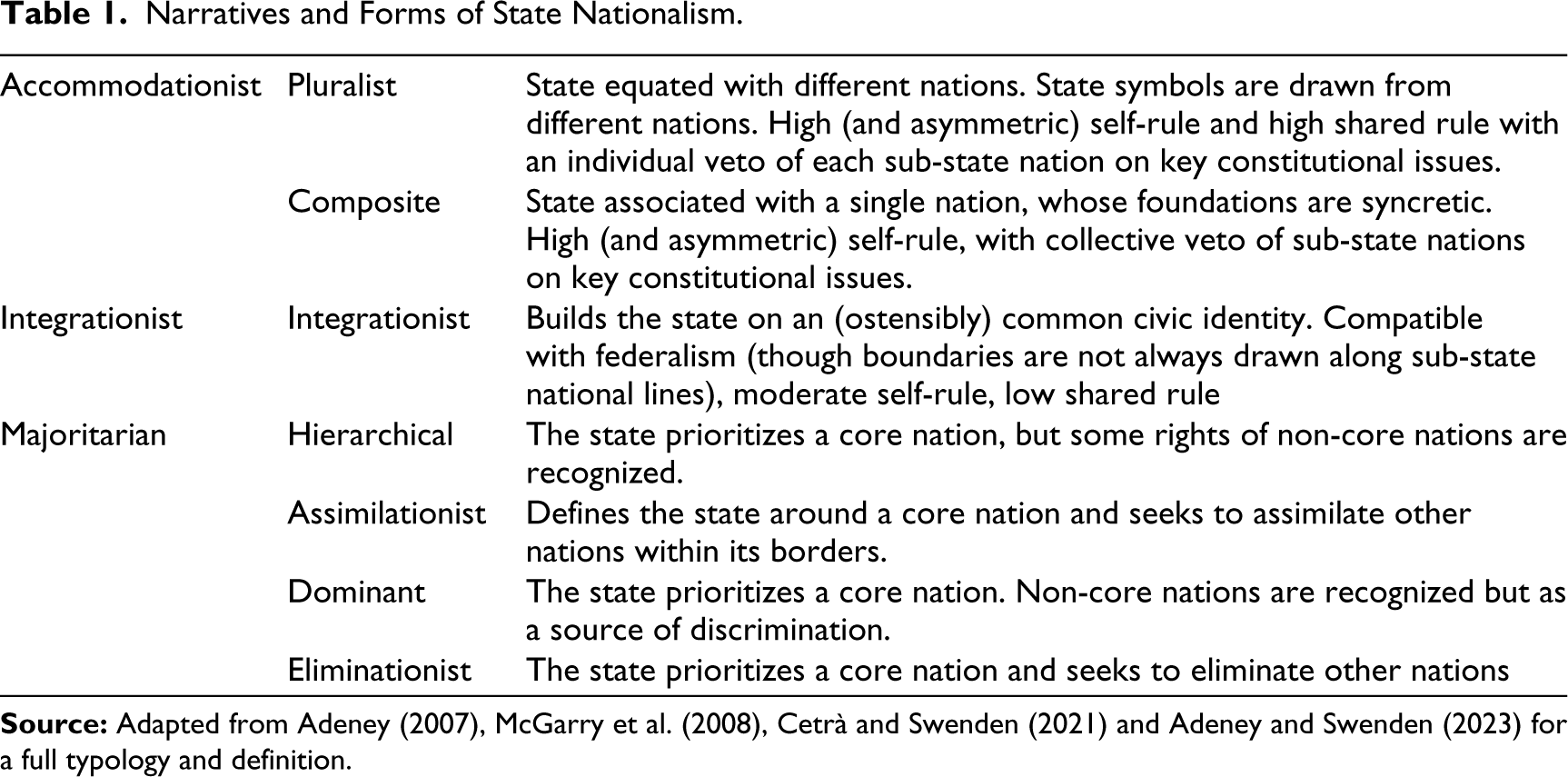
Accommodationist narratives of the state associate the state with multiple nations but vary in the extent to which this is reflected in ethno-symbols (flag, anthem) or the constitutional preamble (as forms of symbolic recognition), territorial self-rule and shared rule. A pluralist accommodationist understanding of the state is most accepting of sub-state group differences, a composite one slightly less so, with implications for symbolic recognition, self-rule and shared rule, as set out in Table 1.
Integrationist forms of state nationalism are more likely associated with a strategy of ignorance or ‘blindness’ to sub-state differences. In fact, integrationist approaches to sub-state nationalism may design sub-state national boundaries, along the lines of US federalism by not creating states with non-WASP (White-Anglo-Saxon Protestant) majorities (Kymlicka, 2001). They also tend to institutionalize weaker self-rule and shared rule, making sure that the centre is sufficiently strong in terms of its fiscal, legislative and executive powers to ‘hold’ the state together. Thus, while ‘holding’ together may be the shared purpose of accommodationist and integrationist narratives of state nationalism when faced with multinational societies, they believe that this can be achieved by different means.
Majoritarian forms of state nationalism are generally dismissive of sub-state national identities. We distinguish between different forms of majoritarian state nationalism. Majoritarian forms of state nationalism challenge liberal democracy. State elites may repress or even imprison sub-state nationalists who seek to transform their sub-state territory into a full-fledged nation, even if they do so in a peaceful and democratic manner. In the worst case, they aim at the forced displacement or elimination of members associated with a sub-state nation. In what follows we apply this framework to the multinational societies of Belgium, Canada, Spain and the United Kingdom, before comparing and contrasting them with India.
Narratives (and the evolution) of State Formation in the Global North
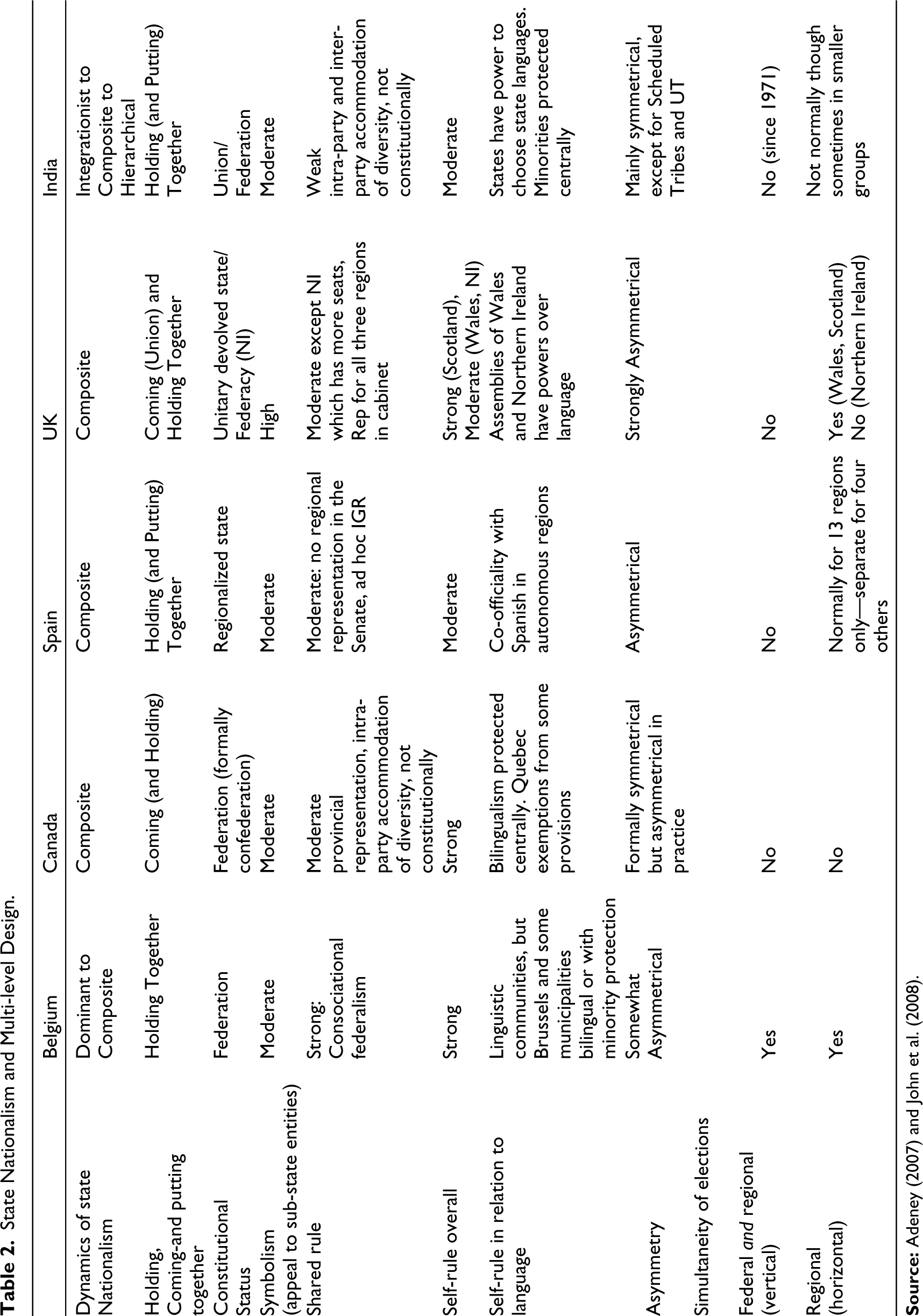
The form of state nationalism is often associated with narratives around state formation (although these narratives can be contested). Of the four cases from the Global North, two are decisively ‘holding together’ multi-level states (Belgium and Spain), one is predominantly built around a ‘coming together narrative’ (Canada) and one blends elements of ‘holding together and coming together’ (United Kingdom). Canada was a coming-together (con)federation at its inception: the Dominion of Canada was formed in 1867 by the joining of three British North American colonies. 1 Although contemporary Canada is known for its linguistic conflict, at the time of its founding ‘what mattered most politically was a religious divide’ (between Protestants and Catholics) which coincided with the French–English divide (Bickerton & Gagnon, 2013:173). It was conceived as a composite accommodationist (con)federation. However, as more provinces joined, Canada morphed into a union of ten, in which French speakers feared being dominated by nine predominantly Anglophone provinces (Hueglin & Fenna, 2015: 110). In addition, Anglophone provinces ‘enacted policies limiting the linguistic rights of French Canadians’ (Gagnon & Simeon, 2010: 115, quoted in Bickerton & Gagnon, 2013: 173). There were therefore pressures for a more integrationist nation. The official narrative was that of a composite nation.
The UK follows Canadian practice insofar as state formation involved the coming together of Scotland and England through the Act of Union in 1707. This Union should be contrasted with the Acts of Union of 1536 and 1543 which resulted in the (imperfect) assimilation of Wales (Mitchell, 2009: 8) and the Act of Union 1801 through which Ireland (already a colony of England) joined the United Kingdom ‘as a semi-colonial dependency’ (McGarry & O’Leary, 1996: 56, 70, 73). Following Ireland’s independence (1922), six predominantly Protestant Northern Ireland counties stayed with the Union, making Northern Ireland for about half a century the only self-governing (devolved) part of the United Kingdom, with its own directly elected legislature and executive. After the 1998 Belfast Agreement the UK government ‘recognized northern [Irish] nationalists as a national minority, not simply as a cultural or religious minority, and as part of a possible future Irish national majority’ (O’Leary, 2002). The historical formation of the UK therefore lends itself to a part pluralist, part composite, part assimilationist understanding of nation-building. The official narrative was that of a composite nation.
Like Canada and the UK, contemporary Spain can best be understood as a composite nation in its current configuration as a system of 17 Autonomous Communities. The origins of the Spanish state go back to 1469 with the personal union of crowns between Castile and Aragon. Spanish state elites for much of the nineteenth and twentieth centuries adopted a dominant form of state nationalism shaped by a Jacobin view of the state. Jacobinism refers to the ‘central figure of a sovereign and indivisible [and therefore centralized] public authority with power over civil society’ (Furet, 1989: 710). However, this dominant state narrative was challenged from below due to the economic strength of Catalonia and the Basque Country, their distinctive histories, rights (‘fueros’) and language. Upon democratization after Franco’s death in 1975, to ‘hold the polity’ together, the Basque Country, Catalonia, Galicia (each marked by distinctive vernaculars) were recognized as ‘historic communities’ while Navarre also received a special constitutional status and more extensive autonomy (though as in the UK, not all at the same level, with the Basque Country and Navarre possessing extensive tax autonomy). Andalucía, which had historical significance, was recognized as a region with a ‘fast-track perspective’ on regional autonomy. These regions exist alongside a further 12, some of them newly ‘put together’ (Heywood, 1995: 43). The official narrative was that of a composite nation.
Since its inception in 1830 and for much of the nineteenth century, Belgium was governed by a French-speaking elite, even though most of its population was Dutch-speaking. As in Spain, its ‘Jacobin’ state elites were of the view that a French-speaking and centralized state was needed to strengthen the development of the state. In only recognizing French as a state language Belgium adopted a dominant form of state nationalism. The ‘federalization of Belgium’ was the result of the Dutch-speaking majority asserting its linguistic rights with the gradual extension of the franchise and the split of the party system along linguistic lines in the 1960s. Linguistic demands coincided with territorial demands rooted in a reversal of economic fortunes with the traditionally richer French-speaking South losing out because of the decline of its traditional coal and steel production and the traditionally poorer and rural Dutch-speaking North gaining economic leverage from the location of new industries and services near the ports of Antwerp, Ghent and Zeebrugge. Until 1970, Belgium was a unitary state, and only formally became a composite federal system in 1993 when Article 1 of the Constitution declared that ‘Belgium is a federal state composed of Regions and Communities’. The state narrative has changed from a dominant to a composite nationalism as a result of pressure from both the majority and minority communities.
State Narratives and Symbolic Recognition
The process of state formation shaped the extent to which sub-state nations within an existing state can legitimately appropriate the term ‘nation’ and the symbols associated with the new state. British (not UK) nationalism appeals to elements linked to English, Scottish and Welsh history and practices, even though it may draw more on English history, given the size of England in the union (Keating, 1998). The understanding of the UK as a set of ‘unions’ enabled a comparatively high degree of symbolic recognition. In this regard the UK is pluralist. The ‘union jack’ (national flag) incorporates England’s St George’s Cross, Scotland’s St Andrews’ Cross and the red Saltire of St Patrick (now only representing Northern Ireland. Wales is not included). Although the national anthem makes no explicit mention of the separate nations, even before devolution in 1999 many sports competitions were organized along sub-state lines, with Scotland, Wales and England competing in the annual ‘Six Nations’ rugby tournament (alongside Italy, France and Ireland) or as four separate teams (including Northern Ireland) in the Commonwealth Games or international football tournaments (though not in the Olympic Games where they compete together as ‘Team GB’—technically Great Britain and Northern Ireland). Where they compete separately, distinct national anthems are sung. The UK national anthem ‘God Save the King’ is played when England competes (minus its fifth verse on crushing the ‘rebellious Scots’)—very occasionally replaced with ‘Jerusalem’.
In contrast, the tension between integrationism and composite pluralism underpinning narratives on Canadian state formation helps to explain the difficulty of Anglophone Canada in acknowledging Quebec as a ‘distinctive society’ (sub-state nation). The introduction of a Charter of Rights and Freedoms (1982) has limited Quebec’s capacity to enforce group-specific policies, such as French-only in Quebec. This contributed to a constitutional impasse and two referendums on Quebec independence in 1980 and 1995. At the same time, the recognition (validated by the Supreme Court) that Quebec is entitled to such a referendum if certain conditions are met provides some validation for the compact theory underpinning Canadian state narratives and its composite nation. In 1965, a maple leaf flag replaced the union jack and Canadian red ensign (which featured the union jack) (Heritage, 2017). Although without reference to Canada’s composite nation, in 1980, ‘O Canada’. originally written to a French-text and composed by a Quebecois musician replaced ‘God save the Queen’ as the national anthem (Heritage, 2018).
Despite the regionalization of the Spanish state since 1978, state elites (especially of the centre-right) have largely refused to acknowledge the state as multinational. The constitution associates the nation exclusively with ‘Spain/Spanish’ and affirms the country’s indivisibility (Cetrà & Swenden, 2021). Some autonomous communities may be recognized as ‘nationalities’ but there can only be one (Spanish) nation. This reflects the ‘Jacobin’ integrationist tradition in the process of state-building and the legacy of a unitary and authoritarian state preceding the death of General Franco in 1975. The Social-Democrats (and other left-wing parties) have been more willing to embrace the Spanish nation as composite (ibid). The Spanish flag in its current form goes back to 1978: next to yellow and red (without symbolic relevance) a crown (referencing the monarchy) and a coat of arms references to the erstwhile kingdoms of Leon, Castilla and Aragon and modern day Catalonia (Brittanica, 2024). The national anthem of Spain has no official lyrics.
Similarly, although the Belgian state is highly accommodative of linguistic diversity, state-elites associated with the mainstream parties and the Constitution usually reserve the term ‘nation’ to refer to Belgium only. As in Spain, this reflects the unitary past and the understanding of the nation at independence in 1830 (Deseure et al., 2018). In this sense, state nationalism post-1993 is composite. To the extent that ‘nation’ is used in relation to Flanders or Wallonia, it is associated with sub-state nationalists. This sets Belgium apart from the UK. The yellow and black colours of the Belgian ‘tricolore’ flag were used in the seal of the erstwhile Count of Flanders, but the additional red dates back to the revolt of the citizens of Brussels against the Austrian rulers in the late eighteenth century and was reused again in the struggle for independence from the Netherlands in 1830 (Smith, 2024). The Belgian national anthem (set to lyrics shortly after the Belgian revolution) does not appeal to the composite nature of the Belgian state and its lyrics affirm the ‘unbreakable unity’ of the country (Classic FM, 2021).
State Nationalism and Dynamics of (De)Centralization: Self-rule
There is some connection between the narratives on state formation, symbolic recognition and the territorial form of the state through self-rule (autonomy) and shared rule. At the same time, this relationship is not perfect and subject to change. Preferences (and the underlying narratives) of state elites may shift because of party competition or deeper socio-economic or demographic shifts driving party system change.
In terms of provincial self-rule, Canada is now one of the most decentralized federations in the world. At the time of state formation, it was more centralized—the result of the US as an external threat (and its then decentralized federal system being seen as a factor in driving the Civil War). The more decentralized nature of the Canadian federation today is in part accidental. Powers that were devolved initially (education, health) gained more salience with the development of the welfare state. However, the electoral rise of the Parti and later Bloc Quebecois, articulating a vision of Quebec nationalism has been the biggest trigger of an increase in self-rule. This was coupled with a demand among some of the western provinces to gain greater control over natural resources and public policy (Thorlakson, 2020). The result was a more decentralized but formally symmetric federation, in which Quebec sought to opt out of certain federal policies, generating de facto asymmetries. In political terms, self-rule is reflected in the non-simultaneity of federal and provincial elections (vertical non-simultaneity) and in the separate elections of provincial assemblies (non-horizontal simultaneity).
The UK is unusual in that the composite narrative underpinning its characterization as a ‘union state’ has coincided with an appeal to ‘parliamentary sovereignty’ (of the Westminster parliament), which is particularly prevalent among English political elites. The union state only gave way to a devolved state in 1999. However, unionism did not preclude the honouring of group-specific practices at a territorial level. After the Act of Union Scotland retained its distinctive religious, legal and education systems. A Scottish Office and a Secretary of State (union cabinet minister) for Scotland was created in 1885 (Wales did not receive similar representation until the 1960s) (Bogdanor, 2001; Loughlin, 2001: 38). This contrasts with the assimilation efforts, which led to the decline (but not eradication of) the Welsh language in Wales. After 1967 Welsh started to be used in legal proceedings and Wales was made formally bilingual through the Welsh Language Act of 1993. In 1998 Welsh became a compulsory part of the school curriculum with the passing of the Education Reform Act.
Since 1999, Scotland and Wales received political autonomy in the form of devolution, with directly elected legislatures (self-rule). Different autonomy arrangements are in place for Scotland, Wales and Northern Ireland (with no such arrangement for England which continues to be governed by the centre). This makes self-rule highly asymmetric in line with a pluralist understanding of the state. Self-rule does not undermine UK parliamentary sovereignty and as such it is to be distinguished from a formal federation. 2 Although by convention, the UK parliament will not legislate on devolved matters without the consent of the devolved legislatures (the Sewel Convention), this convention has been challenged: all three devolved legislatures withheld their consent to the EU (Withdrawal Agreement) Act 2020, but the Act was passed by the Westminster parliament (McEwen, 2022). Thus, in institutional—as opposed to symbolic terms—the UK is not pluralist. As in Canada general and devolved elections are not held on the same day, thus far Scotland and Wales have held their devolved elections on the same day (horizontal simultaneity). Northern-Irish elections have been held on the same day only twice (due to the suspension of Northern-Irish self-rule by the Union government).
Spain was governed as a unitary state until 1978. After the initial devolution, self-rule was extended piecemeal fashion, often because of institutional reforms tied up to the formation of central parliamentary majorities post-election (either as the result of bipartisan support among the major polity-wide parties, or—more frequently—as the result of a mainstream polity-wide party needing the support of one or several regional parties). These bargaining rounds led to the deepening of self-rule arrangements for all regions 3 thus reducing the significance of territorial asymmetries (with the exception of fiscal asymmetries). The key role of the centre in steering this process is reflected in its role in negotiating bilateral ‘Autonomy Statutes’ with each Autonomous Community, changes to which require mutual consent, including that of the affected regional electorate by referendum. Additional provisions are worked out in ‘organic’ parliamentary laws, that is, constitutional laws requiring central bicameral consent with special majorities (but not that of the regional parliaments). Although general and regional elections do not normally coincide, thus underlining the political autonomy of the latter, only the Basque Country, Catalunya, Galicia and Andalucía hold their elections on separate days, whereas the elections of the other (non-historic) regions usually coincide (partial horizontal simultaneity).
Self-rule in Belgium also developed in a piecemeal fashion, with cultural autonomy granted before socio-economic autonomy. The historic demands for recognition of the Dutch-speaking North led to the creation of three Linguistic Communities in 1970 (Dutch, French and German). Linguistic Communities control education, cultural policy, and some sections of justice, health and social policy. In a desire to gain political control over their industrial policy, French-speaking elites pushed for the creation of three socio-economic Regions: Flanders and Wallonia (1980) joined by the bilingual Brussels-Capital Region (1988). The co-existence of three conventional federal ‘sub-state entities’ (Regions) that are linked to territory and three ‘Communities’ that are based on language makes Belgian federalism unique (Deschouwer, 2006). The powers of each Region or each Community are roughly symmetric (though the Brussels-Capital Region and German-speaking Communities do not have the same status as the other Regions or Communities respectively). The main asymmetry in the Belgian federal system arises from the merger of the Flemish Community and Regional government into a single government and the continuous existence of a French Community government alongside a separate Walloon government and administration (Swenden & Jans, 2006), This is because of the comparatively larger share of French-speakers who do not live in Wallonia. To facilitate government formation and stability across all levels, in what is in essence a bipolar and split party system requiring central power-sharing (see below), Belgian federal, regional and European parliamentary elections are held on the same day.
State Nationalism and Dynamics of (De)centralization: Shared Rule
While the accommodation of Quebec nationalism resulted in more provincial autonomy overall, shared rule, i.e. attempts to incorporate the provinces in polity-wide decisions with provincial relevance has remained relatively weak: Canada’s Senate does not represent all provinces equally (instead there is equal representation among the Western provinces, the Maritime provinces and Québec and Ontario). Furthermore, over time the legitimacy of the Senate has decreased due to its entirely nominated character, restricting the effective role it plays as a chamber of regional representation (Swenden, 2010). Although shared rule provisions developed through intergovernmental meetings at executive and administrative levels, they are comparatively weakly institutionalized (Bolleyer, 2009; Mueller, 2024). Although informal arrangements require a third of Supreme Court justices to be French-speaking and several Prime Ministers (Chretien, Martin, Trudeau Sr, Trudeau Jr and Mulroney) have represented Quebec constituencies or ‘ridings’ in recent decades, but there is no explicit requirement for regional, let alone Quebec, representation in the national cabinet). Despite this, the main polity-wide parties (Liberals, Conservatives, New Democratic Party) are highly decentralized internally, and provided they have parliamentary representation across the provinces will seek to balance provincial representation in the allocation of cabinet positions.
Similarly, shared rule provisions are either weak or informal in the UK. Writing in 1977 Birch noted that one-third of ‘British Prime Ministers in the twentieth century (6 out of 18) had been Scottish, Welsh or Irish’ and that the non-English territories ‘comprising 17% of the population, contributed 22% of Members of Parliament, [and] 18% of Cabinet ministers’ (Birch, 1977). Since then, the proportion of non-English PMs has reduced—only Tony Blair and Gordon Brown being Scottish. Shared rule post-devolution has become more formalized with the creation of the Joint Ministerial Committee. However it has been ‘quite limited in its activities…used mainly for information sharing and discussion, rather than making decisions’(Brown Swan, n.d.). Furthermore, deepening self-rule in Scotland, Wales and Northern Ireland has come at the cost of weakening shared rule. Following devolution, the over-representation of Scotland and Wales at Westminster was cut to nearer the proportion of their population, secretaries of state for Scotland, Wales and Northern Ireland were reduced in status and the intention to transform the House of Lords into a chamber of the ‘nations and regions’ has stalled. The rise of English nationalism (the dominant, but ‘self-rule-less’ unit with 85% of the population) may weaken popular and elite support for the UK as a multinational society with stronger shared rule provisions (Henderson & Wyn Jones, 2021).
In contrast, channels of intergovernmental relations (in the form of sectoral conferences) have developed in Spain. However, as in Canada, they remain comparatively weakly institutionalized (Aja & Colino, 2014; Bolleyer, 2009). Furthermore, the Spanish Senate does not operate as a regional chamber. Sub-state demands have been accommodated through self-rule in the main, while the pivotal role of polity-wide parties at the centre allowed shared rule provision commensurate with an integrationist state narrative to persist. The dynamics of the Spanish autonomy arrangements have been contingent on the nature of the multi-level party system. Bargaining and compromise are more likely when the party(s) in control of the central government either lack a parliamentary majority and/or are controlled by the centre-left. The ‘Catalan Crisis’—which led to the organization of an unconstitutional referendum on independence in 2017 and subsequent suspension of the Catalan government—was precipitated by a Constitutional Court ruling in 2010 invalidating changes to the Catalan statute of autonomy. This was compounded by the absolute majority of seats the Spanish Conservatives received between 2011 and 2015. This obliterated the need to consult with opposition (and especially smaller regionalist parties) and shifted the PP’s stance in an integrationist direction (with recent newcomer Vox even propagating a majoritarian discourse). Conversely, attempts to form a Socialist-led minority government at the centre following the 2023 general elections have led to proposals to offer amnesty to Catalan leaders implicated in the 2017 referendum, in exchange for the parliamentary support of some Catalan regionalist parties.
In institutional terms, Belgium has gone further than any state in this sample in accommodating multinationalism through shared rule. This is because before decentralization the centre was already composite to some extent with informal power-sharing rules in place between the French- and Dutch-speaking language groups in the central cabinet (Deschouwer, 2006). Language Communities receive strong recognition due to the split party system and the consociational governance of the Belgian centre (and the Brussels-Capital Region) in which both hold a mutual veto. They are free to impose their language within their territory (an exception is made for Brussels and some municipalities close to the language border). With the development of Belgian federalism, Regions and Communities have also gained a stronger foothold in intergovernmental relations (through multilateral intergovernmental institutions in which each holds a mutual veto). That said, processes of federal constitutional change do not require the explicit consent of Regional and Community parliaments. Change requires federal bicameral super majorities with the consent of a majority of members from each language group (Dutch and French-speaking) in each chamber (House and Senate). This underlines the composite nature underpinning Belgian federalism (Table 2).
State Nationalism and Multi-level Design.
India: Narratives on State Formation and Evolution
Unlike its neighbour, Pakistan, India’s post-independence federal set-up was never seriously in doubt. Although there were debates about the structure of federalism, its size, diversity and previous experience of territorial governance (both during and before the British) precluded any other option (Adeney, 2007; Metcalf & Metcalf, 2012; Rudolph & Rudolph, 2010). However, state formation in India raised particular challenges. Unlike Canada, India was not a ‘coming together’ federation. One important issue India needed to address was how to integrate the more than 562 princely states. As such, India was a ‘holding’ or even ‘putting together’ federation. Nehru and home minister Patel were quick to dismiss the preferred option of princely rulers for a loose federation, a job made easier by their inability to mobilize collectively (Kumarasingham, 2013: 96). Princely states (with the exception of Kashmir) were merged with erstwhile provinces (or with adjoining princely states) and placed on the same constitutional footing. State narratives, while acknowledging the country’s immense diversity as a source of strength, tended to be integrationist on the territorial issue, rather than composite or pluralist. India’s constitution drew extensively on the centralized 1935 Government of India Act, a framework that suited the dominant Congress ideology and objectives (Washbrook, 1997). These included provisions that enabled the centre to take control of state matters in times of Emergency and the retention of a unified civil service (Kumarasingham, 2013: 101–103).
Additional factors added to this state-centric and predominantly integrationist narrative. Nehru had a strong preference for a state-led economy (Adeney & Wyatt, 2004; Tillin, 2021; Tudor, 2013). Despite heated debates in the Constituent Assembly, 4 Nehruvian secular nationalism prevailed (Varshney, 1993), built around notions of a common citizenship and identity, equality before the law, democracy and secularism (Cetrà & Swenden, 2021; Khilnani, 2004). Partition reinforced this centralist impulse: a country recently divided based on religion could not risk being divided further based on territory or language.
State Narratives and Symbolic Recognition
Overall, the choice of flag, national anthem and preamble appealed to a multitude of cultural traditions. The flag appeals more to religious than to territorial diversity, at least in its early Gandhian interpretation, with orange, green and white referencing its Hindu, Muslim and other religions (Roy, 2006). Similarly, although the decision to choose Jana Gana Mana over Vande Mataram as the national anthem was primarily for religious reasons, its lyrics, written by Tagore, appeal to India’s diverse geography. The constitutional preamble appeals to the ‘people’ (singular) of India, even though the subsequent first article refers to India as a ‘union of states’. The constitution then was part composite, part integrationist. Some leading thinkers close to the current BJP government have bemoaned India’s ‘colonial’ constitution (Debroy, 2023; Bhatt, 2023 for a discussion) but the decisions taken in the late 1940s were deliberate ones, tied to the conception of the ‘nation’ that they sought to create. Although the official language of India was to be Devanagari in the Hindi script, Article 345 provided that states could adopt their own language(s). In 1953 India moved towards a more composite model along territorial lines. It did so for electoral reasons—seeking to forestall fractionalization in Congress (Adeney, 2007), which was pressuring for the reorganization of states along linguistic lines. The state of Andhra was the first to be created. The State Reorganization Act of 1956 created 14 states and six Union Territories. Linguistic state reorganization continued until 1966 with the (further) partition of Punjab to make it a predominantly Punjabi (and Sikh) speaking state (Sarangi, 2009; Chopra, 2022 for more detailed coverage). Linguistic reorganization was part of a wider set of measures underlying India’s composite approach to linguistic diversity. English was retained as an associate official language at the centre, 14 languages were recognized in the Eighth Schedule (gradually increased to 22—under the National Democratic Alliance [NDA] in 2002), the right to use these languages in key central institutions (such as Parliament or the civil service), a three-language formula in education and the protection of linguistic minorities at the state level (Austin, 1966: 292 on the CAD debates, Adeney & Bhattacharrya, 2018; Benedikter, 2011; Groff, 2017). However, while territorial strategies were considered appropriate to accommodate language (thus underlining a composite approach), they were not considered appropriate to accommodate religion. Punjab was only reorganized once the demand was reframed along linguistic rather than religious lines, and Jammu and Kashmir’s borders were not reorganized—the complex accession process of this former princely state with a Hindu ruler but Muslim-majority population, linked with its border status (and therefore claimed by Pakistan and India) led to its incorporation into the union with a special status (discussed below).
State Nationalism and Dynamics of (De)Centralization: Self-rule
Given the process of state reorganization, it is sometimes said that India is ‘an ‘indestructible union’ of destructible states’ (after Ambedkar, CAD, 4 November 1948). Constitutionally, state reorganizations require bicameral approval by the central parliament, with the input (but not necessarily consent) of the affected states or territories, something which sets India apart from nearly all other federations (the explicit consent of the affected region(s) is normally required).
Territorial integrity in India is sacrosanct. In 1963 India adopted an anti-Secession Bill according to which every candidate for public office must uphold the ‘sovereignty and integrity of India’. This was enshrined in the constitution in the 16th Amendment Act. This goes further than Spain where the constitution forecloses secession but not the promotion thereof. Furthermore, India’s People of the Representation Act (1951), in Chapter III 8 (k) disqualifies candidates or legislators who insult the flag or constitution or prevent the singing of the national anthem.
Despite large discrepancies in the demographic size and economic weight of its states, India is a predominantly symmetric federation in a constitutional sense. Some asymmetries apply which grant states or sub-states autonomy which other states do not have (until 2019 Article 370 in relation to Jammu and Kashmir, as well as, Articles 371 A and G to Nagaland and Mizoram). The latter do not extend religious and social practices of the Indian Parliament to these states (Saxena, 2006: 113–114) Under the Fifth Schedule of the Constitution, Scheduled Tribes outside the North-East receive protection (in the form of Tribes Advisory Councils) including over land and some natural resources. Under the Sixth Schedule, 10 Autonomous District Councils have been created in the North-East, with a further ten Autonomous (District) Councils established in non-Sixth Scheduled areas (Tillin, 2016: 549). Conversely, India has eight (up from six) Union Territories. These have less autonomy than states and are directly controlled by the centre even though three of these have also directly elected legislatures (Puducherry, Delhi and Jammu and Kashmir).
Unlike in Canada, Spain and the UK, ‘Kashmir’s asymmetrical status in the Indian constitution did not stem from a recognition that its ethnic or religious distinctiveness constituted a basis for a higher degree of self-government than other Indian states’ (Tillin, 2007: 47). It was not therefore intended to acknowledge the ‘distinctive nature or society’ of the affected territories. Its transitional status has been undermined by all Indian governments, the result of ‘rigged’ or ‘khaki’ elections, with Article 35A (restricting the right to employment, scholarships and settlement to permanent residents) as the main asymmetric exception. The situation is more complicated with regard to the provisions for (and within) the NorthEastern states. As Tillin (2007: 56) reminds us, many of the provisions for NorthEastern tribes have not been replicated for tribes in other states. She argues that the asymmetrical provisions must be understood as analytically different given that they are ‘peripheral units’ of the federation. (2007: 47). We would agree with Tillin that the NorthEast is not representative of the federal system and must be separated from the overall narrative. However, they must be recognized as asymmetrical, even if we would categorize them as being evidence of hierarchical rather than composite nationalism given that these autonomy arrangements have often existed under the shadow of President’s Rule and/or the Indian security state (most notably the application of the Armed Forces Special Powers Act, enabling preventive arrests and detentions, or search without warrants; Singh, 2022).
President’s Rule has not only been applied in India’s peripheral regions. Although all federal systems have emergency provisions, India is notable because President’s Rule has been (over) used for party political purposes (Das, 2023). As Adeney observes ‘[t]he 1970s were the decade in which [President’s Rule] was used most extensively. It is no coincidence that Indira Gandhi was prime minister for most of the decade’ (2007: 115). This has undermined self-rule. In the era of coalition government, the Supreme Court put stricter guidelines on the use of President’s Rule and attempts to use it by the BJP-majority government at the centre in 2016 were pushed back by the Court (Swenden & Saxena, 2022). In general, the operation of Indian federalism was most decentralized between 1996 and 2014 when a pluralized party system coincided with a more marketized economy (Sharma & Swenden, 2017). Yet few of these changes led to a constitutional deepening of self-rule, as regional(ist) parties at the centre pursued divergent fiscal or administrative interests and either polity-wide party (Congress or BJP) held on to a more centralized outlook.
The BJP’s unexpected ability to capture central office on its own in the 2014 and 2019 elections changed the decentralizing trend. Federalism certainly has become more centralized in many areas (Swenden & Sharma, 2018). This is especially the case where religion and territory coincide. For instance, the BJP’s decision to revoke Article 370 and scrap Article 35A in 2019 and turn Jammu and Kashmir from a special autonomy state into two Union Territories (Jammu and Kashmir plus Ladakh) without—at this point—directly elected assemblies, fulfilled a long-standing BJP pledge (Adeney, 2005). The party has pursued a more subtle strategy in the North-East by co-opting regional players, making them dependent on central investment support and by Hindu-ising their societies through education and the promotion of Hindi (Longkumer, 2019). Since 2014, the autonomy of all states has been weakened through fiscal centralization, tighter controls on how centrally sponsored policies are implemented at the ground level and a ‘One Nation’ narrative, which it relates to ‘the Market’, ‘One Tax’ (GST), ‘One Grid’, ‘One Ration Card’ and (only envisaged at the time of writing) One Election’. The latter risks undermining the political autonomy of the states by synchronizing all state assembly with general elections (Aiyar & Tillin, 2020; Kailash, 2021; Sharma & Swenden, 2022). The central government has also used centrally-appointed governors (The Hindu, 2023) to constrain opposition-ruled state governments.
State Nationalism and Dynamics of (De)centralization: Shared Rule
Shared rule mechanisms are certainly not absent in India (Saxena, 2021), but they remain comparatively weak, as they have throughout independent India’s history. Representation in the upper house, the Rajya Sabha, is (roughly) in proportion to population, and it is inferior in powers to the Lok Sabha. Executive shared forums are largely dormant (Inter-State Council) or controlled from the top (National Development Council and more recently NITI Aayog—the National Institution for Transforming India). Given the strong legislative and fiscal position of the centre, and the ability to invoke Emergency provisions such as President’s Rule, the dynamics of Indian federal shared rule have been highly contingent on the operation of the multi-level party system. Intra-party democracy and a strong organization under Nehru, including leaders of ‘stature (with) a base of their own’ at state level (Varshney, 1998: 46) ensured that conflicts within and between states could be managed within the ‘Congress system’ (Kothari, 1964)). Under Indira Gandhi the situation changed, bargaining was replaced with top-down centralization.
The period of coalition politics between 1996 and 2004, including regional, regionalist as well as identity-based parties saw a rejuvenation of the party system, but the shared rule mechanisms remained weak. The Inter-State Council scarcely met, and the Planning Commission was not reconfigured to strengthen the voice of the states in central grant-making or in the formulation of centrally sponsored schemes.
In Modi’s first term in office, the rhetoric was all about ‘co-operative federalism’ (Aiyar & Tillin, 2020: 118). After an agreement on a General Sales Tax (GST), secured after multiple rounds of discussions and negotiations between the states and the centre, a General Sales Tax Council, with membership of the states and the centre was created to agree on future levels of taxation. However, the fact that the ‘weighted’ votes of the Union equal to one-third of the votes in the GST Council, means that the Union can veto any proposal (decisions to be binding requiring three-fourths of the vote)—although it cannot unilaterally pass one (Sharma, 2022). Finally, while the replacement of the Planning Commission with the NITI (National Institution for Transforming India) Aayog enables advisory input of Chief Ministers, its meetings are not more frequent than erstwhile gatherings of the National Development Council and are marked increasingly by selective attendance (opposition Chief Ministers often boycott them). The PM office sets the agenda and meetings are not minuted (Swenden, 2019). The Inter-State Council has met only once since Modi became PM.
The rise of the BJP has shifted India from a composite state nationalism narrative to a hierarchical Hindu majoritarian one. This has centralized the operation of Indian federalism, as highlighted above. The Sangh Parivar (Hindu family of organizations) has traditionally favoured a unitary state with stronger local government structures. But the Jana Sangh was also prepared to endorse linguistic reorganization when the compulsions of electoral politics demanded it (Adeney, 2005: 99) and the BJP added three languages to the Eighth Schedule of the constitution in 2002. It should therefore not be surprising that, at least until 2014, these anti-federal impulses were constrained by coalition politics, as the NDA government (1998-2004) was comprised of regional and regionalist parties.
Even after Modi led the BJP to victory as a single-party government in 2014, and again in 2019 India remained a federal state. Before 2014, Modi was a three-term Chief Minister in Gujarat who campaigned on strengthening ‘Team India’ and implementing a ‘co-operative-competitive federalism’. In addition, the party lacked the qualified constitutional majority to drastically redraw the divisions of competencies as set out in Schedule VII of the constitution and may also have encountered the resistance of the Supreme Court (which has declared federalism a part of the ‘basic doctrine’—and therefore in principle an ‘unamendable part’—of the constitution).
The Future of Indian Federalism
Despite the centralizing impulses of Modi, since 2014 and even in the 2024 general elections, the BJP has widened its territorial footprint. It suffered electoral losses in the Hindi-heartland compared with 2019 (mainly in Uttar Pradesh, but also in Rajasthan and Haryana) but advanced significantly in vote share (though not necessarily in seat share) in Odisha, Telangana, Andhra Pradesh and even Tamil Nadu and Kerala (from which it elected its first ever MP). Support for regionalism (and regionalist parties) in these non-Hindi states is more pronounced and this may create pressure from within to retain the states as substantial players and to restrain attempts at Hindi-ising the Indian polity. The return of coalition government in 2024 has added to these pressures in that at least one of the main coalitional allies, the TDP (Telugu Desam Party) has its support base in the southern state of Andhra Pradesh (the other allies are mostly based in the Hindi-heartland). It remains to be seen to what extent this will influence intergovernmental relations or debates on ‘One Nation, One Election’ and crucially, the nature of delimitation in 2026, as a result of which northern states are likely to increase their representation in the Lok Sabha.
A push towards centralized federalism and hierarchical nationalism is only sustainable when the public is willing to endorse such a view. There is mixed evidence for this. The pre- and post-poll National Election surveys give some indication on where voters stand in relation to some key federal issues. For instance, 34% of respondents in the CSDS pre-poll survey considered the ‘removal’ of Article 370 as a good step, whereas just 8% saw it as a bad move. 5 These data underline at the very least conditional support for the measure (though no territorial breakdown is given; CSDS, 2024b: 8).
Yet, federalism matters: despite the non-congruence of Lok Sabha and state assembly elections (with a few exceptions), 40% of respondents in the post-poll survey signalled to cast their vote on the basis of work done by central and state governments ‘equally’ whereas the share of voters responding to do so on the basis of central or state governments alone was almost equal (at 22%) (CSDS, 2024a: 12). 41.5% of voters also agree with the statement that ‘politics and issues are very different in the south and north regions of the country’ with just 28% disagreeing (CSDS, 2024a: 13). We cannot read too much into these statements as no questions were asked on respondents’ chosen identification (India/state) or preferences with regards to the weakening/strengthening of the states vis-à-vis the centre. Furthermore, we do not know on the basis of published results how these data may have varied on a regional basis. However, at the very least they seem to suggest support for a form of federalism that is commensurate with an integrationist view on the state, though (based on the Article 370 question) less so with a composite interpretation, if this is understood as including religion.
Conclusion
In this article, we tried to show how both in the Global North and India elite expressions by state elites on state nationalism condition the extent to which multinational societies are willing to accommodate sub-state nationalism. We differentiated among several ideal types which we associate with different ways of accommodating (or repressing) sub-state nationalism through symbolic recognition, self-rule or shared rule (or the lack thereof).
Our analysis showed that how state elites think on these issues is rooted in how the state was imagined at its inception, with the coming together nature of Canada and—in part—the United Kingdom, providing an interesting contrast with the holding (and sometimes) putting together nature of Belgium, Spain and India. State narratives of the latter are more likely to be integrationist and emphasize territorial integrity at the outset.
However, our analysis also shows how electoral politics has changed how state identities are given expression. Party system change often forced state elites into changing their positions. In Belgium the rise of Flemish nationalism pushed state elites into a composite, sometimes even plural direction and this underpinned the transformation of the state from a unitary state into a consociational federation. Democratization in Spain also forced the transition into a more regionalized state, built on a more widely shared view of the state as composite (though contested by the centre-right, more so recently in view of the Catalan crisis). Electoral politics forced linguistic state reorganization in India while a pluralized party system underpinned a more decentralized federation in practice. The electoral success of Quebec and Scottish nationalist parties forced their mainstream Canadian and British party competitors into deepening self-rule and in both cases accepting a route towards possible exit. Conversely, electoral competition does not always generate a decentralizing effect; attempts to centre the Indian nation around a Hindu core built on the rise of majoritarian preferences among the electorate at large, predate the BJP’s electoral success in 2014.
Finally, our analysis also shows that states do not always align along predicted ways across the various dimensions of our ideal-type categorization. For instance, the pluralist ‘coding’ of Belgium on shared and self-rule coincides with a composite ‘coding’ in relation to symbolic recognition. A pluralist understanding of the state coincides with deep and asymmetric self-rule in relation to the devolved nations in the UK but also with limited shared rule and the retention of parliamentary sovereignty there. In India, the majoritarian state narrative of the BJP has merely eroded self-rule, but only ‘eradicated’ it in relation to Jammu and Kashmir, India’s formerly only Muslim-majority state. Overall, changing formal institutions is harder, given the constitutional and institutional hurdles involved. Sometimes it may not even be necessary where a ruling party at the centre may win most sub-national contests or use the centralizing possibilities of a constitution (such as India’s) to its maximum effect. Yet, we believe that this strategy has its limits in the territorially diverse society underpinning Indian federalism.
Footnotes
Declaration of Conflicting Interests
The authors declared no potential conflicts of interest with respect to the research, authorship and/or publication of this article.
Funding
The authors received no financial support for the research, authorship and/or publication of this article.