



Abstract
We assume that even though voters prefer the policies of their favoured leader they value democracy more greatly. This means that voters on both sides of a polarised policy divide would be willing to sacrifice their preferred policy if it would mean preserving democracy. However voters on one side are unsure whether voters on the other side share this commitment to democracy. We show that in such a situation an autocratic populist leader can act in ways that will undermine opposing voters beliefs that the leader’s supporters continue to value democracy. If these beliefs become pessimistic enough, a self-reinforcing cycle of mutual suspicion between voters on opposing sides leads to the inexorable demise of democracy and its replacement by autocratic rule. Understanding this, an elected leader who aspires to rule via non-democratic means may follow such autocratic populist policies in order to entrench their rule.
Introduction
Towards the end of his life, Ashok Kotwal lamented the state of democracy in both his own country of birth and across the world. He shared the view that, despite its shortcomings, democracy remained an unparalleled means of protecting and advancing human rights and dignity. This view was no better expressed than via his admiration of India’s first prime minister. The reason he most cited for that admiration was not Nehru’s role as a leader in the Nationalist Movement helping India gain independence, his modernization of the country as prime minister, or even his secular humanist ideals. Ashok most admired Nehru’s eschewing of the opportunity to leverage his immense popularity to entrench personal power at the expense of India’s emerging democracy.
Alas, it would appear that few leaders have followed Nehru’s lead in subordinating their own hold on power to the greater good of their countries’ political institutions. For this, and other reasons, many of the world’s democracies have experienced erosion of their democratic institutions over the last 10 years. Take, for example, one of the most common measures of democratic quality—compiled by the V-Dem project. 1 According to V-Dem, and excluding transitions in sub-Saharan Africa, over the last 10 years, 7 countries have suffered the major V-Dem category downgrade of moving from Electoral Democracies to Electoral Autocracies 2 : Hungary in 2018, India in 2017, the Philippines in 2018, Tunisia in 2022, Turkey in 2013 and both Guatemala and El Salvador in 2021. The United States, though not suffering a category shift (it is still counted as a Liberal Democracy, the highest of V-DEM’s four categories), experienced democratic backsliding under the presidency of Donald Trump.
In this article, we discuss a problem for democracies caused by authoritarian populists (APs), of which Donald Trump is taken as our paradigmatic example. Somehow, by undertaking populist policies and implementing them in authoritarian ways, such politicians erode the fabric of democratic institutions. In this article, we sketch how this happens.
We argue that doing one of two actions on their own: either (i) populist policy-making (enacted through standard executive, legislative, constitutional or regular consultative means) or (ii) authoritarian policy-making (e.g., technocratic but not populist), does not undermine democracy, but the combination of both actions does. Furthermore, it does so even in otherwise well-functioning democracies, where a large majority of citizens value their democracy and their system of government.
A recent paper by Braley et al. (2023) comes to a similar conclusion. The authors outline a mechanism, built on mutual confusion, which we mostly agree with. They describe a means whereby confusion between partisan supporters across a polarized political divide can spiral out of control and undermine democracy itself, dubbing their mechanism the ‘subversion dilemma’. As the authors put it:
‘To summarize, we think democratic-loving voters may vote away the democracies they cherish in part because (1) would-be authoritarians convince their supporters that the other party is subverting democracy, (2) leading them to begin tolerating backsliding by their leaders, which then (3) prompts legitimate fears in the other party, (4) leading the other party to entertain or tolerate more drastic action by their own leaders, which then, (5) confirms the unfounded fears generated in (1) and ultimately may start a death spiral for democracy’ (Braley et al., 2023, p. 1283).
More prosaically, and with application to the US’s own recent would-be-autocrat (WBA), their story goes like this. A politician, Trump in this case, creates a democratic backslide by convincing his supporters of an untruth. He manages to convince them that supporters of the other side, Democrats, are anti-democratic, anti-American and a threat to the nation. As a consequence, Trump’s supporters believe it is their democratic duty to stand against Democrats. They believe that Democrats want socialism, do not share similar values, and will stop at nothing to achieve those ends—or so it goes. A true patriot needs to stand against them, and because Democrats are using non-democratic means to achieve their goals, true patriots need to as well. The Democrats rigged the election, so the only democratic thing to do is to bring down a government elected through nefarious means by force. Hence, storm the Capitol—as many did on 6th January 2020—for example.
This explanation rests on the following key assumption that we find problematic. Supporters of Trump take their cues on the true nature of Democrats from him. They believe him when he says Democrats are anti-democratic. But why would Republicans believe Trump, and take any cues from him regarding the intentions of Democratic supporters? He clearly lies. He is known to lie, especially when it is in his interests to do so. He is no expert on Democratic supporters or much else in politics. So, whatever priors Republicans have about Democratic supporters, which may indeed have been very poor, and extremely pessimistic, it is not at all clear how a known and celebrated liar, who clearly has a very strong personal political interest in making his supporters think the worst of their ‘enemy’ can be so persuasive in moving them in any direction? Especially in a direction that clearly favours his own interests?
Our explanation is that Trump is not particularly persuasive about Democrat voters. His supporters simply like the policies he pursues, and they also like him. He is a ‘personalist’ politician, charismatic and appealing to them on a personal level. 3 They like the ban on immigrants from ‘Muslim countries’, they like a supreme court that will repeal abortion rights, they like building a border wall, they like that he claims to root out corruption, they like that he will appoint (perhaps) incompetent but highly partisan judges. In general, they like that he seems to be a maverick, speaking truth to power, eschewing shaky political bureaucratic expertise and making policy that is directly in their interests—or so they believe.
Enacting these policies involves breaking political norms and Trump projects a personality that delights in doing so. He broke many such norms while in office. Examples include: (i) not releasing his tax returns; (ii) not complying with Conflict of Interest rules and divesting from businesses; (iii) interfering in Department of Justice investigations 4 and (iv) abusing presidential pardons. 5
Many of Trump’s efforts to implement policies failed because they were attempted in such an authoritarian way that circumvented the usual constraints or norms imposed on the presidency. From our perspective, his very ineptitude in attempting policy in such a way also turned out to be a feature to his supporters. Even though the policies failed, attempting them by such non-conforming means broke long-standing norms and thus dismantled guardrails. For example, the executive order halting of ‘Muslim country, immigration which failed in the courts. The attempt to shamelessly request loyalty from the head of the FBI, leading to Trump’s investigation and removal of the FBI head. His criticisms of judges who made rulings unfavourable to him and so on. 6
These policies (and others) have two features: (i) they are popular with Trump’s supporters and (ii) they are authoritarian in that they represent overreach on the part of a president. They undermined long-standing political norms and crossed boundaries of presidential behaviour.
These policies did not end up decreasing Trump’s approval rating amongst his supporters. In fact, they seem to have increased it. He was seen as a politician who attempted what he promised, even though he was essentially an ineffective president legislatively. As his supporters note, at least he tried.
So why did his supporters ‘like’ these attempts at policy by such authoritarian means? There are two, non-exclusive, reasons why they approved of Trump’s ham-fisted authoritarian attempts to implement them. The first is that they liked the policies so much, or him so greatly, that they were willing to reluctantly tolerate the erosion of norms that attempts to enact them entailed. The norms are/were valuable, but the policies are more valuable, or his personal popularity so great that they appreciated the efforts, even though by doing so, norms ended up being weakened.
The second is that his supporters do not particularly care about democratic norms. That is, democracy is broken. In this case, they want the right policies, not the right process. So, if obtaining the right policies implies that democracy in its current form is fatally weakened, then so be it.
The latter is a possibility that is hard to rule out. If Republican supporters have truly lost their support for democracy, how would Democratic supporters ever know? If it were possible for Democratic supporters to somehow discern or observe Republican supporters’ values, they would know—but they cannot.
Trump’s actions, which maintained his popularity amongst Republican supporters, further sowed confusion amongst Democrats as to Republican values, not only throughout his presidency but beyond. Towards the end of his presidency, Trump saw polls suggesting he had a small chance of being returned. In response, he anticipated that he would not necessarily abide by the outcome of the election. He then predicted what would happen if he lost, and proceeded to enact his prediction. When the election went against him, he attempted extra-legal efforts to place electors in place that would endorse him, going so far as to strong-arm his own vice-president into ratifying him as president in defiance of the electoral college. 7
When these attempts failed, he challenged the outcome in the courts, again using means that were clearly beyond the legal pale, requiring misinformation and in fact leading to censure of such legal efforts by state bar committees. These efforts were so brazen that his role in organizing them led to his indictment. Even after all of these attempts failed, he continues to maintain that the election was ‘stolen’ from him and that, therefore, he is the legitimate president of the United States. He does not concede that he lost in a fair democratic outcome.
After all this, he remains the most supported of Republican contenders for the party nomination. Moreover, a clear majority of Republican registered voters agree with his contention that he legitimately won the election, and it was stolen from him.
So, in comparison with Braley et al. (2023), we do not disagree on the immense confusion over both sides of the partisan divide. We also agree that when two protagonists are mutually confused about the intent of the other, such confusion can lead them to act in ways that become self-fulfillingly malignant. But we do differ as to how one arrives at that point, that is, step (i) in their schema. They start from the position that WBAs convince their supporters that the other side is in favour of subverting democracy. The ball starts rolling from there because then the other side fears the autocrat’s side subverting democracy themselves, and so on. We start from the position that WBAs convince the other side that the WBA’s supporters are in favour of subverting democracy. The authoritarian populist policies do this by confusing the reasons for why the WBAs’ supporters continue with their support.
Once that has happened, we are in full accord with the Braley et al’s (2023) perspective. They document the extreme misperception that partisans on both sides of the political divide have about each other and how it has increased. Even to the point of both sides thinking that supporters of the others as ‘less evolved’. 8
It is clear that Democratic party partisans have been questioning the commitment to democratic ideals on the part of Trump supporters—that is, the clear majority of registered Republicans. His acts have, thus, moved the ‘other side’, Democrats, into thinking that Trump’s supporters are in favour of subverting democracy or are at least more likely to be than they thought before.
Perhaps as a consequence of this, or perhaps due to deep animus on the part of Democrats, one heard, and continues to hear, democratic supporters (or at least anti-Trump denizens) speaking of ‘No Trump, No Matter what!’. They have spoken of the paramount importance of ensuring that Trump does not return to the White House. Their motivation is that he is a clear threat to democracy. Trump has even stated that himself, and continues to embody it in his denial of the legitimacy of the current incumbent.
However, if Republican supporters take Democratic supporters seriously, and if they believe that these Democrats truly believe Trump is a threat to the United States continuing as a democracy, then Republican supporters know that Democrats will stop at nothing to ensure that Trump does not gain power again. 9 Indeed there is no shortage of left-leaning commentary stating that Trump must be stopped, and in a way that clearly suggests non-democratic means if necessary. For example, quoting from Elizabeth Warren: ‘Health care. Reproductive Freedom. Workers’ rights. Dreamers’ futures. Our planet. Democracy. Everything is on the line—so everything is on the table’ (p. 1283 from Braley et al., 2023). 10
The Democratic view, perhaps erroneous, that Republicans no longer value democracy becomes true. Republicans do not, but not for the reasons that Democrats believe. They do not, because they believe that Democrats believe democracy is no longer in place, and will, therefore, themselves act undemocratically.
The story we briefly model here rests on this confusion. And when we are talking about groups of people trying to imagine what other groups of people think, then confusion is a reasonable starting position. If the ‘sides’ were just individuals this would still be a problem. Two individuals can be confused about what each other wants, and mutual confusion can lead to fear, which can lead to conflict. But the sides of any political conflict comprise multiple people. They act in concert sometimes, but not always, and whether they get to a particular collective decision depends only in part on their values. It also depends on beliefs, and on whether actors within their camp can lead them and coordinate them, and probably on a host of other factors as well. So when, for example, a Democrat voter is trying to assess ‘Republicans’ and what they are going to do—that is, are they actively going to undermine the democratic process, or are they people who simply like different policies? What they are trying to assess is both a set of very diverse people, and they are trying to make some sort of call on what sort of behaviour and policies these people are going to congeal around. This is a difficult inference problem.
The next section builds a toy model of this story. We do not attempt to model the difficult process by which groups of people come to see other groups comprising multiple individuals in a particular way. We treat groups as populated by representative agents, though a better model would tackle this aspect. Our model focuses on showing that a simple version of the story we have sketched out here makes sense. We want to point out how reasonably thinking and acting people on one side can be confused about the other, how this is instigated by authoritarian populists, and how this can lead to democracy falling apart. Such confusion is clearly at play now in the United States, and it would seem there is no shortage of would-be authoritarian populists available to undermine democracy elsewhere.
The Model
Voter Preferences
Voters care about two things: preferred policy and democracy. Assume there are two sides in politics. L and R. Each with approximately one-half of committed voters supporting them. Committed voters like particular policies corresponding to their side. There are also a number of uncommitted voters who are mixed in their support of particular policies. They like a combination of L and R policies, with the mix differing by the voter. These voters serve to inject an element of stochasticity into elections (as per probabilistic voting models); which we detail below.
Let P (Vi) denote the probability, considered from the perspective of a non i voter, that voters of type i = L or R value democracy. Specifically, P (VL) is the probability that an R voter thinks a decisive majority of L voters value democracy. Meaning that democracy is their paramount concern; they would be willing to sacrifice any particular policy if it means preserving the country’s democracy. We start with P (Vi) = 1 for both sets of voters. Namely, both types of voters are sure the other side values democracy above all else.
But this could change. It is possible that a decisive number of L or R voters will decide that the set of policies is so valuable that democracy is no longer paramount. That is, there is a chance that the other side shifts to preferring perpetual non-democracy, with their leader in power, over the possibility of alternating leadership that remains in democracy. If that shift happens, upon losing an election, such voters would favour their incumbent leader suspending democracy in order to remain in power. Upon being given the opportunity to have their leader rule as an autocrat, they would take that possibility. We do not go into the details of the process governing the evolution of such preferences. 11 We shall sketch a scenario here where voter preferences have, in fact, not changed.
We model the beliefs of a ‘representative voter’ on one side of the political divide trying to work out whether there is a ‘decisive’ number of voters on the other side that either continue to value democracy, and would thus not take an opportunity to undermine it and cement rule for an autocrat representing their side, or not. We assume that all voters on one side share the same beliefs.
Relationship Between Voters and Leader
Leaders like the policies that their side of the political divide prefers, and they would always like to stay in power. Be that in a democracy or not. So, they are constrained by the preferences of their voters to respect democratic turnover. If voters on one side do not care for democracy, their leader will not respect it; rig counting of ballots, create misinformation, suppress opposition, etc., so as to remain in power. If their side of the electorate does care about democracy, they cannot do this.
Policy
Governments are constrained in pursuing policy. Some constraints arise from the constitution and laws, others arise from political norms. There are numerous such norms, many of which impede policymaking. For example, take rules that allow for extraordinary executive powers in a ‘National Emergency’. The executive is usually constrained by parliament, fiscally, militarily, etc. with exceptions made in cases of national emergencies. A national emergency is inherently subjective, so a norm holds that national threats cannot be evoked simply to suspend executive oversight. Other examples in the United States are norms that govern the rules of Congressional committees—which are struck and agreed upon at the start of each term. Norms also play a substantial role in executive branch appointments, which need to be approved by Congressional committees but can be circumvented by ‘temporary’ appointees—the definition of temporary being subjective. Though the US Constitution limits executive discretion, its interpretation is subject to disagreement, and when not specified, it is again the case that norms play an important role. Franklin Roosevelt countenanced the possibility of expanding membership of the nation’s Supreme Court to offset a majority of judges that he considered obstructionist. This did not appear unconstitutional, but violated a norm that led to censure by his own party—and a backdown from this position.
A norm-violating government makes policy with fewer constraints. It is, thus, more able to implement policies its supporters favour. The cost of violating such norms is that once broken they are less likely to, or do not, constrain governments in the future. Repeated violations must eventually lead to a norm’s demise. Any future government attempting to be held to such a norm can simply point to the violations as confirmation that it no longer holds. An advantage to a government violating norms is that if it can continue to govern, it will be able to make policy with less restraint.
Of course, a government planning on not leaving office in any case or at seizing control of an autocratic state at the first chance, does not care about loosening restraints on those who would follow them in a democracy.
Information and Beliefs
L voters cannot know for certain how much R voters value policy, nor can they tell how much R voters value democracy. And vice versa. For simplicity, we shall assume that voters know all they need to know about their side of the political divide. That is, each voter type knows the preferences of voters on their side of the divide, and in fact, all have the same beliefs. This is just for simplicity and can easily be relaxed. We shall assume that voters on one side are not able to credibly communicate this information to voters on the other side of the divide.
Voter Inference
Suppose that an R politician undertakes an authoritarian populist policy. That is, the politician both enacts a policy that is popular with R voters (a populist policy) and does so in a way that violates an established political norm (acts authoritarian). And suppose that, after doing this, the leader remains popular with R voters.
How do L voters interpret the continued popularity of the authoritarian populist acting leader on the R side? Either this popularity is because R voters no longer care about democracy, more precisely, R voters have a stronger preference for policy than they do for democracy. Alternatively, R voters still prefer democracy, and even though they may care deeply about the policy that was enacted, they do not care so much that they would be willing to have democracy destroyed. Though they may be willing to allow the erosion of a political norm (allowing future L leaders to make policy more freely too) for the gain of having the policy today, they do not want democracy to fail.
Denote the unconditional probability of an authoritarian populist right-wing policy being enacted by P(R). Given that L voters have a prior belief that R voters value democracy
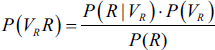
Consider the components of this expression. P (R|VR) is the probability that a leader on the R side chooses AP policies when that side’s voters value democracy. Since P(R) is the unconditional probability of observing AP policies, that is, independent of the preferences of R voters, it is the case that P (R|VR) < P (R). That is, the chances of seeing AP policies generated by a leader whose supporters value democracy are strictly less than seeing them generated by a leader whose supporters may or may not value democracy. This is because it is certainly more likely to see a leader whose supporters do not value democracy generate such a policy. Such supporters see no downside to an AP policy because any norm-eroding effects of the policy are of no consequence to them. Given P (R|VR) < P (R), it necessarily follows that P (VR|R) < P (VR). That is, L’s posterior probability that R voters value democracy falls after L observes R voters continuing to support a right-wing AP following R leader.
We summarize with the following:
For simplicity re-write P (VI) ≡ PI in what follows.
Notice that uncertainty only arises because of the combination of populism and authoritarianism. Neither a government undertaking populist policies without authoritarianism, or undertaking policies that are not populist, but in an authoritarian way, would lead to this downward revision in beliefs. A populist, but non-authoritarian government, that continued to receive approval from its supporters does not raise any questions about their commitment to democracy. A government that is authoritarian but not populist leads to a very clear signal one way or the other. If its supporters still approve of it, they clearly do not favour democracy. But if they do still favour democracy, then they will disapprove of their government’s actions.
The Political Game
Time is discrete and infinite, with a discount rate δ. One of the two sides is in government, G, and one in opposition, O. The government gets to make policy, which is of value 1 to the supporters of the governing side each period. There is, per period, value 0 to being in opposition.
In a democracy, the government wins re-election with probability d. The opposition with reciprocal probability 1 − d, with the uncertainty arising because of the non-partisan voters. So, if one’s side holds government in a democracy, and one is certain that the political system will remain a democracy, the valuation, denoted V G, is:

If a voter believes that democracy might not last forever, V G will be lower.
If in opposition, the value function, denoted V O, is

where PI is the probability that the current leader, I, will leave office if he loses the election. That is, the leader’s side values democracy. With probability 1 − PI, the current leader has become an authoritarian, because his partisan voters no longer value democracy sufficiently, and is no longer committed to democracy. So that even if the leader loses office via the democratic process (probability 1 − d), the leader will remain in office with the support of his followers. Either by suspending the election, creating an emergency, miscounting the results, etc. So with probability 1 − PI there is no chance of the opposition transitioning into leadership, and we assume, for simplicity, that they obtain zero from then on. PI is given by the posterior beliefs determined above after observing what the leader does and how his supporters value him.
Solving using V O and V G yields

This is the most optimistic view of being in opposition in a democracy. It only recognizes a threat to democracy arising from the other side having transitioned away from fundamentally valuing democracy, via the term PI. Any other perceived threats to democracy would make this value lower.
Violent Turnover
Either side may have the opportunity to fight, F, for the leadership. Successfully fighting leads one’s side to govern as an autocrat. And for simplicity, we will assume that this is forever more, as democracy is abandoned. Losing banishes one’s side to permanent opposition from then on.
Assume that the opportunity to fight arises occasionally. A ‘spark’ is needed, and a spark only arises probabilistically. When there is a spark, there is a sequencing of actions. One side gets the opportunity to instigate the fight first. This opportunity is not observed by the other side. If they do not instigate, then the other side gets their opportunity.
Fighting has a probability q > 1/2 of succeeding, so there is a first-mover advantage. If succeeding, the side becomes the leader and obtains policy of value, A < 1 from then on. With probability 1 − q, they lose and are forever banished receiving 0 from then on. Thus, the value of taking the opportunity to fight is

To make democracy feasible at all, we must also assume that fighting is not too attractive. 12
Analysis
No matter how low the chances of winning a fight, provided they are non-zero, and there is some value to the autocratic state, A > 0, if the opposition believes that the current leader is authoritarian with a high enough probability, then V F > V O. 13 Therefore, we have:
One way such a sequence would arise is by design. That is, by a WBA who is charismatic and popular and comes to lead a group whose supporters start strongly in favour of democracy.
Step one, for such a WBA, would be to enact a sequence of autocratic populist policies. Here the WBA is playing on the uncertainty created by such policies—uncertainty about whether the WBA’s supporters really like the populist leader or simply do not care about democracy. To make discussion easier, assume the leader is a right-wing populist, supported by R voters. By Result 1, provided the leader continues to be popular amongst R voters PR continues to fall. After enough authoritarian populist polices are enacted, and provided Rs leader remains popular with R voters, necessarily V F > V O. Suppose that point has been reached. At this point, L supporters will fight to remove the R leader if they get the opportunity to do so. Fighting gives them V F.
Step two is to now consider the perspective of R supporters. If they think V F > V O, they believe the L opposition will fight for the leadership when given the opportunity to do so. The L group has not lost their personal valuation of democracy, nor do the R voters need to believe that. The R voters simply need to understand that the L voters are willing to use violence to bring down the government if they get the opportunity.
Knowing this, if the R group gets the chance to themselves cement their control of the executive by use of force, they will take it and be willing to fight. By taking it, they get the first-mover advantage and obtain a q > 1/2 chance of winning. If they forego it, then L will take it, and R will have a 1 − q < 1/2 chance of winning.
This is the case even though the R group may know themselves to be fundamentally committed to democracy, and even if they also believed that the L group has a fundamental valuation of democracy which would make them unwilling to fight if they thought democracy could succeed. This notwithstanding, the R group knows that the L group no longer trusts the R group’s commitment to democracy. The L group no longer believes that democracy can succeed.
So, either group obtaining the opportunity to fight will do so: the L group because it believes that the R group is not very likely to still value democracy ; the R because it believes that the L has lost confidence in the R’s commitment to democracy and has become radically opposed to the democratic project. Both groups are correct.
Democracy disappears.
Discussion
Many simplifications assumed here deserve more scrutiny. We discuss some of these here.
First, in determining the value functions that we attribute to voters whose side is in opposition, we have assumed that the only threat to democracy is that which arises from the leader’s side no longer valuing democracy. Yet, at the same time, we have sketched a scenario where even if the leader’s side has not lost their valuation of democracy, democracy still fails. A fully fledged model would need to account for this. To do so properly would require thinking harder about the interaction between the opposition’s own valuation for democracy approaching their valuation for fighting, and how this would in turn affect PI of the leader’s side. We believe that the basic insight would persist even with this complication, but have not solved such a case.
It would be ideal to have a model that conceives of the leader’s policy choices and how these affect perceptions. We have only alluded to populist policies that are implemented autocratically and assumed the way in which these affect voter perceptions, but it would be useful to model this process. The process of conflict when democracy breaks down is not modelled at all. It is simply assumed to follow a sequence, and the values are stationary from then on. Clearly, these aspects could be relaxed without effect.
Most importantly, we have not really modelled the agency problem between political leaders and their supporters. The only assumption is that leaders would like to remain in power forever, and if they did so they would implement the policies that their supporters like. But there is more to this relationship than that. Note that, under the WBA interpretation that we have proposed here, the leader dupes supporters into undermining democracy by implementing authoritarian populist policies, and they do so inadvertently by continuing with their support. The supporters have never abandoned their primary concern with maintaining democratic turnover, they just do not believe it is possible. This happens because the leader’s supporters have continued with their support of him, without any concern as to how the other side is reading this. If, however, the leader’s supporters knew that they were close to approaching the threshold at which the other side will no longer trust their commitment to democracy. That is, if R voters anticipate that L voters are becoming suspicious of their commitment to democracy, thinking that PR has fallen worryingly close to the point where L voters may prefer V F over V O. If they are sophisticated enough, these R supporters might wish to signal to the L voters their continued democratic commitment. They might want to climb back from the precipice by signalling disapproval of their authoritarian populist acting leader, even though they might continue to like his policies.
This would look something like some of the R supporters saying, enough is enough, our leader is undermining democracy. We should reduce our support for him. This is reminiscent of the actions of Republican politicians such as Liz Cheney, Chris Christie, Mitt Romney and others.
At the same time, others on the R side might think that the L side is demonstrating a lack of commitment to democracy themselves. This is a reasonable interpretation in light of statements by never-Trumpers that, no matter how undemocratic we need to be, we should make sure that Trump is not re-elected. And there is evidence in the Braley et al. (2022, p. 5) article that supporters deeply misperceive the willingness of the ‘other side’ to subvert norms.
In short, the problem is that there are multiple decision-makers on both sides. When trying to assess the attitude of the ‘other side’, say towards democracy, this problem is considerably more difficult than the already difficult problem of working out what a single individual might value. It requires working out what multiple individuals believe, and what acts they are going to collectively cohere upon.
Seeing this, and not knowing whether the supporters saying ‘enough is enough’ are sincere (because anyone who was trying to convince you that they were committed, only to trick you into not taking your first-mover advantage, would say the same thing), the L voters might reasonably not be convinced about the sincerity of any R voter signals.
A skilful leader may be able to exploit these divisions to their advantage. Perhaps by vilifying opposing voices from within the party that are expressing concern about the state of the country’s democracy. This is what Trump has done with his coining of the term ‘RINOs’ (Republicans In Name Only). It would seem that a richer model that allowed for heterogeneity in both beliefs and preferences on both sides of the political divide would be a fruitful extension to explore.
Conclusion
We have outlined a mechanism by which a democracy with voters who are fully committed to maintaining democracy, and who would prefer democracy even if it would mean sacrificing policy, may nonetheless feature all voters preferring to engage in violent conflict when given the opportunity to do so. The mechanism rests on confusion regarding the true intention of supporters on the ‘other side’ of a political divide, and shares much in common with Braley et al. (2023).
A marked difference, however, is in how this process gets started. We contend that authoritarian populist policies are a key catalyst to starting this slide. Such policies create confusion because they may be popular to supporters of the government, even though the same supporters may disapprove of the norm violating and democratic undermining that accompanies them. This uncertainty eventually leads to opposition supporters doubting government supporters’ desire to preserve democracy. When such doubts become overwhelming, they will seize any opportunity to undermine democracy themselves. Knowing this, government supporters will do the same, and democracy will die.
WBAs may well be aware of this. And if their main aim is to preserve their own hold on power, even at the expense of democracy in their country, they are well served by enacting a populist agenda in an authoritarian way (even when the agenda could be achieved by standard governance). By doing this, they start the process of mutual confusion building amongst supporters of both sides which can eventually lead to their permanent entrenchment in power.
Footnotes
Declaration of Conflicting Interests
The authors declared no potential conflicts of interest with respect to the research, authorship and/or publication of this article.
Funding
The authors received no financial support for the research, authorship and/or publication of this article.