




Abstract
In the first month of the UK first lockdown, we studied the demand and willingness to pay (WTP) for hand sanitizer gel, disposable face masks and disposable gloves, and how information on tested people and coronavirus deaths explains the demand and WTP for these products. The specific hypotheses to test and concrete questions to study were pre-registered in AsPredicted (#38962) on 10 April 2020, and an online survey was launched in Prolific on a sample of the UK general population representative by age, sex and ethnicity on 11 April 2020. We find that there is a demand for these products, estimate the average WTP for them, and show that the provision of information affected the demand (and WTP) for disposable face masks. Providing information on the numbers of coronavirus cumulative tested people and coronavirus cumulative deaths increases the stated demand for disposable face masks by about 8 percentage points [95% CI: 0.8, 15.1] and 11 percentage points [95% CI: 3.7, 18.2], respectively.
Introduction
In the midst of the COVID–19 pandemic, and three weeks into the first lockdown, we investigated whether there is a demand (and willingness to pay [WTP]) for ‘protective gear’—hand sanitizer, disposable face masks, or disposable gloves—in the UK, and whether this demand (and WTP) is affected by providing generic information on coronavirus—information on the cumulative numbers of tested people and coronavirus deaths. Providing an answer to these two questions is still a fundamental empirical matter that will help us to understand ways of decreasing the spread of the virus and finding effective ways (i.e., wearing protective gear) to return to our daily routines while minimizing new waves of COVID–19 infections.
From a microeconomic point of view, the demand for protective gear depends on the utility that individuals derive from it and the costs of acquiring and using it. Consider for instance the decision of buying disposable face masks. An individual will decide whether her demand for masks is positive (or zero) after comparing the costs of buying and wearing a mask—including the monetary (price) and non-monetary costs (e.g., stigma associated with wearing masks, see Joachim & Acorn, 2000; Li & Abdelkader, 2020)—with the utility gains of using a mask—including the increased perception of security and the reduced transmission probability per contact (see Abaluck et el., 2020; Centers for Disease Control and Prevention (CDC), 2020; Howard et al., 2020).
We collected primary data from a sample of the UK general population representative by age, sex and ethnicity with an online survey and an informational experiment in Prolific on 11 April 2020. We gathered information from our participants, including several socio-demographic dimensions, and also ran an experiment providing information.
Our main findings are twofold. First, there was a demand for protective gear in the UK already in early April 2020. In our sample, 57% report having disposable gloves at home, and 26% report having disposable face masks (Supplementary Material, Table S1). When asked whether they would buy these items, at an average price of £14.90 per pack of 100 disposable gloves and £11.65 per pack of 10 disposable face masks, around 33% of respondents answered affirmatively. The average WTP for a pack of 100 disposable gloves is estimated at £9.24 [95% CI: 7.84, 10.64] using a linear probability model (LPM) or at £5.90 [95% CI: 3.65, 8.14] using a logit model, while for a pack of 10 face masks it is £5.99 [95% CI: 4.87, 7.13] or £1.95 [95% CI: –1.37, 5.27], respectively. This evidence is noteworthy given that the UK government had been persistent in not recommending any disposable gloves or masks at all, contrary to most European countries: as late as 15 June 2020 face-covering became compulsory only on public transport in the UK, and as late as 24 July 2020 in shops. Second, providing basic information about the coronavirus spread is relevant for the stated demand of a particular type of protective gear: disposable face masks. Giving information on the cumulative cases of people tested for coronavirus and coronavirus cumulative deaths increases the stated demand for disposable face masks by about 8 percentage points [95% CI: 0.9, 15.1] and 11 percentage points [95% CI: 3.7, 18.2], respectively. Also, the average WTP for disposable face masks increases significantly from the control to the group that receives the information on coronavirus deaths.
Our study shows that a very simple message on cumulative number of coronavirus tested people or deaths, based on the information contained in the daily tweet from the Department of Health and Social Care (@DHSCgovuk), affects the stated demand for disposable face masks. If this effect carries over to the actual demand for disposable face masks, this opens the door to informational campaigns that might reduce the spread of the virus in current or future outbreaks. It is worth emphasizing that our treatment consists of general information that is already present on the internet, and that corresponds to the daily tweets by the government. That is, we report already available information with no additional detail or twist. Therefore, health campaigns based on providing detailed facts on COVID–19 (for instance about its spread under massive adoption of protective gear), health-preserving behaviour, or simple (reminder) messages as a useful nudge, may have a widespread impact on the demand and usage of protective gear.
Our findings are relevant for current and future waves and for countries where the coronavirus is currently spreading (i.e., India, South Africa). Banerjee et al. (2020) conducted informational experiments in May 2020 in West Bengali (India). They show how messaging campaigns such as a short SMS video clip encouraging reporting symptoms and health-preserving behaviour had positive significant effects on the treated, and also spillovers on those who did not receive these messages.
In the US Capraro and Barcelo (2020) highlight the importance of messages about the coronavirus threats on self-reported intentions to wear a face-covering in the early stages of the pandemic, also using an online experiment. They report that simple messages complementing lockdown laws with behavioural interventions devised to impact people’s behaviour beyond the force of law can be effective, consistently with our paper.
Although perfectly enforced social distancing can be very effective, protective gear is important in slowing the spread of the virus in healthcare settings, public transport, shops, pharmacies and other essential services. Thus, face masks play an important role in slowing down the spread of the virus, even in the presence of enforced social distancing, and also when social distance rules are abandoned. Indeed, scientific evidence released after our experiment has confirmed the benefits of the widespread usage of face covering.
Mitze et al. (2020) present the first field evidence on the large positive impact of mask-wearing on reducing the spread of COVID–19. They find that face masks reduce the daily growth rate of reported COVID–19 infections by around 40%, exploiting regional variation in the point in time when face masks became compulsory in Germany. The effectiveness of face coverings is also illustrated in a recent case study of a hair salon in the US by Hendrix et al. (2020). The authors report no infections among 139 clients who spent at least 15 minutes with two COVID–19 positive hair stylists. Everyone wore face coverings (mainly cloth face covering or surgical mask). More recently, Abaluck et al. (2021) show the effectiveness of mask-wearing by means of an impressive cluster randomized trial in Bangladesh.
Our study has two main limitations: one about external validity, and the other about internal validity. With regard to external validity, and as with previous research using Prolific data (Geldsetzer, 2020a, 2020b), our sample of participants is representative of the UK general population by age, sex, and ethnicity, but our respondents may differ from the general population along other characteristics. With regard to internal validity, one potential concern is whether extrapolating our findings based on ‘stated’ demands to ‘actual’ demands is a sensible thing to do. Our stated demands are based on hypothetical questions about buying a product for a given price randomly allocated across respondents, and this may generate hypothetical bias (see Zweifel et al., 2009, Chapter 2). While much has been written about the main problems of using these hypothetical behavioural questions to learn about actual behaviour, it is important to emphasize two distinctive aspects of our setting: first, our contingent valuation exercise is based on well-known products by our respondents, as judged by their actual demands at the time of the survey (73% has hand sanitizer gel at home, 57% has disposable gloves at home, and 26% has disposable face masks at home); second, the stated demands at the random prices are lower than the actual demands (24% would buy hand sanitizer gel, 33% would buy disposable gloves, and 33% would buy disposable face masks). Hence, given that respondents seem familiar with the product at stake and the stated demands are, if anything, lower than the actual ones, hypothetical biases are unlikely to distort our WTP estimates. Moreover, even if a distortion occurs, and as long as this is independent of any treatment effect, our experimental design should not be affected by hypothetical bias.
With the previous two limitations in mind, it is interesting to document sizable effects on stated demands obtained with a basic treatment of generic information on number of people tested and deaths. One could anticipate that specific information about protection from face masks (e.g., relative benefits of medical masks versus fabric face covering, specific figures on how much a high take-up rate of masks decreases the spread of COVID–19) or about protection from disposable gloves would have even larger effects. This is important when thinking about the design of effective public health policies.
The next section provides a brief summary of the data used to measure the main outcomes in our study and test our particular hypotheses. The third section focuses on the demand and WTP for protective gear. The fourth section estimates the causal effect of information on the demand and WTP for protective gear. The fifth section provides a summary of our main findings.
Data and Measurement
The data used in this paper were collected via an online survey in Prolific on 11 April 2020, a platform that has been used to study the gender inequality in the UK during COVID–19 times (Oreffice & Quintana-Domeque, 2021). The project was reviewed and ethics approval was obtained from the University of Exeter Business School Research Ethics Committee (eUEBS003268) on 23 March 2020. We obtained a representative sample of UK respondents by cross-stratifying on sex (male or female), age (18–27, 28–37, 38–47, 48–57, or 58 + ) and ethnicity (Asian, Black, Mixed, Other, or White). Information on the online survey is provided in Section A of the Supplementary Material.
The size of the working sample of our survey, 949 respondents, and their socio-demographic description is documented in the Supplementary Material (Table S1): 51% of the respondents are women, their average age is 46.7, 85% of them are White, 53% of them have attended University, and their average annual income (before tax) in 2019 is £25,767.
The survey contains two types of questions: questions asked before the experiment, and questions asked after the experiment. The main sections of the questionnaire are the following:
Section on pre-experimental questions (e.g., whether respondents have {hand sanitizer gel, disposable face masks, disposable gloves} at home). Random allocated message (information): control, treatment 1, treatment 2. Section on (pre-registered) post-experimental outcomes, including stated demands for {hand sanitizer gel, face masks, gloves} and donations (Section K, Supplementary Material).
The individual stated demands for hand sanitizer gel, disposable face masks and disposable gloves were measured as the answers {Yes, No} to the following questions:
Stated demand for hand sanitizer gel: ‘Would you buy a 100 ml bottle of hand sanitizer gel at a price of £ {2, 4, 10, 24}?’
Stated demand for disposable face masks: ‘Would you buy a pack of 10 disposable face masks at a price of £ {3, 6, 12, 26}?’
Stated demand for disposable gloves: ‘Would you buy a pack of 100 disposable gloves at a price of £ {4, 8, 16, 32}?’
For each question, individuals were randomly assigned (and evenly split) to one price, so that the demand curve is identified across individuals facing different prices for the same product. The ranges of prices for these three different products were based on a pilot implemented on 7 April 2020 and a search of prices for these products on Amazon. Table S1 in the Supplementary Material shows that the average randomly assigned price for a 100 ml bottle of hand sanitizer is £10.6 (SD = £8.8), for a pack of 10 disposable face masks is £11.7 (SD = £8.8), and for a pack of 100 disposable gloves is £14.9 (SD = £10.8). The fractions of respondents stating that they would buy these goods are: 24% for hand sanitizer gel, 33% for disposable face masks, and 33% for disposable gloves.
The main purpose of this paper is to analyse the questions asked after the experiment that was pre-registered in AsPredicted (#38962) as post-experimental outcomes. The pre-registration plan is available here:
Demand and Willingness to Pay for Protective Gear
We start our analysis by focusing on the actual and stated demands for hand sanitizer, disposable face masks and gloves. As explained in the previous section, the actual (revealed) demands were measured at the beginning of the survey by asking individuals whether they had hand sanitizer gel, disposable face masks and disposable gloves at home. The stated demands were measured after the experiment. In order to estimate the demand and WTP for protective gear, regardless of any informational treatment effect, this section studies the placebo (control) group.
Main Analysis on Demand and Willingness to Pay Without Treatments
Linear and Non-linear Regressions
We consider the following demand equations for each individual i and product j = {a 100 ml bottle of hand sanitizer gel, a pack of 10 disposable face masks, a pack of 100 disposable gloves}:

and

Where P ij is the price randomly assigned to individual i for product j, and η ij is an unobservable demand shifter. Equation (1) is a linear demand model, and we estimate its parameters a j and b j using linear regression (LPM). Equation (2) is a non-linear demand model, and we estimate its parameters a’ j and b’ j using non-linear regression (Logit Probability Model), after assuming that F is the logistic cumulative distribution function.
Estimated WTP
In the LPM, the WTP is defined as the triangle formed by the regression line (e.g., Whitehead, 2017; Zweifel et al., 2009). Hence, in the LPM the WTP for product j is estimated as:

In the Logit probability model the WTP is estimated as:

As stated in our pre-registration plan, we also estimate conditional WTP estimates for the Logit model. In particular, we estimate the conditional WTP as:

As recently emphasized by Whitehead (2017), the derivation of and rationale for (5) is provided by Hanemann (1989), who shows how focusing over the positive portion of the probability distribution may overcome one of the main limitations of the Logit model. In the Logit model, the WTP is given by the ratio of the constant over the parameter on the price, hence, a negative constant will lead to a negative WTP estimate when evaluated over the entire range of prices and probabilities (Hanemann, 1984).
Standard Errors
The coefficients in the LPM are estimated using robust standard errors to heteroskedasticity, while the standard errors for the WTP estimates are obtained via bootstrapping (with 1,000 replications). For the logit model, we do not use robust standard errors. The rationale for not using robust standard errors for non-linear models is clearly discussed by Giles (2013).
Findings
Estimated Demands and Willingness to Pay.
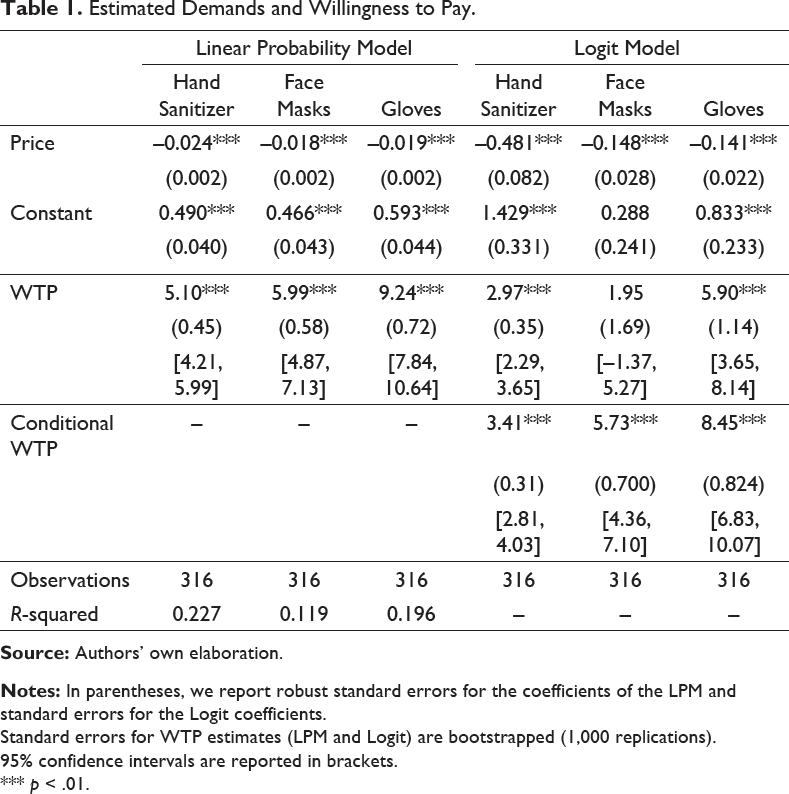
Standard errors for WTP estimates (LPM and Logit) are bootstrapped (1,000 replications).
95% confidence intervals are reported in brackets.
*** p < .01.
Secondary Analysis on WTP Without Treatments: Analysis by Sex
Table S3 in the Supplementary Material displays the estimates of the WTP by sex. While the point estimates of the WTP for hand sanitizer are very similar by sex, a few differences can be observed when looking at face masks and gloves. Perhaps, the most striking difference is found for the WTP for disposable face masks when using the logit model: –£0.750 [95% CI: –10.87, 9.37] among men versus £3.57 [95% CI: 0.622, 6.53] among women. However, none of these differences is statistically significant.
The Causal Effect of Coronavirus Information on the Demand and WTP for Protective Gear
We conducted a between-subject experiment to infer the causal effect of information about the prevalence of coronavirus in the UK (as measured by either number of cumulative cases or number of cumulative deaths) on the (stated) demands for hand sanitizer gel, disposable face masks, and disposable gloves in the UK.
Informational Treatments
Participants were randomly assigned (and evenly split) to one of three arms: information treatment 1 (T1), information treatment 2 (T2), or control. All participants were given the same information at the end of the survey, as described in Figure S1 in the Supplementary Material.
T1 Arm
Participants were informed on the number of people tested for coronavirus in the UK, as reported in the daily tweet of the Department of Health and Social Care (@DHSCgovuk): ‘In the UK, as of 9
T2 Arm
Participants were informed on the number of coronavirus deaths in the UK among those hospitalized who tested positive for coronavirus, as reported in the daily tweet of the Department of Health and Social Care (@DHSCgovuk): ‘In the UK, as of 5
Control Arm
Participants were not given any information.
Table S4 in the Supplementary Material provides a randomization check to assess whether the randomization was successful in balancing observable pre-treatment characteristics across treatment arms. While a few individual statistical differences can be observed, we cannot reject the hypothesis that pre-treatment individual characteristics do not predict participation in any particular arm (χ2(48) = 50.95, p-value = .3585). 1
Main Hypothesis: The Effect of Information on Demands
The main hypothesis is that the provision of generic information on either coronavirus tested people or coronavirus deaths increases the (stated) demands for {hand sanitizer gel, disposable face masks, disposable gloves}, but that the informational treatments have different effects. As is well-known (e.g., Haaland & Roth, 2017; Haaland et al., 2020; Kuziemko et al., 2015), these effects may emerge as pure informational effects, as salience effects, or as a combination of both. Information may be already available on the internet, news or daily government tweets, and individuals may mostly need a nudge to focus on these pieces of information and act upon them. Here we are interested in testing whether the delivery of this information changes demand, which is a first-order concern.
Parametric Analysis
Identification
This hypothesis is investigated and tested by estimating the following linear equation for each product j = {a 100 ml bottle of hand sanitizer gel, a pack of 10 disposable face masks, a pack of 100 disposable gloves} by OLS:

Where Y ij = 1 if individual i answers ‘Yes’ to the question about the demand for product j (‘Would you buy j at a price of […]?’), = 0 if individual i answers ‘No’; T1i = 1 if individual i is assigned to T1 arm, = 0 else; T2i = 1 if individual i is assigned to T2 arm, = 0 else; u ij is an error term capturing any other relevant factor of the individual i’s demand for product j. The parameters of interest are β1 j , which is the causal effect of T1 on Y ij and β22, which is the causal effect of T2 on Y ij . Of course, if some individuals did not pay attention to the informational treatment, what we are identifying are intent-to-treat effects.
Testing
We estimate standard errors robust to heteroskedasticity and test the following hypotheses: β1j = 0 against β1 ≠ 0; β2j = 0 against β2 ≠ 0; β1j = 0, β2j = 0 against at least one βk ≠ 0 for k = {1,2}; β1j = β2j against β1 ≠ β2j.
The minimum detectable effect (MDE) was estimated at 0.07 (see Section A in the Supplementary Material).
Findings
The estimates and tests of (6) are reported in Table 2. We find that the provision of information has no statistically significant effects on either the demand for hand sanitizer gel or disposable gloves. For hand sanitizer gel, the point estimates [95% confidence intervals] for the average causal effects of giving information on number of tested people and on number of deaths are –0.032 [–0.09, 0.03] and 0.006 [–0.06, 0.07], respectively. For disposable gloves, the point estimates [95% confidence intervals] for the average causal effect of giving information on number of tested people and on number of deaths are –0.041 [–0.11, 0.03] and 0.059 [–0.015, 0.133], respectively, although we reject the hypotheses that both effects are zero (F = 3.63, p-value = .0268) and that the effects are the same (F = 7.24, p-value = .0072).
OLS Regressions of Hand Sanitizer, Face Masks or Gloves on T1 and T2.
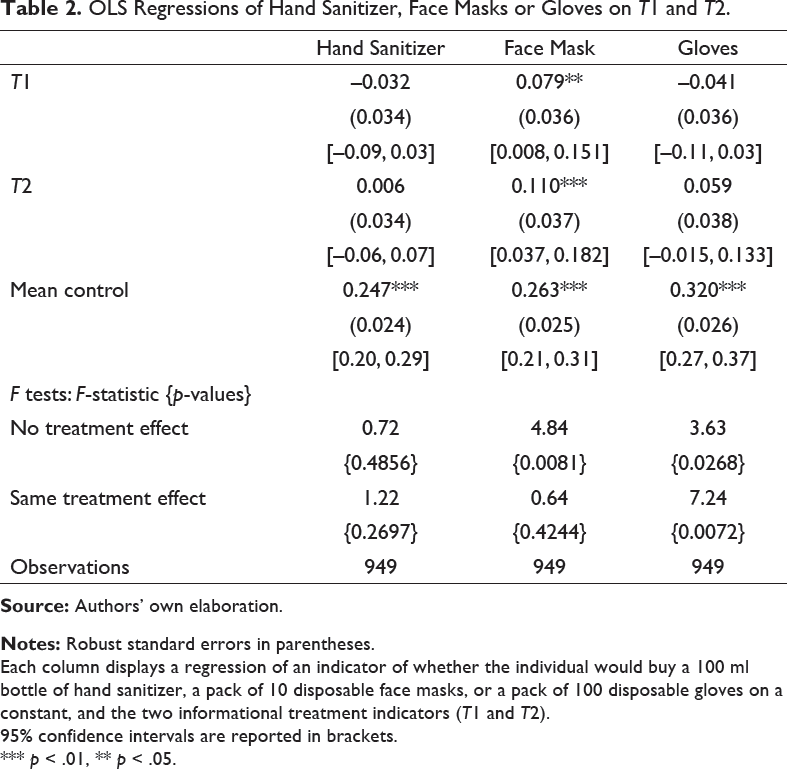
Each column displays a regression of an indicator of whether the individual would buy a 100 ml bottle of hand sanitizer, a pack of 10 disposable face masks, or a pack of 100 disposable gloves on a constant, and the two informational treatment indicators (T1 and T2).
95% confidence intervals are reported in brackets.
*** p < .01, ** p < .05.
Non-parametric Analysis
We also conduct a non-parametric analysis of the effects of information on the demand for hand sanitizer, face masks and gloves. To that end, we plot the (aggregate) demand curve for each product j ={a 100 ml bottle of hand sanitizer gel, a pack of 10 disposable face masks, a pack of 100 disposable gloves} by arm {T1, T2, control}. Each curve is based on four points: the average demand (fraction of Yes-answers) for each product j for a given randomly assigned price. Figures S5–S6 in the Supplementary Material display the estimated demand curves for hand sanitizer gel and disposable gloves, and Figure 1 displays the corresponding one for disposable face masks. All figures contain 95% confidence intervals for each point estimate of the (aggregate) demand curve.
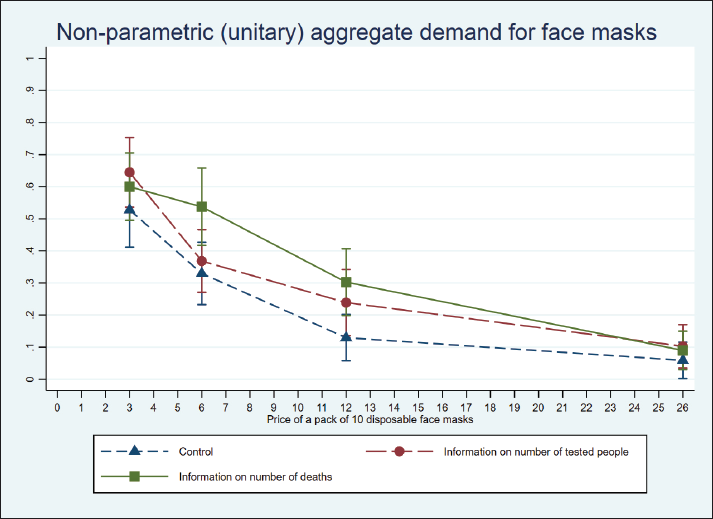
Non-parametric analyses are more demanding than parametric ones, and while they can be noisier, they might offer insights that go beyond the mean. The two main takeaways from Figure 1 (and Figures S5 and S6) are: (a) the law of demand (i.e., for each good, there is a negative relationship between the fraction of individuals ‘willing to buy’ it and its price) and (b) information matters, at least for masks (more specifically, the demand for disposable face masks is higher at each price among those who were given the information on deaths than among those who were not given any information). This evidence is consistent with our parametric analysis, and with the suggestion that public health campaigns and/or simple nudging messages reporting basic key information may play an important role during the various waves of the COVID–19 pandemic.
Main Hypothesis: The Effect of Information on WTP
Willingness to Pay by Treatment Arm.
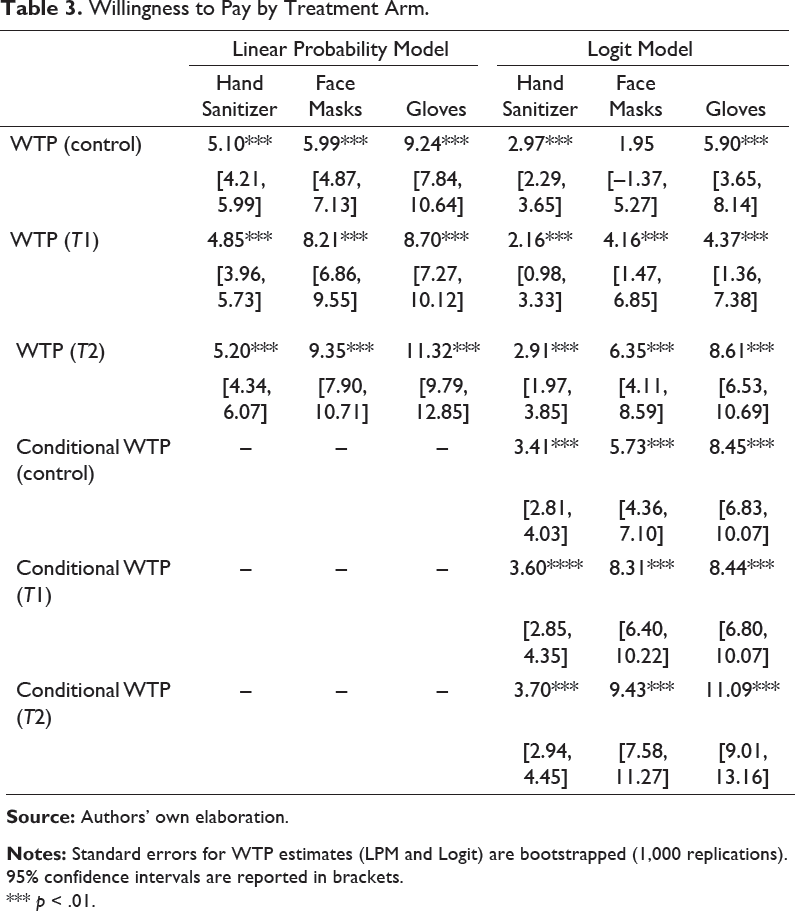
95% confidence intervals are reported in brackets.
*** p < .01.
Secondary Hypothesis: The Effect of Information on Demands by Sex
We have also investigated whether the effects of delivering information on demands vary by sex, but failed to find evidence that this is the case. Table S6 and Figures S7–S9, which contain our parametric and non-parametric analyses by sex, can be found in the Supplementary Material.
Conclusions
In the first month of the UK first lockdown, we studied the demand and WTP for hand sanitizer gel, disposable face masks and disposable gloves, and how information on tested people and coronavirus deaths explains the demand and WTP for these products. We uncover three main findings. First, there was a (stated) demand for protective gear in the UK, already in April 2020, including disposable face masks. The fractions of respondents stating that they would buy ‘protective gear’ are: 24% for hand sanitizer gel, 33% for disposable face masks, and 33% for disposable gloves; these can be compared with the fraction of respondents having them at home: 73% for hand sanitizer gel, 26% for disposable face masks, and 57% for disposable gloves. The average WTP (based on a linear model and without delivering information) for a 100 ml bottle of hand sanitizer gel is about £5 [95% CI: 4.2, 6], for a pack of 10 disposable face masks is about £6 [95% CI: 4.9, 7.1] and for a pack of 100 disposable gloves is about £9 [95% CI: 7.8, 10.6].
Second, the (stated) demand for disposable face masks is increased by providing generic information on coronavirus: delivering information on coronavirus deaths increases the stated demand for disposable face masks by about 11 percentage points [95% CI: 3.7, 18.2]. The average WTP for disposable face masks is increased by providing information on coronavirus deaths: the average WTP increases from about £6 [95% CI: 4.9, 7.1] in the control group to almost £9.5 [95% CI: 7.9, 10.7] in the group receiving the information on coronavirus deaths, which is consistent with the increase in the stated demand.
In the first months of the first lockdown, the UK government had been reluctant to recommend the widespread usage of disposable masks, in stark contrast with the policies adopted in many other countries affected by COVID–19. Only since 15 June 2020 face covering had been made compulsory on public transport and only since 24 July 2020 in shops. In these circumstances, we see our results as a relevant step forward to understand spread containment channels during the various stages of the pandemic; our evidence also supports the use of health campaigns and helpful nudges to encourage the adoption of mask-wearing, and potentially of other protective gear as well.
Our informational treatment consisted of general basic information that is already present in the internet, and that corresponded to the daily tweets by the government. We believe that targeted informational campaigns based on detailed facts on COVID–19 may have a widespread impact on the demand and usage of protective gear, and ultimately on the future spread of the virus.
We hope that our findings will help to understand and devise public health campaigns and nudging messages to decrease the spread of the virus, and encourage effective actions (i.e., wearing protective gear) to return to our daily routines while minimizing new waves of infections.
Supplemental Material
Supplemental material for this article is available online.
Supplemental Material for COVID–19 Information, Demand and Willingness to Pay for Protective Gear in the UK by Sonia Oreffice and Climent Quintana-Domeque, in Studies in Microeconomics
Footnotes

References
Supplementary Material
Please find the following supplemental material available below.
For Open Access articles published under a Creative Commons License, all supplemental material carries the same license as the article it is associated with.
For non-Open Access articles published, all supplemental material carries a non-exclusive license, and permission requests for re-use of supplemental material or any part of supplemental material shall be sent directly to the copyright owner as specified in the copyright notice associated with the article.
