




Abstract
Aim:
To compare the surface roughness, microtensile bond strength (µTBS), and flexural strength of polypropylene (PP) fibers reinforced glass ionomer cements (GICs).
Materials and Methods:
A comparative in vitro study was designed to test the PP fiber reinforced GIC, which was formed when 0.5–1 mm length PP fibers were added into the powder of conventional GIC. Four groups were prepared (Group 1: control, Group 2: 1 wt% PP fiber, Group 3: 3 wt% PP fiber, and Group 4: 5 wt% PP fiber) to evaluate flexural strength, surface roughness values, and µTBS. A total of 10 samples with 25 × 2.5 × 5 mm dimensions were prepared for each group to test flexural strength. Disk-shaped specimens (n = 10) of 2 mm thickness and 10 mm diameter were used to test surface roughness. A total of 24 human primary molar teeth were used to evaluate µTBS, and 12 sticks were obtained for each group. The fractured surface analyses of samples from µTBS was performed using scanning electron microscope. The data obtained from the experiments were recorded and analyzed with one-way analyses of variance technique, and the normality was tested using the Shapiro–Wilk technique. A significance level of .05 was used.
Results:
In flexural strength tests, Group 3 (3 wt% PP fiber) showed significantly increased values (p < .05) when compared with other groups. Group 4 (5 wt% PP) showed significantly highest values in surface roughness tests (p < .05). No significant differences were seen between the groups (p > .05) according to µTBS results. More PP fibers were seen in fractured surfaces, when PP ratio increases.
Conclusion:
It was observed that increased PP fiber percentage showed increased surface roughness, and 3 wt% PP fiber gave optimal values for fracture toughness. Incorporation of PP fiber to GIC does not affect the bonding to primary tooth dentine.
Introduction
Glass ionomer cements (GICs), known as acid–base cements (the reaction of weak polymeric acids with powdered glasses), were invented in the late 1960s and have found high interest and are often used in dentistry.1, 2 As dentists use GIC in many areas of dentistry, it has a lot of advantages, such as favorable thermal expansion, biocompatibility, fluoride release, and chemical bonding to tooth structure,1–5 and also some disadvantages, such as poor mechanical properties like low flexural strength, fracture resistance and wear,3, 4 low resistance to abrasion, 6 sensitivity to moisture, desiccation,1, 5 elastic deformation in masticatory sides, and lower elasticity modules when compared with resins. All these disadvantages limit the wider use of GIC in dentistry.
Various modifications were made to overcome these disadvantages of GICs, and the research works are focused to improve mechanical properties of GIC. 3 Filler particles like bioactive glass particles, hydroxyapatite powders, metallic powders, nanoclay, and discontinuous glass fibers were added to GICs for this purpose.1, 3
Yli-Urpo et al. 7 reinforced GIC with bioactive glass and declared that compressive strength of the test specimens decreased with an increasing amount of bioactive glass.
Gu et al. 8 tested bioactive hydroxyapatite/zirconia added GIC and found that 4% and 12% bioactive hydroxyapatite/zirconia added groups showed better mechanical properties than other groups.
Silva et al. 6 reinforced GIC with cellulose nanocrystals and cellulose microfibers and found promising results with cellulose nanocrystals. Lohbauer et al. 9 and Kobayashi et al. 10 declared that glass fibers could function as a reinforcing agent for GICs.
Hammouda 11 used short glass fibers to test mechanical properties of GIC and concluded that GIC could be reinforced with short glass fibers.
Polypropylene (PP) fiber, which can be efficiently reinforced for structural applications, is a commodity polymer. 12 PP fibers have been extensively used in civil engineering applications for many years. 13 Due to its low density, well-balanced physical and mechanical properties, low cost and easy processability, it is the most consumed polymer globally, which is comparably lightweight. 12 Because of its high chemical stability, electrical insulation, and good processing features, PP fiber is commonly used in the spare parts of vehicles, electronic products, bicycles, civil necessities, chemical products, and medical instruments, like nozzles, needles, and hernia meshes.14, 15
PP fibers have been used in various equipment, like technological devices, medical devices, etc., but PP fiber had never been used in dentistry as a restorative material. The aim of this study was to evaluate the surface roughness as well as flexural and microtensile bond strength (μTBS) of PP fibers added GICs.
Materials and Methods
Setting and Design
Ethical approval was obtained from the Cumhuriyet University Health Ethics Committee, Sivas, Turkey (ID: 2013-10/06). Based on the data from a pilot study, the values used in the power analysis were based on the following: α = 0.01, β = 0.1, 1 – β = 0.90, and the power of these tests was p = .91744. According to power analysis, 10 samples were for flexural strength tests and 10 samples were prepared for surface roughness, and it was decided to collect 24 teeth for this study. The teeth were collected in a saline solution and used within one month.
Sample Preparation
Preparation of PP Fiber
PP fibers of 0.5–1 mm length (Dost Kimya, Istanbul) were added into GIC (Ketac Molar Easymix, 3M ESPE, Seefeld, Germany) by measuring with precision scales (A&D GR 300, Japan). Four groups were prepared as follows:
Group 1: Control group Group 2: 1 wt% PP fiber added GIC Group 3: 3 wt% PP fiber added GIC Group 4: 5 wt% PP fiber added GIC
Flexural Strength Tests
The bar specimens (5 × 2.5 × 25 mm) were prepared according to the ASTM E 399-90 protocols. After adding PP fiber to GICs powder, GIC was prepared according to the manufacturer’s instructions. The specimens were removed from molds after curing and were kept in oven for 24 hours at 37 °C. To evaluate the flexural strength, three-point bending method was used, and tests were completed with a universal test machine (Lf Plus Llyod Instruments, Amatek, Inc., England) at a cross-head speed of 0.5 mm min–1, and the data was recorded in MPa. The samples and tests were completed in one month.
Surface Roughness Tests
For each group, 10 disc-shaped (10 mm in diameter × 2 mm in height) specimens were prepared. After adding appropriate concentrations of PP fibers into GICs, GIC was prepared according to the manufacturer’s instructions. The materials were placed in a stainless-steel mold. Microscopic glass slide and a mylar strip was used to remove the excess material. After curing of the materials, the mean surface roughness values were measured using a profilometer (Surftest SV-2100, Mituyoto, USA). The samples and tests were completed in one month.
Microtensile Bond Strength Test
For μTBS, 24 noncarious primary molar teeth were used. One-third coronal portion of the teeth were removed using IsoMet Low Speed Diamond Saw (IsoMet, Buehler, Lake Bluff, IL, USA). A stereomicroscope was used in order to check for the absence of pulp tissue and enamel. A smear layer was created on these surfaces by using 600 grit silicon carbide paper under water the teeth were flattened. Twenty-four teeth were randomly divided into four groups, and the teeth were embedded into acrylic blocks. After preparing GIC with PP fibers, the materials were applied to the teeth. After curing of the materials, each tooth was sectioned in x and y direction with a slow-speed saw under water cooling to obtain 0.7–1 mm2 beams. The cross-sectional areas and remaining dentin thickness of the specimens were measured with a digital caliper exact to 0.01 mm. Two sticks were selected from one tooth and 12 sticks were obtained for each group. The sticks were stored in distilled water for 24 hours. Sticks were fixed to the microtensile device with cyanoacrylate adhesive and were stressed in tension until failure using a microtensile testing machine (LF Plus, LLOYD Instruments, AMETEK Inc., England) at a crosshead speed of 0.5 mm min–1, and the μTBS was calculated and expressed in MPa.
Statistical Analysis
Obtained data were subjected to statistical analysis, using the software Statistical Packages for Social Sciences for Windows 15.0 (SPSS Inc., Chicago, IL, USA). Normality test of the data was done using the Shapiro–Wilk test and as the data were distributed normally, comparisons between the groups were examined by the one-way analyses of variance (ANOVA) test.
Results
Flexural Strength Tests
According to the flexural strength tests, Group 3 showed significantly higher values than the other groups (p > .05) (Table 1). In binary comparisons, there were no significant differences between the Groups 1 and 3, Groups 1 and 4, and Groups 2 and 4.
Flexural Strength of the Groups

Surface Roughness Tests
Surface roughness tests results are shown in Table 2. Group 4 showed significantly higher Ra values than other groups (p < .05). As Group 2 and 3 showed higher results than Group 1, there were no significant differences between the Groups 1 and 2, Groups 1 and 3, and Groups 2 and 3.
Surface Roughness of the Groups

Microtensile Bond Strength Test
The results of µTBS result are given in Table 3. There were no significant differences between the groups (p ˃ .05). While Group 3 and 1 showed the higher results, Group 4 showed the lowest results.
Microtensile Bond Strength of the Groups

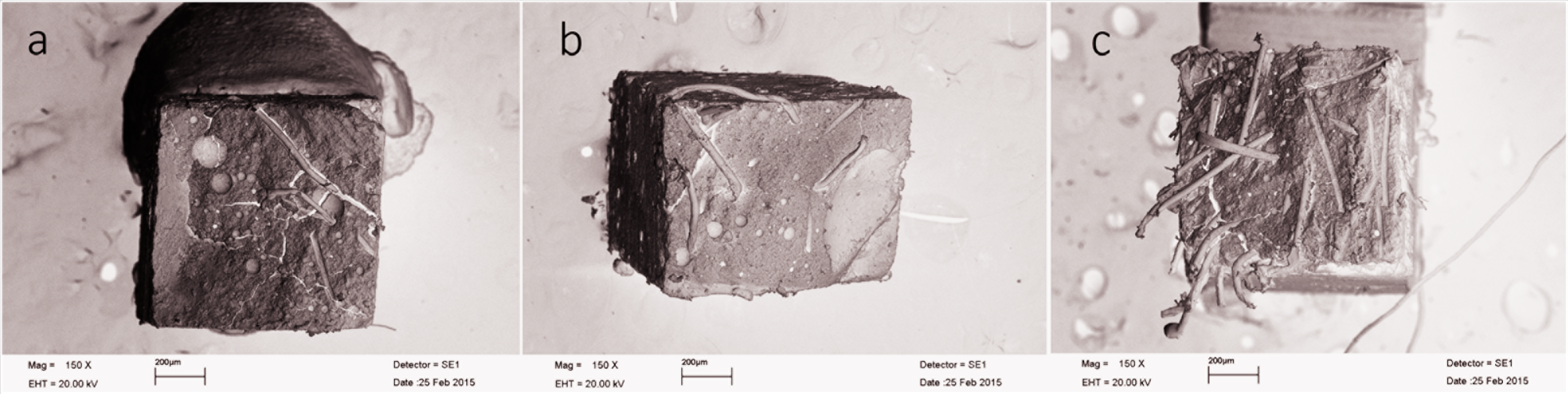
SEM Images of the Groups: (a) Group 2 (b) Group 3 (c) Group 4
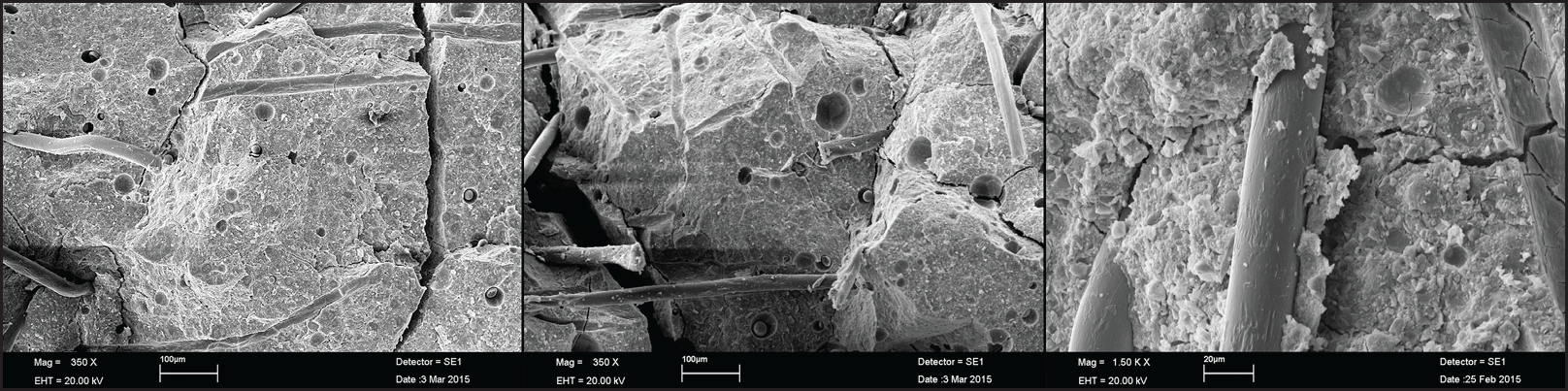
PP Fibers in Cracked Areas of GIC
Evaluation of Failure Patterns
When failure patterns were evaluated with a stereomicroscope (Zeiss) under 25× magnification, Group 1 showed 70% adhesive, 20% cohesive, Group 2 showed 50% adhesive, 10% cohesive, Group 3 showed 70% adhesive, 10% cohesive, and Group 4 showed 50% adhesive, 10% cohesive failure types.
When scanning electron microscope (SEM) images were evaluated, PP fiber were seen more in Group 4 than Group 3 and Group 2, according to the PP fiber concentration in GIC.
In some images, cracks were seen in GIC, but PP fibers prevent them from disintegration.
Discussion
According to the authors’ knowledge, the fiber has never been tested for these characteristics in the previous studies. The fiber tested in this study was used in many areas of technological products including various products that are used in the field of industry, concrete, and asphalt. Not only they are used in these areas but are also used in medical products.
In this study, PP fiber is expected to support the physical properties of the glass ionomer. Sümer and Sarıbıyık 16 investigated the effect of PP fiber on the compressive strength of concrete. During the experiment, it was observed that fiber-free concrete cracked into two parts, but when PP fiber was added in concrete, the latter turned resistant to fractures for a while. As they stated in their study, we are in the same opinion with Sümer and Sarıbıyık 16 while testing GIC with PP fibers in flexural tests, the materials could be easily seen that they were broken but the sticks still continued to be in tension. The reason for this is that a three-dimensional network occurring inside the PP fiber incorporated glass ionomer provides resistance to fractures.
Many variables have effect on fiber reinforcement, such as matrix, length, form, orientation, adhesion of fibers to the polymer matrix, the quantity and impregnation of fibers with the resin. 3 An isotropic reinforcement could be obtained with short random fibers because of the fibers direction, the fibers are reinforced in multidirections instead of one or two directions. Therefore, 1 mm short fibers were used in this study.
GIC is widely used in dentistry. Conventional types of GIC are not used as a restorative material because of its low flexural strength and high abrasiveness6, 11 Many of the research works were focused to overcome the disadvantages of GIC by reinforcing the materials into GIC. Amalgam, hydroxyapatite, bioactive glasses, glass-fibers, stainless steel powders, nanocrystals, etc.,6, 8, 9 were added to GIC to improve these kind of disadvantages.
Gu et al. 8 added different percentages of hydroxyapatite/zirconia into GIC and found that 4%–12% bioactive hydroxyapatite/zirconia incorporated GICs showed better mechanical properties than the original GICs.
De Caluwé et al. 17 added bioactive glass to GIC in order to test the physicochemical properties and biocompatibility of the new GIC and found that bioactive glasses improved the bioactivity of GIC.
Rahman et al. 18 added nanozirconia-silica-hydroxyapatite to the GIC and found an increase in the hardness of conventional glass ionomer.
Kawano et al. 19 reinforced GIC with CaO ± P2O5 ± SiO2 ± Al2O3 and found a higher strength than the conventional cement.
Kheuret al. 1 evaluated GIC in which nanosized hydroxyapatite particles were added and found that the experimental glass ionomer showed an increased mechanical and adhesion potential at the end of the study.
Silva et al. 6 added cellulose nanocrystals and cellulose microfibers to improve GIC. They declared that cellulose microfibers in the GIC matrix did not improve the mechanical properties of GIC but when they added small amount of cellulose nanocrystals in the GIC, significant improvements were seen in all the mechanical properties of GIC.
Lohbauer et al. 9 tested fiber reinforced GIC in their study and concluded that it showed improved toughness properties and mechanical strength, and that these properties might lead to more durable restorations, especially in stress bearing areas. Further, in their study, Hammouda 11 obtained increased flexural and diametral tensile strength, flexural modulus, and fracture toughness by the addition of glass fibers. Moreover, Kobayashi et al. 10 found that glass short fibers acted as a reinforcing agent for strengthening the GIC.
Garoushi et al. 3 used hollow glass fibers to improve GIC and declared that the new GIC showed increased toughening and flexural performance when compared to the GIC used in their study.
Silva et al. 20 added cellulosic fibers into GIC and concluded that cellulosic fibers added group showed the superior diametral and compressive tensile strengths of the GIC, along with acceptable stiffness and elastic modulus.
Sharafeddin et al. 21 tested GIC with polyethylene fiber and found that mixing of polyethylene fibers with GIC showed a significant positive influence on diametral tensile strength of the tested glass ionomers. We are in the same opinion with the authors that PP fibers improved some properties of GIC.
All these aforementioned studies found improvements by reinforcing GIC, and these improvements were obtained by adding limited percentages of the materials. Many of the research works showed that when the added materials’ percentage was increased in the GIC, the physical properties of the GIC begun to decrease, and we are in the same opinions with these authors1, 6–8, 17, 18 because when PP fiber percentage was increased, physical properties of GIC begun to decrease. According to these studies, it can be concluded that there is a critical percentage, a threshold limit, of the materials that should be added in GIC.
The improvements in GIC were affected by fibers’ length and concentration, 11 and therefore, we used 1 mm length and 1, 3, and 5 wt% of GIC. The percentages used were different than those used by Hammouda, 11 to see the effect of increase in percentages of fibers on GIC.
Surface roughness is an important factor for restorations because of the bacterial adhesion to the dental substrate. When surface roughness was increased, an increased bacterial adhesion could be easily seen. According to the results of this study, rougher surfaces could easily increase the bacterial colonization, which is similar to what is opined by Tanner et al. 22
Retention of dental materials to the dental substrate is the most important factor. To the authors’ knowledge, there is no other study that compared μTBS of fiber reinforced GICs. Alves et al. 23 tested μTBS of Ketac Molar both in sound and caries-affected dentin of primary teeth and found 18.81 MPa for sound dentine and 14.52 MPa for caries-affected dentine. Calvo et al. 24 evaluated μTBS of Ketac Molar for 24 hour and 2-year on sound and caries-affected dentine and found 18.8 MPa. When compared with these studies, μTBS of this study was lower than others. The main reason for these decreased results could be associated with that a surface conditioner was not used in this study.
Conclusion
Within the limitations of this study, GIC could be reinforced with PP fibers. A 3 wt% PP fiber could increase some properties of GIC, and it could be useful in load bearing areas. When the percentage of PP fibers in GIC is increased, flexural strength test results increase till threshold limit, and after this the values began to decrease. Reinforced GIC with fibers may maintain better mechanical properties when compared to the unreinforced one. This promising glass ionomer should be further tested to evaluate other characteristics of dentistry.
Footnotes
Declaration of Conflicting Interests
The authors declared the following potential conflicts of interest with respect to the research, authorship, and/or publication of this article: The authors declare that they have no conflict of interest.
Funding
The authors disclosed receipt of the following financial support for the research, authorship, and/or publication of this article: This work was supported by the Scientific Research Project Fund Cumhuriyet University (Grant number: DIS-135).