




Abstract
Aim:
Poor oral health and high caries prevalence in young adults in Saudi Arabia is the result of inadequate oral health knowledge and inappropriate oral health behavior. The present study was conducted to evaluate the knowledge, attitude, and oral hygiene behavior of young adult students pursuing professional courses in Taif University, Kingdom of Saudi Arabia.
Materials and Methods:
A cross-sectional questionnaire survey was conducted amongst the medical, dental, and pharmacy students of Taif University. A pretested self-administered questionnaire containing 20 questions was administered to the students, and the data were analyzed using Statistical Package for Social Sciences (IBM, version 20 for Windows, SPSS Inc., Armonk, New York, USA). Descriptive analysis and difference in the association were measured by using the chi-square test and Kruskal-Wallis analysis of variance, followed by the Mann-Whitney U test. The level of significance was set at .05.
Results:
A total of 500 (287 males and 213 females) students were involved in the survey with the mean age of 23 ± 1.4 years. Fourteen percent of participants brushed at least twice daily with statistical significant gender difference (P = .001). For the query regarding the reason for skipping tooth brushing often, 113 of total participants (22.6%) responded as no time for tooth brushing. A total of 93 participants (18.6%) responded that they have not visited any dentist in their life, with the statistical significant difference for gender being P = .001. The student who received dental treatment from private hospitals was 60.4 percent. Fifty-one percent of students responded that dental treatment is expensive. Sixty-one percent of participants responded for consuming sweet at least once in a day (P = .04).
Conclusion:
The present study highlights the inconsistency in oral health behavior among the study participants, emphasizing on the need for oral health education of the population to improve oral health status.
Introduction
Oral health is linked with general health, and diseases occurring in oral cavity are of major public health importance due to their high prevalence and tremendous social impact.1,2 The most common oral diseases among children are gingivitis and dental caries, with the latter affecting 60–90 percent of children globally. 3 Oral diseases in children and adults are higher among poor and disadvantaged population groups. 4 The prevalence of dental caries is considered very high in Saudi Arabia, and it is estimated to reach 94% in 9 years of age. 5
In Saudi Arabia, the healthcare system is accessible to a wide segment of the population. In the Ministry of Health facilities, dental treatment is provided free of charge without the need for health insurance. 6 However, the recent trend showed that the dental caries incidence and prevalence have increased in the Middle East, particularly in Saudi Arabia. 7 Several studies were conducted to assess the caries incidence in Saudi Arabia8-13, which indicate higher prevalence and attribute their findings to lack of oral health knowledge among children and their caregivers.
Although there are several studies on caries prevalence and oral health knowledge among Saudi school children and school teachers, very less research concentrate on Saudi young adults perusing professional education. With this background, the present research was conducted with the objective to determine the knowledge, attitude, and behavior of students of Taif University.
The null hypothesis for the present study is that here is no difference in knowledge, attitudes, and practices of medical, dental, and pharmacology students regarding oral health behavior.
Materials and Methods
Study Design, Study Participants, and Sampling Techniques
A cross-sectional questionnaire survey was conducted amongst students of Taif University, Saudi Arabia, during March-May 2018. The students of medical, dental, and pharmacy were invited to participate in the study. A pilot study was conducted among 20 participants to check the response rate and study feasibility. Ethical approval was taken from the ethics committee before performing the study (Doc no. 458185/18). Based on the results of pilot study, with this anticipated population proportion of 0.05, and a power of 80 percent, a sample of 480 students were needed to be recruited for this study. A total of 500 students were selected to compensate for nonresponse bias. The random method of selection was followed to select the study participants. The pretested, structured questionnaire was distributed to all the students and received after a period of one week. The questionnaires returned without any or incomplete responses were discarded.
Questionnaire
A pretested self-administered questionnaire containing 20 questions was administered to all study participants. The format of questionnaire was prepared in English and translated to Arabic. Pretesting of the questionnaire was carried out by initially administering the questionnaire to 20 students to determine any difficulty in the understanding of the questions, and any ambiguity within responses was checked. The questionnaire was then modified accordingly and administered to all participants. The reliability of the questionnaire was assessed by asking 20 students to complete it during face-to-face interviews. The Cronbach α was used as a measure of reliability (α = 0.85). The students with written informed consent to participate were included in the study. The study was conducted according to the guidelines of Helsinki declaration for ethical principles of medical research involving human subjects. 14
The questionnaire was anonymous with participants not having to mention their name to encourage frank and truthful response. The questions and their response categories are summarized in Tables 1–5.
Statistical Analysis
The data were analyzed using Statistical Package for Social Sciences (SPSS Inc., IBM 20 for windows). Descriptive analysis and difference in the association were measured by using the chi-square test and the Kruskal-Wallis analysis of variance (ANOVA) as the responses were in nominal and dichotomous scale. The α value, the probability of rejecting the null hypothesis when it is true, was set at 0.05 with the confidence of interval 0.95, and the significance level was set at P < .05.
Results
The total number of participants included in the study was 500, which included 287 males and 213 females. The distribution of students according to the faculty was as follows: medical, 277; dental, 75; and pharmacy, 148.
The responses from the total participants according to gender and faculty are summarized in Tables 1–5.
Regarding the frequency of brushing, 14.8 percent of participants brushed at least twice daily with a significant gender difference (P = .001) (Table 1). A total of 83 participants (16.6 %), which included 28 males and 55 females, responded for not brushing their teeth (P = .001) (Table 1). Among total participants, 48.8 percent responded as using nonfluoridated toothpaste and 14.6 percent participants responded as not knowing if their toothpaste had fluoride or not (Table 1).
Responses from the Study Participants with Gender and Faculty Comparison (Part 1)

Thirty-six percent of dental students responded the reason for tooth brushing is to prevent dental caries. The responses from the medical and pharmacy students were 11.9 percent and 27.7 percent, respectively (P = .03) (Table 2). For the query regarding the reason for skipping tooth brushing often, 113 of total participants (22.6%) responded lack of time (Table 3). Total of 93 participants (18.6 %) responded that they had not visited any dentist in their life with a significant difference for gender being P = .001 (Table 3).
Approximately, 60 percent of students who received dental treatment from private hospitals (Table 4). Approximately, 52 percent of students responded that dental treatment is expensive (Table 4).
Smoking habit was reported among 127 students (25.41%) which included 19.51 percent and 33.33 percent for males and females, respectively. Sixty-one percent of participants responded for consuming sweet at least once in a day (P = .04) (Table 4). As responded by the participants, 24% use Miswak sticks to clean their teeth (Table 5).
Responses from the Study Participants with Gender and Faculty Comparison (Part 2)
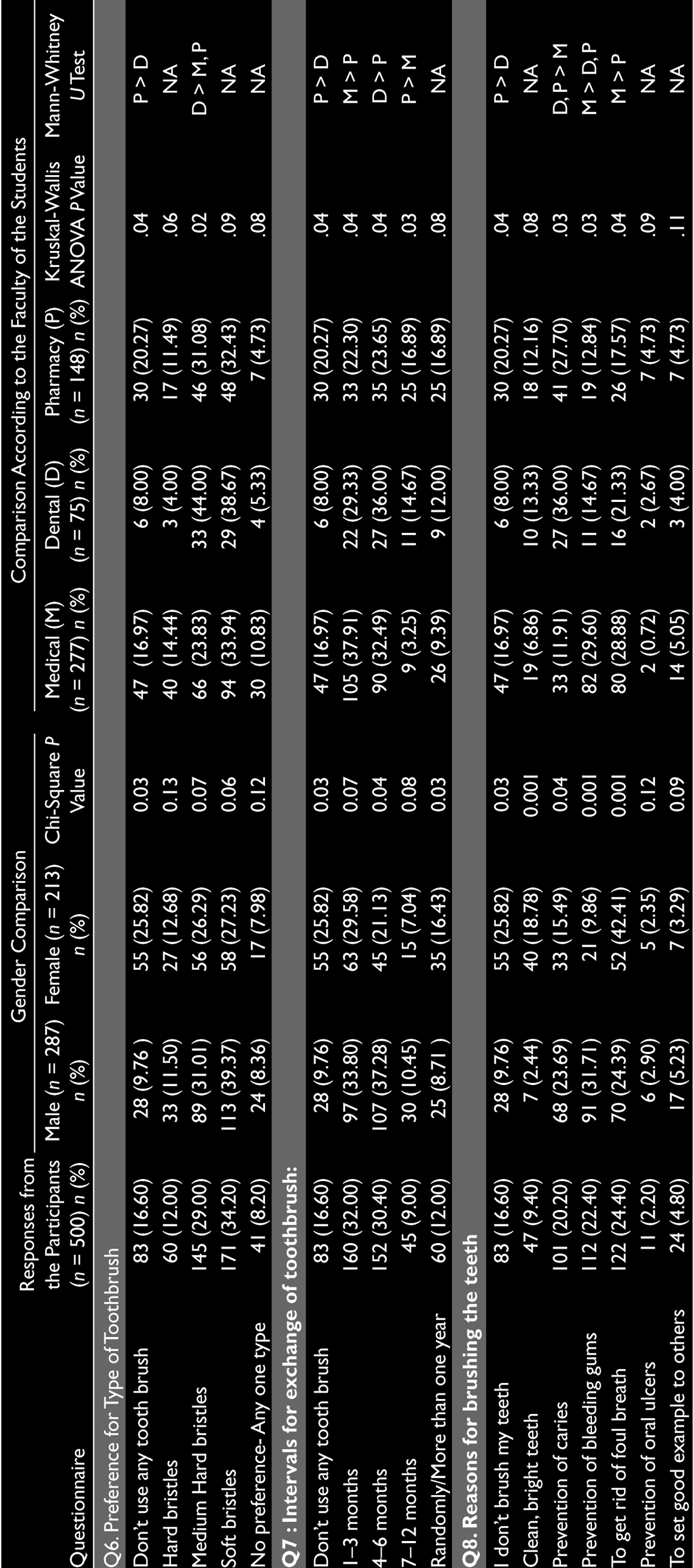
Responses from the Study Participants with Gender and Faculty Comparison (Part 3)

Responses from the Study Participants with Gender and Faculty Comparison (Part 4)

Responses from the Study Participants with Gender and Faculty Comparison (Part 5)

Discussion
The present study intends to know the oral health behavior of students studying in professional courses in Taif University, Kingdom of Saudi Arabia. The high prevalence of dental caries in Saudi school children and young adults is well documented by many resent researchers4,5 It may be attributed to the fact that poor oral hygiene, high consumption of sugared carbohydrates, and carbonated beverages exaggerated the response of oral microbes with increased prevalence of oral diseases.10,15-17
Oral hygiene practice is a habit inculcated into a person since childhood at home through parents. 18 With inadequate knowledge of oral healthcare practices, the childhood practices tend to continue in adulthood leading to poor oral health status. The students studying courses related to health sciences, such as medical, dental, and pharmacy, are expected to be aware about oral health practices and display appropriate oral health behavior. Although there are several research focusing on oral hygiene practices and dental caries prevalence in school children,15,19 the research focusing on the young Saudi adults is extremely limited in numbers.
Researchers elsewhere have considered oral hygiene as a key factor associated with good oral health.15,20 One of the studies conducted on Saudi school teachers showed adequate knowledge of oral healthcare practices; however, the study reported negative attitude in promoting oral health care in schools. 20 In the present study, 41 percent of participants responded with “no” or “rarely brush” their teeth. Similar finding has been reported by El Bcheraouietal. 19
The impact of the oral health education program in improving the knowledge and self-reported oral health behavior of school children has been studied by researchers who concluded with a positive impact at least on a short-term basis.21,22 However, need for frequent repetitions for maintaining the state of motivation toward good oral health is necessary.23,24 From the findings of the present study, such as the participants rarely brushed (41%), did not know if the toothpaste was fluoridated (14.6%), never visited dentists (18.6%), and consumed sweet couple of times per day (38.6%), it can be suggested that the young adults who may or may not have participated in such school oral health programs in their past should also be included systematically in education programs to raise their knowledge regarding oral health and its determinant factors.
In the present study, 60.4 percent of participants received dental treatment form private dental hospitals. The reason for the above finding may be attributed to the long waiting time and to the lack of advanced dental treatments in Primary Health Care (PHC) centers given that these centers are known for primary dental treatment.25,26 Although these results may reveal unmet patients’ needs in PHC centers, the issue is common in many countries across the globe including Saudi Arabia.27-30
However, the data collection method may have certain limitations; for example, the acceptable behavior is reported rather than factual behavior. Thus, over-reporting would be considered with respect to the answers on oral hygiene habits and frequency of dental visits. Moreover, recall bias may have induced under-reporting on services received at the previous dental visit. Despite the potential limitations mentioned, the present study provides an overview of the oral health behavior situation of the young adult population in Kingdom of Saudi Arabia. A recent study also highlights this shortcoming and poor oral health condition of young adults in Saudi Arabia. 31
The present study highlights the inconsistency in oral health behavior among the study participants emphasizing on the need for focused attention toward the oral health education of the population at school and public levels to improve oral health status.
Conclusion
To conclude, the results of the present study suggest that
Oral hygiene practices among the students of professional courses including medical, dental, and pharmacy is inconsistent. A significant number of students who still do not brush their teeth were found, which is detrimental for the oral health of this population group. Although there is a significant increase in healthcare facility in Saudi Arabia, the maximum number of participants preferred private hospitals over government hospitals for receiving treatment. The expensiveness of dental treatment is still the factor affecting the decision on receiving preventive oral health care. The study participants are more habitual of smoking and cola consumption. There is a need for focused attention toward the oral health education of the population at the school and public levels to improve oral health status. Oral hygiene practices are not common among Saudi Arabian people, and the use of health care for the prevention of oral disease is limited. Hence, the need for oral health promotion is pressing. The KSA Ministry of Health should develop and implement programs, through its primary health clinics, to increase the awareness of the importance of good oral health.
Authors’ Contribution
ASA contributed to conception, design, data acquisition, analysis, and interpretation; and drafted and critically revised the manuscript. AOA contributed to conception, design, data acquisition, and interpretation; performed all statistical analyses; and drafted and critically revised the manuscript. MMA contributed to conception and interpretation; and drafted and critically revised the manuscript. RNM contributed to conception, design, and acquisition; and drafted and critically revised the manuscript. SB contributed to design and acquisition; and drafted and critically revised the manuscript. YAT contributed to design and acquisition; and drafted and critically revised the manuscript.
All authors gave their final approval and agree to be accountable for all aspects of the work.
Footnotes
Declaration of Conflicting Interests
The authors declared no potential conflicts of interest with respect to the research, authorship, and/or publication of this article.
Funding
The authors received no financial support for the research, authorship, and/or publication of this article.