




Abstract
Aim:
To evaluate the knowledge of general dentists in Riyadh city regarding tooth avulsion using a questionnaire that contained case-based questions.
Materials and Methods:
Case-based questionnaires were distributed amongst 128 dentists. The questionnaire contained 5 items on demographic data and 10 items on clinical cases. Participants selected the most appropriate answer on the basis of the American were analyzed using the Statistical Package for the Social Sciences (SPSS, version 22, IBM Corp., New York).
Results:
The survey was completed with 74 percent males and 26 percent females. Most participants had freshly graduated and had not experienced any accident involving tooth avulsion. The overall mean score was 5.13 (standard deviation = 1.73). There were no significant differences in scores among the demographic categories.
Conclusion:
Freshly graduated dentists in Riyadh city demonstrated a moderate level of knowledge on management of avulsed teeth. Close adherence to AAE guidelines for traumatic dental injuries could result in further improvement.
Introduction
Traumatic dental injuries (TDIs) are common among children. A recent study showed that approximately 1 billion people have suffered from TDI worldwide, and the prevalence of TDI in permanent and primary teeth is 15.2 percent and 22.7 percent, respectively. 1 TDI is the fifth most common chronic disease/injury. Furthermore, it is considered to be the second most frequent disease of the oral cavity. 1
Avulsion is defined as the total dislodgment of the tooth from its alveolus. In the case of permanent teeth, replantation is the treatment of choice in most cases. However, it cannot always be performed immediately. It should be recognized that for good prognosis, proper emergency management of the avulsion and an appropriate treatment plan are required. 2
The American Association of Endodontics (AAE) has provided guidelines to manage TDI. 3 The detailed management of avulsion is described for permanent teeth with closed and open apices. Adherence to the guidelines could improve the prognosis. However, improper handling and replantation in cases of avulsion could result in resorption or ankylosis of the affected teeth. 4
Studies on the management of avulsion have been conducted in different counties on the knowledge of healthcare providers and staff.5–8 AlJazairy et al. 9 performed a study in 2013 to evaluate the knowledge of dentists on avulsion and its management in Saudi Arabia. They recommended future studies in clinical scenarios to further evaluate dentists’ knowledge of this condition.
TDI is common worldwide. The major recommendations from a previous study were to enhance public awareness on this condition and provide proper emergency services. 1 The general dentist’s role in the management of TDI is critical, and therefore, their knowledge on such management is of extreme importance.
The aim of this study was to evaluate the level of knowledge of general dentists in Riyadh city on management of avulsion using a case-based questionnaire.
Materials and Methods
Setting and Design
A presented questionnaire-based cross-sectional study was distributed to general dentists in Riyadh city from September to October 2018. The questionnaire was structured based on the study by Hatem et al., 10 and the cases were modified based on the AAE guidelines for avulsed teeth. 3 Informed consent was obtained from all participants to complete the questionnaire anonymously. No personal information breaching their identities was required to be disclosed.
Study Method
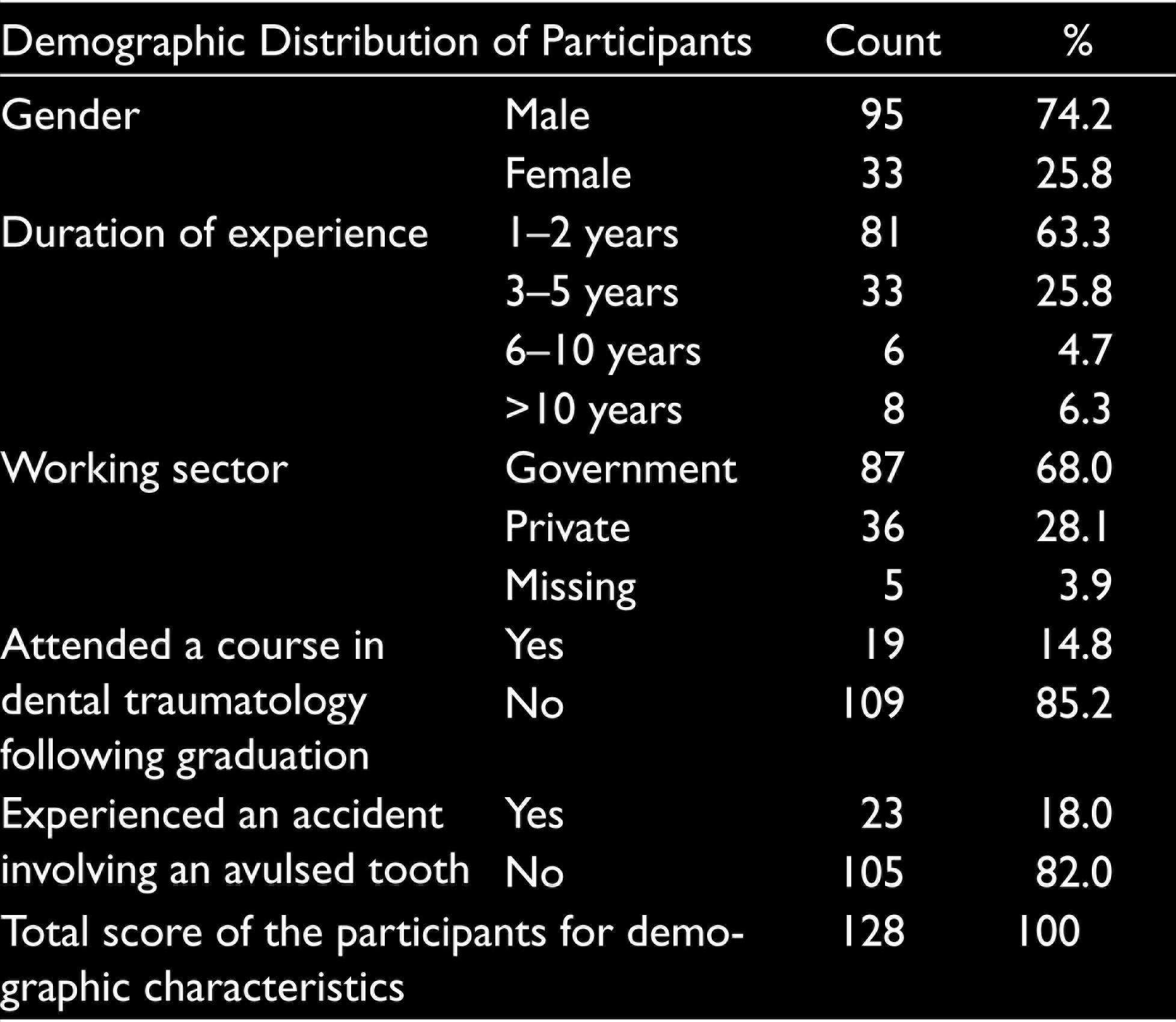
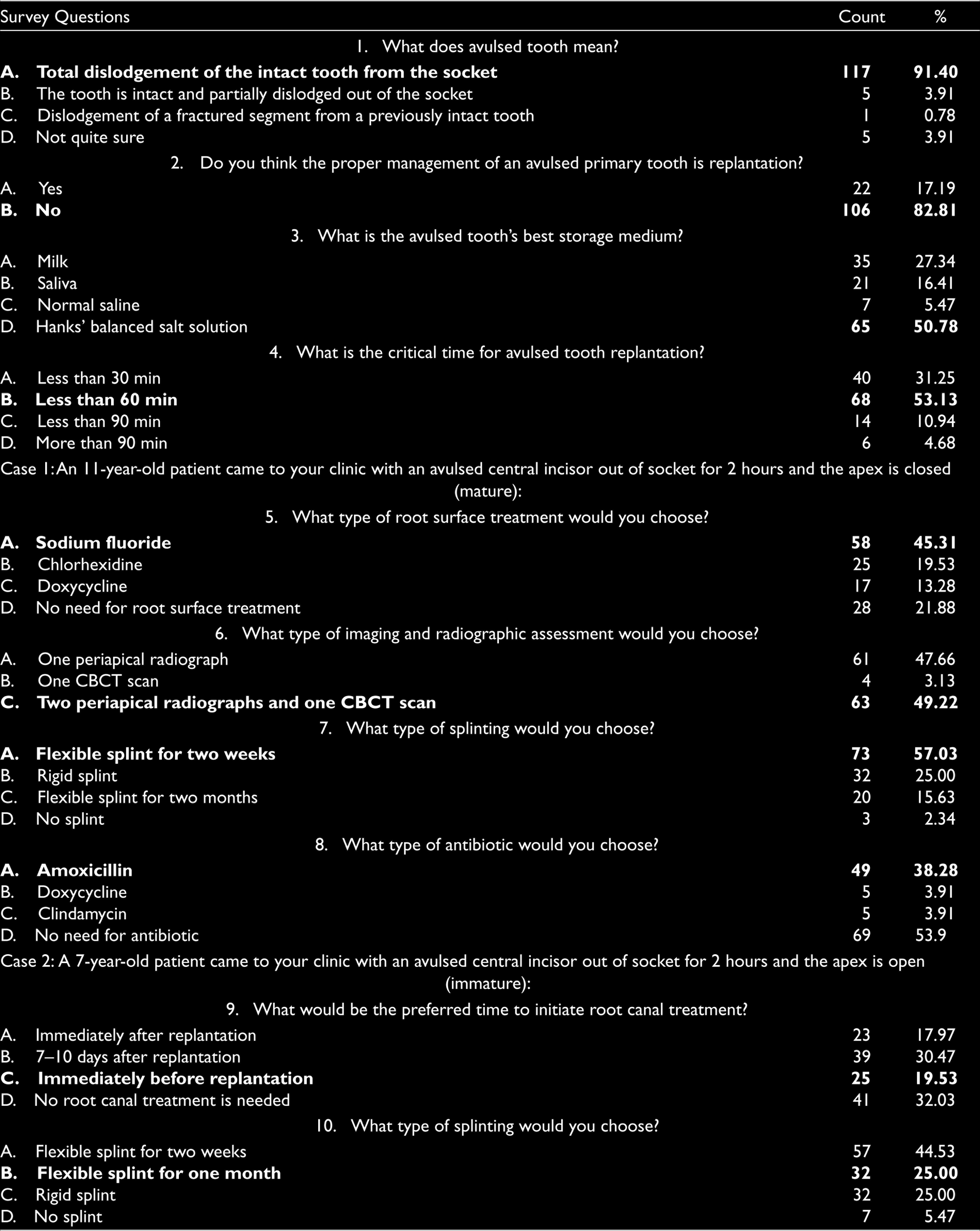
The questionnaire consisted of two parts. The first part included 5 items on demographic characteristics (Table 1), and the second part included 10 items on clinical knowledge, with two clinical cases with different levels of root development (Table 2). The demographic characteristics included gender, duration of experience, working sector, attendance of postdoctoral trauma courses, and experience of tooth avulsion management. Clinical knowledge included the definition of tooth avulsion, management of the avulsed primary tooth, best storage medium, critical time for replantation, and two cases of avulsed mature and immature teeth. Participants selected the most appropriate option on the basis of the AAE guidelines. One point was scored for each correct answer.
Demographic Distribution of the Participants Expressed as Counts and Percentages
Statistical Analysis
Demographic characteristics of the participants and their responses were presented descriptively. The t-test and one-way analysis of variance test were used for continuous variables. Data were analyzed using Statistical Package for the Social Sciences (SPSS, version 22, IBM Corp., New York). A P-value < .05 was considered statistically significant.
Results
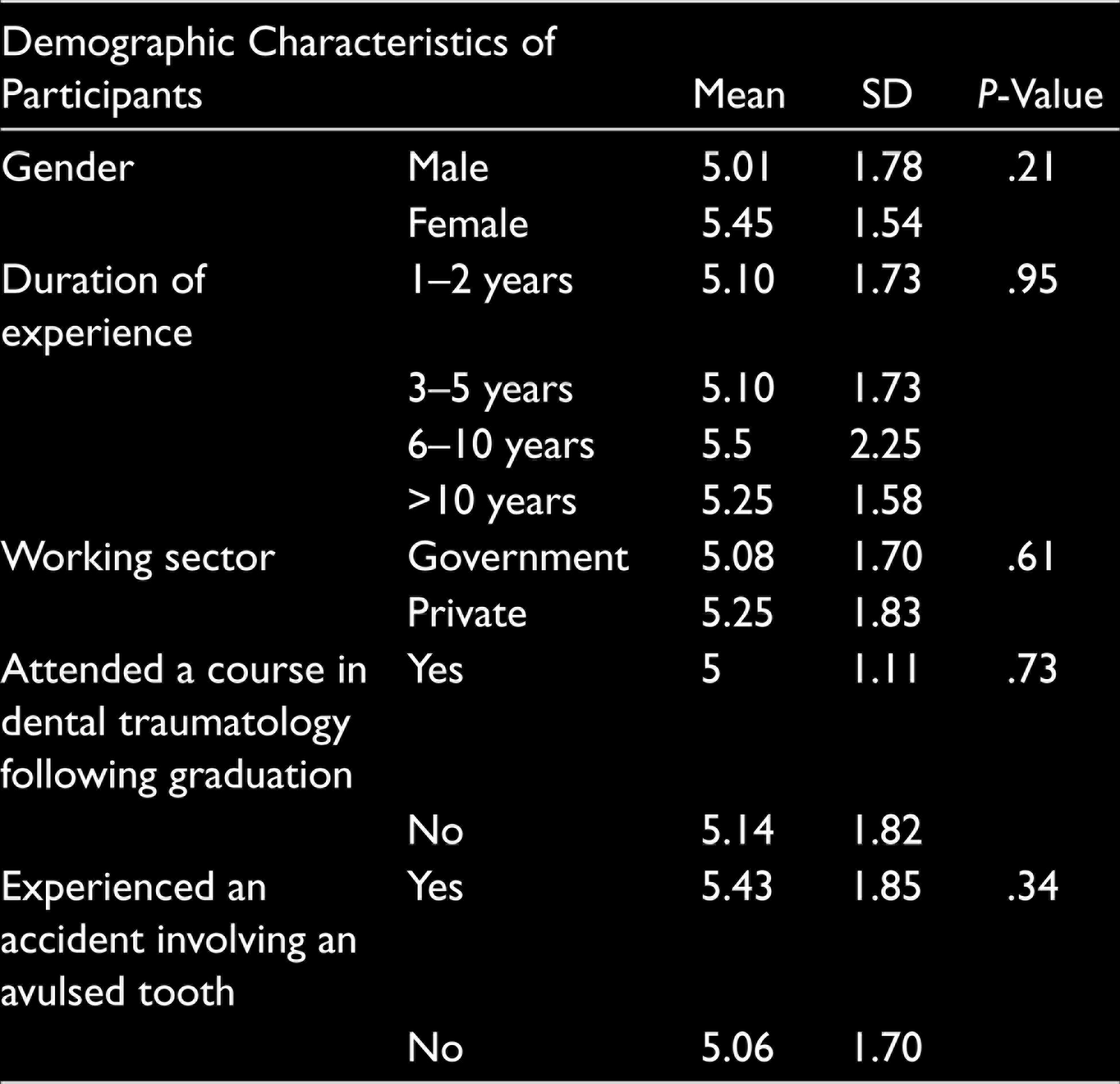
A total of 128 general dentists completed the survey. The numbers of males and females were 95 (74%) and 33 (26%), respectively. Most participants were recent graduates working in government sectors and had not attended any dental trauma course after graduation or experienced any accident involving tooth avulsion. The overall mean score was 5.13 (standard deviation = 1.73). Table 1 presents the detailed demographic characteristics of the participants, which are expressed as counts and percentages. Table 2 presents the complete distribution of the responses to the questions, which are expressed as counts and percentages. Options formatted in the bold typeface represent the correct answers. Table 3 presents the mean knowledge scores of avulsion and its management based on the demographic characteristics, showing no significant differences in the scores among the demographic categories (P > .05).
Complete Presentation of Responses Expressed as Counts and Percentages and Correct Answers Formatted in Bold Typeface
Discussion
Owing to the importance of the subject of TDI, different previous studies have tried to explore the level of knowledge of the team who may be involved in TDI management or the available staff when TDIs occur, which includes emergency physicians, school nurses, and dental assistants.6,7,11 However, the definitive treatment of avulsion is performed by dentists, and therefore, their knowledge on management of avulsion is critical.
Mean Scores of Avulsion Knowledge and Its Management Based on Demographic Characteristics, Showing No Significant Differences Among the Demographic Categories
A previous study on the knowledge of dentists recommended future studies to include case-based scenarios. 9 The current study included two clinical cases of avulsion. The questions included the description of the status of the tooth apex (mature or immature) and time since the trauma occurred. Including these items was an advantage of the current questionnaire.
Regarding the proper storage medium, an earlier study reported that Hanks’ balanced salt solution (HBSS) was the optimal storage medium for the avulsed tooth. 12 On the other hand, a recent systematic review comparing different storage mediums concluded that milk was the cheapest, most convenient, and available medium while still maintaining the viability of periodontal ligaments. 13 The AAE guidelines mention different storage mediums, including HBSS, saline, and milk.
Updates in radiography were included in this study based on the AAE guidelines. This was evaluated through question number 6. Although the standard is to take two periapical radiographs, cone beam computed tomography (CBCT) in these conditions should be considered. This question was designed to stress the necessity of periapical radiographs and the consideration of CBCT to confirm the correct reposition and rule out fractures of alveolar bone.
The present study showed moderate knowledge of Riyadh dentists with regard to avulsion management. It should be observed that most of our samples were freshly graduated dentists (1–2 years of experience [63.3% of our total sample]), whereas most of the rest had 3–5 years of experience (25.8% of the total sample). It can be expected that the level of knowledge would improve with more experience in practice and once the proper trauma courses are attended.
A limitation of our study was that it was conducted in a single city. Future studies involving similar casebased scenarios but in multiple cities can provide a good evaluation of the knowledge of dentists on this particular condition.
Although this study reflects the moderate knowledge of Riyadh dentists, improvement toward excellence is always warranted. The desired improvement can be achieved through more emphasis on the subject of avulsion in undergraduate studies, the use of case-based scenarios in teaching such a clinical subject, and more stress on the AAE guidelines in the treatment of TDIs. 3 Experienced dentists can benefit from attending clinically oriented trauma courses to stay updated.
Conclusion
Freshly graduated dentists in Riyadh city demonstrated a moderate level of knowledge on the management of avulsed teeth. Close adherence to dental trauma guidelines could accomplish additional improvement.
Footnotes
Acknowledgements
We would like to thank Dr Khalid Alsaif for helping in distributing the questionnaire.
Declaration of Conflicting Interests
The authors declared no potential conflicts of interest with respect to the research, authorship, and/or publication of this article.
Funding
The authors received no financial support for the research, authorship, and/or publication of this article.