




Abstract
Aims and Objectives:
In recent years, researchers have focused on finding methods of eliminating caries and white spot lesions under orthodontic bands without requiring patient cooperation. One of the effective and preventive strategies is the addition of antibacterial and remineralizing agents to the band cement. However, modifying the cement should not lead to microleakage and weakening of its mechanical properties. This in vitro study represents a continuation of our previous work of investigating the retentive strength of orthodontic bands cemented with casein phosphopeptide-amorphous calcium phosphate (CPP-ACP)-modified glass ionomer cement (GIC).
Material and Methods:
60 extracted human premolars were randomly divided into two groups (n = 30). In group 1, stainless steel bands were cemented with GIC. In group 2, a novel dental caries-preventive material, CPP-ACP, was incorporated into the GIC for cementing. The microleakage of each group was measured by the fluid filtration method.
Results:
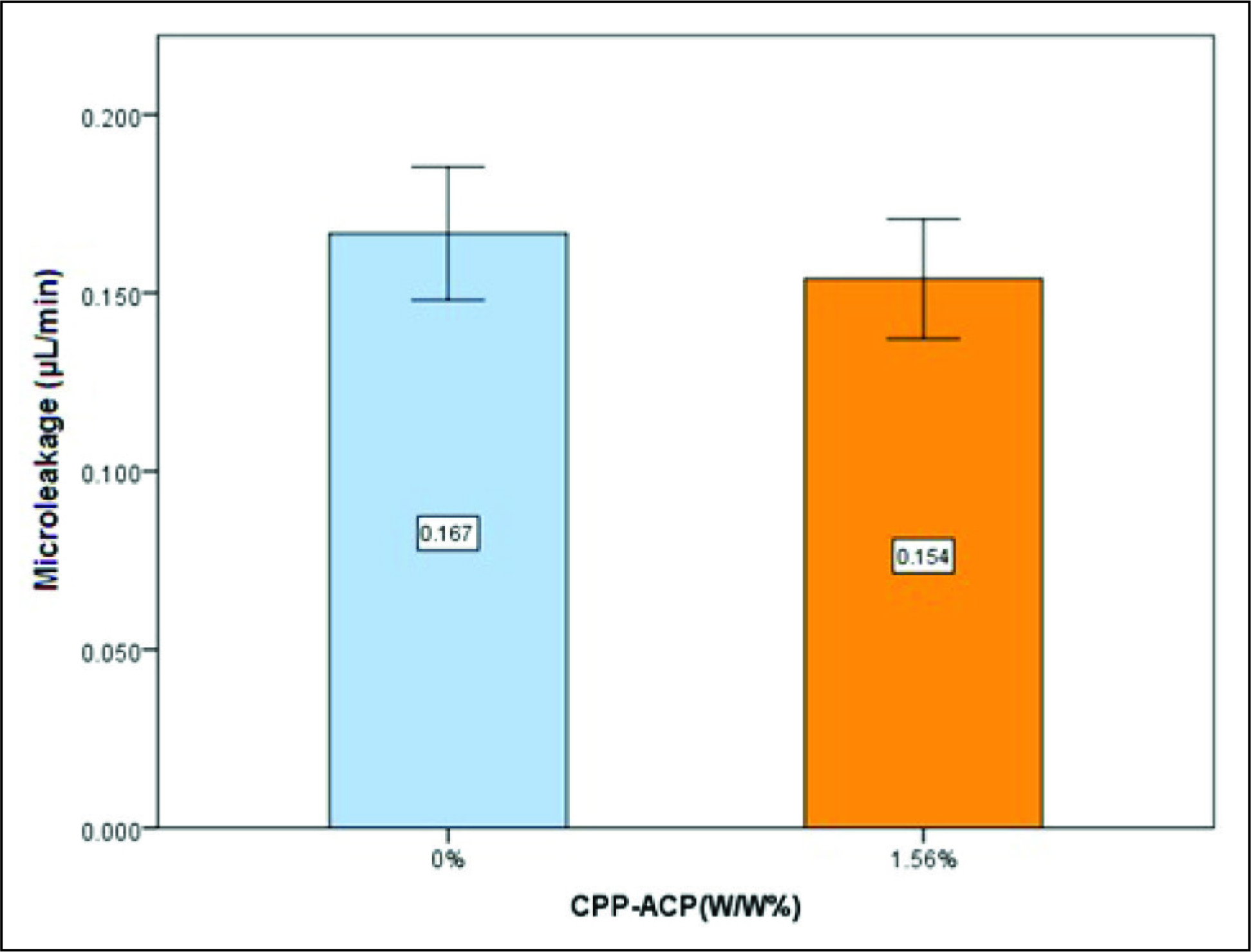
Results showed no statistically significant difference in microleakage of either group (GIC and CPP-ACP-modified GIC).
Conclusion:
We concluded that 1.56% w/w CPP-ACP can be incorporated with GIC for cementing orthodontic bands without promoting microleakage.
Introduction
One of the major challenges associated with fixed orthodontic treatment is the formation of white spot lesions (WSLs) which can lead to an esthetic problem and, without early treatment, can develop into a frank cavitied lesion. 1 Recently, researchers have tried to find novel methods of preventing caries and WSLs that generally formed with the use of orthodontic bands and other fixed orthodontic appliances.2-5 One of the more effective strategies is by modifying the cement with anticaries and remineralizing agents. However, modifying the cement should not lead to microleakage and diminished mechanical properties.
Microleakage under bands may permit the passage of bacteria and oral fluids, allowing microbial ingress and consequent enamel demineralization and WSLs. 6 Furthermore, it can lead to reduced retentive strength of the cemented band.
The current study represents a continuation of our previous work 7 focusing on evaluating the retentive strength of orthodontic bands cemented with casein phosphopeptide-amorphous calcium phosphate (CPP-ACP)-containing glass ionomer cement (GIC). CPP-ACP, a novel caries preventive material, helps in remineralization and prevents caries by stabilizing the amorphous calcium phosphate phase and inhibiting its crystallization to hydroxyapatite. It thus maintains a state of supersaturation of calcium and phosphate ions and helps prevent demineralization,8,9 and enhances remineralization and recovery of subsurface caries lesions.10,11 In this research, in a caries-preventive strategy, CPP-ACP was added to the GIC and the microleakage of the cemented orthodontic bands with CPP-ACP-modified GIC was evaluated, which, to the best of our knowledge, is the first study to investigate this property for CPP-ACP-containing GIC. The null hypothesis was that microleakage did not differ between the bands cemented with GIC and CPP-ACP-modified GIC.
Materials and Methods
In this in vitro study, 60 extracted human premolars (Protocol Number: 930266), free of caries and restorations, were extracted atraumatically for orthodontic reasons and were collected and observed under a microscope at 10× magnification to exclude the teeth with cracks. The teeth were disinfected in 1% thymol and cleaned with nonfluoridated pumice and bristle brush to remove any debris. Then they were randomly divided into two groups (n = 30) and stored in distilled water at room temperature until required for use.
Group 1: Stainless steel bands were cemented to the teeth with a luting and lining GIC (Gold label, GC Corp, Tokyo, Japan). The cement was prepared following the manufacturer’s instructions.
Group 2: CPP-ACP was synthesized according to our previously published articles.12,13 CPP-ACP (1.56%) powder was incorporated into the GIC used for group 1. The bands were cemented to the teeth with CPP-ACP-modified GIC.
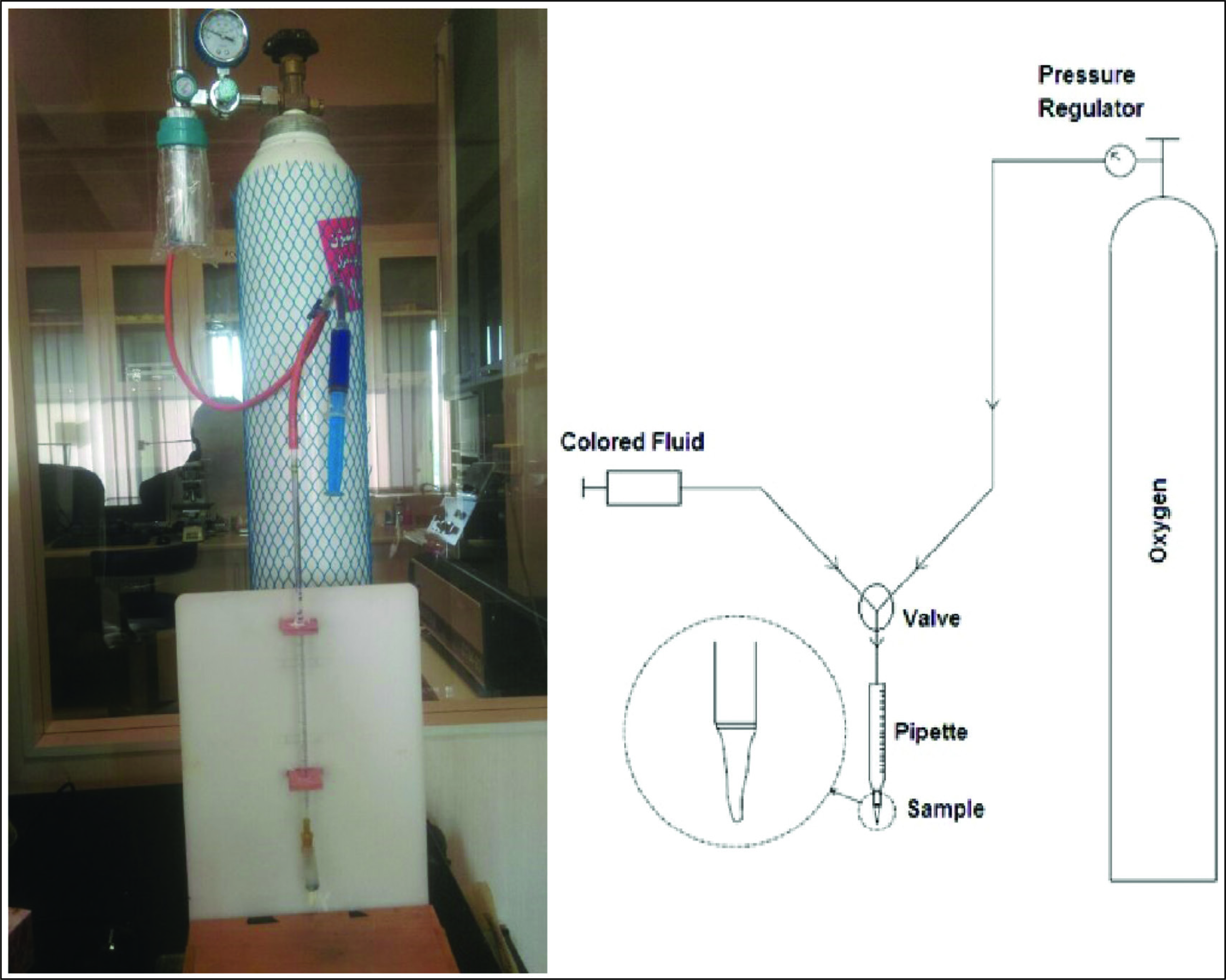
Samples of both groups were stored in distilled water at 37°C for 24 hours prior to measuring for microleakage by the fluid filtration method (Figure 1). Each sample was placed in a silicon tube from the crown side as the tube edge was placed in the middle of the band surface. The hole in the tube edge was sealed accurately. Then the valve was opened and the colored fluid was drained into a pipette. When the liquid level in the pipette had risen to the 0.75 µL mark, the valve was closed; then the oxygen valve was opened to induce oxygen gas pressure behind the liquid. After 8 minutes, the liquid surface displacement was measured. Any leakage led to a reduction in the height of the column of the colored fluid. The amount of microleakage was calculated by dividing the liquid surface displacement by the period of time (8 minutes). The data was statistically analyzed using independent t test.
Fluid Filtration Setup for Measuring Microleakage of the Cemented Orthodontic Bands
Results
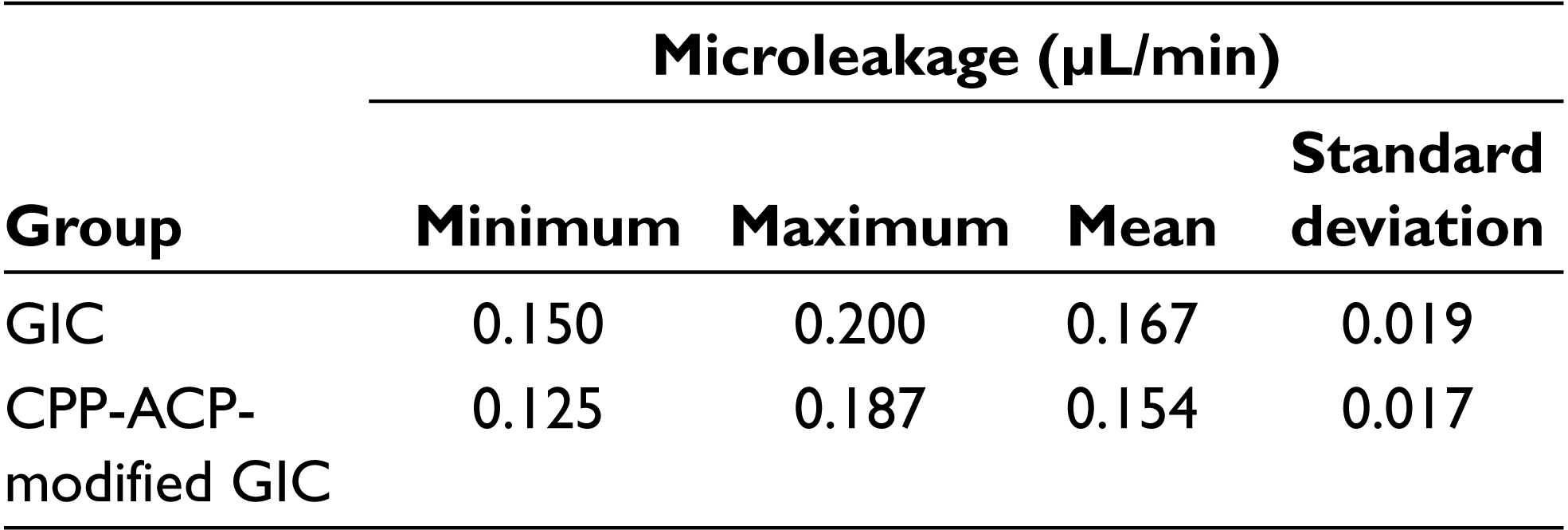
Both groups passed the normality analysis according to the Kolmogorov–Smirnov test. The mean microleakage of GIC and CPP-ACP-modified GIC is shown in Figure 2. Descriptive statistics of the microleakage of both groups are represented in Table 1.
Descriptive Statistics of the Microleakage of Two Groups
Discussion
The prevalence of WSLs at the end of fixed orthodontic treatment has been demonstrated in studies for up to 97% of patients. 14 The modification of cements and adhesives with remineralizing agents can be considered as an effective strategy to prevent WSLs and caries in fixed ortho-dontic treatment. However, it should be investigated that modification of the cements has no negative effect on their properties. In this context, microleakage under fixed orthodontic appliances is of significant clinical importance. 14 Microleakage may cause demineralization under cemented bands or decrease their retentive strength. Thus, it must be considered an important issue in modifying banding cements. In this in vitro study, in a caries preventive strategy, CPP-ACP was incorporated to the GIC, and the microleakage of the cemented orthodontic bands was evaluated. The results of this research showed no statistically significant difference in the microleakage of the two groups (GIC and CPP-ACP-modified GIC). Therefore, the null hypo-thesis tested—the addition of CPP-ACP to GIC does not influence the microleakage of the cemented orthodontic bands—was accepted. Additionally, the microleakage decreased, but not significantly. The results of the previous study 7 showed that the modification of GIC with 1.56% (w/w) CPP-ACP had no negative effect on the retentive strength of the bands. The conclusion of these two studies is that the modification of GIC with 1.56% CPP-ACP offers favorable mechanical and microleakage properties.
To the best of our knowledge, no published studies have addressed the effect on microleakage of orthodontic bands by adding CPP-ACP to the cement. Furthermore, there are very few studies that focused on microleakage under orthodontic bands.
Omidkhoda et al. 15 found no significant differences between the bands cemented with GIC and ACP-containing GIC by using dye penetration method for microleakage evaluation. Uysal et al. 16 compared microleakage patterns of conventional GIC, resin-modified GIC, and polyacid-modified composite for band cementation. Enan et al. 17 found that modifying the banding GIC with nano-hydroxy apatite had a positive effect on reducing microleakage around orthodontic bands. Shimazu et al. evaluated the microleakage of three orthodontic band cements (a dual-curing resin-modified GIC and two light-curing polyacid-modified composite resins). Gillgrass et al. 6 studied the microleakage pattern of a conventional GIC (Ketac-Cem) and an acid-modified composite (Ultra Band-Lok) for cementing orthodontic bands. Atash et al. 18 evaluated microleakage under orthodontic brackets bonded with different adhesive systems. In other studies, microleakage of orthodontic brackets was investigated. Hedayati et al. 14 investigated the microleakage under orthodontic brackets bonded with nanocomposites.
In fact, it is not possible to consider all the conditions of the complex oral environment in in-vitro studies. For more exact results, future studies that more closely mirror conditions in vivo can be performed.
Conclusions
We concluded that 1.56% w/w CPP-ACP can be incorporated with GIC for cementing orthodontic bands without promoting microleakage.
Footnotes
Acknowledgements
We would like to thank the Research Vice Chancellor of Mashhad University of Medical Sciences for financial support required to conduct this study.
Declaration of Conflicting Interests
The authors declared no potential conflicts of interest with respect to the research, authorship, and/or publication of this article.
Funding
The authors disclosed receipt of the following financial support for the research, authorship, and/or publication of this article: This study was the result of a PhD thesis, and was financially supported by the Research Vice Chancellor of Mashhad University of Medical Sciences (grant no. 930266).