




Abstract
From late 2019 to the first half of 2020, the world has witnessed the epic spread and destruction of the novel coronavirus which was discovered in Wuhan, China. The huge number of infections and deaths caused by the virus, the collapse of the healthcare system and the economic consequences have few modern equivalents. While governments of all countries are responding to the pandemic, a heated debate rages about which political system, democracy versus authoritarian, is better positioned to respond to the pandemic. While the worldwide effort to contain the virus continues, we offer a preliminary comparison between democracies and authoritarian regimes in their responses to COVID-19, and policy suggestions for democracies to improve their governance and their ability to respond to crises.
Introduction
In December 2019, people in Wuhan, a major city of 11 million people in central China, were found to be infected by a new coronavirus that may cause severe acute respiratory disease. At first, the Chinese government kept the virus secret from the world until it rapidly spread in Wuhan causing tens of thousands of people to become sick, many of whom died. On 23 January 2020, at 2:00
By April 2020, the virus, which is named COVID-19, rapidly spread in the world. While the final body count is still growing, at the writing of this article (22 April 2020), already over 2.6 million were infected and more than 180,000 died. In merely three months, the world has witnessed the collapse of healthcare systems. The economic consequences that have followed have few modern parallels, and governments of all nations are facing a mounting, grave challenge that is unprecedented.
The crisis has put the governments of all infected nations in a spotlight in terms of how they responded. At first, most people in the world, especially in the democracies, put the blame on the authoritarian government of China for suppressing the information on the outbreak. By mid-March, the Chinese government declared that its military-style measures of closing cities had stopped the spread, and opinions in the democracies began to change. A commentary in Bloomberg suggested that the Chinese model of containment is superior to the democratic one (Brands, 2020). Another article at CNN mused on how Russia, with a population of 146 million, has fewer coronavirus cases than Luxembourg (Ilyushina, 2020). Yet another CNN article praised the ‘success of China’s sweeping, top-down efforts to control the virus’ (Westcott, 2020). A National Review article concludes that ‘for the time being, China seems to be ahead in the geopolitical game’ (Maçães, 2020).
This change of opinions raises an urgent and important question on the regime type and responses to COVID-19 (Alon & Li, 2020), and a more general, fundamental question on how we should respond to the criticism of, or dissatisfaction toward, democracy within the democracies, and their citizens’ preferences for a more authoritarian government for its perceived decisiveness and efficiency?
In this perspective essay, we will examine the responses to COVID-19 by the two major opposing types of political systems: democracy versus authoritarianism. We will present the cases of responses by China, the WHO and by some democracies.
We will use the qualitative method to build our arguments. Specifically, we adopt a multi-case qualitative approach following Eisenhardt (1989). This enables us to follow a replication approach wherein the insights from each case can confirm or refute inferences from the others. We further use Mill’s Similar System Design in order to directly compare China to Taiwan (Mill, 1843). A comparison of China’s response to Taiwan’s provides us with this ‘most similar research design’ popular with comparative political scientists (e.g., Teune & Przeworski, 1970). The two governments have ruled separately since 1949 but share a common history, culture and language. Differences in responses can be attributed to differences in governance. Furthermore, we use anecdotal evidence, reports, statistics, and government documents and policies to support our arguments. We also use scholarly sources to bolster our view.
COVID-19 and Crisis Management
By most definitions, crises are temporally limited events that, while important, do not constitute the bulk of our existence. Crisis in business is a disruption or problem that triggers negative reaction and impacts financial wellbeing (Kádárová, 2010). The Chinese phrase for crisis, wéijī (危机), consists of two ideographs: danger and opportunity. The current COVID-19 crisis presents us with both and gives us an opportunity to examine the differences in policy responses between democratic and authoritarian regimes.
The COVID-19 crisis is, at the time of this writing, relatively new and an ongoing situation. As such, scholarly publications regarding the nation-level response to the pandemic are few. Nonetheless, some researchers have established recommendations for dealing with the novel coronavirus at the governmental level. For instance, several have emphasized the need for cooperation. In Africa, the early formation of the AFTCOR taskforce helped to spread testing capabilities. Prior to the establishment of the taskforce, only 2 countries in the entire continent were capable of testing for COVID-19; afterwards, and as a result of its actions, 40 countries were able to contribute to testing efforts (Nkengasong & Mankoula, 2020). This need for cooperation exists not only at the national but also subnational level. For example, physicians in the USA have emphasized the need for cooperation among states. States are bidding against one another for supplies, which does not necessarily send the supplies to the states which need them but to those which can afford them. This inefficiency may exacerbate the spread of the disease in the long term (Ranney et al., 2020). In addition to echoing the call for international cooperation, Phelan et al. (2020) note that mandatory lockdowns are somewhat authoritarian in nature: They have the potential to erode public trust and may also violate human rights such as freedom of movement.
In examining national responses to the novel coronavirus, other researchers have noted historical parallels with past epidemics. While some of the negative elements, such as a slow initial response, are typical of how epidemics have been dealt with historically on a national level, other items are more promising, such as the success of quarantines in mitigating disease spread and mortality (Jones, 2020).
Theoretical Conceptualization and Considerations: Crises and Regime Type
Following Linz (1964), we refer to governments as ‘authoritarian’ when (a) they offer no or very limited political pluralism, (b) obtain legitimacy through appeals to emotion and present the regime as a solution to easily-identified societal problems, (c) suppress anti-regime sentiment and/or activities and (d) have broadly-defined powers that can be changed at will. Democracy, similarly, has four key elements: (a) the voters are represented by officials chosen through free and fair elections, (b) citizens are permitted to participate in the political system, (c) human rights of the citizens are protected and (d) the rule of law is enforced and laws apply equally to all citizens (Diamond & Morlino, 2004). Although this definition is closer to that of a republic than a ‘pure’ Athenian democracy, it is suitable for a discussion in terms of the Manichean authoritarian/democratic dichotomy.
In democracies, policies reflect inputs and balances of different constituencies; mistakes can be corrected through elections and public debates; information is freely flowing and, due to transparency and competition on the media market, the quality of public information is higher. However, their pluralistic nature tends to make their policy process slow (Li, 2009).
In authoritarian regimes, policy process is opaque and mainly reflects the ruling class’s views. There are no formal channels to effectively correct mistakes. Due to the lack of free flow of information and lack of media competition, public information is of low quality and untrustworthy, and people rely on private messages and rumours for information. Due to the lack of checks and balances and the lack of public debates, policy process can be fast (Li, 2009).
Political science research suggests several avenues in which democratic systems may be overarchingly preferable to others. For example, democracies, in general, tend to have fewer civil wars, fewer wars with each other and fewer wars overall (Hegre, 2001; Ray, 2003). Democratic regimes are also less likely to kill their own citizens (i.e., democide; Rummel, 1997). Political institutions found in democracies are more likely to positively influence the prevalence of corruption, such as freedom of the press or parliamentary systems (Lederman et al., 2005). Democracies also suffer fewer terrorist attacks and fewer casualties in those attacks, possibly due to greater concern over citizen safety and wellbeing (Magen, 2018).
Obviously, framing the debate as being one between authoritarianism and democracy neglects alternative causal explanations and abandons nuance regarding classification of systems in favour of a binary oversimplification of reality. While type of government certainly influences policy which in turn affects crisis response, other factors, such as cultural frequency of gatherings, could play a significant role (Maçães, 2020). For example, incorporating Hofstedian cultural dimensions into our discussion might also help us understand the responses of different countries to a crisis such as the new coronavirus outbreak versus solely examining purely political factors. Specifically, the contrast between individualism and collectivism can provide insights in this regard, since collectivist societies should cooperate more for the greater good, as we discuss later (Hofstede, 2015).
Comparative Cases
China’s Response
In 2002 and 2003, China had its first outbreak of severe acute respiratory syndrome (SARS) caused by a coronavirus in Guangdong Province in the south. This is believed to have originated in bats and spread to humans via civets (Quanlin, 2006).
After the SARS outbreak, the Chinese government spent about $100 million to set up ‘the largest system in the world’ for a ‘direct-reporting network for infectious diseases and sudden public health events’. It was promised that using the system, any doctor at the lowest level would be able to directly report signs of the disease outbreak to the central government in real time (Chinese Center for Disease Control and Prevention, 2019; Cidiwuyan, 2020).
In 2015, Shi Zhengli, a virologist at the Wuhan Institute of Virology, co-authored an article that warned of viruses similar to that responsible for the SARS circulating among the Chinese bat population that may pose a serious future threat (Nandi, 2020).
For the remainder of this section, we discuss that threat and how events have unfolded. See Table 1 for a brief timeline of the early stages of the crisis.
Timeline of Major Events: Early COVID-19 Crisis
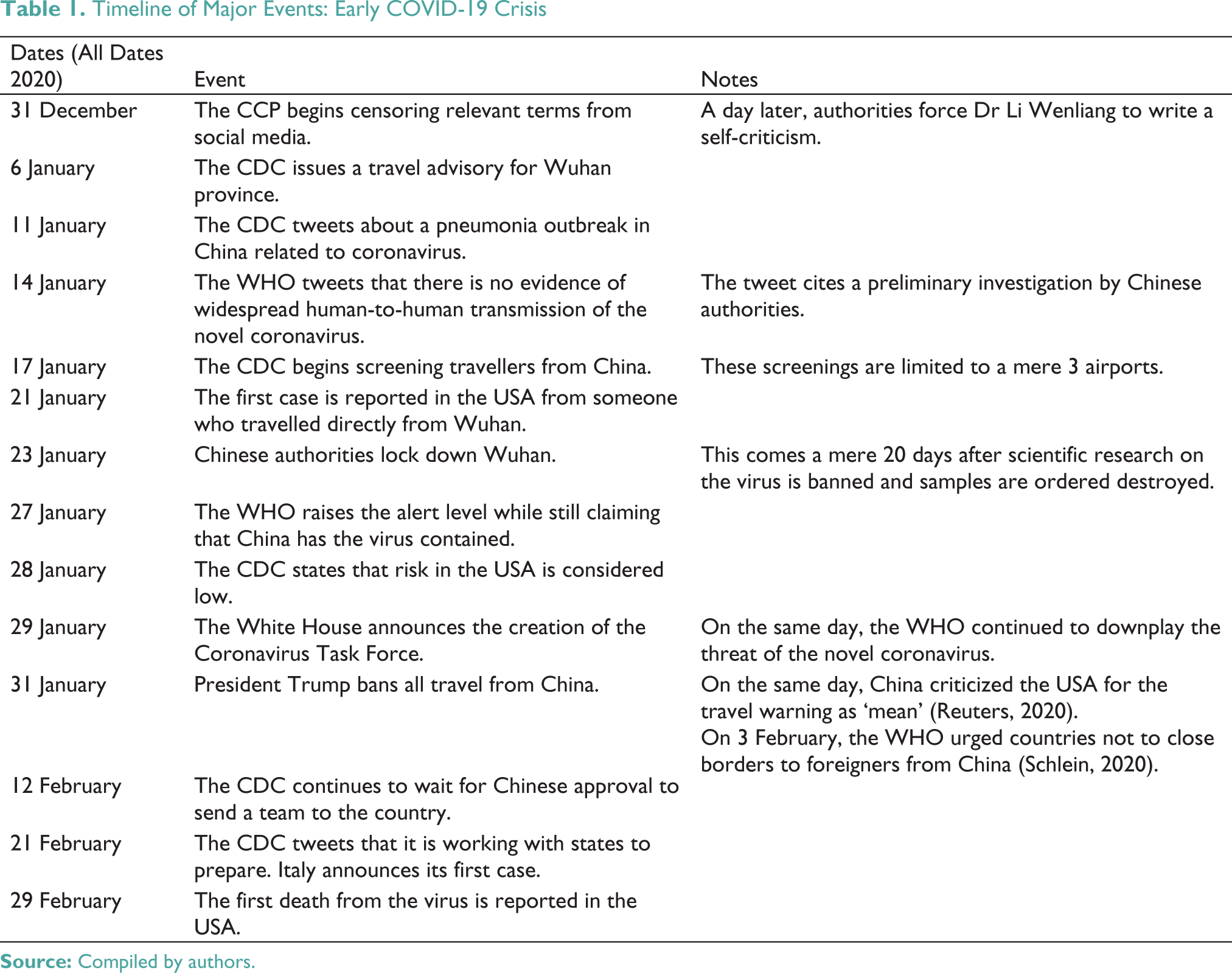
In December 2019, people in Wuhan were found to be infected by a new coronavirus that may cause severe acute respiratory disease. Some of the early patients visited the Huanan Wild Animal and Seafood Market. Doctors in Wuhan warned their family and friends about the disease but they were reprimanded and even arrested. The best-known doctor among them is the late Dr Li Wenliang, who was arrested for warning others and later died of the virus. Some official doctors tried to report it to the central government but were warned by their supervisors to be ‘cautious in reporting’. Fearing being punished, they did not report. Evidence shows that the central government learned of it in early January but it decided to keep the information from the public.
By mid-January, the virus had rapidly spread in Wuhan. On 23 January 2020, 2:00
In February 2020, some reported that Remdesivir, a drug developed by the US company Gilead Sciences, might be effective in fighting the virus. Soon after these reports, the Wuhan Institute of Virology applied for the patent on the use of Remdesivir in China. This act was criticized as unethically profiting from the outbreak (Ye, 2020).
On 27 February, Zhong Nanshan, the prominent Chinese infectious disease expert with the highest political position in the Chinese government, questioned the common knowledge that the virus originated in Wuhan: ‘The infection was first spotted in China but the virus may not have originated in China’. Soon after, a senior Chinese official, Zhao Lijian, claimed on Twitter (which is banned by the Chinese government in China): ‘It might be the US army who brought the epidemic to Wuhan’ (Westcoot & Jiang, 2020).
According to a The New York Times report, ‘Russia and China, as well as Iran, have sharply increased their dissemination of disinformation about the coronavirus since January, even repeating and amplifying one another’s propaganda and falsehoods, including anti-American conspiracy theories’ (Barnes et al., 2020).
Around mid-March, the Chinese government began to claim that Wuhan had achieved ‘zero cases’. However, information leaked from China shows that that may not be true (Bloomberg, 2020b). One report—which has been repeatedly deleted by the Chinese Communist Party (CCP) and reposted by others—described a patient being rejected by several hospitals in Wuhan so the CCP could maintain their ‘zero cases’ records due to pressure from the higher-ups for propaganda purposes (New Tang Dynasty Television, 2020). Beijing and Shanghai, along with some other regions, bar Wuhan, Hubei people who are officially cleared of the virus, indicating that the authorities of other regions do not believe the ‘zero cases’ claim by Wuhan, Hubei (Radio France Internationale, 2020).
In late March, the Chinese government finally allowed families to retrieve the ashes of their loved ones who died during the outbreak in Wuhan under tight security. The families must be accompanied by local officials to retrieve the ashes, and they were not allowed to cry or show any grief. According to the official report, the total deaths due to the virus in Wuhan is 2,535 (which was later adjusted to 3,869 by the Chinese government; Page & Fan, 2020). But based on the large number of urns distributed to the official cremation service stations, which, by one estimate, is 64,000, the death toll due to the virus is much higher. Assuming normal deaths during the period to be 5,000, then the actual number of coronavirus-related deaths is 59,000 in Wuhan. Projecting to the whole country, the actual numbers of confirmed cases and deaths in China should be 1.2 million and 97,000, respectively (Bloomberg, 2020a; Caijing Lengyan, 2020).
Aside from the evidence that the number of cases and deaths may be underreported, the definition of confirmed cases China uses is different: China only counts people with symptoms, whereas the rest of the world count people who tested positive regardless of whether they show symptoms. Logically, the number from China is lower because many infected people do not show symptoms.
Taiwan’s Reaction
Taiwan, South Korea and Japan showcase efficient democratic responses to the crisis. Italy and the USA were slow initially but caught up quickly through travel restrictions, quarantines and social distancing measures. Taiwan’s reaction was exemplary and can be used to contrast with China’s as they share many of the same characteristics such as culture and ethnicity, with the key difference being that Taiwan has vibrant democratic institutions. The island is only 81 miles away and shares a common history with the mainland. Taiwan was well positioned to handle the crisis as it has had experiences with misinformation from China as well as previous exposure to SARS which allowed them to build a national early warning system. Although we are not the first to use these factors to compare China to Taiwan (e.g., Li, 1989); to our knowledge, this method has not been used in the context of the present pandemic.
On 31 December, Chinese officials notified the WHO of several cases of pneumonia, alerting Taiwan Centers for Disease Control to monitor passengers arriving from Wuhan. Suspected cases were immediately screened for 26 different viruses. By mid-January, Taiwan sent a team of experts to China, prompting the rapid establishment of a Central Epidemic Command Center and stopping all flights from Wuhan by 26 January. Simultaneously, the government distributed 6.5 million masks, 84,000 litres of hand sanitizer and 25,000 forehead thermometers. Combining surveillance technology in airports, big data, health data and tracing technology, the government took fast action to stymie the spread (Scher, 2020). Transparent and open communications, a feature of democratic countries, allowed Taiwan’s response to be more effective and less invasive than China’s.
This openness has not only benefitted Taiwan but also the rest of the world. Taiwan has freely shared its experiences and advice for fighting the pandemic. In contrast, China continues to obfuscate and distort available information. For example, the CCP has recently ordered that all research into the origins of the virus must be approved by the party (Gan et al., 2020), hampering future efforts towards preventing the spread of a similar epidemic.
Taiwan has also been successful in rapidly implementing strict control measures—which are supposedly one of the advantages of authoritarianism. Taiwan has successfully rationed masks while repurposing private production in order to more than quadruple the amount available. As we have previously noted, Taiwan’s government was rapid in implementing a travel ban from China and Hong Kong, and also monitors its citizens to ensure the effectiveness of quarantine efforts. Simultaneously, and unlike authoritarian regimes, Taiwan quickly produced a welfare programme for affected citizens, incentivizing them to honestly report symptoms and enabling them to live at home without fear of starvation (Yang, 2020).
As a result of their reaction, Taiwan government did not suffer a loss of legitimacy, protected its citizenry and has earned a special place as ‘a nation-state’ among observers of the disease. Its subjugation in international organizations should be reexamined because it is a risk to not only its own statehood but also the health of the global political economy—and, quite literally, the health of the globe. Although it has been excluded from the WHO due to pressure from China, Taiwan has been more effective in limiting the virus’ spread (Yang, 2020).
The WHO’s Response
The head of the WHO, Tedros Adhanom Ghebreyesus, is from Ethiopia, a country that took large amount of financial aid and investment from China. He and the WHO played along with the CCP to mislead the world. China’s increased involvement in Ethiopia is part of an assertive diplomatic and economic relationship building in Africa, including the exchange of infrastructural improvements for natural resources and political support (Adem, 2012). Africa is an integral part of China’s expansionism through the Belt and Road Initiative (Zhang et al., 2018). China endorsed Ghebreyesus to head the WHO and the relationship between these two organizations is now under a microscope.
The first fatal error made by the WHO was by tweeting on 14 January 2020 that ‘preliminary investigations conducted by the Chinese authorities have found no clear evidence of human-to-human transmission of the novel coronavirus’ assuring the world that a rapid and radical response to contain the virus was unnecessary. This was at a time when the Chinese government already knew the disease was spreading. Why did the WHO not conduct its own due diligence? Was the WHO fulfilling its mission?
The second gigantic error by the WHO was their dismissive attitude towards Taiwan, who forewarned the WHO of the novel coronavirus at the end of December 2019. Taipei reported that they had isolated the infected patients for treatment, implying human-to-human transmission of the virus, to the International Health Regulations (IHR), an organization under the WHO with a task of preventing epidemics from spreading. This warning was not shared with other countries (Manson, 2020). Taiwan is not an official member country in the WHO because China forbids it from being recognized as a separate nation-state. The WHO chose to ignore this warning in favour of official reports from the Chinese government stating that the virus was not transmissible interpersonally.
The third fatal error that the WHO has made is that it did not declare COVID-19 as a pandemic until 11 March 2020, well after it was generally already recognized as having all the traits of a pandemic. The delayed announcement by the WHO has delayed appropriate government responses to the global crisis and has accounted for numerous lives lost. A big question mark rises over the WHO’s relationship with China as well as its effectiveness as an international organization.
The failure of the WHO will be investigated in detail in the months and years ahead. Particularly vexing is the WHOʼs links to the CCP and how the latter influenced it through reciprocal relations, exchanges of favours and financial commitments.
Discussion
The Political System and Response Effectiveness
Why did China’s alerting system fail? Why were the doctors who alerted others punished by the Chinese government? To answer these questions, we need to look more closely at how the CCP was founded and how it is run. The CCP is founded on communists’ conviction that they are the only ones who know the destiny of humankind, and they have the mission to lead humankind to reach that destiny—communism. Unlike democracy, in which officials are elected by voters, the legitimacy of communists’ rule comes from the use of violent force and its insistence on its own infallibility, which requires it to censor all criticism and deprives people of their voting power (Li & Alon, 2020). The central government appoints the heads of provinces, who in turn appoint the heads of cities. In such a system, officials of every level answer only to the officials of upper levels. They all serve the most important goal of the party: keeping it in absolute power. To get promoted, officials must keep their superior happy, only tell the boss good news and suppress anything, decisively, that may cause instability, such as disease outbreaks.
In a democracy, locally elected officials are responsible to the people who elected them or else they lose their jobs. Thus, if there is a new, fast-spreading disease, they must quickly react to protect their constituencies by letting the world know so that their people and region can get help. While democracies are not immune to complacency or incompetence, they do have one feature that authoritarians do not: accountability to the people.
The relative success of Taiwan, Korea and Japan shows that the accountability to the people in democracies is key, democracies are not intrinsically inferior to authoritarians in crisis response and that it does not require a dictatorship to be efficient and effective.
Other Factors That May Explain Differences in Response
As we mentioned earlier, focusing the debate on regime type as the main explanation of crisis response must also consider other factors such as culture (Maçães, 2020). In this respect, Hofstede’s cultural dimensions (Hofstede, 2015), especially the individualism versus collectivism dimension, may offer a powerful explanation on the differences in effectiveness of response between Asian countries, which emphasize collectivism, and Western countries, which champion individualism. It has been observed that East Asian countries tend to respond to the outbreak more effectively than the West, regardless of their different political systems. This implies that culture may be a powerful explanation factor for the effectiveness of response by different nations. While culture is not our focus, it needs to be further studied.
Further, existing political structures might be adapted to service the conditions brought about by the virus. In the same way that democratic regimes sometimes have authoritarian features (and vice versa), measures deemed politically undesirable in the long term but urgently needed in the short run might be undertaken. For example, the USA has sought to deal with the crisis by temporarily granting indefinite detention powers to the Department of Justice. Although this would constitute a democratic country taking an arguably authoritarian course of action, the realities of combating COVID-19 might mean that idealism will take a backseat to pragmatic actions in the short run (Swan, 2020).
The evidence we have presented indicates that authoritarianism is not a prerequisite in dealing with the coronavirus or other crises. The token efforts of authoritarian regimes to peddle influence through donations of supplies do not counteract their negative impact on the world, including calling into question the WHO’s objectivity and ability to prepare member states for the crisis.
Policy Implications: What Can Democracies Improve?
Nevertheless, if being a democracy were a cure-all, there would have been no bungled responses in democratic states. It is a favourite tactic of CCP apologists to cite tu quoque red herrings in an effort to deflect criticism (Economist, 2020), which would seem to be an odd strategy for a regime which views its own actions as defensible. However illogical the technique, their points might be somewhat valid in the case of the coronavirus crisis, as democracies have not been unimpeachable in their response. We offer suggestions below as to how democracies as a whole might improve their responses to crises moving forward.
The first phenomenon that needs to be rethought is directly related to the efficiency of the response. Undoubtedly, from an economic point of view, efficiency and equality (or individual rights) are inherently contradictions. Governments in democratic countries must engage within the scope of law and cannot rely on unrestricted powers as in authoritarian countries, which routinely infringe upon individual rights and pursue a single goal that the government deems important regardless of social costs. This institutional constraint of democracies has caused many inconveniences in rapidly responding to disasters. However, this inconvenience should not be used as an excuse for sluggish action because in response to disasters such as wars and plagues, the governments of democratic countries should have the power to declare a state of emergency and even expropriate social and civilian assets for quick responses.
Of course, when a democratic country requisitions civilian resources and restricts citizens’ rights, the government needs to have a reasonable explanation for society, and it should also compensate affected citizens afterwards according to law. It is relatively easy to implement a state of emergency in a state of war because the enemy’s aggression against the country is the best explanation and reason for mobilization of the people. But it is much more difficult for politicians to persuade citizens to respond quickly to the beginning of an infectious disease because it is often difficult to see the serious consequences of an outbreak. Regardless of calculations based on ignorance, short-sightedness and personal interests, the slow and even wrong decisions of the general public, especially politicians, will bring disaster to the entire society. The slow response of politicians in Italy, Spain, the United States and other countries to the epidemic has already brought heavy costs to the country and the world. 1
Their inadequate response, to a great extent, is the result of the effort by the Chinese government and the WHO to downplay the seriousness, scope and speed of the infection.
Second, this crisis shows the vulnerability of the open society in democracies to an expansive authoritarian power in the world. We need to rethink how to protect our ways of life from dictatorships such as China, as our societies, especially our borders, are open to them. In this sense, democracies should learn a deeper lesson from this disaster, that is, national borders cannot limit the calamities that totalitarian systems bring to humankind. We must realize that the pursuit of power by an authoritarian regime is not bounded by its national border, not only in terms of their military and economic expansion but also in terms of their domestic disasters, which, as we have seen in the pandemic, can easily transcend national boundaries. A consensus that is being formed in this crisis is that the CCP’s stifling of freedom of the press, and concealment of the epidemic, are the initial cause of the spread of the new coronavirus epidemic. The outbreak clearly reminds every democracy in the world that trying to coexist peacefully with dictatorships and ignoring their violations of civil rights is extremely short-sighted. The democracies must realize that supporting the people in dictatorships for their quest for human rights and the rule of law is not merely a charitable action but the first line of defence for the democracies themselves.
Third, unlike the several international financial and economic crises in the past, humankind is currently facing triple crises: First, it is a humanitarian crisis and people are greatly afraid of the uncertainty of the spread of the epidemic. In democracies, politicians are also naturally distrusted by voters in responding to the crisis. This increases the difficulty of implementing any policies. Second, this is also a financial and economic crisis. Unlike before, this time the crisis is simultaneous in both supply and demand. These factors hamper the effectiveness of existing monetary and fiscal policy instruments and will also increase the long-term side effects of these policies. Finally, the crisis is also a showdown of the two fundamentally different political and economic systems. The authoritarian system hopes to use this crisis to further weaken the democratic system. On the one hand, the Chinese government is trying to cover up its mistakes, and on the other hand, it falsely publicizes its so-called institutional advantages. Ultimately, the triple crises lead to the most challenging crisis of all: The lack of world leadership among the democracies to formulate and execute concerted efforts to deal with the crises unseen.
Concluding Remarks
The COVID-19 crisis is a truly pivotal moment in modern history. The economic and health consequences are far reaching but it also represents a possible shift in the world order that will potentially be in favour of authoritarianism (Maçães, 2020). While facing the danger that democracies might lose out in the battle for hearts and minds worldwide, the opportunity exists for democratic countries to embrace this challenge and move the world away from authoritarian systems, who, as we have shown, are not by systemic design better-suited for this crisis. In fact, their upward accountability systems may mean that crises are allowed to balloon to an unmanageable size before the ruling entity is forced to admit to and address them. As we see in the pandemic, the decisiveness of the dictatorship in implementing a coverup has turned a local infectious disease into a global pandemic and then their equally rapid effort to lock down the entire nation has resulted in huge sacrifices and economic costs.
Thus, for the democracies, the pandemic provides a window for us to fight back, an opportunity for us to recognize the shortcomings of our institutions, an opportunity to face up to our internal problems and improve governance and state capacities; it is also an opportunity to recognize the true nature of the authoritarian system, and therefore an opportunity to deal with it with a long-term goal in mind: protecting the democratic system and our way of life worldwide.
Footnotes
Declaration of Conflicting Interests
The authors declared no potential conflicts of interest with respect to the research, authorship and/or publication of this article.
Funding
The authors received no financial support for the research, authorship and/or publication of this article.