



Abstract
The goal of this study is to map scientific publications, relate to an intellectual structure, and research trends in the creation of human resource (HR) configurations by implementing innovative practices, as well as indirect relationships of intellectual capital. Based on the resource-based value, the relationship between employees’ perceptions of HR configurations practices and innovation is explored, along with the indirect role of intellectual capital. Survey data were gathered from a sample of 165 health professionals in the Lahore district. Results confirm that configuration practices enhance innovation; the mediating influence of intellectual capital was also established and proved. This investigation has significance for supervisors who want to keep their employees inspired.
Introduction
In an era when business firms must threaten globalisation challenges and gradually increase cost-competitive environments, human resources (HR) configurations are in a stable operating position to favour the organisational innovation performance and intellectual capital (Lambrechts & Gnan, 2022). Likely, considerate HR configurations are vital dominant elements in organisations’ growth construct. Similarly, the HR configurations model outlooks on basic understanding and related contribution have become more widely recognised (Lambrechts & Gnan, 2022). Therefore, currently, practitioners have developed a keen interest in perusing the HR configuration topic (Gerhart & Feng, 2021). The various ways in which businesses manage their HR activities have an impact on HR configuration practices. As a result, HR configuration can be considerably enhanced as an aspect of corporate policies and practices, in addition to other practices utilised at that time (Hauff et al., 2020). HR configuration planning represents great challenges and opportunities for HR professionals. For example, pay rewards and bonuses in salary could motivate individual employees. Consequently, HR in organisations also reflects organisational innovation (Aboelmaged & Hashem, 2019). Emphasis on innovation, is one of the effective features for organisational success, increased organisational performance and enduring the competition in this rapidly expanding and vibrant environment. Research indicates that innovation leads to a competitive advantage (Alosani et al., 2020). Similarly, a company’s innovative culture is critical to the development of new goods, services and processes. Innovation is viewed as a key method for improving and developing new products or services, developing new approaches to production, distribution and supply, changing management procedures and delivering ideas that lead to high performance and competitive advantage.
Previous literature (Chang et al., 2021) reveals that HR configurations applied to innovative technologies research in non-Pakistani culture have grown. However, studies have reported positive effects on technological innovation and firm performance, that is, Pakistani culture. Additionally, the authors also established their predictions. First, other studies explore HR configurations and innovative possibilities. However, there exists a dearth of research linking HR configurations and innovative constructs (Chang et al., 2021). Second, emphasised exploring the theoretical mechanism of resource-based notion (Chang et al., 2021) and social exchange (Chang et al., 2021) in HR configurations inquiry. Third, HR configurations influence institutes’ innovation performance, mediating by human capital. Hauff et al. (2020) suggested investigation of different mediating paths. Fourth, Martini et al. (2020) found that HR configurations had effects on producing outcomes, that is, new inventions. However, the inconsistency issue indicates moderating constructs, and strengthens the influence of HR configurations on innovations. Fifth, the HR configurations inquiry is centred on Western cultures (Martini et al., 2020), illuminating the gap related to studies in non-Western countries. Also, indication from non-Western countries would give HR configurations overview and their possible repercussions.
Literature Review and Hypothesis Testing
HR Configuration
HR configuration as a concept is a valuable asset for employee enlistment, selection, performance reviews, reward, decision-making input, upgrade, training and growth (Lambrechts & Gnan, 2022). Behaviourists agree that construct elements of HR configurations generally ensure the effective implementation of task in organisations. HR configurations enable learning transmission, leading to long-term competitive advantage. However, HR configuration items would become a pillar of the business cycle. Hence, HR configuration leads the active part of the business cycle through its four forms: commitment-based, productivity-based, compliance-based and collaborative-based HR configurations. Thus, commitment-based HR policies more effectively, motivate the firm’s employees and elaborate efficiency in performance (Popa et al., 2022). Productivity-based configurations particularly indicate excelling in all-production forms (Rambe & Khaola, 2022). However, attachment styles to their leaders and employees’ idea generation and implementation are likely to differ in compliance HR (Lambrechts & Gnan, 2022). Moreover, collaborative-based HR practices become a significant factor in improving individuals’ active participation and informative communication (Martini et al., 2020). Consequently, HR configuration is the ideal fit for the corporation to implement its policies effectively. HR personnel are progressively using configuration as a component of their strategies to push individuals to pursue decent jobs (Lambrechts & Gnan, 2022).
Innovation Performance
The word ‘innovation’ is being used by enterprises in corporate strategy, vision and mission declarations. Different studies have proposed a variety of conceptions of innovation, though one thing that all seem to agree on is that it begins with a new concept (Chang et al., 2021; Madanaguli et al., 2022). Thus, innovative performance is related to knowledge–network and relations, emphasizing the importance of communication (Singh et al, 2021). Alrowwad and Abualoush (2020) also describe ‘innovation’ as the creation of new possibilities for further value-added, not only considering modern manufacturing product/process innovation but also providing market, organisational and resource feedback. Innovation could also be characterised as the creation and invention of new knowledge to improve commercial processes and related structures, as well as producing market-competitive items/ solutions (Siyal et al., 2021). The fundamental notions of innovation underline ‘possibility to encompass latent accessible from external sources by finding and exchanging knowledge within and outside of firms’. Particularly, in today’s free capitalist economy, innovation leads to the creation of comparative advantages.
Intellectual Capital
The most often accepted definition of intellectual capital includes structural and business capital, consumer capital, human capital, organisational capital and process capital (Brennan & Connell, 2000). Individuals, businesses, organisations, regions and countries all require a sufficient amount of intellectual capital. Intellectual capital is regarded as one of the assets that will determine economic strength in the twenty-first century. The notion of intellectual capital is perceived as an unseen but precious asset and the most strong competitive weapon influencing an organisation’s performance (Buallay & Hamdan, 2019). Scientists generally agree that intellectual capital contributes to the creation and extraction of value for companies like a non-physical and non-monetary asset. However, intellectual capital comprises three key components: human capital, structural capital and relational capital (Campos et al., 2020). Employees’ knowledge that they bring home with them after their work shift ends is referred to as HR configure (HC). Novelty, experience expertise, satisfaction, formal training easiness, learning, employee elasticity, enthusiasm, learning ability, devotion and collaboration are all included in human capital (Brennan & Connell, 2000). Structural capital refers to enterprise information that remains with the corporation after employees have left, and it broadly refers to all business knowledge that is not taken by personnel. Corporate culture, managerial practices, explicit knowledge, product development procedures, databases, structures and so forth are all included in structural capital (Alrowwad & Abualoush, 2020). The third dimension of intellectual capital, the relational capital, refers to the sum of assets that organise and manage relationships with the environment. This investment includes the company’s relationships with customers, shareholders, suppliers, competitors, government, public institutions and society (Salinas-Ávila et al., 2020).
HR Configuration/Innovation
The resource-based (RBV) theorist explains, from a different theoretical viewpoint, that the resources of firms increase performance by reducing opportunistic behaviour (Singh et al, 2021). The central patterns of resources would increase reciprocal commitment towards innovation (Madanaguli et al., 2022), which also has a positive impact on HR configuration practices. Similarly, a configuration of HR practices has a positive impact on new product co-invention (Delerue & Moisson, 2021). Therefore, with a specific amount of information and resources, firms take advantage through highly configured practices. Hence, it is constantly significant for firms to have a deep understanding of both configurations and innovative practices.
Ashiru et al. (2021) discussed how HR configurations may have a positive impact on the firm since they allow companies to consider tactical ideas for improving workforce innovativeness. Thus, businesses could use HC approaches to optimise the configuration tactics of their personnel. So, HR configurations enable the organisation to adjust quickly to innovative performance (Ashiru et al., 2021). Furthermore, previous studies have shown that the existence of a structured HR department comprising committed and competent HR experts can help with innovativeness and usually leads to long-term HR configuration excellence.
As several aspects influence the OI practices, Brennan and Connell (2000) highlighted the use of configuration practices to achieve competitiveness. Thus, HR configurations’ development decisions must consider products’ innovative activities and become part of the strategic policies of the firms. Hence, it is hypothesised that:
H1: A configuration of HR positively influences the performance of individual innovation practices.
HR Configuration/Intellectual Capital
Prominent work in the domain has outlined HR configurations’ impact on intellectual capital (Alrowwad & Abualoush, 2020; Mubarik et al., 2021). For example, Alrowwad and Abualoush (2020) point out that an increased HR configuration is associated with intellectual capital positively with a higher return on the asset over time. Thus, intellectual capital is different from tangible resources such as arterial or other financial capital that converted the major reason to firm sustainable performance, through improved HR configuration practices. Even further, intellectual capital is associated with HR practices that help to generate specific HC and is more beneficial to competitive success. Now, HR configuration has developed vital elements (Mear & Werner, 2020), which focuses on how intellectual capitals influence institutional performance. Remember that HR configurations alone will not bring you excellent results, especially if you do not have enough intellectual capital, innovative dedication or appropriate performance. Accordingly, HR configurations can be seen as the starting point for intellectual capital practices in organisation. In sum, intellectual capital can be seen as a holistic partner to both HR configuration and intellectual capital. In sum, we hypothesise that
H2: A configuration of HR positively influences the performance of individual intellectual capital practices.
Intellectual Capital Mediated Among HR Configuration and Innovation
Bos-Nehles and Veenendaal (2019) examined that the configurations of HR practices are seen as a factor of innovative performance. Their study indicated that individuals’ innovation and configurations of HR practices are critical sources of firms’ sustainable performance. Although previous studies indicated that configurations of HR practices, such as recruitment selection and training, are associated with the labour innovative productivity (Bos-Nehles & Veenendaal, 2019); however, the relationship is not as strong as needed. In particular, they found a significant impact of HR configurations (i.e., training, performance, recruitment and reward) on firms’ innovative performance.
Empirically found, Budhwar et al. (2022) reported that configuration practices lead to higher innovative performance. Similarly, Gerhart and Feng (2021) adopt altered categories of HR configurations with each corresponding to human capital, social capital and organisational capital, separately. Li et al. (2021) empirically investigated the significance of indirect relations of intellectual capital. Therefore, we anticipate that configurations of intellectual capital mediate the relations between HR configuration practices and innovative tactics. We hypothesise that
H3: Individual intellectual capital practices have mediated the relations between configurations HR practices and innovative tactics.
To summarise, we recommend our theoretical model (Figure 1).
Theoretical Model.

Methods
Data and Sample
A self-administered (English) questionnaire comprising scale measures of HR configurations, intellectual capital and innovative performance was used. A total of 480 Pakistani employees were randomly selected from five different service hospitals in Pakistan and a questionnaire survey was received, to implement the proposed hypothesis. Overall, 375 members completed the questionnaire; however, only 78% completed the questionnaires. Hence, one-way ANOVA and structural equation modelling (SEM) were utilised for the inquiry of hypothesised relations. SEM-AMOS has been employed, because of these unique features. First, this approach has a single complicated model, including covariance-based (CB-SEM) methodology (Dash & Paul, 2021). Second, this approach enables researchers to take care of complicated structures with various indicators to evaluate (Hair et al., 2016). Third, SEM (structural model) would be used to evaluate for model reliability, through convergent and discriminant validity (Byrne, 2016).
Measurement Scale
HR Configurations
The extent to which the HR configuration in a work unit was measured using a nine-item scale created by Youndt and Snell (2004). The HR manager was issued a five-point Likert-type scale to evaluate, with 1 indicating ‘strongly disagree’ and 5 indicating ‘strongly agree’. ‘Our department gives us ongoing development opportunities’, for example. The alpha reliability was 0.92.
Intellectual Capital
Human capital, relational capital and structural capital are the three categories of intellectual capital studied. According to Subramaniam and Youndt (2005), we develop three components to reflect learning, work training and human capital. However, five-point Likert-type scale was issued to HR managers, with 1 indicating ‘strongly disagree’ and 5 indicating ‘strongly agree’. The alpha reliability was 0.92.
Innovative Performance
The innovative performance in a workplace was measured using a five-item scale used by McMurray et al. (2021). The HR manager was issued a five-point Likert-type scale to evaluate, with 1 indicating ‘strongly disagree’ and 5 indicating ‘strongly agree’. Innovation in my workplace is linked to its business goals. The alpha reliability was 0.84.
Data Analysis
Additionally, AMOS 25 and Statistical Package for Social Sciences (SPSS, v. 25) were utilised to analyse data. Specifically, correlation analysis and SEM-AMOS 25 (Hayes, 2013) were used to address the hypotheses. Unlike other multivariate techniques, SEM techniques can simultaneously evaluate relationships between many variables at the same time (Irfan et al., 2020). SEM-AMOS is suitable for research focused on the prediction and clarification of key ideas; the sample size is small and existing data are non-normal (Anderson & Gerbing, 1988). Moreover, Fornell and Larcker (1981) criteria were employed to measure discriminant validity. However, SEM-AMOS was widely utilised in HR research and has become a fundamental source of researcher analysis.
Confirmatory Factor Analysis
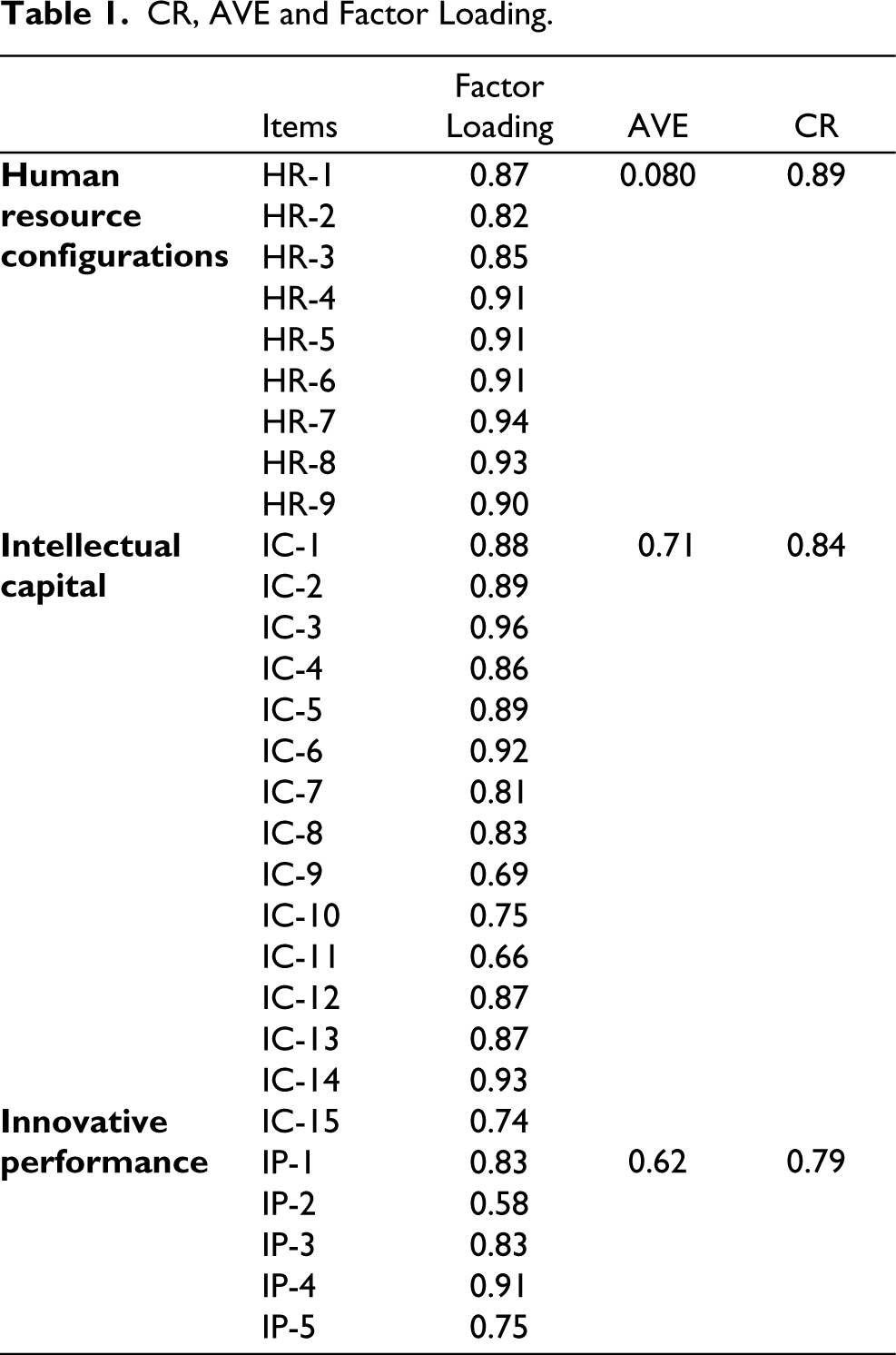
We measured the use of average variance extracted (AVE) and composite reliability; however, Hayes (2013) suggested 0.40-factor loading. The present study’s construct scales accept values of AVE and CR, respectively, above 0.50 and 0.60 (Table 1; Hair et al., 2013). A few items with below (0.40) factor loadings were eliminated. Specifically, three items were from the HR configuration scale, and one item from the scale was intellectual capital scale. Consequent model testing showed the goodness fit indices (χ2 = 399.380, df = 296, χ2/df = 1.349, CFI = 0.91, RMSEA = 0.038) (Tables 2 and 3).
CR, AVE and Factor Loading.
Measurement Model Fit Indices.

Minimum, Maximum, Skewness and Kurtosis.

Descriptive and Correlation Analysis
The descriptive and correlation estimates of constructs involved via mean (M), standard deviations, correlations (bivariate) and reliability coefficients are shown in Table 4. However, the mean of the study’s constructs ranged from 3.19 to 3.24. In addition, these HR configuration dimensions have significant relations via innovative coefficient. Similarly, the analysis of correlations supported with HR configurations and intellectual capital tactics (β = 0.183, p < .001). Moreover, the correlations of (innovative performance) and intellectual capital (β = 0.538, p < .001) were significant and positively associated. Overall, these noteworthy interactions specify the nomological validity of the HR configuration dimensions.
Discriminant Validity (Fornell–Larcker Criterion).

Hypotheses Testing
The AMOS-SEM coefficients for each relationship (main effects) between variables in the hypothesised model are shown in Figure 1. As indicated in Figure 1, HR configuration constructs had positive and significant effects on innovative performance (β = 0.12, R2 # 0.38); HR configuration constructs had also positive and significant effects on intellectual capital constructs (β = 0.19, r # 0.04); and intellectual capital had positive and significant effects on innovative performance (b = 0.58, r # 0.36). As indicated above, to examine the indirect effects between variables, the bootstrapping methodology of Preacher and hayes (2017) was employed. The sample was bootstrapped 5,000 times at 95% bias-corrected confidence intervals. Table 5 displays the total-indirect, total-direct and total-effects of HR configuration items and innovative performance.
Indirect, Direct and Total Effect.
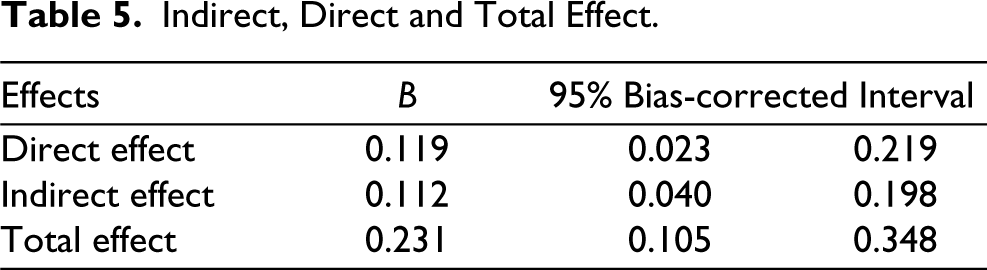
The direct effect was statistically significant (b = 0.119, r = 0.04) because the confidence intervals overlapped zero (95% CI: 0.023–0.219). However, the total effects were statistically significant (b = 0.231, r # 0.01) because the confidence intervals did not overlap zero (95% CI: 0.105–0.348), suggesting that the effects of HR configurations on innovative performance were partially mediated (explained) by others elements. This is also supported by the total-indirect effects that were also significant (b = 0.112, r # 0.38, 95% CI: 0.040–0.198) (Figure 2).
Result of the SEM Estimation.
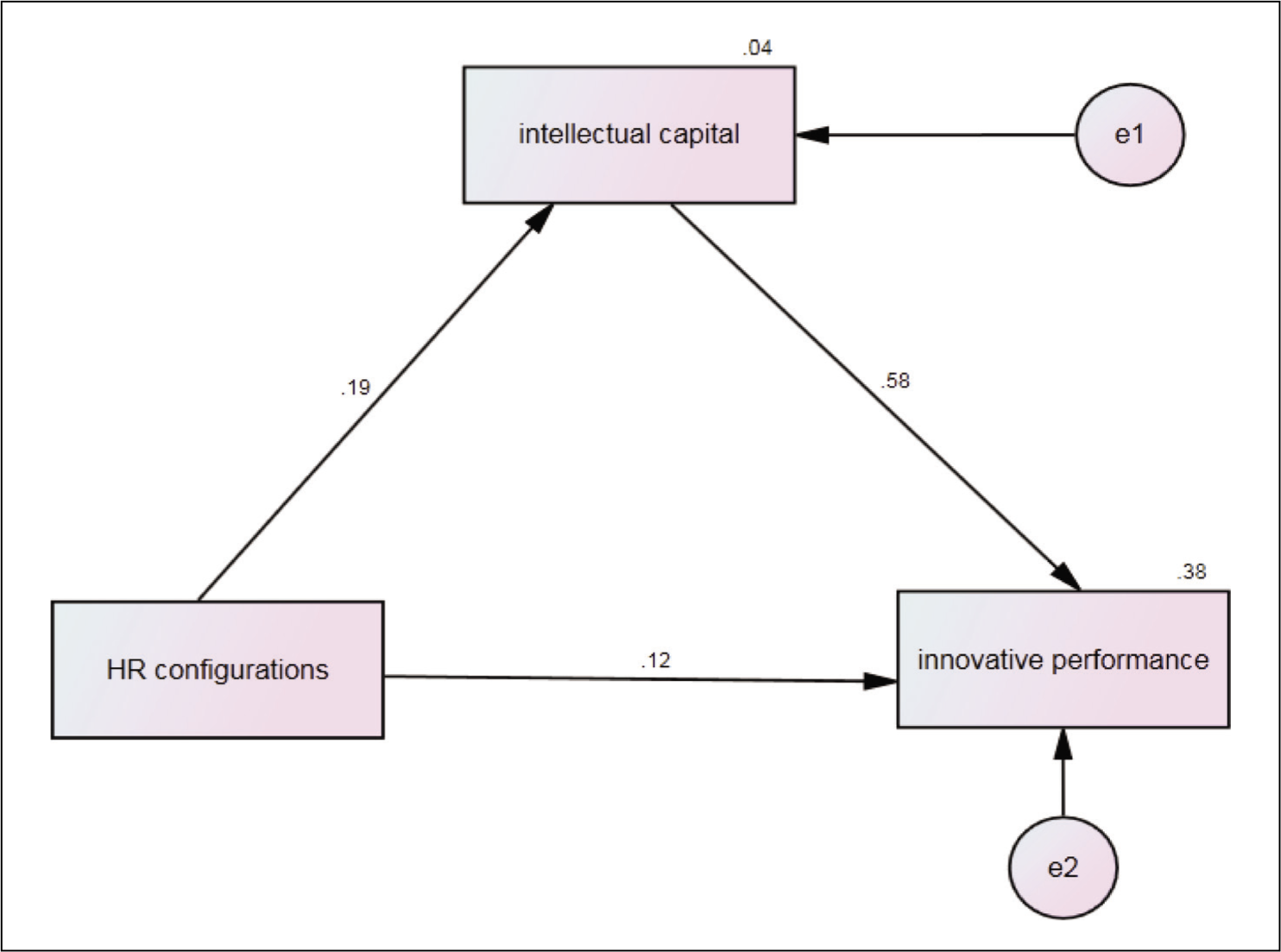
Table 5 shows significant relations among indirect, direct and total effects.
Discussion
The study of the hospitality sector in Pakistan exhibited distinctive patterns of configurations of HR practices in organisations, which influence innovation performance. Recent studies have repeatedly emphasised the need for empirical studies, which help strengthen the relationship between HR configurations and innovation performance (Muñoz-Pascual et al., 2019). These mechanisms are of crucial importance for the casual effects of different HR configurations on the different innovative outcomes (Singh et al., 2021). Besides, there are scholarly contributions on innovative outcomes through better configuration practices. However, this article examined the strategic significance of HR configurations in the context of hospitality innovative practices. Hence, this model of HR configurations generates synergistic effects that create innovative performance in the context of basic hospitality activities. Our results extend the findings of several recent studies (Szierbowski-Seibel, 2018). Additionally, the mediating role of intellectual capital factors guides innovative action through HR configurations practices. However, particular characteristics of the hospitality settings are reflected in this study. Again, only recent studies on hospitality have focused on configurations of HR practices, innovative tactics (Singh et al., 2021) and intellectual capital as mediating constructs. We found that Pakistan’s hospitality generally denominated relatively higher-level HR practices to innovative performance, compared to intellectual capital, and innovative tactics, and relatively higher level HR configurations impact on intellectual capital. Therefore, the findings have several theoretical contributions and limitations.
Theoretical Implications
The current study has several important contributions. First, it theoretically analyses the role of intellectual capital in indirect relationships among HR configurations and innovation, to address the demand for study on the concerned subject (Chang et al., 2021). The current study also demonstrates a direct connection between HR configurations and innovation, which supports a sustainable mediation pathway. Second, earlier research often concentrated on how processes were configured in a Western context (Martini et al., 2020). This empirical analysis of the Khyber Puntunkwa hospitality sector, however, makes a valuable contribution by improving the generalisability and validity of HR configuration research. Third, earlier studies focused on configurations of HR practices in the Western setting (Martini et al., 2020); however, it is important to assess what HR configuration shapes better innovation. Hence, configurations of HR practices are more relevant in directing individuals towards innovative practices. Finally, our study confirms the multidimensionality of HR configurations and the comparative outcome of HR configurations in manipulating innovation (Singh et al., 2021) and intellectual capital. These findings also call other constructs indirect links (such as promise, fairness and motivation) on HR configuration practices, in clarifying innovation practices.
Practical Implications
In practical terms, a better synergy of HR practices is essential to an organisation’s high adaptability and innovative performance. As configuration practices are fairly implemented (Singh et al., 2021), if an organisation has needs for entrepreneurship activities and adaptability, these should be related to institutional innovation practices. Our findings support the value of HR configuration practices for innovative and adaptability culture. Meanwhile, managers and employees should also pay special attention to entrepreneurship orientations. Furthermore, organisations should be equipped with enough resources to encourage experimentation and apply innovative ideas, to attain adaptability and entrepreneurship aims. Obviously, HR configuration practices among staff would pave the way to reach a culture of entrepreneurship towards an innovative and adaptability culture.
Footnotes
Declaration of Conflicting Interests
The authors declared no potential conflicts of interest with respect to the research, authorship and/or publication of this article.
Funding
The authors received no financial support for the research, authorship and/or publication of this article.