




Abstract
Purpose:
Accumulated literature has reported the comparative efficacy of the sinus tarsi approach (STA) and the extensile lateral approach (ELA) for the treatment of calcaneal fractures (CFs). However, the best alternative treatment for CF is still inconsistent. Herein, the present systematic review of overlapping meta-analyses aims to achieve an evident conclusion by performing a comprehensive reanalysis of previous meta-analyses regarding the comparison of the STA and the ELA.
Methods:
We searched several databases, including Pubmed, Medline, Embase, the Cochrane Library, SpringerLink, Clinical Trials.gov, OVID, and CNKI for the meta-analyses comparing the STA and the ELA for the treatment of CF. All related meta-analyses of randomized controlled trials and cohort studies were included. Two researchers independently assessed the quality of the articles and extracted the data. The Jadad decision algorithm was used to evaluate the evidence of the articles.
Results:
Ultimately, five meta-analyses were included in the present study. The Assessment of Multiple Systematic Reviews scores of these articles ranged from 5 to 9 with a median of 7. The analysis of best quality, Bai 2018, was selected based on the Jadad algorithm. In this article, the significant differences were found in wound complications and operating time, recovery of Böhler’s angle, the American Orthopaedic Foot and Ankle Society scores, and the visual analog scale.
Conclusion:
The clinical relevance of the present study is that both the STA and the ELA are effective in alleviating pain and improving functionality in the treatment of CF. However, due to a shorter operation duration and lower complication rates, the STA was indicated to be a superior alternative for CF treatment.
Introduction
Calcaneal fracture (CF) is one of the most common fractures of the tarsal, accounting for approximately 60% of all tarsal fractures and 2% of all adult fractures. 1,2 In all CFs, displaced intra-articular fractures represent about 60–75%. 3 Falling injuries represent the most common cause for CFs. 4 CFs, especially intra-articular CFs, can cause severe loss of function. Although medical technology has developed rapidly in recent years, treatment for CFs still remains challenging for orthopedic surgeons.
For CF of Sanders types II and III, open reduction and internal fixation (ORIF) is becoming more prevalent. 5 Currently, the most popular incision is the extensile lateral approach (ELA), which seems to be the gold standard. 5 –7 It allows us to access the posterior articular surface directly as well as the lateral wall, and at the same time, avoid damage in the sural nerve. Although this incision can supply adequate exposure, it can also cause severe swelling and pain. 8 Furthermore, the necrosis rate of the incision edge can be as high as 14%. 9 Therefore, some surgeons advocate limited incisions, of which the alternative is the STA. This incision limits the exposure of the posterior articular surface of the calcaneus, and theoretically, the possibility of postoperative complications and swelling can be reduced due to its minimally invasive features. 10 –14
To compare the advantages and disadvantages of the two methods, some researchers have conducted many clinical studies including randomized clinical trials (RCTs) and cohort studies (CSs). Subsequently, meta-analyses were written to summarize and analyze these studies. However, the conclusions are not consistent. For example, Zhang et al. 15 concluded that STA shows a significant superiority in the visual analog scale (VAS) pain scale but Bai et al. 16 concluded otherwise. Therefore, surgeons can be confused by these inconsistent conclusions when creating their surgical plans.
To extract accurate and effective information from the literature, systematic reviews of overlapping meta-analyses are becoming more and more necessary. Thus, we performed this systematic review of overlapping meta-analyses to provide a better, more accurate form of evidence for clinical surgeons.
Materials and methods
The study was performed under the instruction of the Preferred Reporting Items for Systematic Reviews and Meta-analysis statement, 17 and the design of this study was based on published articles. 18 –22
Literature search
We searched Pubmed, Medline, Embase, the Cochrane Library, SpringerLink, Clinical Trials.gov, OVID, and CNKI by October 25, 2019. The keywords for the search were calcaneal fracture, calcaneus fracture, os calcis fracture, sinus tarsi approach, extensile lateral approach, minimally invasive, surgical, open reduction and internal fixation, systematic review, meta-analysis. Searches did not limit the publication status but limited the language as English. Titles and abstracts were reviewed for preliminary screening and then full texts of selected articles were reviewed to obtain more information as needed.
Inclusion and exclusion criteria
Inclusion criteria: (1) Meta-analysis of the comparison of STA and ELA, (2) at least one meta-analysis result, and (3) the studies included in the literature were RCTs or CSs. Exclusion criteria: (1) The literature which included a series of case reports, (2) meeting abstracts, and (3) systematic reviews without any meta-analysis.
Data extraction
Two authors read the included literature thoroughly and extracted the following information: first author, publication time, journal name, impact factor, date of last literature search, number of RCTs and CSs, restriction of publication language, restriction of publication status, searching database, methodological information, and meta-analysis result.
Quality assessment
The Assessment of Multiple Systematic Reviews (AMSTAR) instrument was used to evaluate the quality of the literature, which was also used to assess other meta-analyses successfully in other studies. 18 –23 The entire process was completed independently by two authors, including literature search, data extraction, and quality assessment.
Application of Jadad decision algorithm
Jadad decision algorithm is a method to interpret discordance in quantitative systematic reviews by classification analysis. 24 It was conducted by three researchers independently and then, the article providing the best evidence was used.
Results
Literature search
The flowchart of the literature search is shown in Figure 1. A total of 100 articles were found and were finalized to include five articles in the study. 15,16,25 –27 These five meta-analyses were published in 2017 and 2018. The characteristics of the included literature are presented in Table 1. The characteristics of the original studies in the literature are presented in Table 2.
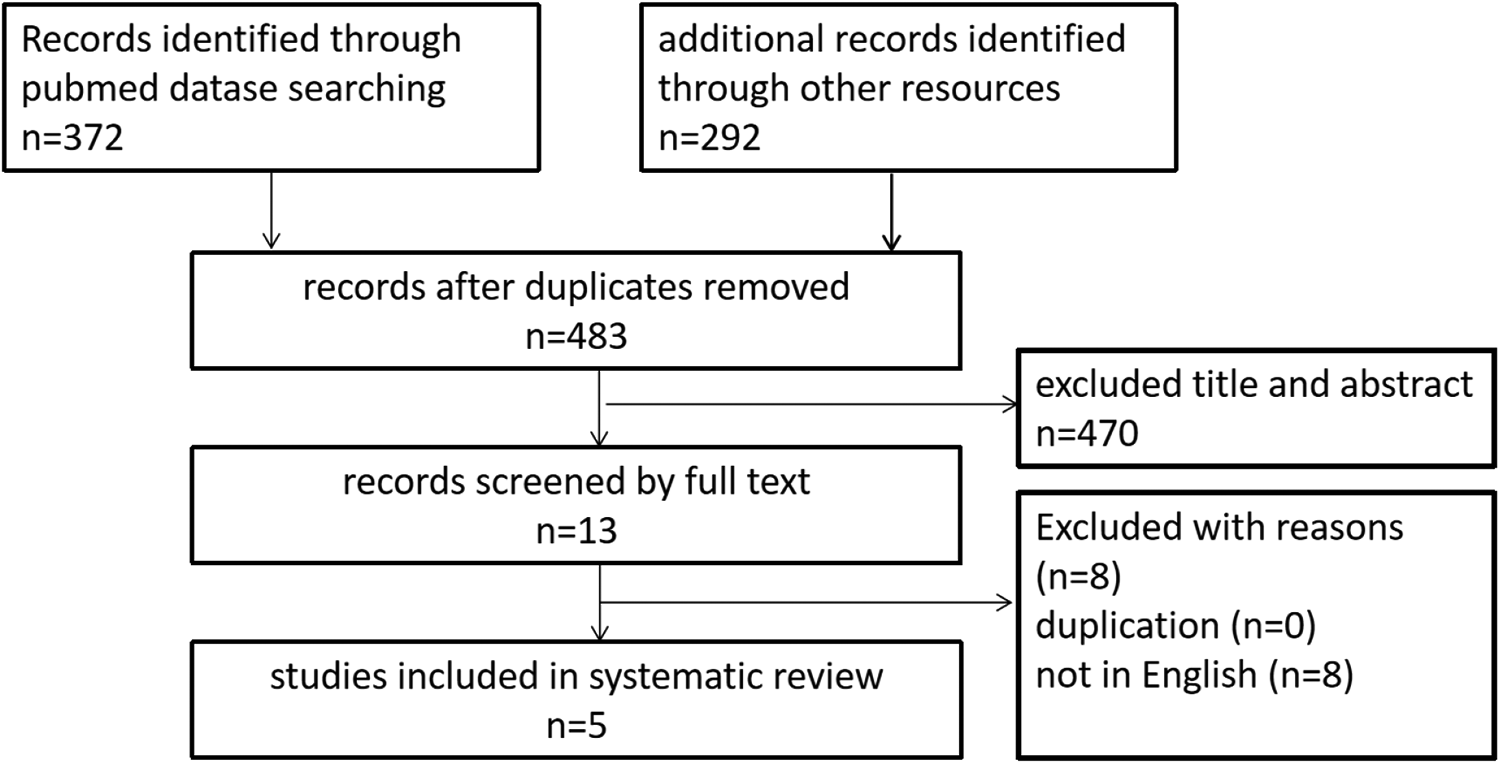
The flowchart of the literature searching.
The characteristics of the included meta-analyses.

Primary studies included in meta-analyses.

RCT: randomized control trial; CS: cohort study.
Search methodology
While one article was limited to their searching publications to only English, the other four articles mentioned in our study were able to expand their search methodology to multiple languages. Three articles limited the searching publication status to be published, but the publication status was not mentioned in the other two articles (Table 3).
Search methodology of the included studies.

Methodological quality
All five articles included both RCT studies and CS studies. They were graded at level III according to Oxford Levels of Evidence. Four meta-analyses were completed by RevMan software and one was done using Stata. Grade was conducted in one article (Table 4). 16 AMSTAR scores range from 5 to 9 with a median of 7 (Table 5). Finally, the study performed by Bai et al. was determined to be the article with the highest quality. 16
Methodological information for the included studies.
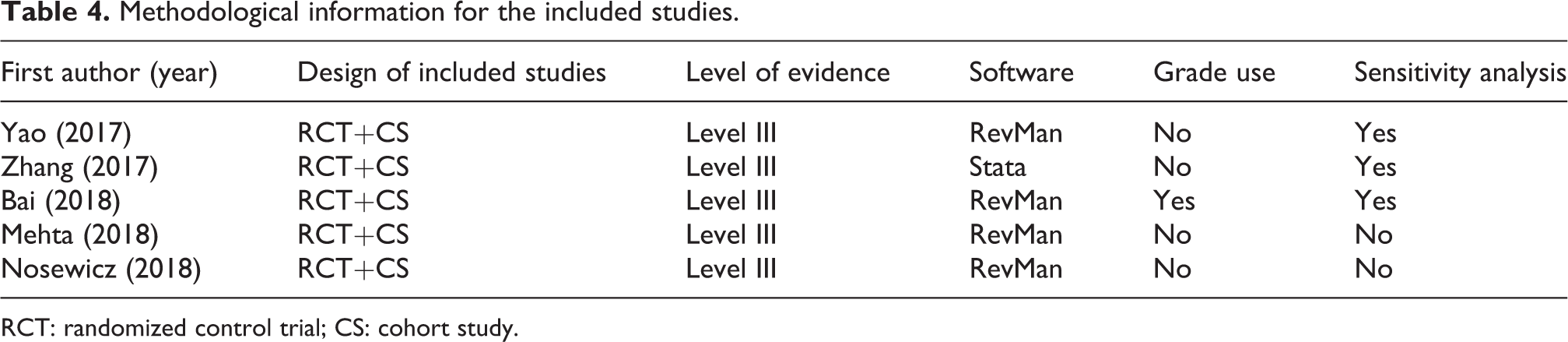
RCT: randomized control trial; CS: cohort study.
AMSTAR scores for the included studies.

AMSTAR: Assessment of Multiple Systematic Review.
Heterogeneity assessment
The heterogeneity of the studies was estimated by I 2 statistic value. Three articles did the sensitivity analyses or subgroup analysis according to methodological quality, whereas the other two did not (Table 6).
Heterogeneity or subgroup analysis of primary studies.a
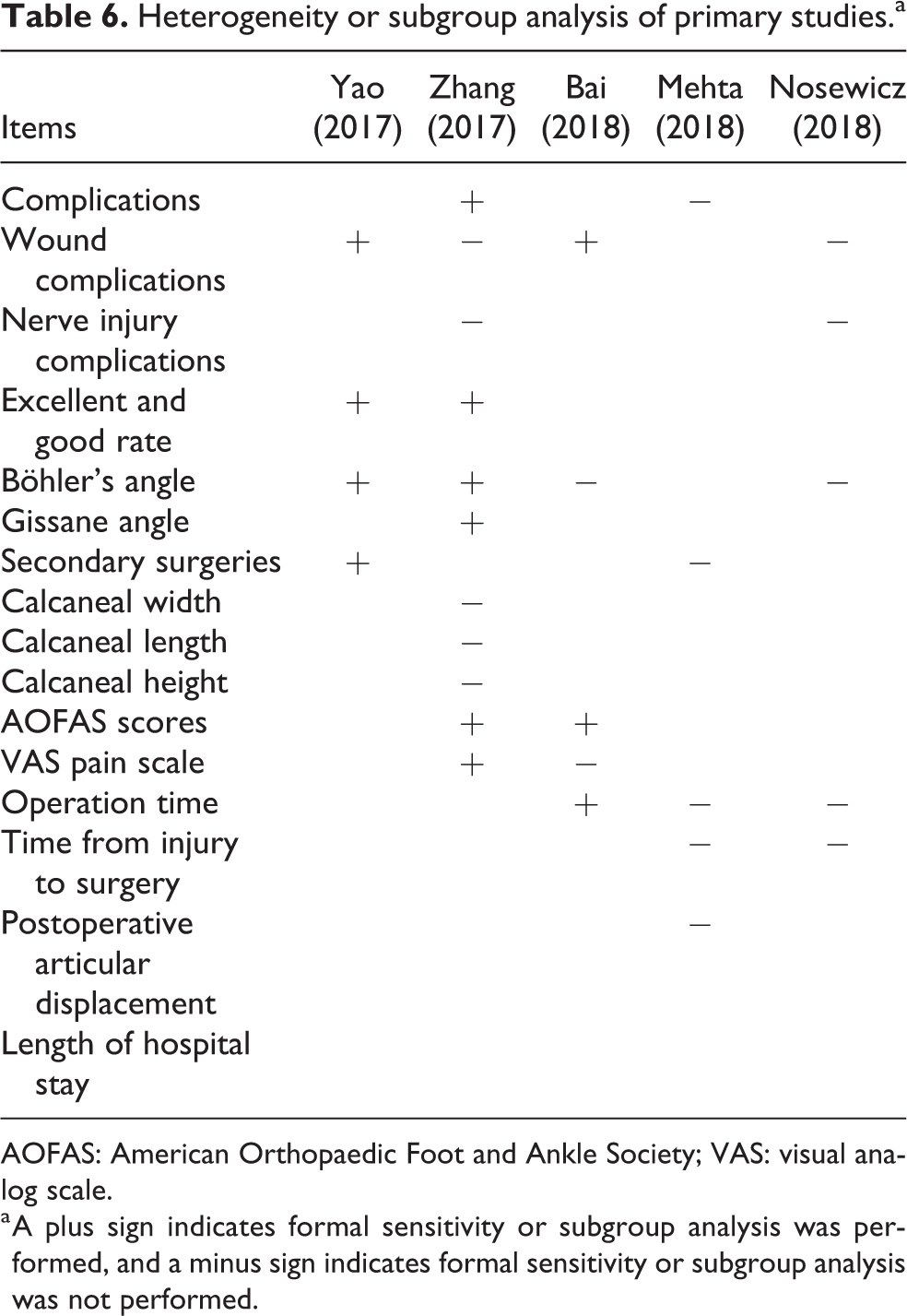
AOFAS: American Orthopaedic Foot and Ankle Society; VAS: visual analog scale.
a A plus sign indicates formal sensitivity or subgroup analysis was performed, and a minus sign indicates formal sensitivity or subgroup analysis was not performed.
Results of Jadad decision algorithm
We used the Jadad decision algorithm 24 to determine which study represented the highest amount of evidence. The analysis results of the five articles included in the study are shown in Figure 2. Due to the inconsistency of the selection criteria and study design, we evaluated the evidence according to the rigor of the study design, the comprehensiveness of the literature search, the scientific nature of the data analysis, and the rationality of the conclusion discussion. Using these criteria for evaluation, Bai et al.’s study was found to have the highest level of evidence (Figure 3). This study concluded that the STA technique could be superior to ELA because it had the shorter operation time and the lower complication rate, however, their anatomical and functional recovery seemed similar. 16

The analysis results of the five studies.

Flow sheet based on the principle of Jadad decision algorithm.
Discussion
This study can help orthopedic doctors obtain the best evidence for the comparison between STA and ELA. Through a comprehensive literature search, a total of five articles were included in this study. All the five meta-analyses were published in 2017 and 2018, but they did not use the same method and trials and did not provide consistent results for the treatment of Sanders types II and III fractures. According to the Jadad decision algorithm, Bai 2018 was the best article for this topic. 16 The present systematic review of overlapping meta-analyses shows that the STA approach can reduce the complication rate and operative time while not reducing the functional score and anatomical recovery. This is the first systematic overview between the overlapping analyses of STA and ELA comparisons.
Our study found that the results of the existing meta-analyses regarding the comparison of STA and ELA were not consistent. For example, Yao et al. concluded that the second surgery rate was lower in STA group than in ELA. 25 However, the analysis results of Mehta et al. suggested that there was no significant difference between the two methods. 26 It was concluded by Zhang et al. that STA was lower than ELA in regard to the VAS pain scale, 15 but Bai et al.’s findings supported that there was no significant difference between the two groups. 16 Nosewicz et al. concluded that the time from injury to surgery was shorter in STA groups than ELAs, 27 while Mehta et al. found that there was no significant difference. 26 The inconsistency of these results may be due to variable cited literature, clinical questions, data extraction, and statistical methods. So, this systematic review of overlapping meta-analyses used the Jadad decision algorithm to determine which of these studies could provide the highest level of evidence.
Ultimately, the study performed by Bai et al. was considered to be the highest level of evidence. It was concluded by this study that for Böhler’s angle recovery, AOFAS scores and VAS pain scores were similar between STA and ELA. However, the incidence of wound complications and operation time was better in the STA group. 16 Although the height of the calcaneus is important to evaluate the surgery, there was only one RCT and one retrospective study mentioned in the study. Thus, there was not enough medical data to make a meta-analysis.
Some factors may have influenced the findings of Bai et al. First, the literature search is not comprehensive enough so that some RCT studies are not included in Bai et al.’s meta-analysis. Second, new technology cannot be analyzed and discussed in the study due to the inconsistency of the included studies’ design. For example, the article “Clinical Comparison of Extensile Lateral Approach and Sinus Tarsi Approach Combined with Medial Distraction Technique for Intra-Articular Calcaneal Fractures” in Orthopaedic Surgery in 2017 8 incorporates the technique of medial distraction, which is not included and discussed in Bai et al’s study. Lastly, some results are analyzed and concluded only by the results of only two or three included studies.
The five meta-analyses included in this study were published in four orthopedic professional journals and one professional surgery journal. The article with the highest level of evidence, Bai et al.’s study, was published in Orthopaedics & Traumatology: Surgery & Research, which ranks fourth of the five journals regarding impact factor. Therefore, it is not true that “the higher the impact factor, the higher the level of evidence.” Impact factor and level of evidence are not positively correlated.
The limitations of this study are as follows: (1) To obtain more data, the clinical trials included in the meta-analyses contained both RCTs and CSs. Furthermore, the evidence level of all meta-analyses included in this study was level III. (2) Subgroup analyses of Sanders types II and III fractures were not performed, so separate results could not be provided. Therefore, we cannot conclude that there is a difference between the two types. (3) The language of the included studies was limited to English, which made the data in this study somewhat limited.
Conclusion
The clinical relevance of the present study is that both the STA and the ELA are effective in alleviating pain and improving functionality in the treatment of CF. In conclusion, due to the shorter operation duration and lower complication rate, the STA was indicated to be a superior alternative for CF.
Footnotes
Authors’ note
TY and YX contributed equally to this study.
Declaration of conflicting interests
The author(s) declared no potential conflicts of interest with respect to the research, authorship, and/or publication of this article.
Funding
The author(s) disclosed receipt of the following financial support for the research, authorship, and/or publication of this article: This work was supported by the National Science Foundation of China [Nos. 81472144 and 31600754].
