




Abstract
Aim:
To evaluate whether surgical treatment for anterior chronic exertional compartment syndrome (CECS) of the lower leg will lead to full athletic activity recovery compared to conservative treatment.
Methods:
Patients diagnosed with anterior CECS of the leg were offered surgical treatment, as surgery considered today to be the mainstay of treatment. Patients unwilling to be treated surgically were treated conservatively. They were followed up, assessing both groups for pain, functional status, and the Tegner sports activity score with comparisons at diagnosis and following treatment.
Results:
Forty-three patients were treated for CECS (31; 72.1% with surgery and 12; 27.9% conservatively) with a mean follow-up of 28.15 (4.16–54.09) months. Reported pain improved at follow-up by 1.59 (0–6) points and by 4.27 ± (0–10) points in the conservatively and the surgically treated patient groups, respectively (p = 0.014) with a mean change in the Tegner score of 0.09 (−5 to 5) and 3.22 (−4 to 7), respectively (p = 0.009). Three patients in the conservatively treated group (25% of 12) and 24 patients in the operated group (77.4% of 31) reported full resumption of their pre-diagnosis activity level (p = 0.001).
Conclusion:
This study supports surgery as the treatment of choice for anterior CECS of the leg with differential benefit for fasciotomy in terms of pain and return to pre-diagnosis athletic activity.
Introduction
Chronic exertional compartment syndrome (CECS) is usually associated with repetitive physical activity, occurring most commonly in young athlete, 1 and was first described by Mavor 2 who reported bilateral anterior leg pain in a professional soccer player. The true incidence of leg CECS is unknown, although it has been reported to be the diagnosis in 14% of cases of undiagnosed lower leg pain, 3 with an incidence of 27% in patients presenting with chronic exercise-induced anterior leg pain. 4 The classic symptom is pain, which is typically described as “cramping or burning” in nature, predictably occurring after exercise initiation. These symptoms often induce a reduction in activity frequency and intensity or even exercise abstention, with a typical reduction in pain after exercise cessation. In some cases, there is associated weakness or numbness/paraesthesia. 5
The classic diagnostic feature is an elevation of the compartment pressure following exercise, with description of a number of pressure measurement techniques including needle manometry, a wick catheter, a slit catheter, or a constant infusion catheter, 6 –9 although there is no universally accepted pressure measurement protocol. 10 Management may be conservative or surgical with surgery being considered the treatment of choice for patients wishing to restore their pre-CECS activity level. 11 –15 Review of the available medical literature reveals no comparative studies of surgical therapy versus conservative treatment in CECS of the lower leg. The purpose of the study is to compare the functional results between conservative treatment and surgical management in patients presenting with CECS of the anterior compartment diagnosed by the medical history and compartment pressure measurements in accordance with the previously reported Pedowitz diagnostic criteria for CECS diagnosis. 16 We hypothesized that surgical treatment will lead to higher prevalence of return to sports at the same level of activity.
Materials and methods
Approval for the conduct of the study and the interpretation data was obtained from the local hospital Institutional Review Board. Ninety-two patients were tested for CECS during the period from May 2008 until August 2011 and October 2012 until April 2013.
Patients were eligible for inclusion into the study if they were between 16 and 45 years of age at the time of diagnosis with the upper age limit being selected so as to reduce the risk of confounding the results with ancillary age-related conditions. The diagnosis was established by a characteristic medical history supplemented by positive confirmatory compartment pressure measurements performed by an orthopedic surgeon. The diagnostic criteria used to confirm CECS of the lower leg were those outlined by Pedowitz et al. 16 and based on a compartment pressure before exercise which exceeded 15 mmHg, a pressure > 30 mmHg 1 min after exercise commencement and a pressure > 20 mmHg 5 min after exercise. After pre-exertion pressures were measured, patients were then instructed to run on a running track outside the clinic to induce symptoms at a speed comfortable for the patient. When the patients developed symptoms and running became difficult, post-exertion values were obtained. If the patient could run comfortably for more than 15 min without symptoms, the test result was considered “negative.”
Patients were excluded from the study if they had CECS of compartments other than the anterior compartment of the leg, namely the deep and the superficial posterior compartments, the lateral compartment, or any additional coincident condition or complaint of the shin or calf at the time of diagnosis.
Fifty-three patients were eligible for the study, and letters with informed consent for participation in the study were sent to all 53 subjects. Of these patients, 43 (81%) were successfully reached for a telephone interview. At least three unsuccessful telephone attempts were made to contact the remaining patients (n = 10). All 43 of the contacted patients (100%) agreed to participate in the study and completed the telephone questionnaire.
Questionnaires
Four questionnaires were completed by all participating patients. The first questionnaire (Table 1) included basic demographic and clinical data. In the second questionnaire, the subjects were asked to evaluate their pain with a visual analog score (VAS) (scale 1–10) prior to and after treatment, also recording the optimum response level after treatment. The third questionnaire was the Tegner score evaluating the sport performance level before and after treatment, 17 and the fourth questionnaire was the SF-36 quality-of-life evaluation of general physical and mental well-being at the time of follow-up.
Demographic data of the patients.a

a n = 43. Values are expressed as mean (range).
Surgical therapy
Surgical treatment is considered today to give the best results in treating patients with symptomatic CECS. 1,11,16,18 Therefore, all subjects with clinical and manometric pressure evidence of CECS, as described above, were offered surgery.
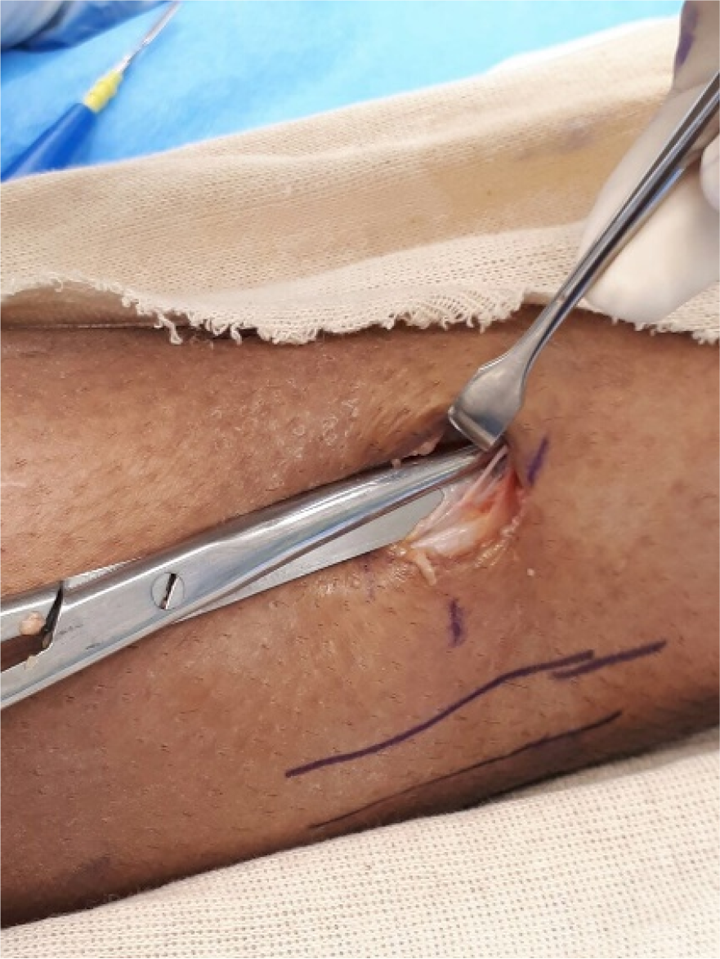
All operations were performed by the two senior authors (GB and RT). The technique of compartment decompression was based on that described by Rorabeck et al. 12 The technique was not significantly varied throughout the course of the study. The operative approach used a single 4-cm long incision approximately 12 cm above the ankle joint line or 14 cm from the tip of the lateral malleolus over the center of the anterior tibial compartment (Figure 1). The superficial peroneal nerve was first identified before incision of the fascia with its protection and visualization during the procedure (Figure 2). The fascia over the anterior compartment was split longitudinally over its entire length (Figure 3). In cases where the surgeon was not satisfied with a single incision, another small incision was made proximally to ensure completeness of the fasciotomy. All patients followed a similar postoperative rehabilitation program, usually supervised by a physical therapist. They were advised to use crutches for at least 1 week following surgery, added with pain medication and anti-inflammatory drugs. One week after surgery the patients are encouraged to walk without walking aids and begin strengthening exercises. After a rehabilitation period of 3 weeks, light physical activity was commenced, and the patients were permitted to start running between 4 weeks and 6 weeks after the operation. Follow-up was commenced at the outpatient clinic at 2 weeks, 6 weeks, 3 months, 6 months, and 1-year postoperatively.

The planned incision is marked approximately 12 cm above the ankle joint line or 14 cm from the tip of the lateral malleolus over the center of the anterior tibial compartment.

The superficial peroneal nerve is identified and protected during the procedure.
The fascia over the anterior compartment was split longitudinally over its entire length.
Conservative treatment
Subjects opting not to undergo surgical treatment were treated conservatively. Our protocol included rest and a minimum of 6 weeks of physical therapy by physiotherapist. Physical therapy included postexercise icing, deep tissue massage and warming, stretching, and mobility exercises.
Statistical methods
Data were analyzed using the SPSS©23 (Chicago, Illinois, USA) software program. Continuous data are presented as means (minimum–maximum), with categorical variables being presented as counts (percentages). Comparisons of categorical variables were made using the χ 2 test or Fisher’s exact test where appropriate. The change in reported pain (ΔP) was calculated as pain on diagnosis minus the pain reported on follow-up examination. The change in the Tegner score (ΔT) was calculated as the Tegner score at follow-up minus the Tegner score on diagnosis. Comparisons of continuous variables between conservative and surgical patient groups were performed using Wilcoxon’s rank-sum test.
Results
The study population of 43 patients (mean age 23.8 ± 7.6 years) included 31 (72.1%) patients who underwent surgery and 12 (27.9%) patients who were managed conservatively. The mean follow-up time between surgery and the postsurgical examination was 28.15 (±17.50) months. No statistically significant difference was observed between the two groups concerning the demographic data (Table 1). Table 2 presents the clinical data of both groups. The mean time from the beginning of exercise to the beginning of pain in the total group was 6.29 (±5.10) min with an overall pain score at diagnosis of 7.38 (±1.98). Pain improved (ΔP) on follow-up examination by 1.59 (±2.10) points and by 4.27 (±3.05) points in conservatively treated and surgically managed patients, respectively, representing a statistically significant difference (p = 0.014). The mean Tegner scores at diagnosis for conservatively treated and surgically managed patients, respectively, were 4.50 (±1.93) and 2.48 (±1.78; p = 0.004), with a mean change in the Tegner score (ΔT) after treatment of 0.09 (±3.14) and 3.22 (±3.19), respectively (p = 0.009). Three patients in the conservatively managed group (25% of 12) and 24 patients in the operated group (77.4% of 31) reported full resumption of their pre-diagnosis activity level (p = 0.001). The mean SF-36 scores at follow-up for conservatively treated and surgically managed patients were 79.15 (±17.50) and 89.2 (±10.86), respectively (p = 0.004). In the operative group, short-term complications included hematoma in three patients and superficial peroneal nerve sensory impermanent in one patient, all resolved in 4 weeks and 3-month postoperatively, respectively. One patient reported long-term paresthesia in the area supplied by the superficial peroneal nerve.
Clinical patient demographics.a

aMean (range) of clinical data. ΔPain was calculated as pain on diagnosis minus pain reported at the follow-up examination. ΔTegner score was calculated as Tegner score at follow-up minus the Tegner score on diagnosis.
Discussion
This comparative study over a 28-month follow-up showed a significantly improved pain score, Tegner score, and, most importantly, return to preinjury level of activity in patients presenting with CECS of the anterior compartment of the leg treated with a tailored fasciotomy when compared with those managed conservatively. The goal of treatment for anterior leg CECS in young athletes or soldiers during military service is to permit rapid return to the previous activity level with minimum pain. In our study, more than 77% of the subjects in the surgical group were able to return to their previous activity level as compared to only 25% in the conservatively managed group. This was accompanied by a better concomitant improvement in the reported VAS pain analog scale in the surgically treated patients.
Moreover, we noticed a significance improvement in the Tegner score (which evaluates sports activity level) compared to the conservative treatment group. Interestingly, the preinjury Tegner score was similar between the conservative and the surgical groups (p > 0.05); however, the Tegner score on the diagnosis day was significantly lower in the surgical group (p = 0.004).
As far as we are aware, there are no comparative studies assessing surgical versus conservative treatment for patients with clinical presentation of anterior leg CECS confirmed by invasive pressure measurement. One small study by Blackman et al. reported outcomes with conservative treatment 19 where there was improvement but where all patients continued to experience exercise-induced pain and where compartment pressures failed to normalize. The surgical treatment of CECS has been reported with both short- and long-term follow-up, where Rorabeck et al. described seven patients with anterolateral CECS, three with posterior CECS, and two with combined CECS all undergoing anatomical fasciotomy. They found improvement in each case only in those presenting with anterolateral CECS. 13 Similar results were reported by Wallensten who performed fasciotomy on eight patients with anterior CECS, reporting good results in all cases 20 and by Styf and Korner where 18 of the 19 patients with anterior CECS undergoing fasciotomy had a good clinical result, although two patients required a second fascial release. 21 Equivalently good outcomes in non-randomized patients undergoing fasciotomy for anterior CECS have generally been reported by other group 12,13,22 with Allen and Barnes concluding in a group of 110 patients with mixed CECS and medial tibial syndrome that fasciotomy is only of value in CECS cases. 23 In a recent study, Packer et al. reported that among 73 patients with CECS treated surgically, there were 81% of success 24 which is comparable with our results of patients who were able to return to preinjury level of sports. Interestingly, Packer et al. reported 41% of success in the conservative group compared to 25% in our study. However, the group of patients the authors chose to present as the conservative group had negative pressure test, thus, were not diagnosed as CECS patients. 24 In our study, the conservative group was diagnosed with CECS but chose to be treated conservatively.
Various approaches toward compartment decompression have been described including open fasciotomies, minimally invasive subcutaneous fasciotomies (through either one or two incisions), partial fasciotomies, 11,13,20 and latterly, an endoscopic technique with balloon dissection 25,26 designed to reduce the complications of traditional techniques which include symptom recurrence, hematoma, seroma, deep venous thrombosis, and cutaneous nerve injury. 27 Although surgical treatment of CECS has generally been reported to be successful (somewhat regardless of the technique used), it is unclear why between 3% and 17% of patients 11,13,26 have unsatisfactory results or why others can only return to a lower postoperative exercise level than that enjoyed before the development of symptoms. Improved understanding of the pathophysiology of CECS may more readily define patients more suited to conservative therapy and better patient selection may be provided by studies which report long-term postsurgical patient follow-up. 22
The outcomes of surgically treated patients do depend upon the compartment affected by CECS as well as on some technical aspects of the fasciotomy procedure. In our study, nearly 23% of surgically treated cases were unable to resume full activity, which is similar to previously reported studies. Suboptimal results are compartment-specific, with better outcomes reported in anterior as opposed to posterior CECS cases 13,21 In this regard, it has recently been suggested that in patients with isolated anterior CECS, concomitant lateral compartment decompression is unnecessary and actually delays return to full athletic activity. 28 Recurrent symptoms may result from an inadequate fascial release, failure to decompress a compartment thought to be asymptomatic, nerve compression by a fascial hernia, or the presence of excessive painful scar tissue.
It is accepted that our comparative study has important limitations where we have only studied small patient groups as well as in its retrospective nature and because there may have been a bias (in the absence of randomization) toward surgery. In this respect, there may be a biased expectation by some patients opting for fasciotomy of a more rapid return to complete activity. In summary, the surgical treatment of anterior lower limb CECS appears to offer advantages over conservative therapy in terms of reduced pain and return to the same level of sports. However, about 23% of surgically treated patients were not able to return to preinjury level of activity and 25% of patients diagnosed with CECS and treated conservatively recovered completely. Further randomized studies are required to define surgical patient selection and delineate risk factors for suboptimal postoperative outcome.
Footnotes
Declaration of conflicting interests
The author(s) declared no potential conflicts of interest with respect to the research, authorship, and/or publication of this article.
Funding
The author(s) received no financial support for the research, authorship, and/or publication of this article.